Articles published in February, 2026
Yesterday Lucas flew me to a remote tribal area, home of the Turkana, north of Nairobi and close to Lake Rudolph. This is my second day.
Lodwar, January 10th

[Outside the hospital, on the sand with Doctor ”Jerry” who invited me here. We’re waiting for the flying doctor who does operations.]
Outdoor surgery. Doctor arrives in LandRover. Soon a woman arrives with her baby boy. But no interpreter. Crowd gathers. Finally, George [the interpreter] gets there. One child on point of collapse with TB, malaria. Very far gone. Will die. Others with mild cough, OK.
“I can tell the healthy ones now from their skin and general appearance. Use methods of diagnosis which are old-fashioned in UK now.“
Old lady eyes almost closed and full of sticky liquid. “They leave these things so long.” An infection that gradually closes the eye until they turn up and scrape the lashes on the eyeball, causing inflammation. She will wait until the Flying Doctors do the next batch of eye ops.
Little boy has his mother worried because his testicles are the wrong shape. Jerry lays him in the sand. Sits him up, and lays him down again. Then: “Tell her it’s all right. There’s nothing wrong. It’s only the shape of the skin.”
Old woman has headaches, then her left arm goes numb.
“Arterial disease is almost unknown here. They hardly ever get old enough.”
Fifty is old in Turkana. The patients are made to queue up by George.
Jerry insists on words like “patient,” “prognosis,” etc. They seem very strange here.
He looks at them one by one, while the others look on curiously, perhaps one minute, five at most. On the back of some obsolete buff forms, torn in half, he prints her name as spelled out by George. The words usually mean “under the fruit tree” or “by the river” or “in the big rain.” And record the circumstances of birth. Then he scribbles his diagnosis, a treatment if it’s straightforward. And tells them to come in next day.
He can handle most things that turn up but has a hard time getting blood to pull back the really desperate cases. He lost a small boy the day before for want of hydrocortisone and has a limited arsenal of drugs. On the other hand, they work much more efficiently where the recuperative well-springs have not been muddied by exposure to drugs before. He thinks the Lodwar hospital loses about the same proportion of patients who could theoretically have lived as a good Western hospital – but the reasons are different.
Pain threshold is much higher. They hate hanging about in hospitals. They insist on sleeping outside on the pathway or in the sand.
No graves except for special cases. Bodies are thrown out for hyenas and vultures. Very little concern for suffering of others, except in family. People die in the ward and nobody thinks to call the doctor. Father will come in and shove sick child off the bed to make room for himself.
Native medicine is extensive. If there is internal pain or deformity the skin is cut around the affected area, in many small incisions, half inch long. Doctor can often follow the course of a growth by these cuts and the newness of them. They have their natural remedies too.

[Immanuel, in the straw hat, is the son of the Mzee, or Chief. He loves pranks, interfering with the fake authenticity. The other “Westerner” is a hospital assistant.]
Immanuel and the Mzee: “With one spear we can kill a lion or an elephant or a giraffe.” Accurate at 20ft. “The Turkana will never change their customs. We want more schools so that children can get good jobs in city and send money back to their parents. But they will never forget their tribe. Only the bad ones.”
“If any other tribe tries to overcome us we will beat them.”
Invincible. Killing another man adds no particular glory or lustre. A little extra respect, but nothing compared to ownership of animals. No indication that a person’s life can be improved other than by material things.
Immanuel says girls have to be very careful not to give the impression of greed. Before marriage they avoid at all costs letting a man see them eating, often going without food for long periods if men are around. If by chance she is seen, she will try to marry immediately before the word gets out.
The most respected men have up to 15 wives. Immanuel’s father has 500 cattle, 1000 goats, plus camels, donkeys etc.
Remember how the girls walk, leather skins polished and rounded to the shape of their buttocks, switching from side to side. There is obvious pride in being able to do this well. They move always in a very girlish way, a movement one only sees among professional dancers in Europe in folk ballet. The pronounced arching of the back, which is natural to Africans, has much to do with it.
[I was flown back to Nairobi the next day.]

Nairobi, Friday January 11th
To the movies to see “All cops are ???”
Could have been any British cinema, but for the pepper on the peanuts. Pretty ugly impression of life in London (Battersea).
[I spent another week in Nairobi. With the bike nicely serviced, and with a new set of pannier bags across my tank and new tyres and innertubes, I set out for Mombasa. Then 150 miles down the road, at Kibwezi Junction, I had a puncture, which led to even more intimate relations with the native population.]
See you next week, Cheers.
Nairobi, Tuesday, January 8th
Mike Pearson, the bluff and hearty boss of Lucas, Nairobi, says:
“I say! We just bought a plane. Where would you like to go?”
So I told him I’d got a postcard from a doctor working with the Turkana tribe in Lodwar.
[Before I left London a few letters from readers arrived at the Sunday Times wishing me well. One was a postcard from a doctor doing volunteer work at Lodwar in Kenya inviting me to stop by. Of course he never imagined for a moment that I would.]
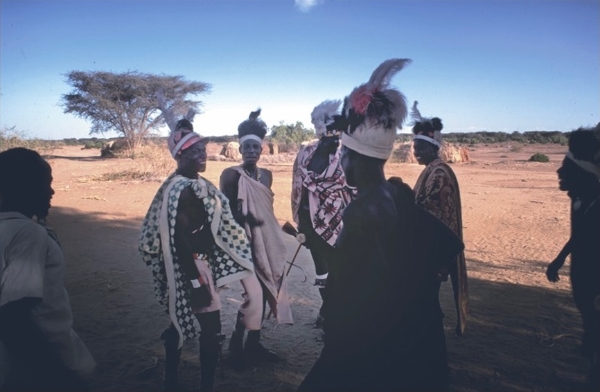
Lodwar, January 9th
Arrived yesty. Cessna 310. Brand new. £34,000.
One and a half hours from Nairobi. (Cost about £100 here and back.) Alongside Rift Valley – far too small to relate to the size of the continent. Bumpy because of midday heat. Drive [Fly] with road map. Bob Croft [the pilot] is a farmer. 80 acres of coffee and a Guernsey herd. Content with Kenya. Would like to stay in spite of gathering problems, blatant corruption.
The hospital ward. Cherubic Irish face [Jerry, the doctor] with huge lenses gleaming up, astonished.
Black bodies with green cotton wraps round their middles, flapping and wrinkled breasts, dusty soles, here and there a bandage where operations have been performed. A batch of post-ops after visit by Flying Doctors. Mostly for hydatid cysts – local menace, either in liver or spleen, grow to enormous size, like grapes in juice. Dogs might be host.
Men like having their feet cut off. There’s a thing that swells the foot up and can be stopped but foot stays big. Also very painful.
Prisoners there with police. One pretty girl with spindly limbs dying of malignant tumour, but no-one can be told, or their rage and grief would be uncontrollable. Also, says Jerry, if parents are told their child will die they just leave it to starve.
[There was mission overseen by a Bishop Mahon.]
Long talk with bishop. “I’ve given up thinking. I never did very much of it, and now I don’t bother at all. Just get on with it, let the future take care of itself.” Caricaturing himself. Quite ready to accept that he’s just creating problems. “What can you do? You can’t just let people starve.”
Sitting opposite me, back to an open-lattice wall with lozenge shaped openings. Breeze bursting through, which he “built himself” – well – arranged with others to build. He had a mould made in Kitale. They pack in sand and a sprinkle of cement. The flies were buzzing around my head, attaching themselves to my eyes and lips, as they do, but I was uncomfortably aware that there were no flies on the bishop.
They’ve got an irrigation scheme going on the river further up. Should have about 50 acres at next rain in April (aiming for several hundred). But it’s hard work and only some of them are industrious. Without direction the channels would choke up.
“Did you see an irrigation scheme in Sudan? I flew over and saw a huge area.”
[I think he was talking about Kashm el Girbar.]
[I arranged a party and bought two goats, so that I could photograph them dancing in daylight.]
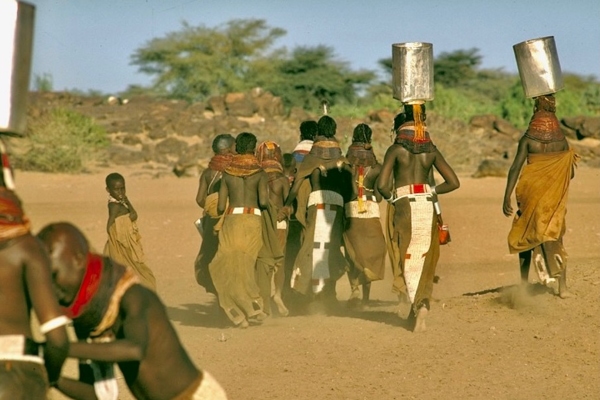
Those metal cans each carried five gallons of corn beer. They use a hard-fibre bun called an Aikit on their heads to support heavy objects. I brought one back, together with a spear, a wrist knife and a very low carved wooden seat.
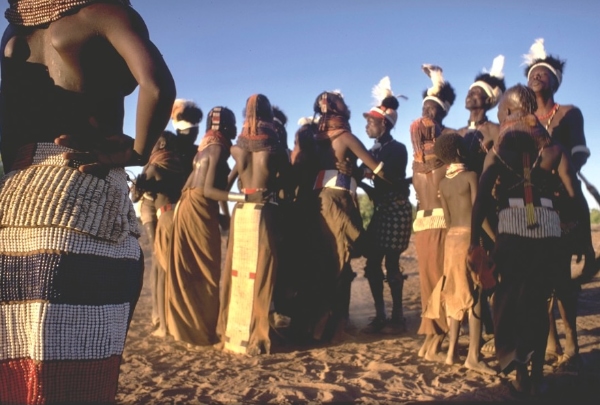
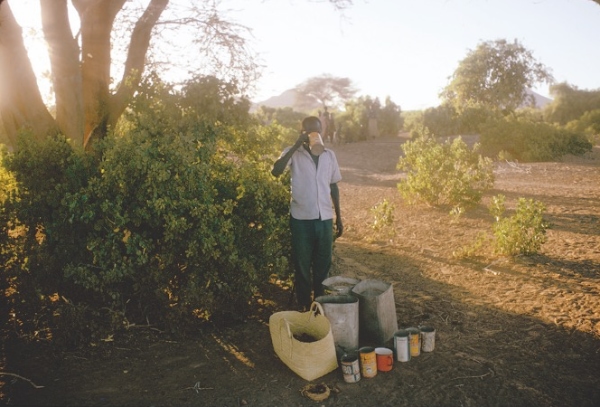
The bartender.
Bishop Mahon (continued). Face that could equally suit a study or a stock pen. Tobacco-stained teeth, straight silver hair, physically fit, lean, golden skin, shorts, tea stained shirt, 9 years in Nigeria, 6 in Turkana, Medical Missionaries of St. Mary. Mission hospitals in various outlying villages (Kakomari?) Also has Danish volunteers as well as Irish pastors and sisters. Finds the Danes better suited, much less demanding than his church people, although can’t quite explain what motivates the Danes. Their unselfconscious, naturalistic behaviour can outrage the sisters, especially at the Norwegian swimming pool. The nuns, he thinks, are too often doctrinaire, officious, and their inflexibility makes it hard for them to survive the pressures. But his mission is dabbling in other things. Irrigation schemes and the Lake Rudolph fish project. FAO man reported the Lake capable of producing between 50 and 150 thousand tons of fish (Nile perch, up to 250lbs)
Got it started. A big British iron trawler is there as a development vessel. Asian traders to set up refrigeration (freezer on a lorry, which crashed: then on aircraft which also pranged on landing). But after good, early catches, yields dropped, and scheme failed to fulfill itself.
Mahon relates the up and downs of his missionary life in the way older men often describe the hopes and disappointments of their sons, with a wistful fondness and a rater irrational belief in the basic goodness of the life and its intentions, whatever the outcome. He would not willingly return to a Western life (hardly any I met could stomach that; its selfish, indulgent nature is too blatant now) but there are few expectations out here. He is resigned to criticism of his “meddling” in matters outside the brief of his mission. One feels that the technocrats of Oxfam, and the specialised relief agencies, have often snubbed his people. He is himself aware of the criticisms.
“We project a terrible image on these people, going round in Landrovers, living in concrete buildings. But if we build with mud, the termites work their way up the walls and eat the door jambs and attack the roof. We’ve tried most things. There’s a chap out here who lives in a tent. He’s very happy doing it, but he’s doing harm, because when he goes, I can find no-one to replace him who would put up with those conditions.”
He warns his people always about imposing their standards on the Turkana. “My only hope is that after a few years we can overcome the bad effects by showing them that we care as people.”
It is not difficult to find evidence of the corruption of tribal life by white civilisation – the universal phenomenon. Bizarre mixtures of western and tribal dress. The inevitable stories of missionaries (more often Protestant than Catholic) determined that native women should cover their breasts. The souvenir selling. The tin roof syndrome. The self-conscious proclamation of haughty pride before the camera followed by the outstretched hand for a posing fee. But the process is irreversible now. And it would be naïve to allocate blame too easily.
H. Johnston, 1902:
“The Turkana are very treacherous.”
“The Turkana are very conceited and idle.”
E.D. Emley, 1927:
“The Turkana is a careless and cruel herdsman and a most efficient liar.”
P. H. Gulliver, 1963:
“Although a general recognition exists that one must give hospitality to travelers, yet each man will attempt to evade responsibility, telling the most bare-faced lies if necessary.”
“A feature of social life which reacts strongly on character is the continual begging – begging that has to be satisfied sine it amounts almost to seizure ––– the only limits that I am aware of are that a man may not beg another man’s wife.”
And by the same author, who seems to have been the recent authority – “Savage and wild as the country he lives in, so he will remain, in my opinion, to the end of time.”
In 1963 there were no schools, no foreign administrative interference. Only the ultimate white sanction of a punitive expedition to prevent warfare. Today there are Flying Doctors from Nairobi, mission clinics. The opening for these intrusions was provided by the big drought and the cholera of the sixties, which persuaded the Kenya Government to open the Northern Frontier Province.
Huts from sheaves of long grass bound together.
Clay pots; three-legged stools, headrests.
Spears, wrist knives with leather guards.
NO musical instruments at all.
There was a British District Commissioner at Lodwar who refused to allow any of his people to wear European dress. They all had to dress like Turkana. Name was Whitehouse. Now Resident Magistrate in Kitale. He put the hawser and pulley across the riverbed to take supplies when the river was in flood. River usually runs six to nine months. March onwards. Now dry. Palms similar to Atbara, but drier.
Next week: The surgery.
The road from Moyale, on the border, to Nairobi had a bad reputation. It was unpaved, of course, and boasted a rich variety of stones of all colours and sizes but I found it relatively easy. There was game of all sorts – I saw my first wild ostrich and giraffe – but no traffic, and it was dry. The vibration, however, finished the job on my luggage rack which broke, leaving me stranded on the roadside with all my stuff. Then, as though the story had been written, a Peace Corps man drove by. He carried my gear on to Marsabit, a township on the way, where a blacksmith fixed it.

I slept on a floor in Isiola and then climbed up the side of Mount Kenya. The higher I rode the more like England it became. Then, on a farm gate, I saw a sign, “The Thompsons,” and turned in on a hunch.

The Thompsons, a slice of old England in the heart of Africa.
Arthur Thompson, Ruth & Charlton. 3000 acres, south of Isiola at Timau. On northern slopes of Mount Kenya. He, older, gray-haired, ulcers, from Northumberland. Came as a soldier after farming background in England. Traces of Geordie accent mixed with colonial. Places much emphasis on ‘classlessness’ of ‘White Highland’ community. She younger, plump, pretty, strong-natured. Small boy “Charlton” (his father’s name).
“One’s enough,” he said.

Ruth Thompson and son, Charlton.
Maize, wheat, barley, pyrethrum, 80 Jersey cattle, 1000 or so sheep. Fields of grass, Napier Grass (Elephant grass). Reclaiming the “Dongo’s” (Wash-outs – i.e. areas denuded by rain).
“Had a good life for 30 years, but it’s nearly over now.”
Where to go when Kenya government has bought the farm for African settlement? South Africa? Good prospect. “I can’t see Europe letting it go. If they do there’ll be no way round.” i.e. Shipping. Strategically important. “For the same reason I think they’ll leave Rhodesia alone.”
Africans: “You can’t trust them. Even if you want to, you can’t afford to. Because even if an African wants to be honest, trustworthy, there are others who can put pressure on him. After the six months I did screening (The Kikuyu during the Mau Mau emergency.) I learned that much.
Kenya government: “Every swindle goes right back to the top. There was a CID man brought here by the Govt. to help police. He resigned because every time he followed something through, it led to the top and was hushed up. Kenyatta has a farm with dairy cattle and wheat. The maximum moisture content was 14.5%. He put it up to 15.5% until he’d sold his wheat, because it was too wet. Then he put it back to 14.5%. The millers let it out, because they were paying more for water. Price of milk went up for the same reason.
“The self-help hospital is paid for through Kenyatta’s personal account. 3,000,000 has gone in – 70,000 has gone out.” (K.shillings, or £s ?)
Future: “Fifty per cent of population is under 14. What will happen when they leave school. There’s nothing for them to do. Once they’ve been to school, they can’t lift anything heavier than a pen.”
Aid? “All these tarmac roads don’t bring in a penny. The amount of money that’s come into Kenya in the last ten years is nobody’s business. Nothing to show for it.”
World Bank financed roads.
“If Europeans had been left here for the last ten years, Kenya would have advanced at a great rate.”
Saw the maize. Hardly a foot high. No irrigation. “They’ll get nothing off that this year.”
Settlement: “They get plots of dry land, one or two acres. Can’t survive. It’s not suitable for Kikuyu farming. Was much better used as it was, for grazing. The Kikuyu needs rain. Their method is to exhaust a patch, then move on and let it go back to brush. The Kikuyu goes round in circles. Round hut. The woman grows yams round the hut. Outside is a bigger circle, the man plants maize. And round that he hunts.”
“Was at the police station about some maize and a sheep stolen by one of his workers. Can’t get the police to take any initiative. When you’ve been used to something better, you miss it. There used to be only one police station at Nyuki, and one European to keep discipline over a huge area. But it was much better. The African cannot keep control over other Africans.”
Perfect lawn, flower beds – “You can grow almost anything here. Roses, etc.” Cooch grass, very spongy. Dove cot, like the Cotswolds.
“The European DC had a gardener, cook, houseboy, a kitchen wallah. The African DC moves in, his wife is gardener, cook, houseboy & kitchen wallah.”
[The Thompsons kept me for two nights, then I rode on to Nairobi and sought out the Lucas offices.]
Nairobi, January 6th
Total mileage, 7,500. Journey mileage (i.e. on the bike) 6,600.
The Delamere [A post-colonial club. I’m taken there by the Boss of Lucas, Nairobi. I made notes of conversation with members.]
Big game fishing. Marlin, off Kilifi (N. of Mombasa).
New Zealanders: “Aren’t allowed to boat a fish under 800lbs.”
How do you measure it?
“Calipers. Along and across. Doesn’t take long. They’re fighting all the time.”
The Mauritius. 1,100 lb fish. Talk of one at 3000 lb.”
They say, “Your boat’s in absolute shite order.”
Blue eyes all around. Dark, polished wood bar. Painted stone or cement pillars, mock Georgian, built in 1910’s. Parquet floors. Wine cellar below. Rooms broad, spacious, undivided, cool.
“Whatever they say, life is still pretty colonial here. The Africans pretend to object, but….”
Lambs kidneys Turbigo. Smoked Sailfish.
“It’s still a bloody good life here. Of all the emergent states it’s still the most stable.”

Publicity for Lucas – a sponsor.
[Lucas were generous. They paid for a hotel room.]
Two Africans sitting in hotel bar at lunchtime. Grey flannels. Short sleeved shirts. Swahili, punctuated by “Anyway,” or “Let us compare this thing” or “We must analyse this thing in detail,” or “ Is it better to make the wrong decision at the right time, or the right decision at the wrong . . “ As English parvenu used to lard their English with French.
Still there at nightfall. Beers coming at 3 or 4 an hour.
Africans are enjoying their freedom with ideas, split hairs with gusto, wear their education like tribal feathers, love to read out passages of official English – Customs Nairobi & document from Moyale.
[They] take refuge in nonsense where sense won’t win the game. But the Europeans can certainly work with them.
Overheard in hotel: Asian man (in turban) and African man replying to Asian woman.
She: “Look, can you see? One eye is higher than the other.”
Asian: “Well, your nose is crooked.”
She: “Yes I know. It was a bad accident I had. Very bad. Now I have the feeling when I look that one side is higher than the other.”
African: “You should take a hammer and straighten it.”
She: “You shouldn’t think it’s so funny.”
African: “It’s better to see something than nothing. But if you lie on the ground, I’ll give it a good kick.”
Next week: Flying into the past.
On my way south from Lake Hawassa, the first stop was Yavello where I had an extraordinary dinner with two drunken teachers who tried to stuff their food into my mouth. I recorded none of this. Happily, when I came to write the book I remembered every detail, but not with pleasure.
January 1st, 1974
New Year’s Day. Leave Yavello for Mega. Road is mostly very good. Instead of a hard day’s struggle I’m there by midday.
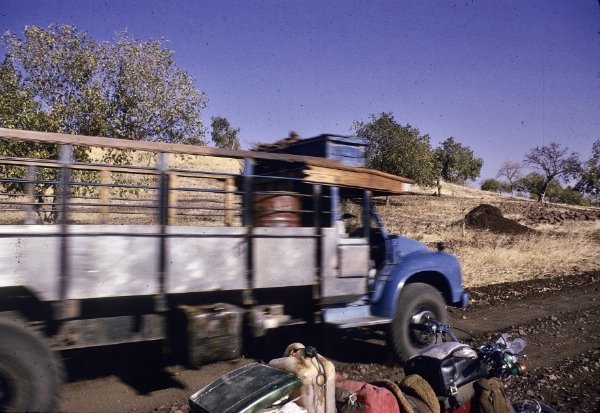
On the road to Mega.
Injera and Wat at small “hotel.” [Injera is a pancake made from a grain called Teff: Wat is a pepper stew of goat meat.]
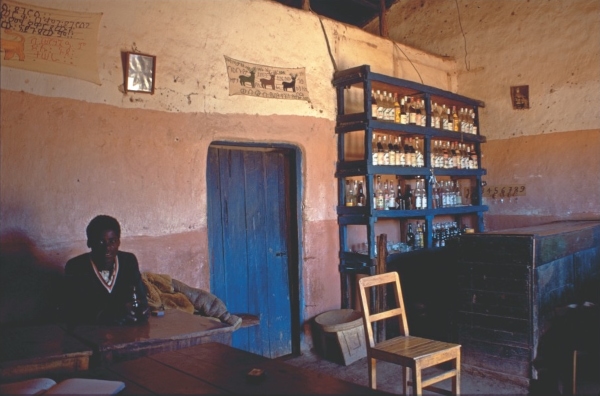
The hotel at Mega. There were string-beds through the blue door, but I didn’t stay.
Now there’s a battle between two tribeswomen, with plaited hair, and silver beads and bangles, and the hotel women in neat dresses and bandannas. It’s all over two small enamel mugs, which appear to have contained butter. The tribes-ladies wear candy striped shawls, red and gray. Their necklaces, more than a dozen each, like chain mail on their necks. (When they say “yes” in conversations the voice swoops up.)
Now the policeman has been brought, and very neat he is too. Trying to arbitrate between the girls he just gets hopelessly tied up. In the end there’s a tug-of-war with girls pulling each of his arms, and he brushes them off and strides away to save his dignity. The TW’s have sticks with which they polish their teeth. Wear loose fronted garments, like a pinafore across their breasts, and a long shawl wrapped round and over one shoulder which falls to mid-calf. They are the Burani tribe – cattle, sheep, and camels. The battle was over a cup of butter, sold to the hotel for four cents which the Tribe woman says she was still owed. This butter is a waxy-looking paste, but which Bridget [my friend in Addis] says can be made very tasty with various herbs.

I coveted the embroidered wall hangings and could have had them for a song but thank goodness I realised they were much better left where they were.
[An Israeli construction company was in the early stages of building a road from Mega to the border at Moyale.]
Go for a walk to watch road construction. They’re filling in a “wadi” over a concrete spillway. Huge Caterpillar earth movers, swinging around like bumper cars. They grade as they tip. Back to hotel where Vassi Fissaha, the Ethiopian civil engineer working on the road, is waiting to leave for Moyale. He is very fat with a round face, becomes interested as we talk. Says I could get to Moyale that day, road isn’t so bad. He’s going in his VW Moke, expects to be there 5.30 to 6. Mega already seems exhausted for me. I accept the challenge. Meet American from Nairobi, Geoff Probitts, coming into Mega on a Honda 350. First encounter.
[It’s the first time since France that I’ve seen a motorcycle on the open road.]
He says there’s nothing very terrible on the road to Moyale. I tell him the worst is over for him. I think maybe we were both guilty of optimism. Road from Mega to Awasa has some pretty ropy bits. As for Mega to Moyale, it’s better than Metema, but only just.
First long section is red sand, brush and termite pillars which Vassi says are strong enough to winch on. This continues in the plain below Moyale but interrupted by areas of black earth (like asphalt) in which grass looks blue, and then a wide belt of white chalk.
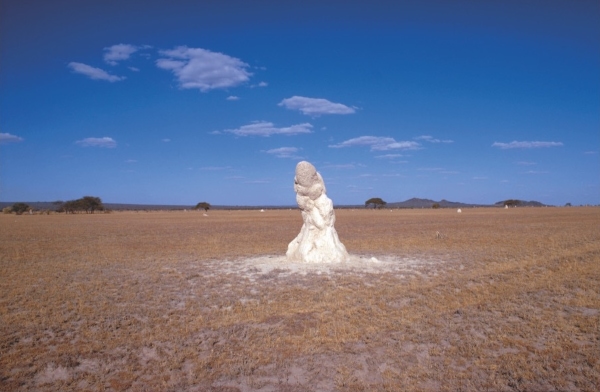
Here the termite mounds are ghostly white, like unfinished Henry Moore’s, for miles. Lot’s Wife. Road is a 20mph average, 2nd and 3rd gear road full of pitfalls, ridges, heaped dust and sand-filled cavities. Some very big bumps probably fractured the pannier rack. Saw little Dick-dicks (many) and a big deer with thin white stripes down its side. Several times uncertain about road, but on the chalk plain the left fork was the proper one. However, without watch or speedometer, [I meant odometer. It had packed up further back, as had my watch] these journeys are a bit hair-raising. No chance of riding this country in dark, and as the sun plunges below hill tops you know you’re not going to make it. I stumbled into Moyale with half an hour’s daylight to spare, and about 20 minutes behind Vassi’s car.
Had contretemps with students at town entrance. They prevented me from entering main street and insisted I must check into police station first (which was untrue). The style of stopping you to do you a favour (real or imaginary, or even spurious) is very strange, involves the most threatening expressions or gestures.
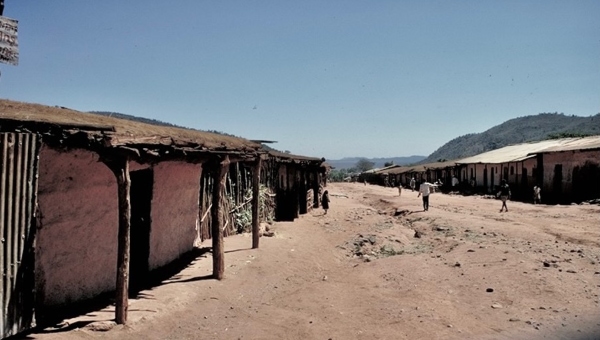
Moyale on the Ethiopian side.
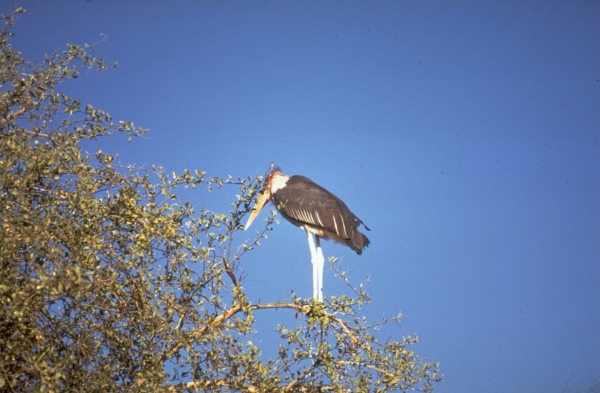
I was fascinated by these huge and apparently weightless Maribou storks.
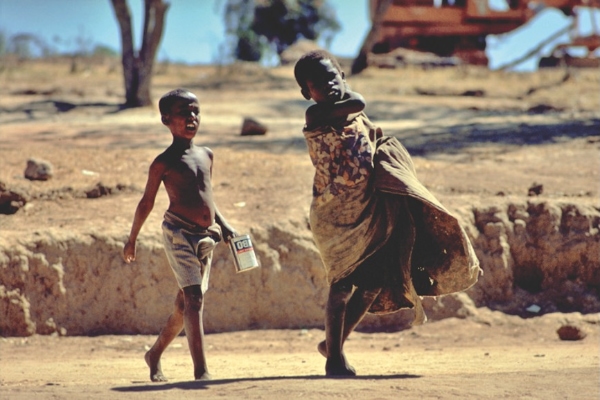
Approximately 40 per cent of Kenyans were under the age of 15.
Both Mega and Moyale show some return to the more attractive house building styles of Sudan, with mud roofs (fringed with grass or weed) supported on wood poles, rather than tin. Long low rows of these houses – wooden doors, red earth. People in mixture of tribal and Western clothes. But the prize goes to the old village of Moyale in Kenya where a combination of the best of these styles has been brought to the highest point and decorated outside in ochre wash. with flower and animal drawings.
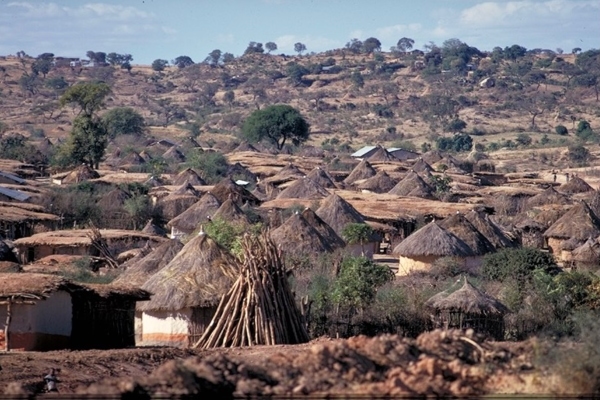
The tribal village at Moyale in 1974.
Vassi had the D.C. [District Commissioner] of Kenya Moyale in his car, and we were asked to drink to the New Year in Kenya with him. So after several beers we set off to breach the frontier in the VW. The soldier wouldn’t let us pass [even though we were carrying his DC. Speaks for the discipline at that time.] and there was much driving up and down in the dark to find the customs man to get a chitty.
People are very vague in their descriptions and instructions, leaving out important details. Their minds don’t seem to follow through the sequence of events predicated by the problem, so that much effort and time is spent fruitlessly.
Eventually we arrived at the New Bar on the Kenya side. Guiness ads, English signs everywhere, big bottles of beer, and noisy convivial atmosphere produce a pleasant illusion of friendliness and intimacy, rather pub like. It is a bit of an illusion though, and falls flat, just as the first impression in Metema [the border town of Ethiopia] led to disappointment. Presumably, after a hard ride, uncertain of what awaits me I have only to be given the merest token customary comfort – i.e. a beer, and a seat, and a little space in which to speak or listen – and I complete the rest of the picture in my imagination. There are enough people here anxious to imitate Western styles to provide a backdrop for this fancy, as banal as the Embassy [cigarette] advertisements used for ‘art pieces’ on the walls.
With William Wa (?) the DC and his friends we got merrily drunk and later returned to Ethiopia.
Next day I arrived, leisurely enough, at customs to find two busloads of Jehovah’s Witnesses being put through a fine mill. I’d known about them yesterday, since Vassi had an aunt and a cousin among them.
[They were treated like prisoners of war. All their goods were spread out on the earth, all their books, pamphlets and other religious materials were confiscated and burnt.]
Next week: The best of British on the equator.
PS: The other night I was wandering through the jumbly forest of my hippocampus when I came across a very wise old hippopotamus called Eisenhower who said BEWARE OF THE MILITARY-INDUSTRIAL COMPLEX.
But that was 65 years ago and nobody iin power paid attention. The arming of America took on a life of its own. The arms industry has been diligent and successful at buying political influence, their message has always played well to national pride, their factories provide jobs, their congressmen and senators have well-funded campaigns.
An arms race is very profitable and the fact that it sucks up the prosperity which might otherwise be used to improve living standards and provide health benefits to poorer Americans is not an issue – or, if it was, it’s well buried.
Speaking now as a European, one of the big talking points around our rupture with the USA has been the relative defencelessness of Europe: As though Europe has been negligent and self-indulgent whereas America has shouldered the burden of defending the free world.
As is well-known America’s military reach is vast and hugely equipped. There are at least 128 major bases in 55 or more countries (including 144 golf courses here and there) inevitably causing China to play the same game.
I wonder who might have already raised the possibility that America has itself invented the dragon we now face.
