Articles published in March, 2026
February 8th
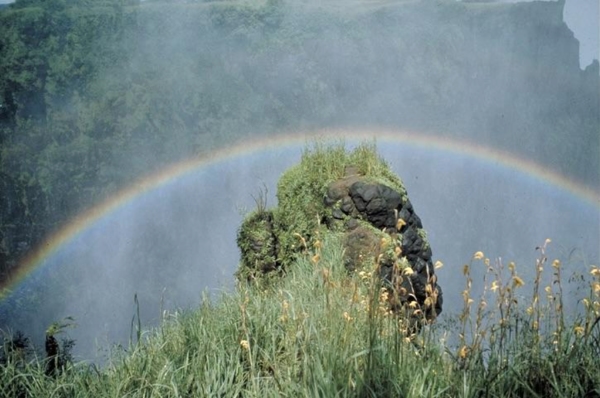
A rainbow spanned the Victoria Falls
Lusaka to Livingstone. Good sunny day with light cumulus, developing to storm clouds in late afternoon but generally off the road. Felt a real sense of the beautifulness of this earth, and as I contemplated the rich pasture land stretching out in all directions to the sound of lowing cattle, and remembered the thousands of miles since Nairobi (and before in Ethiopia) I find it hard to imagine so many people huddled together in Western cities, cribbed, cabined and confined. Thought of the good young men I have met (few girls) who would live peaceful self-sufficient lives out here, not driven to meddle and distort the pattern through mistaken and misshapen idealism.
There is so much fear in the cities, so little faith in the earth. How people love to tell and shudder at horror stories. Africans walk barefoot where a Londoner would expect to be attacked by any of a thousand venomous species. Me too. I’m ashamed of my cautious toe-dipping attitude – and excuse myself by the kind of journey I’m on.
Yet this journey must teach me that man can go free in this world – and the city, which was once a haven and has now become a prison is a habit. Indeed city dwellers, viewed in this light, look like a crowd of old lags, recidivists, huddled together in fear and trembling of the freedom that lies outside.
Remember the couple of Africans who were dancing by the roadside. I snapped my fingers as I passed and they smiled broadly.
February 9th
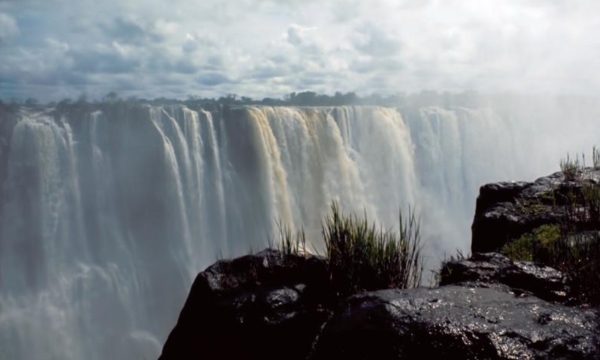
The Falls. The knife edge. Rhodesia – “the enemy”
Late afternoon on the Zambesi. African fishing. One man catching tiny fish. “Whitebait.” One had a bream.
“The Shadow of your Smile,” from a red Datsun pickup. Man who caught several small catfish and bream, and a “croaker” – croaked as he pulled out the hook and snapped off its spines. Bishop bird, and a bee-eater (scarlet bill). Distant grunts of Hippo. Long neck and beak of water bird floating past. Sahimia is weed that floats on the surface of Zambesi, choking up the Kariba Dam.
February 10th
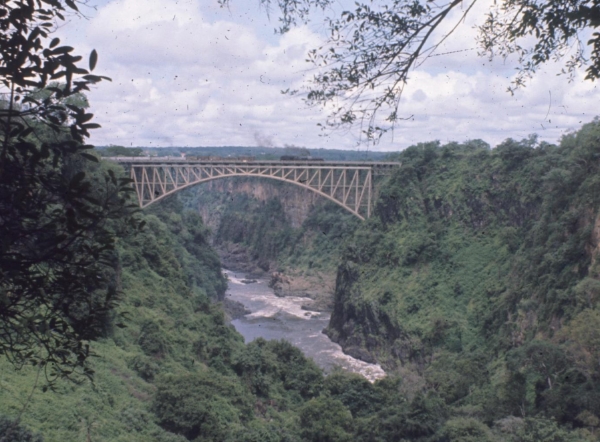
Gentle encounter with official at Livingstone Bridge.
Which side has closed the bridge?
“Both sides.”
[I already knew that the bridge was closed. The only way to Southern Rhodesia was through neutral Botswana, which was reached by driving twenty miles or so downstream along the so-called Kaprivi Strip.]
Away down the road to Kazangula. A highway for Jongolola and Dung beetles. No traffic at all. The ferry, two flat bottomed floats. Group of soldiers sitting on the Zambia side. “No, the ferry has not fallen down.” Botswana immigration – and a glimpse of churned up mud and water where the road out is. Worst fears confirmed. Zambian customs sell me a few Rhodesian coins. Botswana takes them back for an insurance policy, good in SA also though. Off I go, skating on mud. But road improves, and so does my riding. But I’m concentrating so heavily I miss the left turn. After six miles I realise I’m wrong and turn back. Stop at a village, brick huts and singing group. Leader and chorus. Leader has voice like Durante – sings one line, chorus responds, like hot gospel.
Right road soon gets me to customs. Rhodesians in white cotton uniforms – tunic and elasticated shorts. Two men, young and plump, with strained voices. One comes in carrying a gun tight against his chest, like a regimental colour, but as though the slightest movement would set it off.
“Do you have Rhodesian Third Party Insurance, Mr. Simon?”
“No. Can I get it at Victoria Falls?”
“Trouble is, the road from here to Vic Falls is bad. If you had an accident, you might not have a leg to stand on.”
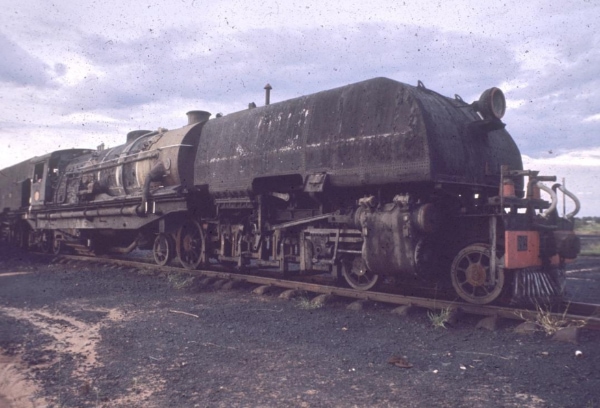
There was a graveyard for famous old locomotives. I can’t remember their name. Can anyone help? I think it began with a G.
Road is bad to worse, but there’s no rain and again I find the dirt much easier to ride. At speed it slides though the little patches of slurry fast enough to get a grip again before much deviation is possible.
See a sable in middle of the road – scimitar horns sweeping back – by arching its back it can kill a lion attacking its hindquarters.
Then little kangaroo type animal – which turns out to be a Springhare. The Falls on Rhodesian side are spectacular view, but there isn’t the intimacy with them that you get on the Zambian side.
February 16th
Salisbury, Saturday. The city, neat as a new pintable, with its well-ordered traffic lanes, freshly painted facades, White men vindicating the much-mocked values of a thousand minor public schools, whose old boys can find here what Britain has so manifestly lost; a decent life for a decent chap prepared to pull his weight (and throw it around a bit too.)
The African in Salisbury is not prominent. He mans the lifts and minds the counters, cooks, cleans and irons, calls you Baas and Sir and keeps his differences to himself. It’s no less British for being ODI and would be even without the prosperous (and surprising) presence of famous British companies like Dunlop and Lyons and Thos. Cook & Sons. Of course, they will explain that it’s not actually Dunlop at all but Dunlop (Rhod) Ltd, or some such fiction.
[Rhodesia, under Ian Smith, was holding out against the inevitable tide of Black independence. Trade between the UK and Rhodesia was supposedly forbidden. Coming into White Rhodesia from Black Africa was a little shocking. I found I didn’t like the white faces I saw; they looked narrow and aggressive.]
I am bewildered. Since Nairobi I have been seeing double – two images – the European idea of Africa superimposed on an African life. At times one image blocks out the other.
Next week: On a long and paradisical road to prohibition.
PS: I thought I’d add a little postscript, to express my concerns, not that I have any particularly brilliant insights to impart. Simply imagine, if you would, that we’re sitting at a bar, or over a coffee table.
It’s just that watching Trump play with his toys I find it impossible to keep quiet.
I am quite certain he decided long ago that Ukraine will have to sacrifice a large chunk of territory, and the sooner the better, so that he can start having profitable transactions with Putin, whom he admires.
Zelensky is just an intolerable nuisance. So anything that distracts the world from Ukraine and Zelensky is welcome.
The two years of the destruction of Gaza – which are as much Trump’s campaign as they are Netanyahu’s – have been very useful in that regard, but people have started looking at Ukraine again, so something else had to be done.
His assault on Iran has certainly been a new distraction, with the additional advantage that in order to rescue the world’s economy from its consequences Trump has been able to let Putin sell more oil and give him a new source of income. We are now at the brink of a huge disaster.
It becomes increasingly irresistible to make comparisons with Hitler. Like Hitler Trump sees himself as a master of the geo-political game, but without even Hitler’s credentials.. The people he has gathered around him resemble, more and more, the Führer’s gang of Goebels, Göring, Himmler, Speer, Riefenstahl, etc.
Meanwhile from Trump’s point of view Western Europe is just a pathetic sideshow, good for pageantry and magnificent state visits, and useful mainly as a scapegoat.
Like Hitler, Trump will surely, ultimately, be his own undoing, but must we all be brought down with him?
I’d been riding on this TanZam highway for two days, but my notes don’t reflect the chaotic nature of it. Because of the war in Angola this road had become provisionally the only outlet and supply route for Zambia – copper to the Indian Ocean and oil to Zambia. Much of it was dirt and in the process of construction. There were many diversions around culverts, the oil tankers were driven recklessly, drivers on drugs to stay awake and there were wrecks all the way along – it was a hell run and a challenge.
January 30th
From Mbeya to [Zambian] border. No petrol, no money. Meet embassy wives at Zambian customs and cadge petrol off them. They tell me about “the Catholic Fathers” at Mpika. Petrol crisis continues into Zambia. So does cloud and rain. Fill up at Isoka (several kms off the road) but fail to fill reserve tank. [This is nonsense. There was no reserve tank, as such. The rain must have gone to my head.]
Ran out [of petrol] before Mpika. Get some off a van, resting at wayside. By now realise towns are not going to have facilities. Opt for “Catholic Fathers at Levimkila.”
[I shared with most travellers a general dislike of missionaries in principle but had to admit that most were very well-meaning, and very useful to people like me.]
Meet Tom and Katrin Hughes. Invited in – visit hospital – “Our Lady’s Hospital”– nurse there says people are undernourished – sheer lack of food turns their hair red. Called Murasma. Much TB. Kwashiorkor. Mainly ignorance. Patients on double treatment – hospital and witch doctor. But if someone dies, they blame the witch, not the hospital.
Tom and Katrin think they have it too good. Expected a rough ‘bush station’. Mixed marriage – i.e. (Protestant) him, and (Catholic) her. – from Falls Road, Belfast. Talk of wonderful old people (priests and sisters). One rolls up (sister) on Honda. With helmet. She’s sixty something. Loves it there. Very brisk (as always)
The rain and the road are numbing my senses. Can’t really trust the bad impressions I’m getting. People less appealing here, physically. Old people clap hands to show respect. Smoke goes straight up through thatched roof of huts. People walk around in the rain quite unconcerned by it, sometimes with transistor radio pressed against chest under straw hat.
Said to be 10,000 Chinese here on railway. Look much yellower than I remember. (is it climate or contrast?) Said to be totally unapproachable. Wear pale blue overalls, sometimes coolie hats. As I drive slowly past worksite on main TanZam road, one in darker overalls pointed angrily/sternly up the road in very dramatic gesture.
Rain this day torrential. Thunderstorm near Serenje, so low, heaviest rain I’ve seen. Wanted to visit Nsalu caves (rock paintings) but didn’t dare ride dirt road in rain. 21 kms. Oppressed by total lack of pleasant shelters. Only “bottle stores” run by moody people. Who wants to drink beer or Coca-Cola after riding through a chilling thunderstorm and soaked to the skin?
February 1st, Ndola
Calculated today that I could drive to Cape Town in 8 days, so the original date is still within reach after all. Astonishing!
[Before the “oil” war, I had booked a passage on a liner to Rio. Now almost all shipping had been cancelled.]
Chinese build a neat railway. Those sections visible might appear in a painting. Stone buttresses to carry line across the road, built of square blocks, outlined in black (protective paint?). Chinese labourers in coolie hats with chin straps, on trestles. Dull green trucks in convoys carrying wood or sharp road metal, five or six at a time driving at a sober 40mph at respectable intervals – unlike the hairy driving of the big Tanzam trailer trucks on piece rate. Regularly along the road, dirt roads disappear into the bush, sign-posted in red on white painted sheets of flattened iron, in English and Chinese – “Quarry of 4th sub-unit” etc. Inspection is vigorously deterred. Tourists going off the road are sent packing if they encroach. Newspapers like the Times of Zambia (Lonhro owned) exhort the Zambian people to guard their railway against terrorism (by whom?)
February 3rd
[I found shelter with a missionary couple, called Bland, off the road to Lusaka.]
Within three miles of the Blands, a terrorist camp. One morning (Saturday) a machine gun battle. Farmers all came rushing into white houses for protection. Frelimo from Moçambique, Angola, Rhodesia – subsidised and supported by K.K [Kenneth Kaunda – president of Zambia]. But with less enthusiasm now, since their leaders seen living it up in Lusaka. Government officially denies their presence. Police much too frightened of them to interfere. Interlopers either warned off – or interrogated first and then sent off – but not violated.
[The Blands took me to visit a nearby village to see how they lived.]
Zambian family compound near Chikankata. Tonga (or Tonka) tribe. Six huts – plus maize store and chicken house. All basic ploughing machinery and oxen to draw it. Husband was away at court. Three wives, two of them had six children each.
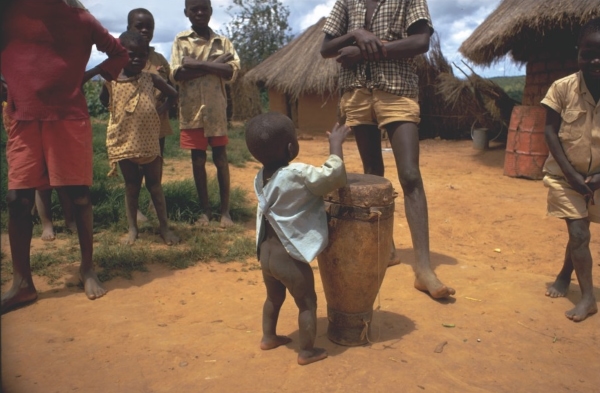
Drum about two feet tall, beautiful sound. Pot cooking on fire in kitchen hut.
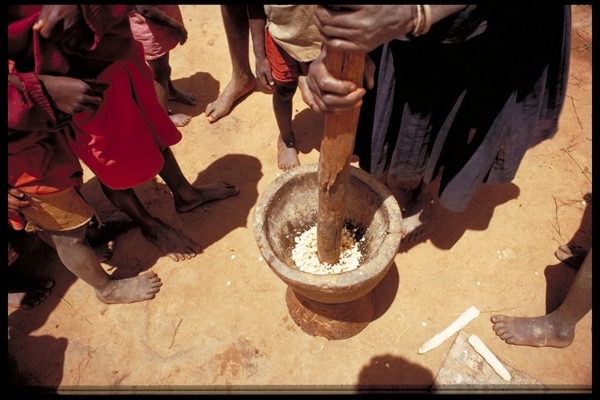
Mortar for grinding up maize with sprinkling of water. Has a narrower depression at the bottom into which stick [pestle] fits.
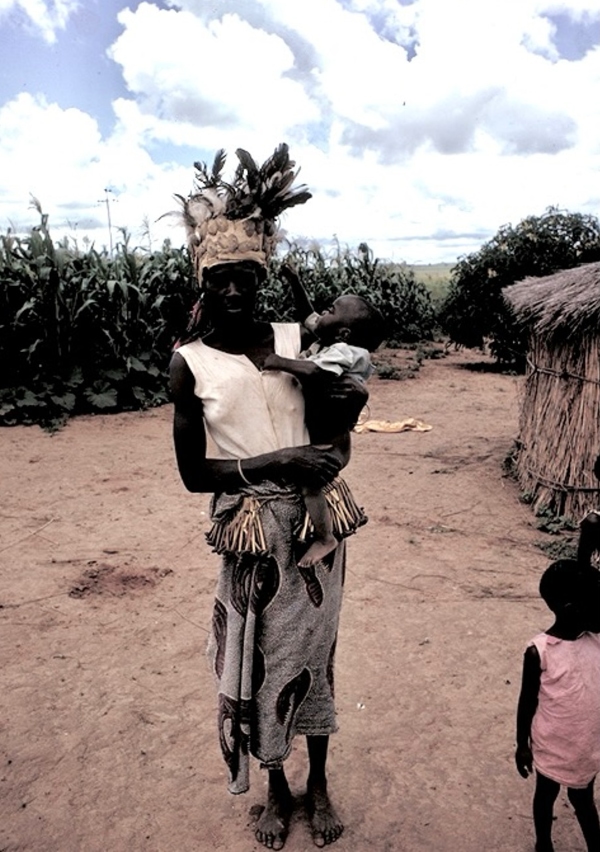
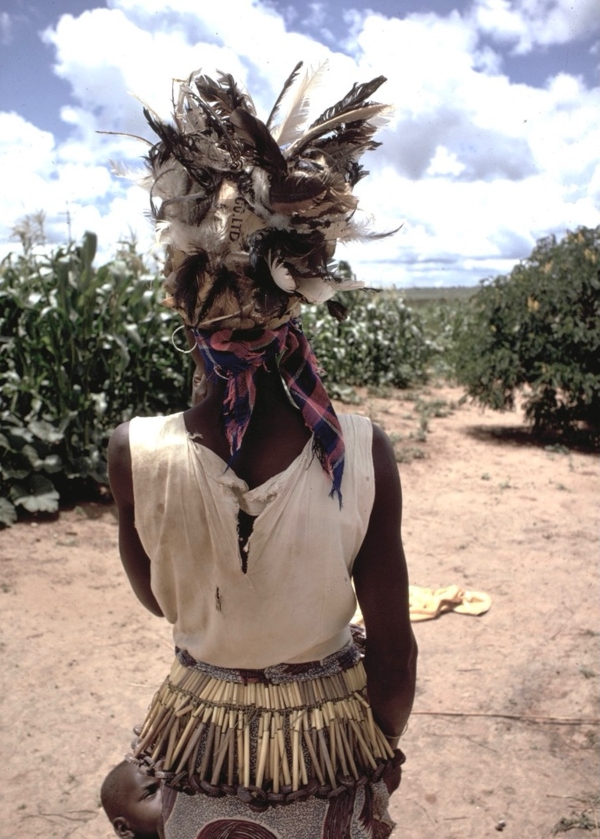
Tallest of wives and most elegant produces dancing gear made of strung bottle tops and a hat made of paper and feathers.
The rains – November to March. Heaviest in December and January. On a good day sky clears after dawn with only a little high cloud (Nimbus?) scattered over the blue. The sky does look bigger in Africa – even where the terrain is uneven. Perhaps cloud cover is higher – perhaps clarity or colour have something to do with it. As morning runs its course whisps of cumulus appear and grow, concentrating in one area and swelling to monstrous proportions looking finally as though an apocalyptic explosion had taken place in total silence. The base of this towering construction, which now looks as substantial as any ogre’s castle, is heavy and black as soot, and hangs threateningly, seeming to distend and sag even further to the ground as one watches. Eventually it’s enormous load is too much for the buoyant cloud above and it slides to earth in a diagonal avalanche, obliterating everything in its path, as lightning lances slash and rip the invisible skin that was strong enough to hold a river in the sky. As the day proceeds, the grayness usually spreads and becomes general, but it may be confined to one area, while the sun shines over and round the cloud playing on the spray and cumulus to produce beautiful prismatic effects. The roads gush with rivers of murran-coloured water, and cars send sheets of it flying over each other. People congregate under shop awnings, but in the country cyclists and people waiting for buses simply resign themselves to a soaking. Life goes on damp and soggy. The rains are too long for life to stop.
Next week, at the Zambesi, I crossed the line, from black to white. It’s a remarkable transition that poses many questions. I hope you’ll come with me.
After a few days in Mombasa, Malindi and Lamu, I rode on to the border at Lunga Lunga. In a strangely fearful mood.
Monday, January 27th
Rain stops. I drive on. No more tarmac. Packed sand. Looks like slippery trouble after the rain, reinforcing my expectation of disaster but it proves easy enough after all, and dries out quickly. But my thoughts stay morbid. A man walks past with a panga [like a machete] I imagine what would happen if he struck out with it. Mentally I kick out at him. It slices half my foot off. I develop an macabre and quite fallacious tale about a motorcyclist, white as death, riding up to a hospital gate and falling off the machine in a faint. Only when they have carried him in and pulled of his boot do they find half his foot missing. “We never knew how it happened because he died without becoming conscious. Lost too much blood.” As I ride I am stuffing the truncated foot into my boot to make the heroic ride, trying to imagine the pain. Only now, writing this does it occur to me that the panga would have taken half the boot off too.
[Today I find these gruesome fantasies quite astonishing.]
It seems clear, as I ride along, that all these thoughts and reactions proceed from some mechanism inside me – some permanent reservoir of anxiety which every now and again rises up and floods over. But where is the spring that feeds these black waters, and what unseen process releases them? I wonder whether I have ever been as aware as I am now of what is going on inside me. I have long ago recognised the converse – those times when light and dry and confident, I have felt free of fear and even been able lately to consciously communicate that feeling to others. But have I known myself in that other state, and what wounds have I inflicted on others thinking that mine was a normal, reasonable attitude.
[I rode on to Tanga and then, later in the day, embarked on the main highway through Tanzania, stopping for the night at Mwebwe.]
January 28th
The day brought no disasters. Even my five-shilling bed at Mwebwe had no fleas. The mosquito net allowed me to listen to their insect whine just a foot away from my face without flinching. But I dreamed, fearfully, of a huge, unpleasantly dominating man who constantly interrupted otherwise innocuous or cheerful scenes to threaten me with homosexual demands.
There have been such dreams before, not often but very potent (“There’s a stain on him somewhere”). [This was a dream I had in my childhood.] Thinking on about the day and the night as I rode on to Morogoro, it occurred to me for the first time that perhaps in my childhood I had been the subject of some such attack. So many things fit into place with such a hypothesis (my recollection of a fearless childhood up to the time I went to hospital in Shrewsbury – followed by pronounced fears, irrational quailing before masculine authority, etc.) I suspect it. But it could be true. Would my mother have any idea at all? I shall write to her, gently.
It occurs to me also that on the same day I had a recurrence of the skin rash which moves around from back, shoulders, arms, to thighs and belly, is evidently not a local thing but probably connected to general state.
(Another memory: The headmaster at Gunnersbury Prep. School wanting to punish me in the bathroom for sending for elbow grease. How terrified I was, naked.)
From Mombasa to the border, road was good. Through palms, tall ferns, villages. Dirt road from Lunga Lunga to Tanga – same sort of open leafy country. [Picked a sample cashew nut from tree.]
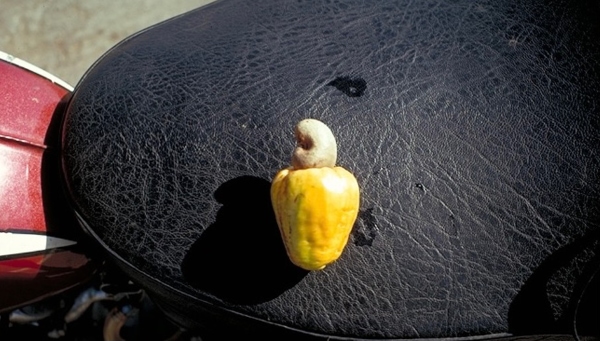
I was amazed to see that the cashew nut grows outside the fruit. In Brazil I discovered that the fruit itself, which I have never seen in Europe, is quite delicious when stewed.
Tanga, on sea, port, has open streets. From there the road passes endless sisal plantations. – all unusually green. Overcast. Mountains to the right up to Kirogwe, then over hills down to Morogoro where mountains again on the left.
One hour in bank to change £5 cheque. [There wase just one endless queue to get to the cashier].
Met Creati, the m/cycle man who had bought all the Triumph spares from Dar.
[Apparently the Triumph dealer in Dar es Salaam had closed shop and sold his spare parts to Mr Creati who was so impressed by my story that he kept reducing the price.]
Sells me speedo cable for 50/-. No 40/-. No, have it for 30/-.
[Odometer stopped working on road to Mombasa, at 5,904 miles.]
Add on to reading for reaching Mombasa – about 25 miles, plus 150 to Malindi and back. Then Mombasa – Tanga – Morogoro 307 miles. New speedo cable in Morogoro. Reading at 5,904.
Mikumi wildlife lodge in National Park. Stopped on road in to stare at elephant by roadside, which stared back with mouthful of grass. Lodge very attractive, swimming pool, overlooking watering hole. Elephant, zebra, bush pigs, vultures by pool. 100/- full board. (got a resident’s rate; 50/- bed and breakfast)
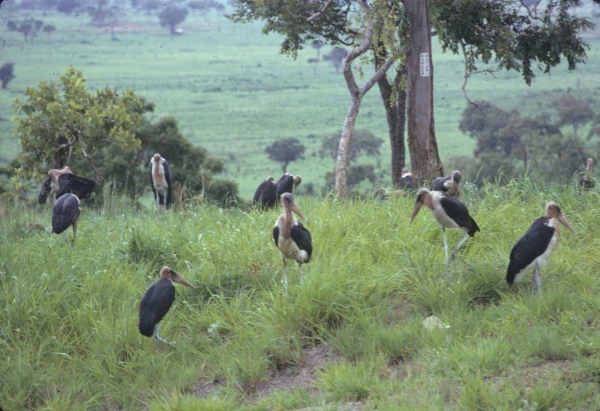
Maribou storks assembled outside the Mikumi Lodge, Tanzania
Met an Indian from Zanzibar, small, neat, heavy shock of black hair brushed forward over intense face. Left Z after revolution with British passport. [He thought it entitled him to go to the UK.] Went to Kenya High Commission who confiscated his passport– “You won’t see that again.” He believes they burned it. That was in 1963. His life’s ambition – or dream – is to float off Zanzibar coast on a raft and try to reach Australia. Wants to make it 12 feet wide, 44 feet long, from Mangrove wood.
Two Canadian engineers working on transmission lines alongside the new Tanzam highway. Last section being built from Morogoro to Ngerengere.
One of them talked knowledgably about Tanzania. Says: 11 million people – country has no known wealth (no minerals or oil yet found.) Nyerere [the president] is absolutely honest. Some tribalism (i.e. Some ministers appointing members of own tribe.) But not serious as compared with Kenya. No starvation, but primitive diet. Mostly maize. Per capita GNP $60. Some efforts towards co-operative farming.
Two American embassy wives asking well-meaning questions.
January 29th
Drove on alongside the Great Ruaha river (muddy red) and then across a range of low mountains. Mountains steep-sided, forested, green. Baboons, very beautiful land. Mostly overcast. Some sun at lunchtime.
Off road and up to Iringa for lunch: sambusa, kebab and chai (1 shilling, 70 cents).
First rain shower. Drive on. More heavy rain. Then on and off. Villages very sparse, small, primitive, offering nothing. Meant to stop at Igawa but couldn’t see anything there to keep me. Pushed on to Mbeya. Heavy rain, desolate, big rock barriers gathering heavy cloud, becoming more wild and mournful as light fades. Polaroids deepen gloom. [I was still wearing Polaroid goggles, for want of anything better.]
Everything drenched. Me too.
To Mbeya as night falls. Guest house like seaside boarding house. 50 shilling bed and breakfast. Very expensive, but friendly. Finnish agricultural research officers experimenting with different methods of maize production. Area unexploited. Says southern highlands could feed the whole of East Africa. One acre can produce 6 tons of maize properly farmed (or three tons maize, three tons weed). Asians everywhere travelling “on business.”
[I found the rain very dispiriting. As I said in the book, I think I “missed” Tanzania.]
That’s all for now. I hope I’ve taken your mind off current events for a few happy minutes.
The heat on the road to Mombasa melts the patches on my inner tube, and I’m stuck.
Kibwezi, 18th and 19th January
Could have been just another place. Jumble of buildings on a dirt road. Buses pulling in. Stalls selling fruit and a few vegetables. Main store on the corner (Asian of course).
[I cursed myself for not having what I needed to repair the tube, because of the heat. I got the bike to a BP station and found a post office to phone Lucas. The operator, in his tiny kingdom, treated customers like his subjects.]
Post office was a small room next to the store, with old standard switchboard and a tetchy African gent playing the plugs, very sharp with his customers.
“That is the correct method to deal with this matter.”
[Lucas agreed to send a new tube by car next day. I looked around for somewhere to sleep and chose the “Curry Pot Hotel.”]
Two ‘hotels’. Mine had big front bar with splendid cash counter with bars. Tables, chairs, usual girls with headscarves, loose overalls (blue), and swinging big legs around in loose easy way they have. Smaller room behind, then inner yard, more tables and chairs, one paraffin lamp, rooms off it. “Gents” is a bed of charcoal in cement bay. Lots of corrugated iron, painted. My room is painted silver. Mattress in plastic cover. Pillow too.
Experience transformed by the three men who befriend me. The “insurance” man – plump, floral, on his Yamaha, rescues me in my punctured state. Takes me to Paul Kiviu at BP station where I also meet the policeman, Samson. Two nights in town, drinking endless Tuskers, talking. Very animated first night. Girls are afraid of me – never slept with “Mzungo.” [Swahili word for white man.] One says she’ll come back but doesn’t. Paul works hard to convince them. Second night more philosophical, melancholy – apart from brief flurry of argument about insurance.
Pius, the insurance man says, “Snake bite is not accident because the snake means to bite you.” So, not covered by insurance. This outrages Samson. We invent examples of accidents to prove Pius wrong. But he insists, any misfortune caused by a live thing cannot be an accident.
“What if someone falls on me from the top of a building?” I ask.
Paul reveals his ambition to irrigate his shamba.
“Employment is a bother,” they all agree. Samson will marry in August.
Paul Kiviu, Samson Ndolo, Pius William Mouka.
“Employment is really a bother.” Samson stretched his legs further under the tin-topped table loaded with empty Tusker bottles, and sank lower in his seat. Black night filled the courtyard behind the Currypot Hotel & Restaurant, and a gentle melancholy washed over the four of us. Paul, the BP garage manager at the Kibwezi junction, nodded his head with its little curly brimmed felt hat.
“Oh it is a bother indeed,” he agreed. “You see, this fellow is not free. He is going round town even after his duties are finished and some person may come at any time saying his attendance is sorely needed in case of a sudden crime, or it may be a fatal accident and what and what.”
Paul had his own reasons to deplore employment. His presence at the petrol station was required every day, Sundays included, from seven to seven, although once a month he managed to visit his wife at the farm thirty miles up the road to Nairobi.
“You see I had to leave this company for two hours this evening. I was forced to go, isn’t it. Some stores came for the canteen, so I must go to search the stocks. This can happen at any time, and I don’t know if I have a job tomorrow.
“What is needed here is a thousand and five hundred shillings. Then I can build a tank for water and then I must have a pump and some pipes and I can put water on my farm and grow many things.”
“It is a bother all right,” said Samson. His voice was now almost disembodied. He wore navy blue trousers and shirt with matching cloth covered buttons over a black skin. Faint paraffin light, reflected off the painted corrugated iron walls of the hotel, failed to reach him and his sold, big-boned body dissolved in the darkness like a ghostship in fog. Only the insurance man was plainly visible now. He had a bright flowered shirt flowing over his fine round belly and his pumpkin face gleamed in the lamplight.
[Eventually, that evening, they found a girl who was willing to take a chance on a Mzungo, and a description of the event is better left to Jupiter’s Travels. Next morning the new tube arrived, and I was on my way to Mombasa.]
First rain fell on me. Saw ten elephants under a baobab tree in Tsavo park on way, and a few giraffs. Baboons at an abandoned gas station. Playing with their children.
From Nairobi speedo works for 328 miles, then stops.
[As I entered Mombasa I drew up alongside two European volunteers in an open car.]
Met Kai and Buran in mini-moke. Straight to Castle Hotel for seven course lunch at 14/- [shillings]. Room at Jimeey’s Hotel. Everyone says how hot it is – don’t feel it myself for a day or two, then everything gets sticky.
The Sunshine Club in Kilindini Street. 3/- for a beer. Smashing girls, tested weekly. Good band with soul singer. Acrobats after 11pm. Extramural fees up to 20/-. Many sailors. Best food at Arab-style Duka. Kima chapati with egg 3/-.
Boy who howled outside hotel window for an hour, dribbling with effort, carried off struggling and howling with hands tied behind his back.
Boy with so-called polio legs. [His legs look terribly twisted and deformed.]
“I’m not asking for help. I merely want to find a kind person to appreciate my problem. I have GCE in (various subjects) and have to look for help where I can. I believe God will look after me. You cannot understand now but one day when you also are in trouble you will see. Etc, etc. How can I want a cigarette when I am starving. Even though I haven’t a cent in my pocket I will not ask for money, only some food. But if I had my fare to go back to the shamba I would not be forced to look here for help. 4.50 is all I need, etc.“
Given a shilling.
“Now give me a cigarette.”
Walks off and [as his legs miraculously become normal] starts to dance down the road.
[I spent a day at the brilliant, sugar-white Mombasa beach.]
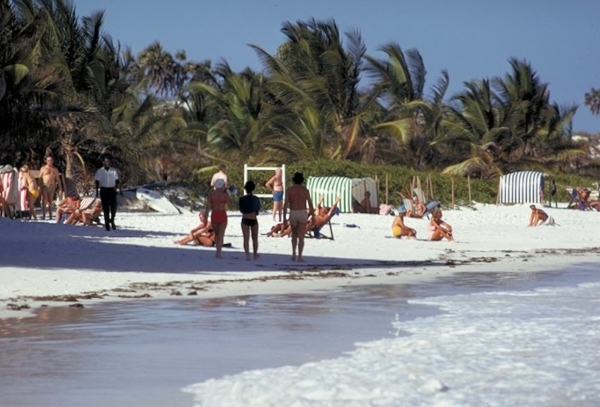
The beach at Mombasa Beach Hotel. White sand. English, Italian holiday makers.
[Overheard.]
“We do 60% of the BBC’s work, and all for Weekend. I usually get to the office about 7 or 8 but I often don’t leave until 9 or 10. But I go home to bathe and change and then go out to a party or dinner. I absolutely refuse to go home to bed.”
[This is where the fishermen at the Muthaiga club go for their marlin.]
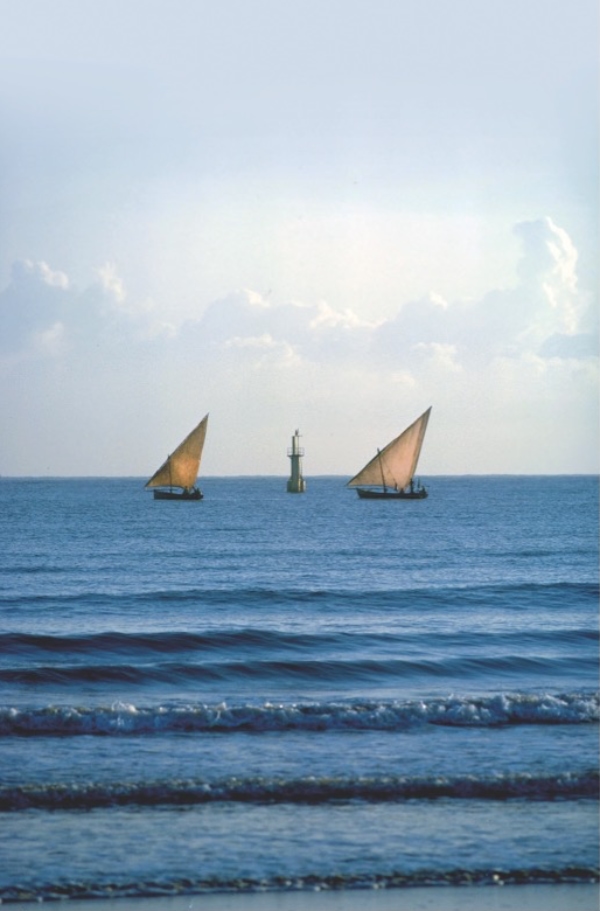
[I went on to visit the island of Lamu, famous for woodcarvings.]
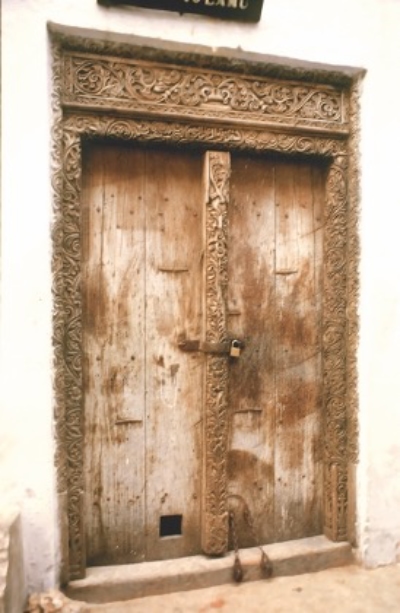
[While there I met the only person on the whole of my four years who was making a journey something like mine.]
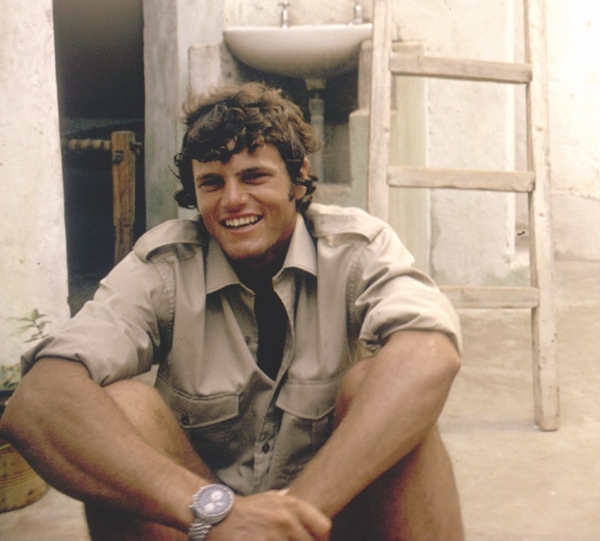
Ian Shaw, 25, New Zealander, been travelling 4 years, first on Yamaha 250, now on 350. Through Far East. Thailand, Malaya, India, now Africa. Fell off through speed-wobble in Thailand. Rolled 100 feet and skinned himself like potato. Hospital stretched him out and poured salt over him. Then washed him and put on mercurochrome. Then sent him off. Drove as fast as he could to make maximum miles to Malaya before setting rigid. Attacked and chased by Karachi mob. No reason. Threatened with shooting and incarceration by Tanzania police. Sleeping sickness in Botswana – thought it was malaria. Now thinks he may have bilharzia. Looks very fit and strong.
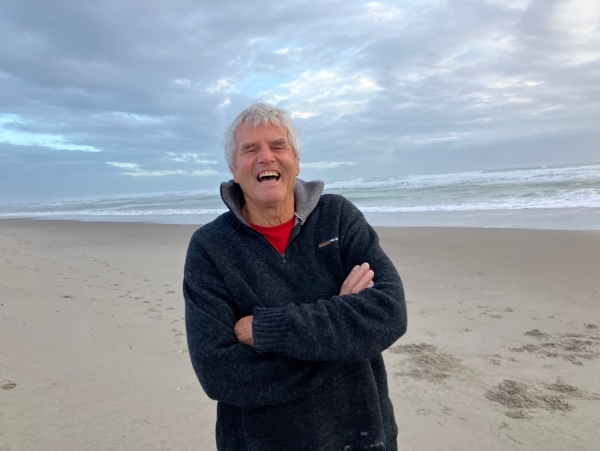
[Although we never met again, I visited his home in New Zealand on my second big trip. He was away, but his wife was at home. Just a few weeks ago, as I am copying out these notes, his wife called to say he had just died. She sent me a recent picture of him, fifty years on.]
Back in Mombasa spent one and a half hours trying to sell my shillings back to the Kenya Commercial Bank. [Strict currency controls at that time.]
Two nights with Kai and Henning had been pleasant and relaxed. At the Sunshine until 4am first night, finally taking back with me the persistent lady called “Marg” (to no purpose), and ferrying her back to her sister’s room next morning – a room in a thirties bloc called “Warden’s Court”– grey angular building with steel frame windows on unpaved ground. Sister sprawled on bed, face down. Afro wig on chest of drawers. Room clean, painted but stark.
Spent day recovering. Read a Victor Canning detective tale about an unconvincing Irish millionaire called O’Dowda and his improbably beautiful stepdaughters.
Sewed up my trouser hems (at last) and wrapped up sand, millipede, and silver box for Jo. Then bought food for two Danes and American and made a terrible mess trying to cook it on their electric Glowworm stove.
Later went out on a night trip to Fort Jesus – marvellous effect by night – soaring ramparts on hewn rock base with rounded crenellations, sloping back slightly, seeming quite impregnable. – can walk right round it – nothing to break the 16th Century mood – and then round Mombasa port – copper ingots from Zambia, rolling stock, freighters, and a tanker berthed and brightly lit, drums of chemicals strewn around, very little apparent supervision. Road winds between sheds and sidings for about a mile. Yugoslav trucks and trailers. Effect is to draw Africa together.
Remember massive derricks on freighter – forest thick. Locomotive with cyclops eye. Kikuyu guard. Tall suave – “You can pass”.
Leaving Mombasa, Monday, 27th
Left next morning, reluctantly, in cloudy weather. Mood of uncertainty developed into deep anxiety – quite inexplicable – which grew worse. Realised that this was a phenomenon to deal with and explain. No apparent rational basis, but undeniably I felt unsafe, threatened. Thought of Ian Shaw’s episode with Tanzanian police – “I can take you out and shoot you, or a I can put you somewhere where nobody will ever find you. We are the law here.” Was it that? Unlikely. When had I felt similar mood before? During second week in Nairobi just ten days before – though had done nothing then to precipitate it. Temptation to read omens, foresee disaster. Should one submit and delay action? Weather is unsettled, very humid. Hot waves of fetid air blow across the road from areas of forest recently drenched by showers. First time I have smelled that tropical hothouse vegetable smell. I drive very carefully, gingerly – anticipating accidents where I would not normally. On the ramp of the ferry at the southern exit from Mombasa.
Some drops of rain hit me, and I seem to be heading for black saturated cloud with dark streaks of rain below. Then road veers away at last moment and circles the gloom. Can’t help reading supernatural significance into it – a general reprieve. Lightens my mood but does not dispel it. At the border I am still uneasy, particularly as I am telling (for the first time) a modified story of my identity and purpose. I am a builder bound for Botswana. No idea of going further south.
[The newly independent post-colonial countries are deeply suspicious and hostile towards anyone with connections to White Rhodesia and South Africa.]
Kenya customs man engages me in an elaborate conversation about my journey, my views on Kenya, on Britain and the effect on it of losing its colonies. I am very wary. It sounds like a polite political screening. The policeman at the gate observes the sword and says it is an offensive weapon and therefore illegal. He is smiling and full of jokes, but I still feel he might do something about it. On the Tanzanian side the examination is more cursory. I am asked to show my traveller’s cheques. A slight schoolmasterly fellow in a light suit and specs suggests that he change my Kenya money. There will be no need to record it on the document, since I will be spending it immediately, no doubt. He is obviously going to cash it on the black market himself and wants no record of its existence. I let him get away with it gladly, feeling that it may buy me some protection. Against what? I don’t know, but the feeling of precariousness is still with me, and I feel the need of any security. He is a lousy advertisement for Nyerere [President of Tanzania] however. Then the storm breaks, and a short deluge descends on the tin roofs.
I have missed my last opportunity to buy petrol 30 miles back. The Michelin map has let me down. There is no longer petrol at Lunga Lunga, due to lack of business they say. A Mercedes drives up – TZ plates, and I solicit a couple of litres from two tall, well-dressed Africans. “You’d better wait and see if they let us through first. If not, you can take the whole car.”
Afterwards the driver lets me siphon a litre or so but stops me then. I have only a five-shilling piece and offer it to him. He takes it saying it’s not much use to him – but it’s worth more than twice the petrol he gave me.
That’s all for now. See you next week.
