I crossed the river and entered Argentina with a minimum of fuss and took the road south through the heavily forested State of Misiones, where the Spanish Jesuits had established some of their missions in the 17th century.
September 11th
Customs on both sides of Iguaçu are minimal. Not interested in my papers at all. What a contrast with Fortaleza.
Dirt road starts at T-junction with tar road joining Foz with Cataras and gives little trouble except dust for 30 kms or so. Ride south on dirt road through forest. Birds with split tails hover above. Prices about half, it seems. Loose stones on road, heavy red dust clouds. Strap breaks on tank bag. Hit a swarm of bees. Notice how slow my reflexes are, or seem to be.
Soldiers stop me at wooden bridge, but quite regular. This is obviously a timber producing area, just like second half of Paraná. Lorries loaded with logs pass by, there are cleared areas in forest, some also replanted with coniferous saplings. Pass a sawmill on right.
Before Eldorado I see sign “Permitido Acampar.” Not quite sure what it means and assume it’s offering a piece of ground on the right just before a bridge over a river. Across road is a bar/comedor where I could eat and I go across there to see if I could get some supper. Three dark and uncommunicative people sit by open window on far side. I ask about “jantar” forgetting that in Spanish it’s “cenar” They seem to understand and nod. They say I can camp here, pointing to grass at back with see-saw and swings, and landscaped terrace leading down to river. They show no interest or enthusiasm. I can’t help expecting some trick. Perhaps they’ll charge for camping. Maybe food’s rotten.
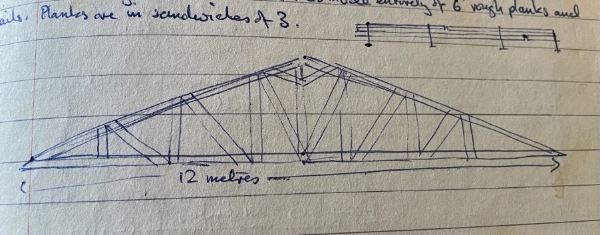
Down to river – Paraythini – to splash water on my dusty face. Into restaurant. Group speaking German. Place has huge wooden ceiling, unsupported. Delicatessen-type cold cupboards. More Germans. Dinner has German style salad. Blonde people rush in – men with widow’s peaks. Boys close-cropped golden hair. Then music blasts out – German ballads. I’m in Germany.
Talk to owner in German. Grandfather came after first world war. Also a bit of Swedish. Says 80 per cent of population of Misiones is European and majority are German, with some English, Italians, etc. German schools. He comes from Paraguay didn’t speak Spanish till he was 7 years old. Says since a year everything has gone to pot. Fixed prices, fixed wages. Wife has 60 hectares of the best oranges in the world left to rot because can’t afford labourers’ wages. Has to buy wine at 4.70 pesos and sell it at 4.50. Result, no wine. Says can’t get oil, meat, screws, all sorts of things. Says he hears that it’s the Jews in the South who own the basic industries – iron, copper, etc – who are running the economy for their profit. Believes that Argentina will split in two, like Vietnam. Agricultural North can’t work without Industrial South. Dictatorship is the answer. [He got his wish – be careful what you wish for!]
Happy to talk. Gives me whisky.
Next morning I was shown the roof. It’s made entirely of six -inch rough planking and nails. Planks are in sandwiches of three. [I made a drawing of it.]
September 12th
Shook dew off my tent and fly-sheet, packed up, shaved in empty motel room, had breakfast (5 pesos) and left for San Ignacio [Famous ruins of a mission]. Passed many orange groves, lemons, tea fields (like fields of clipped hedges). Lorries with sacks of green leaves pass by – probably yerba. Also oranges in trucks. Cattle on rough pasture, with shallow pools of water, Ibis and similar larger bird and many varieties of other birds, hawks, owls, kingfisher, plover, many waterbirds, storks (rather grubby, black and white) little birds all red or yellow with red faces, etc. etc.
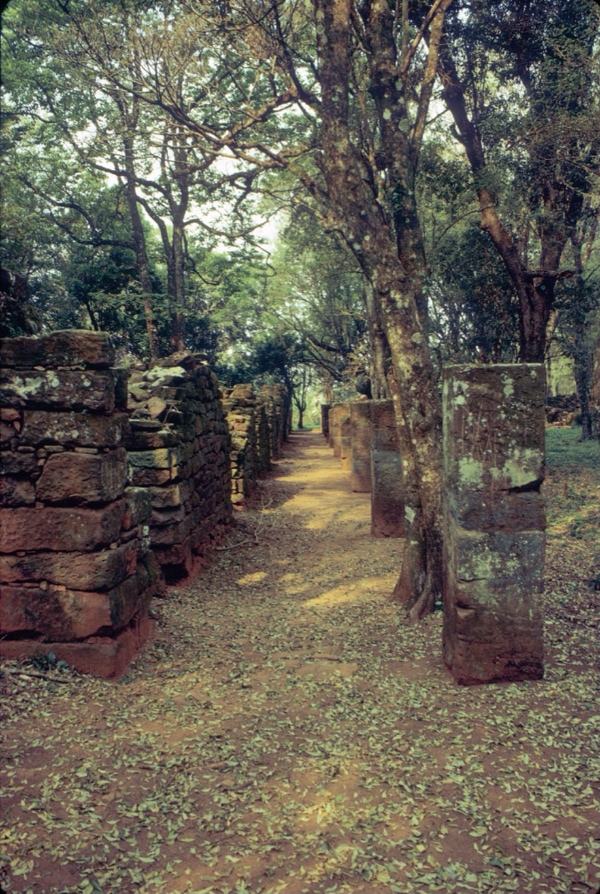
San Ignacio as I saw it. It’s a UNESCO world heritage site now.
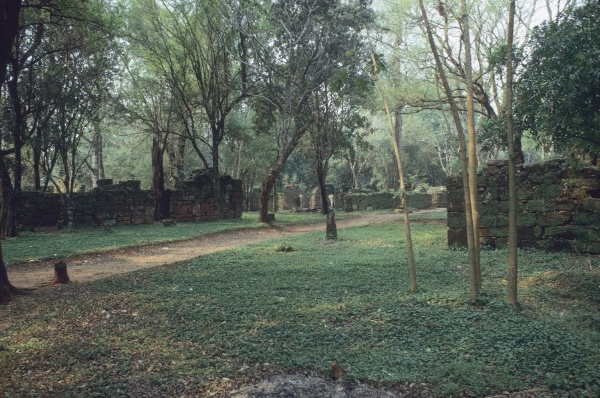
Next week, my meeting with Marx. Don’t miss it.
September 10th, Paraná
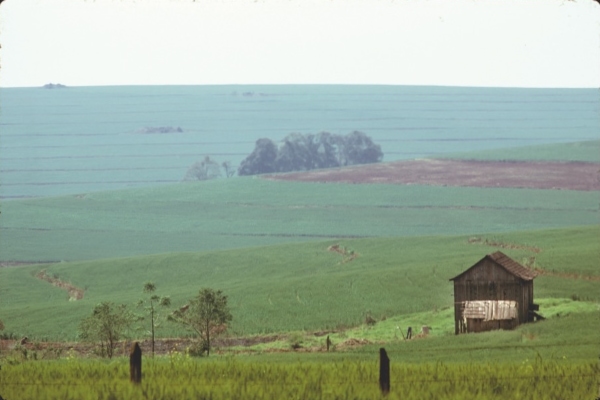
The deep rich soil of the State of Paraná
Travelled from Curitiba 350 km app. Find dirt path off road leading down to reaped maize field and clearing above stream with shed and slimsy wooden shelter of branches and veneer over heap of corn husks. Put my ‘rede’ [hammock] across two posts, tying it to crosspiece. Got out tin of feijoada [Black bean stew] and coffee. Went for short walk and came back just before dusk to light a fire, feeding it carefully since half the countryside seems to be burning and I don’t want to give the corn husks a chance. The stars are very bright and there’s one – Venus? – that’s bigger than I’ve ever seen it. Find myself thinking about Jo, recalling moments of our life together with sweet and painful clarity. I am always expecting a letter to tell me she’s given me up. A tremendous shooting star strikes across my head. Not falling away as usual but travelling towards me with a big trail and actually bursting above me – can see the fragments. What luck that must bring! Unless it’s a satellite, with people frying inside.
Hope my hammock doesn’t bring the house down over my head. Funny thought – could hardly have serious consequences. Unless freak accident. Instantly I see myself in dark struggling with my eye gouged out by a broken stick, screaming for help, staggering up to road, blood streaming through my fingers, to be run over by a lorry. I amaze myself, even, by the gruesomeness of the scene. I realise that my imagination always anticipates the worst and runs through the horrible consequences with practiced relish. I’m afraid to imagine beautiful sequences for fear of disappointment? Is this everybody?
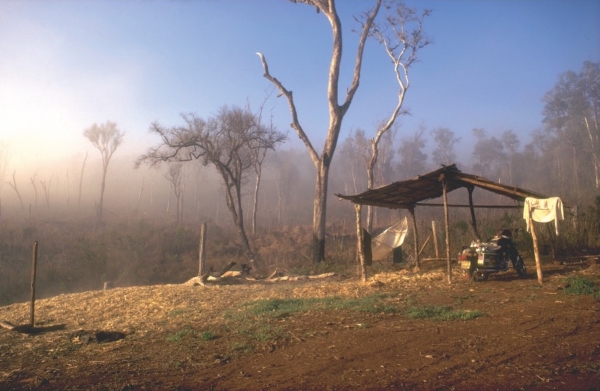
The flimsy structure held up my hammock and survived the night
Night is a series of problems. At first warm above, cold below. Eventually put Lilo under me as insulator and it works. But temperature keeps dropping. At 3 am feet are frozen (despite thick socks) and I have to get up to fetch long pants and long sleeves. But even these don’t get me quite warm again. There’s a freezing mist. Lorries keep going all night. How great it would be to get away from those grinding diesel engines. Noise carries so far and lights sweep for miles.
Morning watch birds through strings of hammock as they fly down to peck at the earth. Oh, the mice in the corn husks are busy at night too, and once a bird flew down to attack them. Its black silhouette rushed past my face but I couldn’t see if it had struck successfully.
There’s a small bird of deep dusty red with crimson cap – a very plump biggish bird with a fine pointed beak – hops along like a big red India-rubber ball. Then there are the two wood-peckers sitting on a stump and looking at me, perhaps nine inches to a foot long, yellow head with markings, yellow breast, mottled plumage, looks grey from a distance. They work on a tree over my head. Flocks of blue birds and green birds flap about, and smaller yellow birds swoop down from the ‘blob’ tree. Can’t get near birds with the camera. Despite trucks it’s so peaceful and interesting. The colours and shapes of things feel hospitable. Sun breaks up mist by 8am and by 9am it’s hot.
200 miles to Iguaçu. One stop at a fruit stand. Group of road workers (DNER) talk to me. “Every day is Sunday for you:” Tell me of nice site with good water at Km 12 “out of Iguaçu” and Supermercado Moringa where Japanese will sell me pesos. Go there. No pesos. Buy meat and butter and condensed milk. Go to site and make dinner. Water is good, as promised, but people have used fountain as a latrine. Want to sleep there but decide against it. Too near road, and prospect of 12 hours darkness drives me to motel. Not bad at 30 crz but not enough bedding. Paraguayan boy speaks a very clear English. Says he learned it for three months.
September 11th
To Iguaçu Falls. Spectacular. Breathtaking. Leaves me in a strangely depressed mood. Was there only an hour taking pictures – composites – thinking “all this way to spend an hour.” But that’s all it takes. After that the impact lessens.
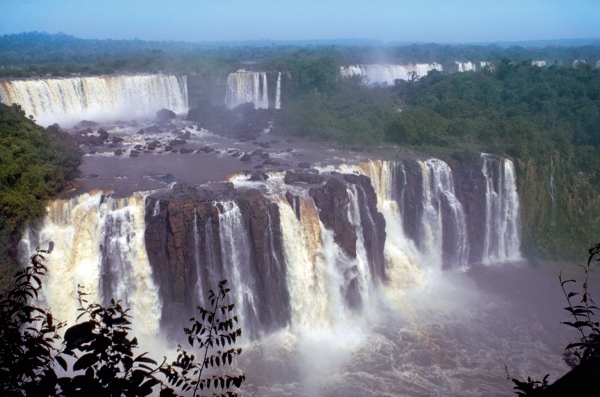
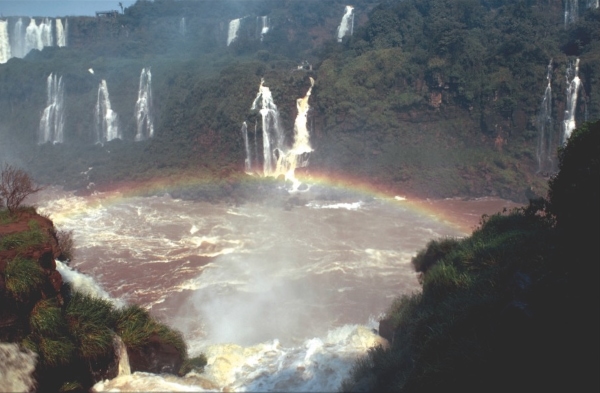
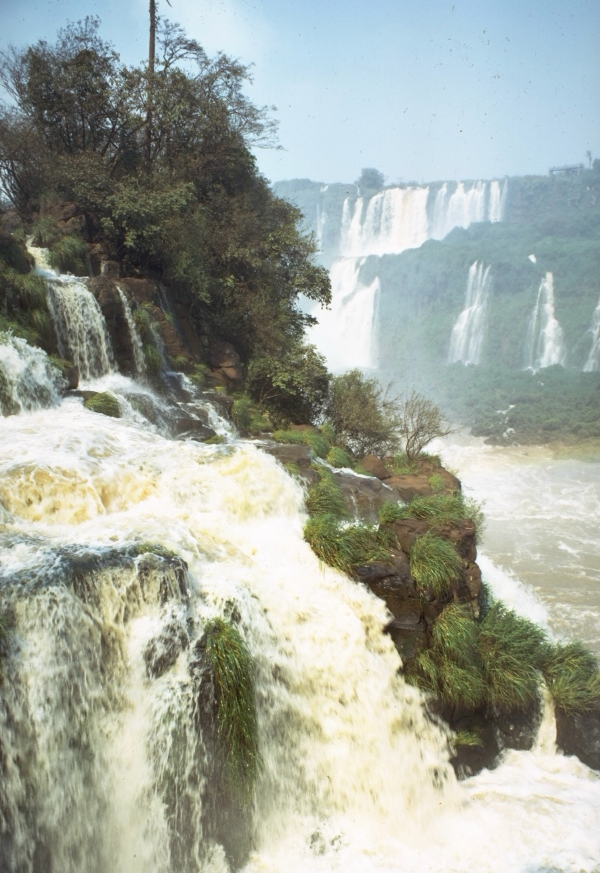
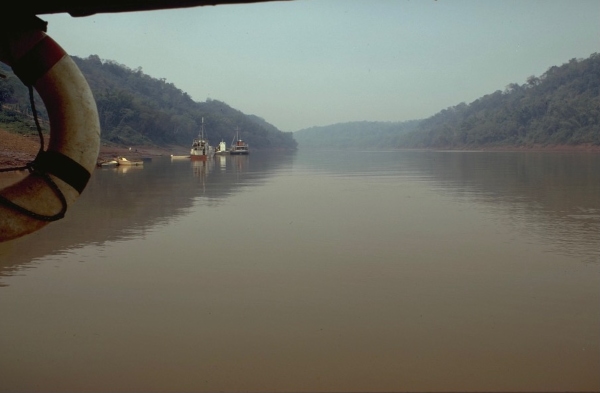
After the turbulence of the falls the river crossing was unbelievably peaceful and calm
Should have gone on to the Argentinian side but couldn’t bring myself to do it. Why? Because it’s not what I need. Instead ride south over dirt road into Missiones.
Missiones is a state of Argentina. That afternoon I found myself in Germany. You’ll find out all about it next week.
6th September, Sâo Paulo to Curitiba
Probably the nastiest ride of all time. At first the dreaded traffic didn’t bother me. Then came fog (or cloud), rain, wind. And it went on non-stop for 8 hours. Cold. Throttle and clutch cable seized. Couldn’t see – and froze.
[I didn’t record the diesel that dirty trucks spewed over me, though I still remember it very well. The road climbed unexpectedly high before coming down again.]
Arrived in Curitiba – for want of anything on the way – ready to spend a fortune to find warmth and shelter. But two men in a VW stopped and talked and led eventually to beautiful hospitality. Warm shower, bed, food, conversation. Fat man is drug salesman, dapper man is sweet maker. Town is, they say, one with the highest all-round standard of living in Brazil, and also most costly. Very civilised town centre (as mentioned in Brasilia).
Went out on 7th September (National Day, Saturday) to see city and then to meet “moto queros” as they call themselves, and to oil my cables. Also repaired damage to right pannier. Discussed politics. These men are solidly behind the regime, convinced it is doing the only possible thing.
Now I’m in a land of plenty where almost every family, it seems, can have its share of modest comforts in the bourgeois style, and a little left over for luxuries. Marcio earns 65000 cruzeiros a month from Glaxo. He has been doing this work for twelve years, previously for Italian firms, but he puts Glaxo above them all. He met his wife 18 months ago at the Rio carnival. She was from Curitiba and her four sisters and two brothers nearly all live there, so he came to live here too. They have a four-room flat, polished parquet floors, electric shower (which always just misses the temperature you’d like) and rather than spend on furniture they have a foam rubber slab on the bedroom floor, and bean bags in the living room, but that’s because the flat is not theirs, and they want one of their own.
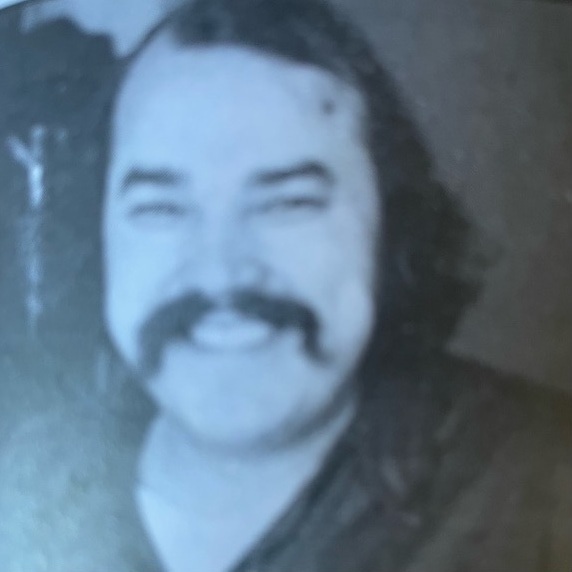
Marcio in 1974
Unlike the Rio rich he makes do with one of the whiskies that pretend to be imported but are firmly called by everyone “Nacional Scotch.” E.g. “Old Lord” blended whisky – malt whisky distilled and bottled in Scotland 12 years ago. Well I’m no hand at scotch at all but I’m not going to swallow a 12-year-old malt at £2 a litre when a bottle of Johnny Walker goes for twice the price.
Also on the drink shelf is an elaborate carton in blue & gold armorial motifs advertising its content as Pinwhinnie Royale Scotch Whisky, and inside is blue cloth bag tied with a golden card at the top containing a smallish bottle _ but by the feel of it the bottle is empty. There are cigars from Bahia in individual jacaranda sleeves, a gift from his father, each costing 25 crz he says. Very good I admit. And electric Japanese clocks. And o ktail sticks from Minas of twisted silver and coloured stones, and a trophy from Glaxo and a wooden carnival whistle and three special looking bottles of wine, one with label attached, and some glass and silver. On the table there are pine cones and a red brown polished nut that looks like a small, closed cone but isn’t – a kernel rattles inside and it comes from a beach near Rio.
There are few blacks down here and there are jokes about them though nobody admits to prejudice. There’s that smell though!
The men dress warmly and fondle their paunches through jersey knitwear. I can scarcely remember a paunch in Ceara. Women are cosy, the weather is cold, but there’s no indoor heating. People go around complaining of cold but looking healthy. There are sparrows on the rooftops and pigeons in the squares and the whole thing is just what you’d expect from a fusion of German and Northern Italian, but strong civic sense.
The Moto Queros received me in a circle specially carved out of the mosaic stone paving at the city centre where the Rua dos Flores is a pedestrian street. And some very nice light metal and acrylic structures have been put up for coffee, phones and information. They sat on their Suzukis – 550 ’75 and a 550 ’74 and a 380 GT, all three-cylinder machines, gleaming, all sitting still as museum pieces, men trapped in an unfulfillable dream. It seems a pity to say so, but few motorcycles get the use for which they were designed.
Marcio said: “It’s easier for me to like what I do than do what I like.”
He is from Campo Grande in Matto Grosso. Family owns huge area of farmland. His full name is Marcio Mascarenhas Grise – Albaneira de Lourdes is his wife.
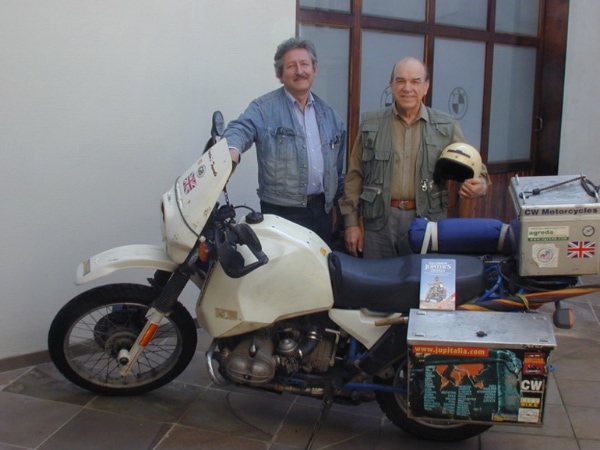
Marcio and me in 2001
[Before I left them to go on to Argentina, Marcio insisted that I exchange helmets with him. I wasn’t too keen on his rather heavy black fibre helmet but I couldn’t refuse.]
[I returned to Curitiba in 2001 and found him again, now in a palatial penthouse apartment. In the meantime, he had become fairly rich, enormously fat and then, after a near-death experience, quite slim. To my astonishment he and Albaneira had preserved my helmet like a museum piece, and he showed us around town with great pride. Unfortunately, all the stress he had put his body through was too much, and he died not many years later.]
I was in Brazil for 9/11. I watched it on a hotel TV in Receife. Because my Portuguese was poor I thought, for a while, that it was another disaster movie. It felt rather remote. People I talked to later were sad but had mixed feelings.
See you next week.
