
From My Notebooks In 1974: Crossing the Continent
1st November 2026 |
Friday October 18th, and camping at Piedra del Aguilla
Piedra had a row of jagged rocks behind it on the left, a few houses, a police post where the policeman was tending his garden, and some shops and houses on the right indistinguishable from each other. All whitewashed and quite neat looking. Found a butcher – young man in a small room with a few half carcasses of mutton in a fridge. Bought a few ribs and the kidney and went to another shop next door to get eggs. Same man appeared behind the counter. Also got half bottle of white wine. Then went off behind the rocks to find the river, along a dirt road about a kilometre away, where it crossed a stream which was a tributary to the Limay, itself tributary to Rio Negro. The stream was milky with lime, and burbled through a corrugated iron duct under bridge. There was a bank, like a shelf, with grass and trees where I pitched my tent.
Made a fire in a shallow hole and dug some green sticks into the ground to lean across the fire on the lee side to carry the mutton.
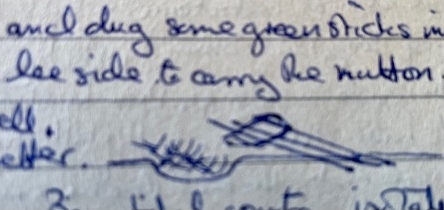
My primitive little illustration
Since the wind was steady it worked well. Next time I shall develop the idea better.
This camp was a great success. Beautiful country, isolated. Only disadvantages were, no shelter from icy wind, and water too muddy to be appetising.
Saturday 19th
Breakfast of kidneys and chopped mutton cooked in butter, with bread and coffee. Back to Piedra del Aguilla, through a shallow flood, to gate where man waited to let me through. He asked for the time and for a moment I suspected him of wanting my watch. These last days I’ve been going through a paranoid phase, anticipating trouble, writing righteous letters to Triumph and Duckams [sponsors] plotting revenge, etc. But the mood affects me far less than it would have done, say a year ago.
The journey from Piedra del Aguilla to Bariloche is marvelous. Desert hills rising and falling, rock escarpments, dusty lime-green tundra. [This road is famous for the fantastic shapes of the rocks alongside it.] Stopped to take pictures near ruined stone building. On delayed exposure, dashing between camera and bike, would have been very funny to watch.
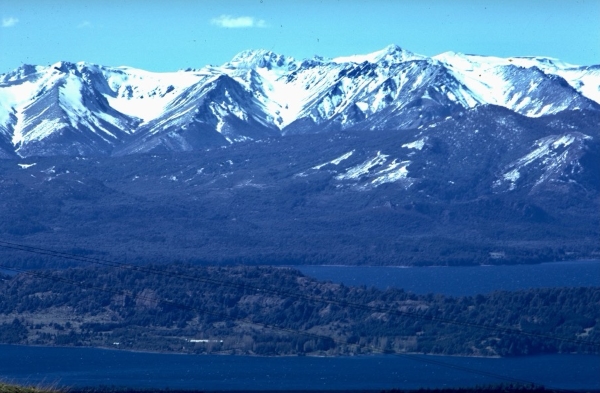
Then the first snow appears on distant peaks.
[I had an introduction from a student called Jorge whose uncle had a hotel in Bariloche.]
I found Jorge’s uncle in his hotel and got tea and directions to Wesleys.
Sunday 19th to 30th
Stayed with Wesleys – just day to day. Teddy Wesley, wife Leo, sons Kevin, Robin, Rocky and Tom. Have business making candles – “Vellas Leo” – Km 15, Ruta de Llao Llao. Formerly had chickens. He is 56, was in commandos in war, born Argentina, descended from Wellesley [Duke of Wellington]. Wears conquistador beard, reddish brown hair, small glittering greenish eyes, slow smile and detached expression. All exhibit behaviour I associate with big families. Rocky has belligerent sociability, wears his sideburns longer than he should, has petulant lips. Tom is said to have dyslexia and still can’t write properly. He has horses to hire out. He and Rocky are still at school – Rocky because he lost a year in Europe.
Staying with them is Hermione Green, chubby girl whom I thought at first to be part Indian or Eskimo. She does wax crayon drawings of prototypical waif girls and old gauchos, and sells them for 250 pesos each, when she can be bothered. (£6 at the time). Also teaches English in afternoons – paid same amount per week of teaching.
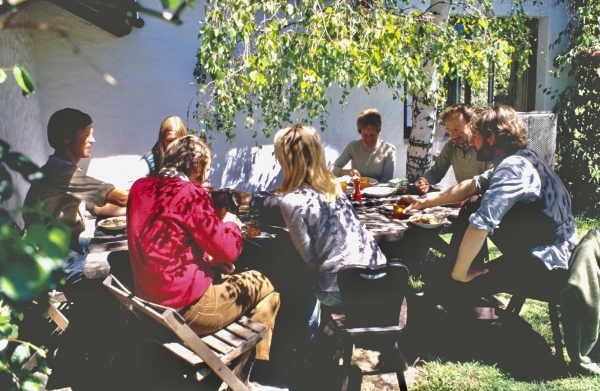
The Wesleys at lunch. Their life struck me as quite idyllic. They were hugely hospitable.
They live on the edge of Lake Nahuel Huapi. On other side of the property is Lake Moreno. Between them and Bariloche is Puerto Moreno. At Llao Llao is a loop of road which goes round the Grand Hotel Llao Llao (once in Peron’s first time a fabulous place) and past it’s gold course, then to L. Morena and back. Called the Circuito Chico.
Skiing mainly at the Cerro Catedral a mountain with three needles which can only be seen from other side of Bariloche. (Teddy climbed one once.)
[They introduced me to the crème de la crème of Bariloche.]
Hotel El Casco – Ruth and Alfred. He from Stuttgart, she from Berlin. Each previously married but separated by war. Her husband was held in Russia. His wife took refuge in Sweden. Both marriages failed. They met and married – and left all their families in Germany to go to Argentina. Gradually their daughters came of age and visited them. One married at the Atomic Plant – but he died of a brain tumour. Then she married there again and another daughter did the same thing. Their hotel is very splendid and personal. Roses on the pillow, chocolate on bedside table, very plushy restaurant.
She, in Wagnerian gowns looms over his neat but crippled body (in black tie when I first saw him). Polio as a boy.
Andrew, the Polish ski instructor, lives a disreputable life in his home-made house on a windy shore of the lake. H makes a presentation of himself, eyes faded blue (Leo’s also) and tells scurrilous stories about people and their private lives, putting a folksy significance on their behaviour. i.e. The woman who threw herself from a window was “because he couldn’t satisfy her;” Most suicides, he says, are due to sexual reasons; He stinks from far away, etc. He worked on the Polish ship ‘Batory’ [Once famous in the Cold War.]
Bariloche offers skiing from May to September, climbing, horses, canoeing on the Limay, Wonderful lakes, mountains, forests. Chocolate and candles. Wesleys have ground on Limay between river and hills. Everything is a dusty lime-green on the way to Piedra. Poplars for windbreakers. [Teddy took me there to try out an idea he had for generating electricity from fast flowing river.] We experimented with turbine model on oil can.
[The most interesting stories in Bariloche came out of the famous Atomic Research Laboratory established there before the second world war. At first, it attracted Jewish physicists escaping from Nazi Germany. After the war it attracted Nazi physicists escaping justice. They were all said to get along with each other extremely well.]