News from Ted
Still in Oaxaca 1975, I was going to continue with extracts from my notebooks as I moved on through Mexico to the USA, but I find them harder to transcribe. Compared with the bare-bones existence of the Andean lands of “No Hay” Mexico seemed quite prosperous, but the prosperity was an illusion. It was created by the availability of goods from the USA which only a few Mexicans could afford.
I arrived in Oaxaca at lunchtime and found it full of Gringos.
“Find a vegetarian restaurant with rooms, called ‘Pices’, opened some years before at the prompting of US visitors.. Meet a Gringo who lives in Oaxaca and trades Indian stuff to (American) stores. He has a small eagle he offers to show me but doesn’t return.
Instead, I meet three other Gringos: A disillusioned screen writer and wife, and a highly nervous dislocated person who walks with short arthritic steps and flits disturbingly from topic to topic, anxious to communicate, fearful of boring, hard to follow. He’s a law school student, probably the victim of a breakdown. He too is planning to trade hammocks. The others are into blankets. Christ, everyone’s at it!”
The hotel had an outside shower with the water heated by a small wood-fired boiler. There was a small stack of firewood. The guest lights the fire and goes on adding wood as long he or she wants more hot water. I was taken by the simplicity of it.
“There must be things to see here but now my interest in Spanish towns is satisfied by a glance at the facades and an hour in the plaza. Church interiors disappoint, and it’s the general disposition of buildings and spaces that please, or otherwise. The Cartesian arrangement of Spanish towns is very apt for Spanish thought, echoing their ideals or wishful thinking. They would like everything to be orderly and just but are hopelessly exposed within these rigid frameworks.”
Well, that’s what I wrote at the time. I don’t know if I agree with myself now.
“On towards Mexico City. Uneventful ride. Stopped to look at small village, but less interesting close up. Went to another to get water from a tap. Took pictures of church and children.
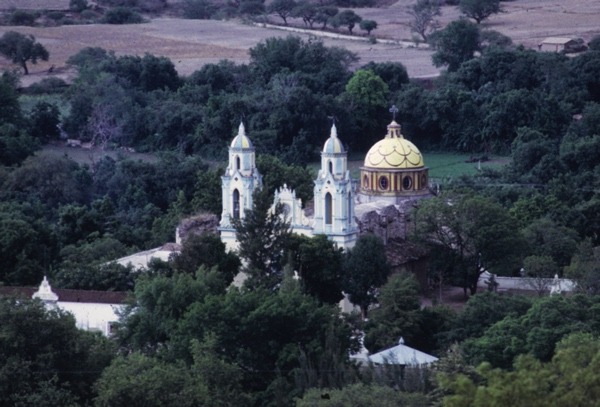
Later followed a path uphill towards micro-ondes (short wave) transmitter to sleep away from the road. Was attended by peasant and his son as I made camp. Others on bikes had been here before me. The man had worked in California (as a bracero) and been badly treated but was evidently pleased to see Gringo visitors. Had my usual dinner, though Oaxacan chorizos were starchy and inferior.
Next morning mother and son came to visit, with tortillas. I offered tea and cheese. Rode on to Mexico City, but now one cylinder is smoking badly.”
In Mexico I was hoping to find Bruno at his girl-friend’s house, and got thoroughly soaked while looking for it. but he had left for France three days earlier. She and her friends let me stay while I found a mechanic called Cojuc, who did some work on the bike. I knew that if I could make it as far as L.A everything could be taken care of there. On a Sunday in June, I left for Guanajuato.
“Easy ride. Good roads. But beginning of valve trouble (still unknown). Begin to experiment again with plugs, under flyover bridge. Very hot. Set off expecting more rain, but country looks dry and sky is clear. The ride into G. is astonishing, because of the endless vaulted tunnel that winds round the top of the hill apparently beneath the foundations of the town to shoot up eventually into the heart of it, by the plaza.. Altogether as impressive an example of preservation and restoration I have seen – (Ouro Prêto, Salvador, Cuzco, Paita, Antigua).
Good feeling. Strange that I’ve never realised before how much more self-respect a city or town has when there’s a university. There’s a graduation party in the square. Small group playing – girl with tambourine, two guitars, drums. Stands all around the dance floor with chile achile, choklo, tacos, and ice tubs full of soft drinks. Watched a cockroach make its way unscathed among all those scuffling feet – a lesson in probabilities.”
I remember that a shiny new bus drove up and disgorged a party of high school kids from the US. The girls all wore shorts and it was the first time in probably six months that I had seen a naked leg. I found it shocking, and almost obscene. The Mexicans around me, who always covered their legs, must have seen this many times, and were unaffected. Another cultural lesson.
I left you last week in Guatemala on my way north. Already in Gringo country – more and more influenced by American tourists and commerce, and I became unreasonably upset that the word “American” now only means the USA. After all I’ve been in America for almost a year. And yet I’m beginning to long for the comforts that I imagine waiting for me when I get there.
To Mexico
May 24:
Rode on towards frontier, where weather improved marvelously. Now very enjoyable. Saw large, cleared space round a pylon and camped in a corner of it. Boy gave me wood for fire – pine saplings – I collected kindling. Cooked onion and tomato and grilled chorizos. Very good. Then rain began. Moved into tent. Boy said many Gringos camped here.
Next day girl came to visit. Would I sell her my (newly purchased) plastic? No. Then later gave her a rather tattered piece.
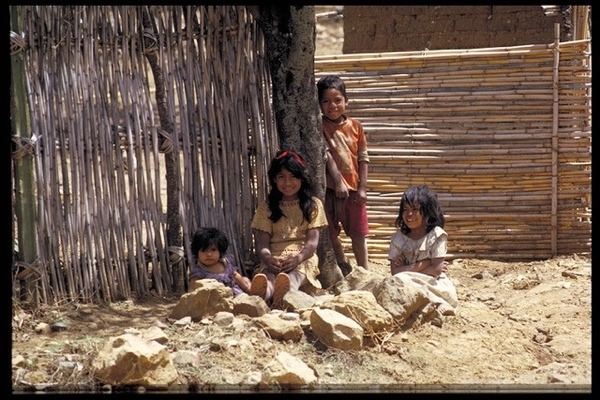
Mexican girls in 1975
Rode to frontier through a narrow mountain pass, very steep defile, impressive, and expressive of history. Know nothing of its history but can sense the drama of the pass.
Weather now beautiful.
Frontier crossing fairly straightforward but for the Mexican agricultural inspector who confiscated my onions and made me eat my orange (lousy!)
His assistant was burning a heap of vegetables with a flame thrower. I asked him if he knew how to cook. He let out a single burst if mirth, then closed up again. They also sprayed my bike, but not my boots though I offered them.
Had I known the geography I would have stayed near there but rode on into the mountains to find it getting very cold and wet. San Cristobal de las Casas, which would have been a natural place to stop, was wet and inhospitable.
I rode past, reluctantly, but soon was forced to stop by a terrible downpour.
Took shelter in a small café where some boys were waiting to play football. There were two jukeboxes and a travelling repair man with a wonderful switch to his hips. His type also drives buses. (I cannot think what I meant by that!).
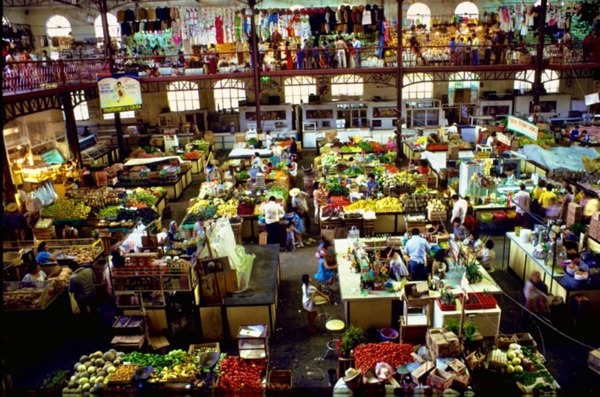
The market at Tuxtla Gutiérrez
At last rain stopped and I drove on to Tuxtla to find a hotel. Hotel Jardin, a rabbit warren round a courtyard in disrepair. 30 pesos.
Old German man in his wooden, screened reception box. Walked round town. Seemed quite prosperous. Ate surprisingly well at Los Arcos.. Best shrimp since Rio and good fish. But prices are beginning their inexorable climb up.
From Tuxtla there is still much mountainous country. I still have the option of turning off to Vera Cruz and consider doing so but it seems to me that if there is rain it will be heaviest on the Caribbean side.
The road fortunately circumnavigates most of the storms (what memories from Africa that revives).
And then, suddenly, I’m at the top of an escarpment looking down on perfectly flat land far below. I can see the road straight as an arrow pushing on to Tehuantepec.
Here it is very hot and sunny. I stop to drink and buy food in the market, determined to sleep out again. The Indians here (according to the South American Handbook)) are a matriarchal society and look it. In the market they are very shrewd and catch-peso. An egg here is 1.20 and over there 0.75.
On I go, running out of petrol and coasting to the petrol station. The tank only takes 12 litres.
A little way along, up the hill a path leads off among bushes to place for a tent. All is very peaceful and pleasant. The stars are out, but for some reason I am nervous about people. I hear a strange “Pssst” sound from my bed and struggle into trousers to see who’s lurking. The sound continues but moves too quickly to be of human origin. Must be an insect – the Psst bug. Back to bed, still unsure, and now buses and lorries are making a terrific din. Distant flashes of lightning and then, quite suddenly, enveloped by a powerful storm, wind threatens to blow the tent away and I cling to the tent poles for dear life as lightning crashes down round me. Then just as suddenly all is peace and quiet again. Fall asleep at last.
Next day is fine. It’s not far to Oaxaca and I arrive at lunchtime.
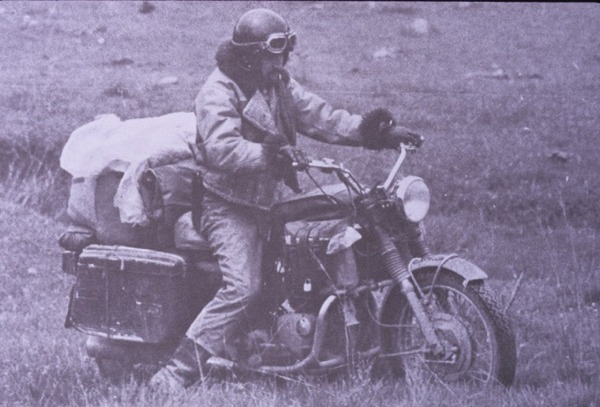
And I found the picture with the goggles, but I’m not wearing them, for good reason probably.
The last time I regaled you with extracts from my notebooks I had crossed Honduras to Copán, on the border with Guatemala on my way up through Central America to the USA. Sadly, I was beginning to long for those first world comforts.
And, so it goes on:
Left Copán at 9-ish. Emigration is in the town. Transit is at the border. The two older girls left at 5 for San Pedro Sula where they fly home. The younger ones were on a micro bus going to the border. Transit took another dollar off me. I pushed them into giving me a useless receipt. On the Guatemala side, the army was represented at a roadside desk by a small, fat man with a bristle (how commonly that’s so). He was in a class of his own though.
“How do you say in English” he said in English “when you have too much in the night?”
“Hangover” I said.
“Hamburger?” he said.
“No, hangover!” and I wrote it out for him.
I HAVE A HANGOVER
“I have a hamburger,” he read. He was entertaining us both.
When he asked for his dollar, and I asked for a receipt he laughed happily.
“Oh no,” he said, “this is for me so that tonight I can make another hamburger.”
For once I didn’t mind losing my dollar. That’s how I like my corruption – honest.
Then there was a police post. An even grosser man, but in uniform, was officiating. He wouldn’t let the girls in because they had no visa, and he couldn’t – or wouldn’t – issue tourist cards. They had to go back on a hundred-mile loop to arrive at the next frontier post at Santa Rosa de Copan – Agua Caliente. I felt for them but there was nothing to be done.
Riding in Guatemala I expected a bad road, but it was quite as good as the Honduras side, but for a couple of easy water splashes.
By now I was in a mood to shorten the journey. At the junction with the asphalt, I should have gone left to Esquipulas but the smooth road to Guatemala City beckoned and I succumbed. It was the beginning of a general crumbling away of intentions, All the planning I did at the Fowlers’ house came to nothing.
At the Capital I nearly came unstuck Took ages to find the Williams’ number (had it in my book all the time, on a card) and then found he was packing up house to move to Paraguay. Kept getting cut off on the phone. But he found a spot for me with Bob Webb of the consulate, and that turned out well.
A new cast of characters now.
Bob Webb, Pat and Greta McCormick, John Rutton (the CARE man) and his nice wife with beak nose, both of German origin. We shot an air rifle, played darts and badminton, went to dinner with an oil man and his family where we sang badly to three guitars and played ping pong. Webb has a maid, country girl with big round eyes, full of superstitions. On my last night there when we had been out and she had gone to spend her day off at Atitlan, Bob locked her out by accident. She had to go to her aunt’s house – a good way off and come back next morning. It upset her a lot, especially having to be out alone at night. I think she said earthquakes are made by the devil.
Visited the market. Very close packed – full of stuff. If only I could see it with fresh eyes. But the profusion of still-unknown vegetables and fruits, the endless variations on woven and embroidered material, left me dazed. If I had a kitchen, if I could ship a ton of stuff home – but this endless looking at things means nothing anymore.
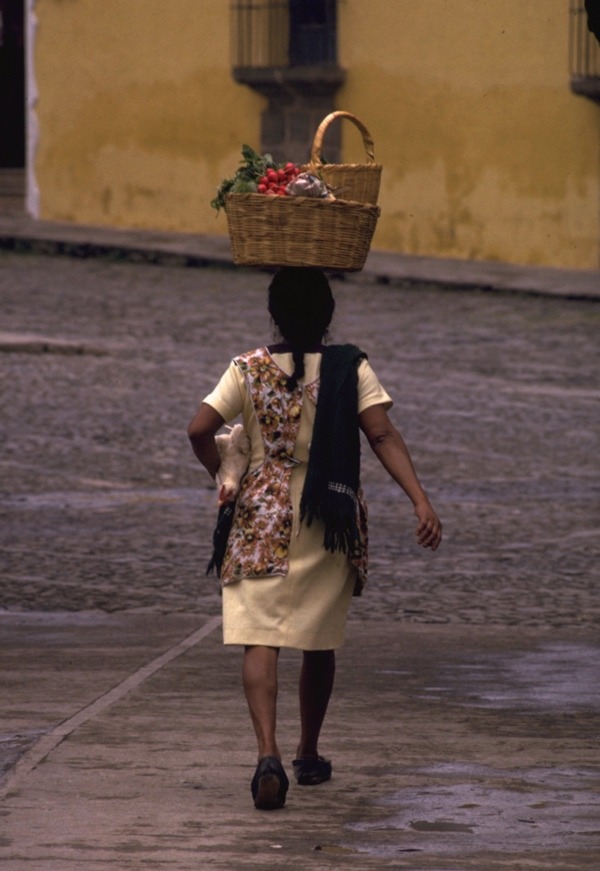
A shopper in Guatemala City
The church also had an imposing interior _ a long narrow aisle, thick square pillars on either side, with oil paintings on each one. The seventy-year-old relief map of Guatemala was a curiosity – fun to look at – and parties of schoolchildren were there to visit. A small group of amusements for children were installed, all made of old car parts, axles, gears, differentials, to turn the roundabouts. Very appealing, human, brightly painted – but all disconnected for some reason.
From Guatemala City I rode on to Lake Aititlan, which was a bowl of mist and rain. Stopped at a Mirador and filled the small hut with my things hung out to dry. Ate sandwiches. (My ”kitchen” is newly re-arranged with shiny new plastic from a very smart supermarket in the city.)
Four Americans stopped to talk. Couple worked for AID. Younger man gave address in Oakland (Berkeley). Suggested a ride from Nepal to Afghanistan. Went on into lakeside town, but all Gringos. Rain threatening. Saw concrete wall with “Las Buenas Nueves” – The Good News – painted on it. Warned there was much hepatitis about. Nothing to keep me there. Rode on towards frontier.
And here my journey very nearly ended, together with my life. I was wearing glass goggles with my open-face helmet. The fog on the lakeside road was almost impenetrable. I was attempting to clean one of the lenses with my fingers and failed to see a big truck charging down on me. We missed each other by inches and the blast of wind almost blew me away.
Somewhere on my computer is a picture of me wearing those goggles and I’ve spent a day looking for it, but no luck.
You’ll just have to imagine it.
Next week, Mexico.
Dear Friends,
It was heart-warming to read of all the kind people – from Orkney to Australia – who toasted my Jupiter anniversary. I myself celebrated by riding my MP3 down the coast towards Spain and, in true Jupiter fashion, got lost and found myself negotiating a goat track in that very rugged country we call garigue. I made up for that though with a wonderful meal at a restaurant that was new to me in a nearby village called Nefiés. The place is called Very’table and you should go there.
I have pictures from all over, but here are just a few. The first is from the Blue Lion in Gray’s Inn Road, where my journey began. You can see the old Sunday Times building through the window behind them.
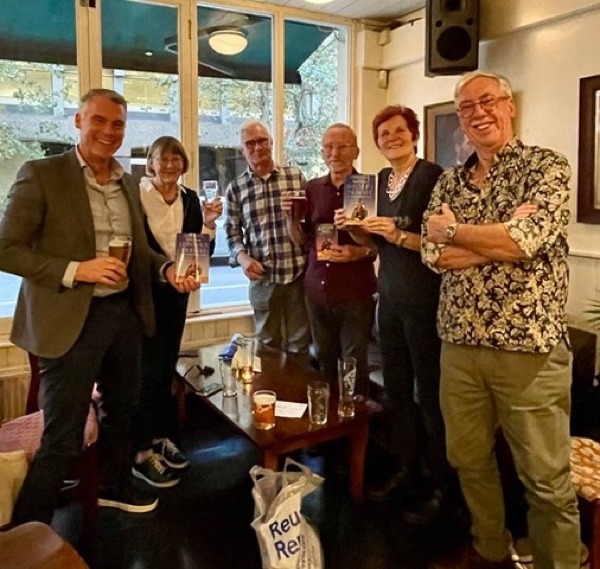
It was Michael Hetherington, on the left, who pulled them all together.
The second picture is from Germany where they did the thing in true Teutonic style.
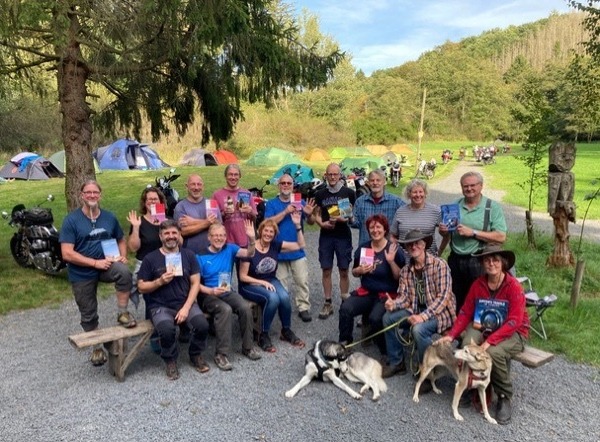
I know them all, but I can’t remember names, so I’d better not try.
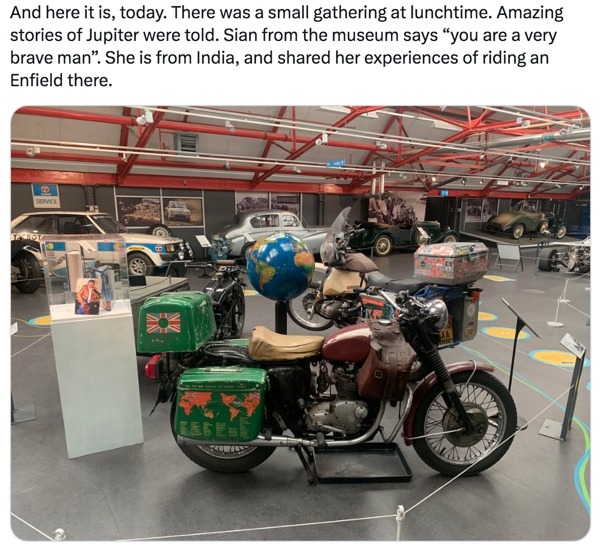
Then my academic friend, Robert O’Toole summoned a group to the Coventry museum, and sent me this:
And finally, transplanted from Meriden to Hinckley, from the Triumph factory canteen and organised by Faye Howe, comes a still life entitled, The Coffee Drinkers.
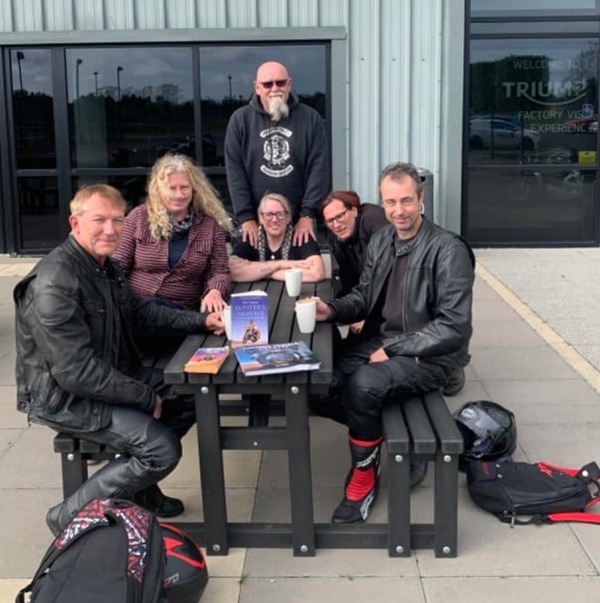
My gratitude and condolences to all the solitary celebrants who hoisted a glass with only my book to accompany them.
Anyway, it was truly wonderful to be remembered by so many people in so many places. Now we can all get on with the more important business of saving the planet.
Hasta Luego. Auf Wiedersehen. Arrivederci, Au Revoir, See Ya’
Cheers,
Ted
We’re ten days away from the fiftieth anniversary of that day.
There was no one on earth I would have changed places with. Or so I thought – until that black night on the pavement of Grays Inn Road, when I stood dripping rainwater, sweat and despair, crushed by the unwieldiness of the monster I had created, and the enormity of the prospect I had invented for myself.
Only three yards away, behind the thick glass doors of the Sunday Times lobby, was the bright and comfortable world that suited most people well enough. I could see the commissionaire, smoothly uniformed behind his desk, looking forward to a pint of beer and an evening with the telly. People in sensible light-weight suits, with interesting jobs and homes to go to, flaunted their security at me and I felt my gut scream at me to strip off this ridiculous outfit and rush back into that light and the familiar interdependence. It struck me very forcefully that if I went on with this folly I would forever after be the man outside in the gutter looking in. For a moment I was lost beyond hope, utterly defeated.
Then I turned away from all that, somehow fumbled my packages away, got on the bike and set off in the general direction of the English Channel. Within minutes the great void inside me was filled by a rush of exaltation, and in my solitary madness I started to sing.
What should we do about it, if anything? I know I’m going to drink something very special. How about you?
UPDATE
Joe Kearns in Dublin suggested people get together to mark the day at various locations around the world.
You can see the list of venues on this page.
It has been so hard to let go. I’ve been promising to do it for a year at least, but even at the last minute, with the money already in the bank, I couldn’t quite reconcile myself to losing the bike.
Drew and Ruth were there with the van, all ready to load but I had to take it off for one last spin around the block and I felt so good on it, no different to the way I’d felt riding to Greece or to Ukraine a decade or more ago.
It had been my European ride ever since Dirk Erker bought it on my behalf, in 1997. Dirk was a master mechanic and a great traveller himself, who rode a lot in Africa. He kept it in his workshop in Duisburg for me and he was the nominal owner for 12 years until he moved to Dusseldorf. By then the bike had a few problems, and it languished at the back of the shop for a while, until some German fans thought it would be fun to resurrect it if I would pay for the parts. Of course I said yes, and in 2017 I rode it, triumphantly, from Bavaria to France. But then my troubles with the French bureaucracy began. They changed the rules, and it was three years before the bike became legal.
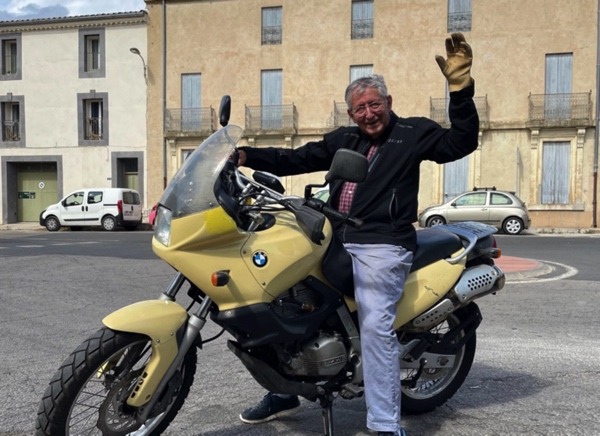
Anyway, now the deed is done, and I know it was right thing for me to do.
So, with the help of two handy villagers, we shoved it up the ramp and, after a tearful farewell, it started its journey to a new life in Ireland.
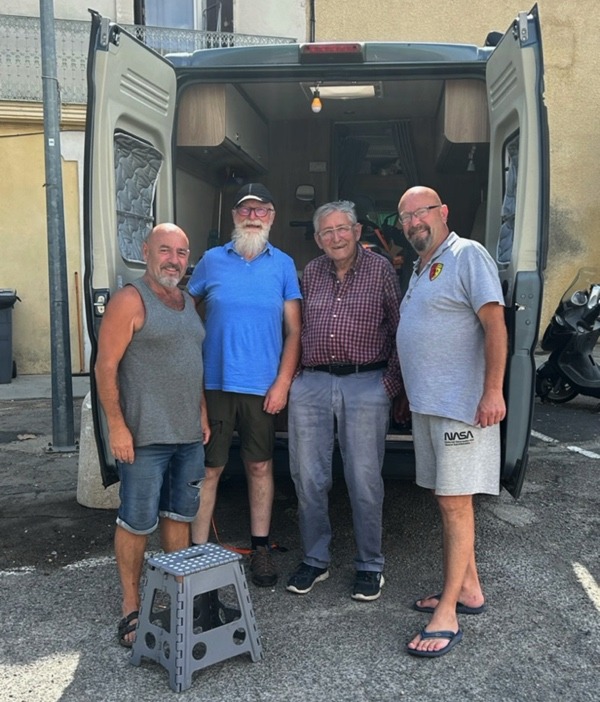
Drew Millar, the happy new owner, is the bearded one. Jean-Marc (left) and his friend are on the outside, and the old guy in the middle – that’s me.
I still have the MP3 of course, and it’s big enough to take me anywhere I want to go. I’ll probably ride down the coast towards Spain someday soon and get a last look at the beach in the tail end of summer. Then I’ll get back to my notebooks, and bring you more memories from 47 years ago, probably from Singapore. I hope you’ll tune in.
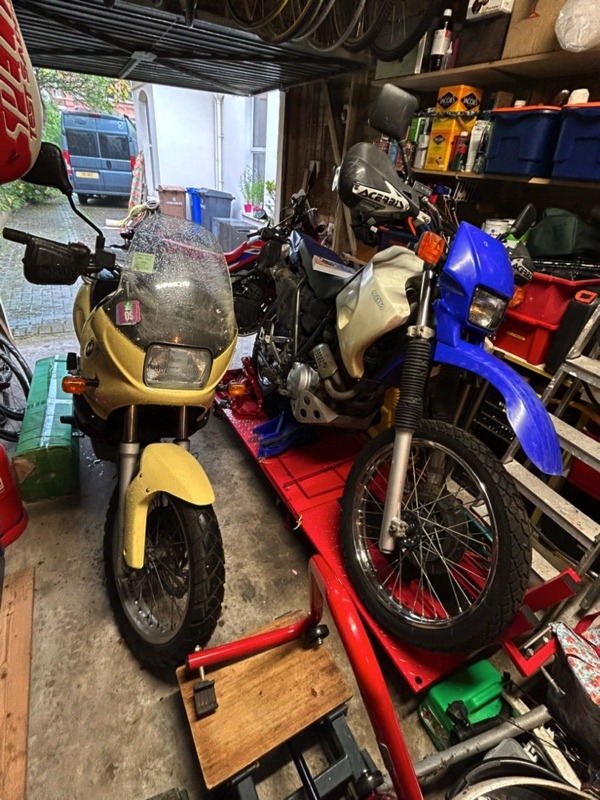
And a new life begins, in Belfast
Next Thursday I will fly to London (Easyjet permitting) to attend Paddy Tyson’s Overland Event, where I’ve been a fixture for many years. Of all the bikers’ meetings it has always seemed to me the friendliest and most relaxed, for many reasons – the wonderful site, the limited scale, Paddy’s obvious passion. There’s only one other I’m as fond of, and that’s the German one at Gieboldehousen – try saying that after a couple of pints – which is held, unfortunately, on the same dates.
But time, my time at any rate, marches on and I suspect that this year will probably be my last visit to Hill End, so if you were thinking of going, please come so that I can get a last look at you.
Like several million others I’ve been struggling through a heat wave for the last couple of weeks, and it sucked the life out of me. I find it difficult to keep up an optimistic view of life unless I’m able to do something even moderately physical, like fixing shelves or digging in a garden, and the heat just turned me into a flaccid and aimless heap.
As it happens I was also trying, at the same time, to make something of the notes I kept when I was riding through India. Of the four books of notes I kept, the notes on India were by far the most comprehensive, and I wrote in tiny script that is quite hard to read now.
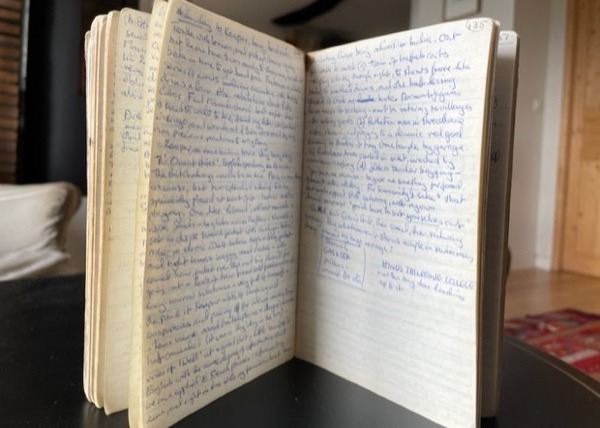
It was very hot in India a lot of the time but I had no problem with the heat. The biggest difference, of course, was me then, weighing 130 pounds and me now at 180. But it’s not just the extra weight I’m lugging around – my entire system was adjusted to the conditions. How far humans can adjust to heat is obviously now the subject of countless studies, because the heat is coming. Probably, as with an epidemic, the heat will first pick off people with other problems, and overweight would be one of them, but I’ll probably get to my natural end before that becomes my achilles’ heel.
Those notes from India are a treasure house. I look forward to many hours this Autumn and winter disentangling them, and if you’re interested, you will benefit from my efforts right here. Let’s stay in touch.
This flurry of flights all over the place is nearly over. The last one, to California, starts on Monday, with a train to Paris, a hotel stay because I can hardly ever find a train to meet a plane, then an eleven hour flight to San Francisco.
When I say it’s all too much, people mock me. “Oh you poor thing, having to go to California.”
Well, of course California is fun, although it’s not the Hollywood and beaches bit that everybody seems to have in mind. It’s a remote valley further north where most people imagine Canada to begin, because very few realise just how far north California extends. Anyway all of that’s fine. It’s the airport stuff I’m fed up with.
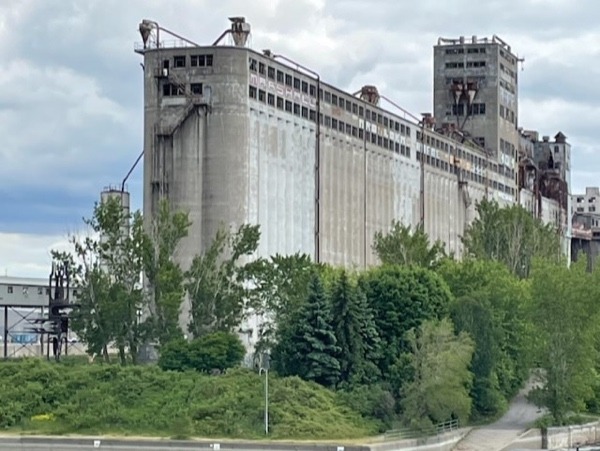
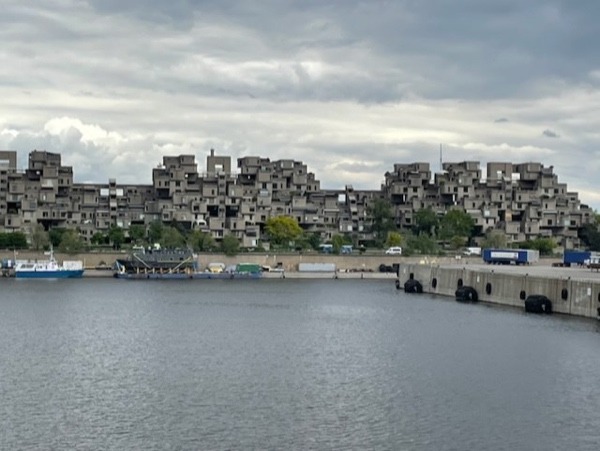
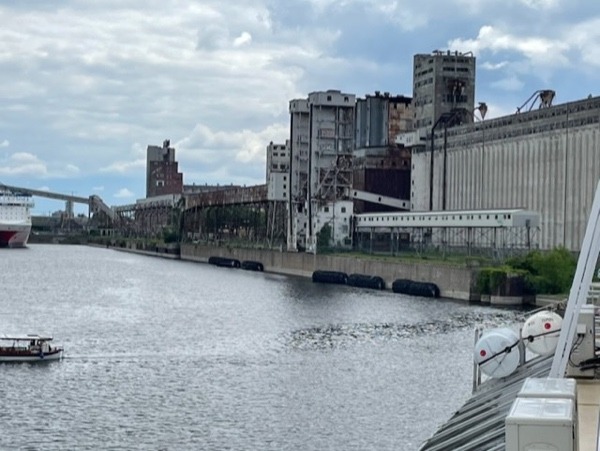
The first trip to Quebec, at the beginning of June, was really enjoyable. I went to an opera and ate some lobster, But more to the point, it included two cruises on the St Lawrence river, and it opened my eyes to the huge and fascinating port activities at Montreal – 16 miles of cranes and silos and godowns all along the river banks. So much of the old nineteenth century ironwork is still intact and those silos are immense even though most of them, I’m told, are obsolete They stored the grain that probably put my grandfather out of business when he was trading wheat out of Romania a hundred years ago.
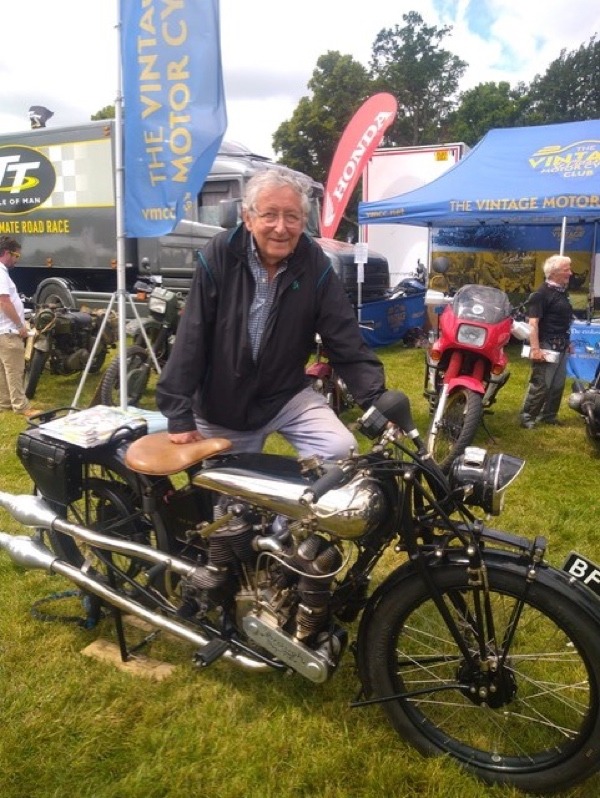
The second brief trip was to England for a bikers’ meeting, the Adventure Bike Rally at Ragley Hall. I talked and sold books, and found myself sitting opposite a Vintage Bike Stand, so I got myself a picture with a Brough.
My own vintage bike, the one in the museum in Coventry never made it to the rally. I was hoping to find that frying pan in the pannier and maybe fry an egg or two. But that story (check out last week’s blog) has a weird twist to its tail. The frying pan that Bob Newcomb’s dad said he lifted from my bike wasn’t my frying pan at all. I remember mine very well, it had a handle you could fold into the pan. I wonder if I’ll ever hear the rest of that story.
I’ll be gone for three more weeks, but don’t let that stop you from ordering books. if you can just wait a little I’ll get to them as soon as I’m back. So, if you possibly can given the horrible things that are happening in this world, enjoy your summer.
I spent the last week in the province of Quebec, seeing the sights and drowning in music. Bikers can be other things too, writers, musicians, plumbers, blood donors and blood couriers, cops and robbers. Because I was there to listen to the first ever production of an opera written almost 200 years ago, I met several musicians and conductors. Of course none of them had ever heard of me and none of them rode bikes. I would have liked to be introduced as a writer, but what fascinated them, what they really wanted to know about, was my journey round the world. I had to work hard to get my books into the conversation. One of them, Louis Lavigueur, dashed from the dining table to bring back a newly minted copy of “Zen and the art…” which he was planning to give to a relation who did ride bikes. At last I had an opportunity to explain that I, also, had written a book. I told him that it was probably Pirsig’s book that gave me an extra boost because it was published just a year before “Jupiter’s Travels” and so far as I know it was the first book involving motorcycles that achieved critical acclaim among reviewers of literature. Up until that moment, it seems to me, anything to do with bikes left an oily smudge on the desks of book critics.
I had to admit to Louis that I had never properly finished reading Pirsig, though I had started several times. My problem was not with the writing, but with the idea of Quality being substantive rather than descriptive. Jim Martin, who does the Adventure Rider Radio Podcast, wanted to do an episode about it, but it involved my having to read it again, properly, and up to now I haven’t had time. Or maybe I did have time but was somehow reluctant. Actually though, later in the year I might feel more like it (Jim, are you listening?)
This year is a big turning point for me. At 92 I think it’s time to say goodbye to my bike, and I’m finally selling my place in California, which is going to occupy me for most of July. There are only 3 acres left of the 40 I once had but it has three houses on it, two of which I built myself, and a huge amount of stuff which will have to go because I have no room for any of it.
I will have to fly there at the beginning of the month. I’ve only just flown back from Canada. On Thursday I have to fly to England, for the Adventure Bike Rider Festival at Ragley Hall. Too much flying ain’t good for ya. I’m beginning to feel it. But I went to the rally last year, they made it very comfortable for me. And I get to sell books and meet the people who read them.
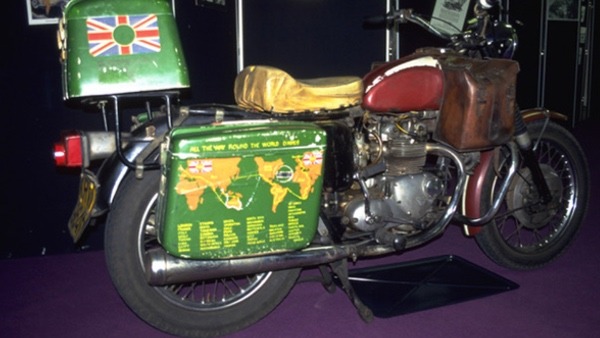
My good old XRW964M will be there, and in one of the panniers I expect to find a frying pan. Not long ago I got a message from a man whose father had just died. Apparently among the things he left was this frying pan which, he said, he had stolen from the pannier of my bike when visiting the museum in Coventry where she normally sits. The son has, he says, recently returned this frying pan. We shall see when I open the pannier.
Maybe, when enough people have crowded around next weekend, we can have a Grand Unveiling. But I don’t think they’ll let me fry an egg. Will they?
PS: The man who’s dad lifted the frying pan has just sent me a message. He’s not a biker, but he says he hopes to be there at Ragley Hall to meet me. If he does come we really must fry an egg.
Still in Managua
I spent two more days with the Fowlers. On the second day the husband, Peter, returned and they organised a party including assorted foreigners, mostly conventional businessmen and wives. One very impressive Nicaraguan woman, a broker, made fun of the others for being dependent on their bosses, provoking some uneasy laughter. I wondered how they all felt knowing that they depended for their livelihoods on a murderous dictator, Somoza, who was supported, in part, by US interests. It was President Jimmy Carter who eventually helped to bring him down four years later. And President Ronald Reagan who would have been happy to reinstate him.
May 18, Sunday
Left Managua for Tegucigalpa [Honduras]. On the way tried to find the centre of Managua. Failed. [The city was all but destroyed by an earthquake in 1972]
Saw crater lake – not too impressed. On to Léon by south road but missed most of Léon. Too much hurry. Very hot. Border at 12.00. Easy but expensive. $3.50 in all. Had too little petrol to reach Choluteco. Bought gallon from café. Met two plain clothes police. Pleasant and helpful to me.
Much trouble in Tegucigalpa, first to find telephone, then to find that Roy Smith [friend of friend] was away. Then to find that cheap hotels either didn’t exist (Hotel Eden) – had been pulled down (Hotel Americano) ¬– or had no water (Hotel Astoria). Finally in despair called Smith’s parents again and was invited to stay. Impressive house in Avenida La Paz, 4 cars in garage. BMW, Mercedes, Lincoln Continental and Oldsmobile. Smith sr. a sluggish fellow of about 50, wife nervously Latin, anxious to please.
I’ve been getting quite well-defined impressions of society in Nicaragua and Honduras, apparently based on the scantiest of evidence. Am I inventing it to satisfy myself? Obviously, a lot of information enters my mind subliminally – expressions caught on faces as I pass by, mannerisms, driving habits, the style of advertising, the style of officials at borders. Then I might meet one or two people or observe a more prolonged incident such as the one at the border. My experiences are checked against those of others I meet. But all is subjective, relative to my own likes and needs. Aesthetically the Nica male is displeasing to me; short, stocky, gross features, quick to put on fat, I think of him as arrogant, boorish, corrupt, brutal. But what does he think of me? Arrogant, feeble, effete, inhibited, pretentious?
Honduras! Ad for cigarette shows male smoking on beach with two ladies courting him. They don’t smoke but assist in the ritual. Makes me wonder whether firms, like Kodak, who have been advertising a long time, use their Thirties American ads for Central America today? Looks like it.
Here’s a combined ad for a beach resort and Kodak.
“A perfect occasion to employ a Kodak camera and film.”
Nica Honduras border: Everybody wants a dollar. On Nica side Customs and Immigration each take 5 Cordobas (7 to the dollar). Hondurans have three departments – Immigration, Transit, Customs. They take 1 Limpeira, 1 Limp, and 2 Limps respectively (2 to the dollar). The transit man does nothing at all but write out a receipt. The others don’t give receipts.
May 19th
Straight to Copán [A famous archeological site of Mayan culture.] Easy ride until La Entrada, then 60 km of dirt (not bad) and a puncture. Big bent nail, sharp at both ends. One and a half hours for whole job of changing tube. Audience inhibits my swearing which may be just as well. Arrive Copán after dark, but bike goes well over loose stuff. Hotel Marino annex. $1.50. Met four US girls in pairs, Tammy and Mary are Peace Corps social workers going home from Colombia. Tina and Judy are older, more interesting. Tina gave up art to wait at tables and travel. Judy (ex-married to Honduran in San Pedro) is buying [ethnic stuff] seriously, to sell in US.
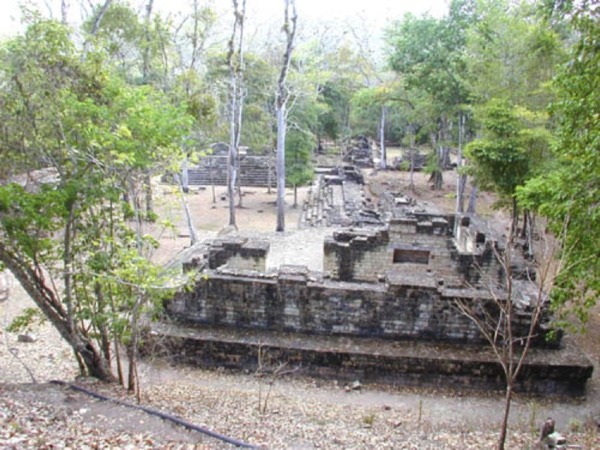
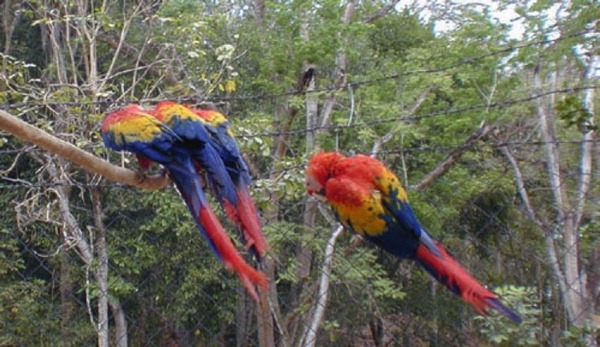
The ruins are undeniably beautiful in their setting. Bird song is wonderfully varied, and I wish I could record it. Took many pictures – but now I’m very convinced the light meter is inaccurate – doesn’t correspond to the readings I took earlier on trip. Bar and drinks seem very expensive. Town is without water. But they’ve tried to make it pretty.
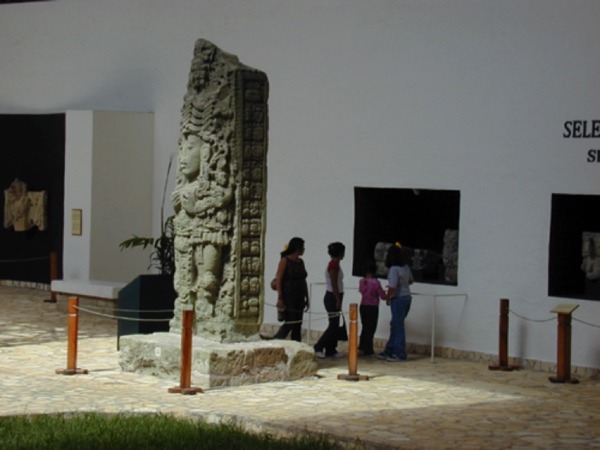
There’s a small museum with some stone figures (the frog and the turkey). Skulls with teeth inset with bits of jade, and obsidian tools. A very expansive old gent rambles on about it all.
Of the girls Tammy is the most eager, but Tina the most interesting. Her very determined way of life seems laudable, if painful, and I gave her my home address in case she comes to Europe. She in turn gave me an address in California of two boys who run an “Earth Shoe” branch and have made a fortune.
Every meeting now emphasises my loneliness. I sat in the plaza alone that night and as I do more often now feel hungry for companionship and/or love. How much of it is unrequited lust I don’t know – but I suspect a one-night stand would do little to help.
A man walks towards me across the square. His silhouette is a perfect Gary Cooper cowboy – slim, bow-legged, cowboy hat. As he emerges into the light he is young, vacant-faced and unworthy of the image. Ridiculous image.
The fellow who came to the ruins with the girls and showed them around was pleasant, intelligent. Wore rather fancy clothes – trousers with a sort of lamé net sewn over the blue material. Had many teeth missing. I traipsed around with them. He showed us bits of obsidian, slivers used for cutting. Also that strange plant, sensitive mimosa, which curls up when you touch it. I thought he was going to want money – but he just went off to lunch and left us.
Tomorrow Guatemala.
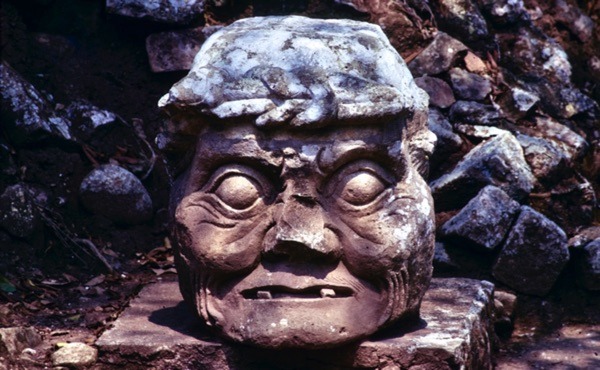
I liked this old man of Copán. When I went back 25 years later he was still there, an old friend, but with a roof over his head.
