News from Ted
I arrive in Bodhgaya looking for somewhere to rest and write.
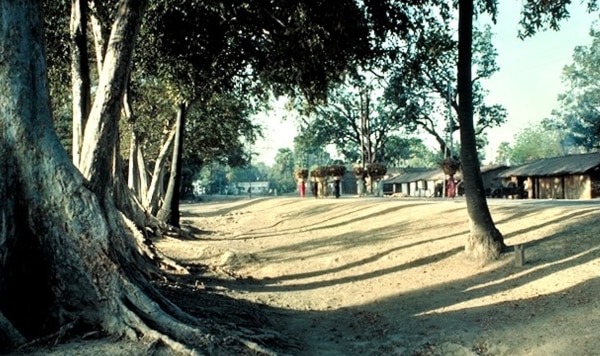
Bodhgaya, Monday February 21st
Tent in grounds of Tourist Bungalow. Not a very peaceful place. Meet Jacques Martin and his girlfriend/wife. They tell me the Burmese Vihar might be better. After two nights I move across, so –
Wednesday 23rd to Wednesday March 9th at Burmese Vihar
[All the most important Buddhist national communities had built temples at Bodhgaya, where the Buddha was said to have attained enlightenment. Associated with the temples were places, called vihars, where pilgrims could rest. Some were more rigorous than others. The Burmese vihar was the most relaxed. It consisted, so far as I remember now, a two-storey building and a large yard, with vegetable gardens. Down one side of the yard were a number of small huts, each with just a bunk and a bench, and I too up residence on one of them. I quickly made the acquaintance of a Burmese monk, Amnuay Bahaddesiri, who held classes in Vipassana meditation, and also led morning sessions of yoga exercises on the roof. I signed up for both while I wrote my piece.]
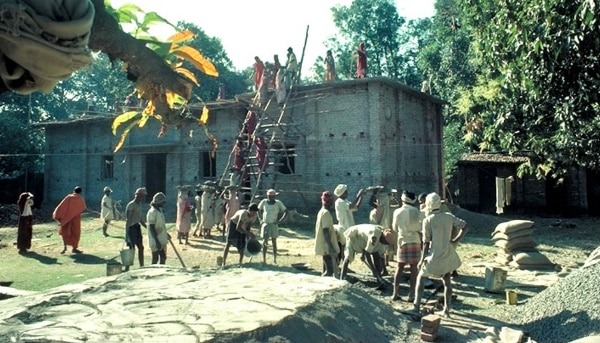
[While I was there they were erecting a new building. As usual the women were doing the heavy lifting, carrying baskets of wet cement up to the roof. I finished my piece – which never saw the light of day – and I heard that Alikhan, one of India’s most famous musicians, was giving a concert in Delhi. I had met him in Assam, and we became friends.]
Buy train ticket for Delhi.
A rickshaw to Gaya, bumping quietly through the night. Conscious of the river of sand beyond the trees and palms on the right. Occasional ghostly ox wagons and pony cabs in moonless dark leave shouts and chatter. Little snatches of sound. I’ve done so little moving at night, and none in silence. It’s not even 9 pm. The train leaves in seven hours. How to pass the time. Have the perverse idea of getting drunk. At Anand’s restaurant ask for a beer. The proprietor himself comes to move me onto a patch of grass, separate from the rest, in gloom, where I swallow two bottles of beer and dream quietly on my own. Have two good ideas. One is to identify societies by the drugs they use. (i.e. the kind of relief needed). The other, better idea I have since forgotten.
Before leaving P.K. Anand [the owner] takes me into his office, which is one of a row of lock-up shops that were once his family’s stables. They were great landlords, he says. He tells me stories about vasectomies – how he once needed labourers and sent someone in a rickshaw to offer 5 rupees to anyone who would come. He got no takers. They thought it was a ruse to get them operated. And the ticketless traveller of 15, caught by police, and taken straight to the operation room. Says family planning is resented as interference with the laws of Karma. A man’s ability to reproduce is determined by his previous life. Virtue is measured by the fruit of his loins.
The long wait on the platform is tedious. Already I’m regretting this impulse. Journey drags on endlessly.
The long, dreary wait on Gaya station after too much beer. Railway employees and passengers alike stretched out on platform. Man in dhoti, shirt, and shabby worsted jacket, rises up and with his lamp disappears along platform into darkness . . . .
Glimpses of mother on opposite bunk caring for her child.
Chai wallahs with earthenware cups. Burned my mouth on coffee at Allahabad. Had a guava at another station, not knowing what it was.
At Delhi station slightly desperate mood, try to phone Alikhan and lose rupees in telephones. All around others are also losing their money. In kiosk the telephone employee is allowed to continue unperturbed – changing notes for people to lose more money.
With sense of rushing into folly, take rickshaw to Alikhan’s address. After much looking, find it, but he is not there, only a student. He sends me on to new house, but I telephone first and, thank heavens, he knows who I am. I’m kindly received and then comes the numbing news that the concert has been cancelled. (And looking back I see that the whole enterprise was dodgy from the start, fraught with compromised motives, last minute reluctance, overcome.) Now I’ve a real struggle for equanimity.
Friday March 11th
Woken by student plucking at sarod, playing scales. Bus to Lucas. Lots of interesting mail. From mother, PH, Pat K, Barbara, Doug and Ash. Lifts my spirits. Set off on my chores which scarcely fill the void I’m in. Peter Kline has left. Ottolenghi retreats as I approach. Call to London is usual farcical failure. Passport office is closed. Follows desperate beer with Madan (Asst. Mgr) who assaults me with talk of serial depravity by English Hippy girls and his friends. He is depressed, but a more general obsession shows through. Undoubtedly, I am not exposing myself generally to the dirtier side of the world’s business and must bear this in mind in case I am misled into making “objective analyses.”
Attempts to get back to the Defence Colony are frantic as each bus leads me further into the unknown. There are election meetings booming out everywhere – huge voices. When you can’t understand what they say it’s obvious that the meaning is irrelevant to the main purpose (?) Remember the speech at La Plata.
March 12th
Breakfast at ‘smart’ restaurant. Waiter leaves door open for light, but others always close it. Music starts, a swinging Hindi number and I object. The owners turn to me with severe regret.
“Prayers,” they say. I’m mortified. Then waiter switches on the A/C directly behind my head.
Thick atmospheres, and rarified.
What does it mean to speak of materialistic societies? Aren’t Indians even more obsessed by money and possessions than we are? But the values are different. We actually want these things for their own sake. But it is noticeable that well-to-do Indians are quite comfortable in shabby, primitive surroundings (e.g. Patna party, religious observances). Other things are at stake. Security. Status. Responsibilities discharged. When an Indian businessman robs his clients it is on behalf of his clan, not himself.
What is there to write about Delhi? Tales of frustration and small blessings on buses and in shops. The saving of it, of course, are the minutes spent listening to Alikhan practicing and his student on sitar afterwards. (And the shy-looking lad on table-tabla who nevertheless managed so much equanimity with his slight inward smiles. The enigma of the Mona Lisa is, of course, that we want her to smile at us, but it is purely inward.)
The passport office was closed on Friday afternoon (otherwise I might have gone straight back to Gaya). On Monday it was like a maze with lines of people queuing, but the counter I wanted was like a trough in a piggery. I always wonder how I can ever expect to reach the clerk, but it happens. George’s story of the Pakistani train ticket office sounds as bad as any three layers of frontiersmen with guns and big muscles sprawling over each other. I suppose I’ve always assumed that one day I would be confronted by just such an impossible situation, and the truth is that I’ve probably been through several already, but having to deal with them practically one can’t afford the dramatic view but must focus on the spaces between the bodies. There seems to be always a way through.
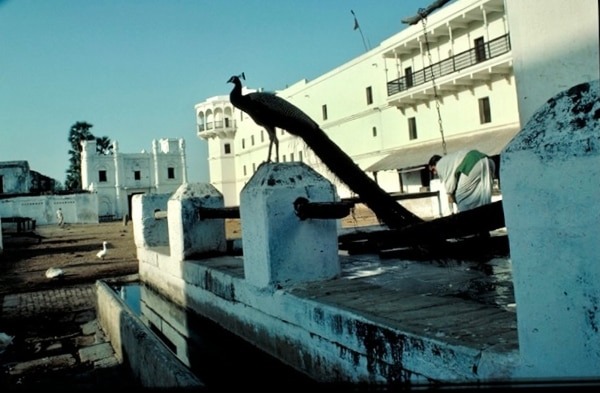
Bodhgaya also had a Maharaja, with his own palace and peacock
Next week: by train to Varanasi – also known as Benares.
From Patna I’m on my way to the religious heart of India but suffer a most felicitous interruption – dancing girls included.
Sunday 20th February
After a haircut (very short) and breakfast with Jha I leave for Bodhgaya anxious to settle down to my piece [I was planning an article on the election for the Sunday Times] and unsure whether this will be the place, though Carol recommended it so highly. It’s a long ride – the short cut I had hoped to find eludes me – and very little English is spoken here. I’m reluctant to stop and ask because of the great crowds that will gather. This is something of a dilemma. People will help, I’m sure of that, but there is no measured response – this one gets in colder climates – and the surfeit cannot be managed. I don’t want to be riding today. It’s too hot. I’ve got too much stuff, and the road is squalid and uncomfortable. I can detach myself from this discomfort and be content – but sweating in a crowd would push me either to anger or to a self-mocking surrender. I should have enough petrol for 100 miles. Gaya is 72 miles, but 15 miles before getting there the main tank runs dry and 5 miles later, the reserve also. I can’t understand why the reserve is so unreliable. Does it splash over? Anyway, there I am.
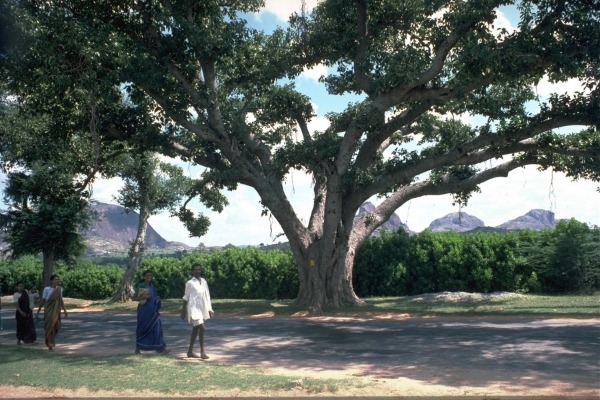
The passing scene as I sat beneath a tree and waited for help to appear.
A couple of villagers come to talk – a Brahmin who looks sly but a bit bright, tells me how poor he is. The other fellow has just come from the village on his bicycle. The Brahmin interrogates him and then sends him back to the village. [To get petrol for me.] The other fellow accepts his instructions willingly. I would give him money, and struggle to empty the oil from my jerry can, but the Brahmin says No, pay later. I sit under a tree and read. Heller. [I was reading ‘Catch 22’]
Nothing happens. Eventually I try to flag down a car. The driver waves me away impatiently. A truck coming the other way pushes him off the road, gives me a thumbs up sign. The camaraderie of the road. Then two chaps on a Bullet stop. The pillion rider wants to help, but they haven’t enough petrol. So we stop a car. And they pump petrol from it to give me a litre. He is the vice-Chancellor, retired, of Madagh University and asks me to drop in at Gaya. The Bullet rider says I must appear at the wedding he’s going to. I can’t refuse, though it means I won’t see Bodhgaya before dark.
He’s a small, solemn, bearded fellow – a Rajput (i.e. Kshatrya). Wedding is off the road, by a village. The groom’s party is under a big tent with multi-coloured ceiling, cushions and floor-coverings and a throne for the groom who is covered with head gear. The father and grandfather, and the pandit wear brilliant yellow turbans. There are weapons also on show, traditional for the warrior cast.
Two dancing girls take turns with a group on tabla, sarod (with bow) and harmonium. She moves languidly from foot to foot (ankle bells) and then shuffles out about six steps in a very stylised way that’s supposed to be very erotic. The facial expressions are most interesting to me – a sort of smugness, indifference of a deliberately false kind (almost contempt).
Sometimes she picks out someone who might pay her money, and squats in front of him, singing some verses at him directly, and accepting a variety of humiliations and jests until he pays up (10 rupees seems usual).
Meanwhile, over at the bride’s house, a similar ceremony is going on. The house is drenched in coloured lights. Next morning groom and bride together endure a series of symbolic acts – he is covered with things dangling from a paper hat, with spangles and mirrors sprouting from it, in heavy clothes, almost invisible, and has to spoon milk with a leaf from one pot into another one and then on to some smouldering cow dung, sometimes with a silk sheet held across his face, while the Pandit jabbers away harshly from some tattered papers, losing his place, coughing, stopping for consultations. Then, in the middle of it, the group and the dancing girls crowd in, and she sings over the top of it all, while the observers chat. And I imagine being the groom and I think I would go quite crazy.
Later before leaving the father reads my hand, as promised. He holds it in a handshake, then pushes back my thumb. “Acha,” he says. “You have a very determined soul. This is reflected also in your mind, etc.” What he tells me is the flattering side of my personality, and true enough. I’m quite impressed. My planet is Jupiter. For seven years under bad influence of Mars, which will continue for two years. After that Success!!! I have a weak hold on the affections of women, and owe everything to my mother. There will be two accidents, not major but not minor either, in these two years. (I wonder if I’ve already had one of them).
Overnight the son and I slept side by side under the tent. People were very concerned about the security of my things. Already two bags and four pairs of shoes have been stolen.
This has been an eventful week. A French journalist, Patrice Roux, brought me to a small town near Paris to meet Anne-France Dautheville who is known, in France, as the first woman to ride a bike across the world. We had never met. What made it most interesting to me was that she travelled at the same time I did. We had a very lively conversation, helped by the fact that she is a lot younger than I am, and her English is better than my French. It was recorded by Patrice who had a film crew with him. He says he was very pleased, and I enjoyed it so much that I typically forgot to take any pictures myself. Take it from me, she’s an attractive, strong-minded woman who has fought and won many battles in life.
I hope that the video gets out, because the other happy thing that happened was a delivery of books, and I finally have copies to sell of Jupiter’s Travels in French. Not only that, but my Italian publishers tell me they are reprinting. So, it’s been a good week for Jupiter.
See you next week.

Just a reminder of the route
Still Saturday 19th, February
[Following an afternoon spent gliding above Patna among birds of prey, I’m invited by my pilot, Jha Prakash, to join a different class of predator.]
In the evening, Jha absorbs me into a party at his brother-in-law’s room at the DAK bungalow. A mild US couple also arrived previous night, and they too have been invited. I assume that virtually anything foreign, that isn’t positively disgusting, confers prestige on a social gathering.
[In the course of the evening I gradually became aware that I was in the presence of the most powerful politicians in the state of Bihar which, at the time, had a population of 100 million or more. Indira Ghandi’s Congress party was in power but was expected to lose in the upcoming election.]
The room is as shabby as usual – flaking pale blue plaster, il-assorted and ill-upholstered settee and armchairs. Ordinary beds. Here are first the MP for Bihar, then the Chairman of the Bihar Congress Party and member of the State Legislature whom I’ll call (X); then a man who has just been made Chairman of the Bihar Homeopathic Board (C); two police chiefs, the “SP” of Patna, and one with an equal but mysterious rank from Delhi. The host is leader of the Bihar Section of Congress Youth (Y) a self-made man credited by Jha with giving away most of what he earned as a contractor. Then there was an ASP, a PR man for Congress, and a newspaper management executive. The politicians were in ethnic dress (C and Y in dhoti).
C and the MP arrived by car in reverse order of importance, each one being greeted effusively and acclaimed as “our great leader.” The policemen simply materialised and then faded away in the same manner.
X was the dominant presence. A crafty grin played on his wide mouth. His eyes glittered shrewdly through slits beneath a broad overhanging brow. He exuded confidence and control even when drunk, sent his power vibrations out in a steady field to every corner of the room. Y’s approach was more mercurial and intense. Between duties as host he would spring suddenly into the foreground of the party, perching with great agility on the end of the bed in lotus position, and deliver a fierce oration as though addressing not a handful of people but a crowd of lakhs [Lakh = 100,000]. His sunken eyes blazed in these short bursts of fervour.
The MP likewise conformed perfectly to his role. He was a bit above it all, the raw politics, the grass roots. He was the Delhi statesman, able to view events with the detachment proper to a cultivated man. He essayed a short speech, in English, pretending to be an army general making a public announcement several weeks following the defeat of Mrs Ghandi at the polls. “ . . . . and so, in view of the chaos and dissension which have swept the country, since abandoning the orderly progress maintained under Mrs Ghandi’s government, we have no alternative but to suspend the constitution and declare martial law . . . .”
The assembled party burst into cries of “Never. It will never happen here. Mrs Ghandi will win, hands down, sweep the country, etc.” The general embarrassment was obvious. It was not a very witty speech and failed as satire. At this point there were several whispered conversations between police and politicians, and the party moved from politics to music. It seems the police were afraid the two US hitchhikers might be from the CIA (an idea which, to me, seemed laughable).
C, who was the object of the party, had been sitting alone in an armchair, taking no part and looking like a bundle of clothes waiting for the laundry. Now he was urged to sing. I was told he was a poet. A beatific expression flooded his features, and he came to life. To my surprise he sang beautifully and the words, though I couldn’t understand them, were offered with clarity, emphasis and meaning. I was convinced they were of real quality. It was impressive that this collection of political animals could respond so sincerely to his songs.
Later, X became completely maudlin. He grabbed me and pressed invitations on me to visit his residence, and the PRO and ASP literally dragged him away from me. Before the party ended I talked briefly to the Superintendent of Police, and gave my view that in comparison with the true dictatorships of Latin America, India was the freest of countries, and that I was pleased to be able to say so. I expected him to be pleased to hear this. Instead, he said, very seriously, “That is the trouble. There is too much freedom. We must have more control. We can achieve nothing like this.”
Perhaps his appearance, which reminded me of a Brazilian apparatchik, made his opinion seem more sinister. And I began to speculate on the existence of a stratum of opinion in the Indian bureaucracy which would like to see “a firm hand” on the people.
[If only I could have had my iPhone: there would have been some wonderful pictures – or on the other hand I might have landed in jail.]
Next week: Onward and inward.
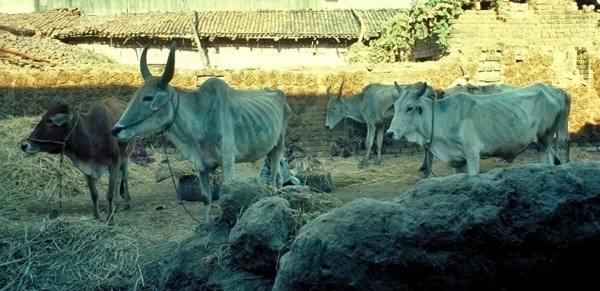
The ubiquitous holy cows of India didn’t look too happy with their diet of street food.
I took Carol to the Bangladeshi border as we’d agreed and returned to Gauhati thinking I would need to renew my permit before leaving Assam. I called on Dr. Das, the academic, who invited me to dinner.
Tuesday, February 15th
Dinner with Das. Wife rather self-conscious about food and I’m sure she’s made it blander than usual. But it’s nice and we have a pleasant time. All the same I feel that we never really get to the point. It’s all rather trivial. Comparisons of customs. He attacks reservation of jobs for scheduled castes.
Dr Das mentions village at the foot of forested slope. The villagers grew sugar cane and made their own molasses. The forest was government property, and a logging franchise was sold. The villagers could no longer get firewood (the trees were clear cut) and they were able no longer to make sugar. Also, he said, their supply of fish was cut off from the other side of the hill. (Why?)
[He talks about the lackadaisical behaviour of students, and quotes one of them.]
“I may start a law practice and fight for clients. Of course I can cheat them. In India lawyers do this.” Young law student in Gauhati: who failed to appear at appointment.
Dr Das invited 1000 families to his mother’s funeral.
Wednesday 16th
My frustration at discovering that today is a Govt. religious holiday comes to the boil. My permit has now expired and I can’t get another till tomorrow. I decide to get out of Assam. Pack and leave early. Get to Barpeta Road at 10am and have short but warm meeting with Debroy. He seems really pleased. Takes Abbey’s book. [I had a copy of Edward Abbey’s ‘Desert Solitaire’]
Shows me his account of shooting man-eating tiger. I ask him to send a copy to France. He agrees. Maybe it will make a good article. Good for him to get some currency.
Just a little trouble later at border because of stupid policeman getting date wrong. Siliguri awaits me and stuff is as I left it, but I seem to have lost my draft of Kolhapur episode. Saddens me. Also there’s an enormous amount of stuff to carry and it takes a while to work out a system. I figure to go straight to Calcutta, see Carol again and offload some gear.
Thursday 17th
Set off at great rate. Road is good. Then after 150 miles make the crucial error and, still on Highway 31, go almost to Patna before discovering my mistake.
[Leaving Assam I crossed the Ganges, but in a maze of tributaries and bridges without signage I followed the river upstream towards Patna instead of downstream to Calcutta.]
On the way, nearly hit a small boy who ran right across my front wheel. Fearfully close, in spite of my being very watchful. Reminder of mortality. How those few inches affected my life.
Now at Barauni junction I’m quite depressed. No Carol. No Calcutta. Raj Pande [The Lucas agent] etc. Only “dirty” Patna awaits me. I struggle through thickening crowds of people on road, who seem to have been gathering by the riverside. The sun was really blinding now, and I was afraid to hit someone. Got to Patna just at sunset, but it proved remarkably easy. The first time I stopped I was directed to DAK bungalow. Two fellows on scooter escorted me there. A chemical engineer received me and eventually found me a room at the Indrasan. Patna is neither huge nor dirty – I’m at a loss to understand where these reputations are formed. Perhaps arriving by train gives a different impression. But then what about London?
Friday 18th
Send telegram to PH (perhaps too frivolous.) Film and letter to Carol in Calcutta. Have good food at Amber restaurant, Fraser Road. Hang out with engineer, and brothers at hotel. Have beer with Prakash, the pilot brother, who takes me upstairs for dinner. No call from PH.
Saturday 19th
This morning got the bank draft at last and sent it to Nasir. [Nasir was the film distributor who helped me in Bombay. I must have owed him money.]
Still nothing from PH. It puzzles me that not even the least courtesy is paid to my message.
Second day in Patna. I would have left but for the promise of a seat in a glider. Prakash was eager to talk to me when he’d seen the bike. He was able to appreciate a measure of what it represented in terms of effort and determination, and also has a high opinion of his own superiority, which allowed him to believe that he measured up to me, status wise. I put it that way because he’s quite boastful of his own exploits and accomplishments. He has been a qualified commercial pilot for a long time. Recently took up gliding. In Montreal he was working as a pilot and took a flyer on a snack bar concession at the world fair. He says he was making $800 a week profit [$4000 today.] He used it all to travel (The gamble included flying two cooks from Delhi to Canada.) On his journey through USA, Far East and Europe he lived in Hiltons, spared no luxury, had girlfriends, and took many photographs. Most of the pictures in his album seem to be pictures of himself taken by friends. In these pics he looks like a boorish, vicious playboy. The vitality and mischievousness which make him attractive are absent. In Europe he was joined by his wife. There are pictures of her looking dumpy and miserable. She seems to have done a lot of shopping. They have one or two children (he never mentions them). She watches indulgently as I look at pictures of his girlfriends and he talks about them in front of her. Although he is likeable, I know I couldn’t enjoy his company for long, but I am excited by the prospect of gliding again. (When I ask him what it costs to have shoes polished, he makes a point of telling me that he always polishes his own). He says he started the family sweet shop and has had an instinctive flair for business since his youth.
Prakash takes me gliding in afternoon. What a rush of excitement. For a bit I felt quite scared but really loved it. He takes me to the airstrip at 2pm – and we go up in a two seat Indian glider (Rohini). It’s very dramatic – much more so than the helicopter – and I try to conceal a surprising nervousness – but it’s very exciting, as we twist in a mild thermal alongside the big kites racing past us [Kite = bird of prey, up to two feet long]. The wind is a tremendous presence. And to watch the big kites swooping around is quite fabulous. One came very close and I got a quite different feeling about it – very powerful and businesslike. The wind which is supporting us also seems to be grasping at the glider from all directions trying to upset it. I’m not sure I’d want to do much more of it, since it feels so unsafe, but I grab these opportunities eagerly for the new perspective they might offer.
It’s interesting that certain risk-taking activities are socially acceptable for mind expansion (i.e. climbing, parachuting, etc) whereas motorcycling is not. Yet all arguments apply to both.
More about the rest of this extraordinary day next week.
[We are guests at the Monobarie Tea Estate after crossing the Bramaputra.]

At a spice market
Monday 7th February
Lazy day, although I get all my addresses transcribed into a small book indexed by country.
The evening is reserved for a cultural program in aid of local high school. Don’t give it much thought and don’t wear much clothing. Arrive to find a big tent like a circus. Gets very cold.
At first, Bihu dances, with little character sketches in them. Another dance from Madya Pradesh. Then main event begins.
[A proper theatrical stage has been set up under the tent.]
Turns out to be an endless melodrama, full of characters, entwined in tales of disaster and degradation. A mother of an illegitimate son has been deserted by her lover. Her brother proposes a new marriage for her, but first she must get rid of her son. He sends the boy off for adoption and finds her a rich Brahmin husband. When her lover turns up he’s told the son has died and she has remarried. He goes off in despair. 25 years pass. The son appears, broke and hungry. A painter/beggar doesn’t help him. Then his father appears as a violinist/beggar. He also can’t help him. His name is “Tettari.” Then a pock-marked villain enrolls the son in a gang. The painter has a daughter. The original brother has become wealthy (presumably off his brother in law) and is a publisher. He has designs on the daughter. She spurns him, but necessity forces her onto the street with her father, selling fake charity tickets. The Brahmin family walks by, and the son buys a charity ticket. Previously he refused to share their picnic with Tettari when he was starving, although the mother wanted to (blood tells). Now the gang robs the girl and father, but Tettari forces them to return the money, and a police inspector gets involved. The old brother seduces the daughter and corrupts her. (Tettari goes over to the police.) after her father has been beaten up while robbing. The Brahmin overhears his wife confessing to the violinist that they have a son, etc, etc.
It’s a soap opera, comic strip acted out on a stage. The rape or seduction of Miranda by the rich and unscrupulous brother was particularly drawn out and harrowing, – lots of mirthless laughter as he closes in on his prey. English words and titles are used by characters who have sold their souls to acquire status and power, particularly by the acolytes of the gang leader, the brother, the inspector. I thought that something like this would be a great success on the London stage, but the cast would be huge.
The characters [actors] were shivering round a small fire in the grounds between appearances. They had mattresses laid out in classrooms, and were giving a series of three nights, different shows each time. They charged 500 rupees each night. None of them, it seemed, spoke any English.
I was fascinated to be so close to a lost tradition of the theatre, but it was freezing. Hard to keep my mind awake, and Carol was raising static about the cold, and how extraordinary it was that Roy and the others didn’t seem to have any concern for the comfort of others. It became clear that none of the plantation people had any idea of what we were in for.
Tuesday, 8th
Another languid day, but a burst of unnecessary excitement in the middle when I suddenly get it into my head that the election is on Feb. 16th and I ought to get my piece in now.
[I had been planning an article about the election for the Sunday Times.]
Eventually declare my folly to Roy, and he tells me it’s March 16th, so no hurry. Feel foolish, but relieved.
There’s a party in the evening to welcome the bride of one of Roy’s assistants.
Notable guests: Indian manager with navy club blazer inscribed DFC with wings [RAF Distinguished Flying Cross] and the most outrageously affected ‘Old Boys’ accent I ever heard [and I’ve heard a lot]. If he appeared alone on the Palladium stage, he’d be a winner. His manner was appropriately unpleasant.
His wife, articulate and intelligent, confesses she hates him, and cultivates her sensibilities in defiance. She was able to relieve herself by talking to me about literature – very fast for a while. I was glad to help, but unable to say much that was worthwhile.
A young assistant, previously in hotels, a bit travelled, came on full spate about the reactionary policies of the planters. “As Lenin once said, ‘Politics is the opium of the people’.” [Rubbish! Confusing Lenin with Marx and politics with religion.]
At lunchtime, one of the fields nearby burst into flame. The Punjabi assistant with the dazzling smile supervises the attempt to beat it out with green branches. Still it spreads. The citronella crop is ruined. He says it was set deliberately by a worker who wanted to save work clearing the land.
Wednesday, 9th
Lunchtime departure to Tezpur.
Roy Boswell receives call to visit local CID and returns happy that they have ‘no objection’ to his permit. [There are two Roys – Eastment and Boswell.]
Boswell’s a fine old gent. Was manager of the same garden as the blazered buffoon. In England his wife died, and he wants to retire in Assam. Has ‘adopted’ an Indian family and plans to live with them, buy some land and pass it on to them. There is a local tradition for this kind of thing. A surveyor in Tezpur did the same – Aitken Bros.
More great rivers to cross, then Tezpur and the DC’s office. We meet the Additional Deputy Commissioner. Mr Buyan, who turns out to be a sweet man. Takes us home for a big tea and fixes us up in the Agricultural Bungalow.
He tells us more about how the joint family system works and stresses the power of the mother to enforce moral obligations. If one of her sons fails in his duty (i.e. to give financial help to a needier relative) she will refuse to visit him and ostentatiously stay at another place nearby. The news of this action will travel rapidly between the wives at the bazaar, and he will be disgraced. Thus, the function of gossip to enforce conformity.
Thursday, 10th
Ride around Tezpur – to a hill with ruins of Krishna temples (2000 years old.) Later move into Circuit house, for the hell of it. Conveniences not much better than bungalow – and beds embarrassingly creaky. Costs so little – 2 or 3 rupees. Roy’s friend, the magistrate, has been living there six months, and is in trouble because she left Tezpur for his party without the DC’s permission. Now threatened with eviction. Fines for overstaying at Circuit House or DAK are draconian – but I doubt whether they are enforced.
Meet the two Roys later, at club. We’re invited to breakfast at home of a cinema owner. His son graduated at Milwaukee Economics. Now works in business.
Friday, 11th February
[After breakfast we went on to Gauhati. It was time for me to take Carol to Dawki on the Bangladeshi border, and leave her as we had agreed, but it was a very painful parting. The road to Dawki from Shillong, over a rolling landscape of tea estates, was one of the most beautiful I’ve ever seen. There was a short mountainous section.]
Small party of ragged men shouting and waving red flag, met on way down from Shillong. Was it a religious procession? Then two sections of cement pipe crammed with women, waving and also shouting at 500 syllables a second.
Then the first blast from the rock face.
[The side of the mountain slid down, but we were unhurt.]
Next week is my birthday and there will be parties. I’m sorry you can’t come. I’ll try to squeeze another episode in but forgive me, please, if I don’t. Cheers to all.

An Ahom castle in Assam
[We are on our way to Dibrugarh, upriver in Assam, expecting to spend the night in a DAK bungalow, one of the many rest houses built for travellers in British India. We already had invitations for the following days to visit first the oil town at Duliajan, about 50 kms East of Dibrugarh, and then on to a British tea estate at Margherita another 50kms or so further East, owned by Jimmy and Jean Beven. Due, no doubt, to our unusual means of transport and our personal stories, we were invited everywhere.]
We got to DAK at 5.30, expecting half-hours peace. Almost immediately the two guardsmen from the Tea Estate appeared: one in a modern stock-broker’s pin-striped suit, the other in lighter gear. I had to send them off, and used Carol’s request for aspirin as grounds to plead for mercy on health grounds. They were very pleasant, and promised the jeep for later, and left. Carol tore into me for using her health as an excuse – not unreasonably – and then went on about it ¬– unreasonably, while I retained my annoyance at not being free to simply stop and sit and reflect after such a lovely day. But we broke it down in time, and when Dilip arrived we were both happy.
Party was chiefly interesting for: A wealth of pretty young Indian wives; Sikh’s talk about rice crops in Punjab, recently bad, and the advances of Haryana; His wife’s lost ambition to be a journalist.
Monday, January 31st
From Dibrughar to Duliajan. First to Dilip, then to Special Branch. [We were supposed to check in everywhere.] Then to Agrawallah, then finally on the road out from the “overbridge” cross-roads, past Triplex drycleaners and the Khodi shop, out along the railway line, 30 miles of quite good road.
Duliajan is a company town, bult by private British interests for Assam Oil Co. Now of course nationalised.
75,000 gals per hour through treating plant.
75 million tons crude per annum to Gauhati through 16inch pipe.
Crude from well to collecting stations where water and gas are separated off. (Flare of gas burning; only 40 % is used by fertiliser plant and local energy needs) Then to tank farm, then to treating plant where heated to 95 degrees C. and cooled. This breaks up the crystalline structure of the waxes (This crude heavy in wax} to enable it to be pumped in winter, 1100 kms to Bihar. (Some refined in Gauhati. Third refinery planned in Assam.)
Drilling well, mud is pumped from plant 10 miles or more away. Also gas and water. Drill pipes of 30’ lengths drawn up in 90’ segments. 90 seconds to pull up each segment. Drill bit may be changed every 80 ft or so. 1400 hp to turn bit. 700 hp to pump mud. New rig costs India $1,500,00. Rig helper gets about 450 rps per month, plus bonus free home and services = 700 rps = $18 per week.
Waste gases used to fire the company crematorium.
[We went on from Duliajan to Margherita where we stayed several days in great comfort.]
Margherita Tea Estate. Jimmy and Jean Beven. 473 hectares. Plants per hectare 11,000 to 15,000.
Tea is one unique species. Varieties, by selection, called clones. 30 altogether. Margherita has 20 or so different ones, by curious names like TV-2 or Margherita 1.
Beven makes tea to customer requirements, as opposed to producing for a general standard and leaving the selection to buyers at auction. Now almost none is sold through auction. Europe and America are a growing market for expensive teas.
Process; Tea plants plucked weekly, two leaves and a bud. Produce 14 to35 quintals of made tea per hectare per annum. Quintal = 100 kgs. His plants yield in 2 to 3 years. Can live for 100 years or more. Mulch and paraquat (herbicide). Guatemala grass when land is fallow (deep rooted). Principal pests, red spider, green fly, and fungus.
Leaves are dried of 30% of their weight by blowers. Then two methods. CTC – cut, turn, and curl – by pronged rollers. Or Orthodox, rolled between revolving discs. First gives a more “liquory” tea. i.e Thick Body – tea “creams out.” When left standing it becomes opaque. Second gives lighter, more aromatic tea. Then laid out on aluminium sheets about half inch deep for 30 to 45 minutes to complete “fermentation” before being dried and packed. Best chests of mango wood, and another wood from Andoman islands.
Plantation Act of 1953 (?) requires brick houses, free firewood, 2 weeks holiday, transport home at certain intervals, minimum 8% bonus (has been as high as 20%) recently profits were about 20%.
The day with R.K.Barua [An oil man.] An evening party
Jimmy and Jean Beven get us an elaborate picnic lunch and we set off to follow various tracks to the “inner line.” Border of Arunachal Pradesh, to find elephants working lumber. On way, stop to take pictures under the road sign for the Stillwell Road, to Chunking, Yunming, Wanting, etc. Barua pulls up. Is very excited by idea of taking us in his jeep to see various things. The wildcat rig, down to 17,000 feet, pipes stuck by extreme pressure forces them against side. Schlumberger lowers explosive charges to free joints.
Pat O’Leary from Burma. The all-denomination temple, recreation rooms. R.K’s constant emphasis on the vulnerability of his installations (explosives, etc) and how much he relies on the goodwill of the people around (Singpho tribes – light grey cloaks, loin cloths, bows & arrows, Tibetan settlement. The ropeway, for monsoon, across the Noa Diking, upstream from Mige.
Lots of logging – Hollock, Hollong, Simal and the ironwood (Nurah?).
February 6th
Crossing the Brahmaputra. DAK bunglow. One bottle of beer and a half of whisky left from Monday night before. Call Sengupta to say goodbye. Then to SB office, back to police station – very fluent policeman in charge – back to SB. Ferry on unmarked, sandy road. On to the “Joya”– tea hut owner in long dhoti gives us boiled egg and tea. Great calm expanse of river, clumps of foliage sailing downstream, like offerings. Pan boy selling betel on board. Ferry costs 7.50 for bike and rider. Soldiers and peasants all with woolen scarves wrapped round heads and chins like toothache sufferers. Large port of Dibrugarh was swept away by erosion in a recent monsoon (’73?) so new business is building in Tinsukia.
On the crossing, waves of sadness engulf me. They seem to rise out of the water itself, since I have no particular reason for sadness or melancholy. As I contemplate it, I feel a great tide of feeling submerged beneath the daily details of life, but ebbing and flowing powerfully according to its own purposes. At times, no doubt, I travel with this current, at other times against it, and probably I have no real conception of its meaning or existence.
My observations and sensations of “reality” must be so conditioned by this fundamental stream of emotion that they would be seen as all works of the imagination. And I’m led to think that a true description of this journey should also be entitled Imaginary. This has some relevance to another recent series of ideas which led me to see the life of the emotion as a “looking glass” image of the physical world, and my hypothesis as “The Looking-glass Principle.”
We are pulsing through this grey flatness of water between banks of sand that crumble and fall before our eyes. The journey has lost its beginning and offers no end and we might be floating along the Styx for all I know.
The ferry arrives on a forlorn bank of the river, wind blowing sand through the rushes and grasses. Long dusty road leads out. We stop and savour the silence for a while. See solitary boatmen out on the river which is now choppy in the breeze. Where we meet the main road an elderly man entertains us with lusty laughter and gestures while giving incomprehensible directions to Demraji and N.Lakimpur. Countryside on this north bank is richer looking and emptier. Great variety of tribal faces pass on the road.
Many men with bows and arrows are thrashing about in a marsh of water chestnuts trying to start up some creature they’re hunting. At one point a small black thing darts out and speeds across the vegetation to disappear again. They follow with howls but lose it. One of them looses off a couple of arrows at an egret – but without much conviction. His string seems rather loose. The arrow’s path very curved. Meanwhile two women work steadily bent over in the mud harvesting chestnuts, each with a basket slung at her hip.
The feeling is that if we stopped here we might be drawn in and able to stay, but we both need rest from experience, and time to think. After 80 miles we get to Lakhimpur – 2.30 pm and get a good lunch at Joya hotel.
[The Bevens have given us introductions to another Tea Estate.]
Then another 80 miles to Monabarie T.E, which seems to recede as we approach. Well after dark we turn into the garden and at last find Roy Eastment’s bungalow. He’s there alone and fixes us up. We eat and drink and play music. Soon we’re dancing to Hindu film music and having great fun.
Monday January 24th
We planned to leave and had breakfast (duck egg omelette). Then Carol began to feel really sick. She notes that several times, when it’s time to move on, she’s got ill and she suggests it’s her homing instinct.
We decide to stay another day. People are most solicitous. Vijay Vikram Singh in particular. He also remembers my suggestion of the previous night that a museum with information about the animals would help the park. Other remarks of mine have less success. However!!!
C in bed most of the day. We assume it has to do with the tetracycline course and wait for it to right itself. Evening I go back to the bar. This time to drink rum with the DFO [District Forestry Officer] a Kachari, and three Bengali auditors working with him. They ask me many questions about the journey.
The Bengalis volunteer to go to out of the way places, and have spent much time among the hill tribes in Nagaland, Arunachal Pradesh, Manipur, etc. Their long absences from home bring the conversation round to the “joint family system” – in which all sons retain a financial interest in supporting the home, according to their incomes, and the wives remain to look after parents, etc.
One of them asks, very seriously, whether I prefer their system or the Western unit of two. I explain my feelings about the need to reestablish contact between our generations, and lead on to the demands of a technological society, specialisation, sacrifice of emotional interdependence and feeling, and suggest that these deficiencies are reflected in national policies and lead to such disasters as Viet Nam. It seemed like a stirring speech at the time – and included an apologia for drop-outs in Western universities.
A fourth Indian, an engineer attached to ITDC was there briefly. He was a foppish insecure young man. Revealed that his father had sent him to boarding school at the age of four. He strove to say something significant and always failed. I appreciate, in retrospect, his bewilderment. He knows he’s quite bright, but he always misses the mark because his own experience is too distorting. Echo of myself in the Express pub. [The Daily Express, in London, as a young man.]
People dealt more charitably with me then than I did with him!!!

An open cast coal mine near Dibrughar. Women seemed to do most of the work. They brought the coal to the train in baskets on their heads.

You wouldn’t think coal and saris go well together.
Tuesday 25th
Leave for Gologhat. On the way, stop for tea with DFO and Bengalis. Carol enjoys them, especially the DFO, who talks about census-taking in the park. They count animal droppings over a sample area. Also try to estimate what population the park can hold. Grazing habits. Snakes. Shows real affection for animals. Spent 11 months at Michigan State. Tells story of American Indian who asks him where he was from.
“I’m Indian.”
“Yes, but what part of the US are you from?”
Says their appearances were very similar.
On to Gologhat.
At Gologhat College: Dr M.K. Saika.
“There is a man in hospital now who fought with a tiger. He saw the tiger attacking a woman and he went to help. He had the long knife that the people carry. He struggled with it and killed it. He was badly mauled. The woman was already dead. He attacked the tiger without hesitation. Our people are like that. They are very warlike.”
Thursday 27th, to Dibrugarh
Changed razor blade. This one has lasted 4 months. i.e. 16 weeks of daily use.
Notes at random: [Watching women working in paddy fields]
Must be unpleasant to stand in mud, cold, bug ridden, all day. The colourful saris make the paddy scene seem cheerful. But then people laugh and smile even in prison.
History of advertising/promotion contests, etc. Like Ovaltineys. And the part they played in perverting society.
What raises a village beyond the sum of its parts?
Recollections of Chowdrey, the geologist:
Lead to the notion that all those experts who advise governments of developing nations on vital policy decisions may in a sense have “gone underground.” If they were to reveal their strategies they would become political targets of the first order, since their tasks usually involve sacrificing the prospects, if not the lives, of large sections of the community. (i.e. Health, Housing, slum rehab. location of Industry, exploitation of resources, fiscal policies, etc.)
In Tezpur:
Indian hospitality requires the guest to be an exhausted and starving cretin.
You may ask for anything, but God help you if you ask for nothing.
Everybody in India assumes that as long as you’ve got a chair to sit in, all other ambitions can be postponed indefinitely.
“Please sit,” is the most common phrase, after “You are from?”
Sunday 30th
Visiting Syam and Ahom villages with Dr. Barua and wife. 35 miles or so into the country.
Syam or Thai-speaking people from Shān province of Burma came to Nagaland in 1600 to follow the Ahom kings (who had come 200 years previously.) They called their new settlement “The Golden Place.” Later they drifted further into Assam.
This village was only three and a half miles from the border with Nagaland. It felt quite definitely more remote and rural than other villages and we’d left traffic a long way behind. We went first to the doctor’s house – a retired surgeon, old Thai face with a few black and crooked teeth, a son who seemed a shade wrong, and family.
Doctor is head man – has mementoes of visits to various Buddhist conferences. Also literature. Then we strolled through the village, gathering a few more people as we went.
Saw looms under houses, between stilts, and rice mills. Admired the spatial proportions of interiors, gardens, and relationships between plots. Also abundance of vegetables, banana, betel palms – sat in a teacher’s house for a while and asked questions about village. They claim there is never violence, undue drunkenness, quarrels between families. All is peaceful.
Why? They don’t know. Later, after lunch at doctor’s asked him the same question. He doesn’t know either. Welcomes education, considers the people backward, yet cannot say how education can help village life, but supposes instead that the recipients will be dissatisfied and move to town. Yet he says he has no fears for the future of the village.
Ahom village: Two elderly brothers and younger family. Spinning in yard, drying out rice, pictures of mulga silk on spindles. The “Danger” notice to frighten evil spirits from the sacred coconut tree.
Even more immaculate house and yard. Lovely sweets and tea in brass goblets. Kitchen is up a ladder, on first floor. Smoky place, says C, and dark. Daughter, who took away the tea things, has a B.A [University degree] Two brothers very neat, light bodies, with nut-like heads, button eyes. Both tied up in the red & white cotton cloths round their waists but with a plain dhoti below. They look strong, monkey-like agility. They go to market once a week, would not like people to come and sell in the village, let alone see permanent bazaar. They value the quiet.
Vice-chancellor, later, on return: Great expansive chuckles. “So now you see how backward our people are.”
We protest that on the contrary we were most impressed. He didn’t even give us a chance to finish the sentence, before assuming we must be joking, and burst into laughter again, repeating the same idiotic clichés.
By now I was gazing into his blue-pebble lenses with the first tender shoots of loathing springing up in my heart. Happily, Barua now put in a diplomatic word, in Assamese.
“Well,” said the VC “even if our people are poor, they are at any rate quite jolly.”
He waved at the untidy expanse of fallow ground all about us, with the weather-stained embryo of the physics building poking its rusty reinforcing iron into the sunset.
“We are growing fast now, and soon this will all be buildings. This chemistry building is coming up. It may all be empty now but . . . . “ He struggled a moment, and I added “Master plan is there.”
‘Yes, yes,” he said. It made a perfect epilogue to a perfect day.

Vinegar Joe’s famous World War II road to Burma
Still stuck in Gauhati doing battle with the police and the bureaucracy.

An Ahom temple in Assam. The Ahom, a Thai tribe, established a late mediaeval kingdom in the Brahmaputra valley which lasted six hundred years until 1826
January 18th
On Tuesday morning we sought out the District Commissioner. who expressed impatience with red tape and authorised us to make an application which I wrote out in his office, very comprehensively. So far so good. All he needed he said was a note from the police that they had no objection – but soon we were back with Das, and Goswamy (his sidekick) and they felt unable to make a decision. Nor could their boss be found. At last, after lunch, I returned to the Special Branch office where they said once again that the District Commissioner could not issue these permits, and we would have to go to Dispur. More in interest than expectation I pursued the DC. again, found him at his bungalow about to have lunch. 45 minutes later we were both back there with our application and the Supt.’s notes. The DC was evidently bewildered to find his path blocked but had the sense to tell us to go to Dispur after all. He would telephone there on our behalf. Finally then, after further persuasion we were seen by the secretary of the passport office.
Here was a most polished young man behind a large desk.
“This is a restricted area,” he explained, “and the words do, after all, have a meaning. They mean that foreigners are not allowed here, with certain exceptions. You may be the exceptions,” and he beamed at us.
“We have to consider each case on its merits. We may have reasons for refusing permission to some individuals and not to others. And of course we will not tell you what our reasons are.”
Two Germans were there, seeking permits for Derange only.
With his fingertips together before a conspiratorial smile, he said “Now this I’m afraid, may be rather difficult.“
In exasperation the German woman said, ”I’m sorry, I can’t deal with this ‘Maybe -Perhaps – It will be difficult.’ Just tell us please whether it will be possible . . . or impossible.”
His smile became even more egregious.
“Let me put it then, that in the case of Derange it will prove actually to be . . . impossible.”
He could hardly utter the word ¬ but seemed pleased to have got it out. Nevertheless, behind the extreme unctuousness, he delivered a plain message. All our complaints and inconveniences were nothing to him. They would deal with us as they pleased, regardless of PR considerations, or the tourist trade.
It was a breath of fresh air, though a depressing prospect. Assam had become most desirable to us both, and with the difficulties grew our ambitions. He invited us to call him next morning for news about our applications.
On our way back to town we stopped at the Lucas office and fell on our feet. Happily received by the resident manager, Sanithanan, a Tamil Brahmin, we also met shortly afterwards Raj Pande, the Calcutta boss on a tour of Assam. He was most friendly. Flattered us both with his attention. Invited us to eat with him at the Bellevue (we had just thought of going there for a beer.)
We went back to the lodge first to let Carol change. Snow White hovered there anxiously. He knew that our permits had expired. I dealt with it in an offhand manner, but I knew that if the Passport Office didn’t approve at least our stay in Gauhati, we’d be in more trouble next day.
The evening with Pande went very well. He is charming, intelligent and capable of listening. Spent seven years in Birmingham, where he took an external degree. Then Amritsar, Delhi and Calcutta (also Jaipur I think). Gave a spirited description of four levels of Indian business. He says they are efficient at the lowest and highest levels. Not in between. (The man who employs apprentices and pays only in roti and dahl, can produce accurate facsimiles of auto parts at a fraction of the price. If an armature breaks down, say, he will say give it back and take another, and he can be relied on to do this. NOT fly-by-night.)
Next day, Wednesday, I’m told our permits will be ready in the afternoon for some of the places we wanted. Jubilation. At two thirty we get them. Stop for chat with Sanithanan. Then very late go to university on spec and find Dr. B.M.Das just leaving. He invites us to visit his home at 6.30. We visit Karmak (?) temple on hill overlooking the river. Good view. A Hindu protests that we should be allowed into the temple. Apologises for the custodians of his faith. “God is the same everywhere.”
The visit to Das is an overwhelming success. [He gave us introductions and advice on places to visit and what to look for.]
Back at the Lodge – Snow White is satisfied. We are ready to penetrate Assam.
Thursday, 20th January
A slow and cumbersome start of packing, marketing, post office, bank. Tried to draw a bank-draft but the queue defeated me.
We get to the park after dark, having stopped earlier at an Inspection Bungalow which seemed inhospitable. Decided to continue to next place and as soon as darkness fell the road entered a winding hill area where it rapidly deteriorated. I joked that it would soon turn to dirt. Almost immediately, it did, and we travelled through several miles of road building. The predictability of this kind of coincidence is astonishing. Worst conditions of light, weather, road, coincide towards end of ride, particularly when a choice has been made to continue,
Overwhelmed by impact of bureaucracy on our otherwise simple lifestyle.
A curse – but mixed with some blessings. What is the price of a streamlined bureaucracy? Is it a consumer society? Probably – because only the demands of commerce can defeat the sloth of the bureaucrat. Meanwhile we have the remarkable testimony of Chaudry, the head of Geological Survey, met in Kaziranga, who tells how he and his sea-green incorruptible colleagues stand in the way of corruption and pollution. The British Tradition he calls it. His story concerns the use of high Sulphur coal in Rajasthan. The SO2 will kill saplings that ensure regeneration of forest. But it was on quite different grounds that he stopped the danger – an Act of Parliament to do with conservation of Silver, Indium and Mercury.
Transferred to Assam to thwart him, but he continued his campaign by mail.
Friday, January 21st
The elephant ride is off because of fog. At Tourist Lodge we are seduced into 20-rupee room and are very pleased by it. Book an elephant ride for following afternoon. The only disappointment here is food. The four Yankees are also here, but we see little of them.
Saturday, 22nd
Lovely morning and lunch. Then to Baguri. Walked across river with the elephant, where she knelt down and a short ladder was given us to mount by.

We plodded softly down the road and very soon after discovered a wild elephant among bushes and trees just off the road. Then through tracts of very high thatching grass and out into a swampy area with a lake in it. Beyond the lake were several rhino, like light grey boulders in the grass. We got round to them eventually and the Mahout brought us face to face with one that wanted to charge us.
He made an attempt to approach but the elephant advanced on him, and he backed down and fled. This, it turns out, is fairly predictable, but not knowing it I felt distinctly nervous of the outcome. The rhino was scarred and bleeding from a fight – (it’s the mating season) – and actually ran off to one of the big rhino dung heaps to have a shit. So it couldn’t have been all that worried.
[I was told later that the rhino is the only animal that can hope to defeat an elephant, by getting under it and thrusting it horn up into the elephant’s belly]

The white rhino came close to attacking us
There were other small animals and the ride was very pleasant. But expensive, and we didn’t much like being asked for a tip at the end. But took several pics.
In the evening I got slightly euphoric and continued a silly attempt to familiarise Carol with Saint Privat – which turned out very badly as Jo figured ever larger in the story, until the thing finished in sterile abstractions, tears, incriminations, and remorse.
Sunday, 23rd
Walked to shops on main road patching up the previous night’s damage. Bought duck eggs and walking back up saw the helicopters which had disturbed us the night before. Walked across grass where they were parked, as a young Indian pilot in overalls was about to warm up for a journey. We talked to him – Capt. Vijay Trehan – and within minutes we were in the machine and up for the first time. Magic. He invited us to stay with him in Gauhati.
Breakfast splendid. Then I played with ideas about the book, trying to isolate some view of the world that had simple relevance. Tried to make something of custom and prejudice but didn’t get it.
Carol went to Ag-research station and Miki village. Lunch was fairly boring. The jeep ride we had booked for the afternoon did not thrill me in anticipation. I thought it would be a waste of money. We were to share with others, and there was a silly scene over Carol’s student card reduction. But the other passengers turned out to be the grandparents of the barman – 80 & 65 years old – and their first time in the sanctuary. That felt much better.
We saw the usual things – going to the Brahmaputra – rhino, buffalo, deer, boar – and admired the sandy desolation of the river bed. And its bubbling water. Then stopped by the forest rest house, where a beautiful marshy pond lay among rushes, with fish jumping, kingfishers, and a gull-type bird diving. Heron, egret, ducks, hawks and waterfowl played. A plump bird with speckled brown outer plumage and white underneath sat ornamentally on a bush. The sun set on the grasses, reflected in the water and it was altogether beautiful. By then I was well-satisfied, so what came soon after was as electrifying as it was unexpected.
The jeep slammed to a halt amid shouts, and I shot up from my seat through the roof frame to see a tiger – a big bright Royal Bengal tiger shining in its magnificent colours in the grass 100 feet way. The reality of it was breath-taking and it stayed long enough to fill me with awe. Not even the lion can compete with it. A sight of a lifetime. The quarry too could be heard in the grass, and we probably came just too soon for the kill – but what a bonus. All of us were very happy. And a sort of intimacy grew up just around the event.
Not much later a black leopard also made an appearance, and monkeys scattered in high branches. The skyline was a splendid black on red, and stars began to appear in a sky that was African in its grandeur. In the lodge everyone congratulated us on our good fortune. We went to the bar and, after a gloomy start, got deliciously drunk with three bottles of beer.
A conversation with the manager of ITDC Travellers’ Lodges, and then the Geological Survey Director who was loquaciously tipsy.
Afterwards in the dining room, the geologist Chaudrey, talked on about how scientists formed a fraternal conspiracy to maintain a balance of power in the world, ignoring national and political pressures to do so.
Not since the late forties have I heard such a roseately optimistic version of scientific idealism. He was full of stuff about the British tradition of doing one’s duty regardless of personal gain – and spoke highly of the British geologists who had turned over every page of their observations and results to India. He had seen the reports.
[The only useful map of India I had been able to find since my arrival six months earlier was a map with some detail of roads and cities produced by the Geological Survey. It was printed as I recall on two sheets of plain paper, and difficult to keep intact.]
See you next week – and be sure to pay your tariffs. Trump needs the money.
The morning after a night of frenzied dancing outside the Barpeta Road police station.

A Girl in Gauhati, Assam
Friday January 14th
Morning, uneasiness persisted. It seemed even less likely that we would get our passports back so easily – although there was no real fear of anything unpleasant happening. Deb Roy came in and heard our account. We went to market, bought eggs, tomatoes. I ate two eggs. A crow ate the rest. We also got a tin of dried milk and had to sign our names in a register. Deb Roy said that after the Bangladesh war, refugees brought about a wave of shortages which lasted up to the Emergency, which was greatly exacerbated by sharks who bought up basic commodities and cornered them, making great profits. Many of them were later punished, and shopkeepers protect themselves by keeping a record of such purchases. Deb Roy continues to impress as a man with a good heart and a real curiosity for life. His bookcase too includes The Pentagon Papers.
So off to the police again. The Sober SI was there at his table on the verandah. He said he had not yet had instructions, though it was now 10.30. Shortly after, however, the phone ins his office rang. He sprang up, leaped off the verandah behind him, ran round the flower bed and up the verandah steps into the building and to his office. I saw him do this several times.
It was obviously much more pleasant to do business outside, and almost certainly he would have had difficulty getting an extension cord for the phone. But there were always minions floating about who could at least have picked up the receiver and called him. In the West he would have done it that way even if he was sitting next to the phone, for the status value.
But he preferred to propel his bulky body and arrive at the phone breathless. Why? Probably the only people who could call him would be superiors, so a hint of breathlessness would be a good thing. Servility is valued above efficiency. In 1957, Chaudhury Nirad C said, “People who are endowed with the power to provide employment in India are incapable of seeing any merit in a man without having it dinned into their ears.” Probably he would say the same twenty years later, and it goes without saying the sweeter the din the better, nothing being sweeter to the undiscerning than flattery and conspicuous awe.
Where the phone itself is concerned, in Assam it is still clearly an instrument of the Gods. I would not be surprised one day to see a calendar depicting Shiva on the telephone to – who? When, some days later I was in hot pursuit of a further set of permits, I was walked about in Gauhati preceded by a khaki clad messenger to no avail, when a simple call should have established that it was unnecessary. People like to send people on errands. It gives them a Caesarean glow to know that legions of messengers and supplicants are marching all about their empires on their business. They have not yet learned, as we have, that the territorial imperative can be asserted by telephone.
While the SSI was shouting “Yes Sir,” in his office, the DSI, now sober, sat behind and between us, still in his jacket and long red scarf. He had the slightly mournful look of a bloodhound which had lost the scent, but was otherwise of a quite sweet disposition. I had feared that on the morning after, memories of the night before might embarrass him and make him irascible but not so. I was glad for him that the uninhibition of the previous night could be so integral a part of his life that they required no explanation or compensation.
Above the SSI’s desk was a poster with thirty portraits of Wanted Men. Later, looking again I was startled to see that one of them closely resembled Nixon. And then I spotted Willy Brandt, et alia. They were the political leaders of the world in 1970. I remarked on it and the SSI laughed, but whether in recognition of the joke I couldn’t be sure.
The SSI returned. I can’t say he looked crestfallen. He simply said that his superior also felt incompetent to decide this issue, and that he advised that we be “produced” in Gauhati before the Special Branch for interrogation. His man would carry our passports, and we would accompany him on the train. The bike would stay at Barpeta Road.
I objected strongly to such a waste of our time and soon he agreed that if the DSI could get the use of the jeep he could convey us to Gauhati. So, resigned, we prepared for the journey, said “Fairwell” to Deb Roy, and then learned that the DSI’s jeep had been taken home by its driver, the passports had already gone by train, and we were free to make our own way.
Halfway there we stopped to photograph a stork, and were invited to a Bihu meal by a very gentle villager by the roadside, where two men were scooping water from one tank to another to catch fish – (water chestnuts). Food was rice cake with seed fillings. Rice & cardamon & sugar, in small enamel bowls. Very gentle ceremony.
In Gauhati just after dark, after crossing the immense and impressive Brahmaputra by the splendid double-decker road and rail bridge. To tourist lodge. Nice room.
Next day, phase two of the ordeal began. At the Special Branch office, I had to tell the story twice, each time in the face of resistance– to Dutta and then Das. Both seemed to have been won over, but it was holiday until Monday, so the “regularisation of Manas” had to wait till then.
Meanwhile our application enabled us to visit Sualkuchi [Centre of textile/silk handlooms] the following day.
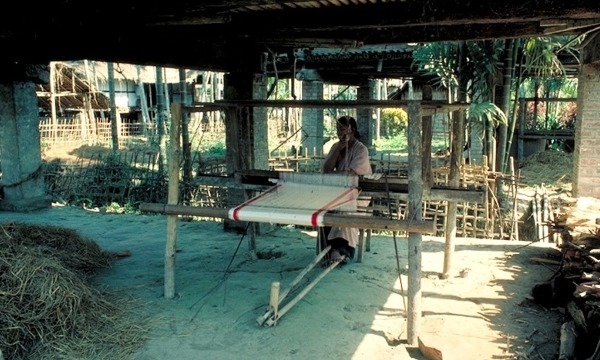
Silk weaving under the houses of Sualkuchi
[I listed the various deficiencies of the Indian bureaucracy. Normally I just took these things for granted and didn’t waste time complaining. Too easy to look like the pompous white man instructing the natives. I must have felt unusually frustrated.]
The 1st Secy at Nepal:” This permit is also valid for Manas.” Untrue
“You can go to Gauhati.” Untrue
Immigration officials: “You can go to Manas.” Untrue
Barpeta Road: No signs to indicate the correct road, or presence of a police post.
No understanding by police or SIB at Barpeta Road of correct procedure.
No machinery to assist tourists with correct information at Gauhati. In particular the officer at the Tourist Office in direct contradiction with the police on where permits are to be had.
Result: Six days at least spent in various police stations with no knowledge of what, if anything, can be achieved. And four days in which our passports were taken from us with no receipt.
Finally on Monday we get the retroactive permit and, planning to go to Dispur, we called at the Tourist Office. The officer was enthusiastic and insisted that we should not go to Dispur but to the Deputy Commissioner for Gauhati, Mr Misrah.
I found him that evening just as he was leaving his office, and he said come back next morning. He seemed competent to do it, a small man, quiet spoken, carefully controlled. At the Lodge itself police were also present – in the shape of a stocky man with white hair whom we came to know as “Snow White.” He asked us apparently aimless questions, cautioned us against visiting Sualkuchi, although Das had authorised it, and was anxious about our permits.
“Mr. Simon,” he said. “You seem much reduced.”
We also received Dutta in our room, who brought a copy of his poems and asked me to write some comment on them. His manner was always awkward, veering between expansive authority and stiff incomprehension – the contradiction between his roles being perfectly manifested in his behaviour, and his dress which was alternately dapper and down-at-heel. On a further visit he brought his wife, a lovely child-like lady in a beautifully embroidered shawl. He seemed embarrassed by her and apologised for her lack of English. He said she had insisted that a group photograph of us should be taken (but I wondered afterwards if it wasn’t his idea) and rushed out to find a photographer with a flash.
Thanks again, everyone, for letting me know you’re there.
I just came across an article I wrote for The Sunday Times after I had returned from my first long journey, in 1978. I think it makes for an interesting read today. They gave it a rather corny title, but I can’t think of a better one.
TRAVEL FAR AND LEARN ABOUT LIVING
The twin track of molten tyre rubber began halfway round the bend, a steeply descending right-hander on a Turkish mountain. I kept to the right side near the rock face, and watched the tracks veer away to the left and across the far edge of the road where they disappeared. Beyond the edge there were several hundred feet of nothing. Some policemen in rough khaki with red insignia stood nonchalantly looking down. I stopped the bike and joined them. Far below, the rear end of a lorry was visible. I rode on contemplating those fresh black tracks, imagining myself in the lorry driver’s seat as he was launched into space. It made me shudder.
I thought of the various ways it could have happened. One lorry overtaking another on the way up? Steering failure? Terminal fatigue? Some drivers on this Eastern run use opium to keep going. I went on to imagine how I would react if a lorry like that came hurtling round a corner towards me, and paid homage to the dead man by using his example to stay alive. It was one of the methods I employed to survive a 65,000-mile journey on a motorcycle.

On the road from India to England there were endless chances to learn from other men’s’ tragedies. At times one could imagine there was a war on. Seven thousand miles strewn with wrecks. A TIR juggernaut sliced in two, the cab here by the roadside, the container in a river 200 feet away. How could that happen? A new white Peugeot rammed down to chest height under the rear axle of a trailer. Tankers ripped open. Innumerable vehicles upside down. All the way through Pakistan, Afghanistan, Iran and Turkey the carnage mounts up as the traffic concentrates. On the Iran-Turkey border (a wonderful old-style frontier where you have to pass through a stone gateway) the biggest TIR trucks queue up, two abreast, in a two-mile-long line.
At the Pakistani end I was, in a sense, lucky. Newly proclaimed curfews and martial law had reduced the traffic to a trickle. I was privileged to see a great city, Lahore, apparently deserted by all life except for the cows moving majestically in herds along the broad thoroughfares, quite independent of man.
Worst of all was the notorious Yugoslav Autoput from Skopje to Zagreb. Juggernauts and impatient German tourists bound for Greece pack these 800 miles of two lane monotony as tightly as the meat in a sausage skin. The skin of course bursts in frequent and bloody accidents.
Nowhere on the 7000 miles from Delhi to London is it a difficult ride, unless one chooses to cross the high passes in winter. (In Africa and along the South American Cordillera I had a much tougher time with rocks, sand, mud, flood, and corrugation). After four years of traveling I was glad to have this relatively easy – and often tarred – surface rolled out for me all the way home but, thank heaven, I had also acquired the road sense to survive on it.
Many people who took an interest in my journey consider that my greatest accomplishment was to come back alive. With my mind full of more positive benefits this seems like the least important achievement, though it was done with great effort. But at least it proves that the odds, however bad they may seem statistically, can be defeated. The only serious injury I suffered –to an eye – was due to a fishing accident.
I found the best aid to survival was the old truckie’s motto, “drive the next mile.” to which I would add my own corollary for motorcyclists “and don’t let the other fellow get you.” Most people believe that situations can arise on the road which make them helpless victims of chance. I think you stand a much better chance if you believe that everything that happens to you on the road is your own fault. Everything.
The truly astonishing volume of traffic that now surges up and down the Great Orient Expressway has rather overshadowed what used to be called the Hippy Trail. but the Hippies still flourish. The “freak buses” still plough between Munich and Goa, Amsterdam and Khatmandu, advertising stereo sound, free tea and fully collapsible seats. In little rooms in Kandahar, Europeans wearing odd combinations of ethnic dress, from Turkish Depression gear to Gujarati mirror clothes, still fondle polished slabs of compressed hashish and dream about the price on the streets of Paris and Hamburg. And dope-hunting Iranian police still make tourists turn their camper vans inside out at the Afghan border where cornflake packets and supplies of Tampax blow away in the high wind. So it is all the more bizarre to find oneself riding in central Turkey among bountiful acres of white and purple opium poppies, their fat pods ripening for another harvest of morphine base.
The anti-Hippy crusades pursued with gusto by some Asian authorities may have been justified but seem designed mainly to clear the way for the big spenders of tourism.
What is a Hippy?
“If you are found dressed in shabby, dirty, or indecent clothing, or living in temporary or makeshift shelters you will be deemed to be a Hippy. Your visit pass will be cancelled and you will be ordered to leave Malaysia within 24 hours . . . . Furthermore you will not be permitted to enter Malaysia again.”
Signed: Mohd. Khalil bin Hj. Hussein
Dir Gen of Immigration
The above definition would have included me with my tent and jeans as well as a high proportion of the native population.
In Nepal “every guest who is in Immigration for their problames (sic) should be polite and noble behaved, any misbehaved activities and discussion by the guest shall be proved a crime”.
Difficult advice to follow in view of the impolite and ignoble behaviour of the officials there.
However Mother India remains mercifully benign to all comers. A few more people in shabby clothes and makeshift shelters are not going to make much of a dent on several hundred millions in the same state. As long as India is India the Trail will live on.
These have been four crucial and violent years to travel in the world. Of the 45 countries I visited, 18 have been through war or revolution. Many of the rest have faced economic depression or internal violence. Yet my own experience has been overwhelmingly peaceful, marked by kindness and hospitality everywhere.
I have returned to find prices double, the European pecking order changed, and the political complexion of Europe much pinker than it was. Britain seems a bit chastened but otherwise unchanged. People are as oblivious as ever of their relatively great material wealth. I suppose they are right to be, since what we have here is not really important to the quality of life; indeed most of it, to my mind, is a burden. My mother’s garden, about half an acre of lawn, flowers and fruit trees, could accommodate an Indian slum of a thousand inhabitants (not that I suggest it should). I watch her move about in it alone, pruning and trimming, and I imagine she wishes there were less to do.
I used the word slum, but for me that denotes people who have abandoned hope in their squalor. The Indian slums that I saw were not like that. They were scrupulously maintained in the village tradition. Given just a few amenities (a source of clean water within reach, drainage, a supply of roof tiles, they would reach an acceptable minimum standard. Direct comparisons between European and Indian lifestyles are as fraudulent as ever.
I have spent a lot of time wondering how “they” could arrive at some sort of parity with “us”. During these four years “they” have acquired much more power to press their demands. I see no alternative: we shall have to sacrifice some of our abnormal privileges. If we did it gracefully and imaginatively we could benefit a great deal from the sacrifice, but I expect it will be a bitter and bloody business in the end. Around the world I have been asked to defend Britain in her “decline” and have tried to conjure up some notion of a British “genius” at work. Under the stresses of these last years I thought maybe new directions would be found, new social forms experimented with. I see now that this was foolish. We still carry so much fat. There is no sense of change, just an occasional whiff of decay.
But things will change. Having been among the two billions who will demand it I know they are not just images on a screen or on posters for Oxfam. They are real. We will have to accommodate them.
* * * * * * * * * * * *
“How will you ever be able to settle down?” people ask. “Will you want to do it again?” I used to laugh. The prospect of stopping in one place, of doing some real work and living among familiar faces was all I could dream of. The book I have to write has been on my mind too long, but now I realise that until the book is written the journey will still not be over. And already I know what makes the tramp go back on the road. There’s a tingling vista of freedom that is as elusive as it is intoxicating, and it is peculiar I think to those who travel widely alone. There is a wild pleasure in being able to vary one’s behaviour at will, with nobody around to remind you of what you said or did yesterday.
For example, I used to take it for granted that I preferred to sleep on a bed. In these four years I have slept on all kinds of surfaces, wet or dry, hot or cold, in a prison and in a Maharaja’s palace, still or moving, in pin-drop silence or in railway platform bedlam. I now find that I would choose, whenever possible, to sleep on a rug on the ground in the open air.
Why does it matter? To me, enormously. The habits of sleeping, eating, drinking, washing, dressing that I learned in youth had great influence on my state of mind and body. But they are not habits I would have chosen and in these four years they have all changed. In many ways I find that the old ways of doing things were unnecessarily complicated and expensive. Today what I do is much closer to what I am.
It does not take much imagination to see that the same process applies to less tangible but even more potent habits of behaviour. I think I used to make great efforts when meeting people for the first time to impress them. This kind of thing obviously demands a lot of energy and creates a good deal of anxiety as well. If I had tried to sustain it through four years during which I met, practically every day, new people from whom I wanted help, often with no common language to fall back on, it would have made me a quivering wreck. Relax or crack were the only possible alternatives. I managed to relax by abandoning expectations.
“Whatever it is you want” I told myself, “you don’t need.” Whether it was a visa or a pound of rice, or permission to sleep on somebody’s land, I prepared myself in advance to be content with refusal. The result was a revolutionary illumination. I was almost always given what I wanted and at the same time I found I wanted much less.
These personal discoveries once begun, became the foundation for a philosophy which, while in no way startling, is intensely real to me, having arisen out of my own personal experiments.
Towards the end of the journey the power I had built up in this way began to fail. There is obviously a limit to a learning process like this; in my case about three years. After many months in India I began to wish I was home. I knew the wish was dangerous and debilitating. To hurry now would invite the accident I had avoided for almost 60,000 miles.
In Delhi I became absurdly frustrated by a delay of two weeks in getting some spare parts. When I finally climbed out of Old India through the Khyber Pass into Afghanistan, I experienced a psychological dizziness that astonished me and kept me in Kabul days longer than I intended. It had a lot to do with the way I had adapted to the pressure of Indian life, the permanent exposure to people, their curiosity, hunger and clamour. Coming out of that was perhaps like decompression for a diver, but earlier in the journey I would have taken the transition in my stride.
On the long route home, I made mistakes attributable only to apathy. For the first time I looked for companions to ride with and used them to support my faltering spirits. And finally, in Istanbul, I lost all restraint, and I rode for home almost non-stop, getting to Munich in three days although I dared not take the bike over 50mph.
Somewhere along the way I wrenched my back and so, having spent four years in almost perfect health I managed to arrive home a physical wreck. And my imagination having worked overtime for so long went into a coma. For many days I could hardly recall, with any conviction anything that had happened to me “out there.”
For a while I felt as though those four years had never happened at all.
