News from Ted
On December 5th the ferry from Aswan came ashore at Wadi Halfa or, more correctly, at a ramshackle assemblage still growing to replace the town, which now lay below the waters of the lake. I had hoped to get back on the bike but was refused permission and petrol, so I had to take the train.
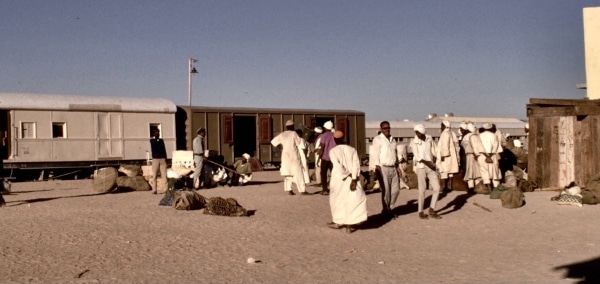
My Dutch friend (hatless) dealing with his luggage. My bike was already in the wagon.
With the Dutch couple I had befriended, I travelled to Atbara, where apparently there was only one hotel. They took a taxi and I followed on the bike.
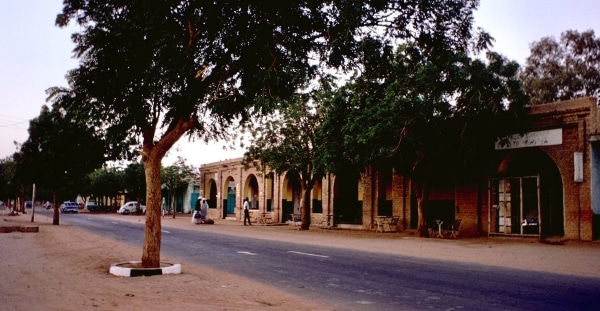
THE hotel. The rooms at the back were cubicles looking out over a verandah on to a courtyard.
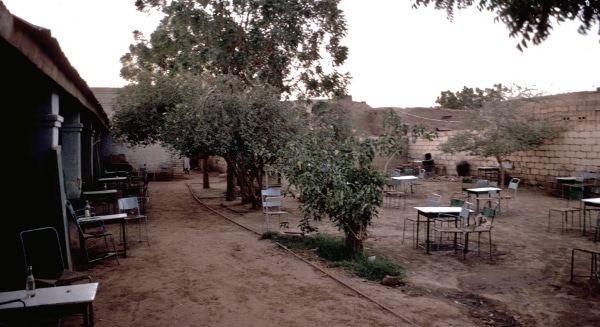
December 6th
Atbara: Hotel courtyard. Pale green lime-wash. Green oil paint. Entered to be greeted by five Arabs with sherry and marijuana. A joint pushed straight into my hand. Played some music but they weren’t interested. Interest centered more on Anthony. Why not? He was suspicious, I think. Later, the southern Sudanese, Fabiano, said the chief Arab was a thief who pretended to be drunk to get others drunk. Used the word ‘teep’ but all his p’s are f’s and his f’s are p’s. i.e. pipty and fresident and feople, etc. We got into quasi conspiracy about Sudan’s internal problems and the Eritreans, but my own astounding ignorance left me unaware that the Eritreans were Moslems opposed to Selassie’s Christian regime, and the southern Sudanese, being Christian, are naturally opposed to the Eritreans. I had imagined it the other way round i.e. underdogs supporting each other. Naïve innocence.
Saturday, December 7th
Bent foot brake [lever] back into place by dropping bike on it. Cleaned Oil Filter. Distilled water – to be found. Tightened nuts and bolts. Some movement on barrel nuts. Tappets? Not yet. Chain tensions; primary all right. Rear chain loosened two turns.
In Atbara we met Thomas Taban Duku and then Fabiano Munduk. Both African Christians from the south of Sudan.
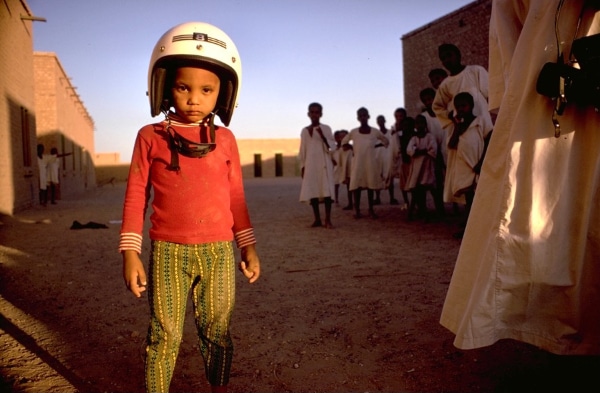
With Fabiano, an evening that started when he came to the hotel with his nephew Peter, a four-year-old boy in brightly striped jersey tunic and shorts. They had come from school sports day. All day I had heard martial music of the Empire drifting across. He explained they had been playing musical chairs. We drank two bottles of sherry between us in a bar, then took him by taxi to his brother’s house. Brother is in police (a captain, he said). Saw one room, open to yard, all in brown and over brick. Brother’s wife spoke no English. He got her to give small bottle of home distilled date liquor. (Like eau de vie)
Dates left in water for seven days, then container put over fire. Above it a lid perforated. On that a small bowl. Above it a bigger bowl as a lid and condenser, filled with cold water.
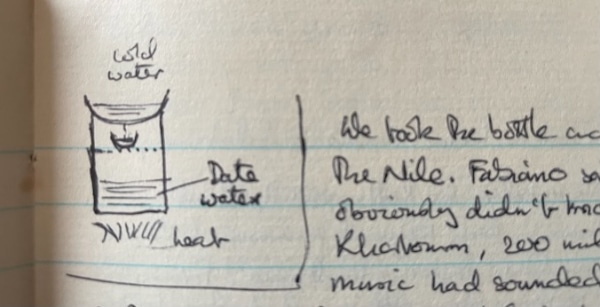
We took the bottle and walked across cultivated ground to look at the Nile. Fabiano said the White Nile was a day’s walk away. He obviously didn’t know the Blue Nile only joins the White Nile at Khartoum, 200 miles further south. We walked back to place where music had sounded. Fabian was dodging about looking into bushes, in the manner of Don Genero looking for cars.
[Carlos Castaneda, a popular writer at this time, described his apprenticeship in shamanism in The Teachings of Don Juan and other books.]
I think he was looking for animals or snakes. We had been hearing about his life in the bush – ‘bus’ – when he and his brothers were refugees from Sudan after his parents had been killed – he said – by the Moslem army of the time. He is proud of his brothers. They are twelve. Two are at Oxford, one doing economics, another librarianship, the others are mostly in the army – all officers He is the youngest and least qualified.
The music came from a wedding party in a community on the edge of Atbara. Large square clearing with canvas spread over large area, illuminated by bulbs strung out in a large rectangle. Rows of chairs all round. Many children jostling for good position, scrapping with each other, but although they pushed each other around quite hard there was no bitterness in their manner, and no crying. Fabiano says the children are allowed to be independent but this only works of course in a simple environment with large family structures.
The band arrived in an army truck. We were given favoured seats, and then plates of food were brought specially for us. Tarmeia, bits of meat, salad, sweet pastry, bread and water. Water in gilded aluminium bowls. When music started men would wander over casually, sometimes two together jigging to the beat, snapping the fingers of one outstretched arm, to indicate their pleasure, and reach over to touch one or more of the players. Then they would retire again just walking away slowly.
[Account of Atbara to Kassala in letter home.]
Monday 10th
[The whole of the following week’s experience is described in detail in Jupiter’s Travels.]
Left Atbara. Tried to find way from town. Took an hour. [Everyone said “the road to Kassala is queiss” – meaning good. But there was no road.]
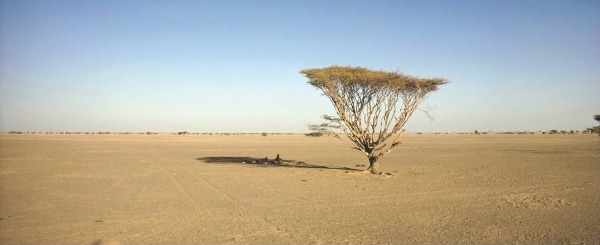
The road to Kassala.
After three hours, in sand up to axles. No water. Too little petrol. Acid in bottle. No money. Come to Kinedra. School. Welcomed. Fed. Refused permission to leave. Headmaster said, must get more benzene first. From car? But car had none. From District Officer at Sedon. But he had none. By lorry from Atbara. But lorry broken down. By lorry next morning. But no lorry.
[After two days at the school I learned there was a bus back to Atbara. I was introduced to a merchant who was also taking the bus and with my five-gallon jerrycan I accompanied him to Sedon where the bus stopped in the night. He spoke no English at all. We lay on the sand in the smpty square to wait.]
“Sudan seňora queiss? You Sudan seňora? Sudan seňor queiss? You Sudan seňor?” Insistent, quiet, gentle. Just teeth in deep shadow framed by turban. Light touches between legs. Seductive, compelling, out of any moral context. Could imagine it.
At last, there was a bus. Bus arrived at 11.30pm. Ford chassis. Heavy riveted steel body built in Khartoum. Out tumbled horde of people. Many with swords. Scabbards shaped like paddles. Crucifix grips. They are a tribe called Bescharyin. From Sedon until Goz Regeb. Most are nomads. Their hair is long and the strands are glued together with oil, called oudak – animal grease, and wear an ornamental curved stick used as a comb, sticking out like an Indian feather, but horizontally. They wear a waistcoat, galabeia, and trousers with crutch below the knees and tied by cord. Three-tiered clothing. All fell to the ground and slept until 4am. I was happy to sleep too, but it got cold and I had no cover. At 4am the bus left for Atbara. Very bumpy. Much coughing. A sort of stale, damp smell. Two B in front of me, hair dangling before my eyes. No expression. Very stern. After dawn people began getting off. Outside Atbara, my companion, the merchant, vanished mysteriously [while I slept.] A family of B’s descended, a pathetic huddle of humanity set down on the sand, with their bundles of mats, sticks, pots and bags, still cold, kids bare chested. They appeared momentarily unable to cope at all.
In Atbara looked for Fabiano to recover cutting, and lost others in the process. Southern tailor’s shop had African flavour. Clear distinction between Arabs and Africans – each considers itself the elite. Tailors rather condescending about clothes they are making. Material from China, Egypt inferior. Suit costs £2.50 up. Got lorry back to Kinedra. Took road in a wide sweep across desert – the road I missed (or dared not find.) which would have got me here faster.
Lorry stopped about a kilometre from Kinedra. I started humping my jerry can across the sand but was soon met by a boy with a donkey, who relieved me of my burden immediately.
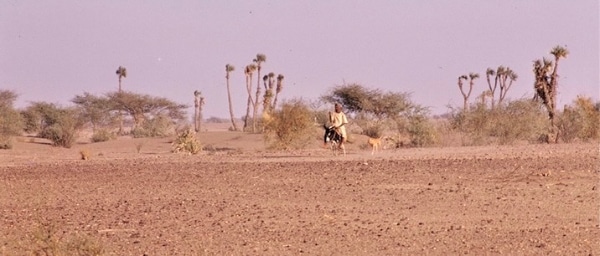
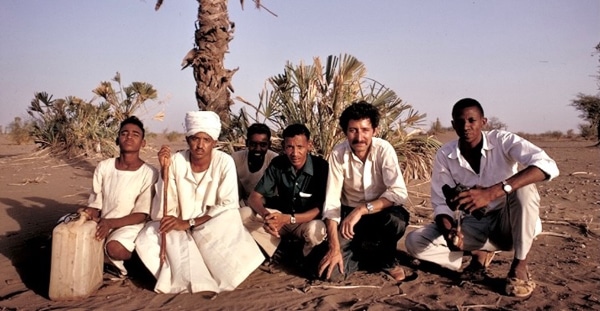
I had intended to go to Sedon to photograph the water pumps, but the teachers of Kinedra would not let me leave. They insisted I accompany them to the river bank to take pictures. Waded in the river. They said prayers. Each had orange-sized patch of sand on forehead. Then visits to the village shops, and the home of . . . . . . brother who has refrigerator. Little bags of flavoured ice. Shabby furniture, not worthy of Austin’s [a popular London warehouse of used furniture.]
[I was persuaded to stay two more days at the school.]
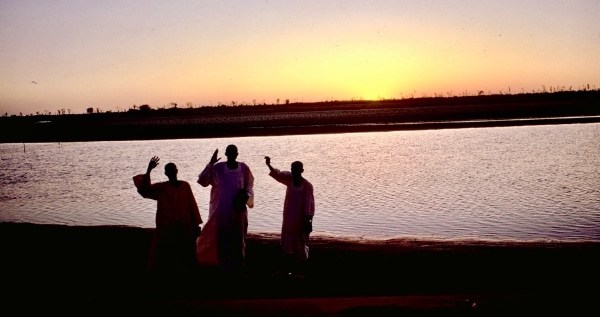
Goodbye, until next week.
PS: Like most people I come into this New Year with grave premonitions. I see absolutely no prospect of Putin stopping the war. Trump’s involvement is toxic. Europe must pull itself together. What can I do about it? What can AI do about it? Watch this empty space.
Thank You Very Much
First of all, I want to acknowledge the response to my offer of a One-time Subscription. It has released a small flood of generosity which makes it plain that over time I have established a place in many lives. Not just through this series of travel notes, but in some cases going back through decades. Although I deliberately avoided pinning my appeal to any future book, I do now also have the beginnings of an idea of how to use these notes as a truly valid companion to Jupiter’s Travels. I’ll be developing these thoughts as this series draws to an end this coming summer.
From My Notebooks In 1973: Aswan and Lake Nasser
Finally convinced that there was no hope of getting permission to ride up the Nile, I bought a train ticket to Aswan. I had become close to Amin, the hotel manager, and he confided in me that he was planning to escape from Egypt and go to Brazil, where he already had an older brother, a doctor, established in Campinas, near Sâo Paulo. Legally, he was supposed to do years of military service first, so he would have to leave only with what he could carry. He asked me if I would carry with me, on the bike, his father’s ceremonial sword and deliver it to his brother when I arrived there. I was touched by his confidence, and the sword, in its scabbard, took up residence alongside the umbrella.
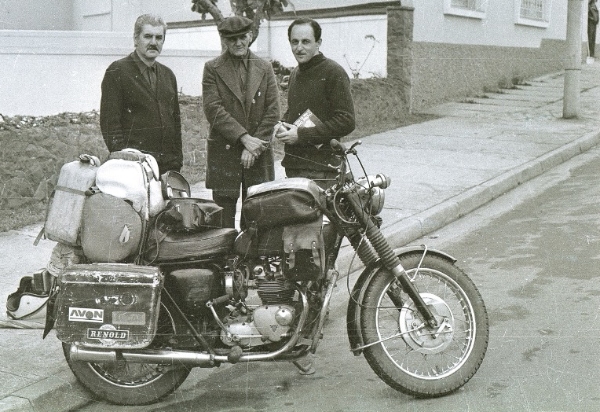
I got to Campinas nine months later. Amin had already arrived. That’s him on the right.
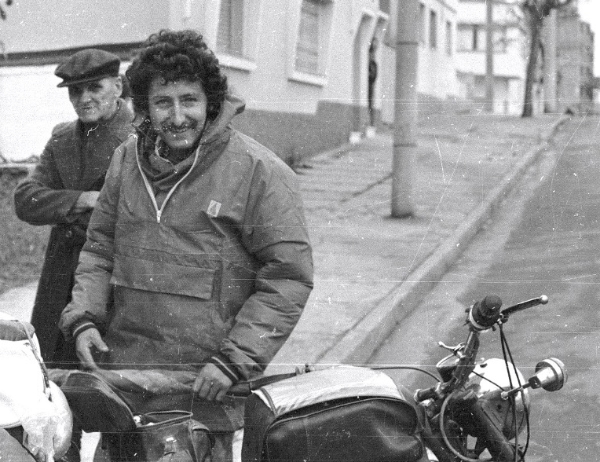
And this was me, holding on to the umbrella.
Meanwhile, back in Cairo, Monday, December 3rd
The train to Aswan. Cairo station – traders, stalls, cattle, crowds of persons waiting to coagulate round any seed.
Two references from Faris Serafim [Proprietor of Golden Hotel, Amin’s uncle]
Moatassam Bereir, influential, Khartoum, Foreign Office.
Mohamad Abouleila, Khartoum, Good family, older brothers know Faris.
[I did what I could to secure the bike and, with serious misgivings, entrusted it to the baggage wagon. The train left at 8pm. I was in a compartment with two Egyptian families who spoke almost no English but they had quantities of food for the 16-hour journey which they shared generously with me. We slept in our seats. In the morning I got breakfast in a saloon car and watched the passing scene. The train travelled very slowly, stopping often.]
Company [of conscript soldiers] descends at Essna. [Reminded me of my own national service.]
Just like UK conscripts being shuttled about, showing no sign of anticipation. Wear heavy khaki like us, plus suitcases, etc.
[Looking out at villages.] Stuffed animals over doorways, lizard, a fox.
[I had thoughts about the evolution of pyramids. Why that particular angle.]
My pyramid theory. Natural form of erosion in Upper Egypt. Rocks have caves in them. Measure angles, etc. Maybe some corpse was found in a cave in goat milk. [What was I thinking?]
In front of some villages, stones stood on end, curious effect immediately noticeable, but why? Not big stones, and all shapes, six inches to a foot, but all unnaturally upright. Still don’t quite know how water wheel works. i.e. don’t know what it discharges into.
[The train stops.]
Three peasants working on a plot of earth beneath window of train. As usual earth divided up chessboard fashion with foot-high dykes around 3-metre squares. Two men were chopping vigorously at earth, one old, one young.
The old man was tough and skinny and wore absolutely nothing beneath his galabeia which became evident when he bent down towards the train. Standing by them, with a five-foot cane pointing at the earth was the most imperious lady I have seen. The mother of all the pharaohs. In black, with black headdress, old but refined, face as strong and vigorous as ever. Tall, straight, irrefutable authority. Head a perfect long oval, mouth in parentheses which seemed on the point of curling down in contempt.
Tuesday, December 4th
Train empties at Aswan and waits. Then on to lake. Unloading is easy enough, though the attendant stands studiously while I hump my bags, then solicits a tip (which I give him, salving my pride by halving it.) From the platform have to drive bike down some steep steps. I let go a bit soon and on the last bounce I lose control and fall into bushes. Malesh!! Short and ineffectual interrogation by soldier, and I follow my self-appointed guide (an Arab Merlin figure) to the stony shore where some people are gathered outside s group of shacks, milling about among bundles. I have a ticket but must pay for the motorcycle. There is one shrewd fat Arab sitting outside a cabin, surveying the mob, while his men work. I give them the correct weight of the bike. and they charge me E£5 without weighing it. Passport control is simple, and the vehicle control looks straightforward, but I’m beginning to wonder how I’m going to get my bulky objects through customs, which is besieged by camel drivers carrying huge canvas and leather bags which I presume they sling over their camels. The carnet man indicates that an amount of money will help me over their problems and I succumb, with half a pound. In fact, if I had known how useless my pounds were to be I’d have been less precise. However, I was through and down to the boat in a flash and forgot completely about changing money.
The problem at the boat then obliterated any other concerns. It was immediately clear that it would be [all but] impossible to get the bike on the boat because my boat was separated from me by another boat. [They were parked side by side on the embankment.]
The first problem was the conventional one – of lifting four cwt down three feet, then to manoeuver it through a narrow passage packed with camel drivers in a terrible hurry. While manoeuvering it round a sharp corner all I lost was one pannier. It was just a matter of persistence. But the final crossing [to the other boat] was inconceivable. Both ships had steel-sided gangways, with openings only wide enough for a person, and the openings did not coincide either with each other or with the end of the passage. The bike had to be manoeuvered through a Z-shaped path, in mid-air at an angle of 30 degrees pointing downwards across three feet of water.
But for the sky-hook that appeared halfway through I think the journey would have stopped there. Even so the bike was resting most of the time on the remaining pannier or the foot brake pedal, which assumed a distinctive slope. There were five people struggling, and I was least use since I couldn’t understand the others. Finally the project passed out of my control, and I had to hope for good luck as I saw the exhaust manifold within an ace of being ripped from the cylinders. The experience affected my view of the boat, which I saw as cramped, dangerous, expensive and inhospitable. The deck, which I had imagined open to the sky, with chairs, was below with no chairs, or indeed anything but refuse and bare steel. Some cars had been brought on from the other side when this boat had been against the bank, and filled most of one half. At the other end, behind some corrugated iron, was a man brewing tea. A desk in front sold chits (or scrip, or torn bits of used paper) but of course took no Egyptian money (except from Anthony because he’d paid for first class.)
[Anthony was a young Dutchman, travelling with his wife.]
Every other floor space, except for a narrow footpath, was resolutely occupied by camel drivers who had their bed bundles down while I was struggling [with the bike]. As the journey advanced it became increasingly difficult to distinguish the people from their luggage. The grimy galabeias merged and an occasional limb or head protruded here and there. Most of them stayed, scarcely moving, for three days and two nights, while drifts of scrap paper, cigarette ends, orange peel and dust, all bound together with spit, built up around them.
The sight of people letting loose a jet of spit on the floor where they sleep is so objectionable that it goes beyond disgust to sheer wonder. How can they? But if you consider the desert your natural home (where spitting is not only harmless but quite natural) then being inside a house or boat is scarcely significant. Considered alongside the meticulous and lengthy rituals of spiritual cleansing which these same drivers undergo every day, it is hard to say who comes cleaner out of the wash – they or the European.
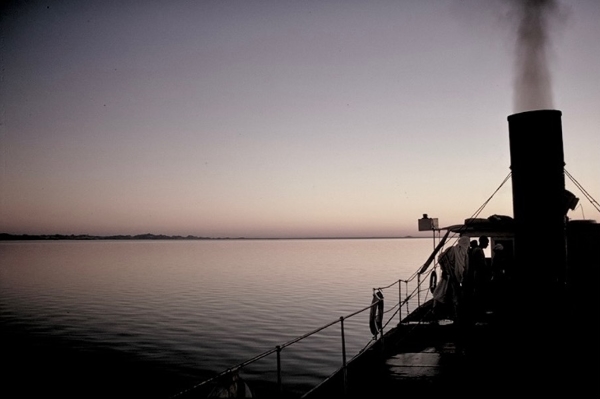
Two nights and three days floating across Lake Nasser.
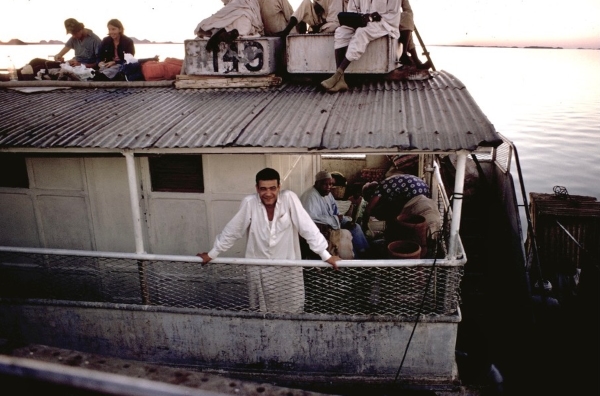
A view of the first class boat from the third class. I soon joined them, on the roof.
It became clear that there would be no room to sleep even in these conditions, but the other boat which was all but empty was said to be for first class only. However, Europeans obviously have a natural exemption to class restraints in Africa. Should I have stuck with the drivers? It was not a productive thought. Other Europeans would not have allowed me even a faint chance of an understanding with them on such a short journey. I smuggled myself instead on to the top deck of the first-class boat, and I slept out under the sky. Bright moon. Stars becoming familiar. Cold at 3 am but not too much so. Spent time talking to Australian Mike – Macdonald. Something about him remained alienating to the last. A conflict of styles? His funny hat – a Moslem cap – was aggressively incongruous. The forthright manner was not quite true – and concealed a complex and uneasy personality. Protestations of easy independence were contradicted by heavy point-scoring humour, and he lost few opportunities for self-congratulation. Yet there is a wistful, touching desire to find peace with himself (which he failed to find in his monastery.)
Although the Dutchman wielded an equally heavy sledgehammer, he seemed to have found more peace in his 26 years. He and his wife Alice were travelling to South Africa to visit her father (?) It was her idea. He had wanted to holiday in Norway but now he was finding much reward. His treatment of his wife was very masterful, and she was obviously devoted to him, even when he scolded her like a father. A big man, studying “marketing,” son of an old family, with a natural confidence which could make him boorish and pigheaded, but for the moderating influences [of his wife] which he is happily able to accept. He was taken by my idea of classifying people as “alive or dead” but said he would have to study it.
Train from Cairo 7E£n+ 6E£ for bike. Left Cairo 8pm. High Dam 1.30pm Boat from Aswan to Wadi Halfa 2E£ 3rd class + 5E£ for bike. Spent E£5 on boat. Train Wadi Halfa to Atbara 3.60 S£+ 3.61S£ for bike (200kg)
Total £24 sterling.
I’m taking a week off, so in two weeks: Atbara and the desert.
Merry Christmas.
To my readers…
My quixotic notion to offer you an opportunity to reward me for the pleasure you have already enjoyed has provoked some interesting confusion.
A few seem to feel it’s almost immoral. “If I’d known I was going to be asked for money I would never have started reading your pieces in the first place.” Well, nobody actually said that, but I got the hint.
Then others thought I must be asking you to subscribe to a future book – I wasn’t – and refrained because they don’t think the book’s a good idea. Anyway, to those who simply thought it would be nice to give me something for past pleasure, thank you very much. I am quite comfortable with it. I believe I have earned it. And if I DO decide to make a book of it, the money will help. It was also a valuable experiment. It helped me to find out where I float in this ethosphere. Now, back to Cairo.
From My Notebooks In 1973: Egypt
[I’m desperately hoping to ride the bike up the Nile – such a vital, rich seedbed of humanity: Luxor and the Valley of the Kings. There’s a lull in the war. Why shouldn’t it be possible? In the meanwhile, I tried as best I could to understand Cairo. At about that same time it struck me that Islamic countries, from Morocco to Indonesia, spanned the globe, rather like a scimitar, and would be a mighty force if they could unite. I put this to a high-ranking journalist, Denis Hamilton, who happened to be staying at the Hilton at that time. He thought a minute and said, “No. The Shah would never allow it.” He meant, of course, the Shah of Iran. We know what happened to him.]
Cairo, 17th to 22nd November
Waiting for permission to ride to Aswan.
Daily round begins. Groppi’s for coffee, etc. Reuter’s office. The Press office at the Information Building, lunch, a game of chess and then anything to get the evening over with. At first, I think it will be just a day or two. My piece went off to London, together with a message, on Thursday. There was no reply, but the bureau lady has convinced me that because of my faulty slugging they may have got scrambled or delayed. So I repeat my message. [“Slug” was the word used to identify a piece of copy.]
Meanwhile at the press office Frau Amin treats me pleasantly enough and I am lulled by her comfortable conversation (which is quite genuine and kind.) although nobody thinks there is any possibility of my being given permission to drive to Aswan.
Meanwhile there are also the first set of papers from Benghazi to expect. And with Amin’s help at the hotel, I try to grapple with Libya and Arab Airlines, but they are too slippery for any of us. On Sunday I decide to cable Kerim for the waybill number, but the cables are subject to several days’ delay. The telephones however are working properly so I book a call for Monday morning. The days pass. I develop a powerful reputation for chess, dodge nimbly across the frontlines of affection between Amin and Alan and learn what I can from Faris Serafim. [Alan was a pale young Englishman with an upper-class accent staying at the Golden. Amin and I both thought he was probably a spy. Faris was Amin’s uncle who owned the hotel.]
Faris was at Oxford in 1919. I gather he read theology. He is, in any event, a Christian, i.e. a Copt, Egypt’s original tribe. He was contemporary with Nehru and, he suggests without naming them, many other luminaries. He recalls that they founded the International Club and toured Britain (Cardiff, Bradford) to speak in halls and churches about their respective countries. He considers there were some whose qualities were greater than, say, Nehru’s but rejected power when it was offered and contented themselves with being obscurely good.
He himself was from a family which had built a considerable position in Egypt. He talks of his great grandfather, who was “keeper” of the village in the reign of Mohamed Ali, and whose citizens hatched a plot to murder him rather than pay taxes. He escaped but the villagers claimed he had run off with their boxes, and a price was put on his head. He, however, made his way down the Nile and finally contrived a personal encounter with Ali when the guards were some way off.
“Surely you know,” said Ali, “that I have put a price on your head?”
“You can have it for nothing,” was the reply, “if you don’t believe my story.”
The upshot was that he promised to double the tax returns if he were allowed to found his own village, and he did so. This then became El Minya and the Serafims became very wealthy – sufficiently, according to Alan, to give a visiting Cardinal dinner for forty off gold plate. By the same source he is said to have been Egypt’s most prominent businessman, who was intimately concerned in and with the political structure of the country.
He knew Strawblow and the two men who helped him to the right hand of Durante and recounts that those two men soon found themselves in jail (this was, of course, on the American side in the 30’s).
[This strange final comment was meant to defer suspicion lest officials came to read my notes. Egypt was effectively a police state. “Strawblow’ was Sadat, “Durante” was Nasser. The words in parentheses were just rubbish.]
The revolution in Egypt stripped Serafim of his wealth, and his true worth is now demonstrated by the ease and dignity with which he assumes his position behind the desk of the Golden Hotel, one of the properties that remains in the family. Land and cash were nationalised. Buildings were merely heavily taxed.
His reflection on the Aswan Dam, on the need to mechanise farming, on the ability of Arab culture to survive the machine age (he says it will – I, as usual, remain pessimistic.)
Menu at Riche [a local restaurant]:
Dorma (stuffed cabbage & marrow) 18 piastres
Awa (Zeiad, Marbut) 4 ½ piastres
Soup/spaghetti 5 piastres
[One piastre was worth one British penny, or 2.5 cents US]
Robes are called Galabeia in Egypt, Shuka in Turkey, Djellaba in Morocco/ Algiers.
Walking on the crowded catwalk across Tahir Square in Cairo I noticed that though the crush looked impenetrable, when you walked in it there was always space allowed you – provided that you didn’t move at your own pace.
[Tahir Square was a huge intersection in Cairo. To enable pedestrians to cross it an equally huge catwalk crossed over it. Thousands of poor Egyptian workers, all dressed alike in blue galabeias, crowded over it.]
Cairo is the first city (I presume I shall see others) in which fate as much as mortar seems to fix the fabric. In Tunis the poorest seemed to have some sense of social movement, could dream and hustle a bit. Perhaps it’s so here, but the impression is different. Cairo is intensely populated. 6 million in a relatively small space. Many of these (I don’t know how many) are newly arrived from the farms and are as completely uneducated and unskilled in city ways as can be. It is they who root the city in its ways.
In Cairo I can fill my stomach twice a day for ten British pence, and this is in the heart of Cairo and going no further than 100 yards from the hotel. At the same distance is a cake and coffee house [Groppi’s] where a light breakfast of eggs, coffee, toast and marmalade involves the waiter in bringing eleven separate items – a glass of water, a glass containing cutlery and napkins, two heavy hotel silver jugs of coffee and hot milk, a cup and saucer, plate of toast, slab of white butter, a silver pot of marmalade, another of sugar, salt and pepper, and the eggs. The cup comes from the kitchen full of boiling water which is poured out at the last minute. It takes the waiter an appreciable time to unload the tray. The price is 28 pence, about the most a citizen of Cairo could be asked to pay anywhere in the city.
Anyone living here within grasp of Western standards is plainly able to enjoy the best that the city can offer, while the poorest are able to subsist on the crumbs he sprinkles in his wake – a penny for guarding his car, two pence for polishing his shoes, a penny for simply being somewhere regularly on the off-chance of a service to perform, and so on. There is little evidence of resentment on the one side, or contempt on the other. Once the donor has evolved his routine, and his small area of patronage becomes familiar, the relationship is warm and benevolent on both sides.
This mutual respect is fostered by the clear duty imposed on the Moslem by his religion to donate a distinct fraction of his wealth or income to others in need (I think 10%) The other duties are: to pray five times a day, to keep himself clean – particularly the ‘private parts,’ to do to others as he would be done by, and to visit Mecca once (if he can afford it). The stability of this system depends on a general belief that it is right, good and practicable. Morale and morality go hand in hand. Where external forces seem to strike at the viability of Arab society they are easily seen as a threat to every Arab’s self-respect, without which he cannot be satisfied with his place in society. I am sure that Arab dislike and contempt for Israel is rooted in the view that the Jews, whose ethical system compares so closely to the Arab system, have betrayed themselves and God for personal gain. Israel is perhaps the Trojan horse of the West.
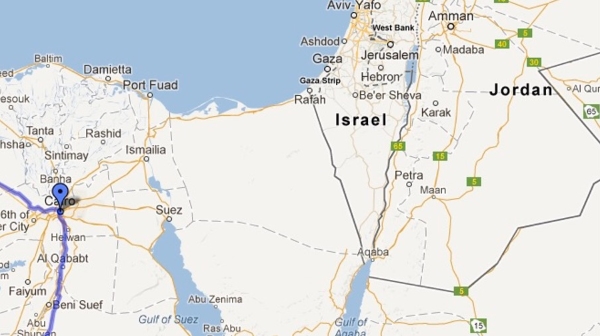
In the aftermath of the ’73 war, Cairo lives in a euphoria of vindication. Egyptians are convinced of a great victory. They have shown the world. Now they can negotiate honorably, and after a few weeks are ready to discuss their mistakes and weaknesses, to begin the process of dismantling their former idols. Other Arab countries who suffered defeat (the Syrians) or who could take no active part in the war (Libya, Saudi Arabia) are less willing to call it off. While Egyptians can joke about Quadaffi fighting to the last Egyptian, the Libyan feeling is that they too want their self-respect established in more dramatic terms. Thus the oil weapon is used not simply for its tactical value, but as a sword for Islam.
It now seems that a negotiated settlement is possible (no more) at considerable inconvenience to the West and given agonising re-appraisals by Israel. Such an outcome, now or later, presumably involves a general recognition that the Arabs are free to go it alone as a society united in its religion and ethical practice and financed by a realistic income from its resources. What then?
Mine is not a political reconnaissance. I have met no members of government, enjoyed no confidences from the wealthy or influential, but I will relate what happened among the people I did meet, experience always being more valuable than promises or advice.
Next week: Up the Nile without a paddle
It’s not too late to reward me for three years of wonderful story-telling with these notebook extracts, you can send me a one-time $100 subscription.
Before we get to the notebooks…
Listen, I know you’ve been enjoying these notes. At various times I’ve asked for feedback, and some of you have been very articulate. I don’t have a very large email list but it’s stayed fairly steady for the three years I’ve been doing this – and of course a lot more people have been reading me through social media.
Now I have to ask myself, why am I doing this? It’s work – quite a lot of work. I justified it originally by the books I was selling through the site, but the truth is you’re not buying them from me any more, probably because you’ve got them already – and I’m grateful for that, of course – but still I feel the need to be acknowledged in a practical way. The plain truth is it costs more to maintain the web site than I get from it in income.
I’ve heard from many of you over the years. I feel I know you. I think some of you would like to contribute, and it’s up to me to give you a way to do that.
Several of you have said you’d like to see the diaries as a book. It’s an interesting challenge – “The Real Motorcycle Diaries” perhaps – but much more difficult than my autobiography and probably more expensive. So here is what I propose (I’m trying to banish the word ”deal” from my vocabulary):
You send me $100 (or your local currency equivalent) to reward me for three years of wonderful story-telling. Let’s call it a One-time Subscription. That seems fair to me. You’ll find the offer on the books page of my web site.
If it all adds up to enough to finance a book, or some other solution, I’ll do my best to make it work. And if you have other ideas about what to do with these diaries, let’s talk about it.
Meanwhile, there’s all of Africa still to look forward to.
FROM MY NOTEBOOKS IN 1973: Alexandria and Cairo
November 14th
My day for sightseeing starts poorly. Showers spill fresh floods across the roads. Visit the tourist office and meet with bovine response from ladies assembled there. To garage first, to find a spanner and manual gone. They give me another spanner, but the manual! So easy to think STOLEN. Still brainwashed by tales of thieving Arabs. But the younger of the men – that charming, soft-spoken best of men who wears the khaki overalls reminds me that I took it to the petrol station to buy oil. Of course! My own stupidity, but on their faces only great relief and pleasure. We march off together in the rain and find not only the manual but the spanner also. Once again virtue triumphs and my Western paranoia put to shame.
Drive to Montasah Palace (King Farouk’s summer house). Fine marble staircase – with rooms arranged in tiers around space open to roof with cheap-looking stained-glass partitions off floors. But light is very good. Otherwise, expensive bad taste. Bathrooms lined with alabaster tiles, but sanitary equipment and design ugly. Foolish trinkets in cabinets. Empty house, empty lives.
Fascinated by the showers. Cage of hot water pipes, showers from above, jets from below. Perfect Edwardian plumbing miracle in that ‘chromed’ metal with dull sheen – was it nickel plating?
Gardens just an ostentatious display of date palms and small firs. Rough lawn. Best of a bad job. Back to hotel for lunch. News of discord between Israel and Egypt disturbs atmosphere. I decide to leave after lunch, rather than stay another night. Aat end of lunch a telegram arrives. It’s for Pacaud. He opens it and takes a sharp breath.
“Mon fils est mort! Je le savais. “ [My son is dead. I knew it.]
His grief is profound and inconsolable. There is a short story to be written about us four at the Normandie. (Mme Mellasse.)
Road to Cairo. Groups of mud houses, dripping hay from the roofs. What are the round cupolas? To collect water? Stables also. Some beautifully made of mud columns, spaced to exclude bigger animals. Huge sails of barges, tall as houses (sixty feet) rising out of the railway line must be road, fill with wind but still require two men pulling. Sail tattered. Many of them stretching out in line ahead. Hard to tell whether there’s room to pass, but must be.
Cairo and the road in blackout. With only my polaroid goggles to protect me from flying sand and diesel soot, it becomes difficult to see where the road is or what’s on it. Bullock carts, donkey carts, cyclists, all unlit, appear on the verge. I catch a lift behind a fast taxi and as an act of faith follow him blindly into Cairo. An hour at 50-55mph. Not comfortable. But Pacaud’s description of route serves me well. Only the one-way systems finally cause difficulty.
Golden Hotel is a bit intimidating at first. The upper floors resemble Alcatraz.
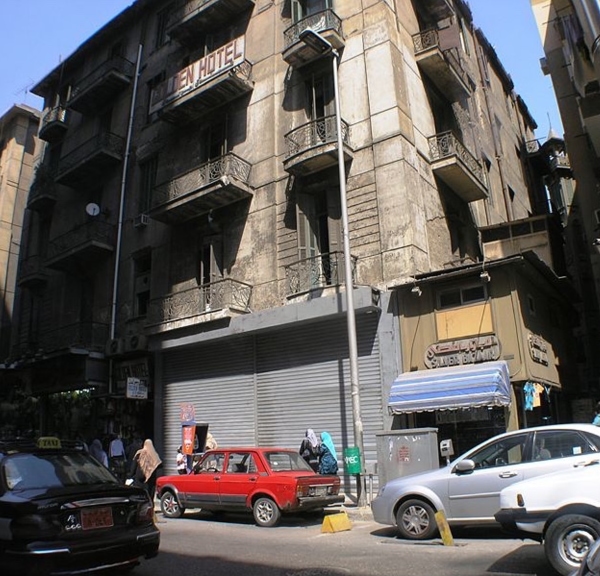
I don’t know now who recommended the Golden Hotel but it was an inspired choice, despite the cockroaches.
Thursday, November 15th
To Reuter Office. Dullforce is middle-aged, lean, grey-haired, unsympathetic. Wife likewise. Brisk, and busy.
Write about arrests. These bureau people are much like the police (in fact all daily newspaper people). Received the minimum of help, much disapproval. It’s the worst kind of arrogance, but I find myself largely immune to the consequences.
Pass on to the Cairo Information Centre, for permission to drive to Aswan.
Eat at Estoril Restaurant in alley off Tallaat Harb. Not very good.
Meet two young girls outside Suez Canal Co. offices. Birds are singing loudly in trees. Animated conversation with men through the bars. Egyptians always good for a laugh. Very warm people. After an attempt at lessons in Arabic, go for an endless walk through ‘garden city’ with Youssef, an accountant with Nile Transport Co. who described himself as “economist.” Earns 35 Egyptian pounds a month. (i.e. £6 a week). In five years’ time he will earn £8 a week. Says he likes the security. Went to East Berlin in Egyptian Youth delegation. Conversation oozing with emotion, empty of content. Leave girls and speed off in a taxi to something resembling an outdoor Peabody Building. Dodging from bloc to block until suddenly, without warning, into small flat bright with several hundred watts and solid with people. I counted over sixty with difficulty. Drums and tambours banging away. Two families celebrating the betrothal of two young people. Immense gaiety, no alcohol, ‘belly dancing’ by men and women (with scarf tied around hips). “Mucho Corazón”
Friday, November 16th
Gizeh pyramids. It’s a general holiday. Pyramids are at the edge of Cairo. West of Nile, on a raised area. A throng of guides, horses and camel drivers make an appreciation of the pyramids impossible. To have first stumbled upon them must have been marvelous but I can find no sense of awe for these lumps of stone. Less barbaric than Teohuacan, but still a monumental egoism. The marvels are all abstract – geometry, astronomy, etc.
I can’t resist the importunities of a guide who is clever enough to be less clamorous than the others, but he shows me very little. In a tent he gives me good tea made on a primus stove by a pretty wife dressed in pink. She boils the water and tea vigorously, decants it, boils it again, decants it again. How the sugar got in or where the tea leaves went I have no idea. Hard upholstered couches on two sides.
Walk away to pyramids. Into second pyramid (Queen Sharfeen?) One tomb with hardboard partitions. Graffiti early 19th Century. G.R.Hill and Scheistenberger etc.
To first pyramid. Meet two unintelligent lads, but girl with them is more aware. Into Cheops. Inside like something out of [the film] Metropolis. All scaffolding and duckboards.
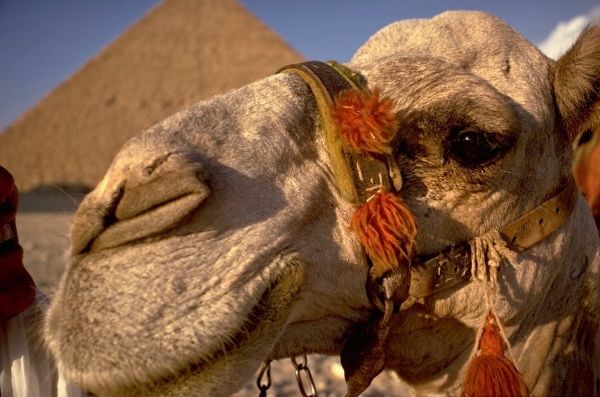
Jack Hulbert was a much-loved actor and comedian in the prewar days – with a big chin and a twinkle in he eye – you can see the resemblance, though how Faris the camel driver knew about him remains a mystery.
Ready to leave when I give way to camel driver, and now my reward. Because he gives me a great ride, over an hour, into the sand dunes, on “Jack Hulbert” [that’s the name of the camel.]
He is bright, humorous, great fun. We take a roll of pictures. Him and his mate.
But what in God’s name does the average package tourist get out of it all?
I really rode that camel, rein, switch and heel. My thighs were aching from the unaccustomed movement. JH lurched and swayed and hobbled along, with brief bursts of crazy trotting. I crossed my legs, Arab style, over his shoulders. He is six and will go on probably until he’s twenty-five or so. Sacks of ‘clover ‘at his side under heavy embroidered cloth. Take two sets of pix. First roll failed to attach to spool. Drivers called Faris Hamse (No. 62) Mandor Shahat (77).
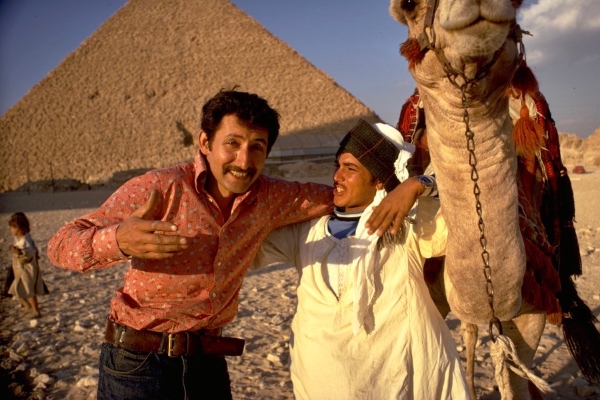
I’m disturbed by my failure to respond to the pyramids and question the quality of response in others. I know perfectly well that if I want I can whip up a storm of fancies and imaginings but I was determined to let the pyramids do the work. As props for a mind hungry for sensation they do very well, no doubt, but as objects to inspire pure awe or wonder I think they fail. Man has demeaned them in scale and industry. Rockets can be built taller than Cheops, more intricate, by more people, and sent to the moon. They have been surrounded by bric-a-brac, haggling, and petty detail.
I’ve been told that it’s better to see them first at night, through ‘son et lumière’ and that it’s a very good show. I quite believe it, but that’s a different matter. With sufficient skill at my command I believe it would be possible to illuminate the history of mankind by “son et lumière” in my kitchen.
The pyramids have an absolute virtue, but depend, like all other earthly things, on perspective. When the perspective is altered, whether by a persistent camel driver or a new catch-penny museum built up against the face of the pyramid itself, the pyramids fail and it is up to the individual to supply, by an act of imagination, what has been stolen. I refuse, because I feel I will become an accomplice of the despoilers.
[I seem to have gone through a rather arrogant phase. Perhaps it was the only way I could find to deal with such a short exposure to such an extraordinary phenomenon.]
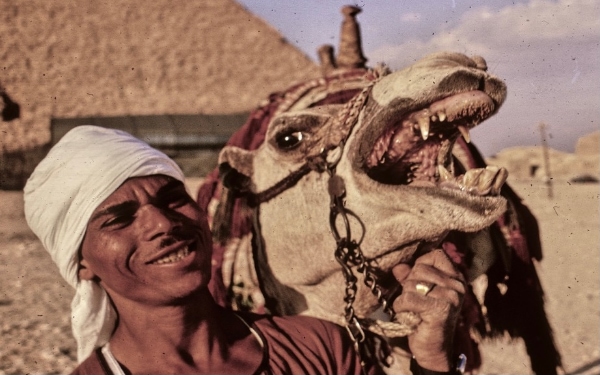
If you’d like to reward me for three years of wonderful story-telling with these notebook extracts, you can send me a one-time $100 subscription.
Here’s a portion of the Michelin map I used at the time:
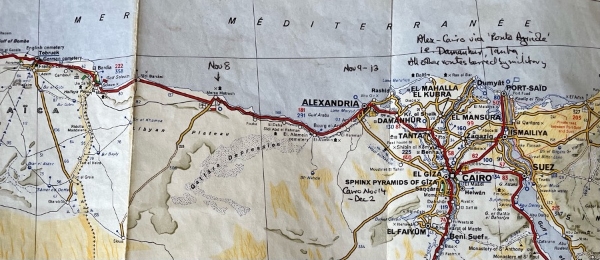
Against the odds I’ve got through to Egypt, and in Alexandria put myself though a crash course in engine repairs. But there were papers I wanted, still coming to Benghazi from the Sunday Times. The owner of the garage was going to Benghazi and said he would get them for me.
Tuesday, 13th
I give my message to the Libyan at the garage. He refuses my Egyptian pound. Says he will pay. Shames my earlier opinion of him. (Although he certainly sought to impress me with his Mercedes). He lives in Barce. Take pix of garage men. Put in new roll of Kodachrome. In my tourist suit I sauntered forth, bristling with Pentax. The feeling was dismal. Suspicion, dislike. Was taken to task for photographing a lady with two children begging across the street. The man followed me for a block, until an older man interceded. “Portez-vous bien,” he said. “Vous pouvez photographier les hommes s’ils acceptent.”
Onto the promenade to take pic of front. Iron grip on my right arm, shouting, instantly surrounded by people. Man in T-shirt, pullover, brown trousers and sort of fez-cum-cap. Face distorted with anger, suspicion, certainty that he had the enemy in his grasp. Shouted for police. “From where you come?” London, I said. “No, no,” he screamed. Soldiers arrive from Navy post right next to me. He insists that they pin my arms behind my back. There is obviously some difference of opinion about the gravity of the matter, but I am marched off to the barracks. Once inside everyone is at great pains to make me feel safe. Captains, majors, and a colonel smile at me and ask me not to let this change my opinion of Egypt. Eventually I am carried off to the general. He sits dignified, dyspeptic, myopic, behind desk loaded with (among other things) medicines. (Parendravite, in pack, other bottles of nameless draughts or lotions). Slowly he peruses my passport, my paper of permission, my ST cutting. Remarks on telephoto lense. I unload the camera and give him the film. Can’t say I mind. The pictures were not dear to me. The major copies down all the details. Then next door, tea with an army brigadier. Asks friendly questions about my journey. Both brigadier and general saw the publicity value to Triumph. He lived in Knightsbridge for two years, next to Harrods. Drive back in blue jeep.
Headquarters spacious, but nothing remarkable. Offices all have army beds made up for the night. Some sense of discipline. Not a bad impression. Walked away looking for my citizen-captor but he had moved on.
Wish I could say I was frightened, but not so. The first moments surrounded by small mob shouting in Arabic, I simply thought, “Well you meant to provoke something, so now we’ll see what happens.” My concern was mainly that it might embarrass the Sunday Times in Cairo, or the old lady at the Pension Normandie. Still hope nothing follows from the incident.
Return to hotel to shed my embarrassing emblems of spy/tourist – the jacket and the Pentax plus lenses. Pull on sweater and walk off to find an older area of the town “quartier populaire.” Not far away I plunged into a narrow street blocked by a lorry. Men passed by grunting under the weight of sacks full of empty cordial bottles. They were being stacked in a “cave” There were may have been up to sixty sacks full. Street level, the houses have doorways and separate lockup areas suitable for small shops open to air, or workshops. In one, two men worked on a great heap of straw or reed, making brooms. Outside another, looking like the debris of a vanished civilisation, stood a number of gilt chair frames as used for public receptions and fashion shows, and a number of people were more or less busy stuffing the seats. A boy passed with a tattered basket of leather straps. A small boy was counting his small hoard of piastres and little notes on the pavement. Fruit, grain merchants. One had a display including corn, whole, broken and ground, dried beans of various kinds including one that swarmed with weevils. I pointed them out and the shopkeeper seemed quite pleased with them. “Sousse,” he kept saying. The beans were for making “fool” as it’s pronounced, a delicious imitation of spiced minced meat, rolled and cooked in sausage shape. Sunflower and sesame seeds also. Then some young people gathered about me. Up to then no-one had approached, and although I was probably being observed, had not realised it. They asked something and I replied as usual that I was English. Then a man with dark blue jacket with leather elbows and mourning strip on lapel asked me for my papers. [They lay the left arm across their upturned right fore-arm and display the right hand. This means “papers.”] but in changing my jacket I had left my passport at the hotel. A certain amount of excitement was noticeable, and I was conveyed through several hands along the street, each one looking more disreputable, although obviously of higher rank. All unshaven, nicotine-stained, coughing. Chain-smoking in Egypt is endemic from the age of seven. Crowd gathered. Several called out “Yehudi”, but as question rather than a menace. Put down in chair outside café. Do I want coffee? Tea? But not so friendly. Just formality. Crowd again. Proprietor throws water at them. They scattered and reformed, everyone coming to look at the Jewish spy. Eventually the chief takes me to his “secret” office. Worthy of any exotic spy film – a hutch buried inside a building, airless, windowless, ceiling barely eight ft. whitewashed, 8ft square, Desk. Pictures on wall of groups of soldiers. One group certainly of British officers in tropical shorts, etc. On desk a montage of magazine cuttings of girls, like soldier’s locker door. Made to sit facing door with my coffee brought to me. Faces kept coming and staring straight at me, long and without expression. By now I felt the crisis was over, but when I was first hustled in there I was ready to expect anything. Nothing is so unnerving as to be propelled into a small space by a noisy crowd you can’t speak to. At last I was ushered out again into a shabby sedan and sandwiched in rear seat between two police in very plain clothes. Three young men in front seat turned out to be chief’s sons. To Police HQ. Made to stand before young, moustachio’d detective who failed to get the Normandie by phone. So off to the hotel to get my papers, although by this time it was clear they had caught no big Jewish fish, but a British boot, which might nevertheless be booby trapped. Even then, having examined my papers (of which the Sunday Times cutting was by far the most persuasive) I was returned yet again to HQ to be formally dismissed with an apology and returned once more to my hotel and the genial M.Pacaud whose appetite was now thoroughly aroused, and equaled the one I had found for a delicious lunch of fish mayonnaise and moussaka.
M.Pacaud’s version, delivered with gusto to the others, was that I had set out in the morning, determined to provoke an incident, with cameras and an obviously sinister wardrobe, and having failed to arouse any interest had climbed onto a pedestal and pointed a telephoto lense at a Russian submarine in the harbour. However my arrest by the Navy having been disappointingly civilised and apologetic, I had returned to the hotel, changed my jacket for an Israeli sweater and, deliberately leaving my papers behind, had sauntered off to the toughest neighbourhood available and behaved as much like a spy as possible while also drawing a merchant’s attention to his infested wares. All of which provoked much laughter and had a grain of truth to it. But Pacaud’s story of the Italian journalist who was sentenced to ten years’ hard for taking a photograph from much the same place suggests that I may have got away lightly.
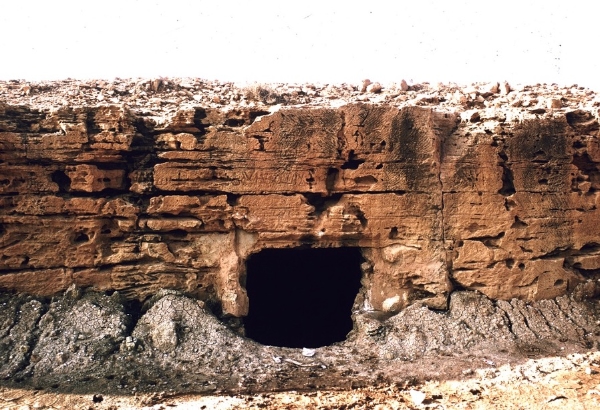
This curious cave was shown to me by Sa’ad, near his house in Benghazi. The inscription carved into the rock above the entrance, he said, identifies it as a refuge for Jews, but he couldn’t say in what period. Does anyone know?
[As all these events and meetings followed hard on each other I was struggling to make sense of them, trying to find words that fit.]
If and when my fate allows me to complete this singular excursion, what will I have to tell my fellow men. What knowledge will I have that is not already theirs. Or if not theirs, ignored deliberately. I shall say that you may meet any man in the world face to face, one to another, and if you take care to stand on level ground you will meet sympathy, goodwill and generosity. But if you set yourself apart, or above, or allow yourself to be one against many, fear may intervene and produce alarming distortions.
Like any growing thing, a meeting between men flowers from a seed that must be delicately sown and nourished. There is no crash programme, for though the stages and seasons may succeed each other in the space of a moment, each one must have its space and be given its time.
Next week: To Cairo and the Pyramids
Despite all warnings and expectations I came through the frontier from Libya with ease. Far from being shot on sight, I was treated like royalty. A valuable lesson. When it comes to borders you never know until you get there. But now I was in Egypt, at night, totally unprepared. My Michelin map has little to offer. Sidi Barrani, Mersa Matruh, El Alamein, Alexandria – just names from World War II. Rommel vs. Montgomery. Here’s what I noted, word for word.
November 7th
In the dark. With only polaroid glasses. What has happened to the visors? Both gone, in Benghazi with Kerim? Drive slowly through Salloum. Cows, several, in the street. Then on to Sidi Barrani. Petrol. Then police post 18 km from Matruh. By now I’m high on the certainty that I really am in Egypt. I’ve saved £55 and several days. Only problem is getting the letters from Benghazi.
Police stop me. Five minutes, they promise me, shuffling through all my papers. They keep passport then suddenly say I must drive, to Matruh behind that car, to the control. The car sets off fast. I put away papers, zip up bag, etc, and go. He drives at 70. Halfway there I reach for the rt hand pannier. Yes, lid has gone. Wallet has gone. Shocked numb, I stop, turn. And drive slowly on the wrong side back to the police post. Nothing. Yes. Two Peugeots have stopped, going each way. The drivers are out and looking at the ground. One waves me on. Incredibly, I go on. Why? I knew they must have found something. What else should it be but my stuff? But I obeyed his signal. Writing this is very painful. I can hardly admit that my nature is so feeble as to surrender so easily to an imperative wave of a hand. It bodes ill, I feel. Later I found the pannier top. Then further on, the truck driver who was helping saw first glove. Further on I found the second. Obviously the wallet should have been between them. Nothing. Demoralised I went on to Matruh. There I was given my passport. I went back to the road, determined not to let go.
Vaccination certificates, driving licenses, Amex card, cable card, picture of Jo, of mother and Bill, of me for visas. And money: Zambian, Ethiopian, Australian, Brazilian, American, – £30 in all. I have marked the distance from the place where we stopped looking. I drive back on the clock and set up a pile of stones. Drive on a mile, then work slowly back and forth. Nothing. Could the wallet have fallen first? Maybe, with lid only locked at the rear end it flew up and stuck, letting the wallet fall.
I drive back to the police post. The fat young Arab is not pleased, but he lets me look. Then I begin to search the verge from that point. Within fifty yards I see a bundle of papers against a shrub. Wallet broken. No money. No address section. No credit cards. Half of one license. No passport pics. Rest intact. Clearly the Arab found it, threw it away again before the police. If I had been able to speak Arabic he would have been caught at the police post. But it was a sad reverse after my triumphant assault on Egypt from the West. And ironic, after all the stories about Egyptian dishonesty. It is now 2 am, too late for a hotel. I am received by police patrol at Matruh and so flattered by their interest and sympathy that my morale is restored. A glass of tea, handful of huge dates, corned beef and bread. Then I’m offered a bedroom. The pock-faced Arab stays with me and engages me with Arabic lessons. Breakfast – Fetarr; Lunch – Redden; Dinner – Ashair. Week, month, year. It’s 4 am now, and the others have put on fatigues and built me a bedroom roofed by soft-board panels.
November 8th
I sleep well. Happy, all’s good and bad equally. So it goes on. Next morning I go back and find, where wallet originally fell, address pages and pics blowing in the desert. But no credit cards. A ten cruzeiro note and half a Tunisian pound. Halva for breakfast, the police on the road to Alex say “Where’s your special permission?” All crumbles before my eyes. Entry to Egypt is just a comedy. It’s the road to Alex that counts. Now they will send me back. The policeman says, No. In Matruh they will give you permission. I don’t believe it. Up to now all such official predictions have proved false. Why should I believe this one, because it’s convenient.
Well, they would have given me permission – if I hadn’t already got it. [I must have found it stuffed inside the carnet] That first meaningless scribble, performed by an illiterate, was the only paper that really mattered, the paper to carry me, as a foreigner, through the radar country between Matruh and Alex.
NOTES
Saved £55 – lost £35: Net gain £20 and three days.
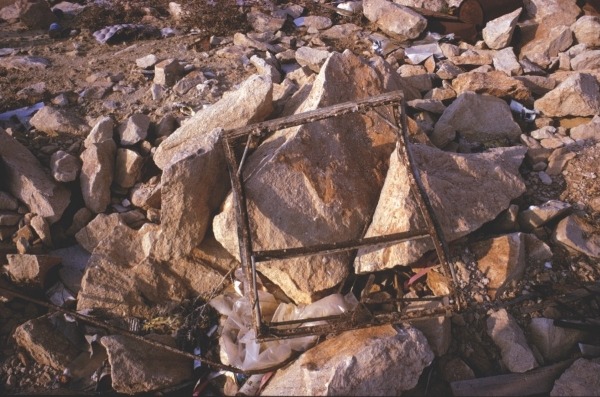
A World War II relic in the desert: Not much, perhaps, but it affected me.
Alex is a labyrinth. Alamein has War II tanks but got little chance to see them. Good lunch + pint of beer costs 75p (English). Petrol about 25p a gallon. Pipeline under construction along the road. Ends halfway. Resumes outside Alex. Dia about 10”. Water, I suppose. Some asbestos pipe, some steel. Little military to see. Donkeys and camels to plough. Turn over top 3” of sandy soil. Plots here and there. Sea is a miracle of blue. Beach white. Cemeteries for everyone – German, Greek, British. Italian. “Manqua fortuna – non valore.” Many police controls – always friendly. Impressed by my newspaper cutting. Can’t gauge whether I’m first foreigner to come through.
Women now graceful. Poised. Balance tin cans of water on their heads, makes them seem precious as any pottery. On to Pension Normandie.
[I arrived in the centre of Alex. A tout directed me to a hotel on the top floor of one of the graceful buildings near the port. Called Pension Normandie, run by elderly Frenchwoman. Noticed smoke pouring from an exhaust pipe. Obviously there was work to be done.]
Monday November 10th, Alexandria
[I found a garage where I could work on the bike. I had never removed a cylinder head and pistons before, but I had a workshop manual. The two garagemen were no help with it but kept me in sandwiches and cigarettes for two days.]
Two days working on motor. Changed a piston. Sculpted the other. Garage life. Consider the number of old Citroens running around Alexandria. Compared with the European view that Arabs have no idea about maintenance. Obviously the truth lies elsewhere. Consider also the things that have not happened to me. I have not been robbed, solicited, harassed or treated as a Martian. On the contrary, from Tunis to Alex I have been fêted. Why? Clearly I stand in a different relationship to them. Monsieur Pacaud [a distinguished Frenchman also staying at the Normandie] would have it that the Egyptian makes no connection between his financial and personal relationships.

My helpers at the garage; near the railway station in Alexandria
Thus, at the garage we haggled over 5 piastres, yet I received much more than that in value. Sandwiches, tea and coffee were brought in impressive quantities. Cigarettes, which are a piastre each, donated freely. The first garage man says he has ten children, earns £E 7.50 a month (well, even if it’s more than that ten times the amount leaves him poor.)
Next week: My arrests
We left our hero (that’s me) stewing in Benghazi, hoping to get help. My visa forbids me to enter Egypt overland. Egypt is at war with Israel. After waiting uselessly for some news from the Sunday Times, my sponsor, I decide I might as well try anyway. Meanwhile I know that between Benghazi and the frontier are famous Roman ruins, not to be missed. These are the notes exactly as I wrote them.
November 5th, leaving Benghazi for the frontier
Kerim’s counsel – visit Cyrene and Appolonius on the way back.
Egyptian consul: “It is absolutely impossible for you to go through to Cairo.” Everybody else more or less emphatically agrees, although when they see I’m determined they say “maybe since you’re journalist”, and so on.
For myself I treat my visit to the frontier as an excursion and set out convinced that I shall return in four or five days to collect the papers now on their way from London, and to put myself and my bike on the plane to Cairo for about $60. I have found this cheaper than road transport for the bike (lowest quote £53) and although a boat would be cheaper there is none till the 20th – in two weeks’ time.
So off to Derna at 2pm. Lose my way slightly and detour by airport, emerging onto main road where the police checkpoint has massive queue of travellers in taxis. But I slip past unnoticed. Travelling East the fez gives way to turban, the women’s white cloak to the check pattern blue and red. Road good but uneventful. Even Michelin green bit is only an average road in the hills of Provence, but rising inland the air becomes quite cold. (although only 1000ft up, at most) and land much richer in vegetation and farming. Building projects, new houses the ‘new town’ with the mosque and grain silo
Realise I must have missed Derna road – and now on the road to El Beida, which means taking the antiquities in now rather than on the way back. But first nightfall intervenes. Find shallow dip between scrub wooded hills, where patch of grass has been cleared and levelled for my particular use by an ally.
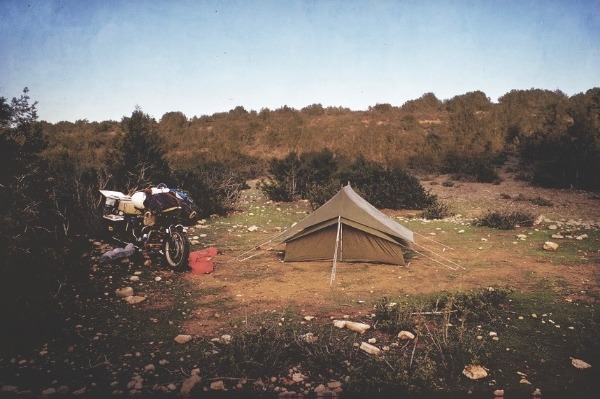
Set up tent. Build fire. Cook Bulgarian mixed veg and peppers with corned beef. Coffee. Very good. Use battery/recorder device. Works well. 8.30 pm. No more distractions. Go to bed. Hear distant male voice, wandering past, coming to me from all directions, talking to dog, which yelps obediently. Can’t help a mounting sense of anxiety. And when the voice breaks into a lusty song I scramble into my trousers, shirt, sweater, jacket, boots and light a cigarette, and advance to confront the enemy. Amazed to find a flock of about fifty sheep gathered by roadside, (hundred yards away). In the middle, two cloaked, turbaned figures; Bright moon gives their clothes a rich appearance. (Next day I see it is only sacking.) We exchange greetings – try to converse but fail. I return to tent and sleep calmly, like one of their sheep. Awake to find them gathered about me. Gazing at the paraphernalia assembled (and am now packing) to pass a night which they endured with such simplicity.
[Although I am not religious, I was aware that this part of the world, called Cyrenaica, had an important part to play in the bible story, and I was powerfully affected by the biblical imagery conjured up in moonlight by noble-seeming shepherds in shining raiment ”watching their flocks by night.” Even more so next morning when, without the trick of moonlight their “raiment” was reduced to sackcloth, their turbans to rags, and they to poor, shivering peasants.]
It is freezing. Dew turned to ice. Fingers numb. Tent soaking wet. Pack and leave.
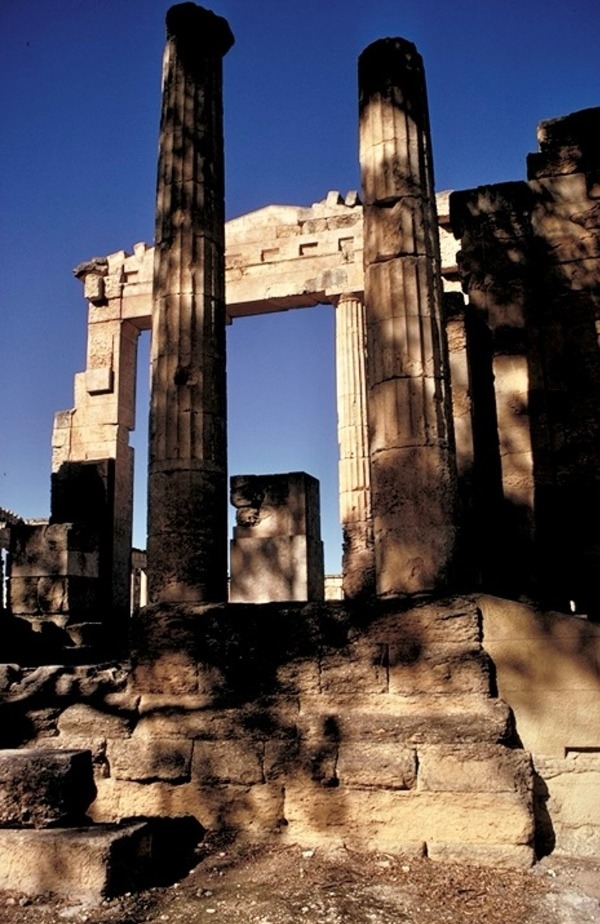
To Shahat, which is Cyrene. Ruins. Pictures.
[I was totally unprepared for what I found. A huge city of Roman ruins, totally deserted but for one Englishman, a French commercial traveller, and a minimal hotel staff.]

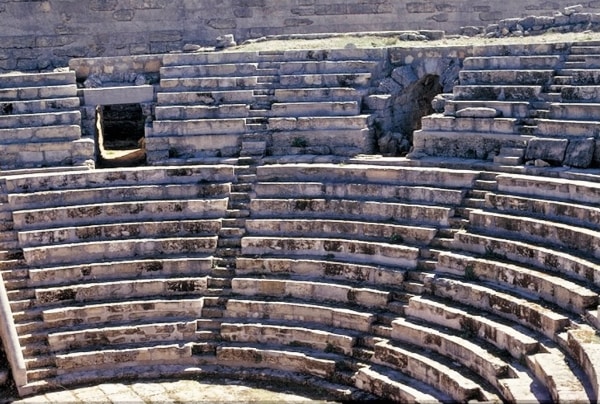
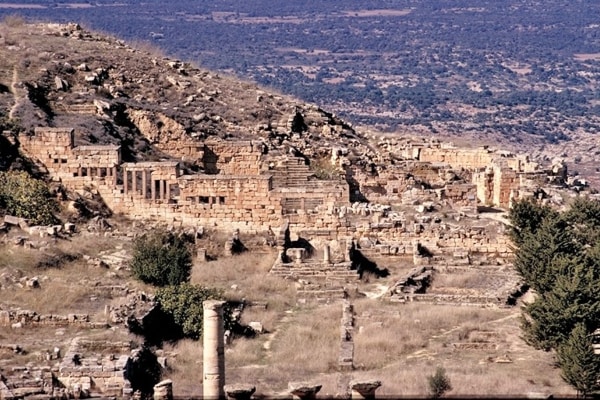
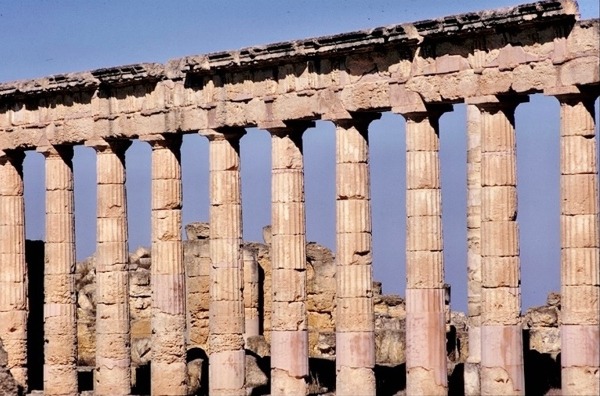
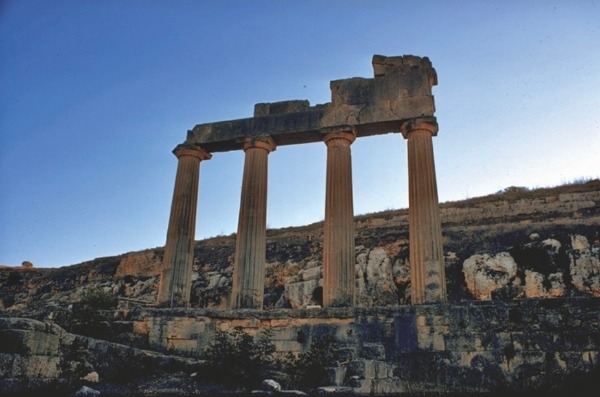
Frenchman at Tourist Hotel. Again, that curious French logic which somehow devalues the Arab quality while paying lip service to it. But good company.
(Jacques Puistienne, African Sales Director, Rhone-Poulenc-Textile, 5 Avenue Percier, 75. Paris 8e. 256 75 75)
Also, English ex-soldier, now wireless/radar installation engineer, living in chalet at hotel. Plastic on horns [???] British bring in brew-it-yourself beer. Says Libyans can’t cope with their technology. Mental age of fourteen.
Party of [Libyan] Air Force bigwigs arrive on guided tour accompanied by Air Force photographer with flash. Very American. After lunch they sweep in and out of Cyrene in ten minutes.
Englishman: “Border is military zone. Itchy trigger fingers. They shoot first then ask. One more Sunday Times man gone.”
All the world loves a lurid tale.
[I leave in the afternoon for Tobruk]
On past Apollonius, and the rugged coast road (the old Italian road) where again the sun catches me. Tent. Mosquitoes this time. Net works well – one bite. Stay up longer this time. Night warm. Sleep well. Morning dry. No condensation. Leave at 8 am. Derna. Tobruk. Hot sun. Meet Noel Moloney in road. Teaches at Oil (‘Isle’) Institute. Invited to tea. Stay for lunch. Wine. Wife Italian. Giuseppina. She hates Arabs. He says they’re childish. Earns £500 a month. 60% take abroad. Buying flat in Ancona. Another in Rome, and farmhouse in Ireland. Says the Libyans regard foreigners as “exploiters.” Has little affection for them. Remarks that after a while the students and staff at institute seem to have fondness for him.
Small children can’t play with Arabs because of skin diseases. [says the wife]
I become increasingly impressed by the difference between my experiences and those of other Europeans. “It wouldn’t be so bad if they didn’t treat us like Martians in the street.” Says Libyans under-use him. Works less than six months in the year (but paid full time.)
They invite me to sleep on my way back. [I am totally convinced they won’t let me into Egypt.]
At 3pm I set off for the frontier. 75 miles. 65 minutes. Convinced I can’t hope to pass but can’t resist the fantasy that I might. Arrive before sunset at Libyan police post. They take my currency exchange form. Why? They show no surprise at my passport. Obviously, they are indulging me in my little escapade. I humour their indulgence. I drive on, waiting for the man who says “No.” Have rehearsed all sorts of speeches about the meaning of war, the importance of adventure, the Arab cause, etc. Come to row of mobile site offices and barricade. More Libyans, but this time they stamp my passport. Now it’s serious because I’m not 100% sure that when Egypt sends me back, Libya will take me. Ridiculous. They wave me through. What, all the way? Yes. I drive into the main customs area, and with delightful innocence plough past the massed taxis, turbans, and mountains of carpet in plastic bags. Eventually I’m hauled back to the “Captain” who presides at a desk on a rostrum.
There, a roly-poly man, unshaven, moustache, takes me personally under his wing. Jumps all queues, gives me a glass of tea. Then:
(1) Man reads my UAR visa, several times looks at “No Entry” qualification. “Access to the UAR via the coast of N.Africa and Salloum is not permitted.” But seems to see nothing there of interest. Takes me to –
(2) Where, with a semi-literate they fill in a Roneo’d form. Great problem with XRW964M. Then give me the paper. I stuff it in with the carnet. Then –
(3) And (4) is another flurry of papers, given and exchanged. I no longer have any idea which are Egyptian, which Libyan, but keeping track is full time as Roly-poly beckons me on. At one point I lose sight of the first paper, something to do with police. “Is it important,” asks Roly-poly. “It isn’t. Never mind.” I give way, knowing I shouldn’t. Change money at (5), pay for licensing bike at (6). Back to (3) for argument about carnet. Then at (7) Libyans discharge it. to (8) where a police officer behind a row of ledgers so thumbed as to be eroded like old stone bannisters, says he’ll give me three months and hands me two heavy steel number plates. Bemused, I totter off with my load.
“That’s all,” says Roly-Poly. “Now, can I help you in any other way?” I don’t know what to do. Fumble towards my pocket, then decide against it. He looks corrupt, but that’s as likely to be my prejudice. Why assume it? He seems happy enough when I thank him and turn away.
Earlier, he asked, urgently, “Did you thank him?” referring to the captain. Puzzled, I replied “I always thank everyone.” He laughs loudly, but I’m no wiser. Did he mean bribe, reward? Meanwhile I’ve found that first cryptic form again, and stuff it away with all the others. There is no room for passport and wallet in the tank bag. I lay them over big gloves in the rt-hand pannier. Lock up and leave. The impossible has happened. I’m in Egypt.
Next week: The rocky road to Alexandria.
A missing chapter. For those of you bothering to follow this series of notes chronologically I have to confess that I mistakenly left out a section of notes about the ferry from Palermo to Tunis. Because I think it was significant and reads rather well, I’m going to interrupt the story and tell it here:

On the ship between Palermo and Tunis, the second class lounge was dominated by two personalities: the Italian barman and an itinerant Tunisian visiting home from the great casual labour markets of Northern Europe. They were at opposite poles of human conduct.
The boat left at 9.30 – a fine looking, modern boat, with drive on facilities, called “Pascoli.” On the deck I met, briefly, two somewhat effete Englishmen with a Renault, driving back to their home in Tangier. I still seemed a long way from the kind of Africa I was expecting. Then I saw the Tunisian Hassen from the market yesterday, and with him was the man who became the pivot of the ship’s life for most of the morning.
He was chubby, Castro-bearded in a green tunic (US style). Shock of black hair at the top, pale skin wrinkled by much facial work. Coconut shaped head. About 30 years old. Started by being merely noisy.
“Ah you, vous, wass machen, sprechen Deutsch. Ich auch. Scheisse.” Burst of Arabic. “Ich bin Hamburg. . . . “ and so on. Then he started singing. I just thought he was a disagreeable oaf, and went down to the lounge for a beer, where the Italian barman held sway. He represented all that was petty and corrupt. He treated the lounge and its occupants, mostly Tunisian Arabs, as his private colony. His strutting and posturing were unforgettable. The bar was his seat of administration where he granted or withheld service as capriciously as any despot. No, withheld is too mild. Refused, volubly, rudely, with accompanying gestures. Every now and again he would fly into a tantrum about the television set tuned, naturally enough, to a Tunisian program and insist on switching to an Italian football match, although the picture was scarcely visible, the sound was no more than a roar of static, and he himself never once looked at the screen. When his bumptious little body, with its prematurely pregnant belly slung over the Italian sailor’s sash, came round on a tour of inspection, passengers dozing iin their seats with outstretched legs had their feet roughly kicked out of the way, while his equally offensive sport was to fling empty bottles into a large container where they fell with a regular shattering crash. It was truly breath-taking to see one man seize upon his environment which theoretically belonged not to him but his customers, and make of it an instrument for the complete expression of his selfish nature while the rest of us submitted in our various ways, resigned, resentful, or merely numbed.
He represented in my eyes all that is brutal, greedy and corrupt in human behavior, and he was a powerful influence in stimulating my sympathy for the Arabs. Short of violence it was obvious that the man could not be stopped.
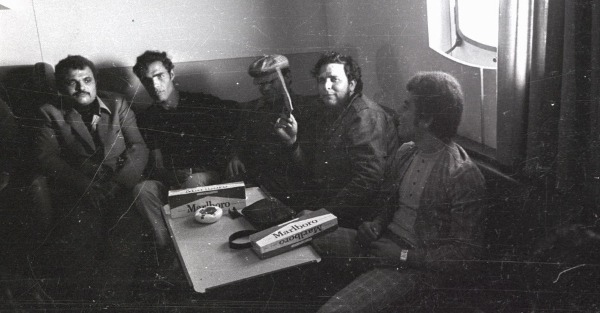
The poet is waving a paper in front of Mohamed’s face
The singing buffoon came in a little later, when it started to rain outside. He sat at the far end of the lounge still chanting and smiling as though at some Sufi vision. In the confined space the songs were much clearer. Hassen said they were nonsense about girls and love, and he was apparently making them up as he went, but at least he offered an alternative kind of vitality to the terrible malignant power of the barman.
The Arabs nearest him began tapping and clapping along, and others drifted closer, but he continued for a while as though he were unaware of any of us, playing the fool for another audience that only he could see. The barman was noticeably annoyed and the tempo of his outrages increased, but although he still commanded two thirds of the saloon he did not meddle with the singer, whose territory was growing. I sat for a while on the border line of their two spheres of influence, and it was like looking out on two different worlds. To my left, shouting, hostility, the smashing of bottles and, from the TV, the gibbering howl of the ether. To my right, singing, laughter and a beat that was beginning to reach into me. Hassen and I moved across to the right.
The singer judged this the moment to come out of his private retreat and began to respond to his followers. I could not imagine how I had ever thought him distasteful. At worst he was a simple clown, but his power now seemed to grow as the barman’s dwindled. He interrupted his buffoonery with poetry, and Hassen told me it was original and good. The same thumb and forefinger placed the words in the air with a precision and meaning that I felt I could understand, though I spoke no Arabic. The songs also became longer, more lyrical. Slowly, over a period of several hours, the pitch of his performance built up. The barman by now was utterly effaced, the TV could no longer be heard. Everyone in the saloon was with the singer, his to a man, and yet he still seemed strangely detached from us, not feeding at all on our adulation in the manner of a Western “star.” Nor was there ever an attempt by anyone to compete with him. He remained the focus of energy for the rest of the crossing.
Towards the end he moved from songs and poetry to oratory. It was a long speech, and if the rhythms were anything to go by, it was in the Arab equivalent of blank verse. His voice now was very muscular and gritty. The harsh, hard-nosed syllables flew out in formation and beat on my ear. His audience replied with moans and cries of agreement. I imagined the voice amplified a thousand times, a hundred thousand times, from loudspeakers on all the minarets of Islam.
The sounds conjured up an atmosphere of great ferocity, yet the sense of the speech, it turned out, was moderate. It had to do with peace and war in the Middle East. It praised the moderate statesmanship of Bourguiba, and poured scorn on the troublemakers who would fight, like Qaddafi of Libya, to the last Egyptian. Hassen said it was good sense, realistic and very poetic.
The train driver from Sousse translated and gave his view.
“At first I thought he was a fool. But now what he says is really impressive. It is realistic and good sense and very poetic.”
It was well after dark when the ship arrived in Tunis. By then I had made another friend, Mohamad, a young Tunisian who was one of the singer’s most enthusiastic accompanists. He was more stylishly dressed than most, with a jazzy peaked cap on, which he never removed. His nickname, loosely translated from Arabic, meant “The Swell.” He asked me where I was going to stay in Tunis, and I said I had no idea.
“Then you will stay with me. My family will be very honored. You will have everything we can offer. We will be extremely proud to have such a famous man in our house and our friendship will last forever. I have a dark skin but my soul is white as a lily. You will be safe and well in my house.”
Before leaving the ship I happened to notice the barman. He seemed a rather insignificant person, cleaning up after us, hardly worth bothering with.
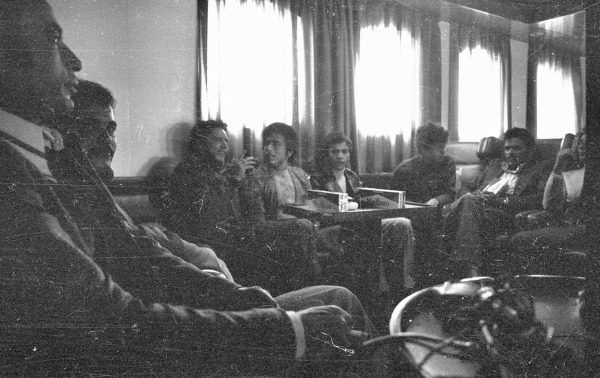
The poet is in the middle. Well, I never claimed to be a photographer.
On the road to Benghazi.
Wednesday, October 31st, Marsa Bregha
Oil refinery and tankers. Aircraft parked in the desert. No houses. Eerie. On to Benghazi. Run dry within sight of it. Fortuitous. Two good young men. Give me petrol. Take me into Benghazi. Buy me a tankful!! Take me for coffee. Help look for elusive Sabecol. [The Sunday Times had a point of contact in a business called Sabecol.] Help me find hotel. Offer to help with phone call – through brother in PTT. [Post office] Lend me a pound. Stupendous hospitality and generosity.
Meet man with garage in the same road. Freedom of the house. Eat beans, tripe, peppers. 10 piastres. Walk round Benghazi and fall in love with it. Squares with parks and fountains. Women in streets. Shops and arcades. Fascinating markets. Poles away from Tripoli. Shoes at six or seven pounds. Watches everywhere. Backscratcher for Jo. But insides are all ugly. Thought is beginning to form. Beauty at price of personal ugliness. Kindness flourishes on barren soil. Streets are paved with potholes. As though a tank regiment had just fought its way through.
Wednesday 31st
I am living in a community virtually created for me. The hotel. Opposite the small restaurant, white tiles, oil cloth, odd smell but you get used to it. Clean, cheap. Just 30 yards down, the motorcycle workshop, put entirely at my disposal by the owner, Kerim Ali.
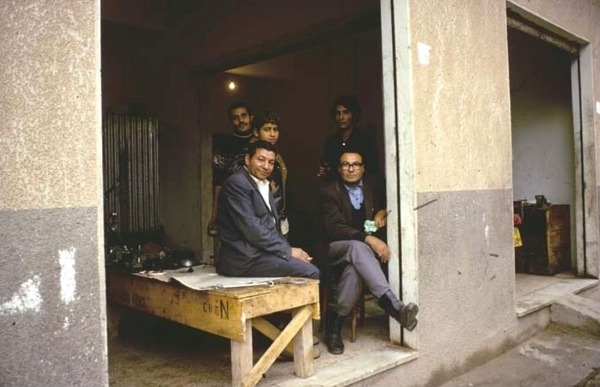
Kerim Ali and his workshop. Tremendous help and enthusiasm.
And opposite him an amazing scrapyard come general engineering shop run by Mustafa, a skilled engineer where I can get anything made, welded, etc. But the mysterious Sabecol still eludes me. Kerim has been given six different telephone numbers. Every time he rings directory, another number. He grins disarmingly. Tomorrow, he says, we will drive there. Sa’ad passes by and starts working with me on the Triumph. I clean it, reset timing, tappets, clean out carb. Change chain, change oil, change plugs. Tomorrow grease and oiling.
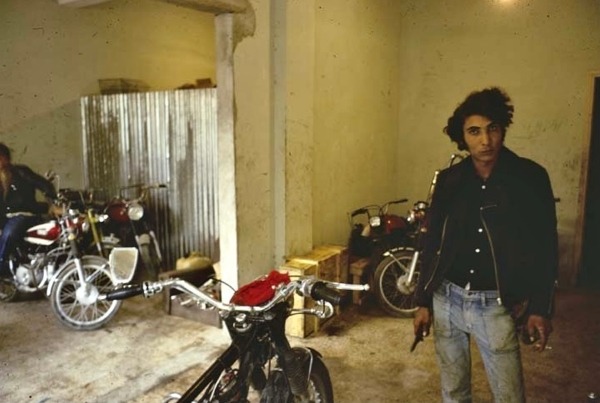
Sa’ad worked on the bike with me, and invited me to his home.
Walk around with Sa’ad. Everything stops at 9pm. Except the café on the sea front. Veery pleasant though. Gold market. Fishing with dynamite. Another tedious banking scene. Dollar down to 2.50 to pound. Bad business. Surfeit of one dollar bills.
Thursday November 1st
Another day. But Sabecol has been penetrated. The omnipotent Kerim drives me out of city on Tripoli road where he says all big businesses have moved. There is very little “traffic” (business) in Libya these days, he says. The people have money, but they keep it. Afraid to invest. Sabecol is an empty space.. Used to do British cars and bikes – now only get spare parts. Letters there from ST. Another, to P.O.Box 217, has got away. Back to Kerim’s shop. Sa’ad arrives. More work on bike, fixing the recorder input lead. Talk to Mustafa the welder. Specialises in cast iron and aluminium alloy welding. Oldest welder in Cyrenaica. Amazing workshop – a jungle of scrap metal. Rusted corrugated iron overhead. He limps. Has a soft, fastidious expression.
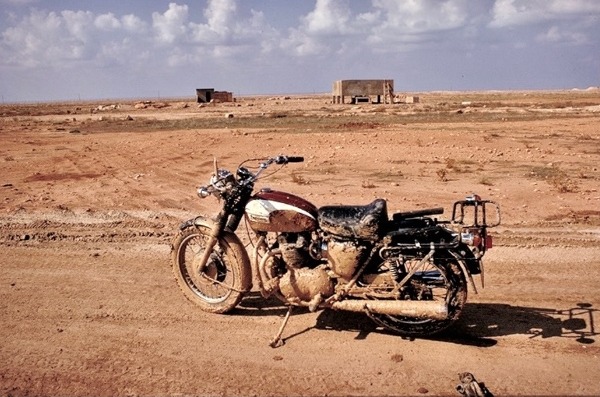
On the way to Sa’ad’s home I disgraced myself in a pool of wet clay.
I drove Sa’ad to his house across a wasteland of rubbish, craters. Old World War II US airfield, with £25 million university rising out of it. Around it – then swoosh, squelch – into wet mud, clay – over we go. Come up like figures ready for firing. Pic of bike. And all that time spent cleaning it. Cameras encrusted. So Sa’ad drives while I palpitate on back. No harm. Very funny incident. But I hope I see it next time if I’m going faster.
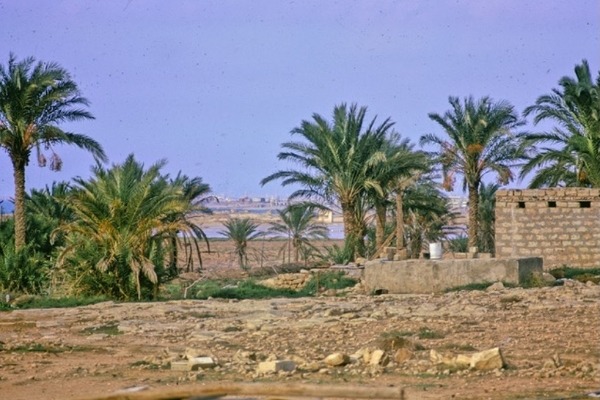
Two pictures of Sa’ad’s home.
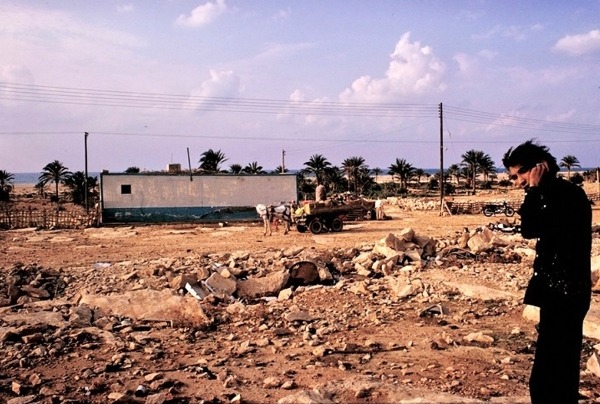
Is Sa’ad on his mobile phone?
Sa’ad’s home a long, square plot by the beach. Those ‘date’ palms, are either unripe dates or something similar. They have sheep in a pen built of old doors, planks, windows. Profusion of parts. Vegetables, onions, cabbage, tomatoes (on ground) Donkey. Dogs ( 3 ) Cat and kittens and endless brothers. Also pigeons, small turkeys – or guinea fowl? All within yards of the beach. A great stack of sandstone blocks (inhabited by a rabbit) waits to be added to the house (hewn from that same quarry). Sa’ad has two shacks of plank strewn with motorcycle parts and machines in rusty dilapidation. A Triumph Trophy, a Guzzi, a Yamaha. Advertisements for cars, motorcycles, and a British shower manufacturer from Birmingham contributes his two pennorth of titillation with banal lady under shower with nipples showing. The shack nearest the shore is on stilts and has a Cannery Row feeling about it.
You drive fifty miles of barren road and ee a triumphal arc across the road, usually sky blue and apparently made of plywood and plaster board. At the foot of the arch is usually a policeman or a soldier, and often they will stop you for your papers. After this the road generally deteriorates and widens out to be about three times the width with rough asphalt or mud. Theen, on either side a row of single-storey, open fronted spaces of brick and plaster, used variously as café, a general store, living rooms, a garage, etc. Because no particular style has evolved to differentiate between premises for, say, a builder or an ironmonger, my western eye has difficulty seeing through the general jumble. On either side a row of pumps, sometimes new, sometimes rusted. It’s hard to tell which are working. They all carry the sign of the government oil company although I gather they are serviced, as before, by different companies, Shell, Esso, etc. But you don’t know or care what you’re getting since its half the British price.
Parked by the pumps are likely to be: A Peugeot 404 estate taxi, nose and tail painted white, mid-section black with a group of sombre men packed inside wrapped in white shawls and topped with fezzes, often clasping cushions or pillows in plastic bags; a row of buses containing a mixed cargo of soldiers and civilians and driven by either; any sort of private car as long as it’s German, French, , Italian or Japanese; a Datsun or Toyota pick-up truck. Buses and most taxis have tarpaulin bundles of luggage on top. In October, November the area is a sea of mud.
I have never seen an Arab manifest impatience or throw rank (except within the family).
Monday November 5th
And I have been here too long. Or rather I have been here long enough to feel time weigh on me. Clearly, I am impatient to get on, frustrated by the delays and still uncertain about a plan to get across, so I feel the time pass. But for the ordinary young man in Benghazi time is scarcely less of a burden. There seems to be little else to do here but work or speculate. The streets are crowded in the evenings by groups of men talking. There would seem to be literally nothing for them to do except go to the cinema. Some go every night. The arrival of a new film is a major event. Much of the audience is acquainted, and they react to breaks in the reel with esprit de corps – like an army audience.
Much lip service is paid to the evils of war but the only convincing sentiments are those deploring its economic effect. Kerim says the price of timber has gone up from £30 to £50 per cubic metre. I don’t think anyone actually wants to fight, but many are impressed by the idea of fighting. Violent films are popular, and there seems to be a karate craze on here. Twice I’ve seen a youth in the street play at a karate blow and it’s been mentioned casually several times. Benghazi itself was designed for more frivolous times. It has several squares with palm trees and fountains, formally laid out with pools geometrically pattered among tiled areas and flower beds. Sharia (road) Omar Mukhtar has arcades running its full length – modern, including the post office, giving way to 19th century. Virtually every ground floor opening onto most streets is a store of some kind. And invariably steel rolling shutters come clattering down at 9pm giving the town a bleak, dead look. Road works everywhere, pumps ins continuous operation provide Benghazi its characteristic background noise, like the cicadas in other places. Yet in spite of the bombed sites (are they really still from the war?) and the shattered roads, the city promises a sophistication and variety which it cannot deliver.
Undoubtedly the current regime has flushed out many babies with the bathwater, filthy as they may have been. With alcohol and tourism gone there are no clubs, no luxury restaurants. The West is represented only by its hardware. A parade of watches, transistors, cars, domestic appliances. No live music at all, except for religious festivals and marriages. Apparently, no theatre, and little demand for it. A ‘bloc’ mentality, faintly reminiscent of pre-war Germany, but without the economic hardship. Libyans have money. The State shares out its oil income with allowances. £5 a month for every child. A £40 pound allowance for married men. £20 for single men. Young people seem healthy, bursting with vitality. Slim. None of that Western obesity. But all heavy smokers. Older generation frequently bow-legged – some squints. Older women all seem stunted and prematurely aged under their red or blue checked burkas. [I don’t explain how I saw beneath them!]
Here at least (unlike Tripoli) girls in Western trouser suits are seen in the streets going to and from work (or school). The atmosphere is less repressive. There are skins of every shade, from pale Libyan through brown Egyptian, to coal black Sudanese. The Egyptians have been brought in as cheap labour and are becoming an embarrassment, I’m told.
As well as selling goodies, there is a disproportionate number of shops dealing in paint, tools and electrical fittings and materials indicating a great preoccupation with house renovation. Police and soldiers everywhere, but not in an intimidating way, except to the paranoid foreigner who feels suspicious eyes upon him. It is considered unwise to take photographs and nobody uses cameras. Arabs are said not to like having their pictures taken. I have always found the opposite to be true however and I think the camera-shy Arab is a myth in the city.
All in all, I feel this society is off balance, and that much of what is wrong in the Middle East may be the consequence. The spiritual life of Islam has no answers for a restless new urban class, yet they cling to it. I can’t honestly say I wish them the benefits of a Western cultural life, or that they should cease to observe the customs of hospitality which I have enjoyed to a surfeit. But there is tension, and loose energy that the pursuit of technology can only exacerbate.
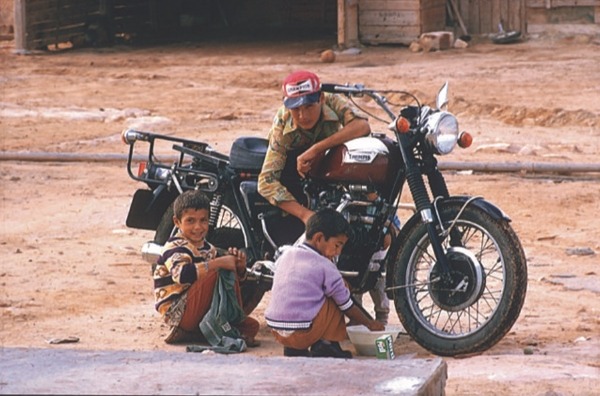
Sa’ad’s brothers did the clean-up.
Chased out of Tunis by the police, and heading for Libya.
Tuesday 23rd October
Drive through Tunisia. Wet. Confusions at Sousse. Wrong name for the train conductor. On to Gabes. Hotel de la Poste. Letter to Peter. Right or wrong? Frenchman at Atlantic. Was there in war to put up radar station. Germans no good at electronics – except Siemens. Italians did nothing for the Libyans.
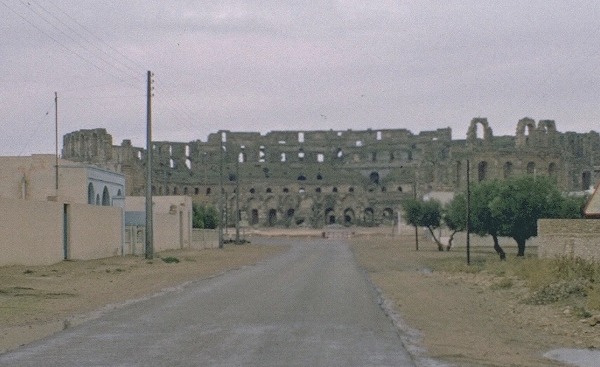
The coliseum at El Djem
Floods. Road cut behind me. Sousse. The Alaba? Hotel. All hawking and spitting. Good restaurant by the roundabout. Room was I dinar (£1) Remember how I was cornered with the bike in small gateway at back and forced to bargain for parking. I didn’t even know there were people sleeping under all that plastic at the back until next morning. I wonder whose lodging was more profitable – the man or the motorcycle?
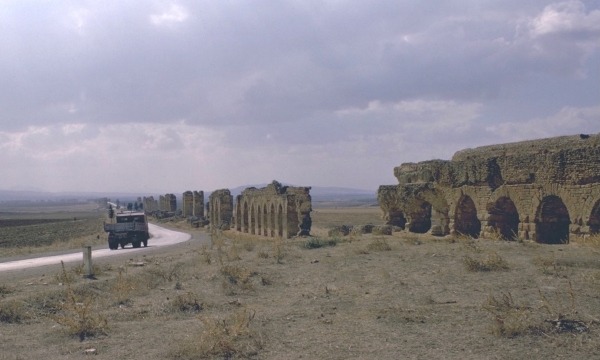
Remains of a Roman aqueduct
[There are some days here I can’t account for, but I arrive eventually at the frontier with Libya. It’s not long since Colonel Gadaffi (or Quadaffi) seized power.]
Libya, Sunday 28th
Police. Man with shotgun. Chief in his shiny Italian suit and suave grin, with carton of Marlborough under his arm. Customs man. Other man who came in to do police forms and passport.
“Helt?” he said. Oh, Health!
Sheets of Roneo’d forms in Arabic. No communication, but goodwill.
“Whisky?”
First taste of Libya, all Arabic. No alcohol. All fizzy water and Pepsi. Night on the dunes. Chakchowka [?] Coffee. Tent tied to bike. Lightening at sea. Then in morning, rain. Will bike fall through the tent? Will I be washed away? Frenzy of packing as huge black storm cloud piles up behind me. More sand than tent in the bag. But bike travels well over wet sand. Hooray for Avon tyres. But what hard work. And what did I lose in the process? Nothing, as it turns out.
On to Tripoli. Totally at sea with Arabic signs. Can’t distinguish one sign from another. Ask a driver for “hotel?”
“Follow me. I have time for you because I see you are lost.”
Customs took half my Libyan money. Hotel costs two and a half Libyan pounds – that’s over £3. Money is going at a rate. Meet Yorkshire engineer. Walk to the esplanade. Port full of ships.
“Been there for weeks. Port is too small. Can’t turn them round.”
Hotel full of roughneck Italians. Pipelaying gang reading comics. Not a woman in sight. In the street occasionally see bulky objects swathed in ‘Barka’, one eye showing. Mustn’t look at them. Who would want to? City looks full of bomb sites. Arrived at 11am. Spent most of the day sorting out mess from the night before. Into the shower with the tent, washing sand out. Dry it on balcony. Boots sodden.
Don’t dry till next morning. But dubbin goes in well. Market is full of transistor gear. All looks like rubbish. In fact it’s all very rubbishy. Not a pretty object in sight.
Amin [Uganda president] is in Tripoli. Appears on television, like an ape-man.
In the morning, the bank. Soldier, shabby, hairy, with gun. Stout Arab is at the cashier. Behind cracked glass three men are all engaged in counting his money. He has brought a stack of notes over a foot high. And all in fives, tens and twenties. They count them again, and again. Holding bundle with one hand, flipping notes sideways with the other, looking around and smiling at friends, losing count and starting again. Twenty minutes goes by. Rain still bursts down sporadically.
Off at last. After eleven. The road to Benghazi. First, olive groves. Small trees. Then thousands of date palms. Dates light brown clusters at centre of palm – like dead leaves. Occasional camel. Settlements, earth confined by mud dykes. Wells of curious shape. Why the steps? Tried to ask the man here at hotel. Yes, he said, it’s like this. The road from here is good for 250km. Then there’s a very bad stretch of 250km !!!!???? Indeed. And what happened to my bed at 75 piastres? One Dinar it costs me for an army bed. But I digress. This is no tourist country. Why should I complain about it? That’s how it is.
The desert. Wow! Really desert. Out for ever. Cloud. Sun. Rain. Blue sky. All at once. For hundreds of miles around. I’ve never seen so much weather. Part of it’s dry. Groups of camels gather by the road. Frightened by noise, but shrubs grow greener at roadside. Pictures. Camels in haze of sand. On and on. Sand drifting across tarmac makes patterns like flames in fire.
First mechanical trouble. Throttle is stuck. Can hardly move it up. Won’t slide back. Have to cut off to slow down. Get to Ben-Gren way station.
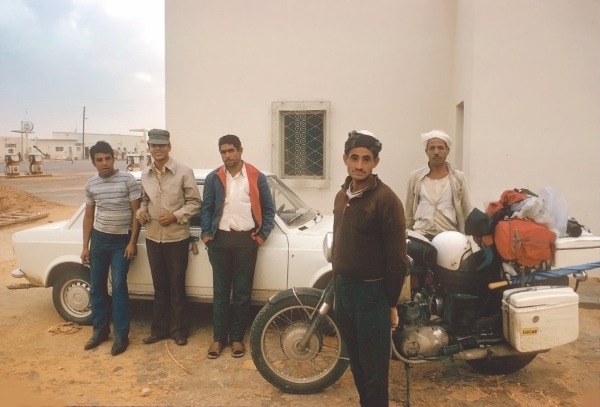
First signs of trouble. Air filter inadequate.
Two Egyptian labourers help to move bike into shelter where I clean sand out of carburetor. This is going to happen again. Get a plate of spaghetti – young fellow, son of owner, speaks English. He gives me the food. Take pictures again. Also took pic earlier of – Septis Magna – was it?
Police stop me once. Go through my papers. No question of insurance, though. Drive on as sun dies behind me. Into the gates of hell. Huge storm blackens sky ahead. Seem to be always driving into the worst weather. Altogether this journey feels like that. Sort of apocalyptic. Like Frodo going to the dark country.
After the storm, road suddenly barred. Diversion points out into the desert. Can’t see a road. Decide to ignore sign. Tarmac continues, very broad, almost like an airstrip. Is it? Nearly at the end, car full of soldiers comes weaving past and stops me. Examine my passport upside down, very earnestly. But always with good humour. Police and soldiers shake your hand afterwards. Wish you well. On into the night. Feel good, alert. Ready to drive all night, but stop for petrol at Sirte, and soldier says I must go to police. Evidently, they don’t like people out at night. Have to stay at this hotel. Rambling building. Group of Arabs in fez and pyjamas sitting in one corner smoking and drinking tea. Those famous pyjamas. Desert dogs look white and handsome. Ground in Libya looks as though it’s had the top ripped off – like bottom of a disused quarry.
Sirte is a sea of wet sand. But everywhere among the broken buildings, the rubbish, the peasant shacks, are new cars gleaming. Black and white taxis drive up to the poorest buildings, rush up and down the highway – big Peugeots, Mercedes, Datsun trucks, Toyota rovers. And everyone seems to have a stack of those big banknotes, to make me feel poor, underprivileged like a newly arrived Pakistani.
In this weather the tent is almost impossible to use. Hotels break me. Only petrol is cheap, thank God.
Oh yes. Big tents in the desert, usually near a village. Like marquees.
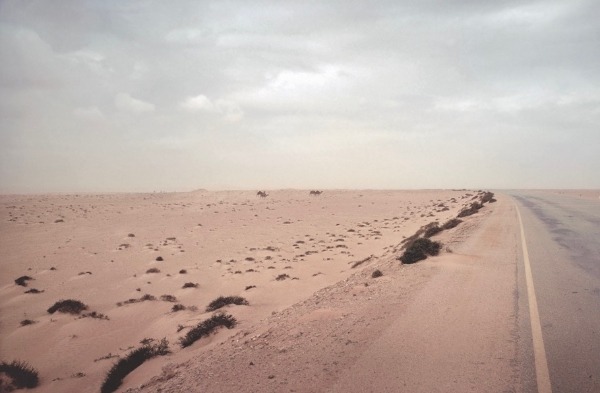
Lousy desert picture, but it’s all I’ve got.
Tuesday, October 30th
Left Sirte at dawn. Clerk sleeping in his clothes by the door, wrapped in a sheet with light on, his white fez by his couch. Arabs by the car-load continuing their journey. Rain goes on. Very heavy for three hours. Can’t believe the bike won’t stop. God bless Triumph, and Avon – and Lucas. Stop for petrol at small place before Sidr. Cup of mint tea, packet of sweet rolls. Bartender takes 10 p. Must have cost more. Had two shaky moments on mud ridges dried hard and then wetted down. Was into the second before I realised what the first had been.
Absolutely soaked. Boots squelching. Crutch sopping. Then, at 10am, after 150 miles head down on tank, like a bullet at 70mph through downpour comes the light. This desert is not the desert of BOP, of Khartoum and Lawrence. This is a primaeval swamp and camels look like prehistoric monsters. Rivers gushing along the side of the road. More permanently garnished with shredded tyres and cautionary wrecks – road safety sculptures of cars frozen and rusting in the posture of collision. A deliberate warning? Or simply neglect.
The sky clears as I drive out from under the roof of raincloud. Stop. Walk in the desert. Picture of bike draped in clothing. Then on in sunshine. 100 miles from Benghazi, make coffee, eat sardines within 100 yards of tented encampment. But nobody approaches.
Next week: To Benghazi
