News from Ted
I’m back in India, and from Madurai I rode out of the state of Tamil Nadu into Kerala, and across the Cardamom Hills through Kodaicanal to the West coast at Cochin.
Colombian country. Neat agriculture. High coconuts, bananas. Last stretch to Cochin in dark, on wrong road. Wet. Potholes. Red buses. Corporation guest house. 7 rupees. Sea Face Hotel. Volga Rest. 5-rupee note.
[I met some Europeans who were devoted to India and the Beatles. They sang a lot.]
Astor, Lydia, Candissy, and ? . . .
“Thank you, Lord, thank you.
Love is the force
That will force the course
Of India. . . . . India.”
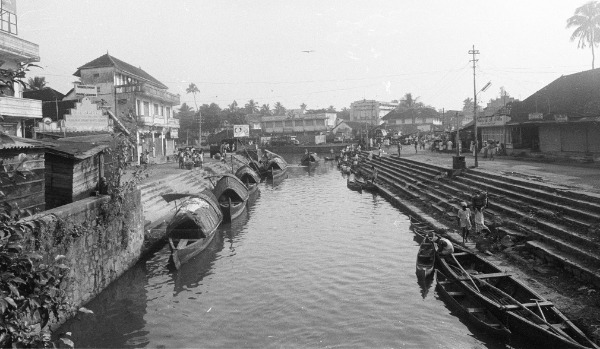
A scene at the old port of Cochin
Dutch church in Cochin. Tanker terminal. Junk rigged barges. Yeasty beer.
October 18th
[On my way to Ootacamund, known to British colonialists as Ooty, a hill station high enough to be cool in the summer.]
Hand-made highways of India. Gang of women in saris circling round roadbed with baskets of earth [on their heads] Man in dhoti and shirt, looking at watch.
Police line roads in villages. Police lieutenant waves me on, sourly. Cavalcade of old cars with state pennant on bonnets comes past other way. Who?
Bamboo clumps, very high. Village sewing machines. Change money in Palghat. Difficulty with signature. Through Coimbatore – busy commercial town. Then up into jagged ridge of Ooty. First through groves of very tall, thin, graceful palms, which are betel trees. Climb up is similar to Kodai but more population up there, first Coonor, then Ooty.
Meet Hans-Georg and Irmgaard [Bohle] on little Enfield struggling up hill. Introduce me to Indo-German unit. Herr Schultz (an effeminate anthropologist) and then Fritz Reich and his wife Elena and son Christian. Fritz is the last of the project which started 8 or 9 years ago with a large group looking for ways to help the potato growers – either by rescuing the potato harvests from blight and golden nematodes or finding better alternative crops. Problem: growers crop up to three times a year, no rotation. Alternative: cabbage. Best yield from Japanese variety – up to 40 lbs per head – but unsaleable.
[What can you do with a 40lb cabbage? This story remains my best example of what happens when well-meaning westerners try to help without knowledge of the circumstances. But they found a better alternative.]
Now a German Weisskohl, more practical (cf; Findhorn). But Indians expected too much from project, dissatisfied, and Germans, disappointed, are withdrawing. Set up one of the world’s finest soil laboratories – now in Indian hands.
[I kept in touch with Hans Bohle throughout his later life. He became an eminent professor at the University of Bonn. His speciality was food security. About twenty years ago I asked him when he and his colleagues had known the world faced a climate emergency. “Oh, fifteen, twenty years ago”, he said, “maybe more”. He died, too young, in 2014. There was an English entrepreneur in Ooty too.]
Nigel Stewart: Nottingham – Boots chemists. To Pakistan. Squeezed out. Returned to Notts with Parsee wife. No good. Went to Kashmir. Found work selling and promoting pesticides. War got in way. Was made Director for plant protection. Kashmiris connived to get rid of him. First blocked his pay. Then got him made Director of Mushroom Promotion. Then wiped out other appointment. But he got a mushroom industry going with help of a German expert. After two years couldn’t stand climate and atmosphere. Came to Nilgiris to start up alone. Starved of capital. After five years wife died. But plodded on. Still loses money – but makes it up on horticulture, etc. But mushroom plant is halfway to completion and capital is promised.
Mushrooms: Horse stable manure and straw. Gets his from Army stables. 3.5 tons at a time. Add 2 tons of water. Stack it in long mound. And turn it over every two days. Add urea, calcium, phosphate, sulphate, reaching 150 degrees F. Ammonia breaks down straw. Temperature kills unwanted organisms. After three weeks ammonia all gone (fatal to mushrooms} Stuff spread on sterile surface to cool, then packed in trays, or sacks. And a bottle of sorghum colonised by mycelium from cultures grown from a selected mushroom spread over each tray. Kept for three weeks as mycelium propagates, then covered with an inch of sterile soil. (In his case it’s the final compost product kept for a year after cropping). Another three weeks in special sheds , and mushrooms begin to come up. Up to five “flushes” at intervals of ten to 14 days.
He now sends 6 Kgs by air to Bombay daily. 30 rupees a kilo. Is looking for a mushroom expert from UK who may be able to feed in £100,000 more in time, to build a canning factory.
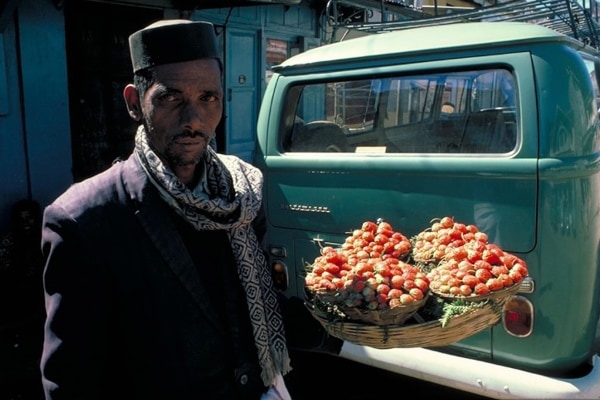
Strawberries for sale in Ooty
In evening, with Germans, we visit Mrs. Widemayer, to join her Deevali celebrations. She ios a Toda tribeswoman who got some sort of medical education and married a resident German. She has become leader and spokeswoman for her tribe and lives in a fancy house uphill. There were children of all ages, and various older dependents, and we had fireworks. Afterwards, the kids did songs and funny sketches. I drank Jägermeister. It was very cold outside.
Saturday. October 23rd
We went to breakfast in town. Forgot to mention yesterday’s breakfast on lawn outside Glyngarth House. Sun and flowers and a load of food. Lovely time.
Today went to silver shops and went mad. Bought at three shops. Little spaces, low ceilings, owners sit behind low counters of wood and glass with silver inside. Painted wooden furniture. First shop is pawnbroker. He has sweet betel smile. Shows a pair of lovely ankle chains. Wants 1.20 rupees per gram. Agree on 1.10. Weight 90 grams. 100 rupees. Next shop is bigger. Old man with cloth round head lounges back. Young man in Western clothes does selling. All 1 rupee per gram. Has heavy necklace of silver rope with ten amulets strung, and silver pendant on heavy chain. Also, waist rope four ft long, child’s heavy bracelet with clasp, another light open anklet, a silver and wool dolly to hang from belt. Altogether weighs 320 grams. Pay 310 rupees. Third shop much smarter, two young men, very businesslike, have heavier necklace and light one with silver pearls. 150 rupees. Buy last two lots and take booty back to house. So pleased I decide to go back in afternoon. Buy ankle chains and more bits (including clasps) from second shop. Another 80 rupees. 640 rupees all told. $US 71.
Take my winnings to Fritz’s house to show. Glyngarth House is a very roomy two-storey house with fancy tower, stairwell at one corner. Fine wooden floors, joss sticks burning. Toda embroidery on walls. Elena gives me tea. Likes the silver. Fritz returns. We talk about life, processes of enlightenment. He is 37, recently discovered the burden of anxieties under which he laboured and is trying to shed them. Came from East (Thuringen) where father had land and lost it. He is a nervous man with many propitiating habits – quick smiles, wry grins, snorts and hesitations, etc. Inclined to explain things in terms of Christianity – weight of guilt. We seem to arrive at a good understanding, but it may be wishful thinking in part. Later Hans-G and Irma arrive. Conversation continues through and after dinner. Discuss possibility that an attitude of mind we take for granted may be totally absent [in India]. It’s the same concept, basically, which I found short in Latin America. A willingness to combine with others in a practical, commercial way for the general good. Indeed the idea of ‘general good’ itself seems not to occur. The Nilgiri farmers do not help each other.
On the way up to Ooty I stopped and watched the monkeys. Had idea of comparing men with monkeys. Some people give us the impression of being as limited as monkeys in their approach to social problems. Seem to lack the vital concept that gives activity a higher meaning. Watched the monkey at Mannar playing with two coins. He rubbed them together, chewed them, struck the ironwork with them, moved them around – nothing happened. Ingenuity without purpose.
In the Indian family there is relatively less scope for individual discovery. Children are held close to parents all the time. Great care is taken that they do everything in the proper way. Small wonder if it later doesn’t occur to them to look for their own solutions, still less that they don’t combine to find solutions. It is easy to propose schemes that would open children’s minds, but they all depend on the powerful presence of ‘enlightened’ adults. Otherwise nothing short of a major disruption of the social fabric can produce the necessary condition – with such painful, wasteful results. Time, of course, and slow pressure might achieve better result, but is time now an impossible luxury?
Interesting to try to see ourselves in as revealing a perspective as we see others. We are monkeys too, struggling for elusive concepts. Must remember that the habits which block our vision are dear to us. They comfort us. We don’t want to lose them. Often they are what we live for. Love, bacon and eggs, Sunday by the telly, possession of our children.
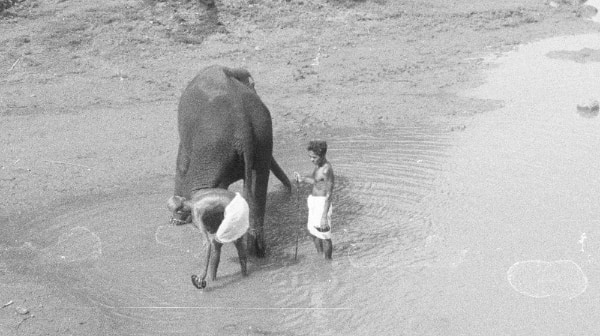
Bath time for elephants
Happy New Year Everybody.
I’ve been riding round Ceylon (Sri Lanka) and I’m back at Mannar waiting for the ferry to Rameswaram, India, but the weather’s against me and I’m still feeling feverish.
14th October
Rain is really punching down in the night. The garden has become a lake. The varnish on all the stairs is sticky. Pools of water on the floor. Write to Tony and Mum and walk to the post office. Then get back to feel feverish again. Decide to take tetracycline. Soon afterwards, vomit (having drunk Coca-cola). Think I might have typhoid. Get scared and get driven to hospital as emergency. Doctor greets me with great amusement.
“What do you want,” he asks. “Medicine, or to be admitted?”
“I want to know what’s wrong.”
He can’t stop grinning.
“You’ve got a fever.”
“Why?” I ask.
“The climate,” he answers. “Take a Disprin and it will go.”
“That’s what I’ve been doing for three days.”
“Cough,” he demands. I give him a couple of coughs.
“You see,” he says. “You’ve got a cough.”
It’s so ridiculous I have to smile too.
He still thinks it’s a huge joke. He asks several questions but doesn’t listen to the answers. But he’s convinced there’s nothing wrong with me, so I begin to believe at last it’s nothing very much. Back to Rest House much embarrassed.
Soon afterwards astonish them by going fishing in the rain. A fish takes away the hook, it comes down in a torrent, and I slosh back to change. Through afternoon, with two more Disprins, begin to feel better. Mr Ratnavale calls on me. My heart sinks, but he’s better today – not so overawed without his weighty companion. Eventually he walks off into the rain and comes back, unsolicited, with a packet of five Capstan cigarettes [a popular British brand]. Very sweet. Has wife and three kids in Jaffna. Means to travel overland to Europe. Give him the ST address, without explaining what it is.
Fun with the monkey on the chain.
Now great wind blows up outside. Will tomorrow be stormy?
Walked round the Portuguese fort. 17th Century. Impressive size.
15th October
Busy night. Great storm blowing, with sounds like gunshots, among others. Between nine and midnight I must have sweated a lake. Both sheets wringing wet and mattress too. Tried to make do with towel and sarong, but mattress too wet and had to change mattresses and put on trousers and blue vest. In morning both these were damp too. The tetracycline must have helped me chase the fever out, so I’ll go on with it for four days.
It occurred to me that the ferry could hardly have docked last night, and this morning at the bus depot someone confirmed that it was anchored a mile offshore. “Maybe this afternoon, maybe tomorrow morning.” I imagine I’ll be here another night yet.
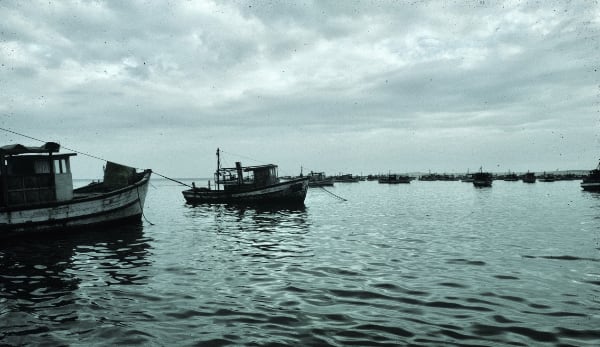
View from the pier at Mannar
Go to pier. Sea very rough. One fishing boat breaks anchor line – tossing about on the other line, spewing out broken fittings, which poor owners are combing off the beach.
Ferry is in, discharging passengers but customs very slow. Captain puts to sea empty, afraid that sea may cause ship to break the pier. No ferry today – maybe tomorrow morning. Meet odd couple from Bolton via Bangladesh.
Ads in the Ceylon telephone directory:
Grow ARLINGON COWPEA – it’s a fine substitute for dhal.
To get 100 bushes of paddy per acre: Grow improved varieties: Disinfect Seed Paddy:
Apply fertilisers: Weed the fields: Control Insect Pests.
Short conversations reduce engaged calls.
Please listen for the dial tone before dialling.
It is a DELIGHT to possess a coloured telephone.
Grow your own vegetables. Obtain top quality seeds in 25ct packets from the Dept. of Agriculture.
Start your own poultry flock. Buy day-old chicks.
Mr. X, Lawyer, Politician and Drunk. First heard talking on the telephone:
“Do you know who you are speaking? What is this? Don’t you know who I am? I am the chairman – (of something or other).”
Then afterwards a long, impassioned declaration – “I do not ask a favour. All I am asking is natural justice. Just give me natural justice – etc., etc.”
Later falls asleep on the ‘opium couch ’next to arak and soda. But at this stage I don’t know that he’s a drunk. At first in conversation he seems to promise liveliness, a few phrases, a gleam in his eye, he actually hears what I say first time – but soon the concentration slides. He has a vendetta with the acting captain of the ferry – has been persuaded to withdraw complaints against him in the past (long past). Now he calls him an incompetent blunderer.
“My clients on the lower deck. ….. ” (Fishermen). Soon mentions his weakness for drink – his wife’s troubles and forbearance, alternately humble and arrogant. Ends by trying to persuade the Bus manager to send the bus to the Rest House to pick his party up for the station. Hi sons run the air services from Jaffna (he implies great influence.) Endless inconclusive flights into political theory, history, philosophy, religion, all trailing off into nonsense. Mr. R. – friend of the famous – joins as a willing chorus. The two American Jews add a further fragmenting influence. Degenerates into a futile discussion of train, bus, boat and plane schedules. All nonsense – hold the fort as long as I can – then supper. Mr. R keeps his eye on me waiting for me to finish. I drag it out. The others stumble out into the stormy night. Mr. R gets the message (at least he gets that kind of message) and I’m alone again.
Was one word of wit spoken? No. Not by me or anyone. My thoughts are all locked up, to flutter behind bars and fall exhausted to the ground. Thoughts about sport & politics – the relevance of Jane Austen’s dialogues to those I’ve just heard – about the barrenness of this life, in which never a book is seen.
“The Sinhalese are a great and noble people – but (and said quite seriously) they are stupid. The Tamils are clever, cunning. The Sinhalese are stupid, but I love them.”
“I am a world citizen.”
“Listen to what my daughter has written to me. She says, ‘You can go on drinking. Just give two years to finish my course, then you can go on your pension or kill yourself’.”
October 16th – Rameswaram to Madurai
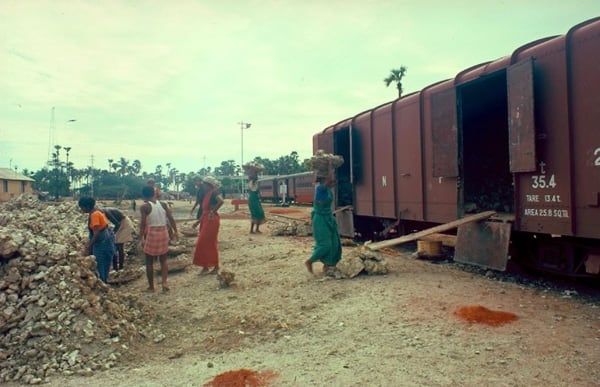
Railway sidings. Grass village. Boys building sand temples. Steam engines. Family approaches from village – to load lime on to wagon. Took pictures.
Sinhalese music seems to play on the same notes as Turkhana songs. But where T is a descending fifth, S rises to next octave.
The porters at Tallaimannar singing work songs as they push the goods wagons along the pier. Chorus and solo verse. Chorus rapid syllables on one note.
Glass of Nescafe in Madurai 1.20 rps (=10p)
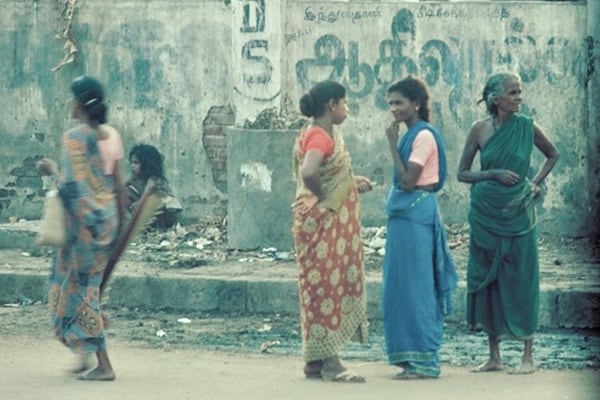
Ladies with rubbish. The boys have gone.
Watching kids play around overflowing rubbish bin across road. Round it and in it. One boy has just shat in the loose stuff on the ground. Big sow meanders round it. Am reminded of the story of Mr. Dodd’s dustheap.
[Many years ago I discovered this 19th-century account by James Greenwood: Journeys through London or Byways of Modern Babylon. Fascinating reading. Women and girls spent all their days working on heaps of domestic rubbish yet were remarkably healthy and vigorous, as attested to by Dr. Guy who later founded Guy’s Hospital.]
Young bank clerk takes me to the cinema to see: “The Burglars.” Omar Sharif. Belmondo. Very bad.
Says Madurai has special people called Shakti who don’t like spending money.

Well, that’s all for now. Christmas is coming, and I don’t know about the goose but I’m feeling fat just thinking about it.
I wish you all a Very Merry Holiday. You may not hear from me until the New Year, and there’s bound to be some good news, surely – so Here’s to a Happy New Year, too and let’s make the most of what’s left of this one.
CHEERS EVERYBODY!
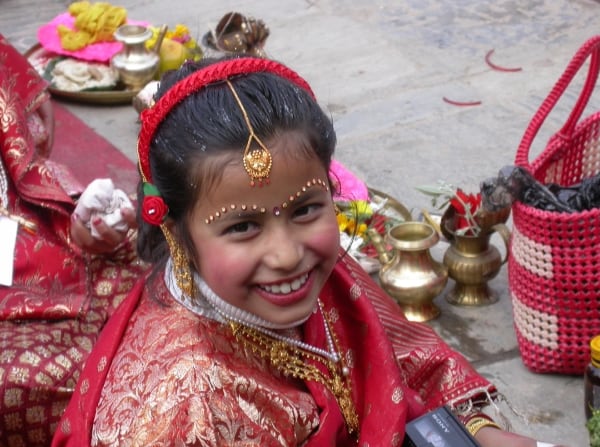
I’m leaving you with the happiest picture I could find – from Nepal.
I’m in Ceylon, having visited one of the best known sites, Sigirya, a fortress created out of a phenomenal rock formation.
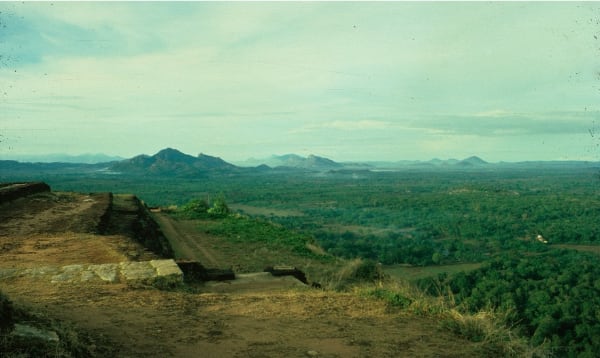
The view from the top of the fortress was extraordinary. There were carvings, but little that my uneducated mind could explain. The next day I left the Rest House (and the German sisters).
October 11th – To Puttalam
On shore of a lagoon. Junction town. Single row of huts, some tiled, some thatched. Small veg market had chiles, kohl-rabi, cabbage, carrots, tomatoes, limes, eggplant, potatoes, yams, etc. In short an excellent variety. Fish market, a small raised cement platform, thatched, had good fish too. Some puppies stood around it. One was so thin and failing that it was scarcely more than a head. Watched some crows on a roof – one had a fruit in its beak but could hardly eat it , since as soon as it put the thing down to grip it with a claw, another bird unencumbered, would threaten possession. It had a younger companion also which simply screeched with open beak and got a couple of morsels for its pains.
By the shore was a thin strand of sand littered with all kinds of rubbish. Again the crows attracted my attention and one – an obviously inferior one – was hanging about behind the others. At one point it raised a claw and put it pleadingly on another bird’s back – twice. The other bird flew away. The mangy one was left alone. Then I noticed a dog, a bitch with distended udders, licking something between its front paws. It was a puppy stretched out on the rubbish, head back and oozing blood. The mother looked up so mournfully.
These small examples of life and death on the rubbish heap moved me and depressed me profoundly. Since Colombo I’d been viewing the world through discomfort and fever with a deliberately jaundiced view. I saw the profusion and luxuriance of the tropics as a terrible mess, buildings as mildewed wrecks, human effort as futile. The people seemed tedious to me, an endless procession of M&S shirt tails hanging over sheets – with facile smiles signifying nothing if not envy and ingratiation. Only the older women impressed me in spite of myself, with the fineness of their features and slim, handsome carriage. The road was murderously bumpy, the traffic foolish. Several times in Ceylon I’ve saved my life by noticing another driver when it was his obligation to notice me. People stop quite suddenly in the road for no apparent purpose., and without indication. I think there is a powerful amount to be said against tropical paradise and I should be grateful for these fevers perhaps. The yearning for temperate home must have been overpowering in early adventurers when they fell sick.
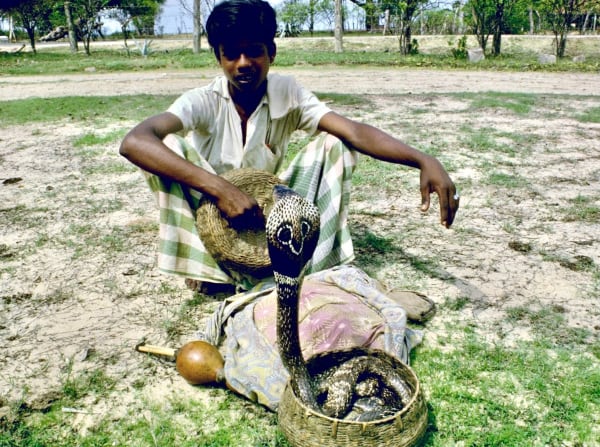
At Puttalam I got hot tea and an extra sheet and tried to sweat it out. There was plenty of sweat, and in the morning I thought I’d won. I rode the 46 miles to Anaradhapura (after photographing a cobra) and sat among the ruins for a while.
A young man came and, by the brilliant tactic of not asking me for a single thing led me to offer him my address. I walked barefoot to the big Dagoba (or whatever). The dome is solid and covered with cement – has little to say to me. There’s a crack where it was once struck by lightning, and a new lighting conductor runs down the side. There’s also a maze of granite pillars sticking out of the ground. The lad says this is the ground floor of a seven-storey building in which a hundred monks prayed on each floor, all in their solitary cells. If true it’s an amazing notion – what a hum must have gone out from that box. Enjoyed also the moonstone outside the temple. Elephant, horse, lion, buffalo.
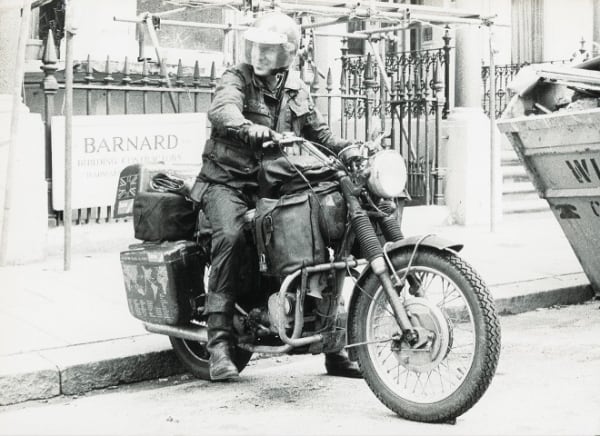
From A on the road to Mannar. And at the main junction was already feeling the fever again. Had a drink and some Disprin at the rest house. Disprin is becoming part of my diet. Rest of journey went well, no more rain. In the morning. I rode through a maximum downpour for maybe 15 minutes – and the jacket is a success.
[Somewhere – in the USA I think – I’d acquired a leather Belstaff outfit. I was still wearing it when I got back to London]
At Mannar got the same room at the guest house. Went straight out to fish off the bridge, thinking how nice to be alone, but a great company of betel chewers lined up alongside me. I managed to live with it however, and got the great excitement of a catch. The fish felt very strong and for a while I couldn’t move it at all – after its first run – then slowly I inched it in. It was a stingray. Very exciting to see it come out of the water. Not really so big – maybe four pounds – with a beautiful mottled brown back – a rather human mouth and two eyes on top. One of the men cut off the tail and showed me the spike which lies alongside the tail close to the root (not as I imagined at all) Took it back proudly to the rest house. The cook said he would fry it for me – but as a fish, he said, it was not famous.
Two men on the bridge started talking to me. It annoyed me at the time, and I must have shown it.
“Your native land, please?” “Are you a university graduate?” “How much does this, or that, cost?” They came afterwards to the Rest House and I had to sit and take tea with them. One was the medical officer for the area. And the other (Mr. Ratnavale) is a clerk of some sort. They have so little to say and understand so little of what I say that it’s largely a ritual. Whatever I said, Mr. R’s face would express perfect wonder and enlightenment, and say “I see,” as though everything was now clear. But the MO did describe symptoms of typhoid which gave me a bit of a scare next day.
That strange Scots family also turned up.
Rest House man told me a series of superstitions – full bucket, empty bucket. If a monk crosses your path when you set out, forget it. If the gecko chatters as you step out of the house – also forget it. If you run over a cat, you’ll have an accident. Woodpecker’s noise is a bad omen.
Also says Tamils smell different. If they use a towel, you won’t be able to. He says Sinhalese and Europeans are much closer.
PS: The response to my offer of a reduced price on the Camera book has been very welcome. If you’ve left it too late, I will still take your orders on Sunday 15th, but after that it will back to normal. Thank you.
May I remind you that I am reproducing here, word for word, the notes I took on my so-called Jupiter Journey, frequently disjointed, sometimes almost incomprehensible, even to me. At this point I am still in Ceylon [Sri Lanka today] at Trincomalee, on my way to Sigirya, an ancient fortress.
October 7th
Back seems bit better. Walk to Fort Frederick – lots of big, shady banyans inside, few monkeys in them, and spotted deer below. Take great comfort from the general quiet. So peaceful after India. Is it the individuals, or the mass makes such a disturbance? Have various half-formed impressions about what happens when population compressed – as in physics. Something must crystalise out. Does structure result from compression – or density. And a pattern having been established does the process continue even after pressure is removed? i.e. Do people cling together as a matter of habit (structure) custom. They seem to. Watch them at any post office counter – cf Penang, noses through the grill. Or remember the queue at the bank at Roissy airport, with the man behind actually pushing against me for almost half an hour – or would have if I’d let him. Is there a difference also between island and mainland (All these ideas seem suddenly very important (cf. Australia – the reverse.)
CUSTOMS & CROWDS
Hindu mythology is as crowded as Hindu life. Ceylon has the Buddha. We have one God, but Africans and American Indians have many spirits.
In the evening I invite Octavia & Cordula to Chinese dinner. Not totally altruistic. I’m invited to stay in Munich. We lie on beach afterwards under full moon – Poya, a holiday – until a heavy shower sends us running. Yes, I can run a little.
October 8th
Ride around Trinco. Tea at boutik, breakfast at Fish hotel. Then pursuit of map takes me to Harbour Road. Welcombe Hotel, ABCD café, Survey office.
Pack and leave at 11.30. Endless entreaties to stay at Traveller’s Nest in Kandy. Will avoid it. Sell my sandals for 10 rupees. 30% profit. 60 miles to Segirya (lion’s throat).
Wanted to go to Baticalao (original Portuguese influence) but too many unpredictable ferries. Stop at Kantalai Rest House for lemonade. Tank almost empty. Then stop for some monkeys with orange faces (most are black) but the interminable process of stopping and switching lenses is far too clumsy. Ride on and stop for rain shower. Leave disposable lighter in road. Suppose a monkey finds it, carries it off, hands it on, father to son, for a million years or so, until long after human race is extinct, an evolved monkey finally gets it to work, and the whole process begins all over again?
Sigirya lies under blackest rain clouds. Circuit bungalow has room. Sit in rest house, as first rain breaks in torrents. Everyone delighted. I’ve done it again.
[Ceylon has been suffering under a serious drought, but I seem to be bringing the rain with me.]
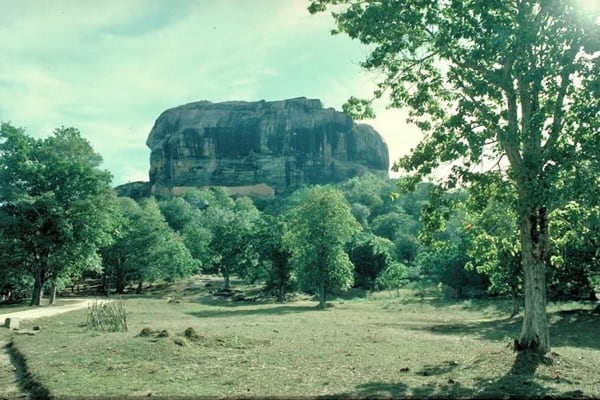
The fortress is carved into the top of this extraordinary rock formation
Two Russians come in soaked to skin. After the angry look he gave me earlier I find that amusing. Another couple arrive at bungalow – a Berliner and a Japanese girl. He has an extraordinarily resonant but monotonous voice which drones from their bedroom. Dinner is terrific. Veg.
Dream strangely of publishing – of responsibility shirked, of floating down spiral stairs round a lift shaft, touching rail delicately here and there [flashback to that childhood fantasy]. Of being with Walsh in a Morris Minor and handing over to him, unable to drive, but without rancour. It suddenly occurred to me yesty that I still owed my mother that £500. Must write to her about it.
October 9th
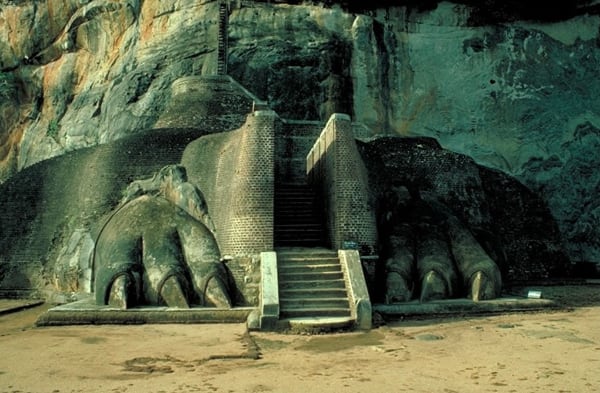
This way up
Got up at 5.45 and walked to rock. Long climb. Back still bad. Long climb to lion’s paws. Then up iron staircase and on to sentry ridge cut in rock. Although the iron rails make it perfectly safe, for me they became as soft and unreliable as marzipan. Halfway along I had to give up and go down again. Then on the stone terrace I reorganised myself and then went up again – this time easily. What caused the breakdown?
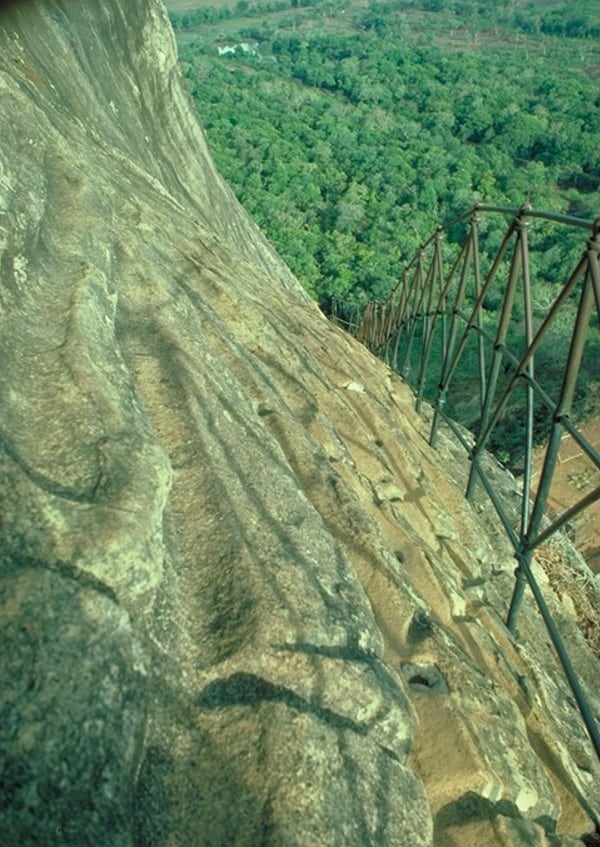
This where I lost my nerve – and found it again
The Russians are Yugoslavs. Also, the woman lives in Paris as a construction engineer. The man is a professional artist and has a sheaf of watercolours to prove it. Furthermore, they are both quite charming people. So, I’m falling into bad habits myself.
Back to bungalow through deep night, with the most fantastic roar issuing from the jungle on left ¬– mostly frogs, I suppose, but sounds much more aggressive. Imagine being in it, or meeting an elephant now, on the road. Everything is extremely wet – rained harder and longer today. At bungalow feel a sense of lively pleasure to find the Schrenk sisters sitting at the table.
They arrived soaked to the skin, but in good spirits.
The man who runs the bungalow directly, helped by a 70-year-old man, has already given my back a massage earlier today, with oil. Now he’s going to apply a hot towel before bed. Has the roundest, most eloquent eyes. Took picture at last.
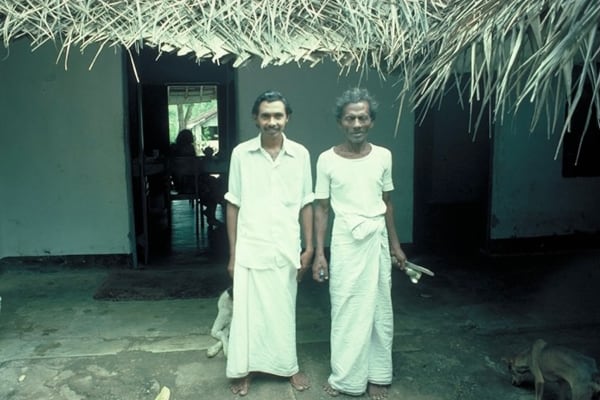
The staff at the Circuit House
PS: If you are wanting to take advantage of my offer of Jupiter’s Travels in Camera, would you please order it separately, not in combination with other books, to avoid a possible problem with shipping.
Thank you
We have a holiday season ahead of us and I’d like to contribute to the fun. I still have stack of my Camera book, and I’d like to see them go. I have no problem saying it’s a beautiful book and I’m sure you all know someone who’d like to have it, so for the next two weeks I’ll knock $20 off the price. It will cost you $30 instead of $50, until Saturday 14th. If you buy more than one, let me know and I should be able to reduce the postage.
Merry Christmas!
. . . and now for the main course
I’ve left Auroville and the temples behind me and I’m about to take a ferry from the mainland at Rameswaram to Ceylon. As in Penang they are insisting that I must pay for a first-class ticket.
October 4th, 1976
The ferry. Shipping office. Uncle and nephew, all in white. I tell them about change of policy on Chidambaram. “It has not reached here yet” they say. And go on to describe virtues of first-class travel. Sometimes boat doesn’t leave till 7 pm. (Sailing time is 2 pm). And at the other end may be held up for hours. Europeans – especially Germans – are outraged by this. So now all white people are forcibly privileged to be the first off – at an extra 22 rupees a head. Total fare 50 rupees. The m/cycle fare is 14. 25 + 10 rupees handling + 2 rupees port charge + 10 rupees tip + 4 rupees drinks and cigs while waiting = 90. On Ceylon side 5 rupees handling, 1 rupee port charge, 6 rupees for maintenance of the floating wharf under the wear and tear of my motorcycle. Total cost, 102.
Formalities began at 10 am. I boarded the bike at about 1 pm. The ferry sailed at 5 pm. At about 8.30 we touched alongside a jetty – but then took off again into the ocean. At 10 we once again touched a wharf, only to sail away in a great circle and reapproach on the other side. Got ashore with bike at 12.15. Sea distance covered, about 25 miles. On the boat were modern tourists, some nuns from Dalhousie with 70 students. Some well-to do N.Indian girls just like the ones on the Chidambaram, and saying exactly the same things, flippant observations with no substance, intended to exhibit sophistication. Well, that’s universal, so it’s the subjects and attitudes that are particular. Jokes about the incompetence and idleness of others, from a superior and detached point of view.
On the boat a very short man with a John Player beard travelling with an African girl.
Mick and Martha Desorbes, travelling by train in India. Endless ordeal. To break journey, ticket must be signed by station master on leaving train and rejoining train. Also you forfeit the sleeper reservation. All this takes hours of time, so every stop is an exhausting prospect. Endless hustling. People running in and out of compartment. Towns all crowded. India [they say] is just a place to go through to get to Nepal, Ceylon, Afghanistan.
Also on board was the short Aussie that Murray called a ‘bushie.’ When I first saw him I’d settled into a cane deckchair to read and wipe my tapes. I had the helmet on the next seat, and he paused in frit if it. “Are you tired of answering the same questions,” he asked. I seized the opportunity with firm “Yes.” He sat on the bench opposite, staring fixedly out across the rail. After a while I thought I’d offer him the chair which was obviously more comfortable. He sat next to me and tried to keep quiet – he knew I wanted to read and was in sympathy, but like a kettle on the boil he couldn’t help spluttering. At one point he said, “Would you like to hear some Communism?”
This is the third time I’ve bumped into him.
On my left were four Hari Krishna disciples. The one next to me had small cymbals. Another had a drum of the two ended kind which he carried on a red braid around his neck As I dozed they went into a chant, almost good at one point. But they were a messy looking quartet – not very convincing. Fellini could have used them.
Somebody said the Indians on the lower deck didn’t get off till 4 am, and that they are badly treated by the officials.
I rode off into mysterious darkness, wondering how to find the rest house, but a boy walking along was also going there. Rooms were occupied. I slept on the sand in the compound next to a smart Aus. Vehicle with a raised roof. Drank a beer and fell into a stupor.
October 5th
To Mannar. 20 miles down the road. But the reserve tap only had nine miles worth. Stopped at bus shelter. Second vehicle stopped and sold me a pint. “Lucky chap,” said driver.
Mannar rest house. Heavy rain clouds. Stayed. Big room for 5.50 rupees. Mick & Marsha [from the UK] were there. Also the American with the myopic personality, and Canadian. Eventually we talked well – especially interested in Mick’s THC [Tetrahydrocannabinol] trip, and his reasons for making it.
He was very strong about continuing class structure (he has a very strong accent) and feels that at home it’s impossible to move. Strong also against immigrants and made some remark about Jews I don’t recall. The Canadian, on the other hand, had much wilder things to say about Socialism which I found more offensive because they were outside his experience. Is this the difference between opinion and prejudice?
Walked out across the bridge where two men were fishing with tapered poles – of bamboo? They seemed to be laminated. Water shallow by the causeway. Many fish and one big crab. Water birds. Low huts along shore, and coconut palms. Peaceful scene. Fort built in 1698 – occupied by customs.
October 6th
Rode to Trincomalee. Since ship felt twinges in my back. Now getting worse. Very bumpy tarred road. At first through paddy fields – very dry. Here in Ceylon, for the first time, I identify entirely with population’s thirst for water, there’s been partial drought for three years. If anyone can bring them rain, I can, and indeed I already have. First rain in eight months on my arrival. Now I find myself actually wanting it for their sakes.
Ten miles outside Trinco there’s a flat piece of rock by roadside with light grass cover. Stop and stretch out – back is now contorted in muscle spasm. After a few minutes under umbrella muscles gratefully relaxed, a car comes and stops. I peer up at the driver.
He looks perturbed. “Elephants,” he says. “Rogues. You must not stay. Rogues. Go on to Trinco. Rogues . . . etc.” The thought of elephants is much more exciting than frightening, but his urgency infects me. Besides, he obviously won’t go until I move. But at least I can stand up straight again.
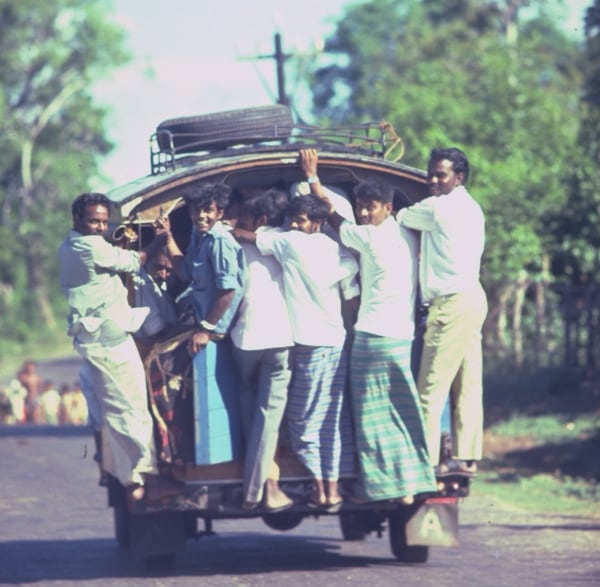
A bus in old Ceylon
Trincomalee is like a town with no middle. Find a hotel and enter it before noticing the flies. They swarm and carpet the tables. Well-meaning but obsequious old man tells me he used to supply vegetables when Europeans were there. Flies because of fish market across the road. Serves me good rice & beef curry for 5 rps (14 to dollar). Then to rest house. Too expensive. Back too bad now to look for somewhere else, so I miss the Chinese Guest House and settle for Beach Paradise, only just short of awful. Bed is particularly bad, sack cloth and straw, very irritating. Cover it with foam pad and lie down. Apart from short dip in ocean, day spent lying down. Back makes me miserable. The two German sisters from Germany are there too and I try unsuccessfully to be entertaining. They lend me a Pat Highsmith book set in Venice. Devour it in bad light.
Here are two more things – for Germans in my audience
My autobiography “Don’t Boil The Canary” has been translated into German – although it has an English title, “Go For It” – and you can get it at these web sites:
Of course you can get it in English from me.
UND
Natürlich kennen sie alle Bernd Tesch. Er hat ein neues Buch und wollte das ich Ihn da von spreche. (How am I doing so far? No AI) Hier ist was Bernd mir geschikt hat,
New Book from Bernd Tesch; Australien Abenteuer Reisen. Entdeckung des Kontinents vom Urknall bis heute durch alle Reisearten.448 S. 500 Abb, Fotos. Hardcover. DM 32,00 plus postage Info und Bezug. https://shop.berndtesch.de
Of course, if you don’t have any Deutschmarks, I’m sure Euros will do.
And here’s one last thing:
You may find this an odd request, but I don’t know any other way to ask.
During the first half of my life, when lying in bed waiting for sleep, I quite regularly experienced a quite pronounced CLICK in my brain – trying to describe it I’d say it was more like the tail end of a small explosion, once or even twice. It stopped some time in my fifties and has never happened again.
Have any of you had a similar experience? Can anyone guess what might have caused it?
Good day, everyone.
I’ve been working at my photo albums, trying to rationalize them. It’s a lot more work than I bargained for, and I haven’t had time to properly prepare for this weekend. So I’m offering you instead some pictures to drool over. I hope you find them as evocative as I do. They are from my journey, almost exactly 50 years ago, in Sudan and Ethiopia.
Can you imagine yourself there then?


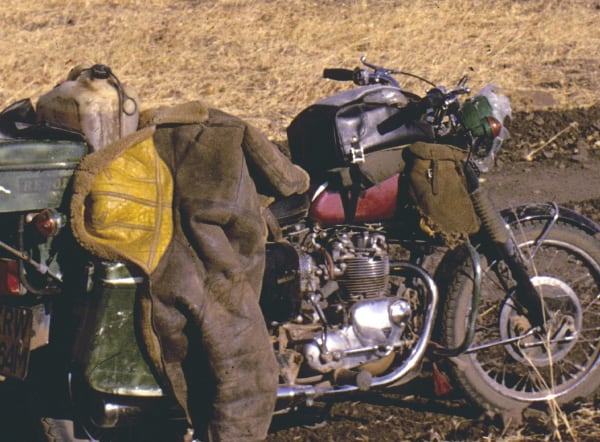


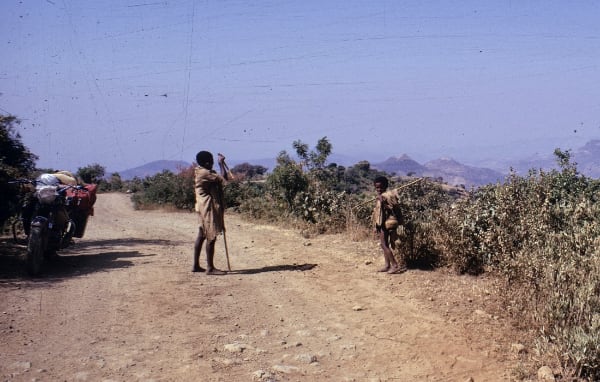


I’d give a lot to be able to feel today the way I felt then.
It’s the end of September 1976 and I’m in Pondicherry on the East coast of India, but for some reason I wrote nothing about that week. I came to Pondicherry principally to visit Auroville. I can’t remember now how I heard about Auroville, but it was already well-known to anyone taking an interest in Indian philosophy or culture. It is situated in the part of India which once belonged to France – then called Pondicherry – on the coast south of Madras, now Chennai. It was inspired by an Indian Sage, Sri Aurobindo early in the last century and finally put into practice in 1968 by his disciple, known as The Mother. When I visited it eight years later there were several hundred people, rich and poor, of all nationalities, living on a substantial piece of farmland. They were free to build homes of any style which made it architecturally fascinating and were in the process of building the central feature, a meditation centre that was literally global, called the Matrimandir. I was welcomed and spent almost a week there. I was much impressed but apparently wrote nothing about it in my notebook. India’s President at the time was Indira Ghandi, who gave it her protection.
Today the Matrimandir has long been completed. There are now more than three thousand inhabitants and it appears to be a remarkable success. I can only refer you to Wikipedia for more information.

Here’s a picture of the Matrimandir in the process of creation.

Some well-to-do French members built to their own designs.
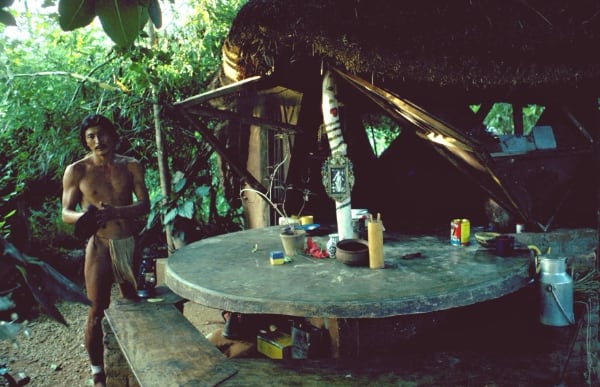
I stayed for a whlle in this shelter, built from poles and reeds. The magnificent looking man, as I recall, was called Tlalloc and came from Hawaii.

The girl may have been his daughter, but I’m not sure.
1st October, From Pondicherry
To Kumbakonam. [Further south on the way to Thanjavur temple] After riding around for miles I could not find a single place to eat, or a hotel. At last, in comic despair, I stopped outside an orange stall. A man pointed to a doorway nearby. “Meals.” I looked up the stone steps and thought it was a secondhand furniture shop. He insisted. I walked up. A cavern opened before me. Men were eating, in pairs, off banana leaves. Two elderly men in white dhotis with bristle and betelnut tongues said, “Come on,” and “Sit down”, like uncles, very familiar. Food was satisfying and I used my right hand with ease.
While riding along and feeling good, sensing respect among those I passed, I toyed with the notion of becoming a god. After all there were so many already, why shouldn’t I be another, riding into their lives, erect and proud on my remarkable vehicle, condescending benignly. Round the very next bend, a beggar in unusually colourful rags, sneered at me and spat deliberately in my path. This has never happened before, in three years.
[I was on my way to Thanjavur where was another famous temple, Brihadishvara. Sometimes called “The drawing room of India. ”Red granite.]
My guide was B. Ravi. s/o V. Balasubramanian. Accountant, Pandyan Automobiles, Tirunelveli – 2, S.India
He was 14, and very sharp. He says being a guide is his hobby. One could almost believe. He comes to Trichy [Tiruchirappalli, a nearby city.] for holidays, and he does have some real knowledge. Afterwards, we walked with his brother and friends to buy juice and oranges. No hint of profit. Sometimes even a joke, to expose my suspicion. (Carrying seven oranges about? “Not so difficult. Carry one, eat one.”)

Thanjavur
Then there was Gopal at Thanjavur. He found me in a quiet moment and by thrashing the water all around me energetically he managed to guide me to his home, where his friends came one after another to see what he had caught.
“Does it not bother you that you have not made your name?”
“Would you know if I had?”
“I would certainly know if you were an important journalist or writer for I am reading always anything I can get my hands on.” (This before he even knows my name. Meanwhile Ted Simon swam through my brain. Who is he anyway? Who has heard of him?)
“What do you think of this inflation? What about the Israeli hi-jack? (He meant Entebbe. He was pro-Amin at first.) What about Ireland? Are the British being fair to Irish Catholics?”
He wants a godfather. All his show of intransigeance and opinion melts in the warmth of a single breath. Not one fixed point that I could see.
“Then your idol must be Gunther.” Who?
2nd October
Riding from Trichy to Dundigal. Reflecting on news of sterling’s further collapse. (£1.66 to the dollar.) and once again began to wonder if I might have some role to play. The notion recurs like a fever. Is it halucination? Found with the questions of Gopal yesterday I had scarcely an opinion to offer. Yet I imagine myself offering an alternative to 60 million people – reappearing like a prophet from the wilderness to rescue the British from their political paralysis. Compared with my last return to Europe it would really have to be different. I would have to initiate a great deal of the interest myself. Probably from a distance. And in person to generate immense conviction and charisma. What evidence is there for this as a possibility? A certain warm regard from a few friends and an easy way of meeting people.
In my dreams tonight I was losing my friends – they were running off regardless that I had been delayed fumbling with something and couldn’t catch them up. Later there was a cat whose affection I was eager to arouse, but with no success. I asked whether it couldn’t be content to live with me. It looked at me and judged me. I felt its appraisal.
“Comme ci, comme ca,” it said. I felt worthless.
3rd, October, from Madurai
Strange beginning. Dropped bike once. Followed wrong directions for a mile out of Madurai, then back. Felt effect of night’s searching dreams. Then outside Madurai on the Rameswaram road saw thatched roof smoking. High brick kiln, like house. Others all around. A village of brick kilns. Two oldish men approached smiling and gesturing. Had they built it? Did they own it? (Hardly). I escaped smiling instead of finding out.
In this humidity you can’t put your hand in your pocket without pulling out the lining.
Goats passing on the asphalt sound like a light spring shower. The soil everywhere looks like sand. I see no clay, yet brick kilns grow like mushrooms. Large areas are washed out and goats graze on the sand for every blade that rises. A rain cloud forms and falls on me, because today for the first time I didn’t leave the leather bag under the blue waterproof – because at Auroville the fat brown ants made their nest on it, leaving strange glutinous white substances on the inside. The umbrella was not big enough for all of us. Leather black and stiff. Straps broken. The brown ants were a phenomenon. They nested in my boots, inside the leather bag, among the waterproofs, in great masses. It’s a shock to find them, difficult to shake them out. But they are harmless.
Eventually the Rameswaram road becomes a single straight ribbon. Erosion and dune formation evident on both sides. Goats everywhere. Some attempts to plant grasses, casuarinas, To Matapam, and to my amazement the road stops. How do I ride to Rameswaram? You don’t. You go on the train. 8.50 rupees plus 10 for labour. I get to ride in the goods van. Train takes one and a half hours to go 12 miles, partly over a bridge and causeway. At R. another 6 rupees, then to Rest House. See Murray hanging over balcony with a double room to share. Spend hours reading detective stories.
Journeys, I have come to believe, are made in the imagination. When the mind is distracted by physical discomfort and unsatisfied cravings it is difficult to appreciate the beauty and significance of scenery and events as they unfold. After ten weeks in France and England I was still cluttered by the desire for the meat and wine of Europe; my skin was uncomfortable in the heat of Madras; I was impatient to find my balance again.
September 19th 1976
Went to dance performance at Vani Mahal, a theatre. Many gorgeous Hindu ladies present. One professional dancer very good – but very little explanation. In audience was Vera Goldman, Israeli from Australia. She talked to me first and went to Chola Hotel for coffee. No espresso coffee – so I asked for a slow one instead. She told me about Aboriginals. Had spent time with them – “dream time” – a time space without chronology in which thought roams free to produce song and art. A woman of great force and temper who worked at Kulashatra Dance Academy directed by a Mrs Arundel (widow of an English theologian). She describes Mrs A. as an evil dragon. Murari and Rada think she’s wonderful. Am fascinated by Vera’s passionate Jewishness, the amazing curves of her face. Nose and mouth. At times beautiful, at times hideous. Ending a dreadfully tempestuous love affair with an Indian dancer. Murari’s gate locked when I return. I lock bike up outside, go to bed and think paranoid thoughts, then get up again to stay with bike. But this time my movement wakes M up, who says he meant to stay awake. Ignominy!
20th
Today the eggs I bought yesterday, which could not be cooked then because it was a holiday, are made into scramble with onions. Good. Go through my tools and parts. All in good order. Write letters to PH, RAC, Th’an, Carol. Mum, Adrienne and Sai Baba. Tea with Rada Krishnan. As he emerges he appears very loose and flabby and his speech is difficult to follow. Quickly it becomes easier and he himself seems to assume a more definite form. Talks most humorously about his dealings with the artists’ community outside Madras founded 11 years ago. Painting on the wall by the president is a nice one. Tale of the ‘untouchable’ who felt that his caste was being oppressed because nobody bought his paintings. Sad story of ugly man who drew painstakingly beautiful line drawings in which he appeared as a lonely, shunned figure. While they were all wondering how to help him he committed suicide.
Also, the visit of Sai Baba to open the hospital of R’s father-in-law.
[Colonel Muirari was a disciple of Sai Baba, a famous holy man with an ashram in Bangalore. He spoke to me often of Sai Baba’s “miracles.” Mysterious appearance of honey and ash, called “vibuti.”]
The light in half the hospital went off, but R swears there is only one fuse. (How could that be? How many bulbs were there?) On to dinner with Vera. V in flames about the hammering rock music. But cools down and tells more about her life. Beautiful parents from Vienna (Hammerbrod?) Recently died. She gets a monthly sum to keep her going. Mother died of cancer. Story of love affair. I engage in amateur psychotherapy, talk a bit about myself. Her lover’s personality sounds like a Peter Sellers. We go on to the Marina and walk around the tomb of the DMIS leader [DMIS stood for the Directorate of Military Intelligence and Security.] then sit on steps facing the beach. Group of Khaki police stroll by, flipping truncheons. Warn us to stay off the beach. Eventually take her home to Ardyor, ten miles along Mount Road.
20th
[I was gradually getting ready to leave. My plan was first to follow a well-trodden path to the temples which are a famous feature of this part of India. Thee first if them was at Kanchipuram.]
More packing. Breakfast. (Rice pancakes). To post office, Cook’s, Lucas. Feels good on bike. Seem to be thoroughly acclimatised again. Most impressive man so far at Lucas. Also hopes to make some introduction to Sai Baba through friends. [Didn’t happen].
21st, Tuesday. To Kanchi
From Madras, 15,121 miles. [I was keeping record of mileage since odometer change, probably in San Francisco.] New oil. Once out of town the flashback to Middle East was most noticeable. The environment felt very similar to Nile Valley. The arrangement of the houses – in occasional clusters ¬– differs from S.E. Asia where each house is larger, better evolved, set in a larger space, a little aloof from road and neighbours. Here also it’s mainly paddy farming with water buffalo, but there are also teams of oxen, maybe six pair, charging through a field in circles, moving much faster than I remember. The people make a different shape too. The men longer sinewed, black, naked but for a triangle of cloth, gleaming thighs, long like Arab thighs. Women in separate groups, very colourful among the greenery. Many brick kilns and quarries. A bright blue bird with darker “wing flaps.”
The road was almost empty, very narrow, with bumpy tar. I rode the whole way at 30 mph and it didn’t seem too slow.
Walking round my first Indian temple, Ekambareswarar. A great slab is held up by carved columns about ten feet apart, some long, some short.

A variety of people are there – all of them give the impression of having been cast there by enchantment. An elegant group with shaven heads and bright saris sits there around a small fire with large aluminium pots, shaped like this. U.
Others like young tramps. A bearded gent approaches me with a holy look and moves his arms in a kind of semaphore.
The man in Siva’s lodge at the entrance also had an imperious look, rather [illegible] I thought, beckoning me to make an offering to some dark, mysterious object behind him (a lingam I suppose). All the way I was accompanied by a dark, graceful man with a sweet smile who simply murmured quietly “Ah, those boys,” when the kids came to me. For a while I sat under some other columns and photographed an elephant, foot in chains, and some people.

Then approached the temple entrance. A tariff of rates, in Hindi, offered 39, 75, 1,25 and 2,50. What for? I asked to see a pamphlet, but it was historical, not descriptive. But the rates didn’t apply to me, and I was shepherded instead around the outer corridors by a younger man – “I am not a guide, I am a priest.” He gave the unintelligible commentary, and led me inexorably to the mango tree, 3000 years old (?) with four branches, bearing different qualities of fruit, sweet, sour, bitter, and something. An elderly man gave a routine patter and led me round the tree – it might have been a mulberry bush. I was told that 10 rupees was the least I should give to be shared “among these friends” – his arm embracing the various acolytes I had acquired along the way. Ungraciously I gave 2 rupees and paid even less attention to my priest on the way out while wishing I had the calmness in refusal that I would have liked. Of course, I was a-dangle with cameras and lenses. The priest got nothing from me – nor the boy with the inevitable “coin collection.” The quiet man at last drifted away. I passed him later in the street, still with the same smile. Was it sincere, or stock in trade?

Round the bike a crowd of children from school. I clowned with them a while and felt better. Then one of them spotted by pen. “Pen, pen,” they cried. It was almost seized from my shirt. I moved it to my trousers and as I got on the bike I felt it slip from my pocket. My good nature failed to survive this, but at least I didn’t become too obnoxious. Now have this lousy pen, bought at a stall.
22nd, Wednesday. From Kanchi
Caught in rain storm just before bed. Moved into hotel corridor. Breakfast, then East to Chingleput for petrol. Took road to Sardas. Beach. Boy to guard bike. Heavy waves. Burning sand and sun. Fishermen scouring water on rafts of four logs and paddles. Later roundabout route to Mahabalipuram. Stopped at village to photograph silk combing.
Offered hank of silk for five rupees, but colours were wrong. Men friendly but no word of English. At M. tried PWD [Public Works Department maintains rest houses.] No success.
ITDC [India Tourism Development Corporation hotels.] far too expensive. To Manali Lodge. 5 rupees. Then rode out to see carvings from solid granite.

Temples, elephant, etc. then had fish at Rose Garden. Intelligent young Indian proprietor – deserves to succeed. Next morning to photograph Arjuna’s Penance. Then hot ride to Pondicherry. Again roundabout route. Got to Continental Hotel at 4pm. Had beer and mutton curry, met Murray Masters, thence to Government Hostel. Not feeling good. Terrible dry cough and inflamed throat from bad night at Rada Krishnan’s house. It is now Thursday night.
Had beans and onions for breakfast at Kanchi.
24th, Friday
Long uncomfortable day with touch of fever. Made leather box for razor. Talked to night man at hostel. Was in Malaysia before war, looked after by sister. Back to India in 1940. British army in North Africa. Demobbed in 1947. Tiny gratuity. Says the French paid vastly better. Told story when he was yardmaster at Suez, and brigadier tried to boss him about. Lots of bluff and bravado. One crazy tooth and a mischievous face.
25th Saturday
Had early adventure with bad egg. Then rode out to Auroville with Murray on back. Low expectations – but found excellent people. Jocelyn the girl; Chris, American; Michael, English. The “revolution”. The meditation chamber. The French Auromodel homes. Bernard. Long rides over sticky red mud. Reforestation. Casuarinas. Neem tree. Banyan. Beginnings of symbiosis between Auroville and the Indian villages. Good feelings. Ride back to Pondy along crowded road and through clouds of insects. Conversation outside Continental with human scrap on pavement. Remarkable person – 40 years old. Address book is full of tourists’ names ¬– mostly German. Head normal. Chest baby-sized. Rest shriveled and contorted beyond recognition. Scarcely 18” above ground. His accomplishment in making contact with people seems very superior to me. Would like to pursue the matter.
There’s much more about all this in Riding High.
I’m going back to California next week to preside over the election of Kamala Harris (I hope). Brexit was terrible, Trump could be even worse. What causes this suicidal impulse? I guess a lot of people just didn’t feel anyone was paying attention.
So I might not be back here for a week or two. Goodbye and Good luck.
[My arrival in India could not have been more fortunate. I had an introduction. Three years earlier an Indian friend living in London had invited me to stay with his uncle, Colonel Murari, retired, whose home was in the outskirts of Madras. I had anticipated that disembarkation from the Chidambaram would be an endlessly frustrating affair, so I was happy to find it was only ordinarily time-consuming, and I was able to get to the Colonel’s house at a reasonable time. Not only that, but my friend also happened to be there for a short visit.
There were three central figures in the household – the Colonel, his middle-aged housekeeper, Gaja, and an elderly man, Rajaram, who was the resident guru.
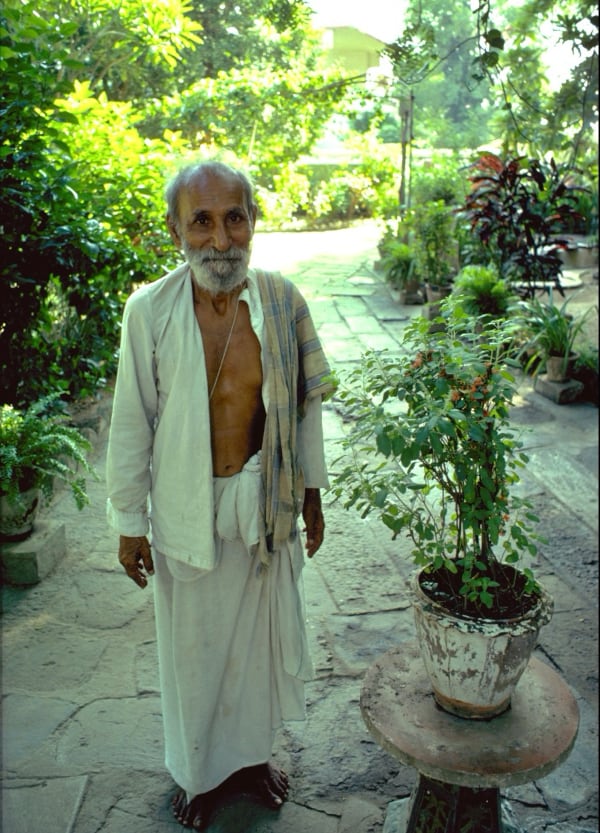
Rajaram in the colonel’s courtyard
It surprises me now that I wrote almost nothing in my notebook about this period in the colonel’s home, although it is described in detail in Jupiter’s Travels, and I can still recall it vividly. I remember how peaceful it was, how perfectly I seem to have acclimated myself to the heat. Rajaram had a daughter who was preparing her wedding and, as was traditional, a vast number of relatives were expected to attend. Rajaram was in high good humour.]
Rajaram – “there are 4000 people – each is getting a tamarind leaf with one grain of rice.”

Rajaram’s daughter and friend discussing the wedding
[Later he examined me closely with his large, luminous eyes.]
Told me I learned to fly and that once I threw stones at a cat – or hit some animal when I was eight or ten – and got hit by some relation.

Rajaram instructing the colonel
[There was a Lucas office in Madras and I connected with them.
Just as I was getting ready to move on, they received a telegram for me from Peter Harland at the Sunday Times. The news was shocking. My stepfather had suddenly died. Even though I had been determined that my journey would be a single, complete and unbroken journey around the world, I would have to break it to be with my mother.
The newspaper generously offered to pay for the flights. I left my bike with the Lucas people, and they took me to the airport.]
Flight from Madras to Bombay – up into monsoon cloud. Plane rocking all over, with Indian music tinkling and the Calcutta tea merchant sitting next to me shooting his cuffs.
London beginning of July. Off plane at London airport. Met by Peter. Very kind. Amazingly familiar. Almost impossible to relate anything new. So, for a message to carry conviction there must be [illegible] at both ends.
We go to pub. The Blue Lion. Drink a bitter, then up to the office after much hesitation about the effect of appearing there like that. Left film for developing – 3 rolls. Projector missing. Driving license I found immediately in parcel. Pretty bad first impression. Lunch. Greek. Retsina. The little place down the road.
Harry [Harold Evans, the Editor] received me and gave me two minutes of enthusiastic time, before being distracted. I had to gulp my bitter lemon to get out in time. Said I’d met Denis Hamilton in Cairo and remarked on my holiday plan for Harry – perhaps that was a bit gauche since I can’t remember how I put it. H seemed to have almost disappeared – shriveled I put it afterwards, naively. But he had read the bludger piece [This was a column I had sent from Australia.] I saw his memo describing it as “refreshing” – and there was a row after it had been cut.
Knightly came through and asked where I’d want to live. “Not Australia,” he said. “I didn’t think it was.” And off he went. Encounters are a bit fragmentary. Only Don Berry [a big shot at the paper] gave me a really warm smile and shook my hand, though I couldn’t remember his name at the time. PH gave me £20, which he said would be on exes, and drove me to Liverpool Street Station.
The train broke down just before Wickford, and we all stood on the platform. A Welsh woman with a man complained steadily about being stuck after their long journey from Wales – all of five hours, I believe, and I enjoyed my secret scorn.
Tried to phone from Wickford station but no reply. Then called taxi, which was unnecessary. Emotional home coming. Mother very happy to see me. Hanne there too, and Marta. [My aunts from Germany] Nell was there too. They said my mother had been crying a lot, and she also admitted it. I had not honestly been able to feel Bill’s death as a personal tragedy – my memories of him were not intimate enough, and I thought of him more as a craftsman and a ‘character.’ My emotional ties were with my mother and so I resolved to remain cheerful until the funeral was over.
TEN WEEKS LATER
15th September. London to Madras
[On the last leg, from Bombay to Madras I sat next to an Indian lecturer in Chemical Engineering, returning home from Frankfurt.]
He boiled all water in Germany before drinking it, because water is all polluted. “Don’t bother in Madras. We don’t have the same problem here. All our river water is pure.”
See snake farm by side of his institute – up to 5pm.
In Bombay he had met a friend at the airport who he said was “a great industrialist” in Madras. He rose from a cycle shop to manufacture scientific instruments. His daughter graduated and is running a new branch in Bombay. My friend persuaded him to offer me a lift to Kilpauk and we drove in my friend’s car, first to the latter’s home, where I was left to heat up outside the house for a while, then taken to Murari’s house. The “great industrialist” was not easy to talk to. I tackled him about quality control which I thought would be a great problem, but he brushed it aside. It was simply a matter of deciding whether you wanted to maintain quality or not. Those who didn’t went out of business – but meanwhile made things more difficult for the others.
Murari and Gaja seemed pleased to see me. My telegram from Bombay arrived the following morning. The place seemed different. The boy [my friend] had gone. The regime is more spartan. Obviously things are more special when “Nippi” is home. But Rajaram was his own sweet self.
September 16th
Trouble with Jet lag and climate. Slept very late. To Lucas in afternoon by auto rickshaw. The bike was beautifully cleaned and polished, but chain rusted solid in places. They put the battery back clumsily, with negative earth. Also, they seem to have lost the ignition key, and I rode off with a provisional connection on the leads.
17th
Time is better, but discomfort continues. Back to Lucas. They found the key. Meanwhile I found the spare. Only thing missing among my things was swimming trunks.
Telephone was cut off and Kutti [the housekeeper] has big scene with telephone people, rescuing torn up evidence from wastepaper basket.
I had bought a chicken in the morning – a bad move. When it appeared next morning it was all neck, head and bones. I asked innocently where the rest was but [she said] it was all in this tiny pot. Rajaram showed great restraint by eating with us at all and Murari felt very guilty.
[Those first days I felt completely out of sync – not just physically but morally and socially. Before leaving I had been perfectly adjusted, but now I was uncomfortable, led by my western appetites into making clumsy mistakes. I longed to get back to the easy rhythm I’d known.]
There was one passenger ship, the MV Chidambaram, that regularly crossed from Penang to Madras (now Chennai) and I was booked on it. Originally the ship had been named Pasteur and was a small luxury liner that crossed the Atlantic. It was known, I believe, to be a popular ship for wealthy gamblers. Some of that luxury was still visible in the upper decks, in the shape of a grand staircase sweeping down to a big saloon. At first the company insisted that “white people” had to travel First Class, which I found much too expensive. After some argument they changed the rules and sold me a Second Class ticket, which meant travelling with middle class Indians, mainly students. There was also a third class which I discovered on the second day. It consisted of wire cages stacked in the hold where poorer Indian families spent the four or five days of the voyage. They cooked their own food and, as far as I could tell, had no access to an open deck. The Chidambaram was eventually destroyed by fire. Here are my random notes on the voyage.
The MV Chidambaram (Née Pasteur) once highly luxurious.
Empty first class. Full dormitory. Packed bunks in cages.
Cockroaches, student ragging, measuring the gangways with half a matchstick. The filthy bar and the maniac barman with the huge, bruised face staring out of his hatch in neurotic hate and fear. The Indians are not graceful in their behaviour. They walk up and abruptly state their requirement in a harsh voice. Like Malaysians, they make a crowd where none need exist, crushing round counters with hands stretched out with money or documents or whatever. (In the post office the man sending a telegram with his nose through the bars watching every move of the clerk’s hand. In the hotel crowding round me simply to watch me write.)
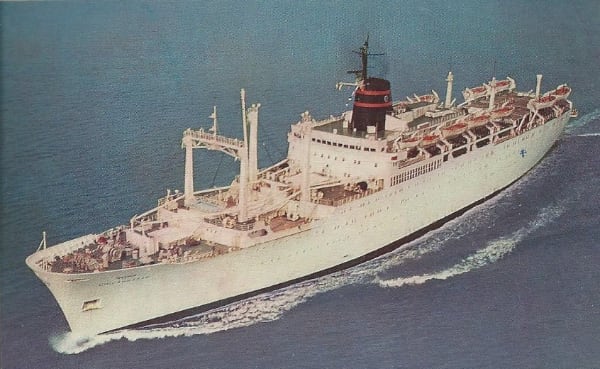
The MV Chidambaram
Saturday morning – 6.30 – woken by unusual messages on speakers. Something about port and starboard. The engines have slowed right down. Are we at the first port? [The ship docked briefly at the Andaman Isles.]
I get out to find the port hatchway open and a man in long shorts and life jacket hanging out over a rope ladder. Someone is overboard. Did he jump? Or fall? Nobody’s sure. But when they threw lifebuoys, he swam like a champion. An old man, maybe 60. A lifeboat had been lowered and it seemed just a matter of bringing the ship round full circle to pick them all up. When the ship did come round it became clear that life wasn’t so simple. The boat was drifting, almost useless. It’s engine or propeller had been damaged in lowering it. There were oars, but with so few men aboard the oars hardly touched the water. The ship came past, beautifully navigated, to within 50 yards of the old man, now securely buoyed on two rings. But nothing happened and he drifted away again. Then the ship shuddered into reverse and slowed down.
“Number three lifeboat!”
This time I watched the boat go down. It was a sight of danger and violence I shan’t forget. The boat is lowered by two hefty steel hooks with pulleys through which the hawsers run. As the boat lowered it began to swing with the pitch and roll of the ship.
Halfway down the ropes were long enough to let it crash into the side of the ship. This happened several times, throwing the men about and bending the side of the boat, before they touched the water. There was a heavyish swell. One minute the boat was afloat, the next it was wrenched up by the tackle as the sea fell away beneath it. It seemed to be difficult to release the tackle. When one was free, the scene became far worse. As the sea dropped the boat bounced and swung, so that to grapple with the other tackle became extremely dangerous. And to make matters far worse, the other pulley, now dangling free, was swinging wildly back and forth across the boat hitting several men glancing blows. Heavy piece of metal. Surprised no-one was killed. Imagine it with a boatful of passengers. How was it possible?
At last the boat was free and away. Meanwhile a white-fin shark, of 7 or 8 feet, came close to the ship and, clearly visible, circled suspiciously. What, we all wondered, was circulating round the old man out there, rising and dipping in the ocean swell on his two rings of cork the colour of a Hindu cast mark? The shark made an exciting object – a brownish colour with all its fins and tail shading to white at the tips.
By now the man had been in the water for about an hour, although as he floated by he seemed all right. Was it sharks that prevented anyone from swimming out to him?
The new boat made its way slowly to him. When he was reached it seemed a long time before he was handed in. Then they went out collecting buoys and finally came back to the port side, but the swell prevented them from attaching to the side. Off again, to bring the other boat in on tow. Then, on starboard side where it was calm they strapped the old man into a mummy-shaped bundle and eventually man-handled him through a hatchway as he twisted and pitched face down and scraping over the metal of the hatch. Then the excruciating business of raising the boats again, just as lethal and bruising as before, with men hanging on to ropes for dear life as an officer shouts, again and again “Sit down! Sit down.”
An officer later said, smiling, that they practised putting boats into the water every two weeks. He said recently their radio operator had jumped in and they’d had him out in 11 minutes. There was a heavy swell today, he said. I suggested that perhaps the shackles couldn’t go down any further. “Yes,” he said. “they go down under their own weight.” But obviously they don’t. “Was anyone hurt?” I asked. “No,” he said, happily. Two minutes later, someone commented that several men were in hospital having injuries treated. “Yes,” he agreed, just as happily. He also added in explanation that if the boat had been full of passengers there would have been no trouble because of the boat’s extra weight and because, he said, “the passengers are asked to cooperate by moving to this side or that.” Since the men in the boat. when ordered to sit down, preferred to ignore the order, I can’t see how passengers could be expected to show more calm and discipline in a shipwreck. One swing of that massive iron shackle across the surface of a crowded lifeboat could be certain, I think, of meeting at least one skull. I’d like to be reassured that we do this kind of thing better. I’m glad this is my last ocean crossing. I think I shall cross the Channel by hovercraft.
Shipmates
The student girls. Easy chat. No shyness. Will sing, play piano, seem very close, but it means No.
The mini-bus party – theatrical Yorkshireman – craggy handsome face, grey windblown hair – self-consciously acting the part – but the world won’t fit his concept of himself, so he is harassed, nervous, and quarrelsome. Wife is a weathered trouper, son is dull and sullen, only (the) girl is open and equable.
Russ Powick – NZ via Aus, good sort if a bit noisy. Can’t help doing the “I say, jolly good show” bit with me. Nicest when he isn’t trying. Says the van party was like hell on earth. One endless squabble, with daughter as referee. Two young Englishmen returning from three years NZ. Two a bit older – one quiet bearded Aus, self-taught in life, from poor Sydney family; other a knowing, half-caste German from Hamburg (half Arabic I guess) Talks about the price of drugs and irritates me with “Rupes” for rupees.
Next week, India.
