News from Ted
At last all the parts are together. I’ve said goodbye to Carol, expecting to be with her again in Europe, and I’m ready to leave Delhi for the border.
From Delhi, May 5th
Sprocket, chain and tyres on. Try to flog old parts, in vain. In State Bank involved in dubious transaction with Frenchman, who wants to double his cheques by losing them. I get what I want – unless the dollar bills are false. To Carpet Co. and Mani Prabakhar. Pay $40 deposit on carpet. Etc. Now midday. Undecided at house, I hang about a while, then pack. Hariom and Kari arrive and closet themselves. I decide to go.
Two awkward farewells. At 3.30, on the road. A last injection of 93 octane at the flyover. By 6pm I’m 90 miles along the highway and breathing again. Stop at Chatravarty Lake Tourist complex. Shunted from the far side of the road to the “Tourist Oasis”. Here a tent (big one) and bed with linen for 5 rps.
Buy a fresh frozen fish. Cook rice. Drink beer. Feed myself (and dog). Sleep. Get out. Sleep again. Get extra cover. Sleep again. All OK. Puri for breakfast. Leave at 9. Ride fast. Have three narrow escapes with buses. Driven off road on both sides – and forced to fall by rickshaw driver. Feel a destructive resentment working in me – and realise I must cool it – or die. Take a rest and go on more sensibly. Amritsar at 4pm.
I’m resisting all impulses to digress, to Simla or elsewhere. Rehearse conversations with people who say, “What a pity you didn’t see Kashmir.” Choose Ed as protagonist. Why? Youth Hostel greets me. Swiss traveller just came through border by bus. So that means OK. Tomorrow I’ll cross.
Find rice and beer. Then Golden Temple. Golden casket. Shirted Sikhs with spears, ancient ones with ancient rifles hugged to their chests. Inside, a small group of musicians – singer, tabla, harmonium – are amplified across whole lake and surrounding colonnades. Marble floors, inlaid. All exudes great air of probity, cleanliness, people at home with each other. At diagonally opposite corners, ladies serve copper dishes of ices water.
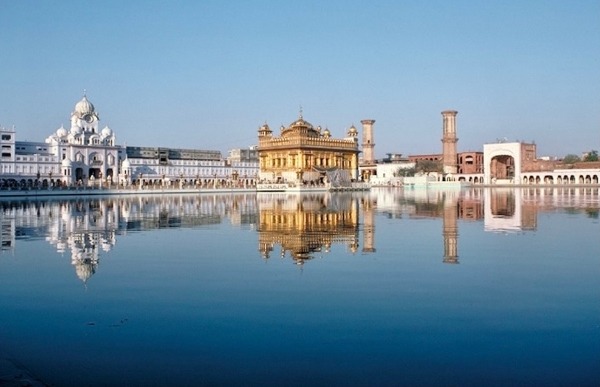
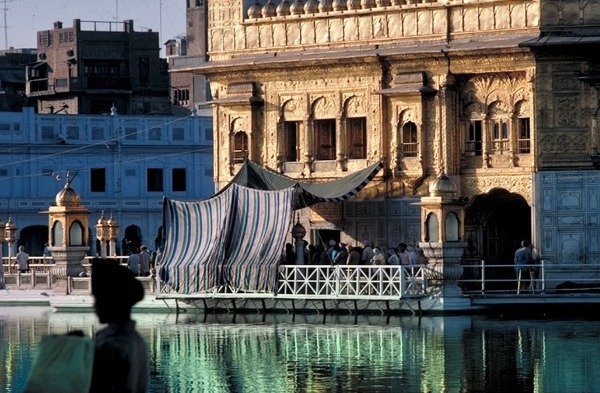
May 7th, Saturday
Last breakfast [in India]. Two boiled eggs, tea and a wafery bread shaped like palmiers.
To border – passing Emergency signs still planted firmly. [Gandhi lost the election, so Emergency is over.] The one I didn’t photograph: “Save the Poor. Support Prohibition.” Crossings fairly easy. Then long wait for obligatory police escort. He rides in bus ahead of me and it’s to save us from the army, not the rioters. Lahore is deserted but for buffalo herd moving apparently without guidance. Yesterday 2 or 22 people died after a curfew break to visit mosque. Now total curfew again.
We foreigners make a curious crowd in this vast, deserted space. Ted and his Jap. girl can’t find money to change. They’re sent to Intercontinental, three miles, but I’m eager to leave the atmosphere. How lucky to have bought those 100 Pak. Rupees in Nepal. The road is very broad and straight, tho’ seems to be going East rather than North. But it is night.
Stop for tea and get address of a curious man in shiny navy-blue pyjamas. His companion puts his finger on his throat and goes through the motion of the ‘strong man’. Then I get to the Jhellum toll bridge. Have just been planning my night. Flashback to Tahir and M’sud Khan. [Two Pakistani brothers I knew as a schoolboy.] Thought to invade some general’s quarters. But Hamid, the elder of a group of Pathans, takes me in.
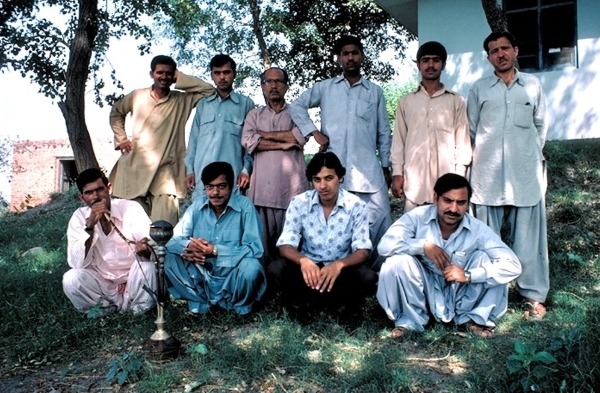
Hamid and the brothers had the business of operating the toll bridge over the Jhellum river. Quite unbidden, Hamid – top right – assumes the job of feeding me and making me comfortable for the night.
Makes up a couch for me. Brings me tea. Prepares bathroom. Another couch outside. More tea. Infinite courtesy. Much quotation from Coleridge, Einstein, Freud, Shelley, Persian poets, copies of “The Psychologist” from 1951. Dinner of roti and dahl. A walk on riverbank. A massage. A bed prepared. Great sense of peace by riverbank. Traffic hardly noticeable. Many birds. Castor oil plants.
Then, once in bed, under net, discomfort grows to an itching catharsis, as traffic roar becomes overwhelming. Eventually, after tossing and scratching for hours, give up. Faithful Hamid is there. He says it’s bed bugs. Prescribes kerosene. Tends me like a patient. Change beds, bedding, and at last sleep.
That book of Materia Medica by Adolphe Lippe MD. Calcutta 1935.
Last night: “How were the inert gases discovered? What new discoveries did this lead to? Where is God? I say that God keeps moving. In the 19th Century He was in chemistry. In the 18th in botany. Where is he now?”
Hamid is [like] an Irishman. “Now wouldn’t you say, Sir, that medicines are very dangerous? Where did you get this mosquito net. Sir. It is very marvellous. I have never before seen the moon in so many colours.” And I was expecting to be asked how much it cost! Goodbye India.
He said he hit his head many times as a child, which damaged his memory. He can’t recall his first five years, and this is a compelling urge in him. Studies homeopathy and natural medicine.
Next week: Back to the beginning.
Most of us “developed” people are in record breaking heat waves. Every single oil-producing state is ramping up production. I watch the human race committing suicide, and I am powerless. Might as well rob a bank. Thank goodness I’m 94.
The election is over. Indira Ghandi has gone. The Emergency and its regulations are over and profiteering is back in fashion. Meanwhile I’m in Delhi, waiting for news from London, waiting for parts (including a new sprocket without which I can’t hope to get home). Anyone who has travelled a longtime through dodgy parts of the world will know the demands made on patience. Usually I prided myself on being good with that, often turning delays into advantage, but this time lost my famous composure. Increasingly it seemed likely that the frontier with Pakistan might be closed, making it impossible to leave. As the temperature rose, I tried to keep my cool.
April 19th
Today got hold of a little theme – Survival of the Fittest – but for what. For selling to suckers at the highest price. Wills Flake Filter now up from 1.50 to 1.75, but no reason. Just that the change of Govt. gives license. Papers report that the trains are no longer running on time. “Chain pulling” is the reason given. Ticketless travelling on the increase, now that ‘Heavy Penalty’ no longer includes sterilisation.
Last night Ricardo and Sharafat played ragas. Tonight a TV recording session with Alikhan. In spite of this I wish I could get out of Delhi and on with it. Trouble in Pakistan is mounting. I’m eager to go.
[“So how do you like my India” – Agra]
[“Dear gentleman, this is India” – Sombalpur – Raipur]
Begin composing letters to my sponsors but decide to leave it. If I never heard from any of them again I’d have to look after myself anyway. Why make strife? So at Alikhan’s a called Lucas and there’s a cable about a package at Indian Airlines.
Recording (taping for the satellite) is pleasant but long-winded, and technically dull. Getting a feeling of the group now – Kari, Hariom, Kalidas, Sharafat. Saw Alikhan lose his composure for the first time, in our driving back, he was obviously in a hurry. Then the tabla player needed a lift to a taxi. We nearly went under a truck (well, I thought so) and later he went in opposite direction. I said I was going to a restaurant and regretted it when I was asked to eat at his house. Thoughtless of me. Silence is better.
Why didn’t Davies write a letter? Where’s PH’s letter? Why no word from Triumph? These things still mystify me.
April 20th
Pursuit of the package. There isn’t one. When it comes the airline will inform Lucas. The day passes in telling each other what we will do and what we have done. & the plot has grown to include a school friend cum customs agent. A letter to PH via B.Airways – cannot reach him before Saturday, meaning Tuesday. As I write this I plunge once again into the whirlpool of speculation, doubt, despair, defiance, anger, which wipes out all tranquility. I am full of ultimati, pronounciamenti, manifestos, and I always in my mind end up by marching off stiff-necked and bitter to my solitary destiny leaving all this useless human riff-raff behind.
Now this is a common problem with the ST, etc, but that alone doesn’t account for the number of times I find myself, in daytime contemplating the satisfaction of hitting someone hard. Usually the target is a motorist of some sort who I imagine is threatening my life with his folly. But I notice that when a lorry driver really does threaten me, I don’t waste much time concocting fantasies about him. The cathartic nature of the event seems to discharge the energy that fuels resentment.
Why am I so full of distrust and bitterness towards others? Because they won’t behave as I believe they should. Why is that? They don’t respect their obligations towards me. Why don’t they? Because they have lost interest in me, don’t care, think I’m foolish, lightweight, unimportant. If any one of them flatters me, pleads for my indulgence I offer it immediately and feel like a king. I’m less interested in positive results than in maintaining my self-esteem. The process brings constant anxiety. To protect myself I reduce my dependence on others to a minimum, which leads me into an unconventional life. This makes me more interesting to others and my ego receives a boost all round, but I can’t live as a hermit, and the fewer people I depend on the more intensely I depend. And eventually I’m undermined by that same fundamental hollowness. I have no sense of service to others though I have talked about it. (To Jo. eg). My mantra has been that what’s good for Ted is good for the world. Eventually others are forced to disagree.
A kite circles in the sky, a grand night, a great bird. But the kite is preoccupied by the pursuit of carrion and is harassed and irritated by small birds and parasites. If it could fold its wings and never fly again it would do so. If it could become a chicken.
At Delhi airport. Note the ancient Sikhs, like Father Christmas, driving taxis and scooters. They race along. Have been doing it since the motorcar was invented.
The airport/flying game is the biggest toy we’ve invented. It stretches us beyond our limits.
Some reflections suddenly about my journey, visualising the earth’s surface as I experienced it, without aid of maps or altitude figures. What does it matter if the Andes are at 12,000 feet. They are just very high. The way to travel is to go and ask along the way. The world unfolds from day to day, not as a preconceived journey to a tourist brochure. What have I gained from visiting the hallowed shrines of tourism? And when it comes to man-made marvels, better one Iguaçú than 100 temples. Even that unknown cascade near Eden overshadows the Taj. Certainly a great part of it all has been to set my mind at rest that there are no transcendental marvels that by their existence/presence change one.
Why do I resist describing the evil people do to each other, that is the cruelty of callous indifference or intolerant zeal? (i.e. Emergency excesses, Brazil versus Indians, etc) because I take it as an inevitable matter of fact. Who since World War can doubt what people are capable of? But the good people do, that surprises me. That’s worth talking about. And conditions which favour or deter human goodness are of supreme interest.
And the evil? Springs not from the heart but the mind, disturbed by the family, or lack of one.
May 1st
Carol goes to Agra. I sleep. Wake up. Go to Roberto’s. Michele and Bernhard are there. M&I engage in a Franco/English breakfast chat about politics and the role of the left in the new situation. I am totally devoid of interest, ideas, energy. None of it makes any sense to me. Am I as exhausted as I feel, or is it only the subject matter? What do I know about Indian village life? After all these months, nothing. And I don’t think M does either.
Endless time in Dehi does not pass, but revolves, the same time again and again. The weather builds to a torrid climax and breaks into daily thunderstorms.
The first break in the deadlock with England comes on Friday 22nd, after I have written, telexed and phoned to all and sundry. A cable from PH: The tyres are on Air India for 24th. On 23rd we talk and I let it flood out. He promises to get it all together. Now I discover that Meriden has used Air Parcel Post. On Monday morning the Foreign Post Office – a fruitless search. On Tuesday, at Lucas, the Waybill Number. Then Carol’s cable that she flies in that night. At first I’m horrified. The complications now seem overwhelming. Where will she stay? A-114 is under siege by the landlord. I feel I’m only just able to hang on myself. I see that Carol’s arrival will cost money, time and energy that I don’t seem to have. I can’t see beyond it, then in the depth of depression I see that the only thing to do is to enjoy it. With Sekhar I go to the airport – but too late to do anything. One of his school chums makes absurd remarks about getting the customs in an hour. The other fellow, Jagaranan, to his credit, is more sober. I take S to his house – the one that didn’t exist on Sunday – because he told me 8 282 instead of 8-282. Back to Palam and C flies in on the first evening Airbus from Bombay. I do enjoy it.
Days and nights with C on the floor of A-114.
Much coming and going, shopping, visiting, Thunder breaks. Phone connection succeeds. Cool. All seems good. Parts coming airfreight. But again Waybill number fails. C leaves on Monday night. Stormy ride to airport. Tricky but finishes well. I’m almost emptied. Then Tuesday afternoon from Kalidas’ house I get Waybill No. To airport. No sign of package. But I dramatise. At last they [Air India] discover it – having cocked up. Like a last fling at some fateful attempt to frustrate me. Still. Customs are on holiday. Next morning, Wednesday, I get my package, in two hours, sweating through every stage.
Sharafat’s father has arrived. Now very fragmented at house.
26,300 miles. Oil changed at 26,000.
Next week: To the frontier.
After I’d broken my leg in Kenya in 2001, I had to find somewhere in Nairobi to recover from the operation and I was helped a lot by Christopher Handschu, a German biker, tall, blond and dyslexic, who had settled there. He gave me a bed and helped me with work I felt unable to do myself. Here he is, on the ground outside his place, but 24 years later I’ve forgotten what it was that needed fixing.
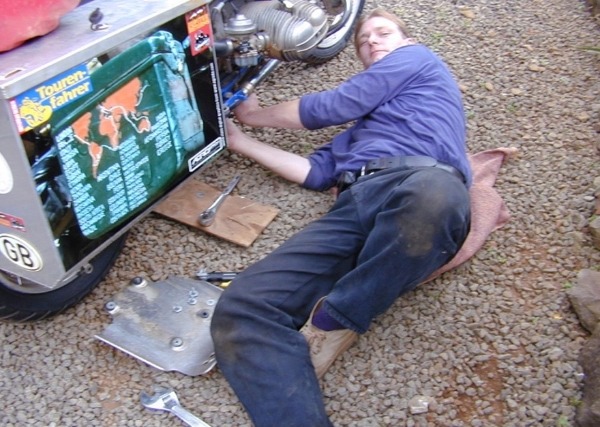
Christopher Handschu
Anyway, after I left he was able to start a hostel for travellers like me, called The Jungle Junction. I believe it had/has a good reputation. Last week, I got this letter from him.
Dear Simon,
Trust this find’s you well!
And thank you for always sending me your notes from your diaries. A grate way to encourage a dyslexic to read!
Today I would like to ask for your help!
After you leaving Nairobi, we started “Jungle Junction” and we are grateful that we have been able to offer travelers in Nairobi an oasis for 22 years.
Through a Public fund raiser we are hoping to finance the move to new premises, after our lease was terminated.
Would you agree to shear the Fundraiser link on your Mailing list?
Your consideration would be highly appreciated.
Thanks in advance Christopher Handschuh.
=-=-=-=-=-=-=-=-=-=-=-=-=-=
Jungle Junction
Langata – Karen/Hardy
Kongoni Road (JJ’s)
Kenya – Maps Google: http://goo.gl/maps/XyHxO
S: 1° 21.767″ E: 36° 44.438″
+254 (0) 722 752 865
=-=-=-=-=-=-=-=-=-=-=-=-=-=
So I wrote back saying I’d like to help, and he replied:
Thank you Ted, for your positive response.
I would not ask for assistance, if the situation would not be dire. It is hard for me to aske for Help – on the other hand i will not give up without a fight.
Sorry for the late response, was in bed with the Flu.
This is the link to the fundraiser. https://www.mchanga.africa/fundraiser/118438
Attached kindly find accompanying letter.
Your affords are appreciated, and if you have any suggestions on how to broaden the fundraiser, would love to hier them.
Kind Regards,
Chris Handschuh
=-=-=-=-=-=-=-=-=-=-=-=-=-=
Jungle Junction
Langata – Karen/Hardy
Kongoni Road (JJ’s)
Kenya – Maps Google: http://goo.gl/maps/XyHxO
S: 1° 21.767″ E: 36° 44.438″
+254 (0) 722 752 865
=-=-=-=-=-=-=-=-=-=-=-=-=-=
And here is the letter:

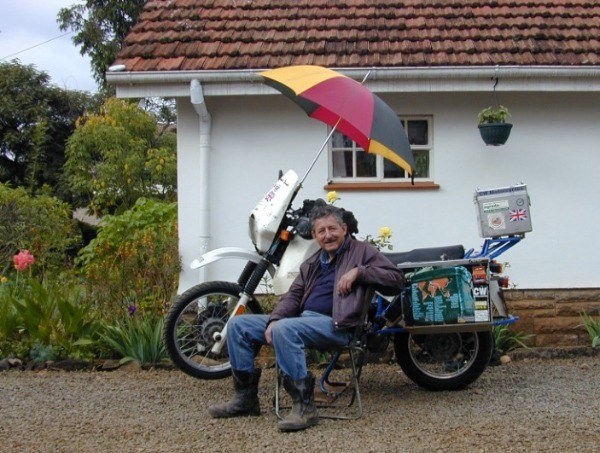
Outside Handschu’s home in May 2001
Thanks. See you next week – through the haze.
After witnessing that horrific tragedy of the girls under the cartwheels, I go back to my hotel.
April 10th, Agra
At Shiraz Hotel the chickens hang by their necks like small people under a neon tube over a little stage decorated with pink tinsel. Fish, chops, sausages, all smeared in the same pinkish paste, laid out below chickens. Sikhs with rosebud mouths mix beer and whisky. What would the Sikhs do in prohibition? After eating I want to wash my hand – I carry my hand – there’s a loo and a washbasin. A man is standing in the doorway aiming a jet of urine at the lavatory bowl. He sees me standing there uncertainly.
“I am making water,” he informs me. “You wish to do so?”
The whole of India seems of a sudden funny and ludicrous. And if it should cease to be funny, God help us.
The income tax employee at the tea shop, in ecstasy because “our rights have been restored.” He was [had been] in Australia. Apart from minor differences of custom he sees no difference between Australians and Indians.

On the road to Delhi
April 11th, Delhi
Arrived today from Agra. First to Lucas, to phone Macarthur, but he was going to Lucknow. Baroda [The Maharajah: I had an introduction, after sleeping in his palace] was due in the following day.
So I went to A-11 [Amjad Alikhan’s house] and found it as I’d left it. The concerts had been cancelled again, but as luck would have it there was another that very night. Not till I arrived did I understand that it was arranged by a set of Sikhs called Nandaris who consider themselves the only pure ones, wear only white (colours are profane) and are great patrons of the arts. Their Guru sits on the stage on a red rug (apparently plastic) with his elders ranked behind him all impeccably white with a splendid array of beards (unbound). Behind him to his left a barrel of [illegible] sat with a long white horsehair fly whisk. He held the brass ornamented handle against his right shoulder, frequently whirling it above and in front of the Guru’s head (though there were no flies, of course) and gazed at his master with evident rapture, seemingly oblivious to the music. An oriental court.
Two brothers sang, and how wonderful to encounter, at its very best, ways of using the human voice which one never dreamed of. Human versatility seems endless, and the variety of ways we find to express our emotions infinite.
Alikhan broke a string in concert, and again I was astonished at his composure in fixing it – but realise now that nervous anxiety is such anathema to Indian music that it must be got rid of very early in the game.
Hariom and Sharafat are being very nice about taking me in. My main problem is that I can never get our plans straight. One vital factor is always missing and I, at one point, got quite paranoid thinking I was being deliberately misled. In fact, there is a tendency for people to tell you as little as possible and not to anticipate your needs. So you may be invited somewhere, but have to ask for each detail of where, when, how, with whom, etc. If this happened in Europe you would have to conclude that the invitation was not meant, but a polite fiction only.
[I have to assume, at this distance in time, that I did somehow convince myself that the invitations were genuine.]
April, 17th
A nice day doing nothing with Kalidas. (Oh, I fixed my steering in the morning, discovering that the handlebars were wrongly set). We went to an art gallery where one of his father’s paintings was displayed. Liked it. A very fat man lay on a daybed, having his legs massaged. He looked up at me, gleaming, and said, “How are you? What are you doing these days?” He beckoned me to the couch as though inviting me to join the massage. His younger brother later appeared and said firmly that it was cheaper to travel by cargo boat than by plane, though of course you then had to pay for your food. All nonsense, but he had to have something authoritative to say and brooked no contradiction.
They were all retailing the political gossip about Sanjay and Maruti. Evening at K.D’s house. We talked and smoked, then “Come. There are some people you’d like to meet.” His father, a single man, and a couple. The second man was most wearyingly affected in the academic manner. They made the barest of perfunctory remarks to me, then talked to each other in Hindi. An exercise in patience. Later, the Don made the most excruciating remarks about the father’s painting as he showed them. The paintings were pretentious. He himself was commendably silent. The food was excellent.
I like Kalidas, he’s young and articulate, but spreads himself very thin. At the gallery a man with breasts came in – he belonged to a sect which castrates itself. But his voice was very male.
Delhi, April 18th
Last night I dreamed it had snowed in Calcutta. I went to scoop up some snow to drink thinking, Ah. Pure water – and had put it in my mouth before realising that only the surface was white, below it was coal black – I understood that it had absorbed all the dirt in the air. It was not specially disagreeable. There was another dream in which I lusted mildly and lovingly after a girl with prominent breasts which she presented even more prominently in a special sort of bra. But they only acted as labels, as it were, denoting a particular type of cool and comfortable personality which I I’ve often thought might be easiest for me to live with. But they have never shown themselves to be particularly interested in me. In this dream she was comfortably involved with someone else. I was merely the voyeur. There was another sequence involving something floating in a lake, a table in a tent with a tiger which was supposed to submerge itself occasionally and some man who was professionally involved with this phenomenon was urging us (me and who?) to witness it. We did and something went wrong with the tiger, but I don’t know what. I was also at the counter of a bank (one with windows) having my tongue examined, again with some warm female companion. My tongue was heavily coated, sand I went into a sort of whirling delirium, waking up to find that Sharafat was playing a skirling sequence on sitar, as practice.
On different days I have: Reset tappets (loose!); Tried to stop rocker box oil leaks; fixed steering head; cleaned spare chain; oiled cables; changed oil. A nasty rattle on deceleration from chain case has me worried, but more oil in there has mostly got rid of it. Was it just dryness? Nervous now about transmission. Also reset L.H exhaust pipe.
Peter’s promised letter still not arrived, but Gopi writes to say Carol will return there on 21st.
Daily visits to Sweets Anil at the D.C. Market for little snack, Lassi and tea. Bothered by a semi-permanent sensation in the bowels – not an ache, just a presence. Not quite right since Ranchi.
Reading Miller’s Nexus. A bit disappointed.
News Flash: Ted Simon isn’t perfect after all. Next week, true confessions.
I’ve left the East Coast and started my journey back to Delhi. It’s April and already very hot. At first I found it was only bearable to ride some parts by night, a risky enterprise.

Amjad Alikhan’s student playing scales on his sitar
April, Jabalpur
There was a sprinkling of rain last night. Now, after Seoni, a full scale thunderstorm at dusk. And with the dirt shoulders of road wet more trouble with lorries, and one wild skid which leaves me miraculously vertical, and the curious mixture of relief and indignation. I write this after a good night’s sleep. I feel the fatigue in my arms.
In Jabalpur a beer behind a wine store with some Sikhs, and a late comer who is overcome by emotion. Shows me two addresses in East Ham and pays my 14 rupee bill. I admire this ability to make passionate gestures on the spot, though I don’t suppose he expected me to leave so suddenly. Another fellow on a scooter talks about the farm he has bought as a hobby, and how he plans to train monkeys to shoo off neighbour’s cattle. He talks fondly about Australia.
I feel quite woozy after the beer, but once again I find that as soon as I’m in the saddle my mind and body settle easily to their task.
The book assumes a sort of structure –
Africa: The exorcism of fantasies and fears, and a new basis for equilibrium in the world.
South America; A testing ground for newly discovered strengths, physical and psychic.
North America: A flowering of qualities leading to new indiscretions and tests of a different kind.
Australia: And back into the world of opulence and corpulence and “couples” – both easy and impossible.
S.E. Asia: Nemesis. Collapse of the myth, and beginning from scratch, but more carefully and with a better idea of resources and possibilities.
India: And the beginnings of a conscious spiritual structure.
Leaving Pithora a bit hastily (if it hadn’t been for the argument about money I might well have stayed the night). At Jabalpur I realised I’d better go to a hotel. The Sikhs sent me to Clarkson’s (should have guessed) and the gentleman farmer led me there. I was so besotted by the Sikh’s 14 rupee gesture, and tiredness and folly that I didn’t ask the price of the room.
Even if it’s 25 or 30, I thought the 14 rupees would take care of it. Even when the bearer switched on an air conditioner I didn’t suspect – it made such a ghastly groaning sound that I switched it straight off again. There was a radio and a phone. I was lucky they didn’t charge 145. As it was 45 shocked me. The breakfast scene was a long room, with Indian businessmen throbbing with self-importance, and giving me the glare which to me still means “How can such an animal have got amongst us?” Are they all imagining me, like the Indian singer in Illustrated Weekly (1st week, April) wiping my bottom with paper?
After arguing 5 rupees off the bill, set off into the rain-cooled air. The monkey trainer had promised to visit me before office but failed to appear.
First part of journey to Katni ordinarily pleasant. After Katni road became a minor one which struck off across a deserted, rocky scrub – very empty and hot-looking, though air still cool. Unhappy about the bike, so thoughts of a breakdown here. Have water and rice. For a moment I think, “You can perish in India.” It’s a joke.
[Dating back to Australia: “You can perish in the outback.”]
In fact, it’s a beautiful landscape, rust and dust coloured, rising and falling, savannah really. A nature reserve apparently. Halfway, at Pappai, stop for tea. Nice tea-house scene. One old man holds forth, giving an imaginary account of me and my travels. Others watch me avidly, but with less grasping curiosity than in towns. Some respect is still there. The man next to me, in white shirt and trousers, speaks English but won’t. After a little he gets up and sits somewhere else and ignores me in a rather obvious way.
Khajuraho

A profusion of eroticism clothes the walls of the temples at Khajuraho
Three groups of temples, airport, 3 smart hotels, a village. PWD etc, and Madya Pradesh Hostel. Sleep on grass. Meet Liz McCloud (Dorset and Cambridge) Two visits to main group of temples. B&W at 64ASA. Irritated and stimulated by Texan Simeon – “Jumping Jack” who produces a pure Ayn Rand philosophy. Difficult to argue with logically. Why? The flaw is the same for all ideal systems. They don’t correspond to human nature.
Touched by group of laughing women anointing their idol with pigments, flowers and water, chattering and singing. Very innocent.
Agra, Sunday, April 10th
Arrive just before a rainstorm. Bike rough again. NB: Famous worries about steering head races unfounded. All dealt with by dabs of grease under the steering head lock. When I think of all the jarring, ratting and jerkiness I’ve endured all these hundreds of miles.
To the Taj. Yes, it’s beautiful. Most impressed inside by the sounds that swell and fade in the dome – like a million sad whispers adding up to a cosmic sigh. It rises and falls, it seems, almost independently of the level of noise at ground level, yet any particularly loud voice is heard briefly above the other echoes before sinking into the common pool. People come in determined to make their mark, young men drunk with power, young women drunk with hope, and where they would chisel their names into the marble if they could, they fling their challenge in the air. And immediately everything that was sharp, personal, assertive in the sound is lost and it becomes a mournful ghost joining the legions of ghosts. This phenomenon has very powerful effect on me.

Leaving I pass round the edge of the enclosure, colonnaded galleries in red stone (someone, I see, quarried south of Panna). Quantities of stone slabs are stacked and masons are cutting new panels to reface the galleries.
Walking back to fort. The fort is closed because 120 ministers from foreign countries are visiting. Asked Army official and was surprised to get answers readily. Were they army or police?
Do we also close these places to public for visiting dignitaries’ sake? I suppose we do. Just an annoyance.
In town, walking in bazaar, ox carts, horse carts, hand barrows, cycles and rickshaws, m/cycles and pedestrians thrash about. One horse-drawn cart was moving with more pace and noise than usual. The driver, a young man with patterned red cloth round his head, tunic and lungi, was looking pleased with life. His cart was heavy with men and sacks of grain but his horse was bigger and more temperamental than the others and he was forcing a dashing pace up the hill through the crush. The horse was tossing its head from side to side, twisting between the shafts.
I don’t know how often it happens. Three little girls, hardly two feet off the ground, dressed like old-fashioned dolls, clinging together, fell in a bundle under the cart wheels. I watched the wheel rise up and rise onto the bodies, all three of them, and then roll back. Astonishing and shocking sight. Men came from the shops to pick the girls up. The driver got down and literally raised his arms in supplication to Allah. His passengers hurriedly paid him and faded away. Two of the girls seemed able to walk. The third lay in a boy’s arms, with bright blood rising from her mouth. An adult man was telling the boy to do something. The boy just grinned as though he thought the whole thing was foolish. The man shouted and gave him a push, and the boy went up the road, none too quickly and still grinning with the small body. Later, outside the Dipty X-ray clinic I saw another man take the girls and ride off on the back of a scooter. What chance, I wondered. There are so many of these tiny bundles of humanity living their lives down there on the street surface, far below adult notice. How many are snuffed out like that. Mustn’t exaggerate. Can’t quite grasp the essence of this event. Something extremely familiar, natural or right in that wheel on those small bodies – as though it were potentially present all the time and I just happened to see it then. Something in that phrase “an accident waiting to happen.” There have been cartwheels and little girls in long dresses for so many thousands of years – an automobile accident is science fiction by contrast.
Next week, to Delhi and on the way out of India.
Thanks for your help with the French edition. It is now available to buy on the website here.
(Scroll down for the English translation)
Enfin, Les Voyages de Jupiter est de nouveau disponible en Francais, et vous pouvez l’acheter ici, sur mon site web. Cette traduction a été publiée pour la première fois par Albin Michel en 1980, avec un grand succès, en grande partie grâce à l’invitation de Bernard Pivot à son émission télévisée emblématique Apostrophe. Le soir suivant mon passage à la télévision, j’ai dîné dans un restaurant près du Panthéon et, lorsque je me suis levé pour partir, presque tous les clients du restaurant m’ont applaudi. C’est le moment où je me suis senti le plus honoré publiquement.

Le livre comporte 598 pages, avec une préface de l’éminent historien Claude Manceron, qui était, par hasard, mon voisin à Saint-Privat. Il comprend 32 pages de photographies en couleur.
Il est disponible directement auprès de moi, signé et dédicacé si vous le souhaitez, pour 29,00 euros, affranchissement compris, en France uniquement. Pour l’usage de ce site, le prix serait exprimé en dollars US 35.00. Si vous habitez hors de France, ecrit moi directement a tsimon@mcn.org
At last, “Les Voyages de Jupiter” is back in print, and you can buy it here on my web site. This translation was first published by Albin Michel in 1980 to great success, largely because Bernard Pivot had me on his celebrated TV show “Apostrophe.” The night after I appeared on television I dined at a restaurant near the Pantheon and as I rose to leave almost everyone in the restaurant applauded. It is the closest I have ever come to being publicly honoured.
The book has 598 pages, with a preface by the distinguished historian Claude Manceron, who happened to be my neighbour in Saint Privat. It includes 32 pages of colour photographs.
It is available from me, signed and dedicated if you wish, for €29.00, postage included, in France only. For the purposes of this site the price will be expressed in US dollars 35.00. If you live outside France please write to me directly at tsimon@mcn.org
Once in Calcutta I made my way to the Salvation Army Hostel, known as the Sally-Ann, by recommendation, where I made friends with Jacqueline LePrince from Paris and Eric Hansen, from San Francisco who had been helping at Mother Theresa’s home.
[Eric wanted to take spices home, so we went to a spice firm and said we were thinking of importing spices. We were given several large bags as samples and were shamefully pleased with ourselves.]
Spices from: K.C. Dutta (Spice) PVT Ltd, 255 M.D. Road, 2nd floor, Calcutta 700. 070
Prices: Haldi. (Tumeric) 9rps/kilo: Dhania (Coriander) 11.5 rps/kilo:
Jeera (Cumin seed) 29.25 rps/kilo
Slight fever back again. Compared it to having two images out of focus, as in bad colour printing – “out of register” – sense of there being two simultaneous existences which have shaken loose. The body turns, but the soul lags behind. The whole idea of soul leaving the body at death might come from that. See page 31 [Staying with Adrienne] Go on from this to other forms of detachment.
Tagore writes about the spiritual tradition of Ancient India, the pursuit of purity. Leading to the discovery of the one-in-all, and the release from self. He speaks of India as though she were uniformly devoted to this search. Observation, alas, contradicts this idea, at least today. It may be the best place to go and lose ourselves, but the majority here are clinging as tenaciously as any to what little they have, and to their traditional forms. The easy fatalism of a once luxuriantly forested and underpopulated land has led to the present predicament . . . . .blah, blah.
Pithora PWD April 6th
Calcutta was hot, sticky, and I never really got used to it. The explosion in my belly from the lunch before Ranchi is followed by an even more unpleasant immovability. (I over-reacted with the Lomotil. Should have left the beautiful machine alone). So I did very little in Calcutta except let Jacqueline LePrince trail me about – she made several remarks about my docility. There was the futile excursion to Tagore’s house, and Bel [??????] Moth where all we achieved were some chores at the tailor and the railway station.
There was the enormous steak at The Other Room, too big by far for my poor stomach.
The [Military] Tattoo. The ridiculous queues and the even more ridiculous battle for survival once inside – while dogs jumped through fiery hoops, and while motorcyclists dared death. Also two days at Lucas and an oddly equivocal Raj Pande [Boss previously met in Assam.] (who could I suppose be having trouble at home).
Mother Theresa’s Home for the Destitute and Dying makes you wonder why you didn’t start one up yourself – until you think about the beginnings of it. Now it’s rather better ordered and more pleasant than the average railway platform. Tube and plastic beds, raised on the left, floor level on the right, very close together, much smaller than I pictured it.
Rick Eager, who lost himself to two Nepalis, and whom I lent 250 rupees. His involvements with Calcutta police, which I heard about from Eric Hansen in Puri, so many passports stolen, so much dysentery.
And the Sally-Ann “big nurse”, married to a Misi tribesman, with daughter, who has a poor opinion of world travellers, and wishes she could get back to working with real children.
The silly proprietress of the two-star Fairlawn Hotel, and the incredible scene over the soda water. [I was disappointed because there were no bubbles. I pointed this out. She threw a fit.]
“Nobody has ever complained about the water before. And you’re not even staying with us. There has never been any sickness from water. We get it from the Saturday Club.” (The clincher).
She managed to go on for quite a while but said no more. Oh yes, “My husband was a regimental …something or other.” So obviously the soda water has got to be OK. I could go upstairs and complain to him she said, heatedly, but her staff politely deflected me.
Next day the bar was closed “for a dry day.”
Was glad to get out of Calcutta, without having really experienced it, neither its enormousness, nor its detail.
Howra Bridge is rather awful. On the way out I ran dry and later broke the chain (on the connecting link). Too much heat. Stopped from 12 to 3, and met a somewhat reasonable “science graduate” at a Sikh shop. Had my tea bought for me by a truckie. Almost went straight to Sambalpur, wavered right up to the Xroads, then went to Puri meaning to go to Konarak. Glad now I didn’t. Slept most of the time (between trying to dislodge my bowels) and fought occasionally with the sea. Had Phil from Milwaukee in my room, a very boring teenager who liked taking things. Jack the Dane turned up same night. Curious blend of softness and violence – still in the pupal stage of conversion. Tends to treat people as mindless – aftermath of self-realisation?
Funny episode in the tali restaurant “I don’t approve of Fanta and Coca-cola drinking,” when I couldn’t eat the lunch he had offered me.
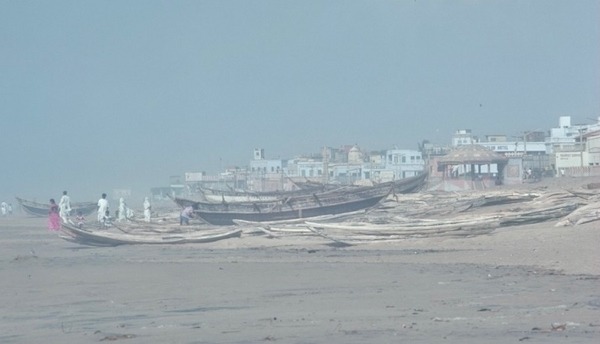
The beach at Puri – before the cyclone
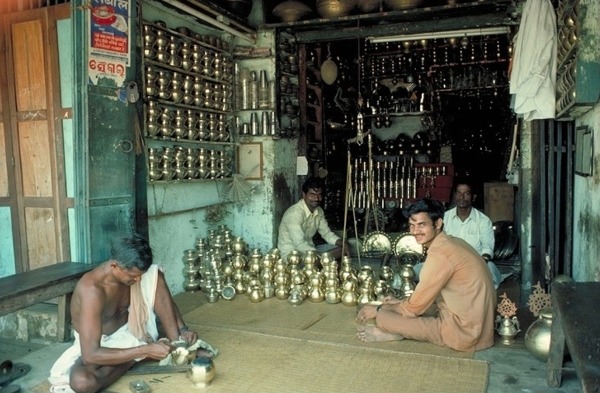
To Konarak on Monday. Bought brass.
[I bought two brass balances: up to 500gms + weights, 65 rps and 250gms + weights, 40 rps. Don’t ask me why; I still don’t know.]
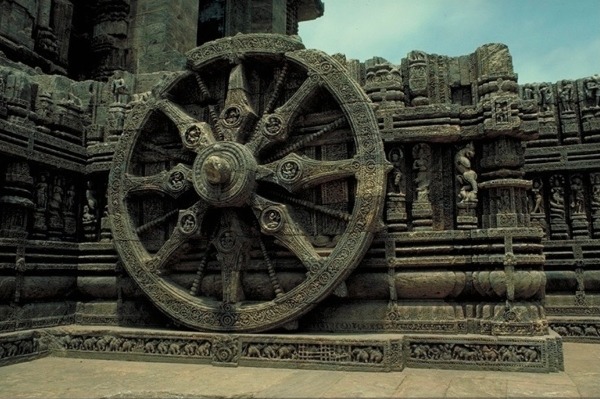
The original Jaganath – at Konarak
Short but worthwhile visit to Sun Temple. Eric in the IB. Then all night ride to Pithora.
Left Konarak for Delhi with 24,400 miles. [Reading on the clock since Los Angeles.]
More thoughts about the book. “You’re a real man,” would lead to personal doubts about sex and gender. Must be careful not to make gratuitous confessions. Thoughts about how an environment – say a TV studio – conditions behaviour. A saint could handle it – I guess that’s a reason for practicing austerities in the forest. Coming to India is a contemporary equivalent for Westerners, though the austerities are thrust upon is.
Have had the horrors about this cross-country ride. The journey to Puri made me realise that it was already much hotter in central India than I’d thought possible at the beginning of April. Air is superheated. Faster I ride the hotter I get. Like air from a blast furnace. The rear sprocket is a toothless mess, and have forebodings about the bike. Tyres are getting close to bald, specially front tyre. Often my mind conjours up clairvoyant’s prediction and I use them to crystalise my anxieties. Forget who put it into my mind to travel at night, but now it seems the only way. Thus breaking a rule for the journey. My sensitivity to the bike is extreme. And I imagine variations in sound and feel. A tinny quality to the engine sound, Hollow rattling in the transmission. And an alarming wobble at slow speeds as steering head deteriorates.
What is there to occupy the mind at night – for the mind craves occupation. Inevitable thoughts about the future, and much struggle against expectations. But generally I’m keeping my mind on the job. No serious lapses of concentration. Bar one, when I was too intent on reading a milestone to notice the big rocks laid out on the road. Hit one and am lucky, though wheel rim is bent somewhat. A million diversions on the highway – for culvert construction – driving off into sandy hollows.
On second night, after Pithora, stop in Raipur and drink lassie with two student eye-doctors who insist on paying. Raipur has an impressive look about it. A little further on is Bilai – biggest steel works in Asia, spread out below me from viaduct. Occasional hellish glow as slag is tipped.
A new cinema hall stands brightly in the middle of nowhere. – all the promise of the old Odeons in the Thirties. A while later, stop to rest by roadside. See one rear box hanging crazily by one rubber mounting. The patent lock had sheared off. More trouble in store. Don’t have the wit to remove the broken part which later shakes off. Much trouble with lorries on the narrow sections, particularly with lights. However, making faster progress than expected. Over 500 kms each night brings me to Jabalpur on Wednesday evening (after a day stop at Seoni in PWD [Public Works Department bungalow] where I argue about 8 rupee bill and pay four after ostentatiously “closing the book”.
Also, the Care official there, who says, “We are helping the Govt of Maharashtra to set up a nutrition programme.” He is a good advertisement for nutrition; sleekly obese.
“You are from?”
“Do you mean today, or originally?”
“No, no,” he says, irritably. “You are from?”
How could this mean anything but “Your native place?”
My impromptu train ride to Delhi from Gaya to listen to Amjad Alikhan play his sarod in concert was frustrated when the concert was cancelled. Trying to make something of all the effort I decided to first take the train to Benares, before returning to Bodghaya. Benares, also called Varanasi, is the holiest of Indian cities on the Ganges.
Monday 14th (The Ides of March)
Peter Wells, the New Zealander met at Delhi on the train is an odd fish; super naïve and sophisticated at the same time. Very young, but with the impassivity of stone – no, less life and more despair than stone. Has been traveling a while– S.E Asia, USA, Mexico, Europe, etc. Worked in North Sea. Likes to take risks and defy authority. Says he enjoys it. Races bikes. Was studying biochemistry. Now determined to find out how cells respond to influence of moon, stars and planets. He strikes me as being in a state of shock. I’ve been thinking again about the disadvantages of too ambitious a first journey. One can be too young to travel? He got caught on a bus in Kabul at twenty degrees below with only his shirt. Has been ill ever since.
We wandered around Varanasi together. I was uneasy because I made every decision. He bought a shirt that didn’t suit him (bright tomato colour) and clung to me a bit.
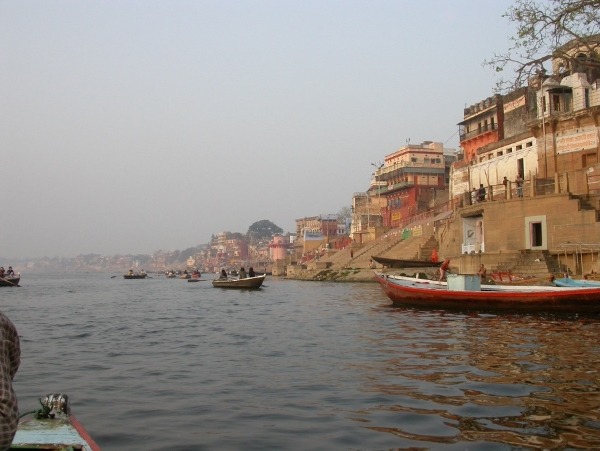
The Ganges at Varanasi (Benares)
Tuesday 15th
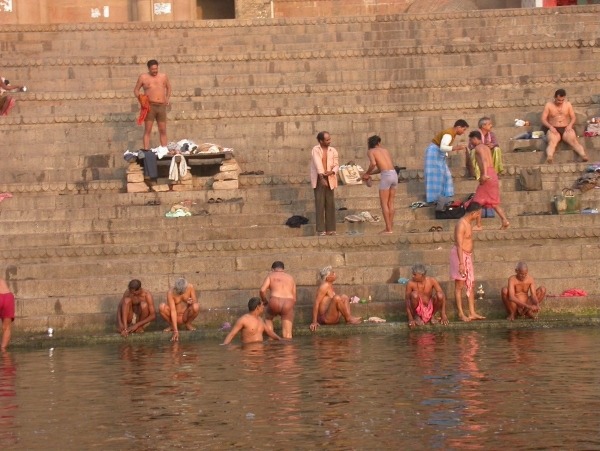
The river boat at Varanasi brought one extremely shattering moment. I see something floating (so much floats; garlands, bits of wood, dead dogs, etc ) Something with a crow sitting on one of its protuberances. Closer, I thought oddly of the knees of a camel sticking up, a ginger colour and hairy. It was a corpse lying on its back, toes, knees and face protruding from water. Crow was sitting on nose and eating the face. Body in attitude of grotesque comfort, lying back in the Ganges. Very moving because it was the materialisation – incarnation – of all the feelings that underly Benares, as though the thought streams met and in the intensity of their interaction caused this body to appear briefly and float past. I thought immediately of Death in Venice – and now I think how often a time or place is infused with secret meanings which yet never manifest themselves. This corpse was the manifestation of Benares. As rare as it is commonplace.
[Peter Wells took a picture of the corpse and, much later, sent me a print which appears in the Penguin edition of Jupiter’s Travels.]
The train to Gaya – perhaps my best Indian train. Crowded, but I was lucky to have the rubber [What on earth was that!] to sit on. Elderly pilgrim couple squatting at my feet. She toothless, stoic, red sari, curled up incredibly small. Knotted into one corner of her sari, a 5 paise coin, which she carefully replaced by a sprinkling of chewing tobacco. He is in euphoric mood, shaven with long whisp of hair on the back of his skull. He has his canes and flags. Once or twice he and his companions let loose great shouts of exultation and incantation. As we rattled over the Ganges bridge, they tossed tiny blossoms from the window and he looked out at the river like one who was seeing his home for the last time, solemn, beyond tears or emotion, trying to fix the moment.
Wednesday 16th
First day of polling in the election. Janata flags everywhere. [Janata was a block of parties opposed to Indira Ghandi’s Congress Party]
Everything is slowing up as the heat grows. Bodhgaya is hotter, calmer. I take the cabin where the quiet tattooed German stayed with the American speaking Oriental girl (the one who had that amazingly trivial conversation with red-haired Deborah over the laundry one day). The second night, when I was less tired, grew into a cavern of sounds and feeling. The beetles were chewing away at the bamboo poles in the roof, sounding louder and more voracious with every hour. The mosquitoes’ whining was intense. I felt oppressed and close to death, felt sure I would die – not in a physical way, but a sort of death of the soul, maybe. Perhaps the ego can only flourish in a temperate climate, where the extremes of nature don’t constantly remind one of one’s fragility.
The East produced the Buddha.
The West replied with the armchair.
Thursday, 16th
Owls swooping into the neon light to snatch a frog from my feet.
Friday March 17th
[I met a Thai monk called Amray who persuaded me to move briefly to another vihar maintained by Nalanda monastery which was joined to the 2000-year-old university of the same name that had been in ruins since 1190. I knew nothing of it at the time. One might say what a wasted opportunity, but ignorance was a price I had to pay to travel through so much of the world.]
Arrived at about 10am. Warm greeting from Amray. The ‘prefect’ is a Laotian ex-monk. He fixes me up with a bed at one end of the prayer hall. Free lunch at the “Thai Kitchen.” Very hot during the day. Many mosquitoes. First evening at 8.30 lying on my bed as monks come in and chant the Sutras for half an hour. Pali is a very melodious language. Very long words, but seemingly succinct. The work of the Institute is carried out in English and Pali. The prefect is very scornful of it. There are three hundred students on the rolls, but only a handful turn up. Lots of them are not even in India. They learn lumps of Pali scripture by heart and get their degree (MA) which is hardly worth anything in reality. Both electricity and water fail frequently.
Reading Miller raises a sympathetic storm in my mind as I stroll round the “cloister,” but the memory fades. Stars are brilliant.
Dogs are an important part of society and in their bestiality and trivial tempers seem to be there expressly to remind us of the perils of bad Karma.
Actually, on another occasion, observing birds, it seems to me that this whole system of grading species according to superiority is a blatant example of the human ego trip.
What would be so terrible about being born a bird or an animal. Actually, the concept is absurd.
What eagle in its right mind would want to be born into the slums of Los Angeles? One hopes that human beings had more dignity in the Buddha’s time.
In afternoon I take Amray to Bihar Sharif [about 50 km away] to get his tax clearance form. It’s a great test of equanimity. Two hours in the office while a Brahmin with a palsied hand and a face engraved with counterfeit cares, fiddles with papers. Two assistants take a tea over the road and buy me one. Talk quite nicely to me. Afterwards I watch him (the assistant) struggling to talk with his lower lip cupped to stop the betel juice from running over onto his paperwork.
[After a few days I left to make my way to Calcutta via Ranchi, where I stopped to have lunch in a relatively expensive restaurant. The food gave me dysentery and I was forced to stop and squat in a field, where I wrote this Ode to Ranchi water.]
The food in Bihar is rather bizarre
You should not stray far after lunch in Bihar
Not even as far as the local bazaar
For none can outrun the food in Bihar
Well, that’s what I wrote in March 1977.
As I told you last week, I have just received copies of a new edition of Jupiter’s Travels in French, and I need to get the word out. If those of you who live in France could suggest the names of magazines or web sites I should contact, I’d be grateful.
I arrive in Bodhgaya looking for somewhere to rest and write.
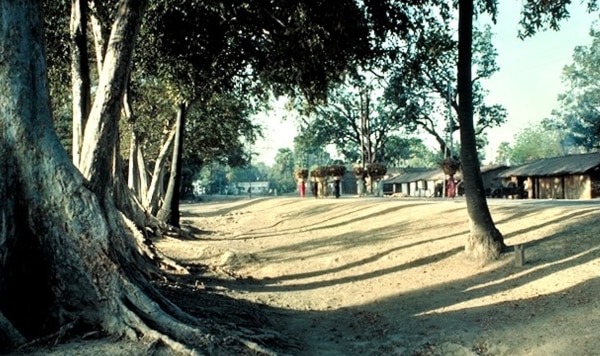
Bodhgaya, Monday February 21st
Tent in grounds of Tourist Bungalow. Not a very peaceful place. Meet Jacques Martin and his girlfriend/wife. They tell me the Burmese Vihar might be better. After two nights I move across, so –
Wednesday 23rd to Wednesday March 9th at Burmese Vihar
[All the most important Buddhist national communities had built temples at Bodhgaya, where the Buddha was said to have attained enlightenment. Associated with the temples were places, called vihars, where pilgrims could rest. Some were more rigorous than others. The Burmese vihar was the most relaxed. It consisted, so far as I remember now, a two-storey building and a large yard, with vegetable gardens. Down one side of the yard were a number of small huts, each with just a bunk and a bench, and I too up residence on one of them. I quickly made the acquaintance of a Burmese monk, Amnuay Bahaddesiri, who held classes in Vipassana meditation, and also led morning sessions of yoga exercises on the roof. I signed up for both while I wrote my piece.]
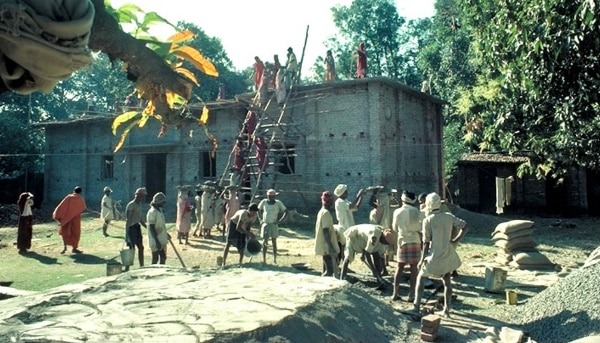
[While I was there they were erecting a new building. As usual the women were doing the heavy lifting, carrying baskets of wet cement up to the roof. I finished my piece – which never saw the light of day – and I heard that Alikhan, one of India’s most famous musicians, was giving a concert in Delhi. I had met him in Assam, and we became friends.]
Buy train ticket for Delhi.
A rickshaw to Gaya, bumping quietly through the night. Conscious of the river of sand beyond the trees and palms on the right. Occasional ghostly ox wagons and pony cabs in moonless dark leave shouts and chatter. Little snatches of sound. I’ve done so little moving at night, and none in silence. It’s not even 9 pm. The train leaves in seven hours. How to pass the time. Have the perverse idea of getting drunk. At Anand’s restaurant ask for a beer. The proprietor himself comes to move me onto a patch of grass, separate from the rest, in gloom, where I swallow two bottles of beer and dream quietly on my own. Have two good ideas. One is to identify societies by the drugs they use. (i.e. the kind of relief needed). The other, better idea I have since forgotten.
Before leaving P.K. Anand [the owner] takes me into his office, which is one of a row of lock-up shops that were once his family’s stables. They were great landlords, he says. He tells me stories about vasectomies – how he once needed labourers and sent someone in a rickshaw to offer 5 rupees to anyone who would come. He got no takers. They thought it was a ruse to get them operated. And the ticketless traveller of 15, caught by police, and taken straight to the operation room. Says family planning is resented as interference with the laws of Karma. A man’s ability to reproduce is determined by his previous life. Virtue is measured by the fruit of his loins.
The long wait on the platform is tedious. Already I’m regretting this impulse. Journey drags on endlessly.
The long, dreary wait on Gaya station after too much beer. Railway employees and passengers alike stretched out on platform. Man in dhoti, shirt, and shabby worsted jacket, rises up and with his lamp disappears along platform into darkness . . . .
Glimpses of mother on opposite bunk caring for her child.
Chai wallahs with earthenware cups. Burned my mouth on coffee at Allahabad. Had a guava at another station, not knowing what it was.
At Delhi station slightly desperate mood, try to phone Alikhan and lose rupees in telephones. All around others are also losing their money. In kiosk the telephone employee is allowed to continue unperturbed – changing notes for people to lose more money.
With sense of rushing into folly, take rickshaw to Alikhan’s address. After much looking, find it, but he is not there, only a student. He sends me on to new house, but I telephone first and, thank heavens, he knows who I am. I’m kindly received and then comes the numbing news that the concert has been cancelled. (And looking back I see that the whole enterprise was dodgy from the start, fraught with compromised motives, last minute reluctance, overcome.) Now I’ve a real struggle for equanimity.
Friday March 11th
Woken by student plucking at sarod, playing scales. Bus to Lucas. Lots of interesting mail. From mother, PH, Pat K, Barbara, Doug and Ash. Lifts my spirits. Set off on my chores which scarcely fill the void I’m in. Peter Kline has left. Ottolenghi retreats as I approach. Call to London is usual farcical failure. Passport office is closed. Follows desperate beer with Madan (Asst. Mgr) who assaults me with talk of serial depravity by English Hippy girls and his friends. He is depressed, but a more general obsession shows through. Undoubtedly, I am not exposing myself generally to the dirtier side of the world’s business and must bear this in mind in case I am misled into making “objective analyses.”
Attempts to get back to the Defence Colony are frantic as each bus leads me further into the unknown. There are election meetings booming out everywhere – huge voices. When you can’t understand what they say it’s obvious that the meaning is irrelevant to the main purpose (?) Remember the speech at La Plata.
March 12th
Breakfast at ‘smart’ restaurant. Waiter leaves door open for light, but others always close it. Music starts, a swinging Hindi number and I object. The owners turn to me with severe regret.
“Prayers,” they say. I’m mortified. Then waiter switches on the A/C directly behind my head.
Thick atmospheres, and rarified.
What does it mean to speak of materialistic societies? Aren’t Indians even more obsessed by money and possessions than we are? But the values are different. We actually want these things for their own sake. But it is noticeable that well-to-do Indians are quite comfortable in shabby, primitive surroundings (e.g. Patna party, religious observances). Other things are at stake. Security. Status. Responsibilities discharged. When an Indian businessman robs his clients it is on behalf of his clan, not himself.
What is there to write about Delhi? Tales of frustration and small blessings on buses and in shops. The saving of it, of course, are the minutes spent listening to Alikhan practicing and his student on sitar afterwards. (And the shy-looking lad on table-tabla who nevertheless managed so much equanimity with his slight inward smiles. The enigma of the Mona Lisa is, of course, that we want her to smile at us, but it is purely inward.)
The passport office was closed on Friday afternoon (otherwise I might have gone straight back to Gaya). On Monday it was like a maze with lines of people queuing, but the counter I wanted was like a trough in a piggery. I always wonder how I can ever expect to reach the clerk, but it happens. George’s story of the Pakistani train ticket office sounds as bad as any three layers of frontiersmen with guns and big muscles sprawling over each other. I suppose I’ve always assumed that one day I would be confronted by just such an impossible situation, and the truth is that I’ve probably been through several already, but having to deal with them practically one can’t afford the dramatic view but must focus on the spaces between the bodies. There seems to be always a way through.
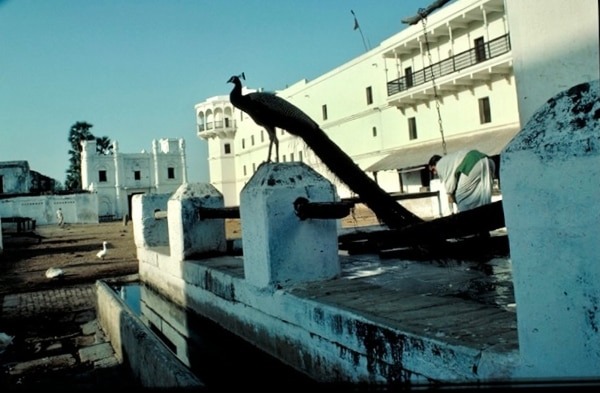
Bodhgaya also had a Maharaja, with his own palace and peacock
Next week: by train to Varanasi – also known as Benares.
From Patna I’m on my way to the religious heart of India but suffer a most felicitous interruption – dancing girls included.
Sunday 20th February
After a haircut (very short) and breakfast with Jha I leave for Bodhgaya anxious to settle down to my piece [I was planning an article on the election for the Sunday Times] and unsure whether this will be the place, though Carol recommended it so highly. It’s a long ride – the short cut I had hoped to find eludes me – and very little English is spoken here. I’m reluctant to stop and ask because of the great crowds that will gather. This is something of a dilemma. People will help, I’m sure of that, but there is no measured response – this one gets in colder climates – and the surfeit cannot be managed. I don’t want to be riding today. It’s too hot. I’ve got too much stuff, and the road is squalid and uncomfortable. I can detach myself from this discomfort and be content – but sweating in a crowd would push me either to anger or to a self-mocking surrender. I should have enough petrol for 100 miles. Gaya is 72 miles, but 15 miles before getting there the main tank runs dry and 5 miles later, the reserve also. I can’t understand why the reserve is so unreliable. Does it splash over? Anyway, there I am.
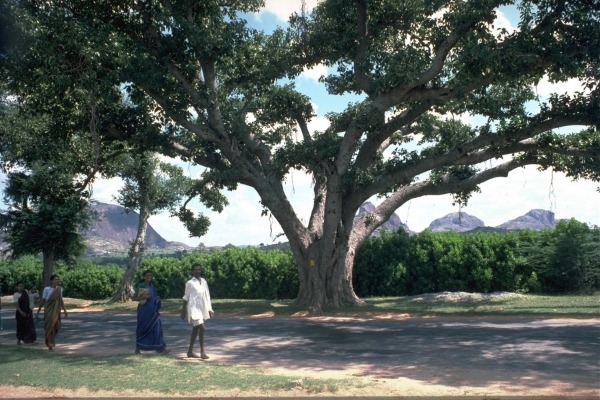
The passing scene as I sat beneath a tree and waited for help to appear.
A couple of villagers come to talk – a Brahmin who looks sly but a bit bright, tells me how poor he is. The other fellow has just come from the village on his bicycle. The Brahmin interrogates him and then sends him back to the village. [To get petrol for me.] The other fellow accepts his instructions willingly. I would give him money, and struggle to empty the oil from my jerry can, but the Brahmin says No, pay later. I sit under a tree and read. Heller. [I was reading ‘Catch 22’]
Nothing happens. Eventually I try to flag down a car. The driver waves me away impatiently. A truck coming the other way pushes him off the road, gives me a thumbs up sign. The camaraderie of the road. Then two chaps on a Bullet stop. The pillion rider wants to help, but they haven’t enough petrol. So we stop a car. And they pump petrol from it to give me a litre. He is the vice-Chancellor, retired, of Madagh University and asks me to drop in at Gaya. The Bullet rider says I must appear at the wedding he’s going to. I can’t refuse, though it means I won’t see Bodhgaya before dark.
He’s a small, solemn, bearded fellow – a Rajput (i.e. Kshatrya). Wedding is off the road, by a village. The groom’s party is under a big tent with multi-coloured ceiling, cushions and floor-coverings and a throne for the groom who is covered with head gear. The father and grandfather, and the pandit wear brilliant yellow turbans. There are weapons also on show, traditional for the warrior cast.
Two dancing girls take turns with a group on tabla, sarod (with bow) and harmonium. She moves languidly from foot to foot (ankle bells) and then shuffles out about six steps in a very stylised way that’s supposed to be very erotic. The facial expressions are most interesting to me – a sort of smugness, indifference of a deliberately false kind (almost contempt).
Sometimes she picks out someone who might pay her money, and squats in front of him, singing some verses at him directly, and accepting a variety of humiliations and jests until he pays up (10 rupees seems usual).
Meanwhile, over at the bride’s house, a similar ceremony is going on. The house is drenched in coloured lights. Next morning groom and bride together endure a series of symbolic acts – he is covered with things dangling from a paper hat, with spangles and mirrors sprouting from it, in heavy clothes, almost invisible, and has to spoon milk with a leaf from one pot into another one and then on to some smouldering cow dung, sometimes with a silk sheet held across his face, while the Pandit jabbers away harshly from some tattered papers, losing his place, coughing, stopping for consultations. Then, in the middle of it, the group and the dancing girls crowd in, and she sings over the top of it all, while the observers chat. And I imagine being the groom and I think I would go quite crazy.
Later before leaving the father reads my hand, as promised. He holds it in a handshake, then pushes back my thumb. “Acha,” he says. “You have a very determined soul. This is reflected also in your mind, etc.” What he tells me is the flattering side of my personality, and true enough. I’m quite impressed. My planet is Jupiter. For seven years under bad influence of Mars, which will continue for two years. After that Success!!! I have a weak hold on the affections of women, and owe everything to my mother. There will be two accidents, not major but not minor either, in these two years. (I wonder if I’ve already had one of them).
Overnight the son and I slept side by side under the tent. People were very concerned about the security of my things. Already two bags and four pairs of shoes have been stolen.
This has been an eventful week. A French journalist, Patrice Roux, brought me to a small town near Paris to meet Anne-France Dautheville who is known, in France, as the first woman to ride a bike across the world. We had never met. What made it most interesting to me was that she travelled at the same time I did. We had a very lively conversation, helped by the fact that she is a lot younger than I am, and her English is better than my French. It was recorded by Patrice who had a film crew with him. He says he was very pleased, and I enjoyed it so much that I typically forgot to take any pictures myself. Take it from me, she’s an attractive, strong-minded woman who has fought and won many battles in life.
I hope that the video gets out, because the other happy thing that happened was a delivery of books, and I finally have copies to sell of Jupiter’s Travels in French. Not only that, but my Italian publishers tell me they are reprinting. So, it’s been a good week for Jupiter.
See you next week.

Just a reminder of the route
Still Saturday 19th, February
[Following an afternoon spent gliding above Patna among birds of prey, I’m invited by my pilot, Jha Prakash, to join a different class of predator.]
In the evening, Jha absorbs me into a party at his brother-in-law’s room at the DAK bungalow. A mild US couple also arrived previous night, and they too have been invited. I assume that virtually anything foreign, that isn’t positively disgusting, confers prestige on a social gathering.
[In the course of the evening I gradually became aware that I was in the presence of the most powerful politicians in the state of Bihar which, at the time, had a population of 100 million or more. Indira Ghandi’s Congress party was in power but was expected to lose in the upcoming election.]
The room is as shabby as usual – flaking pale blue plaster, il-assorted and ill-upholstered settee and armchairs. Ordinary beds. Here are first the MP for Bihar, then the Chairman of the Bihar Congress Party and member of the State Legislature whom I’ll call (X); then a man who has just been made Chairman of the Bihar Homeopathic Board (C); two police chiefs, the “SP” of Patna, and one with an equal but mysterious rank from Delhi. The host is leader of the Bihar Section of Congress Youth (Y) a self-made man credited by Jha with giving away most of what he earned as a contractor. Then there was an ASP, a PR man for Congress, and a newspaper management executive. The politicians were in ethnic dress (C and Y in dhoti).
C and the MP arrived by car in reverse order of importance, each one being greeted effusively and acclaimed as “our great leader.” The policemen simply materialised and then faded away in the same manner.
X was the dominant presence. A crafty grin played on his wide mouth. His eyes glittered shrewdly through slits beneath a broad overhanging brow. He exuded confidence and control even when drunk, sent his power vibrations out in a steady field to every corner of the room. Y’s approach was more mercurial and intense. Between duties as host he would spring suddenly into the foreground of the party, perching with great agility on the end of the bed in lotus position, and deliver a fierce oration as though addressing not a handful of people but a crowd of lakhs [Lakh = 100,000]. His sunken eyes blazed in these short bursts of fervour.
The MP likewise conformed perfectly to his role. He was a bit above it all, the raw politics, the grass roots. He was the Delhi statesman, able to view events with the detachment proper to a cultivated man. He essayed a short speech, in English, pretending to be an army general making a public announcement several weeks following the defeat of Mrs Ghandi at the polls. “ . . . . and so, in view of the chaos and dissension which have swept the country, since abandoning the orderly progress maintained under Mrs Ghandi’s government, we have no alternative but to suspend the constitution and declare martial law . . . .”
The assembled party burst into cries of “Never. It will never happen here. Mrs Ghandi will win, hands down, sweep the country, etc.” The general embarrassment was obvious. It was not a very witty speech and failed as satire. At this point there were several whispered conversations between police and politicians, and the party moved from politics to music. It seems the police were afraid the two US hitchhikers might be from the CIA (an idea which, to me, seemed laughable).
C, who was the object of the party, had been sitting alone in an armchair, taking no part and looking like a bundle of clothes waiting for the laundry. Now he was urged to sing. I was told he was a poet. A beatific expression flooded his features, and he came to life. To my surprise he sang beautifully and the words, though I couldn’t understand them, were offered with clarity, emphasis and meaning. I was convinced they were of real quality. It was impressive that this collection of political animals could respond so sincerely to his songs.
Later, X became completely maudlin. He grabbed me and pressed invitations on me to visit his residence, and the PRO and ASP literally dragged him away from me. Before the party ended I talked briefly to the Superintendent of Police, and gave my view that in comparison with the true dictatorships of Latin America, India was the freest of countries, and that I was pleased to be able to say so. I expected him to be pleased to hear this. Instead, he said, very seriously, “That is the trouble. There is too much freedom. We must have more control. We can achieve nothing like this.”
Perhaps his appearance, which reminded me of a Brazilian apparatchik, made his opinion seem more sinister. And I began to speculate on the existence of a stratum of opinion in the Indian bureaucracy which would like to see “a firm hand” on the people.
[If only I could have had my iPhone: there would have been some wonderful pictures – or on the other hand I might have landed in jail.]
Next week: Onward and inward.
