
From My Notebooks In 1973: Ethiopia
25th January 2026 |
The five hundred or so miles from Gedaref to Gondar were the toughest five days of my entire journey – in part because I was still new to the game. When I returned 28 years later it was virtually unchanged. Then the Chinese came. Today, I’m told, it is paved.
December 17th
By the fourth day I was ready to contemplate the possibility that this journey will never end and to face each problem as part of my life. This is my life and I am surviving it. What else matters? So on the fifth day as I leave the camp I almost immediately find myself climbing steeply against an avalanche of loose boulders to the top of a peak, only to find that a box fell off at the bottom.
Park the bike and walk back down, contemplate the loss of what? Can’t even remember which box is lost, what’s gone? The cameras? Every potential or actual disaster finds me more philosophical. Hear distant voices and engine. Some people have found the box. What are they doing with it? What a way to put Ethiopian honesty to the test! A little further down meet the truck coming up. They are enormous lorries, climbing so slowly, loaded with sacks of grain or cotton. It stops. The driver points to his left. I assume he means he has seen the box. No, he has it there in the cab. I climb in, with helmet and goggles and ride back up to the bike. It is the box with food, torch, washbag, etc.
I am offloaded and settle down to repairing the damage. Bolt torn though the fibreglass. Botch it up with wire. Groups of young men come and admire – and return with a blackened kettle full of cold, clear water for me to drink.
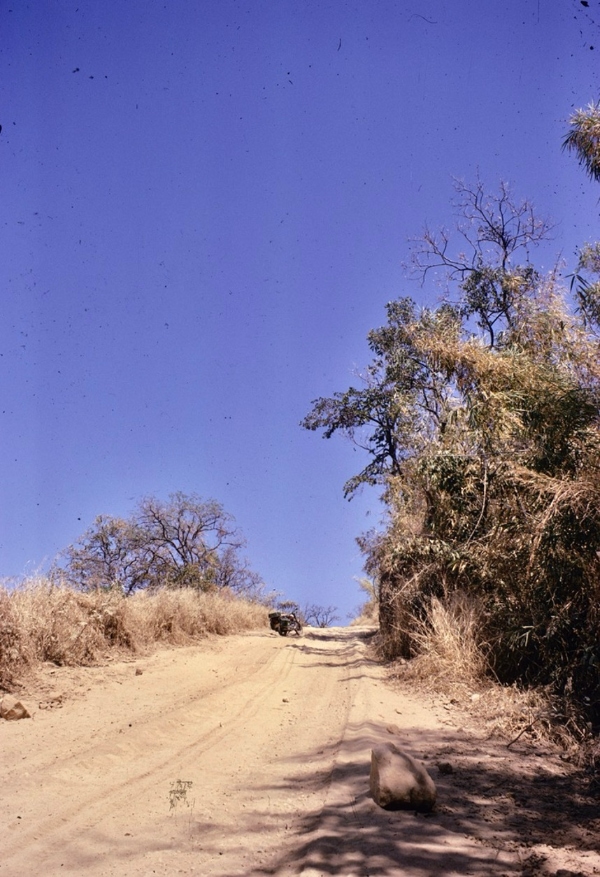
So I set off again. Today the climb is intense. Up and down, and further up and down, and still further up. Always there is a mountain ahead. Loose rocks a constant challenge. Watching the road every minute. Eventually I go over again, sprawling across the middle of the road. Bike flat and my heel jammed under the left-hand box. What’s holding it there? The strap of the boot – there ”for when you come off.”
[Back in London when I was buying kit for the journey, the only items available were a helmet, goggles, a plastic tank bag, gloves and boots. The boots were very simple, but there was a strap and buckle across the arch which seemed to serve no purpose. I asked the kid serving me what it was for, and he said “It’s for when you come off” which made no sense at all. Now it was caught on the axle, trapping my foot under the wheel.]
My goggles have gone. I think they must be in the lorry, which has passed me just as I got the bike upright again. I have found a technique for lifting the bike now, by twisting the handlebar, but with my wrenched left arm it’s a big struggle. Drive on. Bike all the better for a rest. Now country changing radically. Many shrubs, green and red, grassy banks and slopes, with boys popping out naked but for a rag over their shoulders. Alpine country – 18th century Switzerland.
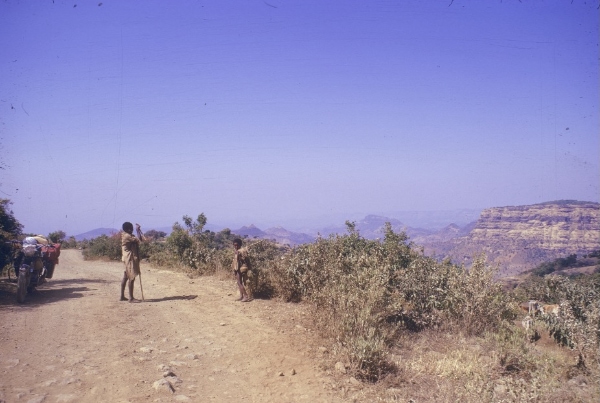
Stop for a rest. Boy of 14 or so pops up through hedge. And holds out his flute. Bamboo tube with holes and binding for mouthpiece. Can make nothing of it and ask him to play. He produces a thrilling and intricate music seeming to play on two registers simultaneously. With embellishments round a simple melody. Lightning finger work.
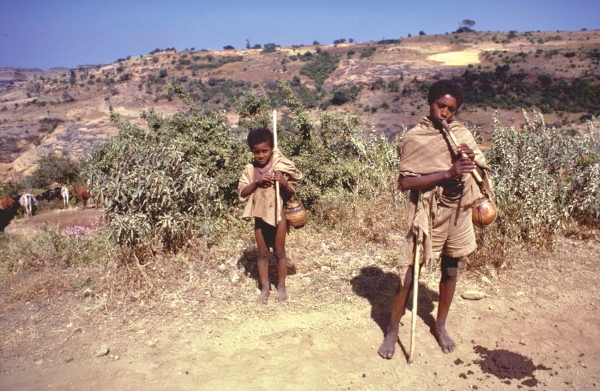
[I was so wrapped up in my own ordeal that I entirely failed to appreciate the situation. Probably he wanted to sell the flute. The music he played was astonishing – a virtuoso. I left without offering him anything in return. It hurt me later to recall it. A little further along, around midday, I came to a village.]
Chelga (now known as Aykel)
At lunch time. Village confirms Alpine sense. The way groups of people stand around. Less spontaneous excitement. People contained, though curious.
Find restaurant. Quiet. Six men at table. In suits, some with overcoats on. Dark clothes. Conferring discreetly. Much fuss made of them. Their faces shrewd, cunning in European way, but black. Exude power, influence. Mafia?
One of them instructs owner to get my passport. Examining it nonchalantly, with neighbours looking casually, then passes it back. No direct contact except smiles in my direction. Eventually they leave. Behind me, teacher who has kept silent, starts talking to me. The one who looked at my passport is police “general” he says.
He talks bitterly of regime, overthrow etc. Compares Ethiopia to France before revolution. Says I should talk to students in Addis. Warns of bad people on the road who will try to stop me. If I “joke” with them they will steal from me. I must “keep a good face. Don’t walk around Gondar alone.
“But you will have your own trick,” he says.
[I arrived in Ethiopia in the last years of Hailie Selassie’s reign, when it had become an oppressive state.]
On to Gondar. One more ford successfully crossed. Then came off again. The other box ripped away. Repair it with crowd looking on. No hostility. The “improved” road from Chelga is flatter but covered in loose stone. Just as hard. When I finally get on to main road, asphalt, it’s like flying. Feel very good. Triumphant. Deserving. Have all sorts of treats in mind for myself. Luxury hotel with beer, bath and good food.
Schoolboy directs me to Fusil Hotel. Room is $4Eth. Italian hotel. When I get there, boy is there too. Can’t bring myself to send him off but his company is cloying. He wants to please. When I suggest he’s expecting something from me he protests. But in the end, though he helps wash the bike and so on I refuse to give him anything. He gets $10 a month from an American who passed through one day – a Bill Rollafson, a chemist from California. Boy’s father is a priest.
Everything costs more here, and people come up for money. In the road there are some boys who throw stones, some men who look as though they might let go with their sticks. After Sudan the atmosphere is very troubled.
[I rode south to Addis Ababa where some friends, Alan and Bridget, were living. He was there on some UK Government mission. They had invited me to spend Christmas with them. We visited Lake Hawassa, south of Addis, famous among birdwatchers. Then I rode on south towards Kenya.]
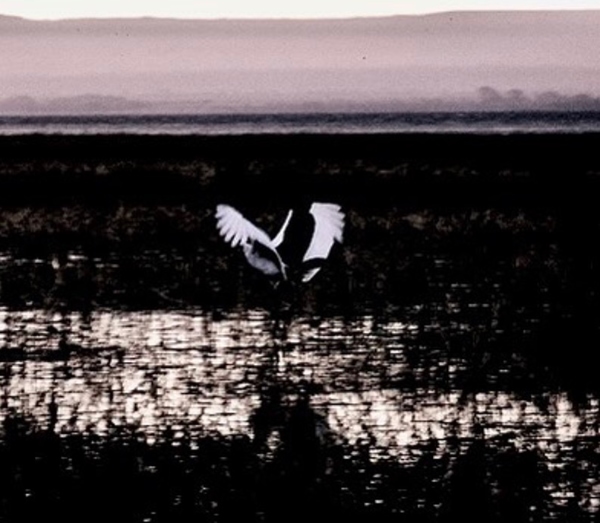
A saddle back crane at Lake Hawassa, or so they told me. Not a great picture but it proves I was there.