
From My Notebooks In 1973: Sudan
4th January 2026 |
On December 5th the ferry from Aswan came ashore at Wadi Halfa or, more correctly, at a ramshackle assemblage still growing to replace the town, which now lay below the waters of the lake. I had hoped to get back on the bike but was refused permission and petrol, so I had to take the train.
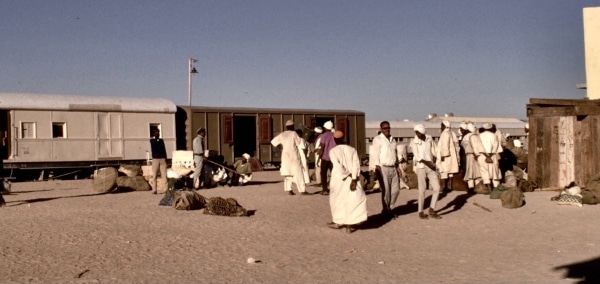
My Dutch friend (hatless) dealing with his luggage. My bike was already in the wagon.
With the Dutch couple I had befriended, I travelled to Atbara, where apparently there was only one hotel. They took a taxi and I followed on the bike.
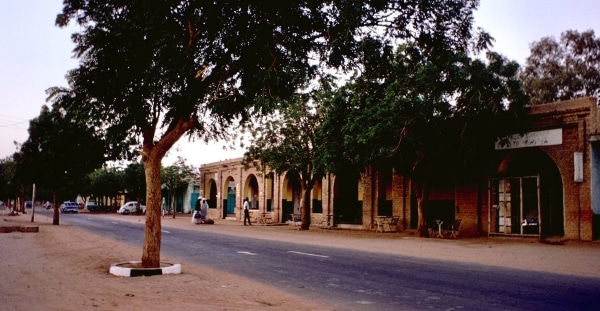
THE hotel. The rooms at the back were cubicles looking out over a verandah on to a courtyard.
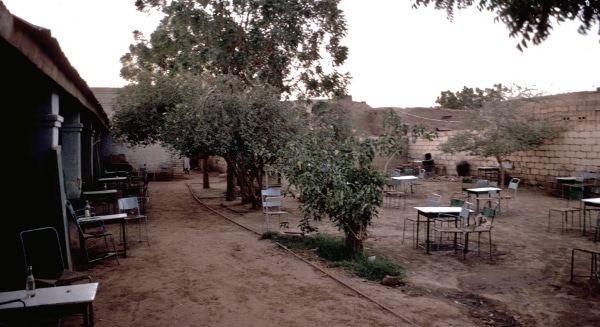
December 6th
Atbara: Hotel courtyard. Pale green lime-wash. Green oil paint. Entered to be greeted by five Arabs with sherry and marijuana. A joint pushed straight into my hand. Played some music but they weren’t interested. Interest centered more on Anthony. Why not? He was suspicious, I think. Later, the southern Sudanese, Fabiano, said the chief Arab was a thief who pretended to be drunk to get others drunk. Used the word ‘teep’ but all his p’s are f’s and his f’s are p’s. i.e. pipty and fresident and feople, etc. We got into quasi conspiracy about Sudan’s internal problems and the Eritreans, but my own astounding ignorance left me unaware that the Eritreans were Moslems opposed to Selassie’s Christian regime, and the southern Sudanese, being Christian, are naturally opposed to the Eritreans. I had imagined it the other way round i.e. underdogs supporting each other. Naïve innocence.
Saturday, December 7th
Bent foot brake [lever] back into place by dropping bike on it. Cleaned Oil Filter. Distilled water – to be found. Tightened nuts and bolts. Some movement on barrel nuts. Tappets? Not yet. Chain tensions; primary all right. Rear chain loosened two turns.
In Atbara we met Thomas Taban Duku and then Fabiano Munduk. Both African Christians from the south of Sudan.
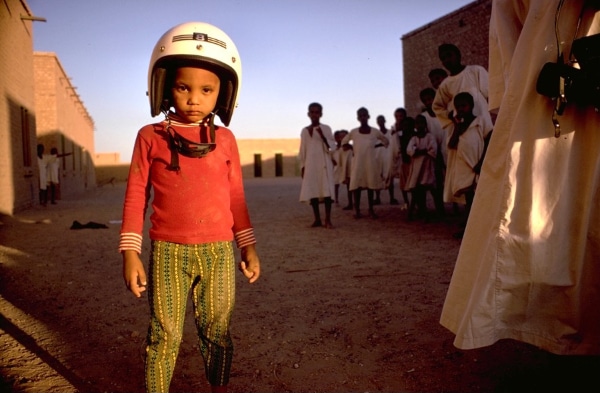
With Fabiano, an evening that started when he came to the hotel with his nephew Peter, a four-year-old boy in brightly striped jersey tunic and shorts. They had come from school sports day. All day I had heard martial music of the Empire drifting across. He explained they had been playing musical chairs. We drank two bottles of sherry between us in a bar, then took him by taxi to his brother’s house. Brother is in police (a captain, he said). Saw one room, open to yard, all in brown and over brick. Brother’s wife spoke no English. He got her to give small bottle of home distilled date liquor. (Like eau de vie)
Dates left in water for seven days, then container put over fire. Above it a lid perforated. On that a small bowl. Above it a bigger bowl as a lid and condenser, filled with cold water.
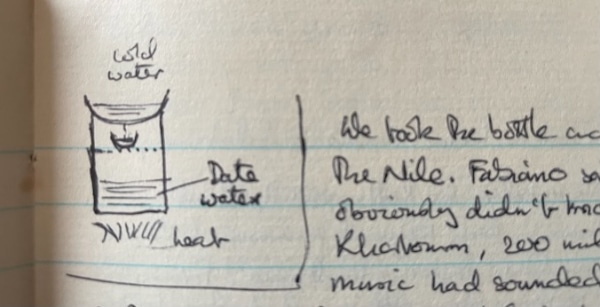
We took the bottle and walked across cultivated ground to look at the Nile. Fabiano said the White Nile was a day’s walk away. He obviously didn’t know the Blue Nile only joins the White Nile at Khartoum, 200 miles further south. We walked back to place where music had sounded. Fabian was dodging about looking into bushes, in the manner of Don Genero looking for cars.
[Carlos Castaneda, a popular writer at this time, described his apprenticeship in shamanism in The Teachings of Don Juan and other books.]
I think he was looking for animals or snakes. We had been hearing about his life in the bush – ‘bus’ – when he and his brothers were refugees from Sudan after his parents had been killed – he said – by the Moslem army of the time. He is proud of his brothers. They are twelve. Two are at Oxford, one doing economics, another librarianship, the others are mostly in the army – all officers He is the youngest and least qualified.
The music came from a wedding party in a community on the edge of Atbara. Large square clearing with canvas spread over large area, illuminated by bulbs strung out in a large rectangle. Rows of chairs all round. Many children jostling for good position, scrapping with each other, but although they pushed each other around quite hard there was no bitterness in their manner, and no crying. Fabiano says the children are allowed to be independent but this only works of course in a simple environment with large family structures.
The band arrived in an army truck. We were given favoured seats, and then plates of food were brought specially for us. Tarmeia, bits of meat, salad, sweet pastry, bread and water. Water in gilded aluminium bowls. When music started men would wander over casually, sometimes two together jigging to the beat, snapping the fingers of one outstretched arm, to indicate their pleasure, and reach over to touch one or more of the players. Then they would retire again just walking away slowly.
[Account of Atbara to Kassala in letter home.]
Monday 10th
[The whole of the following week’s experience is described in detail in Jupiter’s Travels.]
Left Atbara. Tried to find way from town. Took an hour. [Everyone said “the road to Kassala is queiss” – meaning good. But there was no road.]
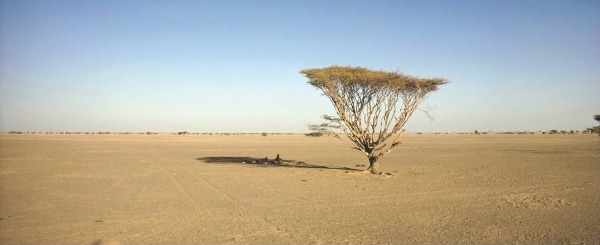
The road to Kassala.
After three hours, in sand up to axles. No water. Too little petrol. Acid in bottle. No money. Come to Kinedra. School. Welcomed. Fed. Refused permission to leave. Headmaster said, must get more benzene first. From car? But car had none. From District Officer at Sedon. But he had none. By lorry from Atbara. But lorry broken down. By lorry next morning. But no lorry.
[After two days at the school I learned there was a bus back to Atbara. I was introduced to a merchant who was also taking the bus and with my five-gallon jerrycan I accompanied him to Sedon where the bus stopped in the night. He spoke no English at all. We lay on the sand in the smpty square to wait.]
“Sudan seňora queiss? You Sudan seňora? Sudan seňor queiss? You Sudan seňor?” Insistent, quiet, gentle. Just teeth in deep shadow framed by turban. Light touches between legs. Seductive, compelling, out of any moral context. Could imagine it.
At last, there was a bus. Bus arrived at 11.30pm. Ford chassis. Heavy riveted steel body built in Khartoum. Out tumbled horde of people. Many with swords. Scabbards shaped like paddles. Crucifix grips. They are a tribe called Bescharyin. From Sedon until Goz Regeb. Most are nomads. Their hair is long and the strands are glued together with oil, called oudak – animal grease, and wear an ornamental curved stick used as a comb, sticking out like an Indian feather, but horizontally. They wear a waistcoat, galabeia, and trousers with crutch below the knees and tied by cord. Three-tiered clothing. All fell to the ground and slept until 4am. I was happy to sleep too, but it got cold and I had no cover. At 4am the bus left for Atbara. Very bumpy. Much coughing. A sort of stale, damp smell. Two B in front of me, hair dangling before my eyes. No expression. Very stern. After dawn people began getting off. Outside Atbara, my companion, the merchant, vanished mysteriously [while I slept.] A family of B’s descended, a pathetic huddle of humanity set down on the sand, with their bundles of mats, sticks, pots and bags, still cold, kids bare chested. They appeared momentarily unable to cope at all.
In Atbara looked for Fabiano to recover cutting, and lost others in the process. Southern tailor’s shop had African flavour. Clear distinction between Arabs and Africans – each considers itself the elite. Tailors rather condescending about clothes they are making. Material from China, Egypt inferior. Suit costs £2.50 up. Got lorry back to Kinedra. Took road in a wide sweep across desert – the road I missed (or dared not find.) which would have got me here faster.
Lorry stopped about a kilometre from Kinedra. I started humping my jerry can across the sand but was soon met by a boy with a donkey, who relieved me of my burden immediately.
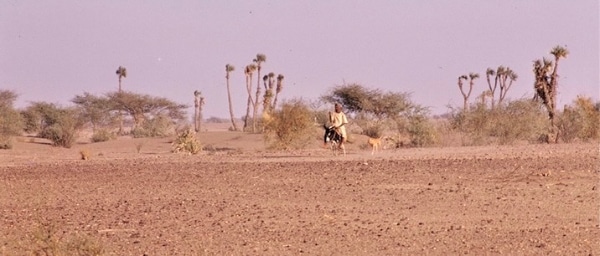
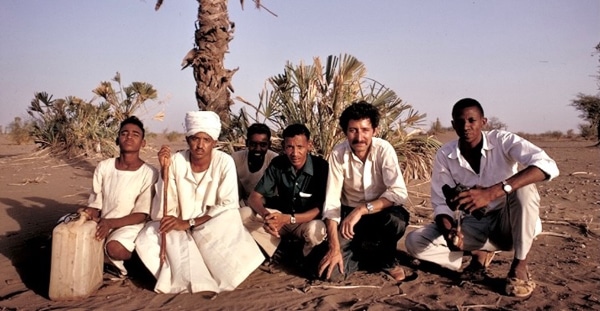
I had intended to go to Sedon to photograph the water pumps, but the teachers of Kinedra would not let me leave. They insisted I accompany them to the river bank to take pictures. Waded in the river. They said prayers. Each had orange-sized patch of sand on forehead. Then visits to the village shops, and the home of . . . . . . brother who has refrigerator. Little bags of flavoured ice. Shabby furniture, not worthy of Austin’s [a popular London warehouse of used furniture.]
[I was persuaded to stay two more days at the school.]
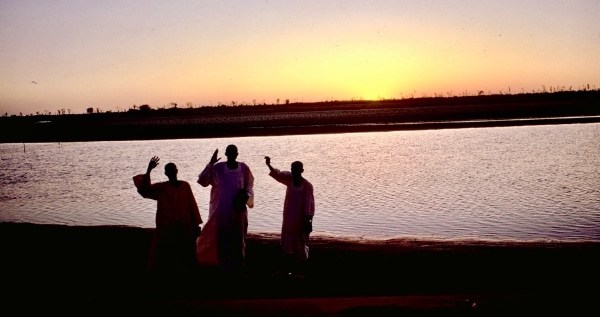
Goodbye, until next week.
PS: Like most people I come into this New Year with grave premonitions. I see absolutely no prospect of Putin stopping the war. Trump’s involvement is toxic. Europe must pull itself together. What can I do about it? What can AI do about it? Watch this empty space.