
From My Notebooks In 1974: Kenya to Tanzania
8th March 2026 |
After a few days in Mombasa, Malindi and Lamu, I rode on to the border at Lunga Lunga. In a strangely fearful mood.
Monday, January 27th
Rain stops. I drive on. No more tarmac. Packed sand. Looks like slippery trouble after the rain, reinforcing my expectation of disaster but it proves easy enough after all, and dries out quickly. But my thoughts stay morbid. A man walks past with a panga [like a machete] I imagine what would happen if he struck out with it. Mentally I kick out at him. It slices half my foot off. I develop an macabre and quite fallacious tale about a motorcyclist, white as death, riding up to a hospital gate and falling off the machine in a faint. Only when they have carried him in and pulled of his boot do they find half his foot missing. “We never knew how it happened because he died without becoming conscious. Lost too much blood.” As I ride I am stuffing the truncated foot into my boot to make the heroic ride, trying to imagine the pain. Only now, writing this does it occur to me that the panga would have taken half the boot off too.
[Today I find these gruesome fantasies quite astonishing.]
It seems clear, as I ride along, that all these thoughts and reactions proceed from some mechanism inside me – some permanent reservoir of anxiety which every now and again rises up and floods over. But where is the spring that feeds these black waters, and what unseen process releases them? I wonder whether I have ever been as aware as I am now of what is going on inside me. I have long ago recognised the converse – those times when light and dry and confident, I have felt free of fear and even been able lately to consciously communicate that feeling to others. But have I known myself in that other state, and what wounds have I inflicted on others thinking that mine was a normal, reasonable attitude.
[I rode on to Tanga and then, later in the day, embarked on the main highway through Tanzania, stopping for the night at Mwebwe.]
January 28th
The day brought no disasters. Even my five-shilling bed at Mwebwe had no fleas. The mosquito net allowed me to listen to their insect whine just a foot away from my face without flinching. But I dreamed, fearfully, of a huge, unpleasantly dominating man who constantly interrupted otherwise innocuous or cheerful scenes to threaten me with homosexual demands.
There have been such dreams before, not often but very potent (“There’s a stain on him somewhere”). [This was a dream I had in my childhood.] Thinking on about the day and the night as I rode on to Morogoro, it occurred to me for the first time that perhaps in my childhood I had been the subject of some such attack. So many things fit into place with such a hypothesis (my recollection of a fearless childhood up to the time I went to hospital in Shrewsbury – followed by pronounced fears, irrational quailing before masculine authority, etc.) I suspect it. But it could be true. Would my mother have any idea at all? I shall write to her, gently.
It occurs to me also that on the same day I had a recurrence of the skin rash which moves around from back, shoulders, arms, to thighs and belly, is evidently not a local thing but probably connected to general state.
(Another memory: The headmaster at Gunnersbury Prep. School wanting to punish me in the bathroom for sending for elbow grease. How terrified I was, naked.)
From Mombasa to the border, road was good. Through palms, tall ferns, villages. Dirt road from Lunga Lunga to Tanga – same sort of open leafy country. [Picked a sample cashew nut from tree.]
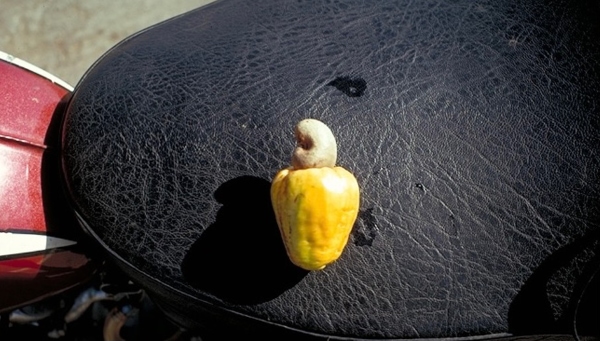
I was amazed to see that the cashew nut grows outside the fruit. In Brazil I discovered that the fruit itself, which I have never seen in Europe, is quite delicious when stewed.
Tanga, on sea, port, has open streets. From there the road passes endless sisal plantations. – all unusually green. Overcast. Mountains to the right up to Kirogwe, then over hills down to Morogoro where mountains again on the left.
One hour in bank to change £5 cheque. [There wase just one endless queue to get to the cashier].
Met Creati, the m/cycle man who had bought all the Triumph spares from Dar.
[Apparently the Triumph dealer in Dar es Salaam had closed shop and sold his spare parts to Mr Creati who was so impressed by my story that he kept reducing the price.]
Sells me speedo cable for 50/-. No 40/-. No, have it for 30/-.
[Odometer stopped working on road to Mombasa, at 5,904 miles.]
Add on to reading for reaching Mombasa – about 25 miles, plus 150 to Malindi and back. Then Mombasa – Tanga – Morogoro 307 miles. New speedo cable in Morogoro. Reading at 5,904.
Mikumi wildlife lodge in National Park. Stopped on road in to stare at elephant by roadside, which stared back with mouthful of grass. Lodge very attractive, swimming pool, overlooking watering hole. Elephant, zebra, bush pigs, vultures by pool. 100/- full board. (got a resident’s rate; 50/- bed and breakfast)
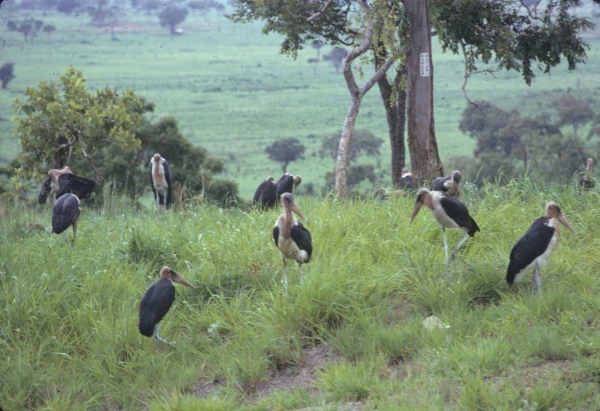
Maribou storks assembled outside the Mikumi Lodge, Tanzania
Met an Indian from Zanzibar, small, neat, heavy shock of black hair brushed forward over intense face. Left Z after revolution with British passport. [He thought it entitled him to go to the UK.] Went to Kenya High Commission who confiscated his passport– “You won’t see that again.” He believes they burned it. That was in 1963. His life’s ambition – or dream – is to float off Zanzibar coast on a raft and try to reach Australia. Wants to make it 12 feet wide, 44 feet long, from Mangrove wood.
Two Canadian engineers working on transmission lines alongside the new Tanzam highway. Last section being built from Morogoro to Ngerengere.
One of them talked knowledgably about Tanzania. Says: 11 million people – country has no known wealth (no minerals or oil yet found.) Nyerere [the president] is absolutely honest. Some tribalism (i.e. Some ministers appointing members of own tribe.) But not serious as compared with Kenya. No starvation, but primitive diet. Mostly maize. Per capita GNP $60. Some efforts towards co-operative farming.
Two American embassy wives asking well-meaning questions.
January 29th
Drove on alongside the Great Ruaha river (muddy red) and then across a range of low mountains. Mountains steep-sided, forested, green. Baboons, very beautiful land. Mostly overcast. Some sun at lunchtime.
Off road and up to Iringa for lunch: sambusa, kebab and chai (1 shilling, 70 cents).
First rain shower. Drive on. More heavy rain. Then on and off. Villages very sparse, small, primitive, offering nothing. Meant to stop at Igawa but couldn’t see anything there to keep me. Pushed on to Mbeya. Heavy rain, desolate, big rock barriers gathering heavy cloud, becoming more wild and mournful as light fades. Polaroids deepen gloom. [I was still wearing Polaroid goggles, for want of anything better.]
Everything drenched. Me too.
To Mbeya as night falls. Guest house like seaside boarding house. 50 shilling bed and breakfast. Very expensive, but friendly. Finnish agricultural research officers experimenting with different methods of maize production. Area unexploited. Says southern highlands could feed the whole of East Africa. One acre can produce 6 tons of maize properly farmed (or three tons maize, three tons weed). Asians everywhere travelling “on business.”
[I found the rain very dispiriting. As I said in the book, I think I “missed” Tanzania.]