
From My Notebooks In 1974: Southern Rhodesia
29th March 2026 |
With all the tough travelling behind me I’ve still got a long way to go to reach Cape Town, but I’m looking forward to an easy ride, mostly on asphalt. I spent a couple of days in the capital, Salisbury (now renamed Harare) and moved on to a motel in Umtali (now Mutare) on the border with Moçambique. Now I’m following the border down the east side of Rhodesia. I was advised to visit the Black Mountain Inn.
February 18th
From Umtali to Melsetter. At Black Mountain Inn talked to Van Den Bergh [Prop.] about farmers around Cashel [an area in the East of Rhodesia/Zimbabwe.] He tells me there’s one Afrikaaner called Baas M’sorri, He brings his labour in from Malawi on contract. (Malawi provides labour here and in South Africa) When the new labour arrives he puts each one in a jute sack and hangs him on the scales to weigh him. Then his diet is arranged according to his weight. He wears big knee-high boots as protection against snakes in the fields. If he comes across a ‘cheeky mundt’ (i.e. a Kaffir who gives lip) he stands on his foot and grinds it with the heel of his boot until the Mundt says “Baas I’m sorry” – hence the name.
Oom Ben Steyn is Afrikaans farmer – about 500 acres – born on the Trek seventy years ago. Lives as his forefathers did.
“African ladies? There’s no such thing. Just Kaffir bitches.”
The route is certainly a beauty. Rough in parts, though never difficult. Very green. Big granite (?) masses poking out, smoothed off by weather. Alongside the Chimanimani mountain range. Many birds – one with a brilliant yellow back that flaps its wings noisily as it flies and pokes about in the long grass (smallish, plump, black and yellow).
Black Mountain Inn is delightful. Van Den Bergh and wife quit business world – he was export manager for Pye in Far East, then Cambridge – to find different life. Been there only a short time. Says he would never have believed such bigotry could exist – but only in the fringe rural districts, and especially among Afrikaaners.
[All the whites in Rhodesia seemed to realise that Black independence was coming. But when?]
Ven Den Bergh says, “Yes, the Rhodesian whites are flabby. The police are in here getting drunk all the time. The army’s the same. If they ever came up against a really motivated black army, well, they’d roll them up.”
“When first we came here we went to the butcher to get meat for the servants. ‘Oh, you mean boy’s meat,’ he said, and produced this chopped up bone and gristle and sinew. It’s cheaper than dog’s meat. So we thought we couldn’t give them that, and we bought proper steak. Well after a while there was a mutiny because we weren’t giving them the proper meat.”
“Independence? It’ll take about ten years.”
I did pass Oom Ben’s house, but I didn’t stop. Didn’t feel like it. It was a beautiful sunny day – and the chance to ride this route without rain was the main temptation. But I saw him on his verandah, just as Ven Den Bergh promised, though whether he had his binoculars on me I don’t know.
[Four years later the Inn was a ruin, rafters exposed, walls cannibalised for bricks, ruined by Frelimo and Zimbabwe freedom fighters. At Melsetter I came across some Asian immigrants. They showed me their art work, which was novel if not exactly beautiful. It’s done by sticking noodles on a piece of board and spraying it with gold paint.]
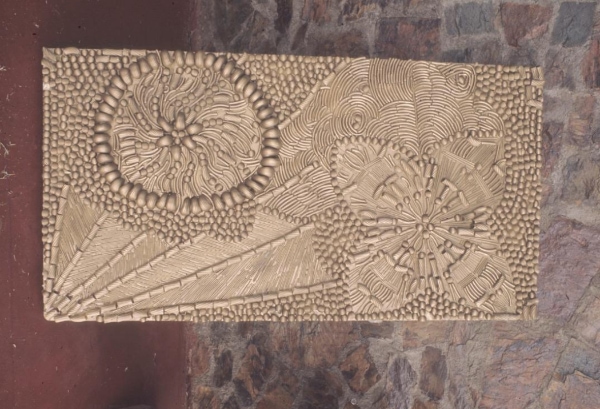
Noodle art
Small boy, 11, says: “You know, the Porks (Portuguese) are funny people, boy! You have to go in secretly and kill a few terrorists and then you tell them on the telephone after.”
Hutchinson (Grandfather was once Governor of The Cape), says” My date is 1980. There’ll be African government by then.”
[He was exactly right.]
[I went on to visit the famous Chirinda forest.]
Seen in Chirinda Forest: Bright red millipedes on rotten wood, three inches long. Small monkey in treetops, and a red squirrel. Trees whose roots seem to intertwine to form the trunk, only merging together at a considerable height, say 60ft or more, relatively close to the canopy. The Big Tree, red mahogany, 200 ft high they say. A liana twisting up full height of the forest. Heard deep “Chuk-chuk” sound. Monkey or bird? Bottle bird which holds same pitch.
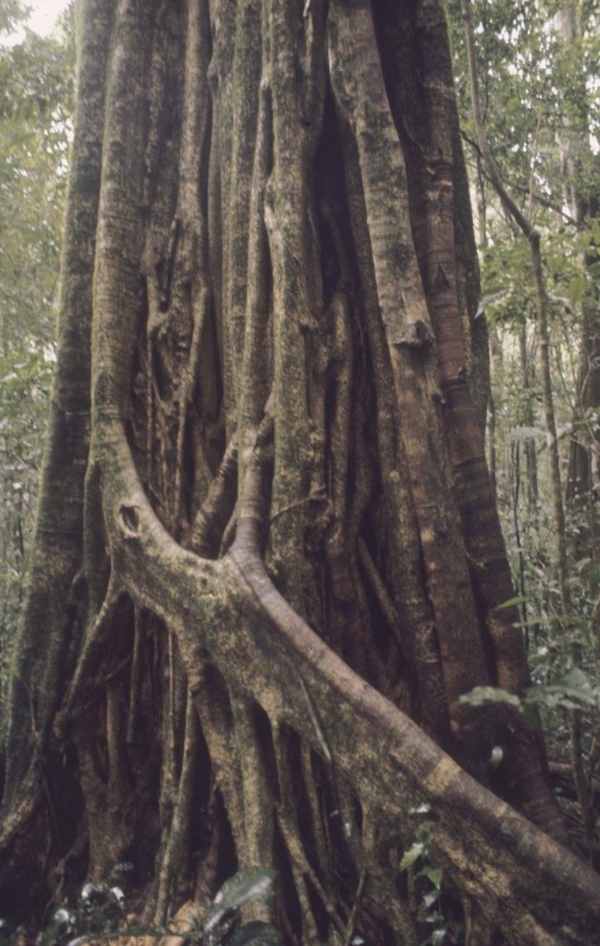
The biggest tree was said to be 200 feet tall.
February 19th, Chipinga to Zimbabwe
Murray McDougal Drive round Lake Kyle. Nice scenery. Dam. View from top of ruins is excellent. Family of Hyrax [Well-furred, rotund animals with short tails – Wikipedia] live up there and will sing for you if you’re lucky. Have white oval markings on upper eyelids. Slept out in tent. Met Joachim from Frankfurt, who has been through South America and Africa (via Congo).
On way stopped at African village in Tribal Trust land. Most attracted by site – rocks and boulders piled in a natural rock garden in immense scale Cattle, goats, maize (and tourism, I suspect). Many hands outstretched. One dumpy lady rushed off for her big copper pot and stood in front of me and put it on her head too hastily because it nearly fell off and she had to stand crooked to keep it up there. The sideways slant to her head gave a comical look to her anxiety.
February 20th, to Beit Bridge
Fort Vic is the exact architectural expression of a tourist trap. Coming in from S.A. its road broadens right out to embrace you and then funnels you in to the snack bars and curio shops.
“Get yourself something unique. Something Arty!!!”
Swirling, towering column of storks in sky on the road to S.A. grouping for the return to Europe.
[The border crossing to South Africa is at Beit Bridge.]
Beit Bridge: I am a prohibited person, because I don’t have a ticket out. I pay over 350 Rand (£250) on deposit, and 2 Rand for their trouble. Get a printed notice telling me I can appeal against being a prohibited person. It seems an odd label to stick on someone you let into your country.
Then the customs. He’s another plump lad in white gym clothes. He has dull blue eyes and a thin voice which swings out of control into upper registers. First he packs me off to pay 50 cents for a road safety token. On my way back I see three of them gathered round my bike. But I’m so accustomed to people gathering round it that I assume it’s mostly curiosity.
“Now Sir,” says Billy the Kid, [trying to adopt a stern voice] “Have you any meat, plants, fire-arms, drugs, books or magazines, cigarettes or tobacco?”
“Yes, I have a book on Christianity.”
“Chris-ti-anity!” He’s incredulous.
I ask him if he’s heard of it, but he doesn’t hear my question.
“Have you anything else to declare?”
“No.”
“Then WHY Sir,” he pounces heavily, “do you not declare the sword?”
Ah, the villain is snared, foiled, as good as beheaded. I never thought of the sword.
He shows me a dagger he took away the other day. He’s proud of it, and the sword is obviously a far greater prize. He speaks of it with awe.
“I shall have to take it away from you, Sir. I am very sorry.”
(He didn’t sound a bit sorry – delighted in fact that his duty could be so rewarding).
I explain about its sentimental value, that it isn’t even mine, and so on. The Kid is reluctant to allow a weakness to develop but his rank is zero – he hasn’t got a single identifying strip on his vest, unlike the broad gold braid on every other shoulder.
“How will I get it back,” I ask.
“We shall see if we can wrap it and send it under seal – and at your expense to Brazil.”
I could tell he was improvising.
“Why can’t I collect it in Customs at Cape Town?”
He felt the ground slipping away. His neighbour at the next desk, who is obviously deputed to keep an eye and ear open for the young whippersnapper if he gets out of control, says, “Why don’t you go and ask your father?”
Father, you might have guessed, is the boss. (“Daddy, I want to be a Customs Officer like you and confiscate my life away!”)
A party collects in his office to inspect the weapon with enthusiasm.
“How can we stop the natives, if we let you in with this?” says No 2.
“See if you can seal it into the scabbard,” says Dad, “and then wrap it up well so no one can see what it is.”
Off we go. The Kid has his orders. He’s happy again. He can carry them out to the last serif of each letter, and with a little imagination he can even add to them.
“Come over here, Sir, please. Now you see, I am going to wire the hilt to the scabbard, and seal it. You see there is a number on this lead seal. If this seal is broken you go straight to jail.
“What would happen,” I ask, “if someone should happen to steal it from me?”
“You go straight to jail,“ we call out in unison.
Then follows the farce with the brown paper, string and sealing wax.
He dances about trying to get the drops of burning wax off his face and legs.
“Usually we get the natives to do this,” he explains.
Finally he attempts to exact a deposit, otherwise “how do we know you will declare it in Cape Town?”
But this is too much for No 2. Who shakes his head, repeatedly.
“You can go,” says the Kid.
[I gathered my stuff together and rode off. It was only a short way to the nearest town.]
Spend night at motel in Louis Trichardt.
Restaurant with glazed kitchen in middle of the restaurant floor. Black cooks supervised by white man. All white guests, of course, looking on as they eat.
[It was my first encounter with apartheid. I was quite shocked. The diners were all perfectly pleasant-looking middle-class people. They thought it quite normal to watch black people imprisoned – because that’s what it looked like to me – in a glass cage, like an aquarium, overseen by a white warder. In the following months I never got used to it.]