
From My Notebooks In 1974: Still in Kenya
1st March 2026 |
The heat on the road to Mombasa melts the patches on my inner tube, and I’m stuck.
Kibwezi, 18th and 19th January
Could have been just another place. Jumble of buildings on a dirt road. Buses pulling in. Stalls selling fruit and a few vegetables. Main store on the corner (Asian of course).
[I cursed myself for not having what I needed to repair the tube, because of the heat. I got the bike to a BP station and found a post office to phone Lucas. The operator, in his tiny kingdom, treated customers like his subjects.]
Post office was a small room next to the store, with old standard switchboard and a tetchy African gent playing the plugs, very sharp with his customers.
“That is the correct method to deal with this matter.”
[Lucas agreed to send a new tube by car next day. I looked around for somewhere to sleep and chose the “Curry Pot Hotel.”]
Two ‘hotels’. Mine had big front bar with splendid cash counter with bars. Tables, chairs, usual girls with headscarves, loose overalls (blue), and swinging big legs around in loose easy way they have. Smaller room behind, then inner yard, more tables and chairs, one paraffin lamp, rooms off it. “Gents” is a bed of charcoal in cement bay. Lots of corrugated iron, painted. My room is painted silver. Mattress in plastic cover. Pillow too.
Experience transformed by the three men who befriend me. The “insurance” man – plump, floral, on his Yamaha, rescues me in my punctured state. Takes me to Paul Kiviu at BP station where I also meet the policeman, Samson. Two nights in town, drinking endless Tuskers, talking. Very animated first night. Girls are afraid of me – never slept with “Mzungo.” [Swahili word for white man.] One says she’ll come back but doesn’t. Paul works hard to convince them. Second night more philosophical, melancholy – apart from brief flurry of argument about insurance.
Pius, the insurance man says, “Snake bite is not accident because the snake means to bite you.” So, not covered by insurance. This outrages Samson. We invent examples of accidents to prove Pius wrong. But he insists, any misfortune caused by a live thing cannot be an accident.
“What if someone falls on me from the top of a building?” I ask.
Paul reveals his ambition to irrigate his shamba.
“Employment is a bother,” they all agree. Samson will marry in August.
Paul Kiviu, Samson Ndolo, Pius William Mouka.
“Employment is really a bother.” Samson stretched his legs further under the tin-topped table loaded with empty Tusker bottles, and sank lower in his seat. Black night filled the courtyard behind the Currypot Hotel & Restaurant, and a gentle melancholy washed over the four of us. Paul, the BP garage manager at the Kibwezi junction, nodded his head with its little curly brimmed felt hat.
“Oh it is a bother indeed,” he agreed. “You see, this fellow is not free. He is going round town even after his duties are finished and some person may come at any time saying his attendance is sorely needed in case of a sudden crime, or it may be a fatal accident and what and what.”
Paul had his own reasons to deplore employment. His presence at the petrol station was required every day, Sundays included, from seven to seven, although once a month he managed to visit his wife at the farm thirty miles up the road to Nairobi.
“You see I had to leave this company for two hours this evening. I was forced to go, isn’t it. Some stores came for the canteen, so I must go to search the stocks. This can happen at any time, and I don’t know if I have a job tomorrow.
“What is needed here is a thousand and five hundred shillings. Then I can build a tank for water and then I must have a pump and some pipes and I can put water on my farm and grow many things.”
“It is a bother all right,” said Samson. His voice was now almost disembodied. He wore navy blue trousers and shirt with matching cloth covered buttons over a black skin. Faint paraffin light, reflected off the painted corrugated iron walls of the hotel, failed to reach him and his sold, big-boned body dissolved in the darkness like a ghostship in fog. Only the insurance man was plainly visible now. He had a bright flowered shirt flowing over his fine round belly and his pumpkin face gleamed in the lamplight.
[Eventually, that evening, they found a girl who was willing to take a chance on a Mzungo, and a description of the event is better left to Jupiter’s Travels. Next morning the new tube arrived, and I was on my way to Mombasa.]
First rain fell on me. Saw ten elephants under a baobab tree in Tsavo park on way, and a few giraffs. Baboons at an abandoned gas station. Playing with their children.
From Nairobi speedo works for 328 miles, then stops.
[As I entered Mombasa I drew up alongside two European volunteers in an open car.]
Met Kai and Buran in mini-moke. Straight to Castle Hotel for seven course lunch at 14/- [shillings]. Room at Jimeey’s Hotel. Everyone says how hot it is – don’t feel it myself for a day or two, then everything gets sticky.
The Sunshine Club in Kilindini Street. 3/- for a beer. Smashing girls, tested weekly. Good band with soul singer. Acrobats after 11pm. Extramural fees up to 20/-. Many sailors. Best food at Arab-style Duka. Kima chapati with egg 3/-.
Boy who howled outside hotel window for an hour, dribbling with effort, carried off struggling and howling with hands tied behind his back.
Boy with so-called polio legs. [His legs look terribly twisted and deformed.]
“I’m not asking for help. I merely want to find a kind person to appreciate my problem. I have GCE in (various subjects) and have to look for help where I can. I believe God will look after me. You cannot understand now but one day when you also are in trouble you will see. Etc, etc. How can I want a cigarette when I am starving. Even though I haven’t a cent in my pocket I will not ask for money, only some food. But if I had my fare to go back to the shamba I would not be forced to look here for help. 4.50 is all I need, etc.“
Given a shilling.
“Now give me a cigarette.”
Walks off and [as his legs miraculously become normal] starts to dance down the road.
[I spent a day at the brilliant, sugar-white Mombasa beach.]
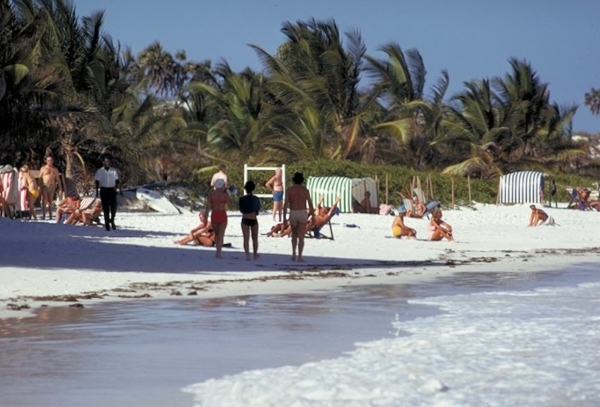
The beach at Mombasa Beach Hotel. White sand. English, Italian holiday makers.
[Overheard.]
“We do 60% of the BBC’s work, and all for Weekend. I usually get to the office about 7 or 8 but I often don’t leave until 9 or 10. But I go home to bathe and change and then go out to a party or dinner. I absolutely refuse to go home to bed.”
[This is where the fishermen at the Muthaiga club go for their marlin.]
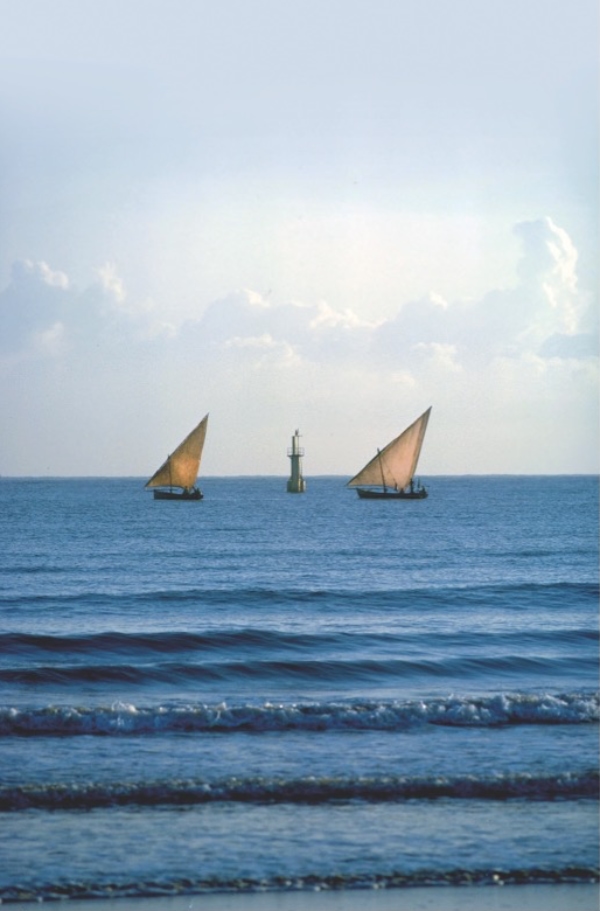
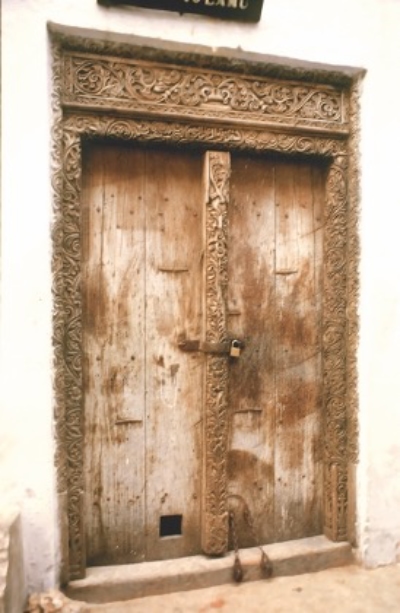
[I went on to visit the island of Lamu, famous for woodcarvings.]
[While there I met the only person on the whole of my four years who was making a journey something like mine.]
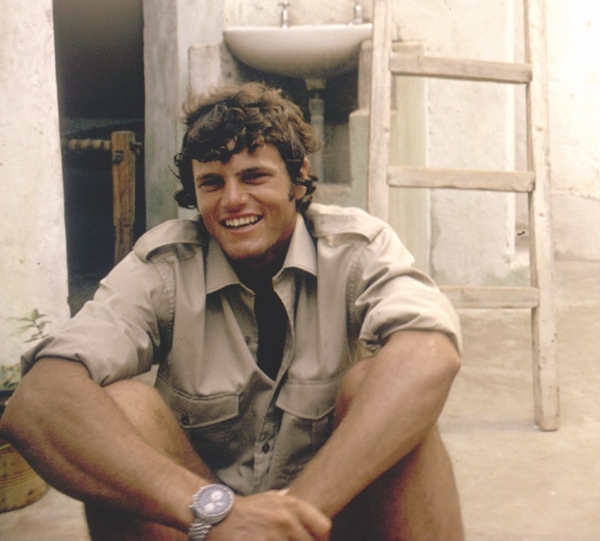
Ian Shaw, 25, New Zealander, been travelling 4 years, first on Yamaha 250, now on 350. Through Far East. Thailand, Malaya, India, now Africa. Fell off through speed-wobble in Thailand. Rolled 100 feet and skinned himself like potato. Hospital stretched him out and poured salt over him. Then washed him and put on mercurochrome. Then sent him off. Drove as fast as he could to make maximum miles to Malaya before setting rigid. Attacked and chased by Karachi mob. No reason. Threatened with shooting and incarceration by Tanzania police. Sleeping sickness in Botswana – thought it was malaria. Now thinks he may have bilharzia. Looks very fit and strong.
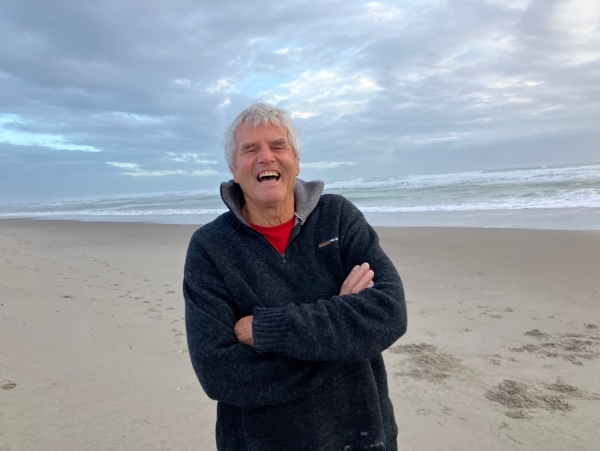
[Although we never met again, I visited his home in New Zealand on my second big trip. He was away, but his wife was at home. Just a few weeks ago, as I am copying out these notes, his wife called to say he had just died. She sent me a recent picture of him, fifty years on.]
Back in Mombasa spent one and a half hours trying to sell my shillings back to the Kenya Commercial Bank. [Strict currency controls at that time.]
Two nights with Kai and Henning had been pleasant and relaxed. At the Sunshine until 4am first night, finally taking back with me the persistent lady called “Marg” (to no purpose), and ferrying her back to her sister’s room next morning – a room in a thirties bloc called “Warden’s Court”– grey angular building with steel frame windows on unpaved ground. Sister sprawled on bed, face down. Afro wig on chest of drawers. Room clean, painted but stark.
Spent day recovering. Read a Victor Canning detective tale about an unconvincing Irish millionaire called O’Dowda and his improbably beautiful stepdaughters.
Sewed up my trouser hems (at last) and wrapped up sand, millipede, and silver box for Jo. Then bought food for two Danes and American and made a terrible mess trying to cook it on their electric Glowworm stove.
Later went out on a night trip to Fort Jesus – marvellous effect by night – soaring ramparts on hewn rock base with rounded crenellations, sloping back slightly, seeming quite impregnable. – can walk right round it – nothing to break the 16th Century mood – and then round Mombasa port – copper ingots from Zambia, rolling stock, freighters, and a tanker berthed and brightly lit, drums of chemicals strewn around, very little apparent supervision. Road winds between sheds and sidings for about a mile. Yugoslav trucks and trailers. Effect is to draw Africa together.
Remember massive derricks on freighter – forest thick. Locomotive with cyclops eye. Kikuyu guard. Tall suave – “You can pass”.
Leaving Mombasa, Monday, 27th
Left next morning, reluctantly, in cloudy weather. Mood of uncertainty developed into deep anxiety – quite inexplicable – which grew worse. Realised that this was a phenomenon to deal with and explain. No apparent rational basis, but undeniably I felt unsafe, threatened. Thought of Ian Shaw’s episode with Tanzanian police – “I can take you out and shoot you, or a I can put you somewhere where nobody will ever find you. We are the law here.” Was it that? Unlikely. When had I felt similar mood before? During second week in Nairobi just ten days before – though had done nothing then to precipitate it. Temptation to read omens, foresee disaster. Should one submit and delay action? Weather is unsettled, very humid. Hot waves of fetid air blow across the road from areas of forest recently drenched by showers. First time I have smelled that tropical hothouse vegetable smell. I drive very carefully, gingerly – anticipating accidents where I would not normally. On the ramp of the ferry at the southern exit from Mombasa.
Some drops of rain hit me, and I seem to be heading for black saturated cloud with dark streaks of rain below. Then road veers away at last moment and circles the gloom. Can’t help reading supernatural significance into it – a general reprieve. Lightens my mood but does not dispel it. At the border I am still uneasy, particularly as I am telling (for the first time) a modified story of my identity and purpose. I am a builder bound for Botswana. No idea of going further south.
[The newly independent post-colonial countries are deeply suspicious and hostile towards anyone with connections to White Rhodesia and South Africa.]
Kenya customs man engages me in an elaborate conversation about my journey, my views on Kenya, on Britain and the effect on it of losing its colonies. I am very wary. It sounds like a polite political screening. The policeman at the gate observes the sword and says it is an offensive weapon and therefore illegal. He is smiling and full of jokes, but I still feel he might do something about it. On the Tanzanian side the examination is more cursory. I am asked to show my traveller’s cheques. A slight schoolmasterly fellow in a light suit and specs suggests that he change my Kenya money. There will be no need to record it on the document, since I will be spending it immediately, no doubt. He is obviously going to cash it on the black market himself and wants no record of its existence. I let him get away with it gladly, feeling that it may buy me some protection. Against what? I don’t know, but the feeling of precariousness is still with me, and I feel the need of any security. He is a lousy advertisement for Nyerere [President of Tanzania] however. Then the storm breaks, and a short deluge descends on the tin roofs.
I have missed my last opportunity to buy petrol 30 miles back. The Michelin map has let me down. There is no longer petrol at Lunga Lunga, due to lack of business they say. A Mercedes drives up – TZ plates, and I solicit a couple of litres from two tall, well-dressed Africans. “You’d better wait and see if they let us through first. If not, you can take the whole car.”
Afterwards the driver lets me siphon a litre or so but stops me then. I have only a five-shilling piece and offer it to him. He takes it saying it’s not much use to him – but it’s worth more than twice the petrol he gave me.