
From My Notebooks In 1974: Still in Rio
26th July 2026 |
Still in Rio, enjoying the patronage of the wealthy.
Rio de Janeiro, Friday July, 12th
Tonight Maria-Luiza and I are to go to a Macumba service in Petropolis. We leave early to get to ML’s first lesson at 10am. [ML teaches ballet.] On the way we pass the façade of an enormous hotel built in a sort of mock Tudor style. She says that inside it is the perfect Grand Hotel of the American twenties/thirties. Mean to see it if possible.
[We are staying overnight in Petropolis with ML’s sister and family, including husband Chris and their young children, Arturo and Marcia.]
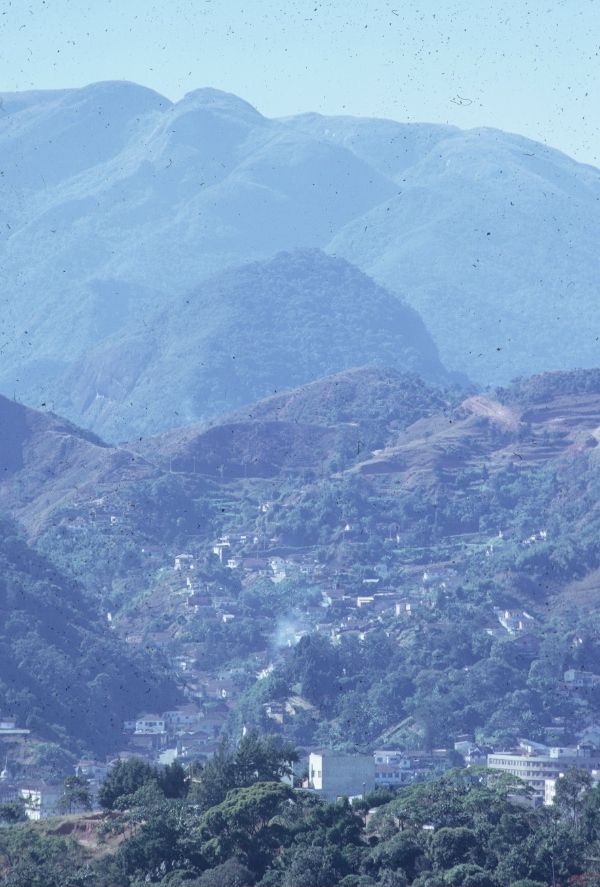
Arturo and I drive up to viewpoint over Petropolis and take a few pictures. The city is tucked away among hillsides and almost hidden by trees. Chris, ML’s brother-in-law, says Petropolis is 90 kms long but I don’t believe anything he says. His son Arturo and, especially his daughter Marcia are sadly addicted to food. In afternoon she took tea – 3 big bread rolls with butter, several sweet biscuits, and cups of tea with enormous scoops of sugar. She is very fat – her trouser zip is always undone, and it’s gruesome to watch her eat. They are eleven or twelve years old. I hope it works out. Nothing to be done, I feel, because the eating is certainly compensating for something else which probably has something to do with Chris’s difficult character. He is clearly obsessed by his Englishness, of the middle-class military variety – blazers, whiskers, grey flannels, whisky, and outright lies about silly things like drink, guns and so on. Has an 0.45 pistol, “It’s the only real man-stopper I know.” Claims he shoots it off in the night, to frighten prowlers. I bet if he does it’s not more than once a year. Thinks American negroes and Africans are the same. Has irritating habit of saying things like – “You know what you should have done, don’t you?” and waiting for some sort of acknowledgement of ignorance. Then utters a quite fatuous remark. But in spite of all this he’s not unpleasant, and one could quite like him. But to live with him would be disastrous.
[ML and I leave for the Macumba service – An afro-Brasilian cult in which individuals are possessed by gods, such as “Ishoo”]
At the top of a winding road, past walking couples of modified African appearance, a single-storey building of brick and cement with steel frame windows. Inside divided into two halves by low wooden barrier with openings in the middle and at the walls. On the entrance side several rows of benches – left for women, right for men. At the near end a counter with shelves for bottles, packages and candles, materials suitable for rites, or “obragacāoes” and a small office. At the far end a shrine in a recess, lighted green, with grotto-type décor. The floor here is parquet. The benches are already full. A mixed audience of poorish people in their best clothes. Young men in white, short-sleeved jackets and white trousers and sneakers hang about like hospital interns, but instead of a stethoscope round their necks they wear a string or two of beads.
Women line the wall of the “dance floor” wearing flounced white dresses with no waist, and white cotton trousers, ankle-length and quite tight. Round their middle they all have a length of some coloured print cotton, and white headcloths tied at the back to hold in their hair. On the floor in front of the shrine is a bowl and a candle (or maybe the candle is in the bowl with farofa) and there’s a jug next to it with cachaça. In the far corner two men sit, with a drum each, and two others each have an instrument of two metal cylinders with loose grains inside to rattle like maracas (oddly reminiscent of the cafesinho machines men carry strung round their shoulders in the streets). There is a microphone, and the speakers are in the audience’s half of the room. There is also a woman to lead the singing, and an elderly man.
The ceremony starts with the men and women, forty or so, shuffling round in a wide circle to an African chant or song. The elderly man calls the changes. They stop and kneel on the floor to sing another song, heads bent low. All this first period is apparently to entice the reluctant spirit, or ‘saint’ to come down. Soon a wild-looking woman with long reddish hair (quite old) comes on to the floor wearing a voluminous gold skirt, calf length. She walks with a nonchalant swagger and puffs on a cigar. She has a mischievous half-smile on her lips. As she passes us a young man in the benches comes over to kiss her hand. She accepts the homage casually and proceeds to the shrine. Various men prostrate themselves before her, and some girls are picked out to assist her. All the arrangements are made in a very matter-of-fact way. No effort is made to impart any sort of reverence or solemnity to the various stages of the ritual, and the participants often chat to each other as they might in the street or a shop. The lady in gold is apparently standing in for the elderly man. Her job is to persuade the ‘saint’ (Eshoo) to enter her, and he is getting too old to take the strain. She kneels or squats before the shrine as the singing and shuffling continue, and various functionaries move around her. Another man of some authority walks round inside the circle swinging an incense holder, and the participants bathe their hands in the billowing smoke and rub them over their faces and heads. He looks at them all, one by one, in a meaningful way.
After a while “Gold” gets up and takes steps backwards repeating a word which seems to indicate that the ‘saint; has come to her. Then she swaggers about the floor. The personality of this ‘saint’ is that of a sympathetic but mischievous and greedy man. Other women also embody other ‘saints’, like the one who looks upwards and makes a whooping noise, like frogs in the night. She is “Ogoon” who owns the forests and other natural phenomena. Another one owns the sea. Another is the warrior. Another owns the main diseases, like leprosy. They all some cheroots.
Some members of the audience have previously asked to speak to Eshoo and they carry numbered tickets. They are asked on to the floor and a circle of hands is formed round them to complete a “current.” The red, blue and green strip lights are switched off. (The dominant colour is green.) Th dancers begin to twitch, writhe, and utter little shouts or yelps. Some go into quite violent, shuddering fits, shouting and screaming. They are there to absorb the evil from the communicants and they do it with a will. The various ‘saints’ stroll around, taking a hand now and then to intensify the effect, or to calm down too violent an hysteria. This is then repeated with other sections of the audience. Later a special session is held for a child and his parents, and tw concentric rings are formed, the members of the inner ring surpassing themselves in their paroxysms and shouts.
At one point in the ceremony (before the arrival of the saint) there is a period of quiet during which a cracked record of Ave Maria is played over the speakers – at another point some popular Chopin – orchestrated “Tristesse.”
But I did not feel there was any idea or intention that the participants should at any time feel alone with a god or spirit or that, by some act of piety, self-denial or restraint make themselves better people. The spirits are themselves possessed of all sorts of contrary traits, and it seems to be understood and accepted that this is nature, human, superhuman or subhuman and nobody could want to change it. Obviously here there is less guilt. You join in and either obey or give orders according to the role allotted to you, and the rest of the time you do whatever you feel like doing. The concessions made by Macumba to Catholicism are not at all convincing. On the other hand the ritual itself is presumably a great deal less potent performed in these surroundings than in some forest clearing or on a tropical beach. A visitor there (who said he was a son of Ishoo) told us that child and parents getting the special treatment were his relatives and that it was a great privilege. He himself was an honoured friend of the house, but he too pains to explain that this was not his religion, since he followed a different branch of Macumba. These variations all deal with the same basic vocabulary of saints, but the emphases and rituals differ, and in his branch, for example, it was not possible to call on Ogoon, whereas here it was. Hence the special ceremony.
All these different branches, however, unite occasionally when funds permit, to have a great ecumenical feast called “candomblé” where much food and drink is passed.