
From My Notebooks In 1974: To Zambia
15th March 2026 |
I’d been riding on this TanZam highway for two days, but my notes don’t reflect the chaotic nature of it. Because of the war in Angola this road had become provisionally the only outlet and supply route for Zambia – copper to the Indian Ocean and oil to Zambia. Much of it was dirt and in the process of construction. There were many diversions around culverts, the oil tankers were driven recklessly, drivers on drugs to stay awake and there were wrecks all the way along – it was a hell run and a challenge.
January 30th
From Mbeya to [Zambian] border. No petrol, no money. Meet embassy wives at Zambian customs and cadge petrol off them. They tell me about “the Catholic Fathers” at Mpika. Petrol crisis continues into Zambia. So does cloud and rain. Fill up at Isoka (several kms off the road) but fail to fill reserve tank. [This is nonsense. There was no reserve tank, as such. The rain must have gone to my head.]
Ran out [of petrol] before Mpika. Get some off a van, resting at wayside. By now realise towns are not going to have facilities. Opt for “Catholic Fathers at Levimkila.”
[I shared with most travellers a general dislike of missionaries in principle but had to admit that most were very well-meaning, and very useful to people like me.]
Meet Tom and Katrin Hughes. Invited in – visit hospital – “Our Lady’s Hospital”– nurse there says people are undernourished – sheer lack of food turns their hair red. Called Murasma. Much TB. Kwashiorkor. Mainly ignorance. Patients on double treatment – hospital and witch doctor. But if someone dies, they blame the witch, not the hospital.
Tom and Katrin think they have it too good. Expected a rough ‘bush station’. Mixed marriage – i.e. (Protestant) him, and (Catholic) her. – from Falls Road, Belfast. Talk of wonderful old people (priests and sisters). One rolls up (sister) on Honda. With helmet. She’s sixty something. Loves it there. Very brisk (as always)
The rain and the road are numbing my senses. Can’t really trust the bad impressions I’m getting. People less appealing here, physically. Old people clap hands to show respect. Smoke goes straight up through thatched roof of huts. People walk around in the rain quite unconcerned by it, sometimes with transistor radio pressed against chest under straw hat.
Said to be 10,000 Chinese here on railway. Look much yellower than I remember. (is it climate or contrast?) Said to be totally unapproachable. Wear pale blue overalls, sometimes coolie hats. As I drive slowly past worksite on main TanZam road, one in darker overalls pointed angrily/sternly up the road in very dramatic gesture.
Rain this day torrential. Thunderstorm near Serenje, so low, heaviest rain I’ve seen. Wanted to visit Nsalu caves (rock paintings) but didn’t dare ride dirt road in rain. 21 kms. Oppressed by total lack of pleasant shelters. Only “bottle stores” run by moody people. Who wants to drink beer or Coca-Cola after riding through a chilling thunderstorm and soaked to the skin?
February 1st, Ndola
Calculated today that I could drive to Cape Town in 8 days, so the original date is still within reach after all. Astonishing!
[Before the “oil” war, I had booked a passage on a liner to Rio. Now almost all shipping had been cancelled.]
Chinese build a neat railway. Those sections visible might appear in a painting. Stone buttresses to carry line across the road, built of square blocks, outlined in black (protective paint?). Chinese labourers in coolie hats with chin straps, on trestles. Dull green trucks in convoys carrying wood or sharp road metal, five or six at a time driving at a sober 40mph at respectable intervals – unlike the hairy driving of the big Tanzam trailer trucks on piece rate. Regularly along the road, dirt roads disappear into the bush, sign-posted in red on white painted sheets of flattened iron, in English and Chinese – “Quarry of 4th sub-unit” etc. Inspection is vigorously deterred. Tourists going off the road are sent packing if they encroach. Newspapers like the Times of Zambia (Lonhro owned) exhort the Zambian people to guard their railway against terrorism (by whom?)
February 3rd
[I found shelter with a missionary couple, called Bland, off the road to Lusaka.]
Within three miles of the Blands, a terrorist camp. One morning (Saturday) a machine gun battle. Farmers all came rushing into white houses for protection. Frelimo from Moçambique, Angola, Rhodesia – subsidised and supported by K.K [Kenneth Kaunda – president of Zambia]. But with less enthusiasm now, since their leaders seen living it up in Lusaka. Government officially denies their presence. Police much too frightened of them to interfere. Interlopers either warned off – or interrogated first and then sent off – but not violated.
[The Blands took me to visit a nearby village to see how they lived.]
Zambian family compound near Chikankata. Tonga (or Tonka) tribe. Six huts – plus maize store and chicken house. All basic ploughing machinery and oxen to draw it. Husband was away at court. Three wives, two of them had six children each.
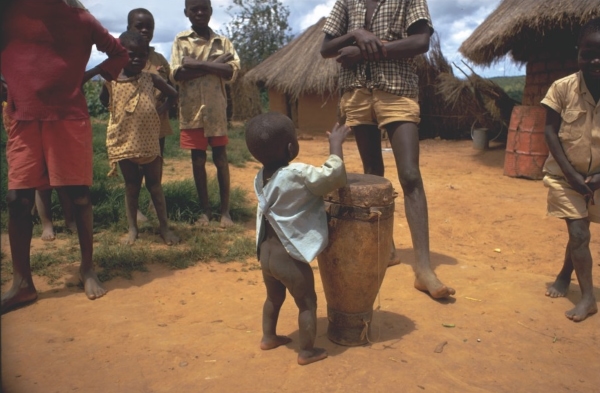
Drum about two feet tall, beautiful sound. Pot cooking on fire in kitchen hut.
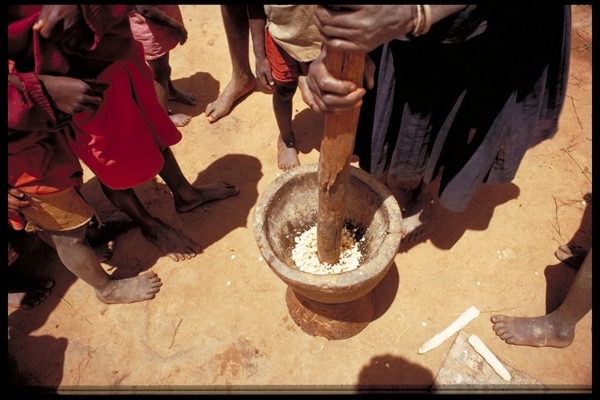
Mortar for grinding up maize with sprinkling of water. Has a narrower depression at the bottom into which stick [pestle] fits.
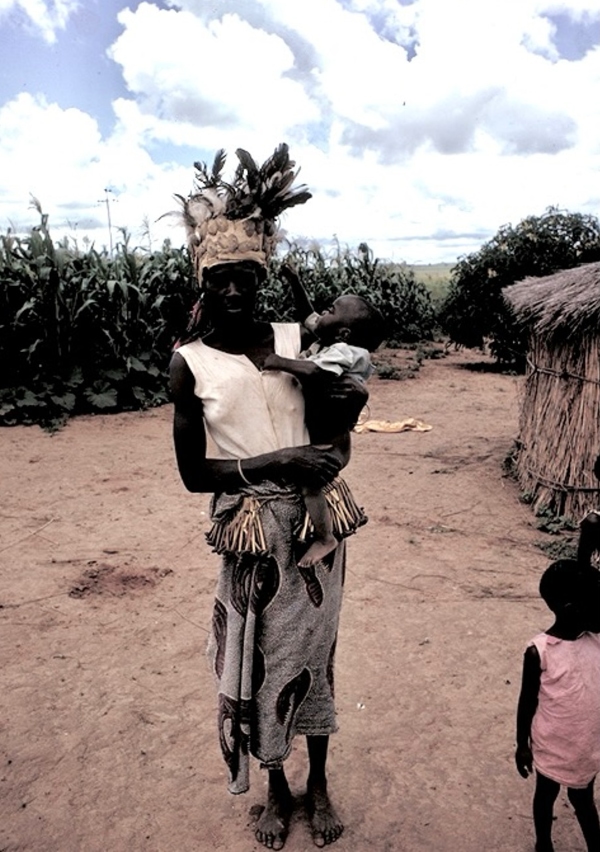
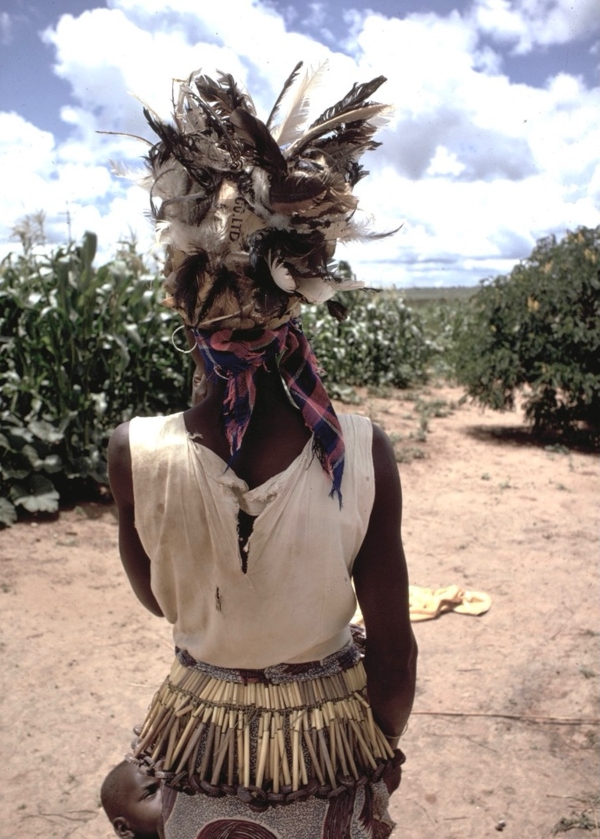
Tallest of wives and most elegant produces dancing gear made of strung bottle tops and a hat made of paper and feathers.
The rains – November to March. Heaviest in December and January. On a good day sky clears after dawn with only a little high cloud (Nimbus?) scattered over the blue. The sky does look bigger in Africa – even where the terrain is uneven. Perhaps cloud cover is higher – perhaps clarity or colour have something to do with it. As morning runs its course whisps of cumulus appear and grow, concentrating in one area and swelling to monstrous proportions looking finally as though an apocalyptic explosion had taken place in total silence. The base of this towering construction, which now looks as substantial as any ogre’s castle, is heavy and black as soot, and hangs threateningly, seeming to distend and sag even further to the ground as one watches. Eventually it’s enormous load is too much for the buoyant cloud above and it slides to earth in a diagonal avalanche, obliterating everything in its path, as lightning lances slash and rip the invisible skin that was strong enough to hold a river in the sky. As the day proceeds, the grayness usually spreads and becomes general, but it may be confined to one area, while the sun shines over and round the cloud playing on the spray and cumulus to produce beautiful prismatic effects. The roads gush with rivers of murran-coloured water, and cars send sheets of it flying over each other. People congregate under shop awnings, but in the country cyclists and people waiting for buses simply resign themselves to a soaking. Life goes on damp and soggy. The rains are too long for life to stop.