
From My Notebooks In 1974: Turkana in Lodwar, Kenya
15th February 2026 |
Nairobi, Tuesday, January 8th
Mike Pearson, the bluff and hearty boss of Lucas, Nairobi, says:
“I say! We just bought a plane. Where would you like to go?”
So I told him I’d got a postcard from a doctor working with the Turkana tribe in Lodwar.
[Before I left London a few letters from readers arrived at the Sunday Times wishing me well. One was a postcard from a doctor doing volunteer work at Lodwar in Kenya inviting me to stop by. Of course he never imagined for a moment that I would.]
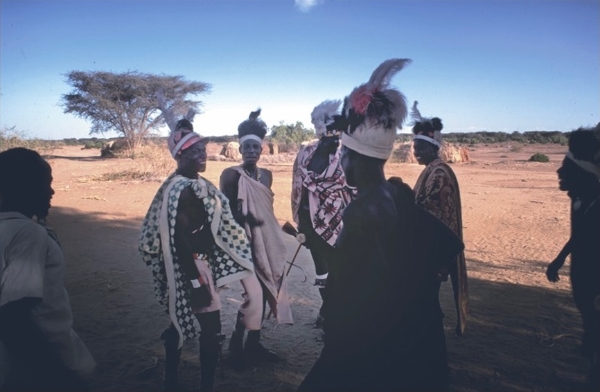
Lodwar, January 9th
Arrived yesty. Cessna 310. Brand new. £34,000.
One and a half hours from Nairobi. (Cost about £100 here and back.) Alongside Rift Valley – far too small to relate to the size of the continent. Bumpy because of midday heat. Drive [Fly] with road map. Bob Croft [the pilot] is a farmer. 80 acres of coffee and a Guernsey herd. Content with Kenya. Would like to stay in spite of gathering problems, blatant corruption.
The hospital ward. Cherubic Irish face [Jerry, the doctor] with huge lenses gleaming up, astonished.
Black bodies with green cotton wraps round their middles, flapping and wrinkled breasts, dusty soles, here and there a bandage where operations have been performed. A batch of post-ops after visit by Flying Doctors. Mostly for hydatid cysts – local menace, either in liver or spleen, grow to enormous size, like grapes in juice. Dogs might be host.
Men like having their feet cut off. There’s a thing that swells the foot up and can be stopped but foot stays big. Also very painful.
Prisoners there with police. One pretty girl with spindly limbs dying of malignant tumour, but no-one can be told, or their rage and grief would be uncontrollable. Also, says Jerry, if parents are told their child will die they just leave it to starve.
[There was mission overseen by a Bishop Mahon.]
Long talk with bishop. “I’ve given up thinking. I never did very much of it, and now I don’t bother at all. Just get on with it, let the future take care of itself.” Caricaturing himself. Quite ready to accept that he’s just creating problems. “What can you do? You can’t just let people starve.”
Sitting opposite me, back to an open-lattice wall with lozenge shaped openings. Breeze bursting through, which he “built himself” – well – arranged with others to build. He had a mould made in Kitale. They pack in sand and a sprinkle of cement. The flies were buzzing around my head, attaching themselves to my eyes and lips, as they do, but I was uncomfortably aware that there were no flies on the bishop.
They’ve got an irrigation scheme going on the river further up. Should have about 50 acres at next rain in April (aiming for several hundred). But it’s hard work and only some of them are industrious. Without direction the channels would choke up.
“Did you see an irrigation scheme in Sudan? I flew over and saw a huge area.”
[I think he was talking about Kashm el Girbar.]
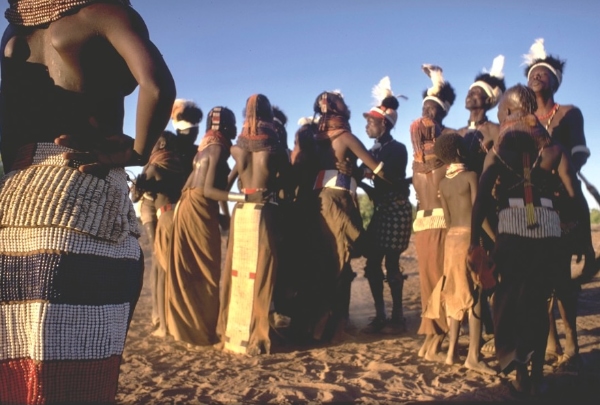
[I arranged a party and bought two goats, so that I could photograph them dancing in daylight.]
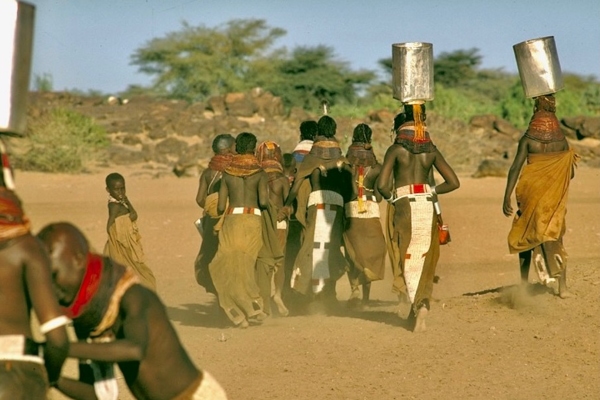
Those metal cans each carried five gallons of corn beer. They use a hard-fibre bun called an Aikit on their heads to support heavy objects. I brought one back, together with a spear, a wrist knife and a very low carved wooden seat.
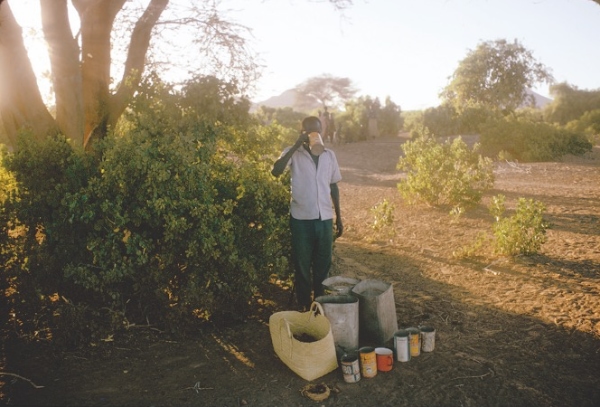
The bartender.
Bishop Mahon (continued). Face that could equally suit a study or a stock pen. Tobacco-stained teeth, straight silver hair, physically fit, lean, golden skin, shorts, tea stained shirt, 9 years in Nigeria, 6 in Turkana, Medical Missionaries of St. Mary. Mission hospitals in various outlying villages (Kakomari?) Also has Danish volunteers as well as Irish pastors and sisters. Finds the Danes better suited, much less demanding than his church people, although can’t quite explain what motivates the Danes. Their unselfconscious, naturalistic behaviour can outrage the sisters, especially at the Norwegian swimming pool. The nuns, he thinks, are too often doctrinaire, officious, and their inflexibility makes it hard for them to survive the pressures. But his mission is dabbling in other things. Irrigation schemes and the Lake Rudolph fish project. FAO man reported the Lake capable of producing between 50 and 150 thousand tons of fish (Nile perch, up to 250lbs)
Got it started. A big British iron trawler is there as a development vessel. Asian traders to set up refrigeration (freezer on a lorry, which crashed: then on aircraft which also pranged on landing). But after good, early catches, yields dropped, and scheme failed to fulfill itself.
Mahon relates the up and downs of his missionary life in the way older men often describe the hopes and disappointments of their sons, with a wistful fondness and a rater irrational belief in the basic goodness of the life and its intentions, whatever the outcome. He would not willingly return to a Western life (hardly any I met could stomach that; its selfish, indulgent nature is too blatant now) but there are few expectations out here. He is resigned to criticism of his “meddling” in matters outside the brief of his mission. One feels that the technocrats of Oxfam, and the specialised relief agencies, have often snubbed his people. He is himself aware of the criticisms.
“We project a terrible image on these people, going round in Landrovers, living in concrete buildings. But if we build with mud, the termites work their way up the walls and eat the door jambs and attack the roof. We’ve tried most things. There’s a chap out here who lives in a tent. He’s very happy doing it, but he’s doing harm, because when he goes, I can find no-one to replace him who would put up with those conditions.”
He warns his people always about imposing their standards on the Turkana. “My only hope is that after a few years we can overcome the bad effects by showing them that we care as people.”
It is not difficult to find evidence of the corruption of tribal life by white civilisation – the universal phenomenon. Bizarre mixtures of western and tribal dress. The inevitable stories of missionaries (more often Protestant than Catholic) determined that native women should cover their breasts. The souvenir selling. The tin roof syndrome. The self-conscious proclamation of haughty pride before the camera followed by the outstretched hand for a posing fee. But the process is irreversible now. And it would be naïve to allocate blame too easily.
H. Johnston, 1902:
“The Turkana are very treacherous.”
“The Turkana are very conceited and idle.”
E.D. Emley, 1927:
“The Turkana is a careless and cruel herdsman and a most efficient liar.”
P. H. Gulliver, 1963:
“Although a general recognition exists that one must give hospitality to travelers, yet each man will attempt to evade responsibility, telling the most bare-faced lies if necessary.”
“A feature of social life which reacts strongly on character is the continual begging – begging that has to be satisfied sine it amounts almost to seizure ––– the only limits that I am aware of are that a man may not beg another man’s wife.”
And by the same author, who seems to have been the recent authority – “Savage and wild as the country he lives in, so he will remain, in my opinion, to the end of time.”
In 1963 there were no schools, no foreign administrative interference. Only the ultimate white sanction of a punitive expedition to prevent warfare. Today there are Flying Doctors from Nairobi, mission clinics. The opening for these intrusions was provided by the big drought and the cholera of the sixties, which persuaded the Kenya Government to open the Northern Frontier Province.
Huts from sheaves of long grass bound together.
Clay pots; three-legged stools, headrests.
Spears, wrist knives with leather guards.
NO musical instruments at all.
There was a British District Commissioner at Lodwar who refused to allow any of his people to wear European dress. They all had to dress like Turkana. Name was Whitehouse. Now Resident Magistrate in Kitale. He put the hawser and pulley across the riverbed to take supplies when the river was in flood. River usually runs six to nine months. March onwards. Now dry. Palms similar to Atbara, but drier.