Articles published in June, 2026
This is Part Two of a dispatch I sent to the Sunday Times after my detention by the Federal Police. If you didn’t read last week’s episode, please do that first:
>>> Fortaleza Part One
At two the team drifted back. There was nowhere to sit. I tried walking about. There was an older sergeant figure with a hard-boiled face. He pointed to the wall. “Fica!” (Stay) he commanded. I protested. Eloquently he mimed a spy taking photographs. His face expressed total disgust. “Fica” he roared and thrust me back to the wall. Nobody raised an eyebrow. At four I was summoned along a corridor and down some back stairs to a cellar to have my own photograph taken, then my fingerprints, each finger and thumb separately, then in groups, all repeated five times. “Do you play the piano?” joked the agent. To me it evoked a quick picture of crushed fingers.
By six I was alone again, with another dish of rice and beans. The hours stretched ahead endlessly. It rained. I noticed two walls were very damp. I tried taking my mind off my predicament but couldn’t. There was nothing to do but think. I slept with a second mattress on top of me to keep off the wet draught.
Saturday began without hope. The office remained empty. There was no work there on Saturdays and as the minutes piled up into hours I slipped further into dejection and fear. Fiercely I studied my prison. I counted the floor tiles (1,520 including fractions). Then the tiles on the wall (1,108). I invented escape plans. Then it occurred to me that perhaps I was expected to escape. What better pretext for doing away with me altogether? This led easily to the notion that perhaps I was being observed and I began to look surreptitiously for a concealed camera or spy-hole.
Only two events interrupted the day. Rice and beans at twelve, and a strange radio message at four. It blared out loud and clear from the second floor. Each phrase was carefully repeated, so that I could understand several words and the general drift. The words were “Ingles . . . Marcello . . .to Rio . . .then . . . to Inglaterra.” The operator replied that he now had the “films of Africa and the coast.” The films could only be mine. The priest in whose company I walked around Iguatú was known as Marcello. I could no longer doubt they had convinced themselves of his guilt and deported him. The little hope I’d kept alive evaporated. I felt sure they suspected me of subversion. They “knew” something was wrong about me. (No.1 confirmed this to a third party later saying, “he smells.” But they would never find evidence. There was none. Eventually, I felt, they would be bound to try to force some out of me and that process, once started, might be irreversible.
Over the next six hours I came to terms with the idea. and wrote a letter to one of the two people I love most (on a scrap of paper I’d saved) and felt calmer as though I had talked to her. That evening Fortaleza had its heaviest cloudburst in 60 years. Water came through the roof and walls, and gurgled in the drains below.
Then the hatch opened and a bearded face appeared, framed in it.
“British?” it asked. I nodded. “Mathews,” it said. “I’m the British vice-consul in Fortaleza.” Nothing I’ve ever heard sounded so sweet as those few words. Spectres which only a few moments before had born down on me with stifling weight shrivelled and faded in the presence of Her Majesty’s representative. God bless consuls everywhere. Mathews could do little to alter the course of events but it was enough to know I could no longer vanish without trace. He tackled his duties squarely and insisted on telephoning No.1 at home. He was told that I was involved in “something very big,” which would be explained on Monday. Meanwhile I was only being retained “with full rights.”
I described what such privileged retention was like and begged him to fetch clothing and shaving things from Sâo Raimundo, and above all news of what was going on. Mathews was tired after a long journey but he slogged out to the parish and came back with some things and the welcome news that everything at São Raimundo seemed perfectly normal. No police had been there yet. Pleased but puzzled I let him go home to sleep.
He came back just before lunch on Sunday with some Agatha Christies from the twenties and told the “agente” on duty that I was permitted to go out to eat. As though amazed that I hadn’t thought to ask myself the agent said, “Of course” with a wide smile and we drove together to a restaurant on the beach. The moment I stepped into the sun for the first time in three days was a physical shock. My clothes had been saturated with moisture. I had a heavy cold and was slightly feverish. The sun boiled the water vapour off me in seconds. I felt it reach into my bones. Only then did I realise what an unhealthy hole I’d been locked up in. We sat at a table with a white cloth, looking across at the sea, eating good food, drinking cold beer, and I couldn’t help feeling the whole ordeal had ended. In fact it had just changed gear.
Altogether it was 12 days before I was released. There were endless pretexts and procrastinations, and I came to resent bitterly the wanton abuse of my life but I soon learned it was useless to complain. None of the agents appeared to place any value on personal liberty. The Consul’s intercession had broken through their indifference and some of the younger agents were interested now and tried to talk but were clearly bewildered by my impatience. An English-speaking girl came to chat at lunchtimes, and I tried to explain my anger at being imprisoned. She laughed at the idea. “Everyone is in prison,” she said. “Fathers, husbands, children, they all make prisons.”
On Wednesday Mathews left Fortaleza for four days. He had been “guaranteed” that my fate would be resolved before my return. No.2 insisted that he was still waiting for routine replies to his cables.
At lunch on Friday I was walking with a policeman when a black limousine rushed up alongside and slithered to a halt, Chicago style. The driver shouted and gestured wildly, ordering us into the car, and then shot off, spinning his wheels on the wet cobbles, in the direction of Sâo Raimundo. “This is it,” I thought wearily. Then, as suddenly, he took a sharp left turn and we were in front of the police station again.
We were rushed into No.1’s office, where he was standing, talking on the telephone. He paused and said, “The secretary at the Ministry of Foreign Affairs wants to talk to you.”
He went on talking and I heard him say I had been in custody four days.
“Eight days,” I said angrily, raising eight fingers. He ignored me. I had a long civilising conversation with the diplomat in Brasilia. I felt sure that his involvement would end my detention.
After the call N0.1 became quite effusive, slapping me on the back and practising his English as we left for our separate lunches. In the afternoon everything seemed to be happening. The Consul appeared a day early, with a Scotsman from the Bank of London. They went in to see No.1 and then came to talk. They seemed confident I would be out that day. Then Mathews went back alone and returned with the depressing news that they were still determined to hold on to me. I was outraged and cursed long and loud. Then he told me: “They say they are after another Englishman for subversion, and he has the same names as yours but in a different order. “In my more fanciful moments I had wondered whether there could have been another Englishman going about to explain the strange fragments of information I had heard. But with the same names?
On Tuesday afternoon I was finally delivered into the hands of the Consul, with the Bank of London acting as midwife. I had been put back on rice and beans the previous day and during the last 24 hours had nothing to eat.
The priests received me back into Sâo Raimundo with great good humour. My belt was still under the fridge, exactly as I’d left it. There were many stories to tell, and they told theirs with scabrous joy. If one didn’t know, one could mistake them for a rather high-class construction crew. When my cold died I got dysentery, and by the time I felt well enough to leave I’d been in Fortaleza more than a month. Was it worth it? One of those Irish stories seems nicely relevant. A stranger, lost in the heart of Ireland, asks the way from a passing local, who struggles with directions and becomes more and more confused himself, until admitting defeat, he says: “You know, if I were you, Sorr, I wouldn’t start from here at all.”
When I booked my passage on the Zoe.G I knew only that it sailed to Rio de Janeiro. Later, once on board, I discovered that it would first call in at Fortaleza, a city in the far north of Brazil. Though it had a population of a million I had never heard of it – an indication of my ignorance. I also did not know that Brazil was a police state, in the grip of a relentless dictatorship. I decided to disembark in Fortaleza and ride the 1,300 miles down to Rio.
Fortaleza, May 14?
The ship drifted in passing fishermen on the most primitive craft, little more than floating boards.
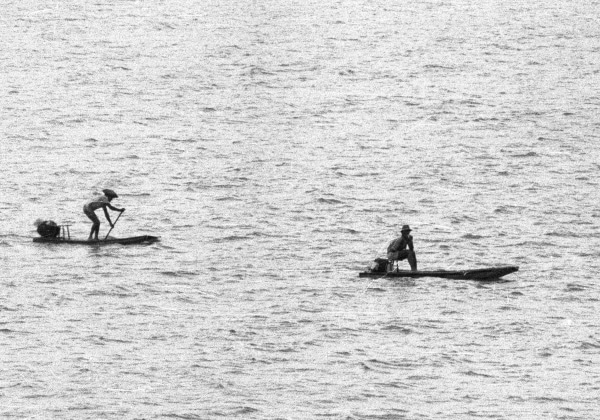
Then the ship docked. My bike was spirited away to customs. Two policemen came on board and questioned me about my Scuba gear. They were convinced I must have diving equipment. I stayed on board two days while the ship was unloaded and while I visited the town my cabin was searched.
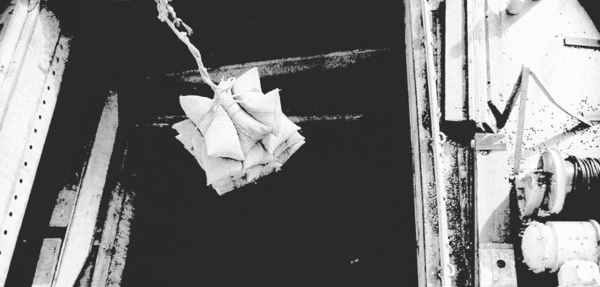
The ship was delivering cashew nuts from Africa, and I watched them being hauled out of the hold.
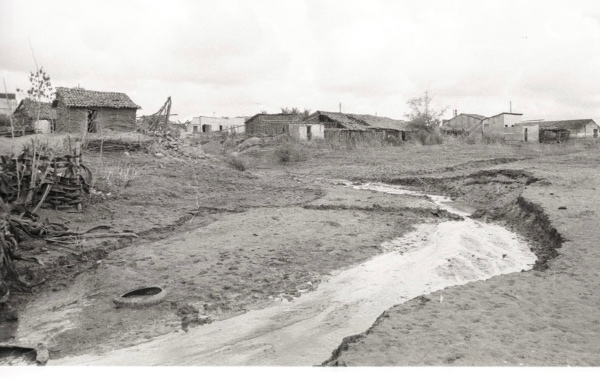
Communicating through telex The Sunday Times suggested I make contact with some priests in Fortaleza and visit a flood catastrophe inland. I followed their advice and took some pictures.
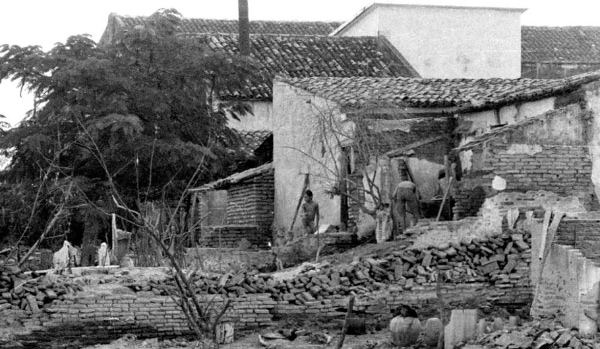
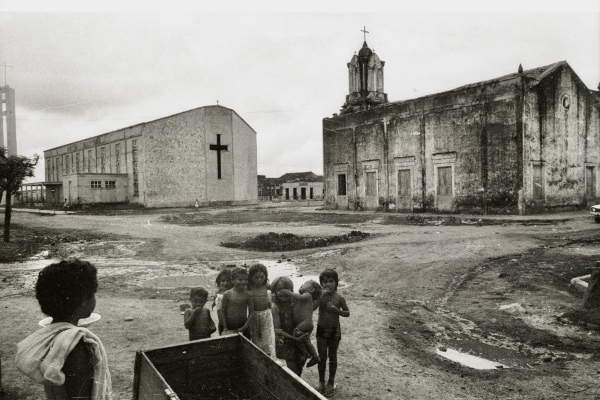
When I returned I was “invited” to the police station. Several weeks later I wrote the following piece for the Sunday Times. Here is Part One.
Obviously I should have been locked up long ago. The Brazilian police have shown me to myself in an alarming new light as a person who’s very being excites suspicion and alarm.
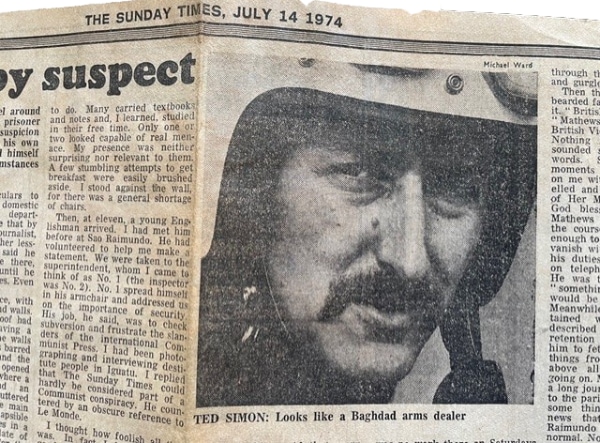
The suspect was apparently born in Germany , of a German mother and a Romanian father. Yet he carries a British passport (with no indication of naturalisation) and lives in France. Physically, however, he looks more like an arms dealer from Baghdad and his passport contains several pages of Arabic script which might as well be a prescription for exploding coconuts. He claims to be traveling around the world on a motorcycle but when asked why can offer no credible explanation. His arrival in Fortaleza on a Greek freighter is inexplicable and unheralded since he has a paid passage to Rio. He presents himself as a tourist but immediately engages in a fierce telex exchange with his masters in London who machinate under the code name “Thomsonews.” They instruct him to join forces with a network of missionaries from Ireland who are vaguely affiliated to another organisation, unknown to the Federal Police at this time, called Oxfam. Under these auspices he slips out of Fortaleza at night by bus (?) to Iguatú, scene of a recent flood disaster and a hotbed of counter revolution. There he interviews flood victims and photographs them and their devastated homes. Two days later he makes the seven hour bus journey back to Fortaleza.
I was not so much seized as invited into captivity. I had long stopped expecting trouble. The first two days the police buzzed around me like flies. Then came the Sunday Times telex about the Irish fathers, Oxfam, and the floods at Iguatú. It smacked strongly of “journalism”, an association I preferred to avoid, and I was fairly sure such conspicuous communications were monitored. However, the police assured me I was “free to go anywhere.”
By now the priests in Fortaleza had invited me to stay. They are well established in the area of Sâo Raimundo with a large college, a church and a number of community projects. They have other groups in many parts of the country, including Iguatú, and one of their number was returning there after an illness. I went with him, by bus, and came back two days later.
The message waiting for me back at São Raimundo was casual and innocuous. Would I call at the Maritime Police office and ask for Samuel. I went the following afternoon. Samuel was the youngest and most sympathetic of the police who had talked to me at the docks. He apologised for the bother and said the Federal Police simply wanted to ask some questions for the record. We drove in a police car to their office behind the cathedral, a white plastered villa webbed over with aerials. We waited for an hour and a half and I didn’t think there could be much to worry about. Then I was taken into an office where several people were waiting. Opposite, across a desk, sat a short belligerent man who attacked me angrily right away. “You have been taking pictures in Iguatú. Are you a journalist?”
I have made a point on this journey of not traveling as a journalist. This adventure is a personal one and not a professional exercise. The Sunday Times does not employ me to investigate newsworthy situations, it helps me in return for an account of some of my experiences.
But behind this truth lurks ambiguity. I have been a journalist, and for emergencies I carry documents and an older passport identifying me as such. These I keep separately, with a reserve of cash in a money belt, and that belt was among my things at Sâo Raimundo.
Having arrived in Brazil as a tourist I was determined to stay as one, and I denied the charge. I cheerfully admitted taking pictures, and with genuine curiosity asked why not? But they were not there to answer questions.
Samuel was ordered to take me back to São Raimundo and fetch my cameras, films, everything. The affair was beginning to look serious. As we approached the crumbling outskirts I tried to form a plan. I thought I should keep those other documents to myself or they would create worse confusion. The house was empty, but I knew where the backdoor key was. I mumbled in English and dashed round the side of the house. Samuel waited patiently while I let myself in at the back, got the belt out of my room and slipped it under the dining-room fridge. Then I let him in through the front door. Samuel was probably the most intelligent of them all. He wasn’t worried because he’d taken the trouble to talk to me. He knew damn well I wasn’t a threat to Brazil or anyone. Unfortunately he didn’t explain earlier that the one thing that would have soothed his chief was documentary proof that I was a journalist. When I found that out it was too late.
The Inspector of the Department of Political and Social Order (DOPS) had been quiet at our earlier meeting. He received us in his office, took the films, rocked himself gently in his padded chair and broadcast my exotic particulars to Interpol and a variety of domestic Brazilian intelligence departments. I began to realise that by refusing the label of journalist I had made room for other less comfortable labels. He said he would have to keep me there, perhaps for the night, until he had replies to his inquiries. Even then I was surprised.
I was taken to an office, with desks, chairs, tiled floor and walls. Once an open patio, a roof had been raised over it, leaving a three-foot space above the walls open to the air. Iron grills barred the exits to the street and the back. A shuttered widow opened on to the reception area where a military policeman and an “agente” stood duty. Shuttered double doors led into the main building. There were collapsible beds with straw mattresses in a corner. I was given a plate of rice and beans and left for the night.
I had nothing with me but my wallet, and the shirt, trousers, shoes and socks I’d arrived in. My shoes were still soaked from the day’s tropical downpour. In the night the wind blew surprisingly cold and damp. From a communications room on the second floor, morse code and telex chattered through the night. I cheered myself that they were bringing information that would release me.
Next morning I was allowed to the bathroom and looked longingly at the shower. There was no towel so I washed my face and dried it on lavatory paper. Then I waited in the office. At about eight the staff arrived. They seemed amiable enough though they ignored me completely. The office houses two departments, DOPS and a drug squad called Toxicos. Two attractive secretaries took their seats. Young men gathered, lounging about, chatting, playing with guns and handcuffs, 332 waiting for something to do. Many carried textbooks and notes and, I learned, studied in their spare time. Only one or two looked capable of real menace. My presence was neither surprising nor relevant to them. A few stumbling attempts to get breakfast were easily brushed aside. I stood against the wall because there was a general shortage of chairs.
Then at eleven a young Englishman arrived. I had met him before at São Raimundo. He had volunteered to help me make a statement. We were taken to the Superintendent, whom I came to think of as No.1 (the Inspector was No.2). No.1 spread himself on his armchair and addressed us on the importance of security. His job, he said, was to check subversion and frustrate the slanders of the international communist press. I had been photographing and interviewing destitute people in Iguatú. I replied that the Sunday Times could hardly be considered part of a communist conspiracy. He countered with an obscure reference to Le Monde.
I thought how foolish all this was. In fact I had formed a good impression of the government’s efforts to relieve the miseries of Iguatú’s homeless. I had seen them temporarily housed and fed as well as might have been expected. I had seen the beginnings of a very promising self-help housing project supported by Oxfam with some impressively ingenious brick-making machines. The land had been granted by the able and energetic governor of the State of Ceara, who had also mobilised the army effectively to repair flood damage and distribute free grain and seed stocks in the rural areas.
We were swept in to see No.2 who asked more questions. I was sad to find that the priests also were suspect. Eventually No.2 composed a three-page statement in triplicate which seemed truthful and harmless enough to sign. Only with the pen in my hand did I discover how strained I was. The pen refused to do what I asked of it. My first attempt was such a mess I had to cross it out and start again. Even the ninth signature was an awkward travesty of my usual mark. Then No.1 reappeared and the mood became quite genial. A day or two would set me free, he said, and repeated that he was waiting for replies to routine enquiries. Meanwhile I would be escorted out for meals if I wished. I asked for a towel, a razor, some clothes and something to read. My friend was due to return home to the next state but promised to let the British vice-Consul know where I was.
I returned to the office and waited to be taken to lunch. My shirt, once white, was grey and sticky from sweat and humidity My face had two days’ bristle. The office cleared for lunch and I was left locked in. After half an hour an orderly came with a bowl of rice and beans, and my morale took a sickening lurch. Clearly nothing said that morning was to be believed. The whole euphoric event seem to have been orchestrated to get my signature and send the Englishman away happy. The Consul? The Englishman had been late for his bus. The police had offered to drive him to the bus station. They could easily say “Don’t worry. You’re late. We’ll see to it.” The priests would be unable to help and that, I realised, disposed of my links to the outside world. It was buttoned up. I was in the hands of professionals.
Next week: Part two
Along the way through Africa I occasionally wrote small essays or mini-reports. A major issue of the day was Southern Rhodesia’s refusal to accept that an all-white government was not sustainable. Britain having divested itself of empire could not afford to be sheltering a white colony, and Ian Smith’s efforts to go it alone led to heavy sanctions. In theory British firms were forbidden to trade with Rhodesia. This is what I wrote:
In practice life on both sides of the Zambesi curtain proceeds moderately well in spite of economic difficulties. On the face of it, the Rhodesians do better. They are inordinately proud of their sanction-busting prowess. British brand names, like Dunlop and Lyons, flourish. I’ve seen machinery newly arrived from Britain, and Rhodesia now manufactures much of what it once imported. But the sanctions, which seemed so feeble are becoming deadly in their long-term effect. While the farmers can hold out well enough, the business community shows signs of quiet desperation. Several times I heard the same story. Shortage of foreign currency, combined with an average 50% extra cost involved in intricate importing procedures are causing stagnation. While Africans can make do (as can the Arabs) with a subsistence livelihood, white Rhodesians are used to high consumption and leisure.
As an interesting sidelight, several Rhodesian women I spoke with took perverse pleasure in telling me that their divorce rate was the highest in the world.
My journey offered an unusual opportunity to experience both sides of a confrontation. A story that illustrates the absurdity of the border closure – the price of high-sounding principles The Chinese contract to build the Tan Zam railway. Part of the price to Kaunda is a delivery of maize. This is produced in Zambia by African farmers – and European growers. To stimulate the African sector KK gives them a preferential selling rate. Instead of increasing the yield the yield drops. It turns out that the African grows only as much as he needs to cover his costs. Result is that Zambia must import maize to settle its obligations to China. The only source of maize is Rhodesia – but direct import is out of the question. So, it is brought in though Botswana. The price in Rhodesia is $3.50 a bag, but Botswana levies a heavy duty to cash in on its neighbour’s troubles. By the time it gets to Zambia it costs double the price. So Zambia is paying a colossal premium to provide China with Rhodesian maize (There is no evidence that the Chinese choked on it.)
The cob is, of course, a vital ingredient of African life. It’s an interesting plant – being flagrantly bisexual. The male half exhibits itself with a flourish at the uppermost tip with a flower (often seven or eight feet high) that sheds pollen. While the female component protrudes more coyly from the stem with bunches of fronds which collect the pollen as it drifts down from above and develops into the cob, packed with corn.
Much expertise is involved in getting the best hybrid, and on both sides of the Zambesi the producers of seed maize are under great pressure to keep up the quality. I talked to experts on both sides. In Zambia an agricultural scientist – a white man who likes it here – said the government had set standards for seed maize that were the most exacting in the world. In Rhodesia a seed maize farmer was equally certain of his truth. The hybrid In Zambia, he said, depended eventually on Rhodesian expertise and since the border closure had degenerated to such an extent that compared with the Rhodesian variety it was hardly better than a weed.
These distortions and misconceptions, present across all the borders I’ve crossed, reach absurd proportions here. To many Rhodesians, Zambia is a land of economic chaos riddled with terrorism and ruled by proxy from China as part of a world communist conspiracy to destroy Rhodesia and ultimately South Africa.
[What actually happened? Instead of making some kind of reasonable accommodation with Tom M’boya, Smith hung on to the bitter end and gave way to Mugabe who pretty much destroyed Rhodesia’s brilliant farming economy. Well, that’s how I saw it. Now, back on board . . .]
When I first took my things aboard back in LM, the Zoe.G was all I had ever imagined a Greek freighter to be, from early readings of Greene and Ambler. The sight dented my morale severely for 24 hours. Evidently she could float but it seemed only a matter of time before the rust gave way somewhere important and let the sea in. I couldn’t see a clear painted surface or a glint of polished brass anywhere. Under the night loading lights the decks were littered with debris except where a great hole gaped. Far below in the hold some Black men where chanting and moving sleeper-sized bars of metal. There didn’t seem much of a cargo.
Now, after several days at sea the gale seemed to have had a cleansing effect. The captain of the ship was Fotius Fafoutis. All his officers, with the exception of the Philippino radio operator, are Greeks. They speak little or no English. I am the only passenger and I do not, as they used to say, “have Greek,’ Morning, noon and night I sat in the saloon watching the faces and listening to the talk. Food is consumed in silence. There is much time on shipboard, and it would be wasteful to duplicate diversions.
The faces generally have a mournful, introverted aspect, emphasised by the Greek talent for running to seed. Bristle and sweat, deep furrows and tangled hair, grubby singlets, grimy nails, the greasy remnants of last year’s shore-going best. Then, with the food almost gone, the talking begins. Usually the electrician started it, the first mate joined in, then the chief engineer, then one of the third engineers, in order of the different degrees of loquacity. The speech transformed them. Once animated their eyes flashed, intelligence illuminated their faces, they discarded their shirts for the robes of a Greek Forum and judging by their rhetoric they might have been debating the existential issues of our time, but Captain Fafoutis explained that the subject matter was cars, girls, furniture, girls, and more girls.
[Furniture?]
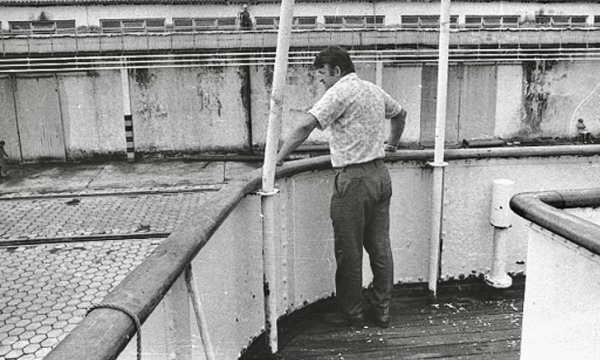
Captain Fafoutis overseeing the loading
“It’s a bad life,” he said. “Far from home and family. Children grow up, you don’t see them. And in port looking for girls. Then three months for worrying. The smallest trouble is gonorrhea, the worst syphilis. Is no good. But when seaman goes home and decide to stay on shore, in three months he looks for another ship. He can do nothing. No work. And go to sea again because is better than nothing.”
But the captain has his wife with him on board.
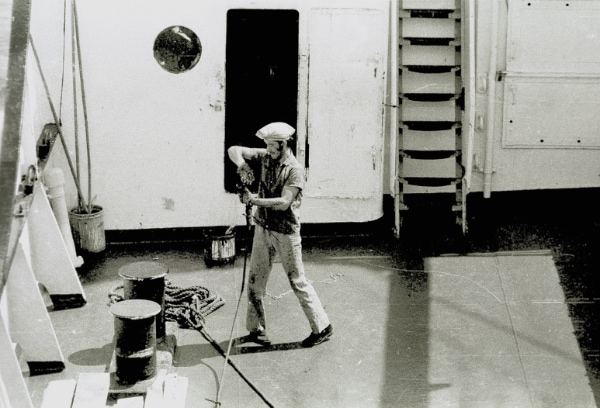
Painting over the rust – it never stops
I’ll see you again next week – same boat.
