
From My Notebooks In 1974: On the Zoe.G to Brasil
7th June 2026 |
Along the way through Africa I occasionally wrote small essays or mini-reports. A major issue of the day was Southern Rhodesia’s refusal to accept that an all-white government was not sustainable. Britain having divested itself of empire could not afford to be sheltering a white colony, and Ian Smith’s efforts to go it alone led to heavy sanctions. In theory British firms were forbidden to trade with Rhodesia. This is what I wrote:
In practice life on both sides of the Zambesi curtain proceeds moderately well in spite of economic difficulties. On the face of it, the Rhodesians do better. They are inordinately proud of their sanction-busting prowess. British brand names, like Dunlop and Lyons, flourish. I’ve seen machinery newly arrived from Britain, and Rhodesia now manufactures much of what it once imported. But the sanctions, which seemed so feeble are becoming deadly in their long-term effect. While the farmers can hold out well enough, the business community shows signs of quiet desperation. Several times I heard the same story. Shortage of foreign currency, combined with an average 50% extra cost involved in intricate importing procedures are causing stagnation. While Africans can make do (as can the Arabs) with a subsistence livelihood, white Rhodesians are used to high consumption and leisure.
As an interesting sidelight, several Rhodesian women I spoke with took perverse pleasure in telling me that their divorce rate was the highest in the world.
My journey offered an unusual opportunity to experience both sides of a confrontation. A story that illustrates the absurdity of the border closure – the price of high-sounding principles The Chinese contract to build the Tan Zam railway. Part of the price to Kaunda is a delivery of maize. This is produced in Zambia by African farmers – and European growers. To stimulate the African sector KK gives them a preferential selling rate. Instead of increasing the yield the yield drops. It turns out that the African grows only as much as he needs to cover his costs. Result is that Zambia must import maize to settle its obligations to China. The only source of maize is Rhodesia – but direct import is out of the question. So, it is brought in though Botswana. The price in Rhodesia is $3.50 a bag, but Botswana levies a heavy duty to cash in on its neighbour’s troubles. By the time it gets to Zambia it costs double the price. So Zambia is paying a colossal premium to provide China with Rhodesian maize (There is no evidence that the Chinese choked on it.)
The cob is, of course, a vital ingredient of African life. It’s an interesting plant – being flagrantly bisexual. The male half exhibits itself with a flourish at the uppermost tip with a flower (often seven or eight feet high) that sheds pollen. While the female component protrudes more coyly from the stem with bunches of fronds which collect the pollen as it drifts down from above and develops into the cob, packed with corn.
Much expertise is involved in getting the best hybrid, and on both sides of the Zambesi the producers of seed maize are under great pressure to keep up the quality. I talked to experts on both sides. In Zambia an agricultural scientist – a white man who likes it here – said the government had set standards for seed maize that were the most exacting in the world. In Rhodesia a seed maize farmer was equally certain of his truth. The hybrid In Zambia, he said, depended eventually on Rhodesian expertise and since the border closure had degenerated to such an extent that compared with the Rhodesian variety it was hardly better than a weed.
These distortions and misconceptions, present across all the borders I’ve crossed, reach absurd proportions here. To many Rhodesians, Zambia is a land of economic chaos riddled with terrorism and ruled by proxy from China as part of a world communist conspiracy to destroy Rhodesia and ultimately South Africa.
[What actually happened? Instead of making some kind of reasonable accommodation with Tom M’boya, Smith hung on to the bitter end and gave way to Mugabe who pretty much destroyed Rhodesia’s brilliant farming economy. Well, that’s how I saw it. Now, back on board . . .]
When I first took my things aboard back in LM, the Zoe.G was all I had ever imagined a Greek freighter to be, from early readings of Greene and Ambler. The sight dented my morale severely for 24 hours. Evidently she could float but it seemed only a matter of time before the rust gave way somewhere important and let the sea in. I couldn’t see a clear painted surface or a glint of polished brass anywhere. Under the night loading lights the decks were littered with debris except where a great hole gaped. Far below in the hold some Black men where chanting and moving sleeper-sized bars of metal. There didn’t seem much of a cargo.
Now, after several days at sea the gale seemed to have had a cleansing effect. The captain of the ship was Fotius Fafoutis. All his officers, with the exception of the Philippino radio operator, are Greeks. They speak little or no English. I am the only passenger and I do not, as they used to say, “have Greek,’ Morning, noon and night I sat in the saloon watching the faces and listening to the talk. Food is consumed in silence. There is much time on shipboard, and it would be wasteful to duplicate diversions.
The faces generally have a mournful, introverted aspect, emphasised by the Greek talent for running to seed. Bristle and sweat, deep furrows and tangled hair, grubby singlets, grimy nails, the greasy remnants of last year’s shore-going best. Then, with the food almost gone, the talking begins. Usually the electrician started it, the first mate joined in, then the chief engineer, then one of the third engineers, in order of the different degrees of loquacity. The speech transformed them. Once animated their eyes flashed, intelligence illuminated their faces, they discarded their shirts for the robes of a Greek Forum and judging by their rhetoric they might have been debating the existential issues of our time, but Captain Fafoutis explained that the subject matter was cars, girls, furniture, girls, and more girls.
[Furniture?]
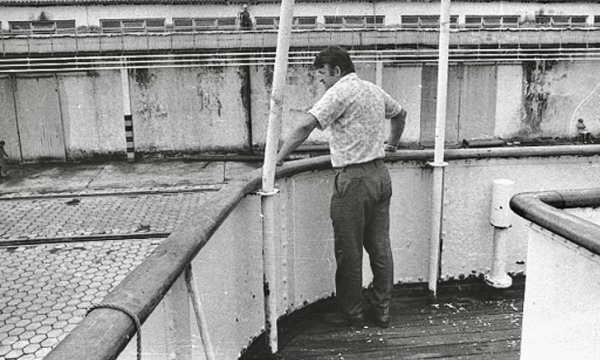
Captain Fafoutis overseeing the loading
“It’s a bad life,” he said. “Far from home and family. Children grow up, you don’t see them. And in port looking for girls. Then three months for worrying. The smallest trouble is gonorrhea, the worst syphilis. Is no good. But when seaman goes home and decide to stay on shore, in three months he looks for another ship. He can do nothing. No work. And go to sea again because is better than nothing.”
But the captain has his wife with him on board.
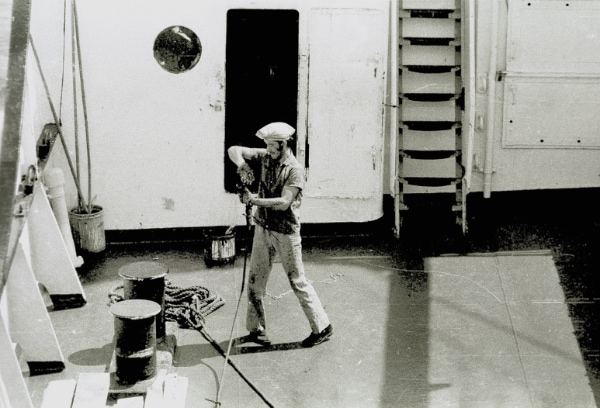
Painting over the rust – it never stops