
From My Notebooks In 1974: Fortaleza
14th June 2026 |
When I booked my passage on the Zoe.G I knew only that it sailed to Rio de Janeiro. Later, once on board, I discovered that it would first call in at Fortaleza, a city in the far north of Brazil. Though it had a population of a million I had never heard of it – an indication of my ignorance. I also did not know that Brazil was a police state, in the grip of a relentless dictatorship. I decided to disembark in Fortaleza and ride the 1,300 miles down to Rio.
Fortaleza, May 14?
The ship drifted in passing fishermen on the most primitive craft, little more than floating boards.
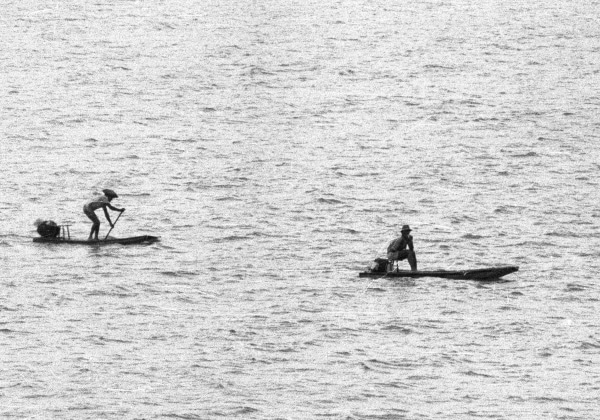
Then the ship docked. My bike was spirited away to customs. Two policemen came on board and questioned me about my Scuba gear. They were convinced I must have diving equipment. I stayed on board two days while the ship was unloaded and while I visited the town my cabin was searched.
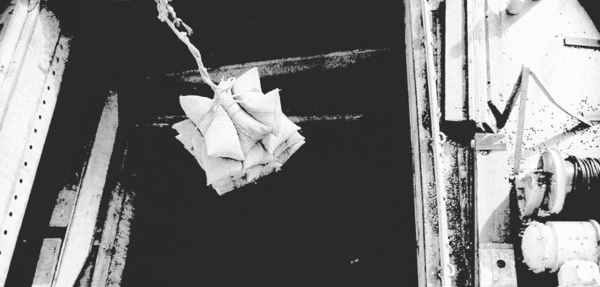
The ship was delivering cashew nuts from Africa, and I watched them being hauled out of the hold.
Communicating through telex The Sunday Times suggested I make contact with some priests in Fortaleza and visit a flood catastrophe inland. I followed their advice and took some pictures.
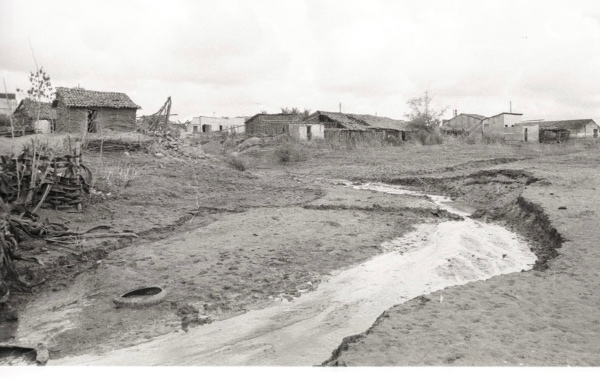
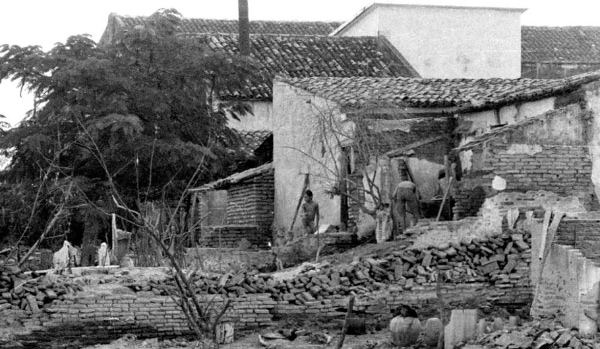
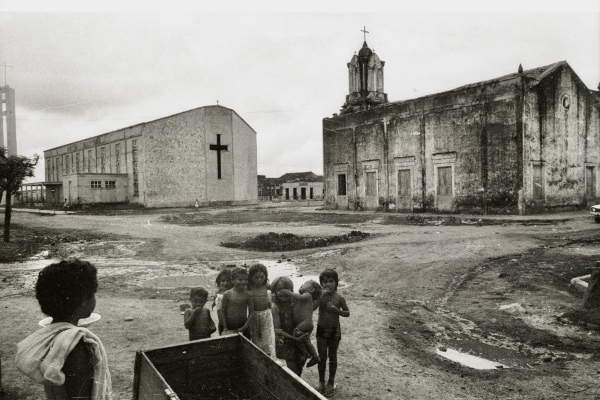
When I returned I was “invited” to the police station. Several weeks later I wrote the following piece for the Sunday Times. Here is Part One.
Obviously I should have been locked up long ago. The Brazilian police have shown me to myself in an alarming new light as a person who’s very being excites suspicion and alarm.
The suspect was apparently born in Germany , of a German mother and a Romanian father. Yet he carries a British passport (with no indication of naturalisation) and lives in France. Physically, however, he looks more like an arms dealer from Baghdad and his passport contains several pages of Arabic script which might as well be a prescription for exploding coconuts. He claims to be traveling around the world on a motorcycle but when asked why can offer no credible explanation. His arrival in Fortaleza on a Greek freighter is inexplicable and unheralded since he has a paid passage to Rio. He presents himself as a tourist but immediately engages in a fierce telex exchange with his masters in London who machinate under the code name “Thomsonews.” They instruct him to join forces with a network of missionaries from Ireland who are vaguely affiliated to another organisation, unknown to the Federal Police at this time, called Oxfam. Under these auspices he slips out of Fortaleza at night by bus (?) to Iguatú, scene of a recent flood disaster and a hotbed of counter revolution. There he interviews flood victims and photographs them and their devastated homes. Two days later he makes the seven hour bus journey back to Fortaleza.
I was not so much seized as invited into captivity. I had long stopped expecting trouble. The first two days the police buzzed around me like flies. Then came the Sunday Times telex about the Irish fathers, Oxfam, and the floods at Iguatú. It smacked strongly of “journalism”, an association I preferred to avoid, and I was fairly sure such conspicuous communications were monitored. However, the police assured me I was “free to go anywhere.”
By now the priests in Fortaleza had invited me to stay. They are well established in the area of Sâo Raimundo with a large college, a church and a number of community projects. They have other groups in many parts of the country, including Iguatú, and one of their number was returning there after an illness. I went with him, by bus, and came back two days later.
The message waiting for me back at São Raimundo was casual and innocuous. Would I call at the Maritime Police office and ask for Samuel. I went the following afternoon. Samuel was the youngest and most sympathetic of the police who had talked to me at the docks. He apologised for the bother and said the Federal Police simply wanted to ask some questions for the record. We drove in a police car to their office behind the cathedral, a white plastered villa webbed over with aerials. We waited for an hour and a half and I didn’t think there could be much to worry about. Then I was taken into an office where several people were waiting. Opposite, across a desk, sat a short belligerent man who attacked me angrily right away. “You have been taking pictures in Iguatú. Are you a journalist?”
I have made a point on this journey of not traveling as a journalist. This adventure is a personal one and not a professional exercise. The Sunday Times does not employ me to investigate newsworthy situations, it helps me in return for an account of some of my experiences.
But behind this truth lurks ambiguity. I have been a journalist, and for emergencies I carry documents and an older passport identifying me as such. These I keep separately, with a reserve of cash in a money belt, and that belt was among my things at Sâo Raimundo.
Having arrived in Brazil as a tourist I was determined to stay as one, and I denied the charge. I cheerfully admitted taking pictures, and with genuine curiosity asked why not? But they were not there to answer questions.
Samuel was ordered to take me back to São Raimundo and fetch my cameras, films, everything. The affair was beginning to look serious. As we approached the crumbling outskirts I tried to form a plan. I thought I should keep those other documents to myself or they would create worse confusion. The house was empty, but I knew where the backdoor key was. I mumbled in English and dashed round the side of the house. Samuel waited patiently while I let myself in at the back, got the belt out of my room and slipped it under the dining-room fridge. Then I let him in through the front door. Samuel was probably the most intelligent of them all. He wasn’t worried because he’d taken the trouble to talk to me. He knew damn well I wasn’t a threat to Brazil or anyone. Unfortunately he didn’t explain earlier that the one thing that would have soothed his chief was documentary proof that I was a journalist. When I found that out it was too late.
The Inspector of the Department of Political and Social Order (DOPS) had been quiet at our earlier meeting. He received us in his office, took the films, rocked himself gently in his padded chair and broadcast my exotic particulars to Interpol and a variety of domestic Brazilian intelligence departments. I began to realise that by refusing the label of journalist I had made room for other less comfortable labels. He said he would have to keep me there, perhaps for the night, until he had replies to his inquiries. Even then I was surprised.
I was taken to an office, with desks, chairs, tiled floor and walls. Once an open patio, a roof had been raised over it, leaving a three-foot space above the walls open to the air. Iron grills barred the exits to the street and the back. A shuttered widow opened on to the reception area where a military policeman and an “agente” stood duty. Shuttered double doors led into the main building. There were collapsible beds with straw mattresses in a corner. I was given a plate of rice and beans and left for the night.
I had nothing with me but my wallet, and the shirt, trousers, shoes and socks I’d arrived in. My shoes were still soaked from the day’s tropical downpour. In the night the wind blew surprisingly cold and damp. From a communications room on the second floor, morse code and telex chattered through the night. I cheered myself that they were bringing information that would release me.
Next morning I was allowed to the bathroom and looked longingly at the shower. There was no towel so I washed my face and dried it on lavatory paper. Then I waited in the office. At about eight the staff arrived. They seemed amiable enough though they ignored me completely. The office houses two departments, DOPS and a drug squad called Toxicos. Two attractive secretaries took their seats. Young men gathered, lounging about, chatting, playing with guns and handcuffs, 332 waiting for something to do. Many carried textbooks and notes and, I learned, studied in their spare time. Only one or two looked capable of real menace. My presence was neither surprising nor relevant to them. A few stumbling attempts to get breakfast were easily brushed aside. I stood against the wall because there was a general shortage of chairs.
Then at eleven a young Englishman arrived. I had met him before at São Raimundo. He had volunteered to help me make a statement. We were taken to the Superintendent, whom I came to think of as No.1 (the Inspector was No.2). No.1 spread himself on his armchair and addressed us on the importance of security. His job, he said, was to check subversion and frustrate the slanders of the international communist press. I had been photographing and interviewing destitute people in Iguatú. I replied that the Sunday Times could hardly be considered part of a communist conspiracy. He countered with an obscure reference to Le Monde.
I thought how foolish all this was. In fact I had formed a good impression of the government’s efforts to relieve the miseries of Iguatú’s homeless. I had seen them temporarily housed and fed as well as might have been expected. I had seen the beginnings of a very promising self-help housing project supported by Oxfam with some impressively ingenious brick-making machines. The land had been granted by the able and energetic governor of the State of Ceara, who had also mobilised the army effectively to repair flood damage and distribute free grain and seed stocks in the rural areas.
We were swept in to see No.2 who asked more questions. I was sad to find that the priests also were suspect. Eventually No.2 composed a three-page statement in triplicate which seemed truthful and harmless enough to sign. Only with the pen in my hand did I discover how strained I was. The pen refused to do what I asked of it. My first attempt was such a mess I had to cross it out and start again. Even the ninth signature was an awkward travesty of my usual mark. Then No.1 reappeared and the mood became quite genial. A day or two would set me free, he said, and repeated that he was waiting for replies to routine enquiries. Meanwhile I would be escorted out for meals if I wished. I asked for a towel, a razor, some clothes and something to read. My friend was due to return home to the next state but promised to let the British vice-Consul know where I was.
I returned to the office and waited to be taken to lunch. My shirt, once white, was grey and sticky from sweat and humidity My face had two days’ bristle. The office cleared for lunch and I was left locked in. After half an hour an orderly came with a bowl of rice and beans, and my morale took a sickening lurch. Clearly nothing said that morning was to be believed. The whole euphoric event seem to have been orchestrated to get my signature and send the Englishman away happy. The Consul? The Englishman had been late for his bus. The police had offered to drive him to the bus station. They could easily say “Don’t worry. You’re late. We’ll see to it.” The priests would be unable to help and that, I realised, disposed of my links to the outside world. It was buttoned up. I was in the hands of professionals.