News from Ted
[In last week’s transcription from my notes, I left you while trying to raise my spirits by riding around the island of Penang. On one of the beaches I met a young German, recently graduated, who was trying to make his mind up whether to study medicine. For some reason he seemed to think my opinion was valuable but there was immediate sympathy between us. In return he recommended that I visit Kata beach, at Phuket, and seek out a woman called Adrienne.
Hans-Georg Hoffman did become a doctor, and he is my friend to this day.
In the meantime, while waiting for the new stator to arrive from England I thought I would take up fishing. I couldn’t find the beach that T’han had recommended, but I saw men fishing along the promenade in town and went to join them with my rod and tackle. What happened next is fully described in “Riding High,” but there is nothing in my notebook about it for the simple reason that I was blind and in hospital for a week, where my documents were stolen, demoralising me completely. When I came out to convalesce, I was in no state to make notes. Meanwhile the stator had arrived, and Lucas installed it for me. Eventually I felt able to ride again, but my plan to cross over to Indonesia for a short while had to be abandoned. I had already booked a passage to India, and there was only time to make a short trip into Thailand in search of Adrienne. Then I started again to make notes.]
Friday, June 11th, Left for Haad Yai
Next to Kings Hotel, a smart hotel with a “drug store“ façade, is a dingy restaurant with box rooms upstairs. Sitting at a table, two Europeans. One tall thin, blonde, and very nervous with boiled blue eyes. A Norwegian. Next to him a squat bearded man with a square hard face. Swiss. The Norwegian speaks an efficient, mechanical English which he drives out of his mouth in lurches of fluency – like a tank turning a corner.
“You are quite right” – grind – “Thailand was full of Americans” – shudder – “the people were dependent on them” – His theory is that the Thais have become obstreperous and greedy because the Americans have abandoned them. An odd thesis. The Swiss listens impassively, obviously not impressed. Tired and shaken by this first journey since my last illness I accept what the place offers – an upstairs box with two hard beds, a fan, and two gauze covered escape hatches on to a narrow space between the two buildings through which float dank odours. 35 baht.
The two others want to make a round of the brothels in an open mini-bus – small Japanese type vehicle with a small bus body superimposed, two benches and a crew of two smiling, softly hustling me.
“You don’t worry for anything. I live here 25 years. You take number of car. You can tell police.”
We visit a series of lock-up shop fronts with the sliding mesh grills almost closed. Inside each one a room with hard seats and benches, a TV, shelves with little dolls on them . And girls with puffy made-up faces sitting around. Some quite pretty. Scenes of fearful boredom. We sit and stare at them a while. The Norwegian makes mechanical jokes. I read his copy of Newsweek. The US primaries are grinding on with their synthesized sensation. After three town brothels (at the third one a nice girl is fondling a toy chick) our guides offer us “the bungalow.” Best girls. Very expensive.
“If you find me a nice girl” says N, “and I don’t think it is very likely,” pause “I will stay with her for maybe one week. My girl has left me. I sent her money. I have given her 10,000 baht from Norway, but she is sick,” he coughs in illustration, “she has gone away. I offered to take her to a doctor. She has bronchitis and gonorrhea. For an injection. She won’t go. ‘Is too painful. Too pain-fool’ she says. I am heart broken. I must have a girl to forget.”
When he hears how I pay for my journey he becomes enthusiastic about journalism. He worked on a local paper. 7000 circulation. But not enough money. He became a radio operator. Worked on a ship for two years, between Malaysia and China. Never got off the ship. It was a hell of a life. I nearly got a breakdown.” Looks as though he might have one any minute.
The ”bungalow” is just outside town. Has two stories – a small suburban house. The prize girl, demure with clean features, a dazzling smile and a faint moustache, sits on show. She has just come back from school, we’re told. She has to earn money for books. N doesn’t fancy her but sees another and bargains for her. Finally for US$20 she comes back with us to spend the night with him.
Out walking in the evening and into King’s for a Thai dinner. There’s a police party filling the restaurant. The big shots make speeches – everybody keeps on talking among themselves – but applaud enthusiastically all the same. Three girls, specially dressed with strings of beads round their top knots, do Thai dances, swaying and figuring with their hands. Then singing. Then dancing. To my surprise the couples also face each other, swaying and moving their hands and arms in classical fashion. A living tradition, by God.
Terrible night in my box. Mosquitoes, damp air, At last get the net out and do my best with it. Some sleep. Narrative dreams.
Next week: In pursuit of Adrienne.
Hi everybody, I’m back.
Since the last instalment of my notes from the seventies I have been to a German biker meeting, in Gieboldehausen in the north of Germany. It’s quite a long way from where I live, so I made it a voyage of discovery, staying overnight in Brioude and Besançon on the way there, and in Strasbourg on the way back. I had never been to any of them before, and all three cities are wonderfully interesting, but the one that struck home was Besançon.
I hadn’t known it, but this city is famous for everything to do with time, and it was once the home of France’s biggest watch manufacturer, LIP. There were three floors of a museum dedicated to it. I don’t know if you remember, but when I got my bike out of the Triumph factory, the place was in turmoil. Now I learned that in 1973, at exactly the same time, the same month even, that the workers at the Triumph factory in Meriden where seizing the factory and locking out the management, the workers at LIP were doing the same thing. That I should stumble on this by accident just seemed remarkable to me. Here’s just one of the graphic posters they produced at the time.
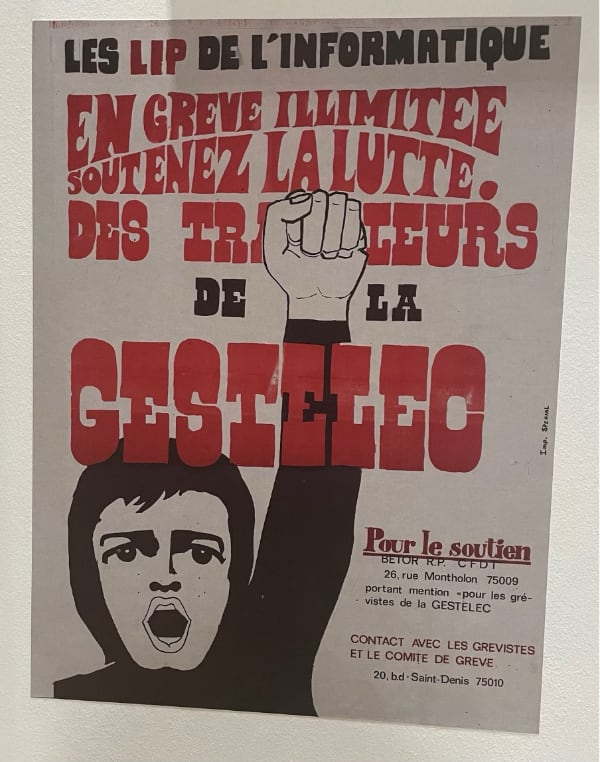
On permanent strike: support the fight of the workers
The fight went on for years but in the end, of course, both struggles were doomed.
I had a reason to go to Gieboldehausen.
My autobiography, “Don’t Boil the Canary,” has been translated into German and it has just been published. Translating a book as long as that one is a tremendous undertaking, and to have had it done by an established professional would have been much too costly. However, I have an angel. Her name is Eva Strehler, she wants to become professional, and she approached me more than a year ago to say she wanted to translate my book as an exercise, without payment. She did a couple of chapters and to my surprise they were good. So she ploughed on and gradually more people became involved in the project, reading the chapters, making suggestions. My cousin Christine, a quite literary doctor in the north of Germany, read them and discussed the problems of translating English vernacular into German with her friends. Ralph Wüstefeld of Gieboldehausen, who is one of the originators of the MotorRadTreffen, or MRT as it’s known also became involved and, being a businessman, he also arranged for it to be printed by Books On Demand. The title “Don’t Boil The Canary” does not translate well into German. It was my cousin who eventually came up with the title, ironically, in English: “Go For It.”
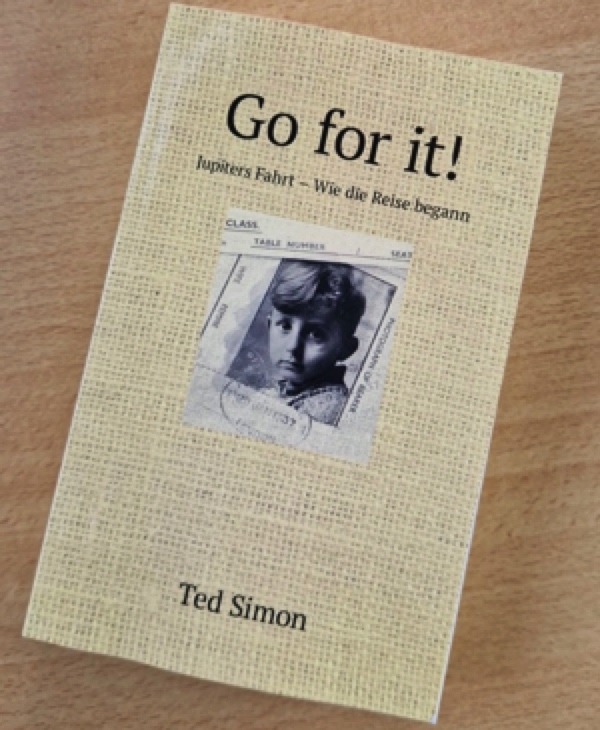
So finally the book was published, and I went to Gieboldehausen for the launch. More than 500 bikers who all have a taste for adventure received it very well and, more to the point, bought a lot of copies, so Eva will get something for all her hard work. She is quite a unique individual, well known for travelling with a sidecar and her dog, Polly. While all the excitement with my book was going on, she was away on her bike travelling through Iran. And then, disaster!. In a heavy traffic situation her dog got spooked and ran away, and is now lost forever. As if that wasn’t enough, when she finally gave up looking and left for Turkey, some miserable thief stole half her belongings. I know how one bad thing leads to another, which is pretty much the theme of these next episodes from the notebooks of my journey.
From My Notebooks in 1976: After Kuala Lumpur
[I remember, now, that Carol wanted me to take her to the Cameron Highlands, an area well known for its beauty and pleasant climate. It was shortly after our parting there, as I was riding down to go to the island of Penang, that I discovered that the stator, the very same spare part that I had just mailed back to England, was kaput. I was able to go on riding as long as the battery was charged, so I had to make frequent stops. At one such stop, where I stayed overnight, there was a three-day funeral in progress, involving tremendous noise all night. I described it in “Riding High.” Eventually I made it to the capital of Penang where Lucas had a branch, and they arranged to have a new stator flown out. I resigned myself to a three-week wait.]
Georgetown, May 8th
Shriven is the best word I can find to describe how I feel; stripped, shorn, reduced, after a series of incidents that have exhausted me.
There was a rough, socially paralysing and exorbitantly expensive passage from Perth to Singapore; followed in rapid succession by the harrowing conclusion of a crisis in my personal affairs, a 48-hour fever and a tropical cold that dragged on for a fortnight.
Singapore itself is an eardrum-shattering ordeal of torrential traffic and K.L. is no better. Between the two was rain. Just north of K.L. the motorcycle suddenly ceased to function, due to the failure of a part which could only be obtained from England.
I struggled on to Penang, determined at least to wait somewhere pleasant. For a few days, life picked up again. I got the front forks straightened out again – they’ve been crossed since Argentina – and . . . .
[Here my notes petered out. Then this on the next page.]
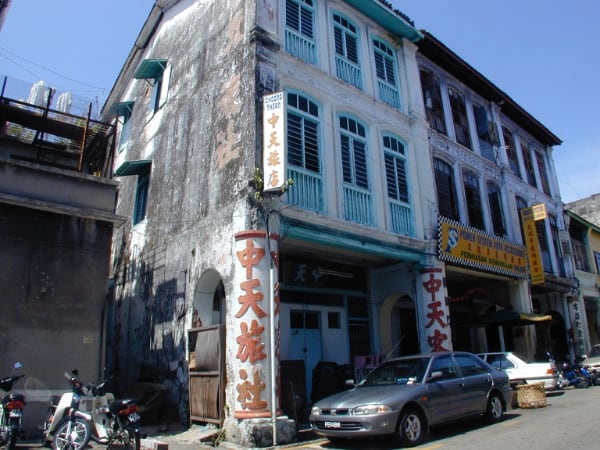
Choong Thean Hotel, 42 Rope Walk, Georgetown
Colours, pale blue and cream. Wooden shutters, painted floors and walls. Ten rooms on two floors, $5 for one, $6 for two. Ground floor open-fronted with folding shutters. Cement floor, motorcycles and bicycles. One round marble-topped table, a desk in corner outside the door of the boss’s room. Several Indian ladies of various ages and sizes sit around waiting for custom, sometimes outside on the pavement, sometimes inside. Most of them get five or six dollars a time, though there’s a thin younger one who gets more and is said to have a good technique. The hotel gets $1.20 for the use of the small room at the back between the mah jong tables and the kitchen. A belligerent bouncy fellow with eyes like marbles runs the tables and gets 40 cents a game. The tables have slots on each edge for counters and pads f white paper pinned on the top to make a fresh surface for each game. Many of the customers are fishermen passing time between bringing their catch to market and going out again at night.
In the room beneath mine the abacus clicks away a lot of the time and there are usually several men there during the day, but what they are computing I don’t yet know.
Th’an sits in the front from about lunchtime to 2 am – sometimes with his head sunk on hos breasts dozing, sometimes dreaming of his forthcoming journey around the world – when he gets his 50,000 dollars. He doesn’t think he can do it for less., and he will of course buy travelling cheques. He will spend several months in each country and is particularly set on visiting France.
At other times his mood is more morose and he dwells on his misfortunes – the sale of his stamp and coin collections during the years of 73 and 74 when he could not get any work and had no food to feed his stomach. Then he remembers the Australian man who was so good to him – “I do not know the reason why” – and Th’an cried when he flew away. Afterwards he wrote many times and got no reply and at last he found out that the man was dead.
Th’an says that he could have been a police inspector if he had been prepared to have an operation on his tongue “to cut the string” but he had been tongue-tied since birth and was afraid to go in. He can manage to speak quite well, even in English, and his vocabulary is better than most. Uses words like “seldom.”
Among my fragmentary thoughts about life in Penang – the first excitement fades very rapidly unless something more substantial comes to support one’s interest. At the temple crowds of people dashing in and out with bundles of flaming paper (money?) and chucking them perfunctorily into the incinerators, eyes bleary from the smoke. Everyone also carries bundles of smouldering incense sticks and shuffles them up and down rapidly. The quantities of combustibles bought and consumed in front of one’s eyes is impressive – but there’s a total absence of any sense of purpose or reverence and a good deal of it is obviously automatic rigmarole made worse by the obvious desire to show off by burning bigger bundles than anyone else’s. Everything goes up in smoke and the industry that provides these ephemera must be huge.
Alongside the hotel in Rope Walk are several concerns engaged in making artefacts for religious ceremonies. From elaborate houses of paper on split bamboo frames to shoes ($2 a pair) motorcycles, human figures, etc. All to be burned in offerings. Opposite is a family which, for five generations, has been performing the ceremonies – dressing up every night – chanting, hitting sticks, gongs, bells – leaping over fire, and erecting and taking down their stages all over town.
The boss is a tough-looking man with stubbly grey hair, too busy to stop. The young man who talked to me says they all feel very serious about it. The idea of spending one’s life constructing such elaborate artefacts only to see them going up in flames is a bit exhausting to my mind.
I had spent a week in Georgetown, mostly working on the bike and while it wasn’t unpleasant, I wasn’t at my best either. The first nights I was disturbed by the fan on the floor below drilling up through my pillow, and a rich orchestra of noises made by the others in the hotel who seemed to take it in turns to contribute their coughs and snores rather than getting it over with in a single crescendo. There was something extreme about their noises – where in Europe you might have a few dry coughs, here it sounds like the last explosive rending of the tissues. In the tropics everything is bigger, louder, wetter, dirtier, quicker.
The days were hot and humid, I was drinking too much bottled fizz and not functioning well. Emotionally I was numbed. Then on a Saturday, after a false start the day before, I got the bike on the road at lunchtime and went round the island. There had been heavy rain, the sky was clear and the air much drier. I got my rod and tackle from the hotel and set off to find Bahu Manang where Th’an had told me to fish. But I’d got a false notion of where it was and far from being a bit along from Batu Ferringhi it was almost back to Georgetown on the other side of the island. It became a fine ride over small mountains, and into the valley between to see a play being performed (mostly for children it seemed) on a stage in a village. Two men were on the stage most of the time. One seemed to be a mandarin figure and the other his very obsequious lackey. At one point they left the stage, and a woman appeared dressed in an amazing costume, a huntress, modelled after an early Victorian engraving. She shot a limp arrow in the air and a red cloth bird fell, thump, from the ceiling.
Those last days together were sweet and cruel. We agreed to part when we got to Kuala Lumpur, the capital of Malaysia. We are moving very slowly, but it is now only two days away. The weather is mild and humid and we continue along the coast.
Sunday May 2nd – To Malacca
Wake up feeling sick, but no headache. Can’t get going till 12. Then with monkey on the back we leave for Malacca.
Lots of lovely houses set back from the road among coconut palms and grass. Most of the houses have one room advanced with a small staircase leading up to it, steps typically wide at the bottom so that they seem to be welcoming the guest. Lots of detail woodwork on shutters, rails eaves, etc. Charming, idiosyncratic, the most evolved form of simple tropical life seen so far. Enticing paths lead from the road into the jungle, soft red earth carpets laid between vivid green, leading into a Rousseau paradise. Heaps of pineapples and coconuts at roadside.
In Malacca through central roundabout below the old Portuguese fort (now gone) and ruin of old church. With burgurish Dutch gravestones, one for three children apparently died within a few months of each other at sea. Image of ship on stone.
Heard of youth hostel 9 miles out on coast. A sordid, rainswept relic of a place, ruined by neglect only a decade after its dedication ceremony, still recorded in photographs on the wall of various dignitaries making speeches from the front steps.
A desolate man presides over the sodden foam mattresses and deep-stained pillows. $2.50 each and 50 cents for sheets and pillow slip. Across the way, on beach, a bravely merry mother from Java welcomes us to her restaurant – a small shack of tin & sagu thatch (anchored on coconut stumps) with tables made from the sides of a cable reel.
Prawn fishers with great triangular nets on a bamboo fork plough the shallow waters, a candle fixed to their foreheads like miners. Each working a short strip of beach – moving caverns of light all along the coast. But they are not catching anything tonight. Then the rain starts. Shocking downpour. We wait for it to finish.
“This is my restaurant. I have just opened it. You must come and eat my black rice pudding for breakfast. I can teach you Malay. Teach you to make fried rice.” Husband was army commando. Broke his knee. Says there is trouble between him and his brother. Had to leave before he did something bad. So now they have started up here on the beach. Anyone can. “If you want you can start a restaurant next to me, here.”
May 3rd – To Port Dickson
Now we move through similar country but also big estates. The name “Guthrie” keeps cropping up. It’s not very far but weather continues wet. Leave coast for a while then return. Stay at resthouse ($10) where Scots seaman, now pilot, talks on veranda of his voyages to China, how they harassed foreign crews in ’46 – roll calls on deck every three hours through the night in freezing cold – and then later how they received impeccable treatment but could do nothing but go to Seaman’s Club. Always a group outside to applaud them as they left.
He is entertaining – monologues rich in incident – but like so many raconteurs, his obvious indifference to anyone else’s stories makes him ultimately tedious. I fall asleep. Carol comments afterwards that somehow I manage to do this without causing offence.
Desultory attempt to fish off beach, then we wander into town. Assaulted by a series of stall holders which upsets our fragile mood, and hard to get it back. Though sweet and sour fish was nice it cost too much. Next day to K.L and the parting is too close for any comfort.
May 4th – To Kuala Lumpur
Through huge plantations of oil palms and rubber.
See dirtiest chimney in the world. On the road by the river, a palm oil extraction plant owned by Telak Marbau Plantations Ltd (incorporated in England). Agents: The East Asiatic Co. Ltd.
K.L manager, I.L Anderson: Engineer L.H Cheong.
I have no idea what I had in mind to do with this information. Perhaps adding it to a list of man-made environmental disasters.
These are the last notes I made before Carol and I went our separate ways and I can’t now remember anything at all of how or where we left each other. Sometimes, I know, one has to deaden oneself against the pain. Perhaps that’s why I have no record.
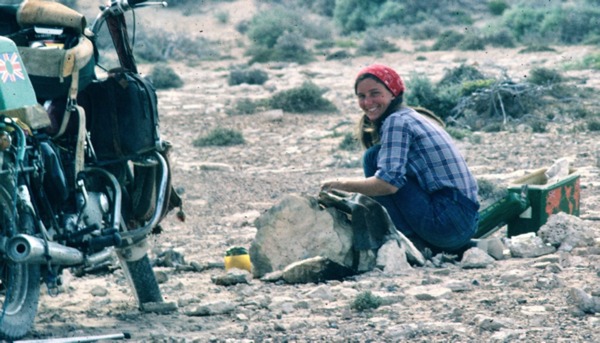
Carol
These were also the last words I wrote in my Australian journal. From now on I’ll be transcribing from this, the last of my four notebooks.
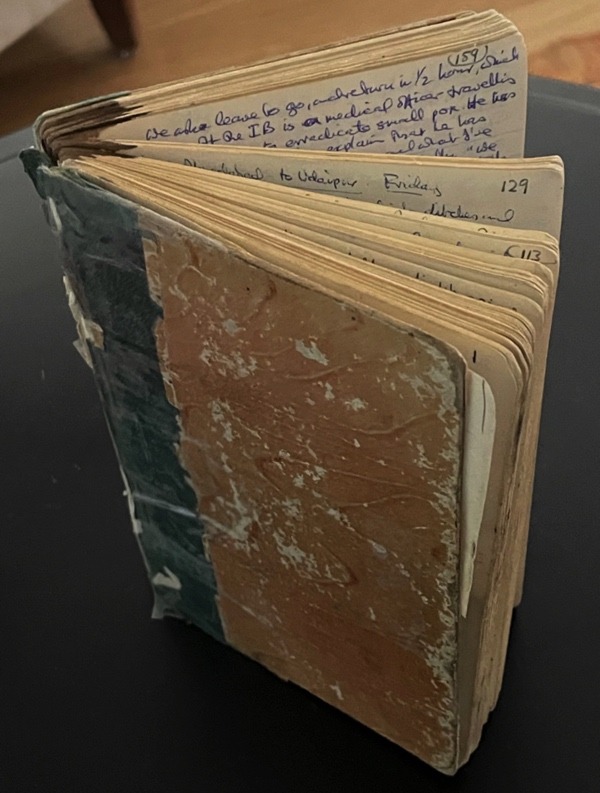
The writing gets smaller and smaller, and packs every page. It covers Malaysia, Thailand, India, Ceylon, Nepal, Pakistan, Iran, Turkey and the usual European countries.
One or two people have suggested that these notes I’ve been sending you for while now would make a good book– yet another version of the journey which many people seem to have taken to their hearts. I have had a few ideas for “The OTHER motorcycle diaries”, but a book needs buyers and you, dear readers are the only people I could hope to sell it to, so let me know what you think. Would you buy the book?
Having left Perth on the Kota Bali after six months in Australia, I am now in Singapore. Still with Carol, but we have agreed to separate in Malaysia. I have decided to lighten my load. Let me remind you that I have transcribed these notes exactly as I wrote them at the time. Sometimes I surprise myself.
April 27th
Make up a parcel for England. Contains my clothes, sweater, boots: Carol’s dress, shorts, shirt, gloves, undies. Carved wombat, shock absorber, stator [which I later profoundly regretted] auto advance coil, pump, books, Carol’s journal. Cost S$ 6.5 i.e. £6.
Every day we develop the theme of our relationship as revealed by the decision to separate. Only touches of bitterness and grief now. Meanwhile, curiously enough, the French couple next door at the hotel are going through intense bickering and were supposed to have left this morning for Colombo.
We ride around island and drink root beer – A&W
April 28th
Only exit papers to get today. Traffic and fumes becoming intolerable. At night visit the famous Bugis street – doesn’t resemble in any way what I remember seeing in pictures or hearing about. A great array of tables with white cloths laid out in the street and an adjoining square – almost all occupied by parties of Western tourists. The “girls” – transvestites – appear very heavily made up and bewigged. Evidently some of them work for tourist agencies and are paid to sit and chat with a group. For the rest, tourists have virtually nothing but an open-air restaurant at which they can look at each other. There is not even any music. And the prices are naturally high, but they seem happy enough with it. Menus are framed and placed on tables. Nothing under S$8.
Today Carol bought an Olympus automatic.
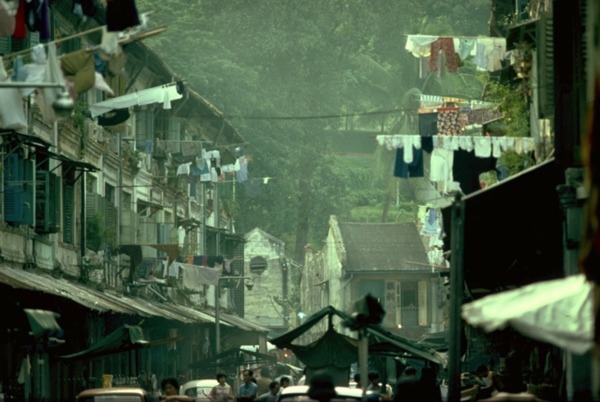
Old Singapore as I saw it
29th, Thursday
Breakfast as usual in narrow café off Bencoolen street. An old Chinaman, with head like Ho Chi Minh’s, is sitting across from me reading a newspaper. Then I see that he isn’t sitting – he’s left his sandals on the floor and is crouching on the chair – but his legs are folded so perfectly that he’s like a vase on its pedestal – perfect feet. Made an unsuccessful attempt to find a shoulder bag – get water bottle instead – and away to Malaysia. No questions or problem at frontier. Johore is a shapeless town. No way to find our tourist contact. At rest house we are referred to the rest house in Pontian. At first, the road to Kuala Lumpur is very ugly – then turn off left to Pontian, and lost among shady green rubber plantations (albeit full of mosquitoes). The girl behind the counter in Johore rest house has full lips, and it suddenly strikes me that her upper lip is the perfect model of a pagoda roof, in all its proportions.
A night at Pontian rest house $15 – $3 more than list price. Air Con but roars like a monster. Lovely view out to sea – small island – delicate wooden jetty widening in three places to make places to sit under cover of rush roofs.
Indian Malay dressed in planter’s gear addresses me like an old-fashioned sergeant-major – upper class cockney. He’s very drunk.
[We went to a restaurant and got to know and like the proprietor, Ambak Jaya, and his wife.]
April 30th
Invited to visit Mr. Jaya’s Garden. At 8.30 we are outside his restaurant, but door and red shutters closed. He is still asleep, on a table.
At 9.0 we set off – in two trishaws – about a mile inland to a five-acre plot with wooden shack and many trees. They are durian, mangostin, coconut, mango and various other fruits which Carol has noted, including one which is probably bread fruit and has to be held in a woven rush net to prevent it dropping too soon. Has some limon trees from Ipoh, a fruit which grows to the size of a melon, but smells like lemon. It is essential for every Chinaman’s New Year ritual, and therefore very profitable to grow once a year.
Afterwards we sit down to a display of sweet meats – balls, pasties, very doughy – and then coconut and coffee. It’s very hot. I sweat profusely. Insist on pedaling the trishaw back with the two men in it. It’s less arduous than I thought, though a bit wobbly at first. The owner is in a great state of nervous laughter as we swerve from one verge of the path to the other, but I manage fine until we meet a group in the road who won’t move. There are no brakes and I misjudge the outer width of the trishaw and clout somebody’s motorbike exhaust – but nobody minds too much.
Later we ride out to Kukup – where some very small, poor shacks sit on stilts in the water.
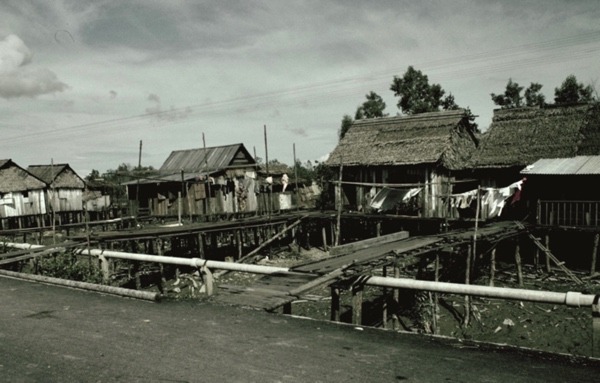
Kukup
See a man up to his neck – old with reddish brown skin, scrubbing the hull of his boat.
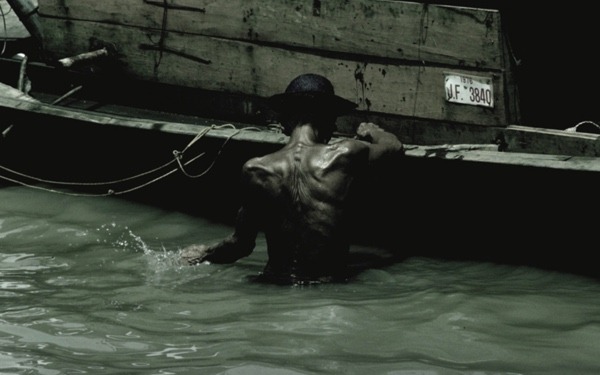
Meet a rubber planter. 25 years in Malaya (Scots) and his girl friend from Singapore. He had read about me in the Sunday Times. Nice gentle man, blue eyes, but bloodshot, and corpulent.
2000lbs an acre of latex per annum is a good yield. Compared with post-war best of 600lbs.
Stopped at sago mill on way back, by a river. Lengths of palm chopped off and fed into a masher. Then water washes out the sago in a revolving pipe with combs. People bring trunks on bikes and carry away sacks full.
May 1st (my birthday)
[We have now moved into Jaya’s house above the restaurant.]
To market with Jaya’s wife to buy fish for birthday lunch. Heavy rain today. Market full of strange fish – a lot of long thin silvery fish with forked tail – reminds me of a knife blade. Also big, plump pinkish fish and reddish ones which might be snapper, though cheap. We buy small triangular fish called Ikan Bauer – supposed to be very good.
There’s a chicken plucking machine, like a spin dryer with rubber knobs – water rushes in and carries off the feathers. First, bird is dipped in boiling water.
At 4pm my birthday lunch is prepared and brought up to the first floor landing outside the rooms. A big platter of noodles, another of vegetables, another of cucumber and salad, a plate of roast chicken and goat, and the three beautiful fish in sweet and sour sauce. Ambak and the three children come up to eat, bringing a great heap of presents gaily wrapped – the monkey [They gave me a stuffed monkey] a sarong, two towels and a box of pretzels. All carefully graded from father to nephew.
That evening we walked together along the main road north out of town and back, pausing to wonder at a chorus of bull frogs – so loud, almost harmonious, reminding me of the fog horns in San Francisco Bay.
Carol wanted to buy me a drink. We went to the rest house bar, where that same fellow who addressed me the first time was still drinking beer, tho’ he seemed less drunk now. He insisted on buying round after round.
“You’ve got to darn well drink up. Karim, another of the same, and make it snappy. So, you’re from England. Well, that’s a jolly fine place. I was at Sandhurst myself. Got a brother in Southall. He’s an army captain.”
He’s from a camp near Alor Star [a border town in Thailand]. He’s here to drink away his leave, with his cousin, the police inspector of Pontian. He infers that there are quite a few cases pending against Ambak at the police HQ.
Karim, a soft-spoken Muslim with a wide, helpless smile, is high on ganja and plays up to the captain’s mock severity. Meanwhile I’m getting quite merry and loquacious too. Karim remembers that the FA cup final is showing. We dash to the kitchen TV just in time to see Southampton score the only goal against Manchester United a few minutes before time. Karim considers me to be a naturally lucky person, and therefore wise, and consults me about his unrequited love. I say foolish things to him but feel good. The Capt. insists that I visit him at Alor Star. Drink more brandy and beer. He drives us to the hotel, very giddy, in the inspector’s car. He leaves tomorrow.
That’s all for now.
I know that some of you following me are German, so it may interest you to know that my autobiography has just been translated into German (but with a different title, in English. Apparently it was impossible to boil the canary in German).
It will be available at the MRT in Gieboldehausen at the end of August and I will be there to sign copies.
Perth, Mid-April
Before leaving the country I wrote this rather harsh assessment:
Australian life does seem to have a dreamlike quality. Life seems to pass in a daze, as though one were just going through the motions. People do work, but never show the effect of it, and this underlying assumption of imperturbability seems to run through even their most drunken or excited moments. There is no real intensity and so boisterousness, un-warmed by real emotion, has a hard and cruel feeling. One must assume that Australians protect themselves from self-awareness, could not bear to know what they feel and so prefer to feel nothing. Better to amble slowly in the sun, in singlet and thongs, a stubby – in its cooler – in hand, drawn by the ever-present aroma of barbecued meat, like a Bisto kid grown up in paradise.
The Passage to Singapore
The Kota Bali was a fairly small vessel. In its upper decks it was a cruise ship. Down below, it was an animal transporter, taking live animals to the halal butchers in Malaysia. To my jaundiced eye it was difficult to distinguish between the people upstairs and the sheep below.
But what really occupied my mind and tore me apart was the thought of the pain I knew I would cause Carol, because it had become clear to me that if I were to write the book I’d had in mind for two and a half years, I must finish the journey alone. It was a terrible dilemma – Carol or the book. There was no question that we loved each other, completely. How could I expect her to understand? That I would let a book endanger our relationship? That having invited her to join me, I could now abandon her? So I wrote:
When there are two people, at least half of what happens concerns the other, or is modified by the other’s presence. Travelling in concert somehow blunts the sense of new, strange experience. If I were writing about two people travelling together that’s a challenge I can accept. But I cannot introduce a second character at this stage. There’s not enough weight or interest to absorb such a change of parameters. But even more than that I have to admit the intensity of the experience is much lower á deux. More comfort, more indulgence – a microcosm of marriage.
The passage to Singapore is fraught with the burden of responsibility for bringing down the towering expectations in which it seems to me Carol has chosen to house her love for me. Every day now it seems a new storey or wing is added to this unstable structure – in French lessons, references to details in the future of the journey and most of all in omissions of remarks, of which I am most conscious. The impending doom is so oppressive but still I can’t bring myself to make the first, simple remark which will bring it all crashing down. It must fall, it seems, of its own volition.
The atmosphere on the ship is crude and harsh. Australian couples who by their mere presence, let alone their references to “your wife” emphasise the wrongness of our situation. For two people to insist on their own forms of truth they must be entirely open to each other, or the uneasy wriggling under misguided interrogations deepens the dilemma.
“When did you start the journey?” they ask Carol. “What will you do afterwards? Are you going to live in France or in America?”
None of our answers mean anything to them. If they had the faintest concept of a life less surely conceived than their own they could not have the temerity to ask so abruptly. And certainly, the first vague, evasive reply would give some hint that perhaps a moment’s thought should be given before the next, inevitable line of the catechism. But no, inexorably they continue. “Are you going to have kids?”
The aroma of beer rolls down the decks every time the saloon doors are opened. The ladies, it’s said, change their frocks four times a day.
Charles and Arthur Booth, bull shippers, sheep shippers, drear and dreadful men.
We are both deeply depressed by the huge chunk of our resources we have had to break off for this miserable experience – to be exposed finally to a parody of everything that was worst about Australia – to be taken through a gale – to be denied the few visual pleasures of the Indonesian coast we might have enjoyed – by a maudlin and waspish Welsh captain whose first words to me were so ridiculous as to be beneath contempt. [Sadly, I didn’t write them down.]
Watching the horizon one day, at evening, so definite a line stretching round the ship below a wash of orange light, it struck me that it was quite obviously circular, and if the horizon is a circle then clearly the surface must drop away on all sides and at an equal decline. Given that the same picture presents itself at all times on the open sea when the horizons are clear, the inference must be that the earth is a globe. It is so much more understandable to me now how Columbus came to this conclusion – and that he cannot have been the only one, but perhaps the one who could least restrain the urge to demonstrate it, whatever the peril.
Passed Christmas Island on Easter Monday – a tree-covered rock rising sheer from the water, with waves breaking on it. A mine of phosphate rock for Western Australia, and little else it seems, but 4000 people.
Next morning we pass by Java Head, but light is poor and hazy and can only distinguish low lying masses on either side. Am sad at having to come this way. Would have been so much better and cheaper to have followed logical route of Darwin – Bali, etc. But there seemed no other way out. [Darwin had been destroyed by a hurricane.]
“We’re on the wrong trip,” I said to Carol. “We’d better get back on the right one soon.” It was as close as I’d dared come to saying it all. Already I was suffering from a sore throat, and my body was preparing to act out my emotional predicament. But Carol took it up and soon the whole edifice lay in ruins about us, with Carol wandering about the wreckage like an earthquake survivor, stunned, howling with rage and grief, cursing me, herself, fate, everything.
So they went on, the storms and lulls, through our last day on board, through the first day in Singapore of chasing papers, hotels, contacts, money. And the second day of more papers and unloading until I could at last go to bed and let the fever break over me. Eventually, as the fever went so did Carol’s blackness, and at last we seemed to be clean with each other again.
“Did you really have to take us through all that?” she asks, unsure of herself. I thought so, had been thinking so, never feeling it right to stop the grief halfway.
[We agreed finally to go our separate ways when we got to the Cameron Highlands, in Malaysia.]
Singapore, April 22nd
Arrived 8am. Took bus from Jurong into city. There, hassled with shipping clerk about import permits, then found hotel on Bencoolen. Back to ship in evening to get documents and few things, then to hotel, struggling on foot part of the way because of difficulties with buses and one-way systems.

A long-vanished sight. Sampans in Singapore
April 23rd
After a bad night, still feverish, to the AA for import permit, then to ship for bike, and at last to hotel with all gear, to bed, to sweat and eventually in night, to break the fever.
April 24th
The infamous lunch engagement with Mr. “Polly” whose sloppy conduct I can’t forgive. [I suspect he was a shipping agent.] Call Sunday Times at night.
April 25th
Walk around thieves’ market – nothing much there really except atmosphere – and ride round the island in the afternoon.
April 26th
Nobody at ST to talk to except Anglo-Asian editorial manager, Mr. Jackson, who is polite and suggests features for the Sundays.
Mr. “Polly” compounds his infamy. Shipping from Penang to Madras comes to too much. Peter Harland is suspected of having appendicitis. Indian High Commission makes ominous noises about visas, and I become profoundly depressed about money. Have only £100 left.
At last, cut the knot and call Tony Morgan for $1000. [Tony was a friend in England who had kept some money for me.] He promises to send it to NatCit, Penang. He sounds pretty demoralised. “You certainly left at the right time.” [Britain, under Harold Wilson, was going through a dark time, literally, with power cuts and strikes.]
Feel much better and cross the road to join Carol on an evening harbour cruise. Nothing to see, but it makes an hour away from the traffic. Singapore Tourist Board has erected a stone carving of a “Merlion” on a pier by the bridge and unashamedly announces that this is a foremost tourist attraction in Singapore.
After harbour we wait out a torrent of rain then go to Telek Ayer street restaurant across the river.

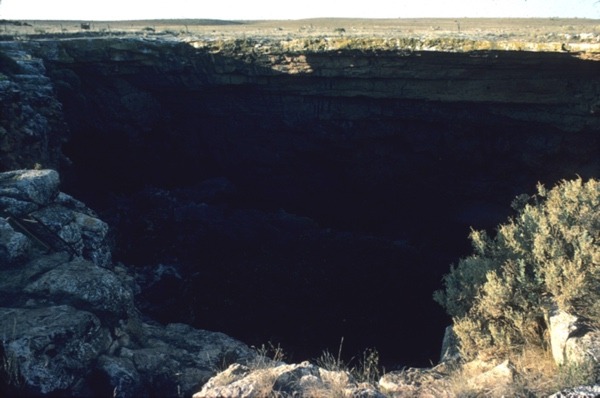 Here’s a picture of Gurney’s hole in the ground that I wrote about last week – where he had his orchard.
Thursday, April 8th
To Norseman. Exchanged thoughts while riding. Carol was on a “bummer” about something she’d written home and wished she hadn’t.
I was figuring out distillation plants from sea water using solar energy or burning slash from the bush. Much attracted by idea of a coastline as desolate as this must be, yet potentially so fertile. Lovely salmon gums in salmon-pink earth.
[The road to Norseman runs along the east and, as usual, I spent the time wondering how to make it habitable, and wondering what kind of life one could live here. Then suddenly, in late afternoon, I felt tremors through the handlebars and stopped just in time. All but two of the spokes on the left side of the rear wheel had gone, and the wheel was about to collapse. Fortunately, I had recently acquired new spokes and I set about rebuilding the wheel, a job I had never done before. As soon as we stopped moving swarms of mosquitoes attacked us.]
Horrible hour and a half battling with flies and mosquitoes.
[But I got the job done, and we arrived at Norseman.]
Friday, April 9th
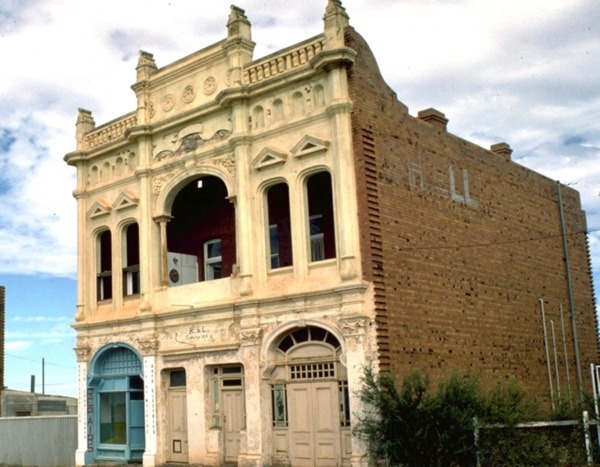 One last remaining building from the gold rush days of Coolgardie
Bill leaves us for Perth. Off to Kalgoorlie, Coolgardie, and as far as Merredin. Carol burned out and hysterical but comes round. Lightening skies. Amazing smoky red sky behind rain clouds and streamers. Stopped at a pub and watch a party of lads talking and drinking. Two wore the same black t-shirts – one was very muscular and male model-y, with his quizzical smiles and profiles. The other a blonde buck-toothed boy with sweet feminine smile. Lots of touching. He was the only one who didn’t have aboriginal blood. One guy, absolutely plastered, wandered around with a jug of beer.
[I can only hope that I was more sympathetic to Carol than my notes seem to suggest.]
Saturday, April 10th
Into Perth. Straight through suburbs to Mosman Park, where found Bill tinkering with his bikes. We went off to a fine pub lunch, and then my first game of Australian Rules, which seemed an exciting enough game, but too formless after soccer. The goal referee with his ridiculous movements of the fingers ¬– and the flags – wears a white trilby and coat.
Gerry Rafferty and Bruce stoning themselves in the kitchen. He’s the drummer. Astrid, the daughter, Leslie and Paul are Rhodesian expatriates working for Zimbabwe, but Perth is so far from anywhere.
Terrible winds and rain lash the house at night and during the day.
The city seems as tho’ it might be a good one to live in – but can’t see that it compares for interest with Melbourne, or for tranquility with Adelaide. But then I saw very little.
Arrived with the engine once again in chaos, the cylinder sleeves scored and an exhaust valve burned out, once again it seems from dirty air, though this time the fractured manifold may have caused overheating as well.
[It astonishes me still that nowhere did any of the mechanics who helped me throughout my journey suggest doing something about air filters, when the one I had was so obviously inadequate.]
Norman Bennett (the Lucas man) was in hospital after a car crash, as well as having his mouth sewn up for a skin graft. Mervyn Whitehead helps me through to Matlock’s and I have the good fortune to meet Dave Waldren there (from Hornsey – ex-copper) who came over with wife Jan on a Suzuki 125 two years ago and worked his way up to being service manager. He does everything to get hold of parts and helps rebuild the bike in a frantic burst to beat the loading time for the ship.
After this we sailed for Singapore on the less-than-good ship Kota Bali – so that was Australia.
I’m off to the Adventure Bike Rally in the UK next week and I’m giving myself a little holiday from my usual holiday, so you might not hear from me for a week or two.
‘Till then, Cheers
Ted
We left Ceduna, and André’s garage, on April 6th to take the road across the Nullarbor plain.
Strangely there is almost nothing in my diary about this part of the journey, although after almost fifty years some of it is vividly memorable, so I will abandon the normal format of this series and just describe it as I remember it.
The next township of any note, so far as we knew, was Eucla, on the state boundary between South Australia and Western Australia. That was about 500 miles away.
We had met nobody coming the other way, so we had no current information of the state of the road, but we had gathered plenty of alarming prophecies. So far as we knew it was all dirt. Kangaroos, bulldust and road trains would be the principal dangers. Bulldust, they said, was thin powdered rock that filled huge potholes so that you wouldn’t know they were there until you fell into them; families of kangaroos would charge across the road unannounced and knock you down, most probably into a large pothole; and road trains – well, obviously you need to get out of the way in time because they don’t stop.
We had no information about fuel stops and had to assume there were none. Since my range on a full tank was about 300 miles, I must have been carrying extra, but my diary says nothing about it.
What we discovered after we got going was that a lot more of the road had been sealed than we expected, and when it did turn to dirt it was quite manageable – certainly nothing like as bad as the mountain roads of Ethiopia.
There were only 200 miles of dirt road left, and halfway across them we met Mr. Gurney. He was a spry, elderly gent with a big white beard, and he had a tin shack by the side of the road where he sold petrol. He lived with his wife (whom we never saw) in a ramshackle bungalow, with some emus, a pet wombat, and some other more familiar animals. It was there that I learned the wombat, a substantial animal, has a sense of humour. It likes to get between your legs and suddenly spin, tossing you to the ground.
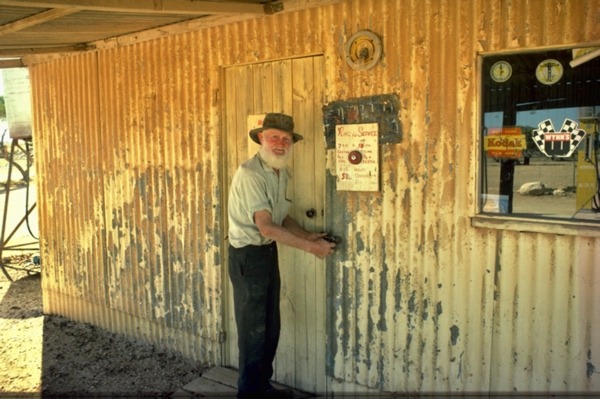
Mr Gurney at his Kunaldra Station
Gurney said he owned eleven hundred square miles of Australia, but it was of no value to him because the only drinkable water was found in a cave near his dwelling. It was the cave we wanted to see, but he was reluctant to show us – “not since those three blokes with guns. They were sitting down there firing rifles at the roof. Mad drunk or something.”
But we persuaded him that we were safe. The Nullabor is quite flat, so we clambered down a crater. As I wrote in Jupiter’s Travels:
“Miraculously, at the bottom of the crater among rocks and boulders Gurney had an orchard, the only place where fruit trees could survive the heat. The cave is a series of great caverns, and an important experience, for it suggests that the whole plain must be largely hollow. Indeed there’s a theory – or fancy – that the Southern Ocean flows by subterranean passages to the interior of Australia. At any rate, the hollowness seemed most significant there, because you can feel the earth reverberate when you stamp on it, because emus call to each other by inflating bladders under their croups and making a noise like the underground echo of a steel drum, and because hollowness is a sign of great age. So in the night, half asleep on the ground, listening to the emus drumming and the clank of distant goat bells and not knowing what they were, I thought I was hearing the sound of a great tribal celebration drifting across the plain”.
We spent the night there outside on the ground. We were among the last to travel that road. Later that year a new road, further south, was built and tarred, leaving the Gurneys alone in the wilderness and I have wondered from time time what happened to them. He called his place Kunaldra Station.
On Wednesday, April 7th, my diary says:
Met Bill McGarry at Eucla. Camped out in the bush.
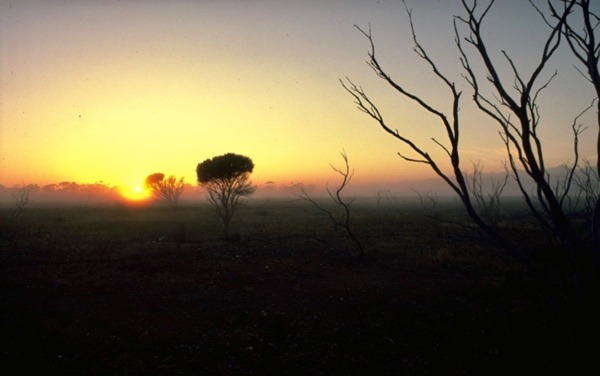
The Nullarbor at dawn
Just like most bikers who have travelled any distance in the last forty years or so I have been well aware of the existence of Touratech.
When I first saw some of their products back in the early nineties – tank bags, boxes, countless clever devices – it was with a very strange and confused mixture of emotions, part admiration, part envy, part regret and part contempt.
I had been riding round the world for four years with none of this stuff, I told myself, and I was proud of having contrived what I needed for myself as I went along with plastic and elastic and bits of this and that: And what about those majestic leather bags, hand stitched in Argentina, that sit astride the tank in the museum today. Of course it’s true that I was happy enough to accept Ken Craven’s fibreglass boxes but still, I would have invented something.
In my mind it was this bare-bones approach to travel that was an essential part of the experience. I was a purist. Just a man on a reasonable bike, wearing recognisable clothes; not a hi-tech phenomenon beamed down from Star Trek.
And then, contradicting myself, I thought if anyone was going to invent stuff to take on a bike through Africa it ought to have been me. I was full of ideas. I should have been Touratech; and then I saw how ridiculous I was being, that the world would go on, with or without me, and I turned to other things.
So when I came to the Touratech Event last weekend, all that history made it especially interesting to me. If you haven’t been yourself, the factory is in an unpronounceable village, Niedereschach, in the Black Forest area of south Germany and is far and away the biggest business there. It was their nineteenth Travel Event, which normally attracts enormous crowds – 17,000 in ’23 I was told – but because it rained comprehensively the entire weekend only a few thousand of the hardiest riders attended.

The hardiest bikers – damp but undaunted
I was invited because I was to be inaugurated as an Honorary Fellow. Being British it’s hard not to laugh, but the heart of the matter is very serious indeed. A strikingly tall and photogenic rider called Dieter Schneider has created something he called the Fellows Ride to combat depression.

The trophy – actually my first ever
It doesn’t surprise me at all to learn that riding a bike is a great antidote to depression, and he organises rides to help overcome what must be a very debilitating state of mind. So even if I couldn’t ride to the event – it was really too far for my scooter – I was all too happy to encourage all those Jolly Good Fellows. Dieter is determined to spread the word beyond Germany and if I can help I will. It’s a Jolly Good Idea.
That was only one of my opportunities to face the crowds this year. I have been enticed to appear yet again at the Adventure Bike Rider Festival at the end of the month. It’s another mammoth event that takes place at Ragley Hall, in Warwickshire. With any luck I’ll have Billy “Biketruck” on the stage to insult me with his fabricated tales of my appalling behaviour. I plan to get back at him this time. And of course I’ll be signing books as well.
I should have been signing books at the Touratech event too. The German translation of my Canary book was supposed to be ready but unfortunately it didn’t get to the printer in time. However, I’m promised that it will make its appearance at the big event, the MRT they call it, in Gieboldehausen at the end of August. I used to go to this meeting regularly, ever since a couple of guys, Ralph and Wolfgang, started it back in the nineties. I remember riding from Sospel, above Nice, to get there in time. I believe it was the longest non-stop ride I’d ever done, around 1,400 Km, and it started on mountain roads in a heavy fog. But I’ve never been interested in endurance riding. I have friends who do “Ironbutt” stuff but, with respect, I think they’re nuts.
And now, going even further back:
FROM MY NOTEBOOKS, Ceduna, Australia 1976
André’s Story
(Word for word, as promised, two weeks ago)
In 1939 he worked in an aircraft engine factory in Paris. (Gnome et Rhone). Then, at least as a skilled man, you earned two or three times what the rest got. He had no father. Was responsible for his mother and family. Lived between Porte d’Italie and Porte d’Orleans. Came war. He stayed at work – reserved occupation. Went on working during occupation. Says the British abandoned France. Promised twenty divisions. Sent only two, and they started the war. Then was trying to escape from romance with an older woman. Took offer of a job in Warsaw. Then another in Russia. Was promised Gaulloises. When they didn’t arrive he protested and resigned. German officer tried to bully him into staying, but A insisted and was given travel papers home via Köln – was even able to visit his uncle there, a POW there, and take him stuff. Then he “disappeared” – – In 1958 he left France in disgust for Australia. Had married a woman, had two children (now both in Australia) but she had mental trouble. Now has no more relations in France. Protests too much. Other reasons for not wanting to go back? In his opinions and personality he reminds me of Papillion’s character.
Next week, the Nullarbor at last.
March 19th to 26th, Adelaide
Our hosts John and Judith Brine were academics who enjoyed our company, as we did theirs, and they looked after us for a week while we explored the city. There was plenty to see but I made only one short note.
Visit to Art Gallery. A quiet mood. Aboriginal bark paintings. The Pleiades and Orion in a T and Oval shape respectively. Some good Australian landscapes, by H.J. Johnstone, John Glover, Heysen, Walter Withers (all 19th Cent.) Some Dutch – a cavalry battle, bulbous white horse glistening like swollen intestines.
Adelaide is the last big city on the south coast before getting to the other side. We set out on:
March 27th and 28th to Laura and Wilpena
Averaging 63 mpg. Spoke gone in the morning. Very brown flat land. Grain silos and sheep trains drawn up at sidings. Big grey and white gums. 50 miles between towns going towards Flinders Range. Melrose seemed a pretty town, just beyond us last night. Hawker was a surprise, but is a tourist outpost, with two grandiose hotels, one now derelict (Grand Junction and Royal) – or were they in Quorn? Will check today. Took wrong road from Hawker for a few miles – under construction. Then 30 miles to Wilpena Pound Nat. Park. Shop. Wine. Stew. Galahs. Sweet-smelling pines and gums. Roseate sky. Walk in the Pound. Kangaroos and babies. Fine woods. Derelict house with graffiti.
March 29th, from Wilpena
Hard ride back to Quorn (Grand Junction Hotel).
[The hotels were in Quorn after all.]
Port Augusta power station, all in smog. Amazing in all this space to see small town in smog. On to Whyallah. Turns out to be a steel foundry (BHP) and almost nothing else. Next pt. on coast is Cowell, another 64 miles. Long ride and turn off on a whim to Lucky Bay. Dirt road. Little row of holiday houses on the coast. Great heaps of sea grass on the beach. Little sign of life. Bed down behind some scrub bushes in the white sand. Grilled steaks, cabbage and potatoes. Perfect bed with net cover.
March 30th
Up with the sun. A man put his gill net out and caught a dozen whiting in half an hour. Gave us two for breakfast. Delicious. On to Port Lincoln. To Cowell, to sharpen knife at butchers. Stopped first at Port Arno where found a man who sold cockles. Then decided to move more slowly round the coast and really do the fishing seriously. So turned off at Port Neill. Quiet holiday resort., Two adjoining bays, one with long jetty. Houses all locked up, likewise caravans, pretty green park, with attendant Scotsman and white tomcat. Spent the rest of the afternoon fishing off beach in rough water but no sign of anything. So went over to jetty towards sundown. Felt a few knocks on the line, but nothing much. Tried the silver lure, but still nought. The Scotsman told Carol there were no whiting here. Only a few Toms – or Tommy Ruffs – which are a small herring-like fish with yellow dashes on their sides.
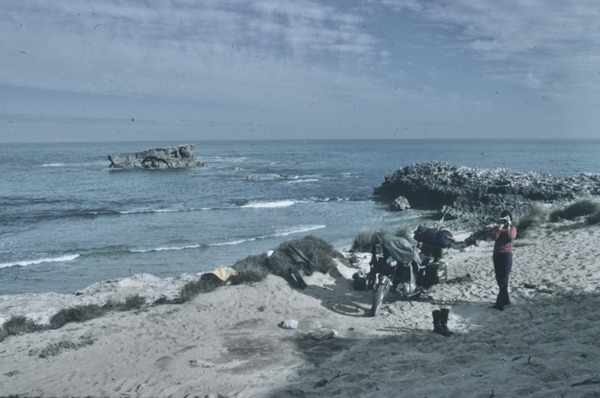
Somewhere near Venus Bay
March 31st, Wednesday
600 miles from Adelaide and two thirds of a pint of oil gone.
First thing after love, i.e. at 7am, to jetty to try again. In first light sea is beautifully illuminated. Can see bait on the bottom (sand among the grass) and also the Toms swishing about. Gradually I learn where they’ll pick it up – i.e, floating and in motion about halfway down and so, painfully slowly over a period of three hours catch four little Toms, and lose two off the hook. But it’s a beginning, and they make a breakfast. We had just finished eating when a young man came to ask if we’d help move some furniture.
“There’s five bucks in it!”
“Not half!!”
The furniture is made of cardboard and is moving into a plasterboard house. Job takes fifteen minutes. Lucky Country.
From Port Neill to Lincoln, long and straight. Huge granary, grain loader, rail head. Spent winnings on a cask of Coolabah and tied plastic bottle on the back. Took wrong road to Coffin Bay but came back to it after eight miles. Big bush fire filled sky with fiery smoke. Sparse, dry country. Scrub. Brown sheep. Coffin Bay, three miles of road, a small town with lots of holiday houses spreading from it. Jetty and series of interconnected bays. We camped on a beach beyond houses on dirt road. Shallow cockle bay. Towards evening, Andy Spiers, the new ranger for the newer Yangie Reserve drove up with wife Helen and three children, and a surf boat. They later invited us to lunch the following day. We had a beautiful night under the net. Went cockling in the morning.
Thursday, April 1st
Caught a sprat from the jetty. Rain clouds formed. Lunch with Andy and Helen. Then rode through the reserve to Avoid Bay, to catch a big one off the rocks. It took the tail off my bait. Then I lost bait hook and sinker in rocks, twice, and cut my foot trying to retrieve them. Stone is volcanic, sharp and friable. Back to Andy’s at night. Listened to his tapes. Then home to tent.
Friday, April 2nd
Weather still cool and damp. Went on to Venus Bay with four lamb chops. Camped on bluff overlooking most rugged coast. With mile-long rollers breaking on rocks. Took pics. Made good fire, in spite of strong wind and had lovely meat and sautéd potatoes. Very warm and comfortable behind bush.
April 3rd
From Venus Bay to Ceduna. Through fifty miles of bad dirt road. Then good road. Said caretaker at Venus (his wife feeds the pelicans, 24 of them) it’s what the Nullarbor is like when it’s bad.
[Ever since Melbourne we were haunted by the prospect of the Nullarbor road, three or four hundred miles of it, across the huge waterless wasteland that divides the south of Australia.]
To Streaky Bay. The café with the couple dressed up in little white numbers – like McDonald’s. Nothing again for 70 miles. Then André’s Garage [in Ceduna] and invitations from A. for dinner. Wife Helga from Munich – the ultimate “Level Gaze” as Carol put it. Children Bernard and Andrew.
[Next weekend I will be at the Touratech travellers’ meeting in the Black Forest, where they want to put me on the stage and make a fuss of me, so there probably won’t be another episode that Sunday. The following weekend, still in Ceduna, and André’s strange story.]
Edging along the south coast towards the Nullarbor
The Rises, 3rd to 13th March
The Handbury family made us feel at home on their sheep station, and even allowed us to earn a little money doing labouring work. I learned a lot, but my most vivid memory was of watching the foreman kill and dismember a sheep. It was done with amazing speed and precision. We stayed for ten days, and I made very few notes.
Helen’s manner a trifle odd at times. Paddy the kindly, strapping younger brother. Ted Jagoe, ex-jockey, Farm hand or foreman?
Worked to make a little money, clearing sticks from paddocks under the big blue gums. Then we cleared out an oat silo together. Hard and itchy work. But had wonderful meals, lovely room.
Fishing. Red fins and one glorious salmon trout, plus a turtle.
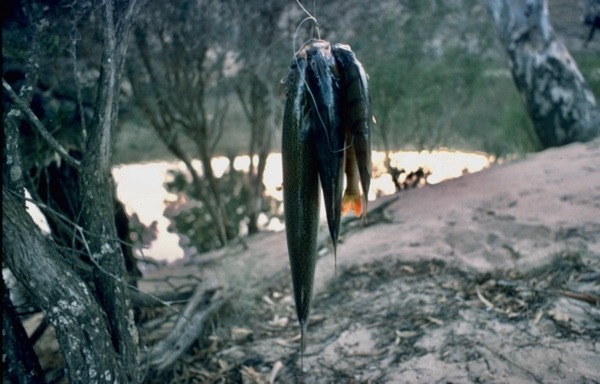
My first catch: two redfins and a salmon trout
On Monday (a holiday) we went sailing on lake Natimuk – and went out on the trapeze on Tony Mitchell’s boat.
On the big paddocks a sheep occasionally dies, debilitated by worms.
Saturday 13th MacArthur
From The Rises, left late, 1pm, Went 70 miles in great heat, stopped at MacArthur for drink. Saw a 28lb conger eel being trailed by two boys on a stick. Looked like a long grey stocking stuffed with jelly. To park, free. Put up my gazebo of tubes for first time – works quite well, but obviously now the sheet should be made to fit it better. One of several lads came to borrow a fork.
Back later, three of them, with a carton full of beer bottles. We talked and drank, and they left a bottle for us. A little later three possums came to roam around. One was particularly tame. All lowered themselves head-first into litter bin.
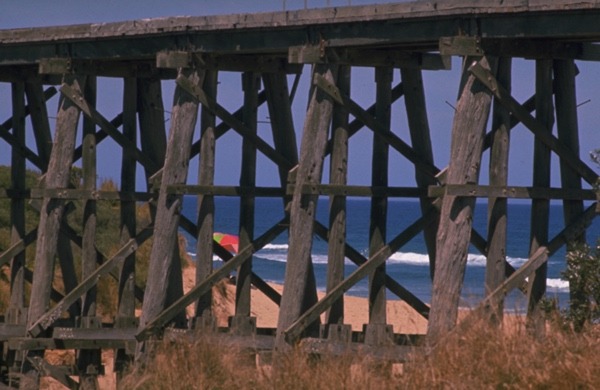
Trestle bridge on south coast
Sunday 14th Port Fairey
Phillip Pilgrim & his ’52 Vincent Rapide, with the Vincent Owners Club at Port Fairey. Amazing coincidental meeting with my Melbourne mechanic friend. Carol gets to ride in a sidecar. I get advice about forks and spokes (heavy duty)
Monday 15th from Mt Gambier
Long straight roads near the coast through endless plantations of Pinus Radiatus from 196 to 1976 some being cropped now. Softwood Holdings Ltd. Crossed state line. Gained half an hour. Beach before Beachport, loads of kelp, collected spherical shells. On to Robe, past lakes (George, etc.) Swans. Theosophy centre. To Robe. Camped on beach. Fished off jetty. Caught one sprat. Ate good dinners at Robe Hotel, slept in perfect little bay, but at 3am heavy sea mist came and got us scrambling for cover. Slept on under lean-to against bike. Woke at 6, good exciting night. Dried things, breakfasted. Talked French, packed. Adjusted timing (LH plug sooty). Big moon hanging over horizon.
Tuesday 16th from Robe
From Robe to Kingston. Little but scrub and sheep. Then along north side of several dry salt lakes, the Coorong National Park, big dunes in the background, Malley trees and succulents. Wandered in over sand and salt to find big ramshackle house with derelict-looking property around it (perfect for heroin lab) but we got no further. Miles to the sea.
Ninety miles of this, then Meningie on Lake Albert. For sandwich lunch. Three ladies from Sydney returning from Adelaide Festival. V Good they said.
From Meningie to Murray Bridge, having remember that Mari gave me names there. Forgot, though, that they were the ancient man/young woman couple. (32.34.29 phone for Bill and Peggy Graton at M.B.)
Wednesday 17th Murray Bridge
A conventional house with a good well-ordered flower and veg. garden. Peggy is the librarian of Murray Bridge – 7000 volumes, about one per capita. A physically self-effacing woman, non-descript clothes, a wad of blue tissue clipped on to the left strap of her bra, but not fastidiously concealed (a mastectomy?) – busy getting things done in the kitchen before a journey to Adelaide. Like any working wife. Then Bill returns. Assume at first that he’s her father. Sparse hair almost white, but covering the crown of a well-shaped hard-tanned head. Features clean, skin clear, though much folded, slightly bowed, trousers hung high on braces – bright eyes, an easy laugh. He’s able to recount events of 25 years ago as though yesterday – but seems to have a good focus on the present. Was a dairy farmer – appears to have enjoyed much success and respect. Read and absorbed as much as possible on the subject. Built stone house (German stone mason) but insisted on concrete foundations, lintels and ties. Says super-phosphate does not leach out, though lime does, according to Rothampstead. Obviously their relationship is very good, though marriage is a convenient word for it.
Murray River water – too thin to plough, too thick to drink.
Thursday 18th to Adelaide (Addleyade?)
But first to Hahndorf – founded 1830s by a German sea-captain and his passengers. All Lutherans escaping persecution. Saw a few attempts to recover early atmosphere. Museum and art gallery in old board school. Interesting paintings by Ruth Tuck of figures, faintly obscene behind lace curtains. Relics of early settlers – lace-trimmed petticoats, baby carriages, etc. Some pottery and jewellery sold there is good. Otherwise, little to recommend.
Hilly country around Adelaide, freeway, then looking down on city and ocean beyond. Into city centre along broad streets to railway station. Had a couple of pizzas then phoned John and Judith Brine and were immediately invited to their vine covered villa on the edge of the city. Heavy polished wood, wainscoting a foot high, Immensely thick brick walls, vines screening the windows, etc.
