News from Ted
May I remind you that I am reproducing here, word for word, the notes I took on my so-called Jupiter Journey, frequently disjointed, sometimes almost incomprehensible, even to me. At this point I am still in Ceylon [Sri Lanka today] at Trincomalee, on my way to Sigirya, an ancient fortress.
October 7th
Back seems bit better. Walk to Fort Frederick – lots of big, shady banyans inside, few monkeys in them, and spotted deer below. Take great comfort from the general quiet. So peaceful after India. Is it the individuals, or the mass makes such a disturbance? Have various half-formed impressions about what happens when population compressed – as in physics. Something must crystalise out. Does structure result from compression – or density. And a pattern having been established does the process continue even after pressure is removed? i.e. Do people cling together as a matter of habit (structure) custom. They seem to. Watch them at any post office counter – cf Penang, noses through the grill. Or remember the queue at the bank at Roissy airport, with the man behind actually pushing against me for almost half an hour – or would have if I’d let him. Is there a difference also between island and mainland (All these ideas seem suddenly very important (cf. Australia – the reverse.)
CUSTOMS & CROWDS
Hindu mythology is as crowded as Hindu life. Ceylon has the Buddha. We have one God, but Africans and American Indians have many spirits.
In the evening I invite Octavia & Cordula to Chinese dinner. Not totally altruistic. I’m invited to stay in Munich. We lie on beach afterwards under full moon – Poya, a holiday – until a heavy shower sends us running. Yes, I can run a little.
October 8th
Ride around Trinco. Tea at boutik, breakfast at Fish hotel. Then pursuit of map takes me to Harbour Road. Welcombe Hotel, ABCD café, Survey office.
Pack and leave at 11.30. Endless entreaties to stay at Traveller’s Nest in Kandy. Will avoid it. Sell my sandals for 10 rupees. 30% profit. 60 miles to Segirya (lion’s throat).
Wanted to go to Baticalao (original Portuguese influence) but too many unpredictable ferries. Stop at Kantalai Rest House for lemonade. Tank almost empty. Then stop for some monkeys with orange faces (most are black) but the interminable process of stopping and switching lenses is far too clumsy. Ride on and stop for rain shower. Leave disposable lighter in road. Suppose a monkey finds it, carries it off, hands it on, father to son, for a million years or so, until long after human race is extinct, an evolved monkey finally gets it to work, and the whole process begins all over again?
Sigirya lies under blackest rain clouds. Circuit bungalow has room. Sit in rest house, as first rain breaks in torrents. Everyone delighted. I’ve done it again.
[Ceylon has been suffering under a serious drought, but I seem to be bringing the rain with me.]
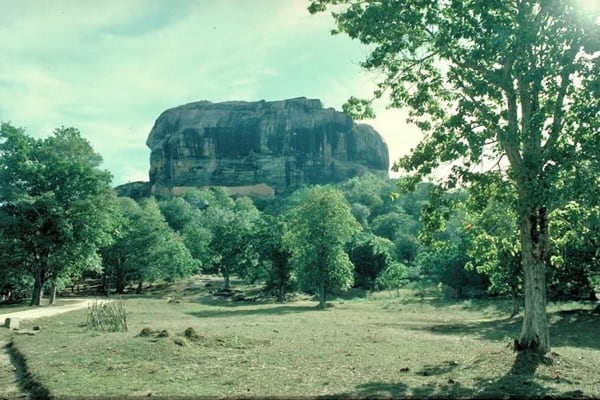
The fortress is carved into the top of this extraordinary rock formation
Two Russians come in soaked to skin. After the angry look he gave me earlier I find that amusing. Another couple arrive at bungalow – a Berliner and a Japanese girl. He has an extraordinarily resonant but monotonous voice which drones from their bedroom. Dinner is terrific. Veg.
Dream strangely of publishing – of responsibility shirked, of floating down spiral stairs round a lift shaft, touching rail delicately here and there [flashback to that childhood fantasy]. Of being with Walsh in a Morris Minor and handing over to him, unable to drive, but without rancour. It suddenly occurred to me yesty that I still owed my mother that £500. Must write to her about it.
October 9th
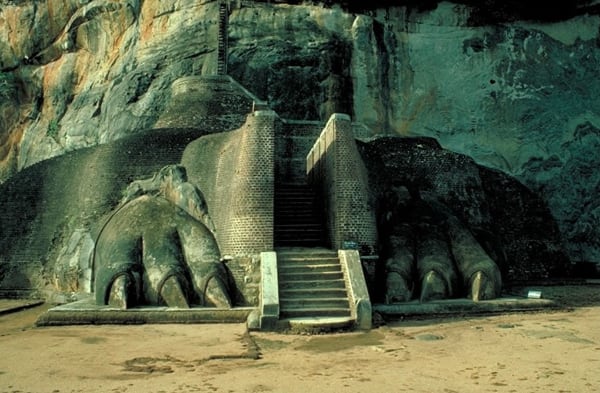
This way up
Got up at 5.45 and walked to rock. Long climb. Back still bad. Long climb to lion’s paws. Then up iron staircase and on to sentry ridge cut in rock. Although the iron rails make it perfectly safe, for me they became as soft and unreliable as marzipan. Halfway along I had to give up and go down again. Then on the stone terrace I reorganised myself and then went up again – this time easily. What caused the breakdown?
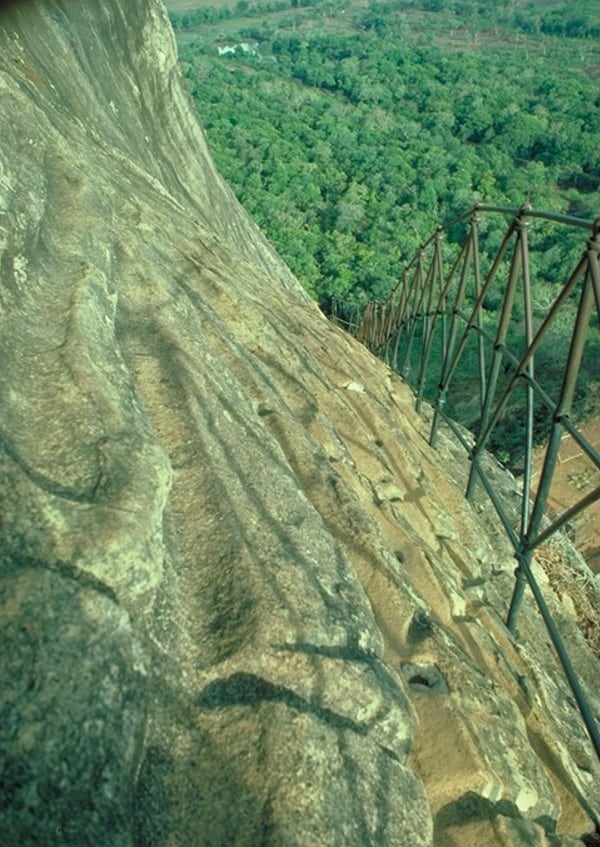
This where I lost my nerve – and found it again
The Russians are Yugoslavs. Also, the woman lives in Paris as a construction engineer. The man is a professional artist and has a sheaf of watercolours to prove it. Furthermore, they are both quite charming people. So, I’m falling into bad habits myself.
Back to bungalow through deep night, with the most fantastic roar issuing from the jungle on left ¬– mostly frogs, I suppose, but sounds much more aggressive. Imagine being in it, or meeting an elephant now, on the road. Everything is extremely wet – rained harder and longer today. At bungalow feel a sense of lively pleasure to find the Schrenk sisters sitting at the table.
They arrived soaked to the skin, but in good spirits.
The man who runs the bungalow directly, helped by a 70-year-old man, has already given my back a massage earlier today, with oil. Now he’s going to apply a hot towel before bed. Has the roundest, most eloquent eyes. Took picture at last.
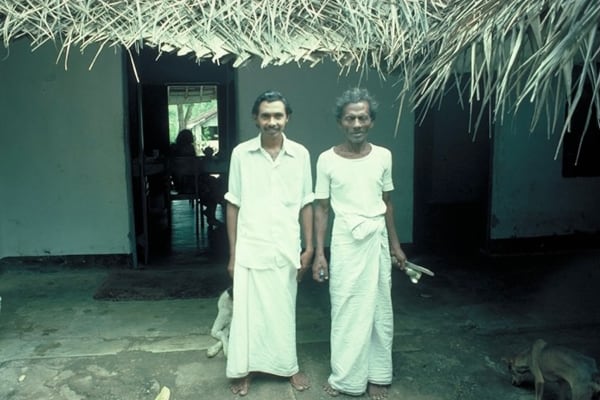
The staff at the Circuit House
PS: If you are wanting to take advantage of my offer of Jupiter’s Travels in Camera, would you please order it separately, not in combination with other books, to avoid a possible problem with shipping.
Thank you
We have a holiday season ahead of us and I’d like to contribute to the fun. I still have stack of my Camera book, and I’d like to see them go. I have no problem saying it’s a beautiful book and I’m sure you all know someone who’d like to have it, so for the next two weeks I’ll knock $20 off the price. It will cost you $30 instead of $50, until Saturday 14th. If you buy more than one, let me know and I should be able to reduce the postage.
Merry Christmas!
. . . and now for the main course
I’ve left Auroville and the temples behind me and I’m about to take a ferry from the mainland at Rameswaram to Ceylon. As in Penang they are insisting that I must pay for a first-class ticket.
October 4th, 1976
The ferry. Shipping office. Uncle and nephew, all in white. I tell them about change of policy on Chidambaram. “It has not reached here yet” they say. And go on to describe virtues of first-class travel. Sometimes boat doesn’t leave till 7 pm. (Sailing time is 2 pm). And at the other end may be held up for hours. Europeans – especially Germans – are outraged by this. So now all white people are forcibly privileged to be the first off – at an extra 22 rupees a head. Total fare 50 rupees. The m/cycle fare is 14. 25 + 10 rupees handling + 2 rupees port charge + 10 rupees tip + 4 rupees drinks and cigs while waiting = 90. On Ceylon side 5 rupees handling, 1 rupee port charge, 6 rupees for maintenance of the floating wharf under the wear and tear of my motorcycle. Total cost, 102.
Formalities began at 10 am. I boarded the bike at about 1 pm. The ferry sailed at 5 pm. At about 8.30 we touched alongside a jetty – but then took off again into the ocean. At 10 we once again touched a wharf, only to sail away in a great circle and reapproach on the other side. Got ashore with bike at 12.15. Sea distance covered, about 25 miles. On the boat were modern tourists, some nuns from Dalhousie with 70 students. Some well-to do N.Indian girls just like the ones on the Chidambaram, and saying exactly the same things, flippant observations with no substance, intended to exhibit sophistication. Well, that’s universal, so it’s the subjects and attitudes that are particular. Jokes about the incompetence and idleness of others, from a superior and detached point of view.
On the boat a very short man with a John Player beard travelling with an African girl.
Mick and Martha Desorbes, travelling by train in India. Endless ordeal. To break journey, ticket must be signed by station master on leaving train and rejoining train. Also you forfeit the sleeper reservation. All this takes hours of time, so every stop is an exhausting prospect. Endless hustling. People running in and out of compartment. Towns all crowded. India [they say] is just a place to go through to get to Nepal, Ceylon, Afghanistan.
Also on board was the short Aussie that Murray called a ‘bushie.’ When I first saw him I’d settled into a cane deckchair to read and wipe my tapes. I had the helmet on the next seat, and he paused in frit if it. “Are you tired of answering the same questions,” he asked. I seized the opportunity with firm “Yes.” He sat on the bench opposite, staring fixedly out across the rail. After a while I thought I’d offer him the chair which was obviously more comfortable. He sat next to me and tried to keep quiet – he knew I wanted to read and was in sympathy, but like a kettle on the boil he couldn’t help spluttering. At one point he said, “Would you like to hear some Communism?”
This is the third time I’ve bumped into him.
On my left were four Hari Krishna disciples. The one next to me had small cymbals. Another had a drum of the two ended kind which he carried on a red braid around his neck As I dozed they went into a chant, almost good at one point. But they were a messy looking quartet – not very convincing. Fellini could have used them.
Somebody said the Indians on the lower deck didn’t get off till 4 am, and that they are badly treated by the officials.
I rode off into mysterious darkness, wondering how to find the rest house, but a boy walking along was also going there. Rooms were occupied. I slept on the sand in the compound next to a smart Aus. Vehicle with a raised roof. Drank a beer and fell into a stupor.
October 5th
To Mannar. 20 miles down the road. But the reserve tap only had nine miles worth. Stopped at bus shelter. Second vehicle stopped and sold me a pint. “Lucky chap,” said driver.
Mannar rest house. Heavy rain clouds. Stayed. Big room for 5.50 rupees. Mick & Marsha [from the UK] were there. Also the American with the myopic personality, and Canadian. Eventually we talked well – especially interested in Mick’s THC [Tetrahydrocannabinol] trip, and his reasons for making it.
He was very strong about continuing class structure (he has a very strong accent) and feels that at home it’s impossible to move. Strong also against immigrants and made some remark about Jews I don’t recall. The Canadian, on the other hand, had much wilder things to say about Socialism which I found more offensive because they were outside his experience. Is this the difference between opinion and prejudice?
Walked out across the bridge where two men were fishing with tapered poles – of bamboo? They seemed to be laminated. Water shallow by the causeway. Many fish and one big crab. Water birds. Low huts along shore, and coconut palms. Peaceful scene. Fort built in 1698 – occupied by customs.
October 6th
Rode to Trincomalee. Since ship felt twinges in my back. Now getting worse. Very bumpy tarred road. At first through paddy fields – very dry. Here in Ceylon, for the first time, I identify entirely with population’s thirst for water, there’s been partial drought for three years. If anyone can bring them rain, I can, and indeed I already have. First rain in eight months on my arrival. Now I find myself actually wanting it for their sakes.
Ten miles outside Trinco there’s a flat piece of rock by roadside with light grass cover. Stop and stretch out – back is now contorted in muscle spasm. After a few minutes under umbrella muscles gratefully relaxed, a car comes and stops. I peer up at the driver.
He looks perturbed. “Elephants,” he says. “Rogues. You must not stay. Rogues. Go on to Trinco. Rogues . . . etc.” The thought of elephants is much more exciting than frightening, but his urgency infects me. Besides, he obviously won’t go until I move. But at least I can stand up straight again.
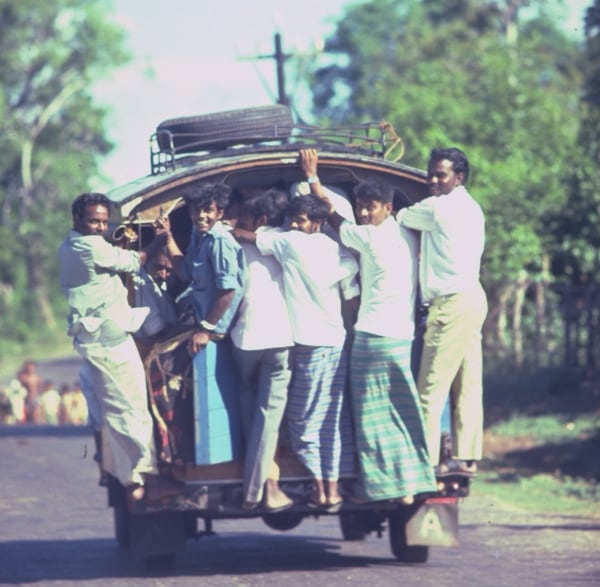
A bus in old Ceylon
Trincomalee is like a town with no middle. Find a hotel and enter it before noticing the flies. They swarm and carpet the tables. Well-meaning but obsequious old man tells me he used to supply vegetables when Europeans were there. Flies because of fish market across the road. Serves me good rice & beef curry for 5 rps (14 to dollar). Then to rest house. Too expensive. Back too bad now to look for somewhere else, so I miss the Chinese Guest House and settle for Beach Paradise, only just short of awful. Bed is particularly bad, sack cloth and straw, very irritating. Cover it with foam pad and lie down. Apart from short dip in ocean, day spent lying down. Back makes me miserable. The two German sisters from Germany are there too and I try unsuccessfully to be entertaining. They lend me a Pat Highsmith book set in Venice. Devour it in bad light.
Here are two more things – for Germans in my audience
My autobiography “Don’t Boil The Canary” has been translated into German – although it has an English title, “Go For It” – and you can get it at these web sites:
Of course you can get it in English from me.
UND
Natürlich kennen sie alle Bernd Tesch. Er hat ein neues Buch und wollte das ich Ihn da von spreche. (How am I doing so far? No AI) Hier ist was Bernd mir geschikt hat,
New Book from Bernd Tesch; Australien Abenteuer Reisen. Entdeckung des Kontinents vom Urknall bis heute durch alle Reisearten.448 S. 500 Abb, Fotos. Hardcover. DM 32,00 plus postage Info und Bezug. https://shop.berndtesch.de
Of course, if you don’t have any Deutschmarks, I’m sure Euros will do.
And here’s one last thing:
You may find this an odd request, but I don’t know any other way to ask.
During the first half of my life, when lying in bed waiting for sleep, I quite regularly experienced a quite pronounced CLICK in my brain – trying to describe it I’d say it was more like the tail end of a small explosion, once or even twice. It stopped some time in my fifties and has never happened again.
Have any of you had a similar experience? Can anyone guess what might have caused it?
Good day, everyone.
I’ve been working at my photo albums, trying to rationalize them. It’s a lot more work than I bargained for, and I haven’t had time to properly prepare for this weekend. So I’m offering you instead some pictures to drool over. I hope you find them as evocative as I do. They are from my journey, almost exactly 50 years ago, in Sudan and Ethiopia.
Can you imagine yourself there then?


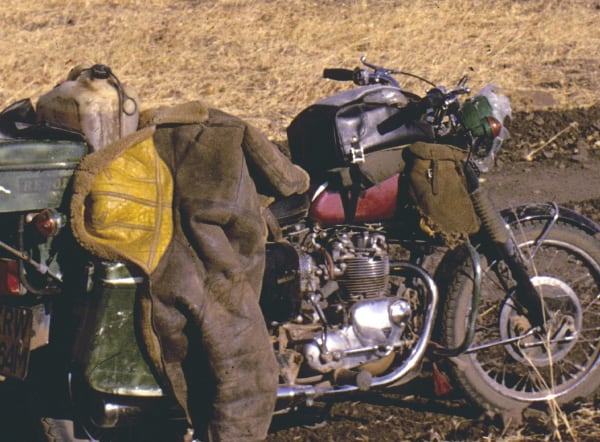


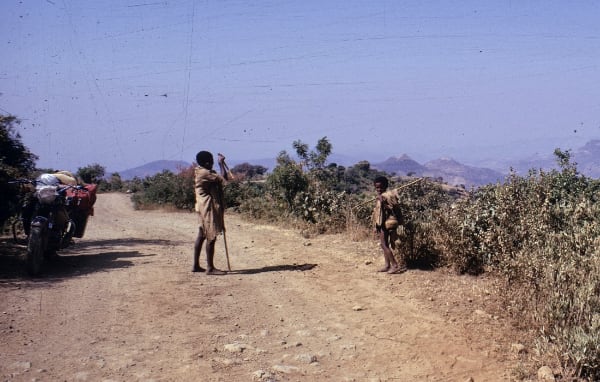


I’d give a lot to be able to feel today the way I felt then.
It’s the end of September 1976 and I’m in Pondicherry on the East coast of India, but for some reason I wrote nothing about that week. I came to Pondicherry principally to visit Auroville. I can’t remember now how I heard about Auroville, but it was already well-known to anyone taking an interest in Indian philosophy or culture. It is situated in the part of India which once belonged to France – then called Pondicherry – on the coast south of Madras, now Chennai. It was inspired by an Indian Sage, Sri Aurobindo early in the last century and finally put into practice in 1968 by his disciple, known as The Mother. When I visited it eight years later there were several hundred people, rich and poor, of all nationalities, living on a substantial piece of farmland. They were free to build homes of any style which made it architecturally fascinating and were in the process of building the central feature, a meditation centre that was literally global, called the Matrimandir. I was welcomed and spent almost a week there. I was much impressed but apparently wrote nothing about it in my notebook. India’s President at the time was Indira Ghandi, who gave it her protection.
Today the Matrimandir has long been completed. There are now more than three thousand inhabitants and it appears to be a remarkable success. I can only refer you to Wikipedia for more information.

Here’s a picture of the Matrimandir in the process of creation.

Some well-to-do French members built to their own designs.
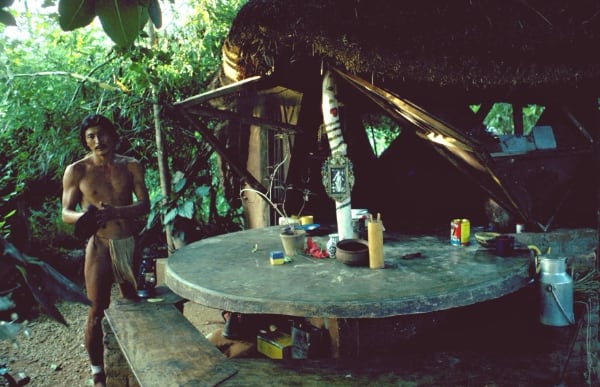
I stayed for a whlle in this shelter, built from poles and reeds. The magnificent looking man, as I recall, was called Tlalloc and came from Hawaii.

The girl may have been his daughter, but I’m not sure.
1st October, From Pondicherry
To Kumbakonam. [Further south on the way to Thanjavur temple] After riding around for miles I could not find a single place to eat, or a hotel. At last, in comic despair, I stopped outside an orange stall. A man pointed to a doorway nearby. “Meals.” I looked up the stone steps and thought it was a secondhand furniture shop. He insisted. I walked up. A cavern opened before me. Men were eating, in pairs, off banana leaves. Two elderly men in white dhotis with bristle and betelnut tongues said, “Come on,” and “Sit down”, like uncles, very familiar. Food was satisfying and I used my right hand with ease.
While riding along and feeling good, sensing respect among those I passed, I toyed with the notion of becoming a god. After all there were so many already, why shouldn’t I be another, riding into their lives, erect and proud on my remarkable vehicle, condescending benignly. Round the very next bend, a beggar in unusually colourful rags, sneered at me and spat deliberately in my path. This has never happened before, in three years.
[I was on my way to Thanjavur where was another famous temple, Brihadishvara. Sometimes called “The drawing room of India. ”Red granite.]
My guide was B. Ravi. s/o V. Balasubramanian. Accountant, Pandyan Automobiles, Tirunelveli – 2, S.India
He was 14, and very sharp. He says being a guide is his hobby. One could almost believe. He comes to Trichy [Tiruchirappalli, a nearby city.] for holidays, and he does have some real knowledge. Afterwards, we walked with his brother and friends to buy juice and oranges. No hint of profit. Sometimes even a joke, to expose my suspicion. (Carrying seven oranges about? “Not so difficult. Carry one, eat one.”)

Thanjavur
Then there was Gopal at Thanjavur. He found me in a quiet moment and by thrashing the water all around me energetically he managed to guide me to his home, where his friends came one after another to see what he had caught.
“Does it not bother you that you have not made your name?”
“Would you know if I had?”
“I would certainly know if you were an important journalist or writer for I am reading always anything I can get my hands on.” (This before he even knows my name. Meanwhile Ted Simon swam through my brain. Who is he anyway? Who has heard of him?)
“What do you think of this inflation? What about the Israeli hi-jack? (He meant Entebbe. He was pro-Amin at first.) What about Ireland? Are the British being fair to Irish Catholics?”
He wants a godfather. All his show of intransigeance and opinion melts in the warmth of a single breath. Not one fixed point that I could see.
“Then your idol must be Gunther.” Who?
2nd October
Riding from Trichy to Dundigal. Reflecting on news of sterling’s further collapse. (£1.66 to the dollar.) and once again began to wonder if I might have some role to play. The notion recurs like a fever. Is it halucination? Found with the questions of Gopal yesterday I had scarcely an opinion to offer. Yet I imagine myself offering an alternative to 60 million people – reappearing like a prophet from the wilderness to rescue the British from their political paralysis. Compared with my last return to Europe it would really have to be different. I would have to initiate a great deal of the interest myself. Probably from a distance. And in person to generate immense conviction and charisma. What evidence is there for this as a possibility? A certain warm regard from a few friends and an easy way of meeting people.
In my dreams tonight I was losing my friends – they were running off regardless that I had been delayed fumbling with something and couldn’t catch them up. Later there was a cat whose affection I was eager to arouse, but with no success. I asked whether it couldn’t be content to live with me. It looked at me and judged me. I felt its appraisal.
“Comme ci, comme ca,” it said. I felt worthless.
3rd, October, from Madurai
Strange beginning. Dropped bike once. Followed wrong directions for a mile out of Madurai, then back. Felt effect of night’s searching dreams. Then outside Madurai on the Rameswaram road saw thatched roof smoking. High brick kiln, like house. Others all around. A village of brick kilns. Two oldish men approached smiling and gesturing. Had they built it? Did they own it? (Hardly). I escaped smiling instead of finding out.
In this humidity you can’t put your hand in your pocket without pulling out the lining.
Goats passing on the asphalt sound like a light spring shower. The soil everywhere looks like sand. I see no clay, yet brick kilns grow like mushrooms. Large areas are washed out and goats graze on the sand for every blade that rises. A rain cloud forms and falls on me, because today for the first time I didn’t leave the leather bag under the blue waterproof – because at Auroville the fat brown ants made their nest on it, leaving strange glutinous white substances on the inside. The umbrella was not big enough for all of us. Leather black and stiff. Straps broken. The brown ants were a phenomenon. They nested in my boots, inside the leather bag, among the waterproofs, in great masses. It’s a shock to find them, difficult to shake them out. But they are harmless.
Eventually the Rameswaram road becomes a single straight ribbon. Erosion and dune formation evident on both sides. Goats everywhere. Some attempts to plant grasses, casuarinas, To Matapam, and to my amazement the road stops. How do I ride to Rameswaram? You don’t. You go on the train. 8.50 rupees plus 10 for labour. I get to ride in the goods van. Train takes one and a half hours to go 12 miles, partly over a bridge and causeway. At R. another 6 rupees, then to Rest House. See Murray hanging over balcony with a double room to share. Spend hours reading detective stories.
Journeys, I have come to believe, are made in the imagination. When the mind is distracted by physical discomfort and unsatisfied cravings it is difficult to appreciate the beauty and significance of scenery and events as they unfold. After ten weeks in France and England I was still cluttered by the desire for the meat and wine of Europe; my skin was uncomfortable in the heat of Madras; I was impatient to find my balance again.
September 19th 1976
Went to dance performance at Vani Mahal, a theatre. Many gorgeous Hindu ladies present. One professional dancer very good – but very little explanation. In audience was Vera Goldman, Israeli from Australia. She talked to me first and went to Chola Hotel for coffee. No espresso coffee – so I asked for a slow one instead. She told me about Aboriginals. Had spent time with them – “dream time” – a time space without chronology in which thought roams free to produce song and art. A woman of great force and temper who worked at Kulashatra Dance Academy directed by a Mrs Arundel (widow of an English theologian). She describes Mrs A. as an evil dragon. Murari and Rada think she’s wonderful. Am fascinated by Vera’s passionate Jewishness, the amazing curves of her face. Nose and mouth. At times beautiful, at times hideous. Ending a dreadfully tempestuous love affair with an Indian dancer. Murari’s gate locked when I return. I lock bike up outside, go to bed and think paranoid thoughts, then get up again to stay with bike. But this time my movement wakes M up, who says he meant to stay awake. Ignominy!
20th
Today the eggs I bought yesterday, which could not be cooked then because it was a holiday, are made into scramble with onions. Good. Go through my tools and parts. All in good order. Write letters to PH, RAC, Th’an, Carol. Mum, Adrienne and Sai Baba. Tea with Rada Krishnan. As he emerges he appears very loose and flabby and his speech is difficult to follow. Quickly it becomes easier and he himself seems to assume a more definite form. Talks most humorously about his dealings with the artists’ community outside Madras founded 11 years ago. Painting on the wall by the president is a nice one. Tale of the ‘untouchable’ who felt that his caste was being oppressed because nobody bought his paintings. Sad story of ugly man who drew painstakingly beautiful line drawings in which he appeared as a lonely, shunned figure. While they were all wondering how to help him he committed suicide.
Also, the visit of Sai Baba to open the hospital of R’s father-in-law.
[Colonel Muirari was a disciple of Sai Baba, a famous holy man with an ashram in Bangalore. He spoke to me often of Sai Baba’s “miracles.” Mysterious appearance of honey and ash, called “vibuti.”]
The light in half the hospital went off, but R swears there is only one fuse. (How could that be? How many bulbs were there?) On to dinner with Vera. V in flames about the hammering rock music. But cools down and tells more about her life. Beautiful parents from Vienna (Hammerbrod?) Recently died. She gets a monthly sum to keep her going. Mother died of cancer. Story of love affair. I engage in amateur psychotherapy, talk a bit about myself. Her lover’s personality sounds like a Peter Sellers. We go on to the Marina and walk around the tomb of the DMIS leader [DMIS stood for the Directorate of Military Intelligence and Security.] then sit on steps facing the beach. Group of Khaki police stroll by, flipping truncheons. Warn us to stay off the beach. Eventually take her home to Ardyor, ten miles along Mount Road.
20th
[I was gradually getting ready to leave. My plan was first to follow a well-trodden path to the temples which are a famous feature of this part of India. Thee first if them was at Kanchipuram.]
More packing. Breakfast. (Rice pancakes). To post office, Cook’s, Lucas. Feels good on bike. Seem to be thoroughly acclimatised again. Most impressive man so far at Lucas. Also hopes to make some introduction to Sai Baba through friends. [Didn’t happen].
21st, Tuesday. To Kanchi
From Madras, 15,121 miles. [I was keeping record of mileage since odometer change, probably in San Francisco.] New oil. Once out of town the flashback to Middle East was most noticeable. The environment felt very similar to Nile Valley. The arrangement of the houses – in occasional clusters ¬– differs from S.E. Asia where each house is larger, better evolved, set in a larger space, a little aloof from road and neighbours. Here also it’s mainly paddy farming with water buffalo, but there are also teams of oxen, maybe six pair, charging through a field in circles, moving much faster than I remember. The people make a different shape too. The men longer sinewed, black, naked but for a triangle of cloth, gleaming thighs, long like Arab thighs. Women in separate groups, very colourful among the greenery. Many brick kilns and quarries. A bright blue bird with darker “wing flaps.”
The road was almost empty, very narrow, with bumpy tar. I rode the whole way at 30 mph and it didn’t seem too slow.
Walking round my first Indian temple, Ekambareswarar. A great slab is held up by carved columns about ten feet apart, some long, some short.

A variety of people are there – all of them give the impression of having been cast there by enchantment. An elegant group with shaven heads and bright saris sits there around a small fire with large aluminium pots, shaped like this. U.
Others like young tramps. A bearded gent approaches me with a holy look and moves his arms in a kind of semaphore.
The man in Siva’s lodge at the entrance also had an imperious look, rather [illegible] I thought, beckoning me to make an offering to some dark, mysterious object behind him (a lingam I suppose). All the way I was accompanied by a dark, graceful man with a sweet smile who simply murmured quietly “Ah, those boys,” when the kids came to me. For a while I sat under some other columns and photographed an elephant, foot in chains, and some people.

Then approached the temple entrance. A tariff of rates, in Hindi, offered 39, 75, 1,25 and 2,50. What for? I asked to see a pamphlet, but it was historical, not descriptive. But the rates didn’t apply to me, and I was shepherded instead around the outer corridors by a younger man – “I am not a guide, I am a priest.” He gave the unintelligible commentary, and led me inexorably to the mango tree, 3000 years old (?) with four branches, bearing different qualities of fruit, sweet, sour, bitter, and something. An elderly man gave a routine patter and led me round the tree – it might have been a mulberry bush. I was told that 10 rupees was the least I should give to be shared “among these friends” – his arm embracing the various acolytes I had acquired along the way. Ungraciously I gave 2 rupees and paid even less attention to my priest on the way out while wishing I had the calmness in refusal that I would have liked. Of course, I was a-dangle with cameras and lenses. The priest got nothing from me – nor the boy with the inevitable “coin collection.” The quiet man at last drifted away. I passed him later in the street, still with the same smile. Was it sincere, or stock in trade?

Round the bike a crowd of children from school. I clowned with them a while and felt better. Then one of them spotted by pen. “Pen, pen,” they cried. It was almost seized from my shirt. I moved it to my trousers and as I got on the bike I felt it slip from my pocket. My good nature failed to survive this, but at least I didn’t become too obnoxious. Now have this lousy pen, bought at a stall.
22nd, Wednesday. From Kanchi
Caught in rain storm just before bed. Moved into hotel corridor. Breakfast, then East to Chingleput for petrol. Took road to Sardas. Beach. Boy to guard bike. Heavy waves. Burning sand and sun. Fishermen scouring water on rafts of four logs and paddles. Later roundabout route to Mahabalipuram. Stopped at village to photograph silk combing.
Offered hank of silk for five rupees, but colours were wrong. Men friendly but no word of English. At M. tried PWD [Public Works Department maintains rest houses.] No success.
ITDC [India Tourism Development Corporation hotels.] far too expensive. To Manali Lodge. 5 rupees. Then rode out to see carvings from solid granite.

Temples, elephant, etc. then had fish at Rose Garden. Intelligent young Indian proprietor – deserves to succeed. Next morning to photograph Arjuna’s Penance. Then hot ride to Pondicherry. Again roundabout route. Got to Continental Hotel at 4pm. Had beer and mutton curry, met Murray Masters, thence to Government Hostel. Not feeling good. Terrible dry cough and inflamed throat from bad night at Rada Krishnan’s house. It is now Thursday night.
Had beans and onions for breakfast at Kanchi.
24th, Friday
Long uncomfortable day with touch of fever. Made leather box for razor. Talked to night man at hostel. Was in Malaysia before war, looked after by sister. Back to India in 1940. British army in North Africa. Demobbed in 1947. Tiny gratuity. Says the French paid vastly better. Told story when he was yardmaster at Suez, and brigadier tried to boss him about. Lots of bluff and bravado. One crazy tooth and a mischievous face.
25th Saturday
Had early adventure with bad egg. Then rode out to Auroville with Murray on back. Low expectations – but found excellent people. Jocelyn the girl; Chris, American; Michael, English. The “revolution”. The meditation chamber. The French Auromodel homes. Bernard. Long rides over sticky red mud. Reforestation. Casuarinas. Neem tree. Banyan. Beginnings of symbiosis between Auroville and the Indian villages. Good feelings. Ride back to Pondy along crowded road and through clouds of insects. Conversation outside Continental with human scrap on pavement. Remarkable person – 40 years old. Address book is full of tourists’ names ¬– mostly German. Head normal. Chest baby-sized. Rest shriveled and contorted beyond recognition. Scarcely 18” above ground. His accomplishment in making contact with people seems very superior to me. Would like to pursue the matter.
There’s much more about all this in Riding High.
I’m going back to California next week to preside over the election of Kamala Harris (I hope). Brexit was terrible, Trump could be even worse. What causes this suicidal impulse? I guess a lot of people just didn’t feel anyone was paying attention.
So I might not be back here for a week or two. Goodbye and Good luck.
[My arrival in India could not have been more fortunate. I had an introduction. Three years earlier an Indian friend living in London had invited me to stay with his uncle, Colonel Murari, retired, whose home was in the outskirts of Madras. I had anticipated that disembarkation from the Chidambaram would be an endlessly frustrating affair, so I was happy to find it was only ordinarily time-consuming, and I was able to get to the Colonel’s house at a reasonable time. Not only that, but my friend also happened to be there for a short visit.
There were three central figures in the household – the Colonel, his middle-aged housekeeper, Gaja, and an elderly man, Rajaram, who was the resident guru.
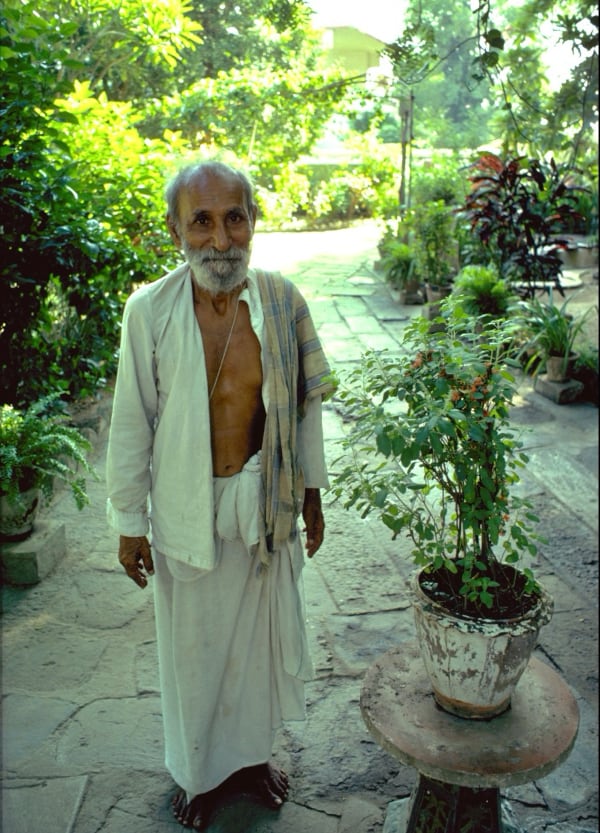
Rajaram in the colonel’s courtyard
It surprises me now that I wrote almost nothing in my notebook about this period in the colonel’s home, although it is described in detail in Jupiter’s Travels, and I can still recall it vividly. I remember how peaceful it was, how perfectly I seem to have acclimated myself to the heat. Rajaram had a daughter who was preparing her wedding and, as was traditional, a vast number of relatives were expected to attend. Rajaram was in high good humour.]
Rajaram – “there are 4000 people – each is getting a tamarind leaf with one grain of rice.”

Rajaram’s daughter and friend discussing the wedding
[Later he examined me closely with his large, luminous eyes.]
Told me I learned to fly and that once I threw stones at a cat – or hit some animal when I was eight or ten – and got hit by some relation.

Rajaram instructing the colonel
[There was a Lucas office in Madras and I connected with them.
Just as I was getting ready to move on, they received a telegram for me from Peter Harland at the Sunday Times. The news was shocking. My stepfather had suddenly died. Even though I had been determined that my journey would be a single, complete and unbroken journey around the world, I would have to break it to be with my mother.
The newspaper generously offered to pay for the flights. I left my bike with the Lucas people, and they took me to the airport.]
Flight from Madras to Bombay – up into monsoon cloud. Plane rocking all over, with Indian music tinkling and the Calcutta tea merchant sitting next to me shooting his cuffs.
London beginning of July. Off plane at London airport. Met by Peter. Very kind. Amazingly familiar. Almost impossible to relate anything new. So, for a message to carry conviction there must be [illegible] at both ends.
We go to pub. The Blue Lion. Drink a bitter, then up to the office after much hesitation about the effect of appearing there like that. Left film for developing – 3 rolls. Projector missing. Driving license I found immediately in parcel. Pretty bad first impression. Lunch. Greek. Retsina. The little place down the road.
Harry [Harold Evans, the Editor] received me and gave me two minutes of enthusiastic time, before being distracted. I had to gulp my bitter lemon to get out in time. Said I’d met Denis Hamilton in Cairo and remarked on my holiday plan for Harry – perhaps that was a bit gauche since I can’t remember how I put it. H seemed to have almost disappeared – shriveled I put it afterwards, naively. But he had read the bludger piece [This was a column I had sent from Australia.] I saw his memo describing it as “refreshing” – and there was a row after it had been cut.
Knightly came through and asked where I’d want to live. “Not Australia,” he said. “I didn’t think it was.” And off he went. Encounters are a bit fragmentary. Only Don Berry [a big shot at the paper] gave me a really warm smile and shook my hand, though I couldn’t remember his name at the time. PH gave me £20, which he said would be on exes, and drove me to Liverpool Street Station.
The train broke down just before Wickford, and we all stood on the platform. A Welsh woman with a man complained steadily about being stuck after their long journey from Wales – all of five hours, I believe, and I enjoyed my secret scorn.
Tried to phone from Wickford station but no reply. Then called taxi, which was unnecessary. Emotional home coming. Mother very happy to see me. Hanne there too, and Marta. [My aunts from Germany] Nell was there too. They said my mother had been crying a lot, and she also admitted it. I had not honestly been able to feel Bill’s death as a personal tragedy – my memories of him were not intimate enough, and I thought of him more as a craftsman and a ‘character.’ My emotional ties were with my mother and so I resolved to remain cheerful until the funeral was over.
TEN WEEKS LATER
15th September. London to Madras
[On the last leg, from Bombay to Madras I sat next to an Indian lecturer in Chemical Engineering, returning home from Frankfurt.]
He boiled all water in Germany before drinking it, because water is all polluted. “Don’t bother in Madras. We don’t have the same problem here. All our river water is pure.”
See snake farm by side of his institute – up to 5pm.
In Bombay he had met a friend at the airport who he said was “a great industrialist” in Madras. He rose from a cycle shop to manufacture scientific instruments. His daughter graduated and is running a new branch in Bombay. My friend persuaded him to offer me a lift to Kilpauk and we drove in my friend’s car, first to the latter’s home, where I was left to heat up outside the house for a while, then taken to Murari’s house. The “great industrialist” was not easy to talk to. I tackled him about quality control which I thought would be a great problem, but he brushed it aside. It was simply a matter of deciding whether you wanted to maintain quality or not. Those who didn’t went out of business – but meanwhile made things more difficult for the others.
Murari and Gaja seemed pleased to see me. My telegram from Bombay arrived the following morning. The place seemed different. The boy [my friend] had gone. The regime is more spartan. Obviously things are more special when “Nippi” is home. But Rajaram was his own sweet self.
September 16th
Trouble with Jet lag and climate. Slept very late. To Lucas in afternoon by auto rickshaw. The bike was beautifully cleaned and polished, but chain rusted solid in places. They put the battery back clumsily, with negative earth. Also, they seem to have lost the ignition key, and I rode off with a provisional connection on the leads.
17th
Time is better, but discomfort continues. Back to Lucas. They found the key. Meanwhile I found the spare. Only thing missing among my things was swimming trunks.
Telephone was cut off and Kutti [the housekeeper] has big scene with telephone people, rescuing torn up evidence from wastepaper basket.
I had bought a chicken in the morning – a bad move. When it appeared next morning it was all neck, head and bones. I asked innocently where the rest was but [she said] it was all in this tiny pot. Rajaram showed great restraint by eating with us at all and Murari felt very guilty.
[Those first days I felt completely out of sync – not just physically but morally and socially. Before leaving I had been perfectly adjusted, but now I was uncomfortable, led by my western appetites into making clumsy mistakes. I longed to get back to the easy rhythm I’d known.]
There was one passenger ship, the MV Chidambaram, that regularly crossed from Penang to Madras (now Chennai) and I was booked on it. Originally the ship had been named Pasteur and was a small luxury liner that crossed the Atlantic. It was known, I believe, to be a popular ship for wealthy gamblers. Some of that luxury was still visible in the upper decks, in the shape of a grand staircase sweeping down to a big saloon. At first the company insisted that “white people” had to travel First Class, which I found much too expensive. After some argument they changed the rules and sold me a Second Class ticket, which meant travelling with middle class Indians, mainly students. There was also a third class which I discovered on the second day. It consisted of wire cages stacked in the hold where poorer Indian families spent the four or five days of the voyage. They cooked their own food and, as far as I could tell, had no access to an open deck. The Chidambaram was eventually destroyed by fire. Here are my random notes on the voyage.
The MV Chidambaram (Née Pasteur) once highly luxurious.
Empty first class. Full dormitory. Packed bunks in cages.
Cockroaches, student ragging, measuring the gangways with half a matchstick. The filthy bar and the maniac barman with the huge, bruised face staring out of his hatch in neurotic hate and fear. The Indians are not graceful in their behaviour. They walk up and abruptly state their requirement in a harsh voice. Like Malaysians, they make a crowd where none need exist, crushing round counters with hands stretched out with money or documents or whatever. (In the post office the man sending a telegram with his nose through the bars watching every move of the clerk’s hand. In the hotel crowding round me simply to watch me write.)
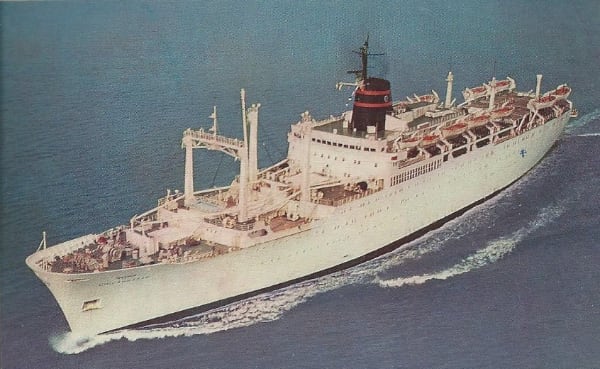
The MV Chidambaram
Saturday morning – 6.30 – woken by unusual messages on speakers. Something about port and starboard. The engines have slowed right down. Are we at the first port? [The ship docked briefly at the Andaman Isles.]
I get out to find the port hatchway open and a man in long shorts and life jacket hanging out over a rope ladder. Someone is overboard. Did he jump? Or fall? Nobody’s sure. But when they threw lifebuoys, he swam like a champion. An old man, maybe 60. A lifeboat had been lowered and it seemed just a matter of bringing the ship round full circle to pick them all up. When the ship did come round it became clear that life wasn’t so simple. The boat was drifting, almost useless. It’s engine or propeller had been damaged in lowering it. There were oars, but with so few men aboard the oars hardly touched the water. The ship came past, beautifully navigated, to within 50 yards of the old man, now securely buoyed on two rings. But nothing happened and he drifted away again. Then the ship shuddered into reverse and slowed down.
“Number three lifeboat!”
This time I watched the boat go down. It was a sight of danger and violence I shan’t forget. The boat is lowered by two hefty steel hooks with pulleys through which the hawsers run. As the boat lowered it began to swing with the pitch and roll of the ship.
Halfway down the ropes were long enough to let it crash into the side of the ship. This happened several times, throwing the men about and bending the side of the boat, before they touched the water. There was a heavyish swell. One minute the boat was afloat, the next it was wrenched up by the tackle as the sea fell away beneath it. It seemed to be difficult to release the tackle. When one was free, the scene became far worse. As the sea dropped the boat bounced and swung, so that to grapple with the other tackle became extremely dangerous. And to make matters far worse, the other pulley, now dangling free, was swinging wildly back and forth across the boat hitting several men glancing blows. Heavy piece of metal. Surprised no-one was killed. Imagine it with a boatful of passengers. How was it possible?
At last the boat was free and away. Meanwhile a white-fin shark, of 7 or 8 feet, came close to the ship and, clearly visible, circled suspiciously. What, we all wondered, was circulating round the old man out there, rising and dipping in the ocean swell on his two rings of cork the colour of a Hindu cast mark? The shark made an exciting object – a brownish colour with all its fins and tail shading to white at the tips.
By now the man had been in the water for about an hour, although as he floated by he seemed all right. Was it sharks that prevented anyone from swimming out to him?
The new boat made its way slowly to him. When he was reached it seemed a long time before he was handed in. Then they went out collecting buoys and finally came back to the port side, but the swell prevented them from attaching to the side. Off again, to bring the other boat in on tow. Then, on starboard side where it was calm they strapped the old man into a mummy-shaped bundle and eventually man-handled him through a hatchway as he twisted and pitched face down and scraping over the metal of the hatch. Then the excruciating business of raising the boats again, just as lethal and bruising as before, with men hanging on to ropes for dear life as an officer shouts, again and again “Sit down! Sit down.”
An officer later said, smiling, that they practised putting boats into the water every two weeks. He said recently their radio operator had jumped in and they’d had him out in 11 minutes. There was a heavy swell today, he said. I suggested that perhaps the shackles couldn’t go down any further. “Yes,” he said. “they go down under their own weight.” But obviously they don’t. “Was anyone hurt?” I asked. “No,” he said, happily. Two minutes later, someone commented that several men were in hospital having injuries treated. “Yes,” he agreed, just as happily. He also added in explanation that if the boat had been full of passengers there would have been no trouble because of the boat’s extra weight and because, he said, “the passengers are asked to cooperate by moving to this side or that.” Since the men in the boat. when ordered to sit down, preferred to ignore the order, I can’t see how passengers could be expected to show more calm and discipline in a shipwreck. One swing of that massive iron shackle across the surface of a crowded lifeboat could be certain, I think, of meeting at least one skull. I’d like to be reassured that we do this kind of thing better. I’m glad this is my last ocean crossing. I think I shall cross the Channel by hovercraft.
Shipmates
The student girls. Easy chat. No shyness. Will sing, play piano, seem very close, but it means No.
The mini-bus party – theatrical Yorkshireman – craggy handsome face, grey windblown hair – self-consciously acting the part – but the world won’t fit his concept of himself, so he is harassed, nervous, and quarrelsome. Wife is a weathered trouper, son is dull and sullen, only (the) girl is open and equable.
Russ Powick – NZ via Aus, good sort if a bit noisy. Can’t help doing the “I say, jolly good show” bit with me. Nicest when he isn’t trying. Says the van party was like hell on earth. One endless squabble, with daughter as referee. Two young Englishmen returning from three years NZ. Two a bit older – one quiet bearded Aus, self-taught in life, from poor Sydney family; other a knowing, half-caste German from Hamburg (half Arabic I guess) Talks about the price of drugs and irritates me with “Rupes” for rupees.
Next week, India.
On my way back to the Choong Thean hotel.
June 19th
I didn’t mean to get to the border [between Thailand and Malaysia] so soon, but I’m loath to start any new adventures. How tepid – and here I am at the frontier. Another set of forms in quintuplet, and a pink one, and yet another, all laboriously filled out by the same young man with the pot belly, wide swarthy face and wearing the same shirt. Halfway through he reaches into his shirt, over his stomach and pulls out a pistol and dumps it in a drawer. Another thirty baht for stamps, and 50 baht for overtime. Saturday is a holiday. I must pay £3 to take the bike in and out.
At the Malaysian checkpoint I ask the customs officer whether he charges overtime as well. With all the smug understatement of a British official at a channel port he says, “This is Malaysia, not Thailand.”
On the new film, just changed fortunately, was a woman planting rice. Well there must be plenty of them about. Also my only picture of those strange outcrops of rock with tufts of veg on top. Would have also liked the long wooden two-storey houses – a full block in length – with shops below: fore-runners of the brick ones in Penang. But these are not colonnaded.
A telegram awaits me at the Choong Thean, telling me not to worry about the crankshaft. Strange. [I wasn’t worried, and had no idea where this came from.]
I’m obsessed by absence of word from Jo.
[I was in thrall to two women, Carol and Jo. All of this will have to be explained, another time.]
Bloat myself on a two-course meal at the Tai Tong restaurant in Cintra street, on corner of Campbell. Only decent restaurant I’ve found in Penang – thanks to Carol. And where is she now? And what does it mean to me? Once again, the sense of sliding away.
At the Kedai Kopi [coffee shop] on Rope Walk. Calendar on the wall. Idiot blond racing driver (Formula 2) wearing laurels and smoking Rothmans. “When you know what you’re doing ….“
Another shows idiot boat designer and client, both European of course, burning up State Express, the successful man’s cigarette.
And another from Lee Yean Lum, shows a woman on a collapsable divan.
Opposite me there’s a skinny brown fellow impatiently filling an empty Benson & Hedges Gold pack with cheap cigarettes. Tosses the empty packets on the floor. The manager screams, and he picks up the refuse. His trishaw waits outside. No, not his. He has only an enormous sack and a huge wicker basket which he carries and drags off down the road. The trishaw belongs to the other man with the fixed crook in his neck who’s always here going through the Chinese papers at night.
The other news at the hotel is that Th’an has got the sack. He looks at me imploringly as he returns my five dollars – which I return to him. But he might be slyer than I think.
Sunday 20th June
Last night slept in the Boss’s room. Surprisingly cool, and quiet once the mahjong players give up after midnight. Today moved back to room 6 – which should have a bronze plaque attached to honour me. Decide to send home everything I can spare. Don’t want my loose bits and pieces around to fall off and disappear. Think a lot depends on keeping a ‘tight ship’ for a while.
That’s a strange metaphor. Seems quite gross and inapt. But it’s a matter of control and outline. Just as any living cell may be composed of exactly the same ingredients as the surrounding environment but still must retain its individuality within a membrane to exist at all. Its form may fluctuate constantly and it is in permanent exchange with its environment. But the order on which it depends must be protected.
The thief ruptures my membrane, but only because it is strained and weak in certain places.
Things to do:
Pack extra things in box and post. $15
Buy ladles and fan
Buy Padlock
Make lense case
Buy gallon of oil
Postage rates: 1 Kg 11.60; 3 15.20; 5 19.30: 10 26.10
Send 9 kg parcel to mother. Contents: Carol’s boots, sweater, Jacket, Helmet. Club, 3 fans, 3 ladles, 2 baskets, maps and papers, sponge bag.
Last days in Penang
Met New Zealander, Jack, in room No. 7. He has inherited the trishaw driver, Jimmy who seems to go with the room. He has already tried opium and shames me. Together we visit Aik Seng bazaar (Smack Alley) and go to a den, one of several board shacks that line the alley. A plump man in pyjama trousers (with pocket) and small glasses squeezed onto a fat face, waits. Two double bunks at right angles fill one half of the room. A table in opposite corner. Bottom bunk is covered with line. Is very wide so that a man can lie on it crosswise. He takes the opium out of a shoe – little packets made from a leaf folded across once then folded again at the sides. Inside a dark brown tarry substance. The pipe is almost like a flute, dark polished wood hollowed and open at one end with a hole pierced in the side near the other end. Into the whole, and glued there by gum, fits the bowl. With a long needle he scrapes some of the resin off the leaf and holds it over a flame from a candle which burns inside a glass. The glass seems very thick, and has been cracked at some time, and patched up. We lie facing each other on the lino, on our sides.
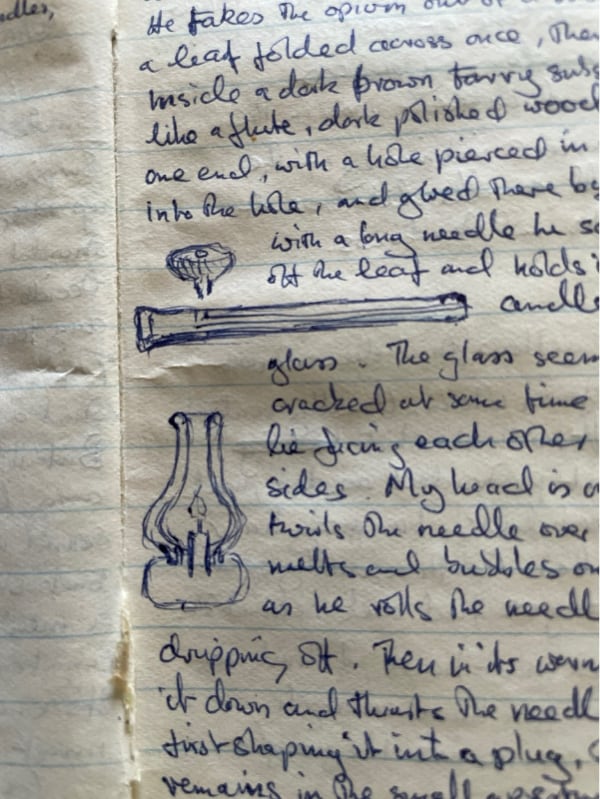
My head is on a wooden block. He twirls the needled over the flame and the resin melts and bubbles out, making fantastic shapes as he rolls the needle to prevent the resin from falling off. The in its warm, pliable state he tamps it down and thrusts the needle into the bowl, first shaping it into a plug then twisting so that it remains in the small aperture with a fine channel for air left by the needle. The bowl is then inverted over the flame, and the art is to draw the pipe, long and slow, until all the opium has been exhausted, in one lungful. I got three lungfuls from a packet but was probably short changed since four or more are usual. When I’d mastered it (not difficult) he made approving noises – “Good, good.” – but instead of staying there to appreciate the effect we were ushered out into the street. All I felt was a prolonged haziness, no tension, which lasted till bedtime but much diminished. Following morning felt a slight undertone of apathy but not enough to stop me from doing my business. The main pleasure and interest was in the ritual and the conspiratorial intimacy of the atmosphere in that small, candle-lit box of cream and brown highlights and shadows.
Th’an, usually dressed in yellow, short sleeved vest and baggy cotton trousers. Usually seated, he flopped a little to the left with the shirt askew at the neckline. His feet protruded as dark and rather scaly objects in sandals. Iron grey hair in a real short-back-and-sides. Mouth usually open in an O shape, with the tongue tied back behind it.
“To go around the world you must have, I think so, five thousand dollars. Only then can you have enough, because I am too old. If I can go into the jungle or the desert I will die. “
As he expressed a sad thought, even though it is a purely hypothetical abstraction his face shows deep melancholy for that moment. It is in fact one of the great faces of my life. My Quasimodo.
I don’t know about you, but it feels very strange to be writing, gardening, cooking, drinking and laughing while the world around us seems to be rushing to a confluence of disastrous outcomes. It reminds me of when I was locked up in Brazil, with a not unreasonable expectation that they might “disappear” me. I found that I could only be really afraid for a few minutes, that you can only sustain it for so long before you start thinking of more enjoyable things. So I can easily imagine us all going laughing into the apocalypse. Right now I’m scared, but soon it’ll be time for dinner.
[I forgot to mention that a few weeks ago I dinged my scooter (and myself) doing a silly thing on a hill in the village. We met a concrete wall, at very slow speed. It was enough to loosen the left mirror, scratch the screen, and hit a nerve somewhere in my left hip. I was persuaded, against my will, to get an X-ray. The nurse asked how it happened. Then she asked how old I was. I told her and she flew into a temper. What was I doing, at my age, riding a bike? I said, against the evidence, that it went very well – “Ca marche tres bien, merci.”
The X-ray produced nothing. The nerve pain has gone. I’m fine, but the mirror is still all over the place, because I couldn’t figure out how to fix it. On Thursday I was invited to lunch by three bikers – Paul, Paul and Pete.
Paula and Paul are two Brits who live on the other side of France. Peter Clark is my friendly neighbourhood Kiwi mechanic who said it will be easy to fix the mirror, next Thursday. So everything, as usual, has worked out fine. Just thought you’d like to know.]
Adrienne’s House, Kata Beach, 17th June 1976
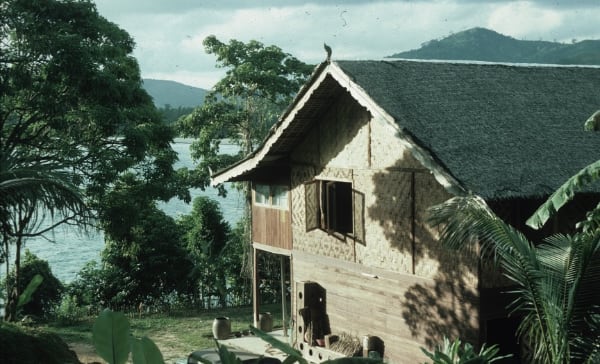
During my first two days I continued shaky and depressed, constipated, tired. On the third day I suddenly felt solid and ‘whole’ again. I know what it’s like to feel whole. Before this my separate parts were not working together, and I felt very vulnerable.
On Monday went to A’s shop at the resort. Saw a silver thimble with set stones that seemed good for Jo. Then became intoxicated by a set of bronze cutlery in a case with bronze handles.
Spent part of Tuesday wondering about it but felt that I would buy it. On Wednesday A & A left on a bus for Bangkok, with some trepidation when one of the regular buses was stopped by bandits and robbed. Paid for the cutlery. Saw them off. Alice gave directions for Nepal. Brought car back. The other two went out. I drank a bottle of beer and had a period of euphoria, considering my novel.
It also came to me that my proper position is to do and say only what I think is right and true, and if there is any part for me to play in the lives of others, then the call must come from them. Futile or destructive to plan participation.
Interesting, says Alice, how the way people travel reveals so much about them.
Here in Phuket an insect whistles in the heat continuously, like a kettle boiling in Ladbroke Gardens.
The English Hippy coming down the trail [in Nepal.] So pale, then he sees a bit of colour on his skin. “You’ve got hepatitis,” says his friend. “Really! I thought I was getting a tan at last.”
The world is kind to those who know how to be kind to themselves.
On my last afternoon walked up the hill behind the house and over the brow to look down on another smaller bay and green water breaking on the long gently inclining beach like lace ruffles on a silk shirt. Passed a small hut at the top where some young boys and a dog were busy. On the way back the eldest boy called “You.” (A very short oo sound) and the smaller ones now clustered in the doorway chorused after him. He held a green mango and proffered it with both hands before him in a supplicating attitude, pushing it towards me in a series of short thrusts. I walked up to accept it (wondering what I could do with it) when one of the other boys call out “One Baht.” That stopped me and my smile must have changed to surprise. “No, no,” he called, with real consternation, apparently overwhelmed by what he had done. I took the mango. It was the first, and probably my last chance to accept an unsolicited gift. Tomorrow, I’m afraid, there will be no free mangoes in Thailand. The Thais have been renowned for centuries by their spontaneous small acts of giving.
Friday 18th June
From Kata. Rose at 7. Packed. Ate eggs and coffee. House has been a bit desolate since the A’s left. Sorry it’s over, but glad to leave. Lost way slightly into town. A soggy-looking sky promises – and delivers rain. Lose my rain jacket at the Esso station. Ride back 12 miles to get it – but gone. A car driver picked it up before the Esso man could get it. Then I saw the green car pass me later in opposite direction. Missed both the sights I’d planned to visit but may have seen the cave outside Phang Nga.
Many small groups of rubber trees along roadside with latex mats hanging on wooden rails outside houses. Huts, rather. Nothing much in Krabi. Go on to Trang.
Enthusiastic schoolboys send me to hotel. Go walking in town. Buy umbrella, 53 baht. Find eating house. Fried chicken noodles with fat shrimps– 15 baht. Beer, 20. Coffee,4. When bill comes, noodles reduced to 10, beer to 17, coffee to 2, cigs and matches,7. Amazing spontaneous deductions. What to make of it? Very cheered. Go to bed at 7pm. Much too early, but tired. Woke up in night to write this. Two people are honking – not snoring.
Saturday 19th June
Up at 7. Coffee. Dim sum with meat filling., some tasty little rolls of prawn & dough, and sweet fried dough. The day seems to start well. Then I notice an unusual slackness about the tank bag. [The bike was parked inside the hotel for security.]
Scarcely able to believe my suspicion, but it’s horribly true. The camera has gone. That awful hostile emptiness where something should be is echoed by the hollow in my stomach. From the first moment I know it’s gone for good. Why even mention it? Why not just wheel the bike out into the sun with a satisfied smile, and leave.
But I have to go through the performance. Gradually the smiling faces around me change to more suitable expressions as they come to believe that I’m serious in my pantomime. The manager comes. He calls his staff one by one and upbraids them for failing to notice the thief. He knows better than I that it’s just a ritual. Then finally he comes to me and expresses his distress in the most ritualistic and, to me, amazing gesture of all. Body bowed forward, face raised up to mine, hands together in prayer, a strange smile with the corners of the mouth drawn down, lips tight across the teeth, nodding, “Sorry, sorry.”
Twice he does it. I’m so impressed that later, trying to keep the picture clearer in my mind, I can almost justify the loss of the camera by the experience. If only I could. In my distress my arithmetic goes to pieces and I’m confused by the currency which is a low denomination anyway. I insist that the camera is worth 100,000 baht. Afterwards I wonder whether I left anyone pondering what kind of camera it was that was worth $5000.
But there’s no denying it. I have been finally stripped of all my heroic, swashbuckler’s aura and reduced to the common tourist that I am. All tourists have their cameras stolen in Thailand. Well, I haven’t met one yet who hasn’t. And I’ve thoroughly joined that sorry legion of trippers. First the jacket. Then the camera.
Riding on, my mind turns the matter over and over, looking for its significance. An unusual number of near misses – two dogs and a kid goat come within inches of my front wheel. A lorry drives me into a patch of wet, newly laid tar and stones – the bike feels unstable again on slow corners. I feel the need to muster up more strength and resolution than my low reserves can provide. Care, patience, good humour.
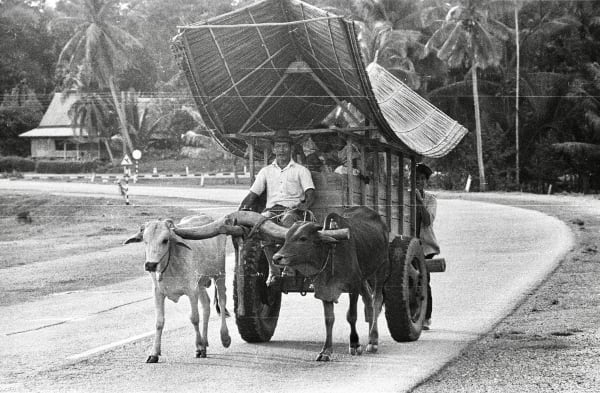
I’m passing blind through the countryside. No excitement, no interest. A pity. I thought I’d recovered it with my health. It must come back again. I still have the other camera. Only one to look after now. And the important lenses I still have. Will the ST stand as insurance? Who did I have that conversation with? Was it Mike Randall? And if the camera – what about the tape recorder? [I lost it in Ethiopia.]
Must remember the use of motorcycles in Thailand. Three or four people sandwiched on a small Honda is quite common. It’s rare to see one person alone. Here’s a complete family. Three adults, a baby on the back and another one stuck between them somewhere. And not going slowly. No helmets. And girls driving. Saw one girl fall off the back. She spun and tumbled in the air. Seemed to be all right though.
[Next week: Down ‘Smack Alley.’]
[Everything in these notebooks is, of course, personal, but some of what I wrote is so intimate and revealing that I was tempted to edit it out. I have resisted the temptation because the introspection that plays out inside the helmet on a solitary journey is a valuable part of the experience. My thoughts and judgements were necessarily fleeting and not what I might think today.]
From Haad Yai, Saturday June 12th
8.30 am Breakfast seems too expensive. Can’t get map. Ride out. Find myself trying to make comparisons between SE Asia and South America.
Somewhere there’s a conference to improve the world’s water supplies. Impossible. Would ruin the soft drinks industry.
And in Vancouver, Peter Shore at a housing conference criticises new building projects. Says emphasis should be on rehabilitation. Here they can’t tear the old buildings down fast enough. In Singapore one high-rise apartment every 15 minutes. Impossible to stop. What would the bright urban Chinese do without these projects to pay for their Mercedes, stereo and whisky?
Thai landscape looks cleaner than Malaya’s. My tinted goggles colour the rice paddies to look like a Singapore Airlines ad. Remember the hopelessly incongruous Western cigarette ads in Chinese coffee house – snatches of Henry Mancini orchestrations between Chinese messages on radio.
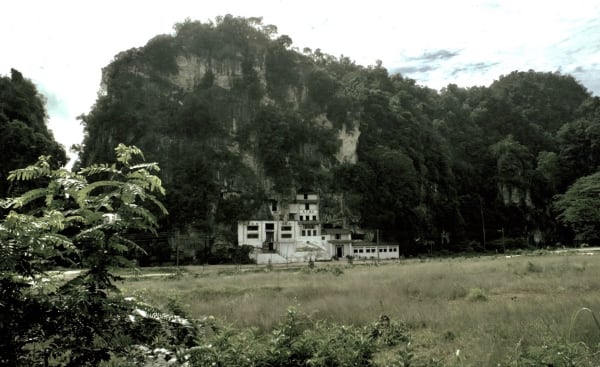
Pass through winding mountain passes. Soldiers around. Then to Trang. Stop for coffee and cakes. Previously ate a poor pineapple. The woman who sold it to me was so ashamed to take the money that she thrust another pineapple upon me. The last part of the journey was through gathering masses of those stumps of rock thrusting through the earth’s crust, with vertical walls eroded by falling water, trees and brush growing on every available ledge and from every cranny, and above all on the top so that they somehow seem crowned with green wigs. While others come to resemble each one a huge tree in a forest of giants. The road curls among these rocks in a series of ever tightening cavortings leading many drivers (in my mind’s eye at least) to a vortical doom.
I still find my handling a trifle unsteady when not under power. But nothing like what it had been earlier. Then I’d had a feeling of wobble so great that one, stopping at a junction, I was convinced my rear tyre had gone flat. The bike didn’t seem to want to go above 45 – increasing vibration and a sense of terrible strain. Later it occurred to me to check the alignment, not done when wheel was changed. The off-sides of both wheels were in line. I centered them and the effect was dramatic. There was much greater stability and the biked surged forward without protest.
I reflected on the damage that would be done to various parts by continual bad alignment, chain, both sprockets, tyres perhaps, even engine balance from the slightly outward component of tension.
As a result, arrived happily in Phuket before dark. I had carefully schooled myself against expectation knowing that particularly now my resilience was low. But I had not anticipated that I wouldn’t even be able to find Kata Beach. I had imagined an island with a ferry and so was surprised to find myself suddenly in Phuket, without even noticing the bridge. I rode the length of a drab-looking main street, hoping to spot a lucky sign with English subtitles. Nothing. Then I was at the end. A terminal roundabout. A couple of restaurants. Already I’d realised how little English is spoken.
Last night I’d battled to understand a young man in the restaurant. (He looked so much like the early Mike Molloy [an acquaintance from my newspaper days] – youth with dignity – eagerness with gravity) who wanted to tell me about something at 9 o’clock that I could go to. When it was 9, he came up and said “Now you can go. When he realised I wasn’t going it must have suddenly penetrated that I hadn’t understood a word. All my nods and grunts of encouragement hadn’t meant anything except Jimmy Carter’s self-centered desire “not to irritate.” He became all formality and distance.
In Phuket I found no-one who spoke even as well as he did. The word Kata itself, pronounced every way I could (correctly it sounds like “cutter”) left faces bright with incomprehension. Then at last somebody asked somebody and came to point me back into town with talk of “five ways” which seemed to be a roundabout. Then I found an expensive hotel with a Chinese receptionist. She did her best to dissuade me from going to Kata. “It’s a long way she said.” (It isn’t). Then she produced a map. “My hotel is here …“ For five baht.
At last I was on my way. Even so, the directions were wrong. But fortunately I asked again at the crucial crossing and got the right advice, to follow a dirt road over two brows and down to the beach hut, coffee shop.
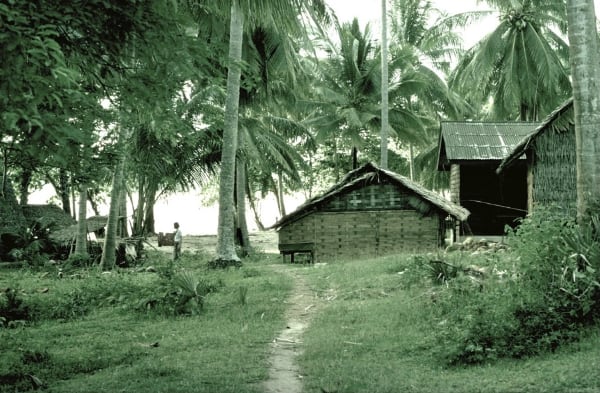
Kata beach, in 1976
A native came to greet me. I took him to be the proprietor when he offered me a drink. I took tea. Then he turned out to be the schoolmaster Hans had sent me to. And as we talked Adrienne came past in a Datsun. So, abandoning the bike went with her and companions (son Daniel, American Carol, Australian Alice) to another beach to eat fish and stuff. Now I had to admit the beaches were very welcoming – feeling I hadn’t known since San Andres. I was less certain about the girls – particularly the American who had a pseudo-fey act and strained after impossible similes – the sky she said, rather conclusively ¬– was like Beethoven’s Fifth Symphony.
Alice, argumentative and self-assertive, drew the same attitude from me (or was it vice-versa?) But at last it became clear that we could all co-exist, mainly because Adrienne seemed to glow with equal fondness at all of us.
Am much aware that I have to recover a great deal of moral strength to continue this journey. Physically I’m poor too. Constipation and putative piles make a poor combination, and my sequences all seem dislocated. There’s still a midget swinging his tiny torch around the edge of my right eye, and that ultimate fuzziness of vision is certainly depressing and disorientating.
Monday 14th
Reading “A Thinker’s Notebook. Posthumous papers of a Buddhist Monk.” And I suddenly realise:
I DON’T BELIEVE ANYONE
How long has this been true? For a very long time – it certainly goes back to my schooldays. When and where was I betrayed, and by whom?
And it comes to me now, as the immediate next thought, that the only person I know that I would be prepared to believe is Jo. [The girl friend I left behind in France.]
This not the same as believing in someone.
I believe in Carol, for example, but only in what she is – not in what she says or does.
This leads to a clearer perception of my love of ideals and systems, then my feeling for objects and wildlife and my eagerness for experiences. Always looking for the foundation for some credibility. And myself. How much I want to believe myself.
It is notable that no successful politician ever exhibits the qualities that thinking and feeling people associate with greatness. When the word genius is used in connection with elected politicians it is always understood to refer to a special and elementary scale of values suitable for mundane achievements.
I am accustomed to hear from people who stay in one place that there is no more to be learned from travelling around the world than by scratching in one’s own backyard. They seem to ignore that the proposition would be true either way around. A chacun son gout. (i.e. travelling seems to them a waste of effort.)
In fact the first requisite is to keep up the scratching. For a limited (though long) period of time I have found that travel stimulates me to scratch, while those who stay at home and talk about it generally have very smooth backyards.
There are of course other benefits of travel which cannot be had so easily at home, offering so much more of life’s furniture and ephemera, with which to clothe and refresh one’s ideas. And to travel alone is not unlike inhabiting a moveable monastery – attachments can be few. Often as I travel and feel my isolation I wonder whether I am moving towards a life free altogether from attachments or, on the contrary, am learning to value better those things and people to whom I wish to be attached once more. To me it is like the difference between meat and vegetables.
Wisdom is of the moment. It cannot last, but quickly decays and has to be renewed. So ‘wise people’ are always being caught out in acts of folly. While wisdom comes out of the mouths of babes. The wise “wise man” knows when to retreat into doubt and ignorance. Thus ‘no man is a hero to his valet’ and no man can be a guru to his wife. And heaven help him and his children if he tries to be a guru to them.
“The futility of life and the world” The man who insists that the violin in his hand is actually a hammer will soon find the violin futile.
PHUKET 13th – 18th June
Kata
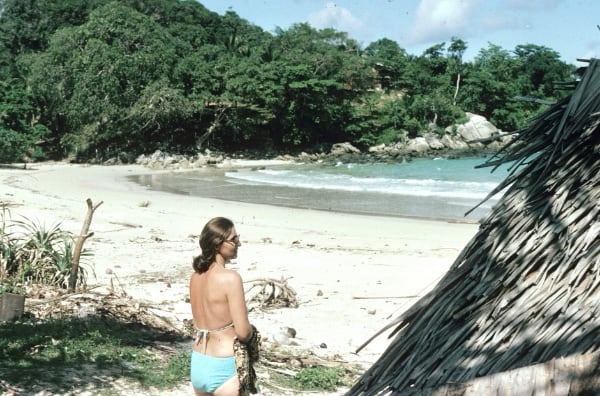
Adrienne and the beach
Half a mile of curling beach facing NW with small island at mouth of bay. Heavy vegetation on slopes, coconut palms on shore. Sea is green (shallow) and blue (deeper). Road enters at West end – two huts selling food and drink. Other huts at East end, and a generator. Fluorescent tube light and oil lamps. Water buffalo. Chickens. People moving slowly in sarongs. Fishermen along the beach at night, with torches among the rocks at the East end. Soon a prince is to build a hotel, and all will change. Now the schoolmaster rents out a bungalow, (e.g. to Hans.)
Alice: a blonde Gunilla in search of a title? Everything she says is extruded with great force, otherwise no-one will hear or believe – herself too, perhaps. Incredible, amazing, totally and completely. She and everyone else is always freaked out, spaces filled with “you know” often repeated. Good head, intelligent, greedy, ‘Jewish nose,’ square forceful jaw, neck round and pillar-like, set slightly forward on soft round shoulders. Too fat, but not obese. Australian originally, from Melbourne. ‘Ran away’ at 17, to Israel. Kibbutz, university at Jerusalem, BA in variety of subjects – major English. Now thirtyish. Worked in Hong Kong. Essalon where she met “amazing, incredible, high energy, powerful people.” [Llama Govinda, Feldenkreis, whose speciality is helping people recover disused faculties. Ruthie Allen, his disciple, etc.] Also Nepal, monasteries, courses, If any of this has planted a seed will the shoots ever emerge? Smokes heavily (so do I). Arrived at Phuket resort very debilitated. Met Adrienne and on the basis of mutual acquaintances, came to stay. Is much attached to the idea of “people chain.” One feels that without a mutual friend one has no credentials. Ours was Jane Raphael in Cape Town.
Dan: heavy, superficially benign, (21), but obsessed with his own problems – with some reason. Son by a previous marriage to an American in Louisiana but does not know his father. (Ceasarian birth perhaps – Adrienne has the scar but might be by other operation). Has few accomplishments but parlays them wildly in conversation. “Do you speak Thai?” – “YES, FLUENTLY!” Plays guitar – has never been able to keep a place in a band. – “I’ve played in a LOT of bands.” Likes buying machinery and taking it to pieces but, says Adrienne, someone else always has to put it together again. Came on very knowledgeable about Triumphs. He had one – knows the man with all the spare parts in Bangkok. Likes to talk about his problems – you can see him settling in to wallow in them – but cannot ask for help and finds it irrelevant when offered. He knows, you see. He wants to be a racing driver. Might kill himself at that, or some other way. Hope not. There’s a good man inside. His recent hernia operation is useful to him also. He used to lift cars with one hand. Paralysed.
Karen: Whatever is inside there she’s determined to hide it for forever. Make-up, blank eyes, frizzed hair, head band, clothes, gestures. She hangs tight and loses her balance constantly. Has learned to play and sing with a guitar – like a machine. She is a permanent disturbance, like generator – but produces no light.
Adrienne: Is French, from (somewhere) near Nancy. First to Louisiana where she met Paul, a Swiss who joined the US Air Force, flew planes, crashed one, and was grounded. Studied in the South on a GI Bill, later went into advertising in Thailand (Nestlé). Over ambitious, ulcers, eventually changed to hand-crafted jewellery exporting. Both embraced Buddhism. She pursues her knowledge and development on a daily basis, and has achieved much calm, enough to maintain tranquility for all these dissonant elements in her house. She likes to draw meaning and morals from life but can also stop talking. Often hums a few bars of something to displace the energy.
