News from Ted
This flurry of flights all over the place is nearly over. The last one, to California, starts on Monday, with a train to Paris, a hotel stay because I can hardly ever find a train to meet a plane, then an eleven hour flight to San Francisco.
When I say it’s all too much, people mock me. “Oh you poor thing, having to go to California.”
Well, of course California is fun, although it’s not the Hollywood and beaches bit that everybody seems to have in mind. It’s a remote valley further north where most people imagine Canada to begin, because very few realise just how far north California extends. Anyway all of that’s fine. It’s the airport stuff I’m fed up with.
The first trip to Quebec, at the beginning of June, was really enjoyable. I went to an opera and ate some lobster, But more to the point, it included two cruises on the St Lawrence river, and it opened my eyes to the huge and fascinating port activities at Montreal – 16 miles of cranes and silos and godowns all along the river banks. So much of the old nineteenth century ironwork is still intact and those silos are immense even though most of them, I’m told, are obsolete They stored the grain that probably put my grandfather out of business when he was trading wheat out of Romania a hundred years ago.
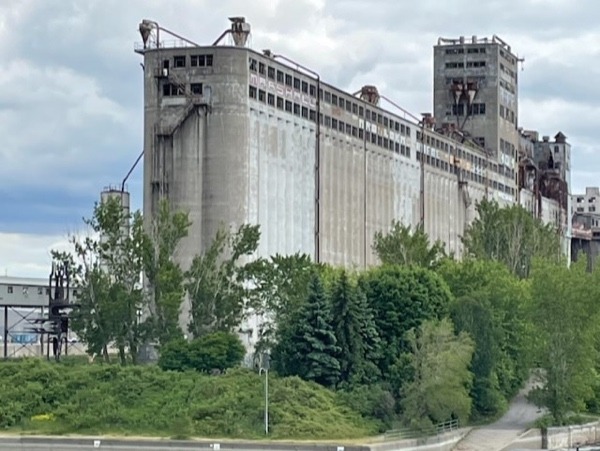
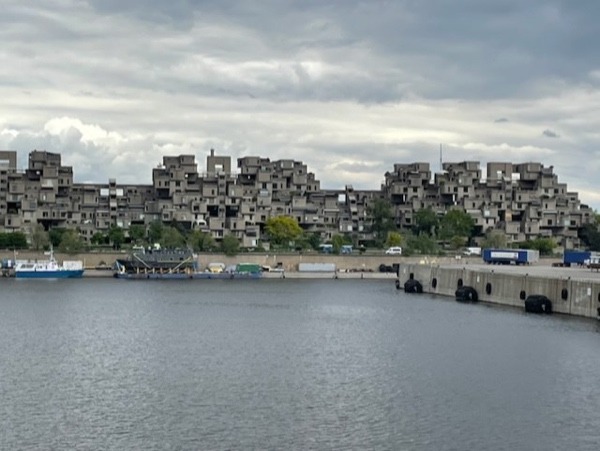
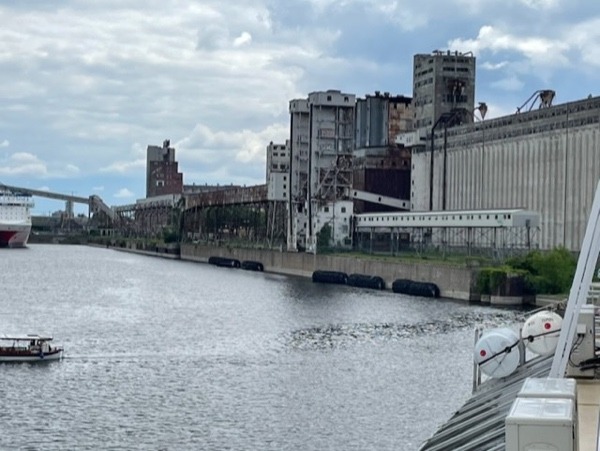
The second brief trip was to England for a bikers’ meeting, the Adventure Bike Rally at Ragley Hall. I talked and sold books, and found myself sitting opposite a Vintage Bike Stand, so I got myself a picture with a Brough.
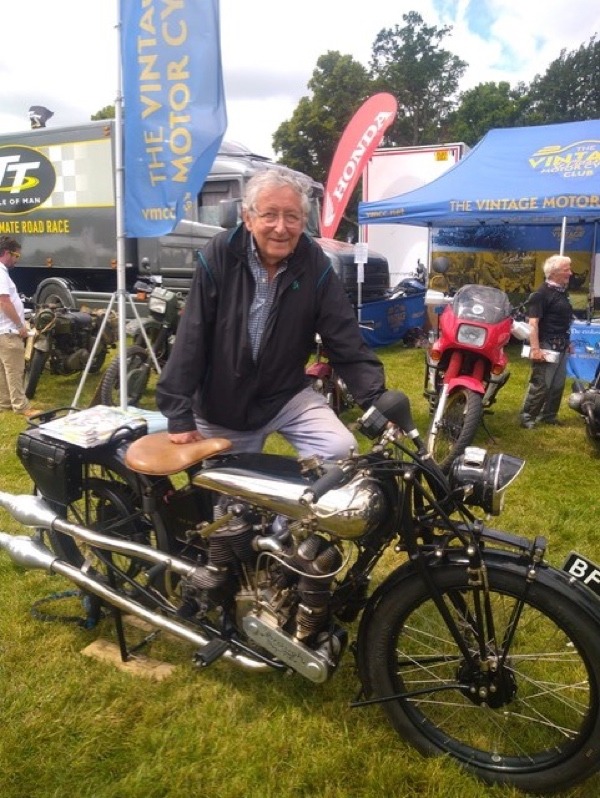
My own vintage bike, the one in the museum in Coventry never made it to the rally. I was hoping to find that frying pan in the pannier and maybe fry an egg or two. But that story (check out last week’s blog) has a weird twist to its tail. The frying pan that Bob Newcomb’s dad said he lifted from my bike wasn’t my frying pan at all. I remember mine very well, it had a handle you could fold into the pan. I wonder if I’ll ever hear the rest of that story.
I’ll be gone for three more weeks, but don’t let that stop you from ordering books. if you can just wait a little I’ll get to them as soon as I’m back. So, if you possibly can given the horrible things that are happening in this world, enjoy your summer.
I spent the last week in the province of Quebec, seeing the sights and drowning in music. Bikers can be other things too, writers, musicians, plumbers, blood donors and blood couriers, cops and robbers. Because I was there to listen to the first ever production of an opera written almost 200 years ago, I met several musicians and conductors. Of course none of them had ever heard of me and none of them rode bikes. I would have liked to be introduced as a writer, but what fascinated them, what they really wanted to know about, was my journey round the world. I had to work hard to get my books into the conversation. One of them, Louis Lavigueur, dashed from the dining table to bring back a newly minted copy of “Zen and the art…” which he was planning to give to a relation who did ride bikes. At last I had an opportunity to explain that I, also, had written a book. I told him that it was probably Pirsig’s book that gave me an extra boost because it was published just a year before “Jupiter’s Travels” and so far as I know it was the first book involving motorcycles that achieved critical acclaim among reviewers of literature. Up until that moment, it seems to me, anything to do with bikes left an oily smudge on the desks of book critics.
I had to admit to Louis that I had never properly finished reading Pirsig, though I had started several times. My problem was not with the writing, but with the idea of Quality being substantive rather than descriptive. Jim Martin, who does the Adventure Rider Radio Podcast, wanted to do an episode about it, but it involved my having to read it again, properly, and up to now I haven’t had time. Or maybe I did have time but was somehow reluctant. Actually though, later in the year I might feel more like it (Jim, are you listening?)
This year is a big turning point for me. At 92 I think it’s time to say goodbye to my bike, and I’m finally selling my place in California, which is going to occupy me for most of July. There are only 3 acres left of the 40 I once had but it has three houses on it, two of which I built myself, and a huge amount of stuff which will have to go because I have no room for any of it.
I will have to fly there at the beginning of the month. I’ve only just flown back from Canada. On Thursday I have to fly to England, for the Adventure Bike Rider Festival at Ragley Hall. Too much flying ain’t good for ya. I’m beginning to feel it. But I went to the rally last year, they made it very comfortable for me. And I get to sell books and meet the people who read them.
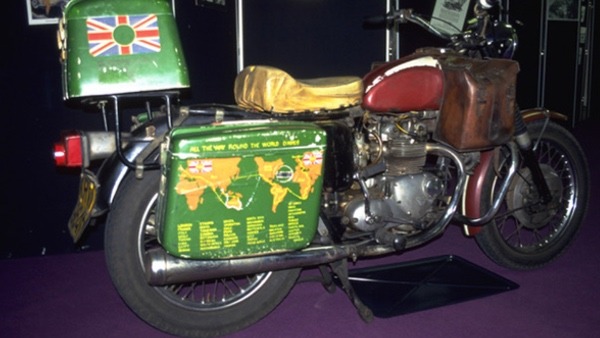
My good old XRW964M will be there, and in one of the panniers I expect to find a frying pan. Not long ago I got a message from a man whose father had just died. Apparently among the things he left was this frying pan which, he said, he had stolen from the pannier of my bike when visiting the museum in Coventry where she normally sits. The son has, he says, recently returned this frying pan. We shall see when I open the pannier.
Maybe, when enough people have crowded around next weekend, we can have a Grand Unveiling. But I don’t think they’ll let me fry an egg. Will they?
PS: The man who’s dad lifted the frying pan has just sent me a message. He’s not a biker, but he says he hopes to be there at Ragley Hall to meet me. If he does come we really must fry an egg.
Still in Managua
I spent two more days with the Fowlers. On the second day the husband, Peter, returned and they organised a party including assorted foreigners, mostly conventional businessmen and wives. One very impressive Nicaraguan woman, a broker, made fun of the others for being dependent on their bosses, provoking some uneasy laughter. I wondered how they all felt knowing that they depended for their livelihoods on a murderous dictator, Somoza, who was supported, in part, by US interests. It was President Jimmy Carter who eventually helped to bring him down four years later. And President Ronald Reagan who would have been happy to reinstate him.
May 18, Sunday
Left Managua for Tegucigalpa [Honduras]. On the way tried to find the centre of Managua. Failed. [The city was all but destroyed by an earthquake in 1972]
Saw crater lake – not too impressed. On to Léon by south road but missed most of Léon. Too much hurry. Very hot. Border at 12.00. Easy but expensive. $3.50 in all. Had too little petrol to reach Choluteco. Bought gallon from café. Met two plain clothes police. Pleasant and helpful to me.
Much trouble in Tegucigalpa, first to find telephone, then to find that Roy Smith [friend of friend] was away. Then to find that cheap hotels either didn’t exist (Hotel Eden) – had been pulled down (Hotel Americano) ¬– or had no water (Hotel Astoria). Finally in despair called Smith’s parents again and was invited to stay. Impressive house in Avenida La Paz, 4 cars in garage. BMW, Mercedes, Lincoln Continental and Oldsmobile. Smith sr. a sluggish fellow of about 50, wife nervously Latin, anxious to please.
I’ve been getting quite well-defined impressions of society in Nicaragua and Honduras, apparently based on the scantiest of evidence. Am I inventing it to satisfy myself? Obviously, a lot of information enters my mind subliminally – expressions caught on faces as I pass by, mannerisms, driving habits, the style of advertising, the style of officials at borders. Then I might meet one or two people or observe a more prolonged incident such as the one at the border. My experiences are checked against those of others I meet. But all is subjective, relative to my own likes and needs. Aesthetically the Nica male is displeasing to me; short, stocky, gross features, quick to put on fat, I think of him as arrogant, boorish, corrupt, brutal. But what does he think of me? Arrogant, feeble, effete, inhibited, pretentious?
Honduras! Ad for cigarette shows male smoking on beach with two ladies courting him. They don’t smoke but assist in the ritual. Makes me wonder whether firms, like Kodak, who have been advertising a long time, use their Thirties American ads for Central America today? Looks like it.
Here’s a combined ad for a beach resort and Kodak.
“A perfect occasion to employ a Kodak camera and film.”
Nica Honduras border: Everybody wants a dollar. On Nica side Customs and Immigration each take 5 Cordobas (7 to the dollar). Hondurans have three departments – Immigration, Transit, Customs. They take 1 Limpeira, 1 Limp, and 2 Limps respectively (2 to the dollar). The transit man does nothing at all but write out a receipt. The others don’t give receipts.
May 19th
Straight to Copán [A famous archeological site of Mayan culture.] Easy ride until La Entrada, then 60 km of dirt (not bad) and a puncture. Big bent nail, sharp at both ends. One and a half hours for whole job of changing tube. Audience inhibits my swearing which may be just as well. Arrive Copán after dark, but bike goes well over loose stuff. Hotel Marino annex. $1.50. Met four US girls in pairs, Tammy and Mary are Peace Corps social workers going home from Colombia. Tina and Judy are older, more interesting. Tina gave up art to wait at tables and travel. Judy (ex-married to Honduran in San Pedro) is buying [ethnic stuff] seriously, to sell in US.
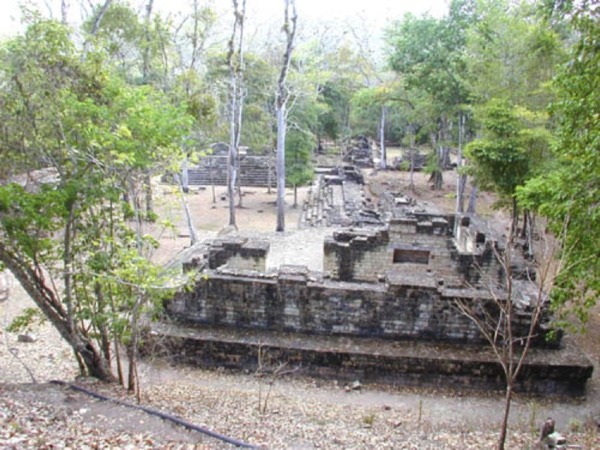
The ruins are undeniably beautiful in their setting. Bird song is wonderfully varied, and I wish I could record it. Took many pictures – but now I’m very convinced the light meter is inaccurate – doesn’t correspond to the readings I took earlier on trip. Bar and drinks seem very expensive. Town is without water. But they’ve tried to make it pretty.
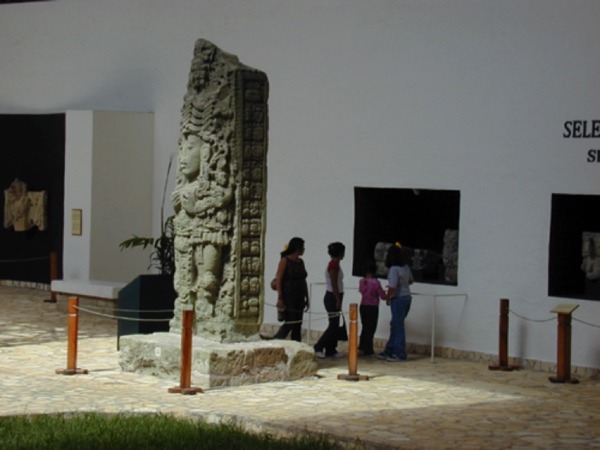
There’s a small museum with some stone figures (the frog and the turkey). Skulls with teeth inset with bits of jade, and obsidian tools. A very expansive old gent rambles on about it all.
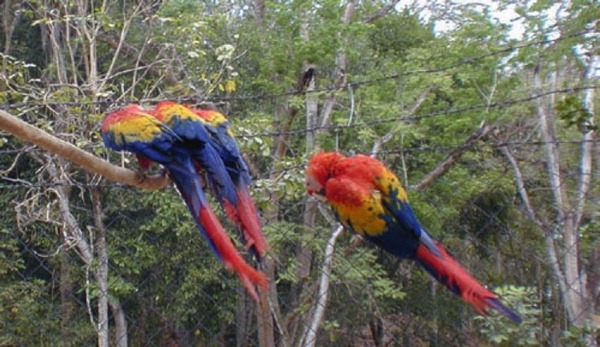
Of the girls Tammy is the most eager, but Tina the most interesting. Her very determined way of life seems laudable, if painful, and I gave her my home address in case she comes to Europe. She in turn gave me an address in California of two boys who run an “Earth Shoe” branch and have made a fortune.
Every meeting now emphasises my loneliness. I sat in the plaza alone that night and as I do more often now feel hungry for companionship and/or love. How much of it is unrequited lust I don’t know – but I suspect a one-night stand would do little to help.
A man walks towards me across the square. His silhouette is a perfect Gary Cooper cowboy – slim, bow-legged, cowboy hat. As he emerges into the light he is young, vacant-faced and unworthy of the image. Ridiculous image.
The fellow who came to the ruins with the girls and showed them around was pleasant, intelligent. Wore rather fancy clothes – trousers with a sort of lamé net sewn over the blue material. Had many teeth missing. I traipsed around with them. He showed us bits of obsidian, slivers used for cutting. Also that strange plant, sensitive mimosa, which curls up when you touch it. I thought he was going to want money – but he just went off to lunch and left us.
Tomorrow Guatemala.
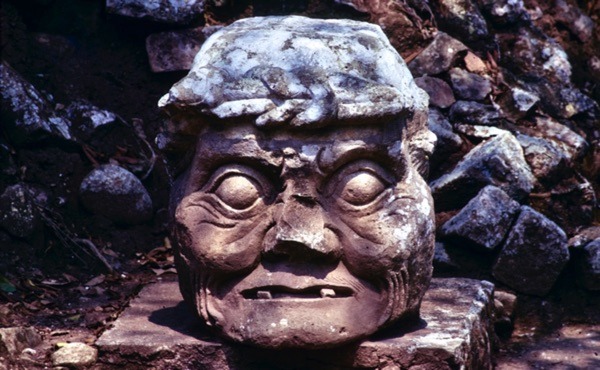
I liked this old man of Copán. When I went back 25 years later he was still there, an old friend, but with a roof over his head.
In May 1975 I was making my way up through Central America. After 18 months on the road, in Africa and South America, I was almost half way round the track I’d set myself. Feeling a bit weary I was bedazzled by the prospect of California and, moving faster than I should have, I crossed into Nicaragua from Costa Rica.
May 11
Drove up to see volcano Poas. Was lucky that mist cleared just enough to get a good view and take pictures.
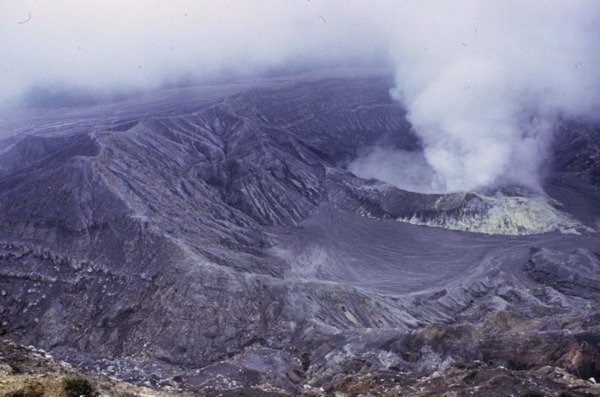
Then visited Michael and Cherida Cannon on their 480 hectare farm of dairy cattle. Holsteins – with mechanical milking machine from N.Z. The bull and his mounting block (the bull’s broken penis). Two gallons of diesel an hour to generate their electricity. Then visited Andy, the medic. Building his log cabin. Land up to $1000 a hectare. Very wet. Horrible storms. 7000 feet up on the Caribbean side.
[Of all the central American countries Costa Rica is the one that attracts by far the most American expats, and it goes out of its way to make it easy for them. In the relatively short time I was there I also made it easy for myself by hopping from one to another. They told me I should visit the Santa Rosa national park on my way north.]
May 12
Left early for Santa Rosa, stopping only in Liberia. Dry all the way. Heard later that rain bucketed down at San Jose.
Santa Rosa at midday. Spent afternoon setting up hammock with fly sheet and mending mosquito net.
The Malaria Inspector came by, on a small motorbike, with a sterile mask. He makes a call every fifteen days to make sure that people fumigate their homes.
Enormous Cebu bulls strolling through to waterhole. They are very timid.
The Park’s director came over to see who I was. Young man, zoologist from San Jose. Said he was waiting for results from Michigan about a scholarship. Told me about Santa Rosa’s significance as hide-out for a volunteer army in 1855 when, led by an assorted group of 4 Europeans, they beat a much larger army from Nicaragua and changed the balance of power in Central America.
In the night I met a small animal close to my camp. About 18 inches long, black with white stripes from nape to tail tapered snout, tail with sparse hairs, erect, blinded by torch, it moved slowly away, but turned once when trapped by tree roots, and jumped up and down on all fours to frighten me.
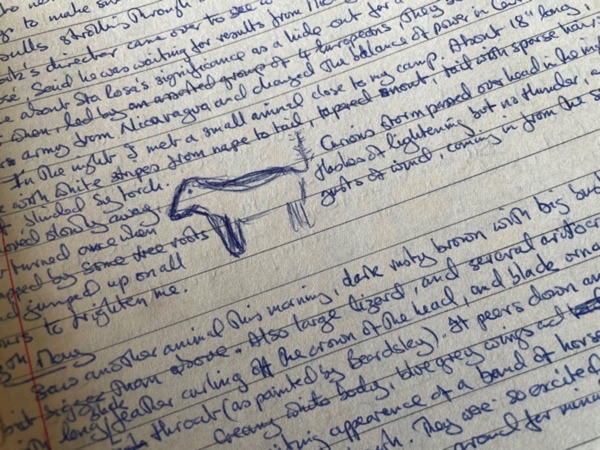
Bad drawing of strange jumping animal
Curious storm passed overhead in the night, flashes of lightening but no thunder, and gusts of wind coming in from the sea.
May 13
Saw another animal this morning, Dark rusty brown with big bushy tail. But bigger than the one above. Also large lizard and several aristocratic birds. One with long black feathers curling off the crown of the head and black ornamental band round throat (as painted by Beardsley).
It peers down and shrieks insolently at one. Creamy white body. Blue grey wings and fantail. Almost a foot long.
Exciting appearance of a band of horses galloping past to the water trough. They were so excited that they couldn’t stop when they arrived and were dancing around for minutes before they calmed down sufficiently to drink.
Left Santa Rosa at 10.15.
Frontier (with Nicaragua) at 11.15. Easy passage. Then stopped for beer and Coke. Very hot. Saw Nicaraguan male with huge paunch and fleshy face picked up by hitch-hiking woman. She wore a blouse of a net material, and trousers, with just a bag slung over her shoulders. She was quite good-looking, with an expression that invited attention without soliciting it. He wore an open white shirt, dark trousers, whiskers. Terrible studied impassivity. Had small truck. He was going to leave when she walked to the truck and whispered something. He came back to the table and waited for her. Then they left together. This scene became a prototype.
Took road through Granada (on lake Nicaragua) then Masaya, and finally found Susan Fowler (Pat’s cousin) in suburban estate above Managua. Quiet, intelligent woman, occupational therapist, married to US banker. Languishing rather in Nicaragua.
May 14
We went out to see the volcano Santiago. Walked a kilometre up to crater, then walked round to the opposite side. Was unbelievably impressed looking down into the cup, within a crater, and seeing the rock plasma, red liquid lava, slopping about, sometimes darkened over with flecks of black, sometimes bright cherry red, and occasionally spurting up. Like a window into the middle of the globe, full of mysterious implications – a reverse moon shot, and just as awe inspiring. We sat and looked for a long time, entranced by this shimmering, irregular fragment of pulsating energy. Occasionally, it seems, it rushes up to overflow into the cup and form a visible lava lake. What a sight that must be. A unique experience and, as at Iguaçu, I felt it justified the whole journey.
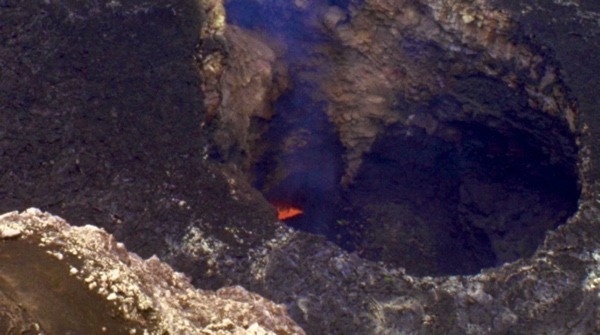
As close as I could get to the lava at Santiago
I was told that the dictator of Nicaragua, Somoza, got rid of his political opponents by hurling them down there.
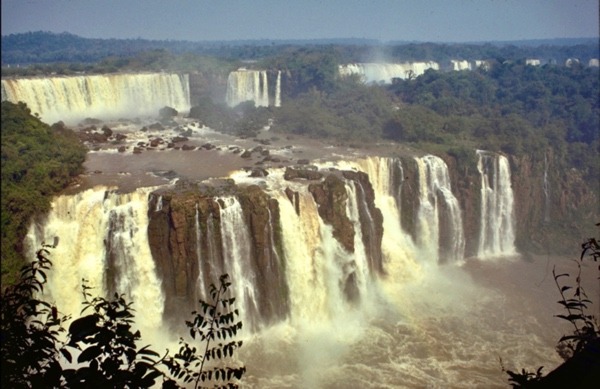
The Iguaçu Falls
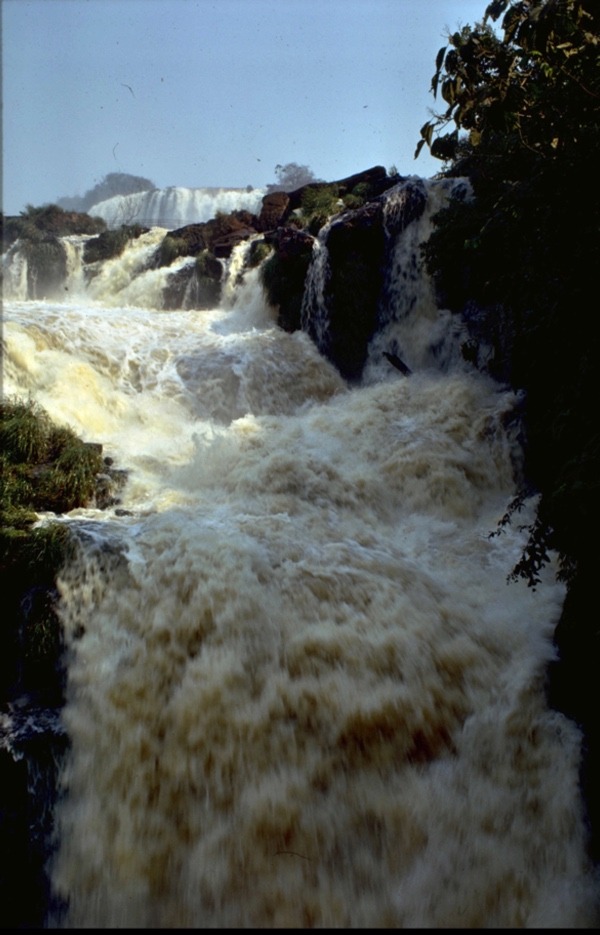
And Iguaçu again
May 15
Thursday. Wrote piece about Jesus.
[I have no idea what that refers to. I’m sure it wasn’t about Jesus Christ. It may have been about Jesus Clavijo, the padron of the hotel in La Plata, who had half his hand sliced off by machete while playing billiards.]
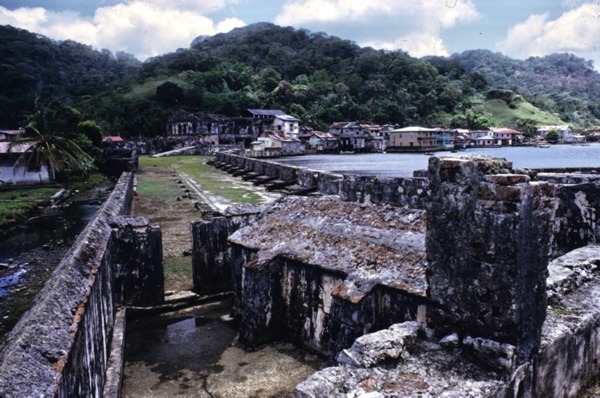
I spent a lot of my early life very close to Portobello Road, in North Kensington, so I felt a particular attachment to the Spanish port of that name.
This is where Spain counted and loaded its treasure fleets.
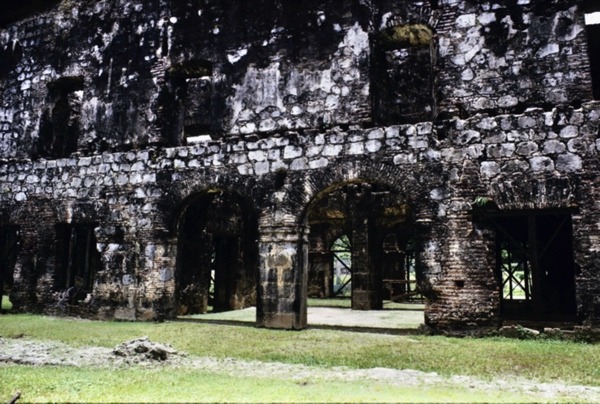
An obvious target for pirates and privateers, it was well defended. You can see the canon still lined up below, facing the Caribbean.
April 29th, Monday
I leave for Costa Rica. Very soon one cylinder starts missing. If it gets worse, it seems I may have to turn back. It’s hard to reject the idea. But the missing continues, uncertainly – worst when engine is asked to work harder. Fiddling with the HT lead seems to affect it. Plugs are white. I raise carb needle. That night I get close to border. David (a town) then Concepcion. Decide to go to Volcan. It’s wet but not raining. Volcan is nearly at 3000 metres. All lush but nowhere obvious for tent. At entrance to town are cabañas, $8 a night. Ask a young man where I can go. Eventually he suggests I can sleep in the garage, and tells me where to eat. Have fish, and converse with several Panamanians who are very friendly and interested in my journey. The garage is a porch with pillars. Good for a hammock. The man comes over to talk with me. He’s an evangelist and wants to do me good.
“What a remarkable coincidence,” he says, “that we should meet. If you had arrived a few minutes earlier or later, we would have missed each other.”
He is straining my sense of the miraculous, but he means well. His tracts are in Spanish, distributed free from some US mission.
“Sospendido por un hilo,” is one of them. “Pessada y hallado falta,” is another. [Hanging by a thread. Weighed and found wanting]. Like US advertising slogans, they are translated literally, word for word. Coca-cola – “Chispa de la vida.” [Spark of life] McDonalds – “Su classe de lugar. » [Your kind of place]. They say the translations really don’t work at all. I think this is a very good example of what is really offensive about North American intrusion into South America. Before sleeping I changed a coil on the bike to try and track down the fault. Put foam plastic in hammock against cold.
April 30th
Morning was lovely. Small dog was dashing about the garden, occasionally dashing towards me and then, overcome by nervousness, dashing off again. Standpipe in garden produced milky water. Rode off to highway, then to Routier at Paso Canoas (The frontier).
Not too difficult. About fifteen minutes each side. Then to first town for breakfast – quite a nice place – eggs, rice and meat – two coffees. Rode on and passed a petrol pump. [My principal vice, for I knew I should stop but wanted to change money first, which I should have done at the breakfast town but I was too impatient] and shortly afterwards ran dry.
The bike was burning too much gas and the cylinder was still missing. I got a litre of petrol off a laughing woman and gave her fifty cents for it. It didn’t last me. I stopped some telephone people, and they siphoned half a gallon for me.
The mountain range before San José took me by surprise. I hadn’t expected anything so ambitious – both high and long – very cold air and a lot of cloud/fog. Meanwhile I had changed back to the French plugs and the misfiring ceased. However, the provisional rocker-box plug was failing and I was losing oil over the engine, carb, and gearbox. Also overheating and possibly the two were connected.
Got into San Pedro at 4.30 and it began to rain. Stopped for coffee and watched two girls drinking tea and doing their nails by the window. One was very pretty and they both smiled at me a lot. Should have done something about it, but I didn’t imagine that I would be sleeping next door for two days.
When I came out, found Lee waiting by the bike. He was from Boston, had come down with two others – Richard and Gerry – on two Harley Sportsters and a truck.
[He saw that I’d come halfway round the world]
He invited me to stay. I thought I should try to get to Mark and Sally Beaudoin [friends of friends] but asked if I could come back if necessary.
“Sure,” he said. “See you tonight or tomorrow morning.”
I went on into town and saw the rain clouds ahead. Then o the turnpike it began to pour. The directions were confusing, and I rode around in buckets of rain before finding the address. They had moved out a week earlier. Now I was very thankful to know that Lee was there. He received me enthusiastically in the restaurant – called La Fanega – which they had bought only two weeks before from another American.
Half-pound hamburgers, quesoburgesas, pescoburgesas, machoburgesas, cerveça cruda (draught), dim light, good music, lots of writing on the wall.
[I stayed a few days, sleeping in a storeroom, and then moved on to another friend of a friend on the Gringo expat circuit, the Davidsons at their Santa Ana ranch. He was away but his wife, Pat Davidson, young and lonely, invited me with enthusiasm.]
The Country Club. Christina the impeccable gossip from Florida, with the perfect sweet American “ass” and the slightly buck-toothed cocktail sipper’s mouth, dispensing chat about the Foxes, the world’s most disagreeable couple – ugly as sin – he an alcoholic about to die – she a telephone addict. Forbidden the phone she uses the neighbour’s and runs up 6000 colones – $750 – in a month. A cosmetic surgery freak – her eyes lifted and two inches of stomach fat – eager to show her scars she drops her pants without provocation – “Isn’t she gross!” When he was ill last she hired a Lear jet in Miami to fly down and pick him up that instant. “It burns my stomach,” was one of Christina’s expressions.
From the rough and ready life on the road in 1975 I’m transported to the big rock candy mountain, a bubble of luxury kept inflated by the US Navy and its Marines.
April 15th, a Monday
Life in the Canal Zone begins on Rodman Marine Base. Thirties barracks buildings, big, spacious, landscaped – now a golf course runs through the middle. Captain John B. Mallard jr USN (that’s one down from Admiral in the US) lives in the last house of five with open porches and garage below, a fleet of rooms above.
John and Ann Mallard, daughter Lynn was nurse, is married to USAF helicopter pilot on rescue service in Iceland. Born of Russian émigré family. Wedding was Russian Orthodox in New York State. They also have a son who is about to do post-graduate work at the University of Salamanca in Spain. John is nearing fifty and expects to retire in two years or so. I don’t know Ann’s age. She’s small, grown dumpy, but very active. Hair grey, face still youthful. Saw picture of her at 18 in scooped crinoline dress, belle-of-the-ball, all firm flesh and sparkling eyes – a great catch. She has developed ideas about social work – “one to one.”
The Admiral, Blunt, is the butt of all jokes and criticism. He’s a weak man, but ambitious. They say he’s determined to get to Washington but he’ll never make it. But just before I leave he’s posted to Washington, to some office of research and development. They say it’s a meaningless post where he’ll fade forever from the sight of man, surrounded by hundreds of the same rank.
The Admiral has arranged for tulips to be brought by KLM. He wants all the officers’ wives to buy them, for charity, and Ann is put in charge of selling them. She thinks it’s an imposition but doesn’t quite see the essential absurdity of it. The tulips, when they arrive, fall to pieces. If they were plastic the petals would have been stuck on firmer, no doubt. These tulips are wear-dated.
She and all the other ladies are all disciples of the Mola cult – vying with each other for superior understanding and judgement of these folk-art pieces.
(Molas are brightly coloured pieces of appliqué, usually about a foot square, stitched together by the natives of the San Blas islands, not far off the coast of Panama. Originally they were stitched by hand but now, since the Peace Corps brought sewing machines to the islands, they are sewn by machine. Inevitably only the hand stitched ones are considered authentic.)
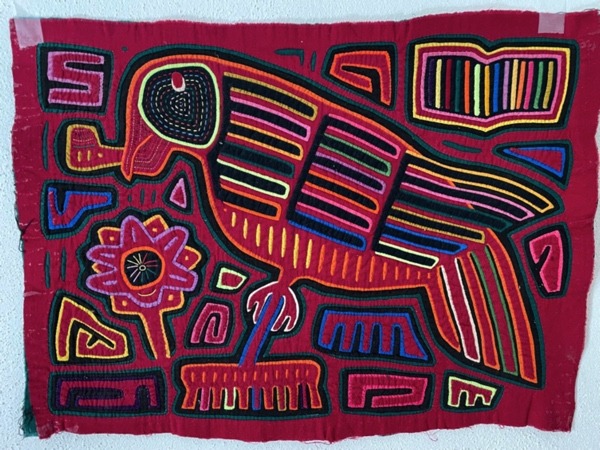
My Mola – stitched by hand, of course
Marge Asman, wife of Commander Bob next door, repairs my hammock expertly (It was ripped by Skip Kaltenhauser on the boat to San Andrés). She sews two little Molas on by hand.
The marines have movies every night, picaresquely described – “Rape, murder, pillage and violence” – and violence?
Marines are very tall in their seats, spring up as from dragon seeds to obscure the screen.
The Canal controversy is very low key here. (Panama is pressing the US to relinquish the Canal Zone to local control). Nobody seems to imagine that much will happen, although John is mostly resigned to a shift of power eventually. Vietnam finally collapses while I’m there. He has a ruminatively resigned appreciation of the faults of USA. Any criticism can be voiced in his presence and receive attention.
He wants to build a house in North Carolina to retire. He will get 75% or more of his full pay. Thinks it’s ridiculously extravagant and seems most worried about the general waste of public money.
The visit culminates in the big party with fairy lights on the green, two bars, an enormous display of warming dishes, but all the work was done by the ladies themselves. Servants in the Zone are paid $2 an hour by order, (two dollars then would be roughly eleven dollars today) and the USN goes out of its way to avoid any charge of exploitation or discrimination against Panamanians. Money buys the image.
John was in submarines – his commands were all under water. I grow very fond of them both, and they make me very welcome, always renewing their invitation to stay on.
April 29th, Monday
I leave for Costa Rica.
PS: Some of you were intrigued by a remark I made in my notes, a few weeks ago. I wrote:
“The explanation of these fits of urgency, interspersed by periods of timelessness, must be explored somewhere.”
I didn’t get around to doing it then but, thinking about it now, it seems to suggest that there are actually two journeys going on simultaneously, the conscious “real life” journey and another subliminal journey across the ocean of the subconscious, sometimes peaceful, sometimes threatened by anxieties, like Scylla and Charybdis, demanding hasty escape.
In 1975 the Panama Canal and roughly 5 miles either side of it was still US territory and called the Canal Zone. Politically I was trying to stay neutral, although the Vietnam War was at its height . . . I had no idea what to expect, but my sponsors, the Lucas company, had an important depot in Panama.
11th April, 1975
Leave San Andrés for Panama on SAHSA plane. $90 all in (tips and tax included)
For some reason I say nothing in my notes about this extraordinary event. The plane was a Lockheed Electra with a Honduras airline, SAHSA – often referred to as Stay At Home Stay Alive. They tried to squeeze my bike into the cargo hold but it wouldn’t fit, so they rolled it up the gangway into the cabin and tied it to the back of the pilot’s seat.
Fly over sea for an hour, then over Colon and parts of the canal (before landing at the airport).
Because some of my luggage seemed to have been lost I wasted time and missed the cargo deadline. So had to return next day for the bike. But all worked out (thanks to the sponsorship of the Lucas agency in Panama).
The Ambassador had me to dinner and found me a hotel. Lucas man, Martin Allen, took me to the airport the following day.
12th April
Taken to visit Colon by a rep. of the David Brown company.
In spite of all the attention I was getting, I was bitterly disappointed to get no mail in Panama. The absence of my pieces in the Sunday Times has had a two-fold effect on me – more subtle one being that it robs me of a form of communication with my friends. If they then fail to write to me I feel lost to them entirely. Why didn’t Jo write? I know that the most probably explanation is that it required too much effort, sorting out how much to say or how little. I am deeply resentful that she can’t even get a postcard off but prevented from expressing my resentment by sense of guilt – or rather my undeservedness. (I walked out. She drove me to it. I failed to satisfy her. She made Utopian demands. I was too weak to resist the temptation to step up on her pedestal. Once up there, there was nowhere to go but down.)
Riding through South America is nothing like riding through Africa. Nor is the second year of this journey like the first. It has taken a while for me to appreciate the cumulative effect of this second continent.
My confidence with the bike is much greater, and I have fewer morbid fears of sudden disaster – though the accidents I’ve had were, if anything, more dangerous than any in Africa.
The experience is more varied and intricate. The psychic pressure is greater – there is more aggression, hostility. The journey is slower, more tiring. I feel much more remote here which combined with absence of mail makes me feel abandoned. But against this there’s Bruno’s company, and Malu’s friendship.
I find myself much more rigidly held by habit than I would like. Although I know that people and situations will respond to my needs, I still find myself reluctant to let go of accustomed sources of comfort and security.¬ Restaurants, hotels, cash transactions, conveniences.
Riding up to Volcan yesterday in Panama, I had to force myself to go on rather than return to the certain comfort of known hotels in Concepcion.
When I arrived in Volcan (because everywhere the grass was too tall and wet for comfort) I looked longingly at the Cabañas and asked a man how much they cost.
Eight dollars – too much. Where else can I go? The pension at five or six dollars. Is there a camping place? He thought about it – then said I could sleep in the garage by the motel.
Out of the conversation my confidence revived. In fact, with my hammock slung between the posts of the porch (which was what the ”garage” turned out to be) I was more comfortable and happy than I would have been in a hotel. The human contact was the essential prerequisite.
The pension Mexico on Av. Del Sur 4 (formerly Av. Mexico) is four streets up from the Av. Balboa, which runs along the coast – but not I think right on the sea; I can’t remember the water’s edge.
The name of the proprietor is Maduro – this is an old name for one of Panama’s richest families. He is brisk, balding, dapper, not afraid of unpleasant details (“I sell combs. They are not expensive. You see, this one is 20 cents. It is so plastic it conforms immediately to the shape of your hand as you drag it over and through a 4-month growth.”)
Or – guests are not allowed to cook, although here’s Pete Shoemaker doing it in front of your very eyes. He has a special dispensation awarded by himself on the grounds that if he’s not allowed to cook, he’s leaving. They would rather have him stay. He pays a daily rate ($6) but lives there by the month. Mrs Maduro is white and all knots and sinews under her kimonos. She hustles and hassles and loves it.
Shoemaker is a young alcoholic sex-maniac. I accused him of not being able to leave the drink alone [The accusation was remote and implicit, but he dug it out] He swore it wasn’t true. When working, he said, he never drank until after work. He has a good face and body, but the skin round his eyes is inky stained. He has just ridden round from Rio to Panama on a Kawa 750. He says there wasn’t anywhere he wouldn’t rather have been in a car.
When he got to Iguacù and found he had to go back to Säo Paulo for some papers, he went there and back non-stop. Curitiba, Säo Paulo, Curitiba, Iguacù, 1200 miles non-stop – mostly at night. Insane.
He didn’t enjoy the journey – just fucking and drinking between rides. Spent $10,000.
“Remember that bridge coming into Ecuador,” he said.
It was in Ecuador, and I remembered it well. Two planks for four-wheeled traffic and only joists in between.
“I fell on it,” I said.
We were both laughing and he howled and shook my hand.
“Me too Pal. Which way did you fall?”
“Into the middle!”
“Jesus! I only fell against the side.”
He says he has screwed every girl in the pension (a very job lot they are too). Says they’re all very discreet about it, but he doesn’t mind telling me. That’s why he stays here. It’s a license to screw, he says.
There’s a Sanyo Widemaster fan in every bedroom. It’s really silent. I have a big double room and fill it as usual with my stuff. There are those louvered windows which you can never open, and lots of recesses in the walls. It’s not a bad life at the Mexico. The style is “rooming house international.” Panama is just a blend.
The Ambassador was leaving on Friday for Boquete with his daughter, to return on Sunday evening. I was invited to use the new pool at the weekend.
Called his secretary (Sheila?) who received me there. There were three women stranded on the concrete round the pool. The first impression was hideous, but of course conversation and attention brought them to life. Sheila was a widow capable of having fun – a compulsive talker – she wore horrible slacks and bent the door of her brand new car on the pillar of the Ambassador’s porch.
With her was a floating 3rd secretary – Scots – who filled in for the holidaying 1st secretary and had massive jellying white thighs and a dour and homely face. The Australian girl had a reasonable figure, but her face had never got finished off properly.
At some point during the week I went to a bank in the city to change my traveller’s cheques into dollars, since that was the official currency of Panama. These were the same cheques that I had been carrying since Rio, nine months earlier, where the Sunday Times had misguidedly arranged for me to receive money in this form. The whole of Latin America was starved for dollars – no bank would give me dollars for my cheques, and the denominations were too high so that I was always left with piles of local currency which lost much of their value when changed at borders.
In Peru I thought I’d found a bank that would give me dollars. After I had countersigned them the bank official told me that I couldn’t have dollars after all. There was a heated exchange, and I took my cheques back but now, in Panama, the bank refused to cash them because they were countersigned, and I would have to have a reputable person to vouch for my identity. In the absence of the Ambassador
I was in despair when an American voice behind me said, “I’ll vouch for him.”
I turned to see an American Naval officer who introduced himself as John Mallard.
“Glad to be able to help,” he said. I thanked him profusely and he gave me his phone number, inviting me to call him any time. He explained that he lived on a naval base in the American Canal Zone. In fact he turned out to be Captain John Mallard, a submariner, and he ran the show.
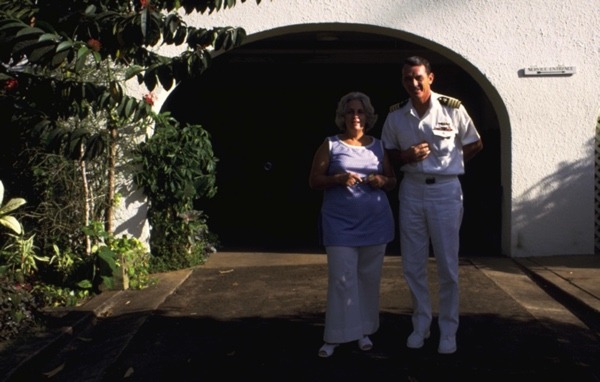
Capt. Mallard and his wife Ann
April 15th
On Sunday I called the Mallards. Was immediately asked over. Within an hour of arriving I was asked to stay there. The change was instant, abrupt. I felt as though the ambulance had finally arrived – the rescuers had spotted me – I was going to be all right. It’s only afterwards that you see how good or bad things were before.
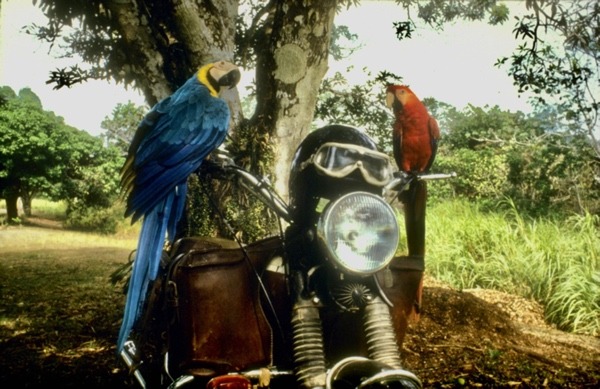
In the Mallards’ garden
Still following my notes from 48 years ago in Cartagena on the Caribbean coast. Trying to get to Panama, but with no idea how to get there, I took my bike on a boat to a pirate island, San Andrés.
At sea
There were flying fish, but no albatross this time. It was a fairly easy sea. Ship was “Ciudad de Zap … something or other.” Captain talked to me once. Said his grandmother was Indian. He looked fairly Indian too. The ship was putting up its entire stock of pennants in a grand show. I asked why. He said, “This is the first visit of the ship to San Andrés.”
How did we get on to drugs?
“I refused to carry them. I have a family in Baranquilla. I have been offered $15,000 just to take one packet, but I value my tranquility too dearly. Some others who went to the naval school with me are already millionaires – but they have no tranquility. Once you carry drugs you can’t stop. They would kill you.”
I can imagine Denis Nahum’s scepticism, but this captain seemed honest to me.
We were two days and nights at sea. The third night we spent anchored on the lee side of the island and then drew in. (One of the ties snapped and the boat crunched on the quayside. No rubbers, either).
9th April
There were two ships at the dockside waiting to leave when I arrived. Both were going to Panama. I felt unhappy about having to leave again within hours but knew I should try. (The explanation of these fits of urgency, interspersed by periods of timelessness must be explored somewhere.)
However the bigger of the boats was going to Bocca de Torres, the United Fruit Company port from which there is no exit other than by boat or by plane. The smaller boat would not take me.
San Andrés. – ten miles long, seven miles wide, reputed haven of Capt. Morgan. Some beaches of crushed white shell and coral – rest, ugly black coral. Two little islands – perfectly round with coconuts, – cartoon desert islands – called Johnny Cay and Aquarium.
Found Amigo Pepa sitting on his lot, watching his new house go up. He said he wanted to preserve the style of the original islanders. Talked about the days before the island got crowded – quoted cheap prices and said nobody used money.
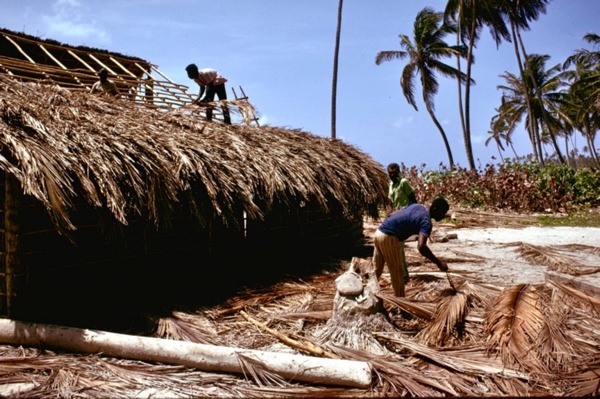
Amigo Pepa’s new house on San Andrés
Said he was building his house out of all natural materials. I was a bit uneasy – it sounded too pat, as though he’d been taking ecology lessons from visiting gringos. He had a carpenter making the frame of the house – a little man with bloodshot eyes called Brachman – named after Dr. Brachman who strode out of the mists of legend to give his name and then apparently disappeared again. Brachman gave an impassioned and drunken eulogy of Dr. Brachman on my second night which was impressively eloquent.
[But I’m still no closer to knowing who this mysterious doctor was].
Slept in hammock between coconuts – the splashes of black against the sky.
Gringo lady with little son – shrieking with anxiety and unaware of it – talking of Pepa as great man – fending me off (for no reason).
The English couple on the boat – he thin, gaunt, bespectacled, looking helpless, but innately tough, she plump, baggy – like babes-in-the-wood. Talking about the fish we were going to grill on the beach.
We got ourselves a four -and-a-half-pound bonito, failing red snapper. Then two huge black men telling us the fire was illegal – move to Pepa’s – the iron bedstead torn out from under a fallen palm to grill on.
Pepa’s green jump suit – his huge son, “I have found bottles in the sea. I have found several bottles in the sea. Yes, several, several, several. I have found several bottles with messages. Sad messages, man. Yes, sad messages. I saw a message in a bottle that broke my heart.”
Pepa said he smoked a lot of dope. He has letters from people in England and USA. Showed me one from Trinity College, Bristol. All charter holiday people to Trinidad, I expect.
The town of San Andrés seems to be called San Luis. In the middle it’s smart cement shops; then up the side of the island past the port, it’s wood. Tarmac, then dirt. Pepa’s is at the beginning of the dirt. You can get into the sea there, over flat rocks, with sea buds growing, and urchins lurking in crevices. Green water, blue sea. So clear. On the Aquarium – looking at fish – glorious.
I spent two nights on San Andrés. Through Skip I met the Argentine couples, Jeanine and Malcolm Donaldson, and Manuel Pedro Peña and his honeymoon wife Pixie – the last with his easy laugh, and easy claim to supreme court judgeship, which is so embarrassing.
Malcolm is a doctor, Jeanine an architect. She has some incurable weakness which makes her unsteady. She can’t drink alcohol. She is very attractive (Skip was aflame). They met in hospital and she wanted to tell me what a very good man he was. He probably is too – but in South America any man who is free of the worst traits of machismo will seem like Christ to any intelligent woman.
I’m back again, after three weeks in California and another week recovering from my first dose of Covid: but I’ve had five vaccinations and apart from one day of sickness and a few other days just feeling tired and unbalanced, I’m fine. So as promised I’m going to plunge you back into my diaries of 1975, and I am just leaving Medellin, Colombia, hoping to find a way to get past the Darien Gap to Panama.
Even today, just as then fifty years ago, the Darien Gap is considered an obstacle to human progress. It’s a large area of swamp between Colombia and Panama inhabited, I was told, by primitive tribes. I am very happy for it to be there and resent all those foolish efforts to drive Jeeps and Corsairs and Land Rovers through it. Leave it alone I say, but all the same it was an obstacle to my progress, and I had no idea how I was going to get around it. The only shipping line turned out to be useless, so now I was headed for Cartagena, a port on the Gulf of Mexico, where I hoped to find a solution.
April 3
Start out for Cartagena. High mountains to cross. Get caught in rainstorm and let bike slide into a gulley at roadside. Can’t get it out again and have to wait till rain stops and passing lorry driver helps me lift it out. Very foolish.
Down into Cauca valley – and find that my petrol consumption has dropped to a very satisfying 74 kms per litre, or more. Texaco Special. Apparently, according to Andrès, the octane figures for Esso Extra and the others are phony – not 94 at all, but in the low eighties. Texaco alone have one which corresponds to European two-star, and with this I get the original European results.
Beyond Caucasia – and 30 kms before Planeta Rica – I stop at a hacienda called Aguas Vivas. Looks very nice¬. Building laid out round a garden, with religious statues in middle. All neat, with every imaginable animal. Well, turkeys, ducks, chickens, pigs, dogs and cats. Mango trees, lemons, gourd tree. Big open barn behind, where I put my hammock. Four young farm hands are very good company – until one of them suggests I take him out on the bike to a village 2kms away.
In fact, it’s an endless journey to Planeta Rica – and nothing there anyway but a glass of beer. Coming back we go past the hacienda and he insists it’s further on but he means another village. He’s determined to ride all over Colombia to get another beer. Thank goodness I realise in time and refuse to go any further. We’ve already finished two bottles of Aguardiente and half a bottle of rum, and we’ve been out on this aimless ride for two hours. But it was very pleasant on the hacienda talking, watching the toads catch “grillos” under the lights – with the two maimed turkeys flopping about. One on a stump where his foot should be (a cow trod on both of them two months ago) and walks like a person with a peg leg.
April 4
Given a breakfast of coffee, lemon juice, rice, platanos, beef and egg. Can’t complain. Hot ride to Cartagena. Cattle Ibis, heavy hot air. Like Mombasa. Hit on the lip by a bee. Swells and makes a villainous expression. Cross marshy river by a bridge that seems oddly derelict. Cluster of thatched huts on the riverbank. Fine birds, people floating about in piroguas – but looks very poor and primitive – poorer even than Iguatú.
(It was visiting Iguatú, in Brazil, that got me locked up.)
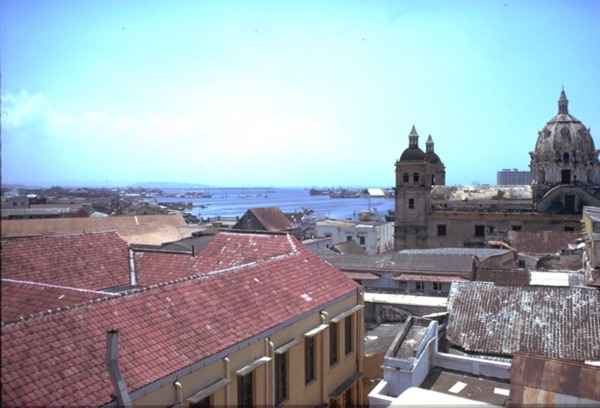
Cartegena
Come into Cartagena about 4 pm, past Torices (a district of Cartagena) and through wall to old city. Stop for two glasses of flora juice and directions. Ride to Club de Pesca with letter from Chris (a Royal Navy officer I got to know in Bogotá gave me an introduction to Denis Nahum). But Nahum isn’t there.
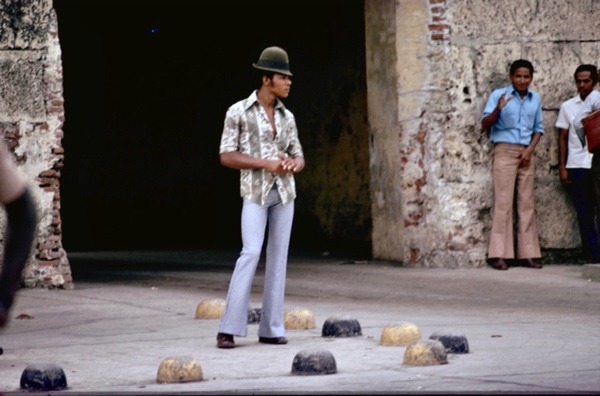
At the old wall
Looking around I get a slight recollection of Venice – more in the disposition of things – perhaps the Piazza Roma area more – the Manga Bridge – and the atmosphere. Telephone to Nahum’s house. Penny Lernoux, his wife, answers. Go to hotel Plaza Bolivar. Wander about a bit looking for restaurant.
April 5th, Thursday
Visit Dennis Nahum. He is suspicious at first. Asks for a Sunday Times identification.
Fortunately I’m carrying newspaper cuttings with me and I turn the tables on him rather by exposing his suspicions.
“The quickest way to a free meal is to claim that you’re a journalist,” he explains afterwards. “Don’t know how good they are in the Navy (at sorting people out). Was in Naval Intelligence myself so I’m perhaps more suspicious for that reason.”
Thereafter much hospitality, lunch at his home, meet Penny – read her piece about Chile (she is apparently a well-known journalist writing on South American Economy and Politics.)
House is attractive and holds many enviable objects. The cat-o-nine tails and a marlin spike. There’s a toucan, a parrot, a macaw, two monkeys and a bush-baby.
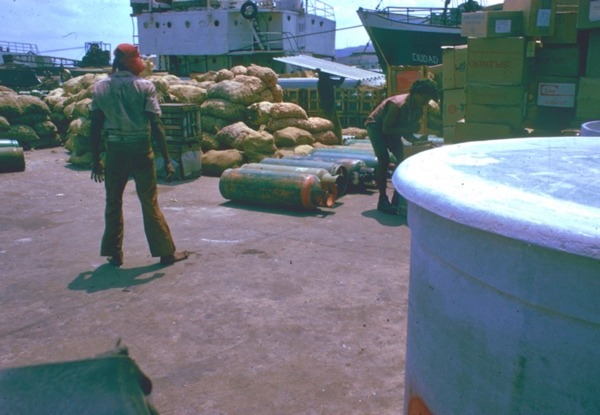
On the quay at Cartegena
April 6th
In morning walk down quayside to find a ship to San Andrés. None to Panama from here it seems.
(San Andrés is an island in the Carribean that used to be called Saint Andrews, a notorious hang out for pirates. It’s not much closer to Panama than Cartagena. I have no idea why I thought going there would get me to Panama.)
Sent to (a man called) Giraldo at Torices. He wants 1,400 pesos. 400 for the passage, 1000 for the bike. Boat is supposed to leave next day. Dinner that night – alone – at club. Penny is finishing outline on a book about the Church in South American politics.
Back to quayside to try to get the price down. Nobody seems interested. Boat should leave at midnight. Then at 4 am. Lunch at club with Denis. Take pictures in afternoon. Eat at Italian place in the evening. Old man and drunken wife who cooks. The Manhattens cost a fortune.
Afterwards back to their place to talk for a while. They go to bed and leave me to while away the hours. After a scotch I decide I must lie down on couch, sleep and wake at 4 sharp. Walk down to quayside, but ship won’t sail they say before 12. Go back to hotel, sleep on couch in lobby.
April 7th
Borrow my old room and get a shower. Walk around a bit on the fortifications with my camera. Call Penny to tell her our lottery tickets won. Ten pesos for seven. Go there for lunch. In middle of the meal there’s an earthquake – a considerable tremor lasting for ten seconds or more – we eventually walk outside by small pool, in case. The maid in the kitchen comes out screaming that everything is falling down (nothing did) but it became quite frightening during the last moments. The damage is done more by the duration than the intensity I’m told.
Eventually, at about 4pm, go back to the ship and wait many hours.
Then Giraldo tries to duck out of the deal, says it’s up to the captain, that there’s no room for the bike, etc He’s very evasive. I have to raise my voice and insist that G. take a moment to settle this matter. (What I tried to say was – “for once, will you speak to me, man to man,” but heaven knows how it came over in Spanish.) He took me on to the ship. The captain turned out to be one of the men I’d seen coming and going with Giraldo. A youngish man, short, sturdy, with a stony face.
G. told him that he’d agreed a price, all told, of 1000 pesos – 600 for the bike, 400 for the passage. I was astounded and had a job hiding it, for G. had resolutely refused to take less than 1000 for the bike alone. Why? Was it a slip?
Seems improbable he would make such a mistake. His livelihood depended on these prices.
Was it too sentimental to suppose that he’d reduced it in respect for the way I’d spoken up to him at last?
(Yes. Most likely he’d hoped to keep the extra 400 for himself).
The Captain demanded to see my passport and saw that I was five days over my visa time. I told him about my enquiries in Medellin, and they sounded very feeble. In fact he refused to believe that a police chief had given me verbal permission to overstay my welcome. A Frenchman who was also going to San Andrés was several months expired, and the captain was sure we would be checked by immigration at San Andrés.
At last he made us promise that if we were sent back on his boat we would pay the fare. We both promptly agreed but I knew the Frenchman didn’t have the money, and later he decided not to risk it. Cheerfully he announced he would go to Ecuador instead.
He was a slim, good-looking man but in a rather old-fashioned Bohemian way, with a little beard and hair brushed back long.
Then there was Skip Kaltenhauser from Kansas University – with the anxious, celluloid smile, overwhelmed by his experiences but quite unable to react naturally to them. Quite unable, too, to express an opinion or a true feeling – but suddenly shattered to find that he had to. He was on a two-month holiday before signing into law school. Now, that prospect seemed deadly, although he couldn’t quite rid himself of the need to achieve more security. I surprised myself by my eloquent condemnation of law school and what it represented.
We walked over to the market together to get some fruit juice – maracaju – he in his strangely baggy shirt and trousers – the former with an intricate pattern in shades of beige, lined with green. He wore a hat too. In his language everything was “neat,” and he strove for a quip constantly. Later, in San Andrés, he thanked me for “showing me some pretty good times” and hoped “he wouldn’t disappoint me.”
The boat went out shortly before midnight, but with none of the magic I’d felt at Laurenco Marques. I got my hammock across the ironwork on the upper deck and gave Skip my foam rubber. He was getting progressively more sick. (We’d eaten tuna fish and mustard on old rolls, perhaps not the best preparation). During the day there were three times I came within an ace of being sick but with a great effort, swallowing the great quantity of saliva that flooded into my mouth, was able to keep it down – and I’m sure it was the best thing to do.
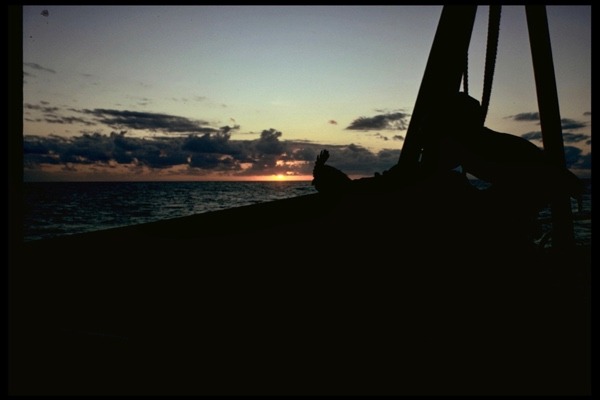
A rooster at dawn in the Caribbean
Well, I’ve got my work cut out. Hundreds of you came out of the woodwork to tell me to keep at it, so in deference to my readers here is a bumper edition from my South American notebook of 1975.
Good trips, bad trips – the road to Medellin
After Bruno’s unfortunate meeting with the front of a lorry, which reduced his Renault to a shambling wreck, he packed what possessions he could in a duffel bag and took the bus to Bogotá, the capital of Colombia, where he could catch a plane to Mexico City.
Bogotá was half a day’s ride for me and the logical next stop on my way north. He said he’d leave a message for me at the French Embassy.
Bogotá, Tuesday 18
Arrived at 1pm to find the French embassy closed and empty but for a manager who says come back at 3pm and sends me to a café called “The Parasol”. Woman who owns it warms to me as I wait. Eventually she proposes marriage. Says it’s the only way she can get out of Colombia to work in the USA. Doesn’t seem sure of her facts. Afterwards, I’m told all a Colombian needs is a paid-up tax certificate. But she touched me and let me off a few pesos on my bill.
At 3.30 got Bruno’s message; to find him at Jane’s flat, but there’s no room for me. Her ample cousin Nicole has arrived to wait for her passport (stolen) to be replaced.
Ring British Embassy and shamelessly ask to be put up.
David Lloyd makes an effort (I think) but eventually sends me to Pension Allemana (50 pesos + 10 for garage).
Wednesday 19
Next day I visit him [David Lloyd] – he’s your all-English smooth man, but with a slightly crooked mouth. Has Information & Intelligence function.
Friday eve. Meet Tim & Sorita Ross [Observer newspaper]. Fled from Brazil where Govt. has warrant for his arrest, for denigration and incitement of insurrection. Also meet a stringer for Sunday Times. Eat churrasco at Indiana – very good – open grill on charcoal. Sorita was moved to tell me she was raped in Brazil by carload of police (in Salvador) and I feel like touching her, but don’t. He [Tim] is impelled to pursue risky, violent stories. Much understated bravado about tear gas (CS & CN) and mob violence. Emeralds.
All the usual stories of robbery and violence in Bogotá. I’ve escaped so far.
Tim calls me later to ask if I’d like to have lunch with the Defense Attache next day (Saturday). He fetches me in a car. Chris Jenne, Commander, Royal Navy, tall, shock of white hair. Suburban stye house, wife Elizabeth, sons Charles & Edward, daughter Tina.
Chris Jenne and co very kind, hospitable, informal. Spend best part of two days with them at Sports club. Roped into a game of cricket. Take two catches and score five. Never did so well at school. Very enjoyable.
Visited the Gold Museum. Astonishing.
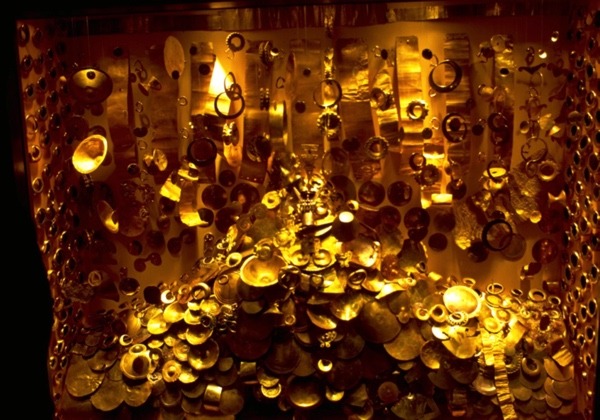
ONE OF THE WINDOWS AT THE BOGOTA GOLD MUSEUM
Tremendous evolution of form to classic perfection. Continue to wonder why certain variations of anthropomorphism are current in certain societies. Alex Bright (No.2 at the museum) talks about hallucinations being common to all takers of some drugs – only interpretations vary. He is not very convincing – either unwilling or unable to let his mind range over possibilities. A disappointment to Chris and myself.
British Council has [copies of] Sunday Times except for Jan 19, Feb 16, March 9. But nothing of mine anywhere. Suspect that I’ve been squeezed out of the revamped Holiday Section and have no place elsewhere.
[There was a period of many months when certain editors at the paper thought my stories were inappropriate and wanted to cut me loose. Although my expenses were very low I was dependent on the connection.]
Bruno has sent the bulk of his luggage back to France including my stuff from Peru. On Saturday evening, coming back with Chris to Pension Alleman we found him outside hotel door trying to get in. He had left his luggage in my room. So far had I sunk into British Sporting Life that seeing him there was like being reminded of a forgotten episode in one’s life.
Before leaving Bogotá I wanted to arrange some kind of passage around the Darien Gap. The first possibility that presented itself was to go round by ship with the Italian Line which sailed from a Pacific port called Bonaventura to Panama.
I visited their office in Bogotá.
First, they insisted that a carry a plane ticket out of Panama.
I got the Panamanian consulate to call them and say it wasn’t necessary, but they called my hotel to cancel my booking, with gratuitous abuse to one of the guests.
When I called them to protest they said they had sent to Panama for instructions.
The next day they said I had to leave a $200 deposit (that would be $2000 today) against being refused entry to Panama. Traveller’s cheques will do, they said, but when I arrive at the office only dollar bills would satisfy them.
But it’s not at all clear how I would retrieve the money if I miss the boat, and time is already short. I decided to continue North to Cartagena and hope for the best.
It was with a note of triumph that Señor Torrenegra cancelled my booking.
Wednesday 26th
Leave Bogotá at 1.30 after wasting time on Italian Line. Arrived that evening in Fresno – just after Honda – a small town in mountains. Hotel Bella Vista (no view) at 25 peso a night. Dinner in small place on square, where they try to serve me an old beer with a swig taken out if it. Two small children come in at the end of my dinner and point silently at my plate which has a potato and 3 slices of tomato left on it. I nod, and swiftly but politely they gather the remains in their fingers and dart off. It was the most telling incident so far in my encounters with hunger – and quite unexpected.
Easter Thursday 27th
Leave for Medellin.
The church (an exceptionally ugly cement one) broadcasts cracked recordings of bad songs through loudspeakers at 7, and again at 8. Ride off into mountains. Apart from a short, but terrible stretch it’s all paved to Medellin.
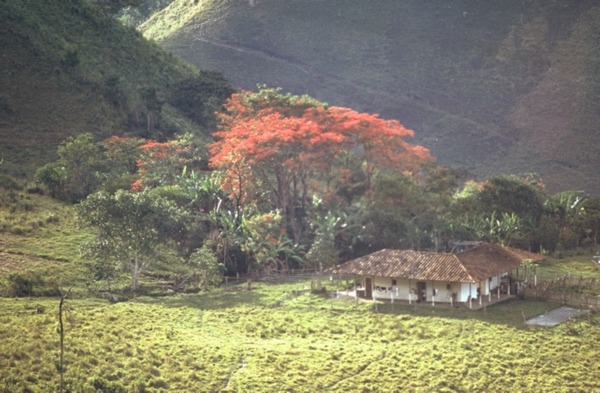
A RURAL IDYLL, FROM THE ROAD TO MEDELLIN
Arrive at 4.30 looking for British Consul. but can’t remember her name. And all offices closed. After long search I look in the [telephone] book for any English name and ring a family called Smith.
“Fantastic” says girl, when I explain, and they invite me to visit because they know Ampora Villa [the consul]. When I get there they fetch another motorcyclist round called Antonio, who is a dentist and paints. He is smoking pot all the time we talk, with no apparent effect. He takes me off to Andres, but I don’t realise till later that it’s the same person I rang earlier (as given me by Matt and Andy and Cleo [in Otavalo] who spent several nights there).
Mrs Smith is an interpreter. She will work at the first International Congress of Sorcery, to be held in Bogotá in August. Her electric typewriter was stolen and she is willing it to return. She says she thinks she’s got it – but it’s not quite there yet.
Her daughter, MaryJo, writes tender verses about love, grief and springtime. Has very good grey eyes and a busy life of arts and crafts, all macramé and pottery, flutes and drums and drawings. Very Hampstead, or Gloucester Crescent.
Andres Ceballos is a curious man. Seems very alive and dead at the same time. Advises textile firms on selling lines. Intellectually developed but physically unresolved. Wife, Eleanor, returns from Cartagena with four-year-old daughter, Catalina. He encourages her freedom – to study, to live apart from him. Was 15 when she married him. Now a passion for learning and travel. But all their energies seem focused on external things.
[I remember one day I smoked one joint of the stuff Andres smoked incessantly without effect, and I had a truly terrible trip which I thought was going to fry my brain.]
March 31st
Spent two nights at Andres’ home. Went to see Ampora at hotel, then to the Cuerpa de Bomberos [fire service] for free hospitality – a room, bed, clean sheets – amazing. They have old fire engines from the Twenties, beautifully preserved. Nice, gentle men, very poorly paid, it seems, but dedicated.
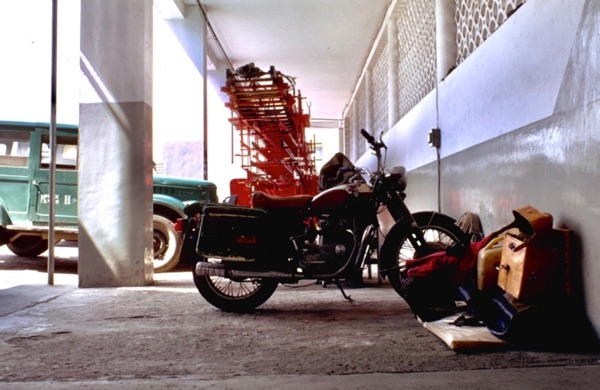
MY BIKE AT THE MEDELLIN FIRE STATION
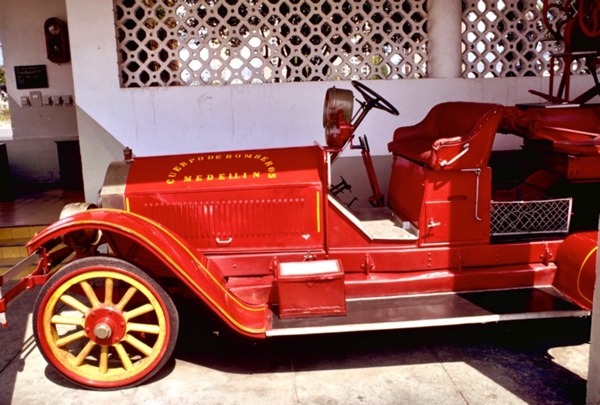
A FIRE ENGINE FROM THE TWENTIES
April 3
Leave for Cartagena.
That’s all I can manage for today. Thanks again for taking an interest. I won’t be back for a few weeks. I have to go to California to take care of a few things, so I’ll see you again in April when you’ll learn how I caught a boat to a pirate island and flew to Panama with the bike in the cabin.
