News from Ted

Feb 4
Into the Cauca valley. Tropical. Bananas. Music. Good asphalt road. I flew. Up a mountain. Down again. Up again, and then sat there watching Bruno’s van appear over the previous summit.
(The van had a damaged cardan, or half-axle)
Went on to Popayan. Pretty town. Colonial Facades. Churches with beautiful carved wood, gilt and maroon on white. Remember the pulpit of San Francisco.
Found a hotel – Los Balcones.
Feb 5
Moved to another hotel, El Monasterio. Superb. Only 240 pesos (eight dollars) for two. Pleasant day walking in town. B has his cardan repaired for next to nothing. Remember chapel of Encarnacion in convent. Had lunch and dinner at hotel. Excellent.
Feb 6
Hotel breakfast (Fabulous – remember it to this day) Laundry. Supermarket. On to La Plata again.
(We were heading inland into the mountains to San Agostìn where – we had heard – a large number of statues had been recently discovered underground)
Bruno leaves before me. I get out at 12.30. Lovely weather. Then a fuse blows. Waste time trying to trace the fault. Then give up and put in a temporary circuit. Meanwhile a storm blows up. Find myself in a terrific downpour. Makes me very unhappy. But later, in good weather, on very dry roads, ride fast – and slide uncontrollably right across one bend.
(There were lorries driving fast downhill and filling the road. To meet one unexpectedly on a bend could be fatal)
Catch up with Bruno just before La Plata. He’s had another bash with a lorry.
(Lorry drivers surrounded him, insisting it was his fault.)

The end of the road
Paid 600 pesos damages. His other half-axle is broken. Has a Quebecois hitch-hiker with him.
(Looking for a place to camp I spot a lovely green field)
I lead us all into a bog. Struggle to escape – ploughing up the field. Ride into La Plata. Find the Residencia Berlin. Jesus and Domitila Clavijo and their ten children. Parrot called Roberto.

Ten kids and a parrot
Feb 7
(Bruno’s van is now lozenge-shaped and undrivable. It is illegal to sell a foreign registered vehicle in Colombia)
Still in La Plata. Bruno sells his car to a policeman. Auctions the contents. (See full description in Jupiter’s Travels)
Feb 8th
To San Agustin. Two rivers to cross. Take first one very seriously, barefoot. Fast but not too deep. On last stretch from Pitalito to San Agustin – dirt – fall off. Break strap on pannier and crack spark plug in half.
Bruno arrived half an hour before by bus. Is finding out about horses already.
(Bruno is devoted to horses and rode steeplechase. I know nothing about horses)
Have mixed feelings about it – still think of horses as potentially dangerous. But excited by idea also. He walks for hours and says he has found two good ones for the next day. I begin to get a feeling for San Agustin and the hotel.

Fuzzy rider
By horse to Alto de los Idolos. Tremendous ride down the side of a ravine. Only loss of my raincoat spoils the trip, but soon get over that. Staggering descent and climb. Statues don’t measure up to the experience. (Why should they?)


Feb 10
Idle day – last hours at park (Parque de los Idolos)
Feb 11
Horses again – to Pamela’s Hacienda. Spiky reception but ends well with banana bread. She has an enormous bottom but carries it quite well. There are two children there. Whose? Pamela and Harry get paid ($100 a month) to keep them for the summer months. They also get money sending Colombian stuff to her mother’s shop in New England. They spent eight months – she says – scraping old lime wash of the woodwork. No animals, except chickens. She is very defensive about their position. The only ones, she says, who stuck it out.
Feb 12 to 14
Back to La Plata. Bruno leaves for Mexico. End of a chapter.
PS: It’s interesting transcribing these old notes, but it’s an effort and I want to be sure it’s worth the trouble. A precious few faithful readers have shown their appreciation, but not enough. If you want me to go on doing this, please let me know.

Feb 21
Leave Quito. Too late. Fantastic downpour & hail. Inches of water on roads. Bike fails on way out, but only for a short time. Reach Otavalo at nightfall. Frozen. Indian café. Find Peace Corps house. Ray (Raimundo) receives us. Sleep in kitchen. Ray illustrates textbooks to help Quetchua-speaking Indians to learn Spanish. Very pleased with progress of program.
Feb 22
Saturday. Market at Otavalo. Very Indian – and quite unlike Peru or Bolivia. Indian dress is sombre. Navy blue wool ponchos, pigtails. Characteristic diamond shape of men, short cotton trousers, women wear hats of piled up shawls, straight dark dresses, white blouses. Almost all are barefoot. Gold bead necklaces (glass from Czechoslovakia).


Much more communicative than other Indians. Sellers line up in two facing rows – with their blankets in front of them – shoulder to shoulder – while buyers walk between them. Permanent kiosks of masonry for stallholders. Many Gringos taking pictures. One of my cameras has failed (light meter) after soaking on Peruvian beach.
The Gringo café – pancakes US style – granola for sale – like refectory at Berkeley. Bruno is astonished. Ride out to hacienda to meet Matt coming the other way.
[Matt Handbury is Rupert Murdoch’s young nephew, riding a BMW, trying to decide what to do with his life]

The Hacienda
Went to see hacienda, then back to Otavalo – where Andy and Cleo arrive at Ray’s. Together return to hacienda, by old Pan-American route – cobbles, then grass slide down past precipice. Andy at first strikes me as quite strange. Thin – gaunt – blonde, moustache, tight leather trousers, orange satin smock. BMW. Front teeth missing on left side. Cramps his smile. Easy to underestimate, as I do at chess.
Feb 23 – 27 at Hacienda
Bob and Annie there too. They’ve decided to stay and get married. Play card game called hearts. Marathon session till 4am. Vegetarian meals. Indian family very close. Girls just come and sit. Fascinating and lovely to watch. Always smiling, greeting. Maria says photos steal her spirit – her father told her so.


Andy becomes ever more interesting. His dead-pan manner, slow uneasy smile, would fit a Western hero. The missing teeth could explain it, but there seems to be more. With his specs on he seems quite innocuous, small-minded, hard to imagine him fishing tuna – $500 in one day off ‘Two-fold Bay’ in Australia. Tells story of killer whales and fishermen combining to catch blue whales. Also of his hero, the Irish Australian skipper he has sent me to see.
So we went out to dinner on the last night and coming back Bruno drove into a foot of plastic mud on the old highway and was stuck there for the night. Took two hours of digging to get him out in the morning.
[I also remember that Andy, inexplicably, accused me of stealing his camera body by switching it surreptitiously for one of mine. Could not disabuse him. Bob and Annie gave me an address of friends in California, leading me eventually to the commune that played a huge part in my life.]
Feb 28
Rode off to Colombia in the rain. Wet but easy. Got to border at 4.30. But customs is back in Tulcan. Bruno is furious. Then, on Colombian side, ride up hill to Ipiales to find that passport control was at the frontier. And while we stop to talk to frontier guards a section of hillside falls on the road we were about to take.
Roast chicken at Ipiales, then into night to find place to stop.

Getting ready to leave

On the road the Ipiales

March 1
Woke up to beautiful scenery and sun. A curious dip in road, against a grassy hummock. On other side a valley, cultivated, and mountain beyond. A bus has been abandoned down the road – one of those fairground vehicles without doors, common in Ecuador & Colombia. A small house nestles in the ground beside us, smoke oozing through the roof. Took many pictures. Left about midday on switchback road to Pasto. Most impressed by countryside. On smaller scale than Peru, greener, less bare stone, but spectacular. Waterfalls, trees, much cultivated land. White house, L-shaped with porches, tiled with clay or wood. Found a patch of flat grass, near a mountain top to camp on, about halfway to Pasto. Spent much effort, both nights, preparing for prospective assaults by delinquent Colombians. Arsenal included my knife, machete, Bruno’s pistol. Seen by many lorry drivers and imagined the gossip at nearby hamlet, but a peaceful night.
March 2

In Pasto I was a sensation
To Pasto – ordinary town with some big modern municipal buildings. Searched uselessly for (spark) plugs. Bought food. Took road to lake. Not so impressive. Slept in car outside rustic hotel owned by Germans (Swiss?) who said they’d come to Colombia 20 years before, after being soldiers – to supervise the opening of a number of hotels. Then opened their own. We ate, bought wine (Chianti at 180 – in shops 130). Played chess.
March 3
Renault failed to get up hill. Towed by lorry, into Pasto and out, to eat in a rainstorm on the road. Bruno develops a passion for porridge and bacon & eggs, but I still don’t dunk my bread and strawberry jam in my coffee. Who’s the chauvinist?
Where did we spend the night?
Four days on the road to Quito
Feb 14, 1975

We Left Guayaquil in the rain, over the bridge again and back along the same road to El Triumfo, a busy, muddy cross-roads with roadside stalls selling bananas, pineapples, small mangoes, and muddy-looking juice. Bought two pineapples for 4 sucres (7p). These stalls always look crammed with a variety of foods until you look closely – also striking how hard it is to get vegetables in the countryside.
Passed some enormous banana plantations – kilometres long. Thickest, lushest vegetation I’ve seen. Then the rapid rise into the Andes again, and soon we are up to 2,500 metres, but the hills here are smoother than in Peru, the countryside more ordered, better worked, with some large houses. Had the idea of being invited at a hacienda and chose a large white house, below the main road, to the right shortly before Riobamba.
Met in the yard by a peon (but in Western clothes) who invited us to sleep inside. Building seemed deserted. In fact it is used as a school (one room) filthy and bare, as was our room. B wanted to use the hammocks, and pulled up a gate post, under the appreciative gaze of the custodian and his family – an Indian woman and tots. The post went on the windowsill against the steel frame windows. Another post went inside the cupboard, diagonally across the room and the hammocks were slung between them. Four eggs lay in some grass in the cupboard.

The Indian woman with her tots
We asked if we could buy some food – eggs or meat. They said there was a tienda (shop) cercita (nearby) down the road. We decided to walk there and we walked forever down the hill and eventually met the custodian coming back on his horse. He pointed out a house and we asked for a chicken. They were dubious at first (three men and a woman) then tried to decide which bird to sacrifice. At first they went for a cock but it was too expensive so we settled on a mottled pullet for 50 sucres and had a fine chase all around the yard to catch it.
The walk back took me over an hour. It would have been shorter if I had been as enterprising as Bruno and caught the back of a passing bus. I tried to wring the chicken’s neck and failed. B chopped the head off with his machete. The family plucked it, I gutted it, and we boiled it. It was a stringy bird but the legs were tender. The family also gave us a plate of pork, but it was too much after all for one meal. There was still the chicken’s carcass in the pot.
Feb 15
Woken in the morning by a hen at the window, anxious to get to its nest and bewildered by the change of scenery. It stood on the windowsill observing us from every conceivable angle and clucking. At last it managed to edge its way along my hammock and with much floundering and shattering made its way to the cupboard, but failed to lay.
Before leaving I at last took the trouble to examine my rear axle. The bike had been wobbling strangely since Lima where I had aligned the wheels (i.e it was much worse than before when the wheels had been really out of line). Found to my stupefaction that both spindle nuts were loose and presumable had been for 1000 miles or so. What I get away with! Terrifying what omissions I’m capable of. Got the wheels straight and tight, and of course the wobble is no more.
Getting out was an ordeal for Bruno. His van couldn’t make the climb up the dirt path. He had to take a series of dives from off the road to get enough speed up but eventually he got out.
Riobamba was a pleasant town. People seemed more relaxed here – less aggressive. Many plazas, a few nice buildings, a nice working market, helpful shopkeepers, little attempt to sell things to us. Went on until dusk when I found an inviting field by the side of the road. Children all said we should stay there, so we went in. Then adults arrived. Owner’s wife and her sister. Sister was very inquisitive and aggressive but invited us in to talk. They were enraptured by Bruno, gasped at his exploits, plagued him with questions and took no notice of me at all. For me a very unusual evening since I have become used to being the focus of curiosity and attention. Most of all it astounded them that he insisted on sleeping out. They were sure he would freeze to death, and I thought he’d find it chilly (he did).

Bruno and his audience
Feb 16
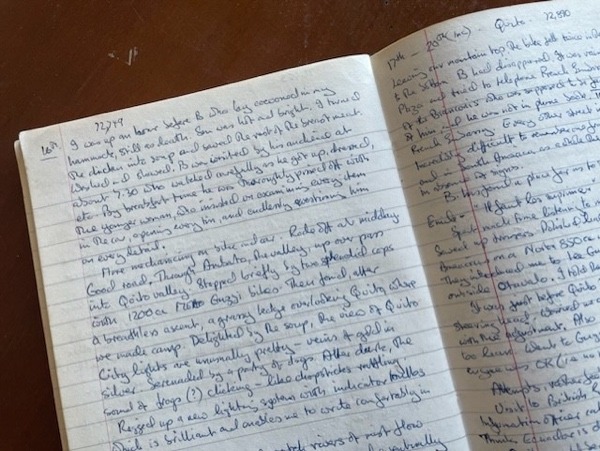
I was up an hour before Bruno, who lay cocooned in his hammock, still as death. The sun was hot and bright. I turned the chicken into soup and saved the rest of the breast meat. Washed and shaved. Bruno was visited by his audience at about 7.30, who watched carefully as he got up, dressed, etc.
By breakfast time he was thoroughly pissed off by the young woman who insisted on examining every item in his car, opening every tin, endlessly questioning him on every detail.
The road to Quito was good and we made good time. Crossing through Ambato into the Quito valley we were both stopped by a pair of splendid cops mounted on shiny 1200cc Motoguzzis, but after a short period of mutual admiration, we went on to find ourselves on a pleasant grassy ledge above the capital.
Comforted by the chicken soup I had made that morning, we looked down on city lights which were unusually pretty – veins of gold in silver. A party of dogs serenaded us, and after dark a sound like chopsticks rattling which we thought must be frogs. I was particularly pleased with a new lighting system I had rigged up using indicator bulbs – brilliant, and allowed me to write in my tent.
Just before going to bed we watched rivers of mist flow down and engulf the city. Then came a chorus of distant shouts, sounding like a political demonstration. The P.C.M.L.E (Partida Communista Marxista Leninista de Ecuador) was busy agitating for oil nationalisation without compensation to ensure a bright future for everybody. But it turned out to be a football crowd.
Feb 17
Bruno hoped that some French volunteers in Quito would put us up, so the following morning in light rain we went down to the city. Well, I slithered down, and went over twice in the mud.
By the time I got to the bottom Bruno had disappeared. I found the central plaza and tried to find the friend of a friend who was supposed to be famous, but nobody had heard of him, and he wasn’t in the phone book.
It took me two hours to find Bruno at the French Embassy. Every other street in Quito is named after a date – incredibly difficult to tell one from another – and in South America the traditional revolutionism is reflected in an absence of signs.
Bruno did find a place for us both to stay, with Emile and Claude, who also had a gramophone, and we spent half a day just playing, again and again, at top volume, the overture to Tannhäuser. Our conversation with the two volunteers was inevitably about our experiences and frustrations. Emile had not benefited by his time in Ecuador and thought its inhabitants should be put down. “Il faut les supprimer.” After a while we realised he wasn’t joking, which made us uneasy.

Bob and Annie, from California on their Norton
The following day, riding around Quito, I came across an American couple on a Norton 850. Of course we stopped and talked. Bob and Annie were from California. They told me about a hacienda near Otavalo where we would be welcome. They were on their way to Cuzco and I told them to take the road from Huancayo. They introduced me to Lee Guzman and his garage, where I took up the play in my steering head, and changed my 140 jet for 150, 140 being too lean.
Quito would be a pretty city in better circumstances – nice buildings, plaza, etc – but rain too heavy for appreciation. Next day we leave for Otavalo.
I’ve been reading my old notebooks again and enjoying the memories. There is so much that never made it into the book. Sometimes the story is written out in enough detail so that I could lift whole episodes straight onto the computer as I did a couple of weeks ago, with the story from Sri Lanka. At other times the notes are very brief but I can reassemble the story from memory. That is the case with my visit to Gauyaquil.
Forty-eight years ago this week I was still travelling in the company of Bruno, a young Frenchman with a much-battered white Renault van. His own companion, Antoine, had left him to fly back to Paris from Lima. Now we were making our way up the coast of Peru towards Ecuador and we had just spent two glorious days on a perfect beach, feeding off the sea.

Without the fish the impoverished people living on this arid coast could not survive. It never rains and water has to be delivered by tanker. But the sea off the coast of Peru was said to be among the richest fishing waters in the world, and we took full advantage.
Not that we caught anything ourselves, for all our efforts, but two fishermen who had brightly painted boats anchored there were happy to sell us a big, beautiful sierra and another fish they called a lenguada which we grilled and ate with tea and cigarettes.
The beach was scarcely visited but as I was packing up to leave three men and a woman came down to the sea. I was some distance from the water’s edge, just able to see their faces, and I saw the men ducking the woman in the water.
She was fully dressed in a short black skirt, a yellow blouse and a pink scarf round her hair.
She scrambled out of the water and appeared to be laughing, but they threw her in again. I went on packing but every time I looked up they were doing the same thing and as I rode off the last thing I saw was the men throwing the woman into the sea again. Needless to say I felt uneasy.

SAN JOSÉ, PERU
It took us two days to reach the frontier with Ecuador, passing through an oil field at Tumbez where we ate enormous oysters, and suffering a hot, sticky mosquito-ridden night at Puerto Pizzarro on our way. The border at Aguas Verdes was extraordinary – quite unreal. On one side, everything was dry as bones: on the other side a profusion of humid vegetation as though nature had conspired to create this barrier between two nations. Thick banks of tall grass interspersed with banana trees extended from the roadside into the surrounding hills, making any thought of camping difficult, and rising up from the grass, here and there were wooden houses on stilts, some quite lovely, all wreathed in air misty with moisture.

The road left the coast and climbed up into the Andes again, but there were wearying police controls, six of them, before we got to Durán and the bridge that took us back down to the coast and the important port of Guayaqil.
Quite why we went there escapes me now. Perhaps Bruno was hoping to do something useful with the French consul. We found a hotel that rejoiced in the name of a five-star Parisian hotel, the Crillon, but there the resemblance stopped. As I entered my room I heard the stampede of cockroaches making a dash for the shadows, and the ceiling plaster over the shower had fallen away to reveal the plumbing of the shower above. Even so, with the help of a Sanyo Widemaster fan I spent two nights without too much discomfort.
Before leaving England two years earlier a friend who was also an Olympic yachtsman had told me that if I should ever find myself among sailors the mere mention of his name, Tony Morgan, would guarantee that they would take me to their hearts. I noticed on a folder for tourists that there was a Yacht Club in Guayaquil so in the afternoon we trod the boards of the port to find the massive carved door of the club firmly shut. I persisted, ringing and knocking, until a porter came to open it, and I explained that I wanted to meet some yachtsmen. He appeared to be bewildered and it took him a minute to register. Then he said, “Señor, there are no yachtsmen here. Nobody sails. They only come here to drink.”
We were equally disappointed in our efforts to find the beautiful part of old Guayquil promised by the tourist flyer, and after tramping around some mouldering but far from charming neighbourhoods we thought we would at the very least find the lobster that had eluded us since Lima. We found a restaurant with lobster on the menu and paid a rather high price for lobster that was not especially good. Furthermore, there was no wine. It must have been all these disappointments that made me particularly vulnerable. When a boy of about 12 came to the table to offer me (and it’s interesting that he chose me and not Bruno) a bottle of Dubonnet at an absurd price. At first I laughed at it, but as the price began to come down to something almost reasonable my scepticism dissolved in the pool of my greed and I bought it. As soon as I’d given the boy the money I opened it. The seal was in perfect condition, but by the time I’d tasted it he had gone. It was a bottle of vinegar.
I was mortified by my gullibility, but Bruno was outraged. He dashed out of the restaurant and seizing two of the boys always loitering in the streets he charged them with the job of finding the miscreant for a reward and sent them off in opposite directions. They came back after a while and both said they’d found him, but one was more credible than the other. Bruno followed him, but instead of a boy he found himself facing a man who looked so villainous that Bruno decided justice could wait for a more worthy object.
The following day we met a man who thought our “wine” was delicious. But that’s another story.

Last Sunday I joined a small group of bike riders on Zoom to talk about depression, not everyone’s favourite subject but a difficult one to ignore. I met with Eva Strehler, who is translating my latest book into German, and Claudio Gnypek, who was recording the meeting for a podcast, but the main man was Dieter Schneider. Dieter is in his youthful sixties but he had a son who suffered from depression and committed suicide, an unimaginable tragedy no less awful for being one of many thousands.
He found he couldn’t simply accept it. He felt he had to do something, and after long journeys looking for a solution he appealed to his friends to join him in a ride, to focus attention on the problem. He discovered, of course, that he was far from alone, and his ride is now a regular thing with hundreds of bikers taking part. He thinks of it as a fellowship and calls it the Fellows Ride. There is even a film going the rounds in Germany.
I have never been depressive and like most people, however deep in the dumps I might be, I can generally find pleasure in just being alive. But in my early life there were aspects of my personality that I did find depressing. I was self-conscious to a fault, convinced that I was always being judged and found wanting. I went to unnecessary lengths to please, and I was timid in the face of authority. I rehearsed all my important meetings ahead of time and never really learned to think on my feet. I was quite aware of all this and it sickened me, but I couldn’t overcome it. I relied almost entirely on my intelligence to make progress in life.
My big journey, the one that crystalised out as Jupiter’s Travels, changed all that, even though the change was totally unexpected. It never crossed my mind that the journey would have any effect on me. I was driven by curiosity, not self-improvement, and yet the effect it did have on me was life-changing. I have spent a good deal of time since trying to extract from the experience the elements that brought this about and released me from my earlier inhibitions.
First of all, I was alone, with nobody to judge me or help me or take over. I was on a machine that I had only recently learned to manage, and only in quite easy circumstances. I knew that, as a novice, I was in danger and that the danger would increase as I moved into ever more unfamiliar surroundings. Inevitably there was always a degree of fear to overcome, and I found a way to work with it and learn from it.
Then there was the machine itself. I had only basic mechanical knowledge, a few tools and a workshop manual. I had to keep it going, meaning I had to learn about it, be aware of it all the time, check it out every night looking for problems. It was all I had for the next 50,000 miles.
The travelling itself was demanding; finding shelter and food, managing currencies and borders, learning the rudiments of languages, learning how to avoid accidents, and of course keeping notes of everything. And to balance against all this drudgery was the sheer excitement of it all and, at first, the wonder that I was actually able to make it all work, that it was really me here in the desert where I once as a child read about Rommel’s Afrika Korps battling with Montgomery.
There was no time or reason to think about I how looked; I was unique, a traveller on a motorcycle, a phenomenon and I set the standard. Who would care how I was dressed, whether I was clean or dirty, shaven or bearded. So I soon forgot about myself and found that I could see others much more clearly. And all those hours alone with myself inside my helmet? They were busy with thoughts about what I had seen and what lay ahead, people I had met, the scene I was passing by and how I would describe it.
What I am trying to demonstrate is that I was so physically and mentally stretched by the enterprise that there was no room for negative thoughts about the meaning of life. I am convinced that by being voluntarily exposed to great physical and mental effort I defeated my old mindset.
I am afraid this may all sound naïve and boastful. Would it be impossible for someone suffering from clinical depression to launch themselves into such a project? I don’t know. But I have had letters (via email) from people thanking me, profusely, for helping them fight off depression simply through reading my book.
Is there a way . . .?
I’ve been asked for more raw notes from my notebooks. Here are my last days in Ceylon, as Sri Lanka was still called, 47 years ago.

Puttalam: On shore of a lagoon. Junction town. Single row of huts. Some thatched, some tiled. Small veg market has chilis, kohl rabi, cabbage, carrot, tomato, limes, eggplant, potatoes, yams, etc. In short, an excellent variety. Fish market, a small, raised cement platform, thatched, had good fish too. Some puppies stood around it. One was so thin and failing it was scarcely more than a head. Watched some crows on a roof – one had a fruit in its beak but could hardly eat it, since as soon as it put the thing down to grip it with a claw another bird, unencumbered, would threaten possession. It had a younger companion also which simply screeched with open beak , and got a couple of morsels for its pains.
By the shore was a thin strand of sand littered with all kinds of rubbish. Again the crows attracted my attention, and one – obviously physically inferior – was hanging about behind the others.
At one point it raised a claw and put it pleadingly on another bird’s back – twice. The other bird flew away – the mangy crow was left alone. Then I noticed a dog – a bitch with distended udders – licking something between its front paws. It was a puppy stretched out on the rubbish, head back and oozing blood. The mother looked up so mournfully. These small examples of life and death on the rubbish heap moved me and depressed me profoundly. Since Colombo I’d been viewing the world through discomfort and fever, with a deliberately jaundiced view. I saw the profusion and luxuriance of the tropics as just a terrible mess, buildings as mildewed wrecks, human effort as futile. The people seemed tedious to me – an endless procession of Marks & Spencer shirt tails hanging over sheets – with facile smiles signifying nothing if not envy and ingratiation. Only the older women impressed me, in spite of myself, with the fineness of their features and slim handsome carriage. The road was murderously bumpy, the traffic foolish. Several times in Ceylon I’ve saved my life by noticing another driver when it was his obligation to notice me. People stop quite suddenly in the road for no apparent reason and without indication. I think there is a powerful amount to be said against “tropical paradise” and should be grateful for these fevers perhaps. The yearning for temperate home must have been overpowering in early adventurers when they fell sick.
At the Puttalam Rest House I got hot tea and an extra sheet [for the bed] and tried to sweat it out. There was plenty of sweat and in the morning I thought I’d won.

I rode the 46 miles to Anaradhapura (after photographing a cobra) – and sat among the ruins for a while. A young man came, and by the brilliant tactic of NOT asking me for anything led me to offer him my address. I walked barefoot to the big Dagoba (or whatever). The dome is solid and covered with cement – has little to say to me. There’s a crack where it was once struck by lightning, and a new lightning conductor runs down the side. There’s also a maze of granite pillars sticking out of the ground. The lad says this is the ground floor of seven story building in which a hundred monks prayed on each floor, all in their solitary cells. If true it’s an amazing notion – what a hum must have gone out from that box. Enjoyed the moonstone outside the temple. Elephant, horse, lion, buffalo. From A on the road to Mannar, and at the main junction was already feeling the fever again. Had a drink and some Disprin. Disprin is becoming part of my diet. Rest of journey went well. No more rain. In the morning I rode through a maximum downpour for maybe 15 mins – and the [new Belstaff] jacket is a success.
Got the same room at the [Puttalam] rest house. Went straight out to fish off bridge, thinking how nice to be alone, but a great company of betel chewers l;ined up alongside me. I managed to live with it however, and got the great excitement of a catch. The fish felt very strong, and for a while I couldn’t move it at all – after its first run – then slowly I inched it in. It was a stingray. Very exciting to see it come out of the water. Not really so big – maybe 4 lbs – with beautiful mottled brown back, a rather human mouth, and two eyes on top. One of the men cut off the tail and showed me the spike which lies alongside it close to the root (not as I imagined it at all). Took it back proudly to the Rest House. The cook said he would fry it for me, but as a fish, he said “it is not famous.”
Two men passing on the bridge started talking to me. It annoyed me at the time, and I must have showed it.
“Your native land, please?”
“Are you a university graduate?”
“How much does this – or that cost?”
They came afterwards to the Rest House and I had to sit and take tea with them. One was the Medical Officer for the area – the other. Mr. Ratnavale, is a clerk of some sort. They have so little to say, and understand so little of what I say, that it’s largely a ritual. Whatever I said, Mr. R’s face would express perfect wonder and enlightenment and say “I see” as though everything was now clear. But the MO did describe symptoms of typhoid [nausea, among others] which gave me a bit of a scare next day.
Rest House manager told me of a series of superstitions. If a monk crosses your path when you aet out – forget it. If the gekko chatters as you step out of the house – also forget it. If you run over a cat you’ll have an accident. Woodpecker’s noise is a bad omen.
He also says Tamils smell different. If they use a towel, you won’t be able to. Sinhalese and Europeans are much closer [he says].
14 October
Rain is really pounding down in the night. The garden has become a lake. The varnish on all the chairs is sticky. Pools of water on the floor. Write home and walk to the post office. Get back, to feel feverish again. Decide to take tetracycline [which I carried with me]. Soon afterwards, vomit {having drunk Coca-Cola). Think I might have typhoid. Get scared and get driven to hospital as emergency. Doctor greets me with great amusement.
“What do you want – he asks – medicine or to be admitted?”
“I want to know what’s wrong.”
He can’t stop grinning. “Cough,” he says.
I essay a couple of coughs.
“There you are you see. You’ve got a cough.”
I deny it, but he just laughs. “You’ve got a fever.”
“Why,” I ask? It’s so ridiculous I have to smile too.
“The climate,” he answers. “Take a Disprin and it will go.
“That’s what I’ve been doing for three days.”
He still thinks it’s a huge joke. He asks several questions but doesn’t listen to the answers. But he’s convinced there’s nothing wrong with me, so I begin to believe that at least it’s nothing very much. Back to the Rest House, much embarrassed. Soon afterwards astonish them by going fishing in the rain. A fish takes away the hook. Later it comes down in a torrent and I slosh back to change. Through afternoon, two more Disprins, begin to feel better.
Mr. Ratnavale calls on me. My heart sinks, but he’s better today – not so overawed by his weighty companion. Eventually he walks off into the rain and comes back, unsolicited, with a packet of five Capstan cigarettes. Very sweet. Has wife and three kids in Jaffna. Means to travel overland to Europe.
Now great wind blows up outside. Will tomorrow be stormy? Walked around the Portuguese fort. 17th century. Impressive size.
Busy night. Great storm blowing, with sounds like gunshots, among others. Between nine and midnight I must have sweated a lake. Both sheets wringing wet, and mattress too. Had to change the mattress and put on trousers and vest. Both damp in the morning. The tetracycline must have helped me to chase the fever out so I’ll go on with it for 4 days. It occurred to me that the ferry would hardly have been able to dock last night and this morning, at the bus depot someone confirms that it was anchored a mile off shore. Maybe in the afternoon, maybe in the morning. I imagine I’ll be here another night yet.
Go to pier. Sea very rough. One fishing boat breaks anchor line – tossing about on the other line, spewing out broken fittings which poor owners are combing off beach. Ferry is in, discharging passengers, but customs is very slow. Capt. puts to sea empty, afraid that sea may cause ship to break the pier. No ferry today.

Forty-eight years ago this week, I was about to leave La Paz, the capital of Bolivia. Travelling with me but separately were Bruno and Antoine, two Frenchmen in a small white four-horse Renault van whom I’d met coming into Bolivia a week earlier. These are my notes.
January 14
Bruno, Antoine and I agree to meet at 7am to leave. I wake at five. It’s pouring. The sound of the rain drumming down on the tin roof depresses me. In my dozing state I even slip and lose my footing – in bed. I walk over to their flat [we were in separate houses] at seven. 12 Frenchmen in it. It’s got a terrible rancid smell. Filthy mess. They agree it’s better to leave later. At 10am the rain stops and there’s some sun. But the Renault won’t start. When at last, after changing the oil, cleaning the carburetor and plugs, it does start, it begins to rain again. There’s bread to buy, money to change. Then up to the big bus and lorry concourse on the altiplano, 800 meters up. There’s fog and rain and mud everywhere. The [government] controls are even harder to endure.
The road is semi-ripio [gravel] but plenty of mud. I begin to get the hang of it, but it’s hard work. All combinations of surface present themselves, Then cloud thins and eventually, as we approach lake Titicaca and the hills, the sky clears a bit. Beautiful light as we follow the lake shore. Reeds in the water, many rich-looking plots of irrigated land, sailing boats. Come down at last to the ferry. Long boats with Johnson outboards. Some trouble maneouvering off the boat backwards. Costs me ten pesos, then another 45. More riding through mountains and along the lake. The water is a glorious blue. The contours are very appealing, The grandest lake and mountain combination yet – though Bariloche was more hospitable, having trees. No trees here, just surfaces interacting.
Round one corner an extraordinary sight: A man bending over flinging stones off the road, arms like windmills, cloak flying. Three handfuls, then he stands up, takes his hat off and holds it out to me with the most sly and ingratiating grin. But he was too slow to start his pantomime. I was just in time to see him stoop He was not young, but vigorous. The Frenchmen, after me, got the same performance but this time he stood in their path, with menacing gestures, and they felt obliged to give him bread.
Indian women, still with bowler hats (why?) and shawls, rather than ponchos, fully pleated skirts in blue and crimson to below the knee with many petticoats also coloured, thick woolen stockings, leather sandals, usually a coloured blanket flung over their backs with some kind of burden, or baby, in it. And often spinning yarn as they go, from a handful of raw yarn onto a spindle in the other hand.
After following the shore we cut across a promontory to come down to Copacabana, a small town between two hills on the lake shore – oddly similar to the one at Rio at a distance. Nice looking town, but all the hotels are dreadful. The most luxurious-looking hotel is like a barracks inside – 25 pesos. We cooked a huge dinner in the room, regardless of regulations. Next day the promised hot water never materialised. The manager, a strangely shambling Indian, wanted us to pay for the garage. With some bad feeling we parted.
January 15th
The road from Copacabana went straight up a steep hill. The Renault couldn’t make it – even with a mighty run-up, even in reverse – so they took a long diversion, got stuck in a bog, and eventually reappeared round the hill 45 minutes later. After a short way we met a police control. He told us we were not allowed to leave without a stamp from the police at Copacabana. Engagingly he produced the stamp we should have. Alas, he said, if we didn’t want to go back to Copacabana (Heaven forbid) we would have to pay 10 pesos. We had no pesos. A dollar would do. A very neat trap, but not very expensive.
Eventually we got to Peru and waited endlessly for immigration. Here is where we first met the raft of Germans who were to hound us all the way to Puno and beyond, filling the hotels, eating all the food, and covering me with mud from their taxis as they passed. There were two rivers to ford. The second, by far the fastest and deepest so far (about two feet) was too much for me. I stopped halfway across but managed to stand the bike upright. Then some police drove past me, sending tidal waves. I waded to the shore with camera and bags, and back. Then a driver threw me a piece of cord. I tied another one to it. Two Peruvians and a German helped to haul me out. As the Frenchmen arrived I was wringing out my socks and emptying my boots. They got across the river but couldn’t get out. So I had to get back in the water and pull.
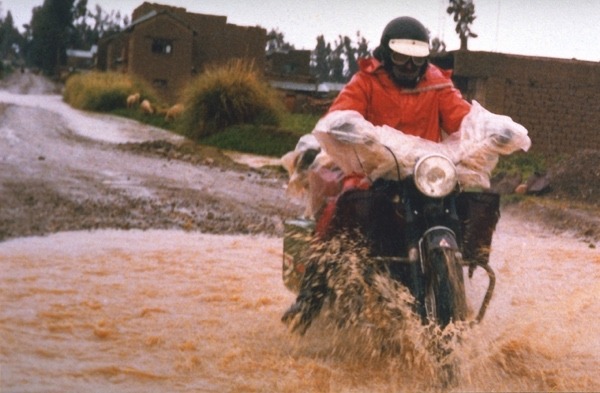
We drove the last 20K in the dark, but fortunately here it was dry. In Puno great difficulty finding hotel rooms – the Germans had them all. Someone did find us a hotel. The courtyard was an extraordinary labyrinth of makeshift constructions, rickety steps and drums of water. There was one room and three beds. The bike was outside in the passage. We felt like having a grand meal to offset the horrible hotel, but the Germans had eaten all the food. We found a chicken take-away and ate like savages – but with two bottles of good wine.
The hotel manager had a nightwatchman who slept just inside the door. He came into the room when we were fast asleep, switched on the light and said the bike had to be moved. I told him to move it then and went back to sleep. At six he came back, switched on the light to say he was “revisando” everything. We cursed and tried to sleep again.
January 16th
From Puno next day was fine most of the way, then a hailstorm. I left B&A behind me with a punctured tyre.
65 km to Sicuani. First 35 km were fast and dry – the last 30 km were the worst ever. Deep red mud, mostly in the dark, with corrugations. Reminded me of World War I battlefield. Craters everywhere with just a lacework of road showing. In one village it looked impassable. I tried riding on rough ground but fell and couldn’t pick it up because ground just slipped away under my feet. With help got going again.
B&A turned up late. To our surprise Sicuani had the beginnings of a luxury hotel. There was hot water (a little), a separate dining room, a llama, two gorgeous parrots. We did quite well, though the food was less than brilliant. Next day, to Cuzco…
PICTURES BY BRUNO BOUVERY
In December of 1975 I was in Chile. At that time the entire country was under a fierce military dictatorship. In this same week, 48 years ago, I was in the capital Santiago where a nightly curfew was strictly imposed by lethal means. I was deeply in love at the time with a Chilean journalist who belonged to Chile’s upper social stratum and lived in a prosperous part of town, but her circumstances made it impossible for me to stay with her. My hosts lived some miles away, there was gunfire in the streets every night and several times, leaving her too late, I ran the gauntlet on my bike.

Chile really was beautiful, but deadly
The dictatorship was imposed by four generals, Pinochet for the Army, Leigh Guzman for the Air Force, Merino for the Navy and Mendoza for the police. The most notorious then was Leigh Guzman, whose planes had bombed the presidential palace and caused the death of the President, Salvador Allende. My lover was passionately opposed to the dictatorship but had friends everywhere and we were invited to a party where most of the guests were upper class and favoured the regime. As always in extreme times the producers of tragicomic episodes worked overtime. I met a leather-jacketed man who supported the generals but had been arrested by mistake and imprisoned with left-wing suspects for some days. Frightened to death at the time, he nevertheless described with awe and relish the horrifying screams of tortured victims echoing through the building, relieving me of any doubt I might have had about the stories I had been told. Fortunately for him the mistake was discovered in time and he was released, but he remained convinced that ‘leftists’ all deserved what they got.
I also met a rather pretentious newspaperwoman called Perla Searle who worked for El Mercurio, Chile’s oldest newspaper whose editor, Silva Espejo, fervently supported the generals. I asked her to talk to him on my behalf, and soon after was told that the Air Force General Leigh Guzman had agreed to an interview for The Sunday Times.
So on this Sunday, 48 years ago, I went to her office to meet Perla who complained that she had had to interrupt her lunch, and that we would have to use her car because the paper wouldn’t reimburse her for a taxi. We drove through empty streets to the UNCTAD building where Silva Espejo was waiting to introduce me to the General. Apparently the generals had seized that United Nations building, a great glass barn with a heli-pad on top, for their offices. Uniformed carabinieri, with slung machine guns, unusually shiny boots, and many more leather straps than seemed necessary, were clustered around all the doorways. Because I had no other clothes, I was in my travelling jeans with a broad leather belt and leather pouch, which seemed oddly suitable, and I toyed with the idea of asking to borrow a gun.
Eventually Silva Espejo, an elderly man, formal and impassive, arrived walking very, very slowly and seeming to have trouble with his shoes. Together we advanced at a snail’s pace to the reception area, also dominated by police. A woman exchanged my passport for a piece of paper, I was asked to open my camera case, and we proceeded across a courtyard to the main building. There were some steps to go down, and twice I had to hold Espejo up as his legs gave way.
A guard travelled with us in a lift and passed us on to a reception area, and Espejo went into the general’s office first for 20 minutes before I followed. The General, a short man of undistinguished appearance, greeted me easily and sat opposite me at a table. We talked in French. He began by asking me which countries I had visited. I went through the list as quickly as possible and told him, truthfully enough, how beautiful I thought Chile to be.
“How do you find things here?” he asked.
I said I was anxious for him to know that I had not been sent to get a story. I would only write something if I thought it could be constructive. Thus my opinions would be my true opinions, not those he might want to hear. I said Chile made me nervous, that people were afraid, that if I lived here I too would be frightened of being carried off in the night.
He replied by making a general case for the measures they had taken, putting most emphasis on the “Communist Plot” to isolate Chile psychologically, economically and militarily in preparation for “a Viet Nam in South America. He walked across to his desk, fished out a printed White Paper about the build-up of arms in Peru and came back to sit next to me. It had a rather meaningless title, “Defense: Foreign Affairs,” and he read out lists of arms being supplied to Peru, which had a moderately reform minded government at the time. I remember seeing SA 5, 6, and 7 missiles and 500 T4 tanks. He said he got it from his attaché in London. He read them out as though they were self-explanatory; Peru was being primed for war with Chile. Peru he said was “on a direct line to Communism”, part of the world conspiracy, financed by Russia, through Cuba. Then more stuff about human rights in Cuba and Russia, all confirmed, he said by an exiled Cuban singer whom he’d met the night before. Meanwhile, he said, the British were strangling his air force by refusing to supply parts for his British Hawker Hunters. This was all to do with Communist Unions in the UK.
“Better watch out,” he said, “or we’ll bring all our money out, and won’t sell you any copper.”
Most startling though was his belief that Britain would soon have its own military coup, and I only found out later that there had, in fact, been a crackpot scheme, involving a general or two, to overthrow the government.
I said that my preoccupation was with the many thousands he had locked up and subjected to torture.
“I don’t think you appreciate the significance of the human rights issue in Europe,” I said. “Even those who might otherwise support Chile would not do so in face of the evidence. Surely by now you must have removed the threat to your internal security.”
“Yes, he replied, “there is no more an internal problem.”
“Then you can relax your repressive measures,” I said.
“Yes, I am going to talk to the other generals about it this month.”
“And your prisoners?” I prodded.
“We realise we must let them go.”
I left on a wave of euphoria, but before writing anything I went to discuss the matter with the British ambassador’s number two.
Far from being encouraged, he was disturbed by my news. We sat outside the embassy on a plumbed lawn where the risers, inconveniently, popped up to water the benches we were sitting on, causing him to speak sharply to his gardener. After a lengthy talk I was persuaded not to send anything to London for fear I was being used and that it might upset the ambassador’s arrangements.
I have regretted it bitterly ever since. There never was a relaxation and, so far as anyone knew, no prisoners were released. At the very least I would have exposed their hypocrisy.
I visited Gustavo Leigh Guzmann again in 1982, now retired and in business. He received me in his office in jovial fashion. Shortly afterwards men burst in with machine guns and assassinated him.
On this day, 49 years ago, I drifted along the Nile from Aswan to Wadi Halfa on a ferry consisting of two rickety boats tied together. One of them, the second class, was occupied by Nubian camel drivers. The other first-class boat carried Europeans. My ticket was second-class, but I found the snoring intolerable and smuggled myself into first class and slept out under the sky.
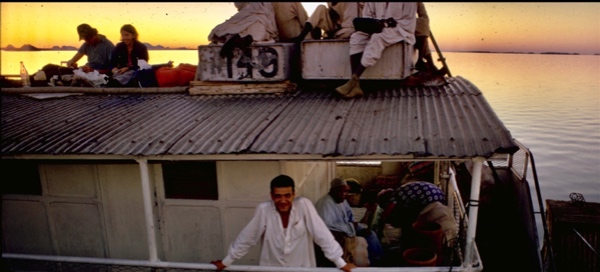
First Class accommodation on the roof of the ferry to Wadi Halfa
What follows is straight out of my notebook:
Bright moon. Stars becoming familiar. Cold at 3am but not too much so. Spent time talking to Australian Mike McDonald. Something about him remained alienating to the last. A conflict of styles.? His funny hat – a Muslim cap – was aggressively incongruous. The forthright manner was not quite true. – and concealed a complex and uneasy personality. Protestations of easy independence were contradicted by heavy point-scoring humour, and he lost few opportunities for self-congratulation. Yet there is a wistful, touching desire to find peace with himself (which he failed to find in his monastery).
From Wadi Halfa I had to take the train to Atbara and met a Dutch couple:
Although the Dutchman wielded an equally heavy sledgehammer he seemed to have found more peace in his 26 years. He and his wife Alice were travelling to South Africa to visit her father. It was her idea – he had wanted to holiday in Norway. Now he was finding much reward. His treatment of his wife was very masterful, and she was obviously devoted to him, even when he scolded her like a father. A big man, studying ‘marketing’, son of an old family, with a natural confidence which could make him boorish and pig-headed but for her moderating influence which he is happily able to accept. He was taken with my idea of classifying people as ‘alive or dead’ but said he would need to study it.
In Atbara I met Thomas Taban Duku and then Fabiano Munduk, both African Christians from South Sudan. With Fabiano an evening that started when he came to the hotel with his nephew Peter, a four-year-old boy in brightly striped jersey and shorts. They had come from school sports day. All day I had heard martial music of the (British) Empire drifting across. He explained they had been playing musical chairs. We drank two bottles of sherry between us in a bar, then took him by taxi to his brother’s house. Brother is in the police (a captain he said). Brother’s wife Rita speaks no English. He got her to give us a small bottle of home-distilled date liquor (like eau de vie). Dates left in water for seven days, then the container set out over a fire. Above it a lid perforated. On that a small bowl. Above it a bigger bowl serving as a lid and condenser, filled with cold water.

We took the bottle and walked across cultivated ground to look at the (Blue) Nile. Fabiano says the White Nile was a day’s walk away. He obviously didn’t know the Blue Nile only joins the White Nile at Khartoum 200 miles further south. We walked back to place where music had sounded. Fabiano was dodging about into bushes in the manner of Don Genaro looking for cars. I think he was looking for animals or snakes. We had been talking about his life in the bush – ‘bus’ – when he and his brothers were refugees from Sudan after his parents had been killed – he said – by the Moslem army at the time. He is proud of his brothers. They are twelve. Two are at Oxford, one doing economics, another librarianship. The others are mostly in the army – all of them officers. He is the youngest and least qualified.
The music came from a wedding party in a community on the edge of Atbara. Large square clearing with canvas spread over a large area, illuminated by bulbs strung out in large rectangle. Rows of chairs all round. Many children jostling for good positions, scrapping with each other but although they pushed each other around quite hard there was no bitterness in their manner and no crying. Fabiano says the children are allowed to be independent.
The band arrived in an army truck. We were given favoured seats, and then plates of food were brought specially for us, ta’ameya, bits of meat, salad, sweet pastry, bread and water. When the music started men would wander over casually, sometimes two together, snapping the fingers of one outstretched arm, to indicate their pleasure, and reach over to touch one or more of the players. Then they would retire, just walking way slowly.
I don’t know now who it was that sent me to the Golden Hotel in Cairo, but it was an inspired recommendation. Right in the centre of the city, on a busy but fashionable street, it should have been too expensive, but despite the noble façade the rooms were quite spartan and the facilities very basic. In reality it was pretty run down and although I don’t remember any cockroaches, I’m sure there were some around.
Even so the manager, Amin Simaika, worked mightily to keep it clean. I had only intended to stay a couple of days, but in fact I got stuck there for over a week, hoping in vain for permission to ride up the Nile to Aswan, and during that time Amin became a good friend. He endeared himself to me immediately by bringing the motorcycle into the hotel, relieving me of the biggest of my problems.
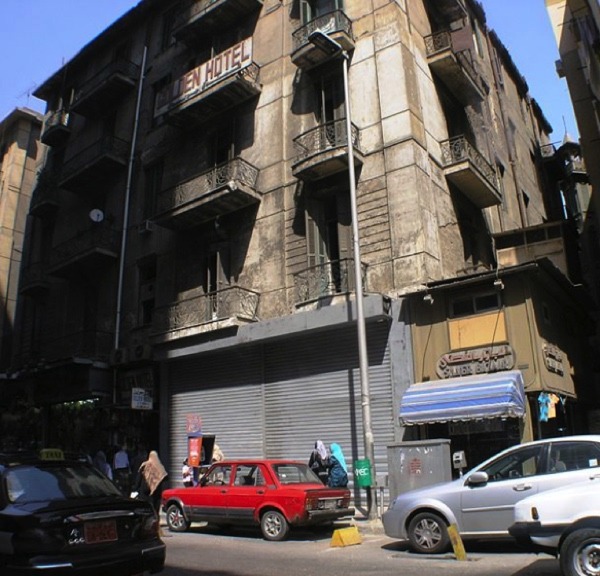
I spent most of my days on fruitless missions to the Government Press office in pursuit of a permit, but although they didn’t accuse me of being an Israeli spy – which had happened to me twice in one day in Alexandria – I was obviously viewed with suspicion. And in fact I have to admit, retrospectively, they may have saved me from a nasty fate because the population had been raised to a high pitch of ardour by the war. The cities along the Nile, like El Minya, Asyut and Luxor, became infamous years later for massacres perpetrated by fundamentalist Muslims and any foreigner would have been suspect.
The evenings I usually spent with Amin and Alan, a very English young man with blond hair, a slightly posh accent and a sardonic manner whom Amin was convinced was an MI6 agent. We played a lot of chess, which I discovered to my surprise I was quite good at, and learned as much as I could about what was going on.
Amin was a Copt – that is to say, a Christian – which put him and his sect somewhat at odds with the Muslim population. His uncle, who actually owned the hotel, was a very distinguished old gent called Faris Serafim whose family had founded the city of El Minya. He told of his great grandfather who was “keeper” of a village in the reign of Mohamad Ali. The villagers hatched a plot to murder him rather than pay taxes. He escaped, but they claimed he had run off with their taxes and a price was put on his head.
However, he made his way down the Nile and somehow contrived a meeting with Ali when the guards were some way off.
“Surely you know,” said Ali, “that I have put a price on your head?”
“You can have it for nothing,” was the reply, “if you don’t believe my story.”
The upshot was that he promised to double the tax returns if he was allowed to found his own village, and did so. The village became El Minya, and his family became very wealthy: Sufficiently wealthy, according to Alan, to give a visiting Cardinal a dinner for forty off gold plate. But most of the wealth was confiscated by Nasser at the revolution.
Faris was at Oxford in 1919 with Nehru and other famous men of that generation, who founded an International Club and toured England – Cardiff and Bradford were mentioned – to speak in halls and churches about their respective countries.
In my notebook I wrote:
“Cairo was the first city I’d come to in which fate as much as mortar seemed to fix the fabric.
In Tunis the poorest appeared to have some sense of social movement, could dream and hustle a bit. But here the impression was different. Cairo was intensely populated – 6 million in a relatively small space. Many of them – I don’t know how many – were newly arrived from the farms around and were as completely uneducated and unskilled as can be.
I saw them swarming into the city on foot in the morning, hundreds and thousands it seemed, in identical pale blue galabeas, crowding over a footbridge that crosses a big central highway.
Economic inequality is, of course extreme. Despite having kicked out the British, the shadow of the Raj lingers on. My small amount of money buys me luxury.
Not a hundred yards from my hotel is a cake and coffee house called Groppi’s, where a light breakfast of eggs, coffee, toast and marmalade involves the waiter in bringing eleven separate items to the table; a glass of water, a glass containing cutlery and napkins, two heavy silver jugs of coffee and milk, a cup and saucer, a plate of toast, a slab of white butter, a silver pot of marmalade, salt and pepper, and the eggs. My coffee cup comes from the kitchen full of boiling water which is poured out at the last minute.
It takes the waiter, who wears white linen and a turban, an appreciable time to unload the tray. The whole routine, I presume, was prescribed by the British, and the price is 28 pence.
Anyone living here within grasp of a Western income is clearly able to enjoy the best the city can offer, while the poor are just able to subsist on the crumbs he sprinkles in his wake – a penny for guarding the car, twopence for polishing his shoes, a penny for simply being somewhere regularly on the off chance of a service to perform, and so on.
There is little evidence of resentment on one side or contempt on the other. Once the donor has evolved his routine, and his small area of patronage becomes established, the relationships are warm and benevolent on both sides. This mutual respect is fostered by the clear duty imposed on the Moslem by his religion, to donate a distinct fraction of his income or wealth to others in need (10%, I think) The other duties are, to pray five times a day, to keep himself clean – particularly private parts – to do as he would be done by, and to visit Mecca at least once, if he can afford it.”
I finally surrendered all hope of riding the bike to Aswan, and took the train. Just before leaving, Amin asked me if I would carry his sword to Brazil. It was his father’s ceremonial sword (he had been a soldier). Amin was plotting to leave Egypt illegally and couldn’t take anything much with him. Of course I agreed. It fitted next to the umbrella, caused a bit of excitement here and there, and I delivered it a year later in Campinas, as promised.

In Campinas, Brazil in September 1974. You can see the tip of the umbrella, but I had already given the sword to Amin, on the right.
