News from Ted
During the course of this past week I have been relieved to learn that the world is probably not flat after all, and that the flat-earthers seem to be losing their grip, so I’ll leave that subject and go on to something else.
I still have all the notebooks I filled during my first journey around the world, so I thought it would be interesting to see what I was jotting down 49 years ago today. But while I was looking this up I noticed something that I thought would interest you.
I was, as you know, a novice motorcyclist – I had only got my license three months earlier – and I was, quite plainly, scared. Just before starting the journey, on an overloaded and badly packed bike, I wrote:
Here is a list of the things I fear
Getting on rough ground and finding that the load makes it undriveable; Dropping the bike and not being able to pick it up again; That the odds on a fatal accident seem unreasonably high; That the combination of chores may become crushing, and pin me down to immobility; That if the bike is stolen I shall have nothing left but a few dollars to get me home; That my fear for the bike will force me into unbearable cost and sterile apartness; That the natives will really be hostile; That with one hand clamped down on a gushing artery, I shan’t be able to unpack and open a field dressing with the other; That wherever I go it will always seem to be too late.
Four years later I was happily able to say that my fears were exaggerated (although I never did have a gushing artery). But I am quite sure that being afraid during the first months were key to my survival.
So it turns out that on November 21st 1973 I was in Egypt, in Cairo and riding my bike to visit the pyramids, just like any tourist. But there weren’t any tourists because there was a war on. Remember? Egypt and Israel?
To my astonishment I see that in Jupiter’s Travels I wrote nothing about Cairo at all. Let me make up for some of it here. It turns out that what I wrote in my diary surprises even me. Only lightly edited, I quote:
A throng of guides, horses and camel drivers make an appreciation of the pyramids impossible. To have first stumbled upon them must have been marvelous but I can find no sense of awe for these lumps of stone. Less barbaric than Teohuacan, but still a monumental egoism. The marvels are all abstract – geometry, astronomy, etc.
I can’t resist the importunities of a guide who is clever enough to be less clamorous than the others, but he shows me very little. In a tent he gives me good tea made on a primus stove by a pretty wife dressed in pink. She boils the water and tea vigorously, decants it, boils it again, decants it again. How the sugar got in or where the tea leaves went I have no idea.
Walk into the second pyramid (Queen Sharfeen?) One tomb with hardboard partitions. Graffiti carved into the stone in the early 19th Century. G.R.Hill and Scheistenberger were here.
Back to the first (big) pyramid, Cheops. Inside is like something from the film Metropolis – all scaffolding and duckboards. What, in God’s name, does the average package tourist get out of it all?
I’m ready to leave altogether but give way to a camel driver, and now my reward, because he gives me a great ride, over an hour, into the sand dunes, on Jack Hulbert (that’s the name of the camel).
Faris, the driver, is bright, humorous, great fun. We take a roll of pictures with his mate, Mandor.
I really rode that camel, rein, switch and heel. JH lurched and swayed and hobbled along, with brief bursts of crazy trotting. I crossed my legs, Arab style, across his shoulders. My thighs ached from the unaccustomed movement. He is six and will go on probably until he’s twenty-five. There are sacks of clover at his side under heavy embroidered cloth.
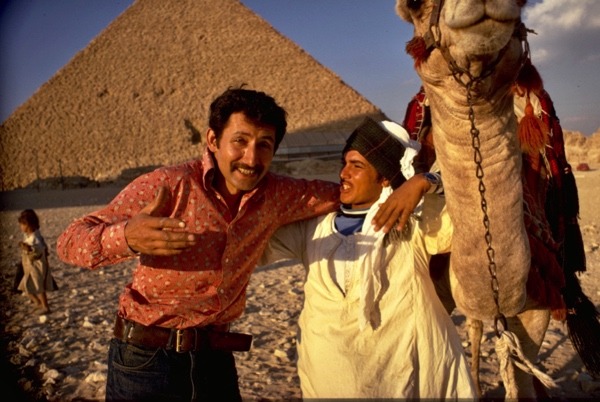
I’m disturbed by my failure to respond to the pyramids and question the quality of the response in others. I know perfectly well that if I want I can whip up a storm of fancies and imaginings but I was determined to let the pyramids do the work. As props for a mind hungry for sensation they do very well, no doubt, but as objects to inspire pure awe I think they fail, even more so as they are surrounded by bric-a-brac, haggling and petty detail.
I’ve been told that it’s better to see them first at night, through ‘son et lumière’ and that it’s a very good show. I quite believe it, but that’s a different matter.
The pyramids depend, like all other earthly things, on perspective. When the perspective is altered, whether by a persistent camel driver or a new catch-penny museum built up against the side of the pyramid itself, the pyramids fail to overcome. The viewer has to supply, by an act of imagination, what has been stolen. I refuse because I feel I will become an accomplice of the despoilers.
Yesterday I recorded the final chapter of Don’t Boil The Canary. It’s a huge relief. I had no idea, when I started doing this nine months ago, just how demanding it is. For one thing my voice has been constantly on the brink of collapse, and a frog has taken up permanent residence in my throat.
When the idea of recording Jupiter’s Travels first came up I was hoping to persuade Ewan McGregor to do it, and he told me, vehemently, “I’m not the man for this job. It’s absolutely the hardest thing to do to keep it alive for days in a recording studio. I recorded five short stories once for Radio 4 and it almost ended me.”
I should have been warned then what I was in for.
Well, I didn’t have a recording studio – only the kitchen table. And I suspect that if you listen to it, as the recording proceeds you’ll hear me getting older. I am full of admiration for Rupert Degas who recorded Jupiter’s Travels with that marvellously rich, even-toned voice, with never a hint of stress or uncertainty.
My only excuse for doing it myself is authenticity, and there’s plenty of that. It’s possible, if you listen carefully, that you may hear my neighbours shouting in the street, and there was a month when the village authorities were tearing up the square.
To be honest I have no idea what will happen to the recording now. I have a friend, Iain Harper, who I hope will help to bring it to market, and I expect to make it available from this website.
So, in other news, it has taken me five years to discover that a motorcycle mechanic from New Zealand lives in the next village.
A friend of his from Los Angeles introduced us, but Peter Clark and I are now buddies, and he has carried off my 650 Funduro for a last ditch attempt to discover why it has the unfortunate habit of dying under me at completely arbitrary intervals.
You may have heard me complaining about this before. Several times I thought the problem was resolved. This will be my last attempt. You have also heard me threatening to give it up and it may come to that too, but not until I’ve ironed out this last wrinkle.
When I did my first big journey I rather took it for granted that the world was a globe, but there are some people going around now saying the earth is flat?
There was a time, many thousands of years ago, when everybody thought so and it’s easy to see why. They didn’t know if it was a disc or a rectangle, or what happened at the edges, but it didn’t bother them. They would have said that when I rode my motorcycle round the world I was just riding in a flat circle.
Today most people – pretty much everybody – knows the earth is a globe, but now, suddenly, there are people who say they got it on very big authority that the earth is actually flat, and they want us to give them money and vote for them so they can beat the scoundrels who say the world is round?
As a reward they say they will bring down gas prices, conquer inflation, and stop aliens from clambering up over the edge of the world to do bad things.
So what do you do? Do you believe them? I guess I’ll find out on Tuesday.
I suppose it’s about time I started believing what people tell me. For forty years now they have been saying that it was my book that inspired them to get on their bikes in the first place, and then out into the world. I have always been afraid of letting all that praise go to my head but now, at 91, perhaps I can let go and be proud of that achievement because I believe strongly that individuals travelling in that way can only be good for society.
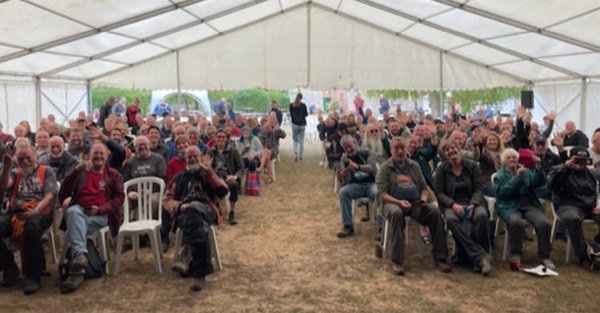
And yet, at the same time, when I’m asked to talk to an audience about my experiences I have very mixed feelings. I talked to a tentful of friends at the Overland Event near Oxford (pictured above) and a few days later I talked to a room full of people at a lovely pub called The Richard Onslow in Cranleigh, Surrey.
Sara Linley, who runs a motorcycle apparel shop in Guildford with her husband Chris, approached me two months ago. It was their friend, Elspeth Beard, who lives nearby in a converted water tower, a quite extraordinary building, who suggested that they ask me to talk when I was over in the UK for the biker festival at Ragley Hall. The talk was such a success that when I came back to the UK this time for Paddy Tyson’s Overland Event they asked me to do it again.
My job is still to convince people that nothing can compare with riding out alone into the world and yet, even as I’m talking, I can’t help feeling a little sad. I know that no one today could hope to experience it in the way I did.
I was lucky of course, very lucky. I set off around the world at a very good time – in 1973 – long before ordinary people like us dreamed of communicating with anything more sophisticated than the telephone. The world was divided up, more or less, into compartments. Unless it was your business to know what was happening outside your bailywick people generally had only a vague idea of what was going on in the rest of the world, or what it looked like. True, after the war “Wogs” didn’t begin at Calais anymore, but people and places beyond the edges of Europe were only dimly recognisable to most people. No Instagram, very few pictures at all, and no blogs.
The little I knew of South America was mostly coloured by my stepfather’s description of various sordid ports he visited when he worked as an engineer on merchant ships, and my ideas of Africa were shaped by the war, and novelists such as Rider Haggard and Joseph Conrad.
Today we all see and know too much about the outside world, but what we know is shaped by others who decide what we should know, and what they want us to believe. How often travellers today find, when they arrive at some distant destination, that what they see and hear is nothing like what they’ve been told.
You could say I’m guilty too; that if you had travelled to, say, Zimbabwe at the same time I did, in 1974, you might have seen it quite differently, but in my defence I say Jupiter’s Travels is not reportage. It is as much about how the world affected me, as it is a picture of the world, and one of Its purposes is to persuade you, the reader to go and see for yourself. And although the world is very different today that is still my purpose and it seems, to some extent, I have succeeded. I think the people who listen to me, know that. And I’m grateful.

Marabou stalks in Tanzania’s Mikumi Nature Reserve
Forty-eight years ago, when I was riding through Tanzania on my way to Mbeya, I came across an elephant. *
“It stood a little way back from the road and facing me, arrested in the act of chewing a trunk-load of grass. The grass stuck out on either side of its mouth behind the trunk, like a cat’s whiskers, giving it an undignified and rather lugubrious look. We stared at each other for a while. Then I got the definite feeling that it was fed up with me and planning to do something about it. I kicked over the engine and rode on.”
“Farther along a small troop of zebras also stood grazing and again I stopped. All stood still as statues, heads turned to face me from whatever position they had been in. Their small, round ears strained upwards and seemed to tremble with the effort to pick up any slightest signal. Their markings were immaculate, as if freshly painted on with immense care. All wild animals gave this impression of sharpness and clarity that was new to me, and I began to remember zoo animals as having lost this edge and looking faded and grubby by comparison.”
“Nothing ever enchanted me so much as coming across wild animals. I thought often how human society had impoverished itself by driving this element out of its life. In Africa I began to see the human race, sometimes, as a cancerous growth so far out of equilibrium with its host, the earth, that it would inevitably bring about the destruction of both.”
Well, we’ve gone a lot farther down that road since then. I’m writing from one of those heat waves which are soon likely to become another word for summer. I shall leave this world long before the worst of it but how dismal to see it coming. Are any of you from West Virginia? Can’t you recall Joe Manchin? Is there anyone in Moscow? Can’t you plant a bomb under Putin? We’ve got rid of Boris, but not in a very useful way. If only my pen were really mightier than a sword. If only I were mighty enough to wield it.
So far life is still manageable. I rode my new MP3 a few hundred miles recently, just as the heat was coming on. I rode past grand vistas of green grassland and newly verdant vines, and plunged into aromatic forests of evergreens. It’s a 500cc machine and it gobbled up the miles with ease. So I still get these ideas . . .
Africa may be a bit too far for me now. Anyway, the second time I went, there were no elephants on the road. But the first time will always be an explosive experience.
I have to assume that if you are reading these words you have an interest in travel, probably by motorcycle, and that you are curious about those parts of the world you haven’t experienced. Even though the abundance of images from everywhere today can give the illusion of being there, you know that it is an illusion. You need to be there to know it and, more importantly, to know how you personally respond to it. Adventure travel, after all, just means getting out of your comfort zone and finding out what happens.
So, of course you would want the world, as it is, to survive, and you would want travel to be possible and unhindered by wars and dictators.
This is my clumsy way of establishing what it is that you and I have in common, regardless of age, nationality, politics, religion and gender: and I want to say that what we have in common is vastly more important than those other things. So, what are the biggest threats to our common interest? Well, I would say, first and foremost, climate change. Apart from making “normal” life abnormally uncomfortable, it will create dangerous, chaotic conditions in the most interesting parts of the world, like Africa and Asia – travel will become difficult and downright dangerous, but not in a very interesting way.
What is puzzling, and extremely aggravating, is that American voters, who have the power to turn the tide, are so concerned about their current discomfort that they are shutting the door on measures that must be taken now to avoid a dystopian future. Do they feel helpless? Why is the only charismatic leader around determined to make a bonfire of the environment?
I reckon I may be talking to a couple of thousand people who feel as I do. I keep coming back to it, I know, but are we helpless too?
* Jupiter’s Travels: P 153
I’ve had a wonderful week in England, right across the spectrum of motorcycle travel. First there was the enormous ABR meeting at Ragley Hall, and then, on my last night, an intimate evening in a pub with sixty fellow bikers.
I must admit I was nervous of the ABR. Huge meetings like that have never been my thing although I compromised for years in the States because it was the only way I could get to see my friends. But somehow something as big as that, attracting tens of thousands, didn’t seem right for little England. But I was wrong. Immaculately managed by Bryn Davies it was even better than the Overland Expos I used to go to in the USA. For one thing, there was acres of sitting room. And there were hi-tech tents I’ve never seen before covering huge areas. It was under one of those tents that I had the pleasure of being grilled by Billy “Bike Truck” Ward, and under another that the unstoppable Simon and Lisa got me flowing on a cold morning.
Thank you all for making it so easy for me. Billy has been especially generous to me. He is the man who arranged for me to fly to Dubai on a 380 in business class, my best stratospheric experience so far, until I go up one day with Elon. It almost hurt me to learn that Billy himself only flew coach.
XRW964M was parked up by Ragley Hall and it gave me great pleasure, as always, to be near it. The Hall itself disappointed me, a huge grey pile on a grey day, looking rather unfriendly, but perhaps in sunshine it does better, and I heard there are beautiful gardens behind it somewhere. Much more friendly and luxurious was the Arrow Mill hotel I stayed in very nearby, where my room looked out over swans, and the bathroom was like something out of pre-war Hollywood. Fortunately for me I didn’t have to pay.
The night before flying home I had dinner with sixty bikers in a splendid pub in Cranleigh, Surrey. Cranleigh is said to be the largest village in Britain, which doesn’t seem to be something to brag about, but the bit I saw looked pretty enough. The dinner was arranged by a super nice and efficient couple, Sara and Chris, who have a motorcycle apparel shop called Motolegends in Guildford. Everybody liked me. It may surprise you to know that it always comes as a bit of a surprise to me too. I’m very likely to go back, and I really want to visit their shop. The website is full of surprises. Next September maybe, when I go to the Overland Event at Oxford, which is the diametric opposite of the ABR. It’s a lovely small meeting I try not to miss, and I still hope against hope that XRW964M might find its way there again, as it has all these years.

A summer’s evening in Aspiran – where I live
SPOILER ALERT
I’m sorry, but there’s a question I have to ask. It’s not that I don’t care about guns, or abortions, or LGBTQ, but I care more about the survival of our species.
When will someone find a way to explain to Republican (whatever that means) Americans that their representatives are lighting the gas in the oven which is going to roast my grandsons?
Do those six sick Supreme Court justices (what’s justice got to do with it?) not know that there are already zones in the ocean that are 2 degrees hotter than normal and killing off their inhabitants?
Do they not know that desperate workers building football stadiums in Quatar are dropping like flies because working in fifty degree Celsius heat is lethal, which is what those sick justices and their enablers on the Hill are preparing for us all?
They must have, at the very least, the intelligence of your average working Josephine. The only explanation I can come up with is that they know the game is up, and that they might as well have some fun. Shall we join them? I’ve heard of Hanging Judges, but I’ve never seen one hung.
PS: Since only a miracle can save us, I bring you news of a miracle. The morning after I returned from England (via Easyjet, and that in itself was a minor miracle) our ancient water-heater packed up. We called a plumber.
He arrived at our door, young and enthusiastic, in under ten minutes.
He diagnosed the problem and returned twenty minutes later with a new heater. In no time at all we were fixed up and he took the old one way.
I consider that to be a miracle. Of course you may say it doesn’t count because it happened on a Thursday and true plumbing crises always happen on Saturday night. Well poo to you.
My partner Ann has lived in France all her adult life but she still switches to Radio 4 every morning, and so, like it or not, I am gradually drifting back into being British, combining breakfast with the bitterness of a Brexit hangover and taking some pleasure over the woes of Johnson. But I haven’t been there for almost three years. Mainly because of Covid, of course.
Now at last I can once more burst forth on England’s green and pleasant… and I won’t be coming by rubber boat to secure my free trip to Rwanda. I shall fly into Gatwick next Thursday and a chauffeur driven car will collect me, and whisk me to the revels at Ragley Hall, which my friend reminds me is usually pronounced Wagley Hall because of its long association with effete aristocrats.
I don’t think any of them will be there next weekend though. It’s all biker boys and girls and I hope they don’t rough me up too much.
I’m going to be cross-examined by Billy Ward and what’s left of me after that will be roasted over a camp fire the following morning.
But that’s not all. There are some people I am looking forward to meeting who also have a chauffeur driven car (you can see I’m not used to this luxury) and they are also going to whisk me to a pub at Cranleigh the following Tuesday where, having washed down a jolly good pub dinner under the eager gaze of a hundred invitees I shall have to sing for my supper.
I told them that I was going to read my book. No, not out loud. I actually haven’t really read it since I wrote it 45 years ago. I thought if I read it now I might be surprised, and it would be fun to talk about it. Well, you know I forgot what a bloody long book it is, and I’m hardly a quarter of the way in, but it IS surprising. And it does prompt some very interesting thoughts that I hope will keep me on my feet.
If I survive, there will be more whisking the next day, to the airport. I might see a bit of England through the car windows. I’ll tell you all about it next time. Slava Ukraina.
When I first moved into Aspiran, my village in the South of France, there were people here who thought they would be overrun by hordes of noisy bikers; a sort of Mediterranean Sturgis. Alain, the café owner, would have been delighted, of course. Everybody else would have wanted to run me out of town.
They vastly overrated my notoriety. It seems I am not so famous after all. What with Covid and all, I can count on my fingers and toes the number of riders who have actually turned up at my house, not to mention the three others who came to the village but couldn’t find me.

What I will say though is that the ones who did find me have all been very interesting, intelligent people with an extraordinary range of professions, like the two who turned up the other day. Matthias from Berlin spent years of his life working for a UN agency trying to control drug production before he gave it up, I gather, as a lost cause. Oskar from Holland runs a head-hunting agency in the field of logistics. I have had a marine biologist, a high-flying geneticist, an agricultural advisor to under-developed countries, and a video producer from New York, but also several people who were just very stimulating regardless of what they did for a living.
People who travel on bikes are pretty extraordinary, and even though many credit me with having got them on the road I’m fairly sure they would have found their own way there sooner or later. My problem, sadly, is to find my way back.
My yellow BMW sits in the garage and looks at me despairingly. I keep the battery charged but it’s a long time since I took it out. The truth is I know I am losing strength – physical strength. Sitting on the bike is not a problem; I can ride it well enough. But manoeuvering it on the ground is harder, and I am not at all sure I could pick it up. Then the other day I thought I really must make my mind up about this and got ready to ride it out of the garage.
The starter failed.
Just a stream of rapid clicks. How could that happen, with the bike just standing there? I started it not long ago, just to make sure. Who says bikes don’t have feelings?
Does it know that only ten days ago I bought another MP3 scooter? I’ve finally admitted the truth; for running around here, between two houses, shopping and so on, the old MP3 I took around the UK was really much handier than the BMW. So I’ve bought another one, with a bigger engine. 500cc.
I bought it from a restaurant owner 125 miles away in Toulouse and brought it back in an exhilarating ride just before dark.
So now I will have to get the BMW to a mechanic, three miles away, and I don’t feel I have the strength to push start it safely. Sure, I’ll find someone to help, but the lesson is all too clear. If I can’t handle the bike on the ground maybe it really is time to let it go. I shouldn’t complain, and stop dithering. We’ve had a wonderful twenty-three years and 40,000k together, everywhere from Spain to Ukraine, England to Greece. Isn’t that enough . . . . well, not really. Damn!
I know, I know, it’s the battery, not the bike. No more street cred for Ted. But the rest of it was true. By the way, that was Matthius in the picture with me. He came from Berlin on his 1100.
It’s that day again, MayDay; and not for many decades has life on earth been in such need of saving from distress, but I needn’t remind you of that. For me it is a day of joy, a birthday, and most of all, thank heavens, I am NO LONGER NINETY.
For a whole year I have been labouring under the weight of that zero, so from now on I’m shooting for 99, but save me from the dreaded double zero. That would really finish me off.
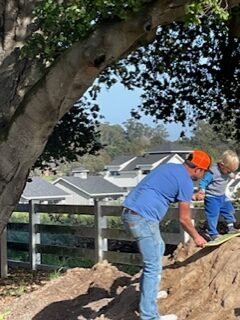
For the last month, more or less, I have been trying to wind up my affairs in California and I’ve come back with my affairs as unwound as they’ve ever been, but in a much more pleasing pattern so I shouldn’t complain. I’ve had the company of my son who presented me with another grandson two years ago. His name is Wyatt and he shows great promise with the skate board, sliding down a mountain of sand. Every kid’s dream.
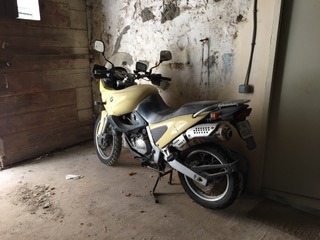
Meanwhile my bike sits in my garage, lonely as a cloud, and I must admit that the time for our parting seems to be drawing close. I’d be much happier on that MP3 I rode around the UK twelve years ago. Sadly it fell apart last year, and I’m thinking of getting another one. So if anyone’s interested in a lovely old Funduro with scratches but only 45,000 km let me know.
Now we’re off to the seaside for oysters and champagne – and let the world go hang, for today at least.
In 1993, when I was on a long journey through Europe, mostly on foot, I walked through a part of Ukraine, between Poland and Romania. Ukraine, newly liberated from the Soviet Union, was deep in crisis, but the crisis was economic. I can’t think of anything useful to say about the tragedy unfolding there now, so I thought I’d offer you a short extract from my book about that journey, “The Gypsy in Me.”
I arrived in Ukraine from Poland by train, to the city that was then Lwow but is now L’viv.
I joined the human tide that swept into the station building and swirled around inside it. There was not a calm spot anywhere. Almost every arriving passenger had brought huge bales, boxes, and baskets, and they were bobbing about in the confusion as though two columns of porters on safari had met in head on collision.
I searched the station walls in vain for any sign of a language I understood, or a map that might tell me where to go. Outside the station, to my disoriented eye, all was frantic chaos. There were buses and trams, but I could not know where they were going and the competition to get on them was fierce. I should have been patient, followed my own rules, sat it out quietly somewhere until the crowd dispersed and I could get some kind of grip on the situation. Instead, anxious for a quick resolution before it turned dark, I asked a policeman.
Two of them were moving through the crowd. They wore pale blue uniforms and I swear it was the colour that seduced me. I confused them subliminally with the United Nations and equated them with peace and security. I walked up to them and said, “Hotel?” One of them turned to me and I saw immediately that I had made a mistake. He had the kind of face I personally detest, a lean, jocular, ass-kicking face. He managed to grin and bark simultaneously.
“Passport!”
I showed it to him. He scanned it, marched me briskly out of the station, and yelled at a crowd of disreputable men gathered around some vehicles that even a wrecker’s yard might have refused. The call was answered by a burly and villainous looking man in the standard black leather jacket, and the cop addressed him with an offhand, joking remark. To me it sounded something like:
“Here’s a little gift for you, Georgi. Don’t forget to cut me in on it later.”
Georgi, if that was his name, ushered me to his taxi, if that’s what it was. There was not really enough of it left to tell. We were able to squeeze in at the front somehow. A comrade of his already occupied the remains of the back seat. I had just enough of my wits about me to remember the Russian for “How much?” so I said “Skolko stoit?”
He raised both hands.
“Dyesyat dollar. Ten,” he said.
Outrageous as I knew this must be, I felt like paying a penalty for my own stupidity and let it go. The contraption ground into motion and we set off. Georgi spoke about ten words of English, and the same number in German. He quickly came to the point, and I understood him a lot better than I let on.
He did not want to take me to a hotel. Hotels are expensive. He had a room. It was somewhere called Ternopol. He would take me to the room. Hotel bad. Room good. Ternopol. He wanted to imprison me in a room, take all my dollars, and then sell me to a laboratory for radiation experiments.
Reasonably enough, I refused.
“Hotel”, I kept insisting. In frustration he slammed his fist on the steering wheel, which I thought a risky thing to do. He held frantic conference with his mate, then started all over again. Actually, as I watched him perform I began to warm to him. Scurrillous and unshaven as he appeared, there was a soul in that bulky body, and it was strained to bursting with resentment over my thick-headed obstinacy. I could sympathise, having endured hours on the train with much the same emotion, and I had to admit he expressed it much better than I had. Fuming with impatience, slapping at everything near him, he tried again and again to get me to surrender to his plan, and we seemed to drive around forever while I wondered whether he really needed my permission.
So I was quite pleased at last to find ourselves outside the Grand Hotel in the heart of town. It was too grand for me, but at least the clerk spoke English. With sorrowful disdain he spoke of another, cheaper establishment and sent us and our jalopy a few hundred yards farther along the road.
It was called, curiously, the “George’a Hotel”. What the “apostrophe a” meant I tried later to discover, but it dated back to Polish times, and nobody seemed to know. The name was up there, in stucco, on the facade, and that was almost all that could be seen of the hotel, for the rest of it, including the main entrance, was obscured by scaffolding.
The side door, the only way in, was more like the entrance to a jail than a hotel. People entering and leaving had to run the gauntlet of a bunch of tough-looking men who were gathered round it, laughing and smoking, while watching them from the side street was an even bigger crowd of soldiers or police with a military vehicle. There should have been an air of crisis, or at least some tension around this unusual scene, and it was puzzling that all the players were evidently treating it as a normal everyday occurrence.
It struck me, not for the first time, that I had spent the greater part of the day being mystified by one thing or another. The explanations I gave myself were pure speculation. Without language, passing through societies in catharsis, I was no better able to account for the phenomena around me than an illiterate peasant resorting to magic and superstition. I was schooled to be forever explaining things, and to be miserable unless I could understand and interpret what was happening around me . . . and yet, the kaleidascopic images I had witnessed that day were all the more fascinating for being inexplicable. Ignorance might be more hair-raising than blissful, but I had survived, and there was a certain joy in simply recording how things were, rather than forever asking why?
Feeling unduly magnanimous I gave an extra five dollars to the rogue who had brought me there. He wanted more and I laughed and squeezed through the hotel door. The receptionist was just as haughty and abrupt as I expected. It would have been more correct to call her the interventionist, but I already had a sense of the local style, and laughed it off. The price of the room was $14, with no bathroom and a suggestion of occasional hot water. She made it clear that only a fool would not know that the restaurant was open until eleven, and she thought me stupid for asking whether I could call Germany from my room. Then her phone rang and she had no more time for me.
I climbed a fine staircase with elegant curving bannisters to the first floor, where the rooms were arranged around a central well with a broad domed skylight above it. Tall carved doors opened on to big rooms with lofty, molded ceilings and high windows. Clearly this hotel had once had a lot of class, and maybe one day would again. Meanwhile, it was a disaster. I managed to squeeze a meal of sorts out of the restaurant and walked out into the night.
The tough guys round the doorway wanted to buy dollars, and from them I discovered that the unit of currency, for want of a better name, was actually called the Kupon. One mystery resolved. The hotel was close to an intersection of several big and busy streets. The statue of a local hero, Shevchenko, stood in the middle of the road. Beyond it, in the direction from which I had been driven, I saw that the street broadened out into a great open area, about a hundred yards wide and very long. Down the middle of it ran a broad, cobbled carriageway and at the far end stood a fine, ornate building that looked like, and was, an opera house.
On each of the four days and nights I stayed in Lwow, I spent some time walking around this splendid esplanade. I joined the enthusiastic audiences that gathered to watch chess players with time clocks hurling joyful insults at each other as they slammed their pieces across the board and their palms on the clocks at breakneck speed.
On the afternoon of Saturday, the big market day, the benches were packed with peasants resting under the bright sun. There were many stout women, past their youth, firmly seated on the benches with their legs apart, skirts smoothed tight over stockinged knees, in blouses, wooly cardigans and scarves round their heads, weathered faces fixed in expressions of satisfaction. Done with the market, it was their chance to claim the freedom of the city for an hour or two before the long road back to their farms. Some of them had a man alongside, bucolic, slightly tipsy and grinning like a jester.
Other older men, pensioners maybe, in faded nondescript suits with stiffly pressed pants like the post-war clothing of my parents’ generation, walked carefully with canes, upholding their dignity. Farther along towards the opera house, the crowd became younger. The racing chess virtuosi were there that day too and a dense knot of men watched and listened to their good-humoured taunts, but many other, quieter games were in progress, attracting less attention but creating pools of tangible reflection alongside the mainstream of people ambling to and fro.
I was there on Sunday, August 14th too, which happened to be Ukraine’s National Independence Day. Up and down the esplanade fiery impromptu orators draw small crowds into loud and lusty argument, while ancient veterans paraded in pale blue uniforms and little boxy caps, larded with operatic piping and medals.
Overlooking the scene from all sides were the great ornamental buildings of the nineteenth century. In this vast precinct from a bygone era there was a peaceful atmosphere which I thought would be impossible to reproduce among modern buildings, however carefully designed or placed they might be. Those massive old stone blocks, dinosaurs from the age of czars and emperors, were once as potent and aggressive as the concrete power structures of today. They had housed the great corporations and institutions of empire, and must have been hot in the pursuit of profit and the prosecution of control. They had been raised up over the labours of millions. In their time they were overbearing symbols of the powers that ruled the throng, that chained armies of clerks to their desks, labourers to their gangs, and soldiers to their batallions.
The polished black cobble stones I walked on, like the billions of others that paved Europe during that century, were laid by hand, and cleverly too, to form a pleasing fan-shaped pattern. Rich men in carriages could look down and see their superiority illustrated in stone beneath their horses’ hooves. But that was all in the past. Today, the pattern in stone was just that, a pattern. The big buildings had taken their toll and were paid for long ago; the heat had gone out of these monoliths of a hundred years ago, their force was spent, and a cool serenity remained. The art survived the loss of power and became benign. In Lwow, where the war passed them by undisturbed, they now shed their benevolence over the newly liberated population. Time matters. Time changes things. Time can’t be faked.
That was the best of Lwow (which I learned to pronounce L’viv*, as the Ukrainians do). The rest was hard scrabble. I began immediately to look for a map to guide me between L’viv and the Romanian frontier at Chernivtsy, but without success. The hotel clerk told me categorically that there was no such thing as a map of Ukraine. Of course I didn’t believe her, but proving it was another matter. I spent Friday in fruitless efforts, and gave up. All I could think of was to find an atlas of some kind and make a copy or tracing. At least I would know the names of some towns along the way and have a rough idea of the distances between them.
The main library, as it turned out, was nearby and close to the market, and I went there on Saturday morning after looking round the stalls and buying a few odd things I hoped would keep until I was on the road. It was a modest library, with very little on open display, but the woman (Why always women? What do the men do?) at the reference desk was nice, and helpful. She found a school atlas. The 200 miles I intended to walk were shown on three inches of map, but still it was a lot better than nothing. I tore a page out of my notebook, did a rough tracing of the roads south and began to make dots for the towns. The cyrillic script was printed so small that I had difficulty reading the names. It was an old atlas and the roads were indistinct and undifferentiated as to importance or condition. I foresaw having a great deal of trouble.
It was then that the usual miracle intervened. A chubby, balding little man in his sixties bustled into the reading room, and stood next to me at the counter where I was working. As he was talking to the librarian I saw his eyes wander my way, and then he asked if I spoke German. So I began to explain what I was up to, and he said he could help.
“Come and sit at the table”, he said. “You see, I am a geography professor, retired actually, but I have surveyed every bit of this territory you are going through, between here and Chernivtsy.”
He gave me the names of the towns where it would be best to stay, where he thought there were hotels; and he knew from memory how far they were from each other.
“But why don’t you get a map?” he asked.
I laughed. “That’s what I was trying to do, all of yesterday. It’s impossible. There aren’t any.”
“Come”, he said. “I’ll show you”.
We went out together and he walked me to the very first and most obvious shop I had gone to, just a hundred yards from the hotel. Within minutes he had procured a road map of Ukraine. I was astonished and a little humiliated.
“How is that possible?” I asked. “Why didn’t they give it to me yesterday?”
“Ach, don’t blame them,” he replied. “They only came in today. By Monday they will be all gone. Do you want a small scale ordinance survey map? They have those here too.”
But the flow of miracles had dried up. They had maps of everywhere but the area that interested me. And as for dictionaries, phrase books or guides, there were none. Still I pushed my luck.
“Do you know anyone in the English department of the university?” I asked. “It would be a great help to talk with someone there.”
My cherubic factotum, whose name I wrote down, lost, and later couldn’t remember, was more than willing. We walked the streets behind the hotel for fifteen minutes to arrive at a classic example of a nineteenth century temple of learning, not very different from my own alma mater in London, lavish with brown marble and granite, echoing flagstones and neo-gothic windows, where thoughts fly heavenward while the feet freeze. L’viv has a typical continental climate of hot summers and long freezing winters. During the summer months, when the building is largely empty, the architectural environment is ideal. It was pleasantly cool and breezy as we clattered up the long flights of steps and down the galleries to the small rooms where the English department was tucked away. Luckily a secretary was working there to tell us that one of the professors was probably in town. She phoned his home, and then told me to call him later when he would be back.
I thanked my guide profusely – he seemed not to want anything else – and buoyed up by my good fortune I went to the post office, thinking I would write to my son William. I had sent letters from Russia, and postcards from Poland, but I didn’t know how long they would take, or whether they would get there at all.
It was an intimidating challenge to write something comprehensible to him about my experience. A vast chasm separated it from anything he could have known. I wasn’t sure how to make the bridge, and thinking about it made me uneasy. Even though we lived a rather simple life by American standards it distressed me to see him already taking for granted so many things, in the way of food, leisure and entertainment, that I regarded as luxuries. It made me equally uncomfortable to watch his growing addiction to electronic imagery, junk movies, and cool clothes. At home in California I used all the cliché arguments on myself to restrain my objections:-
The world has changed out of recognition since I was a boy.
So I wrote down a few anecdotes I hoped would amuse him, and returned to the George’a. I found the hotel full of bicycles. That is to say, the hall was packed with them, some assembled, some in parts, big bikes, little bikes, baby bikes, flowing up the staircase and through the doors. Accompanying them were a number of men who resembled the cop at the station. By now the receptionist was talking to me – as I found in Szczecin and later, it takes time to develop a relationship – and she told me that the bicycles belonged to a party of Serbs. Their buses were waiting outside and would be leaving soon. They came twice a week to buy bicycles. Two years before it had been the Poles. Last year it was the Romanians. This year, it’s the Serbs.
It was revealing to observe how conventions give way to necessity. This once luxurious hotel condescending to act as a bi-weekly goods depot brought home how close to the bone the knife of austerity had cut. Yet people behaved with dignity and spirit where the Russians, I thought, were more stoically enduring. I supposed that Ukrainians were feeding off the joys of liberation, while Russians viewed their new freedom as a mixed blessing.
As for the Serbs, I could not restrain the foolish reflection that one should not be dealing in bicycles while one’s compatriots were out raping and torturing [in Bosnia]. Of all people, I should know, in war or peace, life goes on in all its trivial detail. Wasn’t I the one who, at the age of thirteen, looted the bombed ruins of a block of flats down the road from my school and came away with a caged canary?
I had hoped to get the English professor to have dinner with me that evening, and on the phone he said he would be pleased to meet me, but not until tomorrow, at lunch-time. It seemed worth spending another day. On my walk back from the university – more correctly, the Polytechnic Institute – I had passed a restaurant with huge plate glass windows and majestic purple velvet curtains drawn inside them, so I thought I’d try it out.
At first the headwaiter wouldn’t let me past the lobby. It was not for foreigners, he said. The menu was only in Ukrainian. How I understood him I don’t know, but I took the menu from him and read out some items I recognised, like kotleta, salat pomidor and kartofel.
“Dobre“, he said, half-convinced, and let me through. It was an enormous space, two stories high, with pillars, dim wall lighting and chandeliers. Carved wooden partitions discreetly separated the tables, visible through the gloom only by their small table lamps. They covered most of the floor, but there was a curtained stage on the left and a small dance floor in front of it. The atmosphere was one I love, of mysterious shadow and suggestion. I was halfway through a pretty good meal when the lights went down even further and a hilariously bad cabaret struck up on the stage, consisting mainly of girls writhing in swathes of chiffon without the benefit of choreography or dressmakers. Coloured spotlights wandered about looking for something worth lighting, and I think the music was being poured out of oil drums.
It was an evocative, if unintended, throwback to the improvised nightclub scenes of the forties, and I enjoyed it immensely. Back on the Esplanade, though, something else of a much superior quality was being offered that night. A slim young man, with refined features, sat with a guitar in front of the opera house, singing songs of great dramatic range and depth. Behind him, in the deep embrasure of the main entrance, a girl danced. She also was wrapped in long black chiffon, but hers was consummately well designed to follow every nuance of movement. What had been ridiculous in the restaurant was made sublime. A crowd of hundreds stood around them in a large arc of silence. It was clear that the words matched the music in importance, but even without them this was a performance of great merit. His songs had the force and delivery of Jacques Brel’s, but were distinctly his own, and her inventive improvisations kept fresh and alive what might easily have become tedious. Like everybody present I felt a great joy at being surprised with such a wonderful gift. People were generous with their coins and surrounded the couple with congratulations.
When I came back to the hotel and walked under the scaffolding my happy mood was abruptly broken. A sinister figure was lurking in my path, hiding stock still in the shadows. At the other end of the scaffolded tunnel a small girl was crying out for her mother:
“Gdzie jest Mama? Gdzie jest Mama?“
At her feet a little poodle was scurrying around in a panic. Then the hiding figure burst into peals of laughter and stepped out from her hiding place. A horrifying kidnap in progress was transformed into an innocent game. They had wanted to see if the poodle could find Mama.
On Sunday I took the professor, whose name was Yuri, to lunch at the Grand Hotel. It was a cheap gesture. I was getting a very good rate for my dollars from the tough guys outside the hotel, and I could easily afford it. For him, as he admitted, it represented a small fortune. I was beginning to realise that the modest amounts I carried with me in dollars made me a plutocrat by Ukrainian standards, a heady but disturbing phenomenon. I told Yuri of my incredulousness when I discovered a loaf of bread cost only a small fraction of an American cent. He interjected a sobering thought. I might be a Kupon millionaire, he said, but by the time I left Ukraine I could also be a dollar pauper. He warned me that outside L’viv I would be forced to pay my hotel bills in dollars. This was the exact opposite of what the receptionista had told me, and so I was inclined to believe him.
I would not be able to get dollars for them, he said, and there would be nothing to spend my Kupons on, unless I intended to invest in bread. We calculated that I had enough Kupons to buy 50,000 loaves. I said that although I had the highest regard for Ukrainian bread, it would be difficult to get so many loaves out of the country while they were still edible. But we agreed that if they could be dried in the right conditions they would make excellent bricks; light, strong, durable, with a high insulation factor, and of course a valuable resource in the event of a siege.
I live in a whirlpool of email. I have 94 mailboxes, and lots of them have long strings that trip me up when I go searching. The other day I followed a string and there, twitching at the end of it I found an ancient, buried email from Carla King telling me that Google has archived one of my books. Google didn’t ask my permission, but then I don’t expect such courtesies anymore. It’s a different world and monster corporations can do what they want. Carla gave me an extra bit of string – well, a URL really – to see for myself.
https://books.google.co.uk/books?id=dtSzIBwbAAAC&printsec=frontcover&dq=The+River+Stops+Here:
+Saving+Round+Valley,+A+Pivotal+Chapter+in+California%27s+Water+Wars&hl=en&
sa=X&ei=mjvYU4vNC46qyASryIGgBQ&redir_esc=y#v=onepage&q&f=false
So I fed it in and started reading my own book. It’s called The River Stops Here and I couldn’t stop reading. It was gripping. It’s thirty years since I wrote it and now it’s as if it was written by someone else and I’d come across it in a library. It’s a modern-day Western and I challenge you to read the first pages and then put it down.
I remember that it took me the bigger part of three years to research and write it, and that when it was done I had spent so much time sitting at my tiny Macintosh computer that I was desperate to do something physical. That’s when I conceived the idea of walking across Europe, and that led to another book “The Gypsy in Me” which isn’t half bad either. And there isn’t a motorcycle in either of them, unless you count the time I got a lift on the back of two-stroke in Poland and very nearly fell off.
I hope everyone who ordered Don’t Boil The Canary has got their book. I just heard from Steve Villinger, who lives in the Australian outback, that his book has just arrived, ten weeks after I mailed it. Here he is with his wife and his dog.
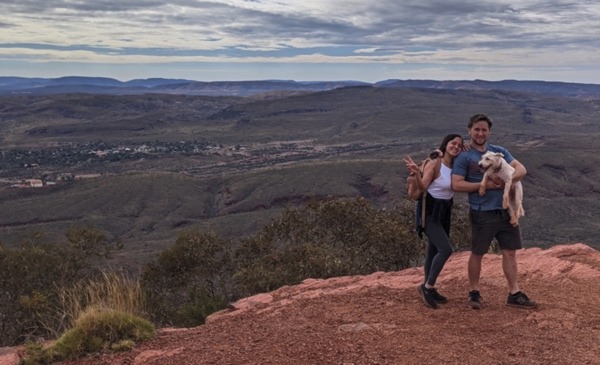
I’ve had to send quite a number of books twice because the address labels came off the envelopes but I hope that’s just a bad memory now. I’ve had some rave reviews but if you want to add to them don’t let me stop you.
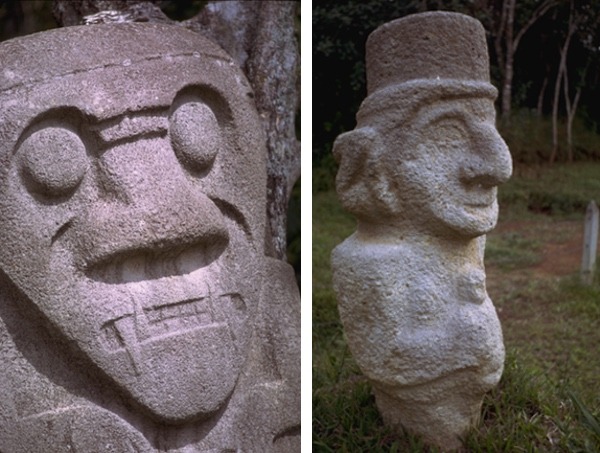
WE reach around the world. I got a nice message from Colombia, from an area I remember well. It’s not too far from San Agustin, which I visited on my first go-round. They had only recently disinterred the remarkable “guardians” that protected graves (as I understood it then). Here are a couple of them. The one in the top hat always makes me laugh.
Here’s the message:
Greetings from the Valley of Sibundoy, Colombia.
I just wanted to say thank you for sharing your view of the world, all that you’ve experienced as you’ve inched your way upon its crust. I appreciate your outlook and encouragement of “WE.”
I’ve been living on a motorcycle more than six years now, a biologist and conservationist, currently traveling South America by motorcycle. I follow a “map of hope,” writing about the positive efforts to help wildlife and the environment and lending a hand in any way I can.
I am filled with hope to meet the people and projects on the frontlines of conservation, to witness firsthand their efforts and the challenges they are up against.
There is so much beauty on our planet and we mistakenly think we are separate from nature, somehow, when we are inextricably linked.
Thank you for being a voice of connectivity in the motorcycle world, of reminding us to get lost in the wonder of existence.
Peace, Love, & Adventure,
Janelle (motogypsy)
So WE is everywhere already. Perhaps someone with more youth and energy than I have will take hold of the idea. It’s a gift.
