News from Ted
In an hour I will be driving to the airport at Montpellier, and by six this evening I should arrive at the Bike Shed in London’s Shoreditch. I’ve never been there before. Apparently it’s a super cool biker club, and every now and again they invite worthy people like me to sit at the Captain’s table and be interrogated – in a friendly way, I hope – by the members.
They’ve gone out of their way to make it a stress-free experience, so I hope to be on good form. I’ll tell you more about it afterwards, but I’m looking forward to a great visit.
I only recently learned that Peter Mayle has died, much too young, at 78. David Ogilvy, the advertising wizard, used to call him the Mayle Man but you may know of him as the man who wrote a hugely successful book, A Year in Provence, followed by many others. I knew him long before all that.
It was just after I’d come back from my four-year ride around the world, in 1977. My life – I should say my mind – was in considerable turmoil. I hadn’t yet started to write Jupiter’s Travels and couldn’t get to grips with it. Nothing that I had experienced in those four years seemed real. Although I remembered everything clearly it was only as an observer, as though I were reading a cold government report. To write about it I had to be able to feel again the emotions that those experiences had aroused in me but it all seemed clinical, lifeless. I was close to desperation, because writing the book was all-important.
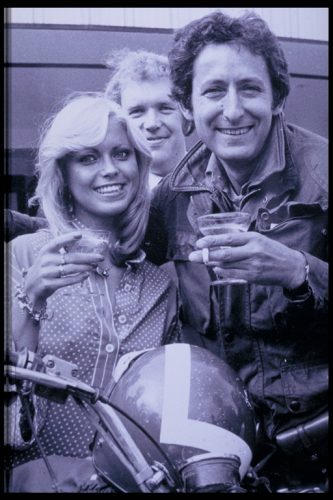
At the same timeI I was torn between two people that I loved and made a terrible hash of it, bouncing back and forth between the two. All the celebrations of my return were behind me. I’d ridden the Triumph back to London, enjoyed the champagne and a cuddle from Miss Great Britain, delivered the bike back to the Triumph factory which was still at Meriden, and come back to France on the new Triumph 750 they’d given me in exchange.
I was back in my 13th century semi-ruined home trying to find some way to reconnect with my memories when I got a message from a friend, Ernest Chapman, to say that he was over on the other side of France, about two hours away, and would I like to visit.
Ernie was a solicitor with an old, very staid firm called Russell, Cooke, Potter & Chapman at Grays Inn, but he had liberated himself from doing the estates of deceased duchesses and had taken on more colourful clients. He became Jeff Beck’s manager, and also on his list was Peter Mayle. He was visiting Peter at Gordes, in Provence, and that’s where I went on my Triumph, looking for some relief.
I stayed with them for a few days and I have very happy memories of that time with Peter, his wife Jennie, and Ernie. They were warm and wonderful company. “You are such good value,” Jennie said to me once, and I never forget a compliment. We ate and drank and laughed a lot together. Then, reluctantly, I got back on my bike, rode down the hill and straight into the path of an oncoming van. It was an inexplicable accident. After four years of riding safely through every imaginable situation I had failed to see a vehicle in front of my eyes.
The rest of that story is in Jupiter’s Travels, including the prophesy that remains a mystery. Like all my accidents so far I was very lucky. The front end of the bike was destroyed, but all that happened to me was that I sat down rather hard on the road. My friends rescued me, we did what we had to do with the wrecked Triumph, and very generously Peter Mayle lent me a small Citroen Mehari with a canvas top.
I kept it through that cold and miserable winter, still struggling to find a way into the book. After a while I took refuge with friends who lived over the hill in a small chateau they had reclaimed from dereliction. Then in early Spring one of my loves, Carol, came to visit me to tell me that she was going to marry someone else. I knew that if I put my mind to it I could persuade her to change hers but I simply couldn’t find the energy to do it. She stayed with me in the chateau for a week and one windy day we drove to my house to fetch some things, including a beautiful Kashmiri carpet I had brought back on the bike. At the top of the hill, as we returned to the chateau, I stopped at a junction where we met a bigger road. On my right was a big enamelled road sign on posts, four feet high at least. Behind the sign the mountain side dropped away steeply among loose rocks and gorse. Suddenly a gust of wind powering up the mountainside behind us lifted the car up over the road sign and dumped it down the mountainside. The car did a complete roll and landed across a boulder which prevented it from rolling any further. Astonishingly we suffered only minor injuries. The car was totalled. The carpet disappeared and was never found.
Peter Mayle was very forgiving. The car was insured and he asked for nothing, but I don’t think he or Ernie ever really believed my story.
Soon after that I found my way into the book, and it took over my life. I lost touch with Peter Mayle after he moved to that village in Provence, and I never saw him again. A pity. I see him still very clearly, full of life and fun. He had exercise machines and was waging war against potatoes, “those little brown buggers,” for fear of putting on weight. I am so sorry he’s gone.
PS: I am writing an autobiography, mostly for my son’s sake and for his son too. My publisher likes it but thinks not enough people would buy it. Would you? If so, please let me know, at tsimon@mcn.org Thanks.
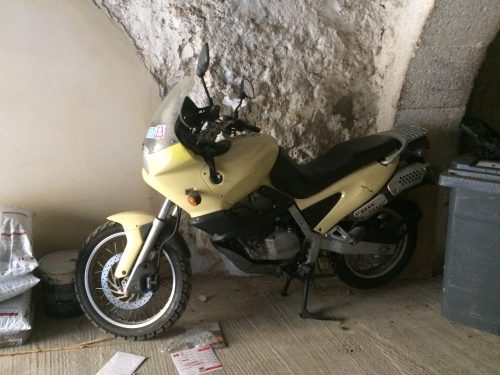
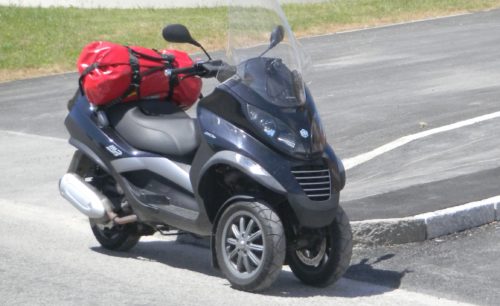
Spring is sprung, as Mr Durante used to say, and I’ve been out on my MP3 to taste it. Unfortunately my yellow BMW still cowers in the corner of my garage, because a rare but violent disagreement with an erstwhile friend has left me with a bureaucratic nightmare, but Hey, shit happens and one day it will be resolved. Meanwhile there’s always the bar around the corner for solace.
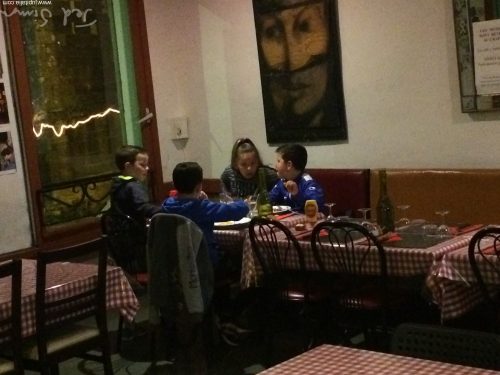
I was there at the Cafe de la Poste last week listening to some super Brazilian songs, and again on Saturday hoping for more music. This time I was unlucky, the singer was ill, but instead I saw something that is very French and all too rare in other countries – four children sitting at a table, eating their dinner and talking to each other like ordinary, civilised human beings. Thought you’d like to see it.
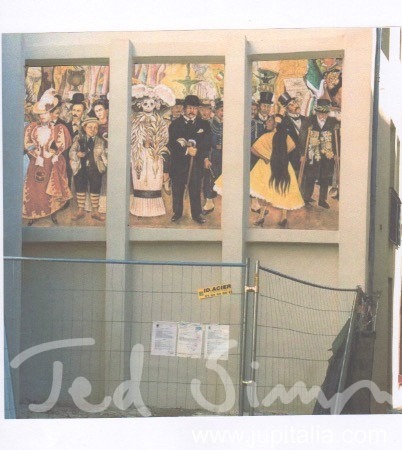
Remember this? Three weeks ago I was on my way to see the Mayor about getting murals up on the wall. Plenty of you thought it was a fine idea. some of you even offered to paint them. And then you probably thought I’d forgotten all about it.
Not at all. The Mayor, Monsieur Bernardi, was in Paris at a congress of mayors from all across France – there are thousands of them – and when he got back he was very busy catching up, but this morning he asked me to come along. And of course he likes the idea. Nothing would please him more, but . . .
The house that burned and was demolished by the commune, even though it is a non-existent virtual house, still belongs to the previous owners. That is to say the ground on which it stood, and the walls where I want to see those murals, still belong to someone. And because that someone was uninsured, and has understandably paid no fees or taxes for years, the actual ownership is rather complex and probably resides with a bank. And so, regrettably, the Mayor is unable to authorise the project until the village eventually acquires the property, which it hopes to do some day . . .
However, it occurs to me now that since he did have authority to paint the walls a lovely cream colour, why could he not authorise another coat of paint that might just happen to be multi-coloured? I shall send him a note. Don’t hold your breath . . .
I did also, as an afterthought, raise the matter of the vanished “epicerie” – or grocer – and once again he was as dismayed as we all are but, once again, there were legal consequences to it’s disappearance which must be dealt with before an effort can be made to encourage someone else to take it on. But there is hope. It is not uncommon for communes to provide help to bring commerce into the village. Alas, I am no grocer. But I’ve got my fingers all knotted up.
I’ve had this idea for a while and I’ve finally decided to do something about it
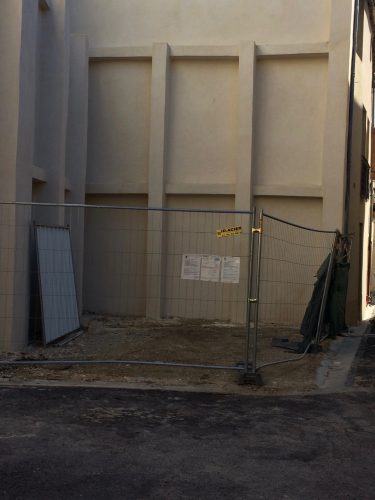
On a corner between my house and the cafe, the commune recently demolished a burned-out building and finally left a wall that was neatly reinforced and stuccoed and looks like this:
So I thought wouldn’t it be terrific if it could look like this:
and I am going to see if the mayor agrees. Of course it would be difficult to get Rivera to repeat his marvelous murals in our little village because he is well and truly dead, but the idea lives on. The government has money for street art and we could have a competition for the best ideas.
I’ll try to see the mayor tomorrow. Wish me luck.
A minor disaster struck our village a few weeks ago. Our only grocery shop – “the epicier” – closed for good. I don’t know why. There were always people in the shop. Anyone fancy opening a grocery shop in a lovely French village? Lots of sunshine. Let me know.
Although the Jupiter journey for which I am best known began in October 1973, the road leading up to it was long and eventful. There were several major milestones along the way. Getting the bike from Triumph was one. Getting a license to ride it was another. But the most significant of them all in those pre-digital days, when newspapers were still the most powerful organs of mass communication, was winning the support of the Sunday Times, and that meant getting the approval of it’s illustrious editor, Harold Evans.
The Sunday Times, like its daily sister The Times (though they were separately owned) was a Very Important Paper, not one you would expect to associate with plebeian pastimes like motorcycling, and it never occurred to me to go there. The tabloid Daily Mirror, an obvious target, said they’d love to support me if I could be back in three months. This was not what I had in mind. There were other, equally uncomfortable offers, but I was lucky enough at the time to have a warm and loving relationship with Pat Kavanagh, a rising star among literary agents. I discussed my predicament with her, and she knew that Harold Evans – improbably – rode a BMW, so she took my madcap idea to him and he fell for it.
So much so that we spent an afternoon together doing a motorcycle training course on an old airfield at Hendon, led by three police sergeants, Farmer, Fittal and Easthaugh. We rode round corners under their watchful eyes. We were instructed to give hand signals and not to rely on those silly little lights, and to ride well out there in the middle and “Command the Road.”
There was a general expectation that I might be around the world and back again in about eighteen months. Harry (as I now know him) gave me £2000, worth about ten times that amount today, and a double-page spread in the paper with a picture of all the bits and pieces I had assembled for the adventure. I carried the picture with me on the journey and it was often more persuasive than any official document.
The journey lasted four years and despite rumblings of disbelief among his subordinates, Harry stuck with me to the end. I still believe it might have been the longest continuous sponsorship in newspaper history. I did get more money along the way, not all of it from Harry, but I was always on the breadline. I calculated later that I had spent, in total, about £5000.
After my return Rupert Murdoch acquired both Times newspapers and persuaded Harry to become the 12th editor of The Times in 200 years. I went on a journey of reportage for him then, but within a year Murdoch revealed his true colours, trashed all the promises he had made regarding the papers and, as I understood it, soon made Harry’s life impossible. I was in Buenos Aires when the first news broke that Mrs Thatcher’s fleet – “La Flota Pirata” – was sailing for the Falklands. Argentines were convinced that it was going to bombard their capital. It was a ready-made scoop for me, but I couldn’t bring myself to do anything with it because I had just heard that Harry had been fired. A day or two later, drawn by morbid curiosity, I watched as various colleagues gathered outside the Intercontinental Hotel – Simon Winchester complaining about something being “absolutely unconscionable” – but I was too disgusted to join in.
Equally disgusted, I imagine, Harry moved to America. Later I met him a few times in New York, but only briefly. As the boss of Random House he published two of my books, “The River Stops Here” and “The Gypsy in Me” but California, where I now lived, was a long way from New York.
So what is all this about?
A few months ago I was afflicted by a powerful stab of nostalgia for New York. My first visit in 1964 had been quite magical. In those days when the Beatles hit America everything British was pure gold, and all my fantasies were fulfilled. George Plimpton, a literary lion, lived downstairs in the house where I stayed and I was in Elaine’s cultural hot-house every other night with a high-ranking Southern Belle on my arm.
I came back there in the Eighties when the city was recovering its pride after the bad years, and again I was inspired by its challenging energy. It’s a city like no other and I wanted to taste it at least once more.
So in October this year I booked a flight and for the first time in ages it was without having a job or a gig to go to. New York is expensive. I found friends to put me up. Marty Sabba’s email handle is “hypnodoc” but he is not a stray from Jurassic Park. He’s a retired psychologist who specialised in hypnotism. He is also utterly devoted to BSA motorcycles, but magnanimously he put differences aside and invited this Triumph-riding heretic to his houseboat which floats at Port Washington.
Another friend agreed that for a couple of days she would shoe-horn me into a tiny apartment she had rented in Manhattan. There were events she thought we could go to – I suffered through a modern opera at the Met – but for me the principal allure was always just to walk the streets. And the cherry on the icing on the cake was the possibility of meeting Harry again.
But by now he was Sir Harold, the knighted husband of the celebrated Dame, Tina Brown. I was 86 which meant, I knew, that he was 89, yet despite his age he was still immensely productive, still working at Reuters, with another new book out. And he spends time regularly with many of the most influential people in America. All that could change a man and I hadn’t seen him in over twenty years. The more I thought about meeting him again the more improbable and unpredictable it seemed, but I fired off an email anyway about having lunch or something and got an email back.
“Love to,” he said.
So here’s what this is all about. I walked into a restaurant on the East side where Harry was sitting and within seconds it was as if we had been meeting and talking every day. But it was better than that because we hadn’t, and it was a triumph of friendship and respect over circumstance, over age, over distance, and over time itself.
We should all know such good fortune.
People with long memories may recall that four years ago, in 2013, I rode my 20-year-old 650 to Greece and had a few minor mishaps along the way (see Greece: A slippery adventure). When I brought it back to the shop in Duisburg where Dirk Erker kept it and maintained it for me, it was a bit battered and the forks were noticeably skewed: Nothing to stop me riding the 3000 kilometres back quite comfortably, but Dirk told me, very firmly, that it was too old.
He didn’t want to work on it any more, it wasn’t worth it, he said, and I should get a new bike. Since he was the technical owner, and there was no way I could register a bike in Germany under my own name I had to give it up.
I can’t blame him. After all I was 82 years old, I’d had a harmless but silly accident along the way, and in Zagreb the bike threw a pint of oil on to the tarmac. I was riding on his insurance. Maybe he was just too nice to tell me he couldn’t risk sheltering a doddery octogenarian any longer.
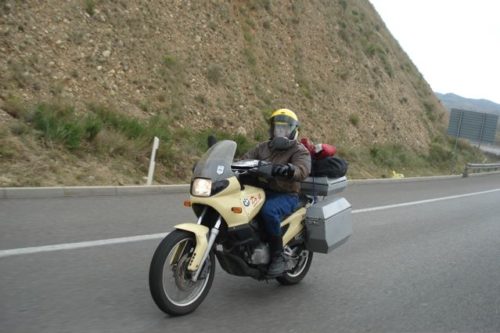
How it was – eight years ago
Anyway I told a friend of mine, Doris Wiedemann, that there was this bike at the back of Dirk’s shop and that it only had 45,000 km on it, and that he was throwing it away, so one of her friends, Horst Anderten, who likes challenges, said he would see what he could do with it. And a few years later he wrote to me:
I removed the Cylinder, cylinder head with all the parts inside, camshaft, valves, shims, springs, decompression parts for the r/h exhaust valve, the piston with rings and so on. I found the piston rings a little bit stuck, after cleaning now free movement. Cylinder bottom and Cylinder head packings are new, Valves are adjusted, all parts cleaned and reinstalled, cooling fluid replaced. Now normal compression at about 8,0 bar. Whole bike cleaned and all parts ( which was removed by Dirk) reinstalled. Also new oil incl. filter, new air filter, new brake fluid and a lot of screws replaced, flashlight temp. fixed….. and so on.
My first thought was just to give the bike away. Then I wondered whether I might ride it again. I dithered. It’s very difficult, at my age, to know what’s realistic and what’s foolhardy. How do you know when you should stop riding? I have had many conversations about this. What are the signals? Reaction time? Physical discomfort? Eyesight? Temperament? All I knew was that when I rode that bike in Europe I had never felt so safe since I handed the Triumph back to Meriden in 1977. Finally I decided I had to ride it again. So I sent Horst money for the parts. The labour he said was for love and beer.
The bike ended up with Doris in Bavaria, and we hatched a plan. Doris would put the bike on her insurance, and then she would ride down to France with me and keep me out of trouble.
Her friends thought she was nuts.
“Just imagine the trouble you could have with an 86-year-old man on a bike,” they cried.
But Doris is a brave woman, with a very solid biking reputation, and she stuck with me, although to be honest we were both a bit nervous.
There was still plenty to do. It needed a tyre, a speedo cable, several rear spokes, a battery, and further efforts to untwist the forks before it could pass the German technical control. Doris and her friends put so much into this project I can’t thank them enough.
Then she took it out on test and it ran well. There was a minor hiccup which stranded her out in the country. Fuel wasn’t getting through. Her friends rescued her, and one of them reckoned he’d fixed the problem.
So I took a train – or rather six trains – to meet her, and three days later, on Friday August 11, we set off under cloudy skies for the south of France.
Quite soon, after maybe 20 km something marvellous happened. I discovered that I felt just as happy and as much in command of the bike as I ever had, as though we had never been separated. I felt forty years old.
Because I had the GPS Doris was following me and she said she was surprised how well I was riding, and there was a stupid grin all over my face.
We took three days, stopping in Belfort and at a camp ground in Roybon. I couldn’t get over how good it felt, after getting used to the MP3 scooter, to be using the gears and to be leaning so much more naturally. It was a revelation.
Unfortunately the hiccup returned and stopped the bike arbitrarily. There seemed no rhyme or reason to it. The fuel would suddenly choke off and the bike would die. I found that if I took the tube off the petrol tap, letting fuel run out, and stuck it quickly back on again, the filter would fill up once more, but it was aggravating and messy. There was no sense to it and we couldn’t come up with a decent explanation.
I’m afraid we didn’t do well with the interruptions, and for once the journey would have been better without them. While i was enjoying my born-again biker experience Doris was feeling very exposed stuck on the side of busy roads and, as always with these things, the roads got hotter and the stops more frequent towards the end.
Still we made it and I at least had a wonderful sense of rejuvenation.
Sadly, it will be a while before I can ride that bike again. First I have to go through the French registration process, but I’ve done it once so maybe it will be easier this time. Wish me luck, please.
Can I remind you that I have books to sell? I think I can honestly claim that they are all worth reading, even the one that isn’t about bikes. The picture book is especially beautiful, having been art-edited by Yucel Erdem, and there aren’t a whole lot of them left. If you find my shop at all confusing, please email me: tsimon@mcn.org
I’m off to the first HorizonsUnlimited meeting in Switzerland next weekend, and the following weekend I will be at Gieboldehausen, a favourite German meeting of mine. I hope I see you somewhere. Enjoy the rest of the summer.
There’s a hotel at the Paris airport called Citizen M that proclaims itself, in a way I find rather clumsy and irritating, as though it were an exclusive, almost secret, organization. The walls and furniture are peppered with little homilies like “Citizen M says a good night’s sleep is worth two at the office” or some such nonsense. However, the typography is brilliant and the hotel is a triumph of design. I suspect that the whole thing is the brainchild of a dyslexic art director from Amsterdam, but aside from the peculiar branding it’s actually a great hotel, and very convenient – you can walk from it to the Terminal. Unfortunately it is also rather expensive for a cheapskate like me but I find that if I try booking.com a couple of days before I can sometimes get in at around 70 euros. Then it’s a bargain, so I book at a cheap and much less convenient place which I can cancel later and try my luck. This time I was lucky.
So on May 7th I drove my car from my house to Montpellier, parked it in the front garden of a friend – a huge one-time favour (thank you Toby) – took the tram to Saint Roche station, took a remarkably cheap TGV to Paris, got on the RER train to Charles de Gaulle, spent the night as Citizen M, caught a plane to Washington DC and then another to Phoenix, Arizona.
I’ve gone into all this because it interests me that, even today, the logistics of going anywhere much can be as challenging as riding a bike across Central America, though less rewarding – if you don’t have your own helicopter and private jet, of course.
In Phoenix I hung out with Al Jesse who has made himself a sort of unofficial patron of the Ted Simon Foundation. He’s famous for designing motorcycle luggage. He used to make it as well, but now he doesn’t have to do that anymore, so he does other, stranger things instead, like imprisoning rocks in cages of rebar.
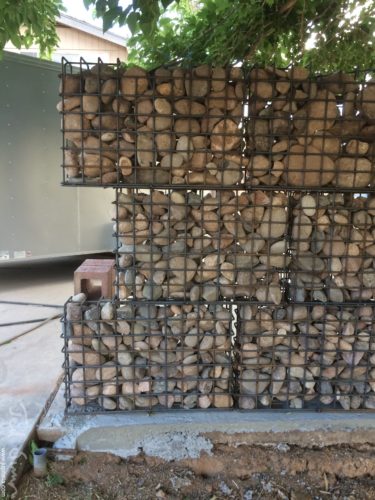
On Thursday Al drove us both up to Flagstaff by the scenic route and I saw for the first time those astounding red rocks near Sedona. There’s still so much I haven’t seen, it hurts.
We were on our way to the Overland Expo, where I hold the Chair as Visiting Eccentric Emeritus. The job is very demanding. It consists of surrounding myself by a vast crowd of people and telling them what’s on my mind – for an hour, like a live talking Facebook. The wonder is that there’s enough in my mind to last more than five minutes, let alone that anybody stays to listen. And I don’t even promise them cookies. But it went really well. I was talking about what it means to have an adventure. What does the word even mean, when it’s not being hi-jacked by someone selling Adventure Socks, or Condoms maybe.
I’ve been reading lately about the epic struggle between Imperial Russia and the British Empire in India. Their battle to dominate that vast and then totally unknown mountainous area north of the Himalayas was called the Great Game, and the urge to discover it and map it was a huge challenge to adventurous young men, almost all of them junior officers in one army or another. Henry Pottinger, for example, was a 20-year-old subaltern 200 years ago who travelled 1600 miles by camel and on foot across completely uncharted mountains and deserts disguised as a Muslim Tartar horse trader. He moved from one fortified fiefdom to another, in appalling conditions, knowing that if he was discovered to be European he would be inviting almost certain death. That is what used to be considered an adventure. By comparison my journeys look like a ride around the block.
So what defines an adventure today? Does it have to involve risk? Discovery? The unknown? Huge distances? Must it be solo, or can it happen in company? Does it have to be physical? We had a great discussion, and came up with some interesting ideas. If fate spares me I plan to do the same sort of thing in Asheville at the end of September, when the Expo West takes place at the Baltimore Estate.
As if that wasn’t enough for this sad old sack, I then undertook to fly immediately to Indonesia.
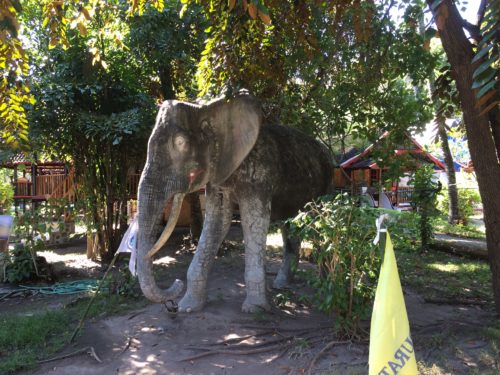
I really didn’t appreciate just how far away that is, having only got there slowly by bike from Australia. To be wafted directly from the dry heat of Arizona to the humid heat of Bali in 24 hours of flying and airport time is my least favorite form of travel, but Hey, it was free, and I ended up in Bali. That was thanks to Jeffrey Polnaja. After riding his own bike around the world, he has bent heaven and earth, and his bank balance, to bring biker brotherhood to Indonesia. He found a fabulous beach two islands along from Bali, in Sumbaya, and a couple of hundred lucky people sported around palms and Crystal™ clear water, being watched over by a life-sized concrete elephant, a giraffe and a giant turtle.
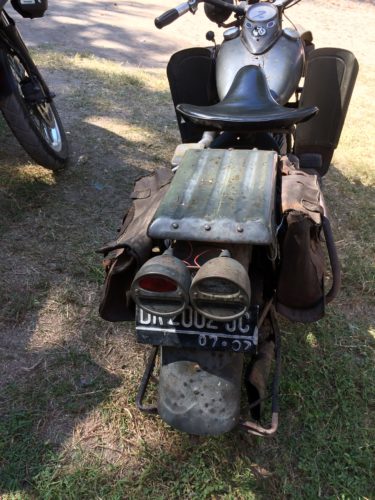
It was all under the auspices of HorizonsUnlimited and I think it’s there to stay. I saw an amazing World War Two Harley that looked as if it had been rescued from a primaevel swamp.
I also had a massage that was worse than interrogation under torture because she didn’t actually want to hear my stupid secrets. It was so terrible that I had to have another one just to be sure I wasn’t fantasising. That was a mistake. But after that everything was doubly delightful. Great food. Good conversation. Go there.
I’m back in France now, where the elections have given this phenomenal new President a big working majority. After so many decades of stagnation it’s hard to believe in big changes, but equally difficult not to hope for them. Meanwhile Britain is looking more and more like a rudderless vessel drifting off course under a delusional captain. But that’s just politics. There are great meetings there this summer. The HU meeting is just over, and I’m sorry I had to miss that, but Paddy Tyson’s wonderful Overland Event is coming up at Hill End in Oxfordshire at the beginning of September.
As for me, I’ve just been to the beach at Meze. The water was wonderful – but not crystal. The Indonesian massage is only a memory. I wish you all a lovely summer. Don’t let the idiots spoil it.
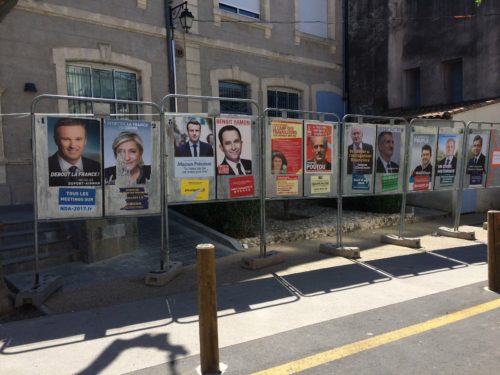
Aspiran is voting today. As you can see from my picture, posters of all 11 candidates are up in the village square, but only Marine Le Pen’s is defaced. Those of you who would like to take consolation from this should beware. The people round here are much inclined to like her regardless of the neo-fascist origins of her party and her friendship with Putin and Trump.
In the second world war this part of the world was called Vichy, and was governed by a French authority that collaborated with the Nazis. You might think that after 70 years this would be forgotten, but it cast a slur on the region. Recently Le Pen was asked to comment on the fact that French collaborators in Paris rounded up 30,000 Jews and handed them over to the Nazis to be sent to the gas chambers. Le Pen insisted that this was not a reflection on France. France, she said, was not to blame. This is an alternative fact that will please some of my older neighbours.
And young people, who are 20% or more unemployed, like to think that she will kick out foreigners and give them jobs, which is nonsense. The French believe (according to a reliable poll) that there are vast numbers of Muslims in France, whereas the actual figure is a single digit percentage.
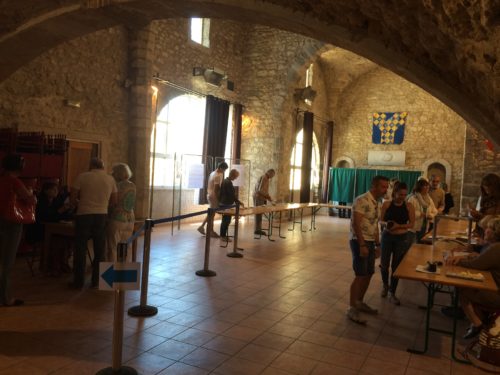
The media are caught in the same trap here as everywhere. Even though, for the most part, they would rather the devil than Le Pen, they can’t help helping her. Even though the Dutch and the Austrians have held fast, the media’s relentless pursuit of controversy makes it seem as though an irresistible wave of nationalism is drowning Europe, which makes it harder to fight back. Well, we’ll see. At least the French are cushioned against disaster, because they will vote again in two weeks’ time when the blood may cool. Here they vote in a lovely, ancient building – the Chapelle des Penitentes. And there will be time to repent.
Whatever they do I doubt that it will affect me much in the short or medium term, and after all that’s probably what I’ve got. My love affair with the bureaucracy has born fruit. The plates for my bike should arrive any day, and health care is free. I’ll see this one out.
Next Sunday I turn 86 (there’s a party, of course) and a week later I’ll fly to Arizona for an Expo of overland vehicles in Flagstaff. And from there – my envious friends – I’m going to Bali, to help spread the word that two wheels are better than four, with my friend Jeffrey Polnaja who is determined to make Indonesia the next best thing for bikers.
Hope to see you soon.
Cheers
PS: Well the results are in now, and thank heavens the French have found a way to avoid the populist trap. Macron, a newcomer with no political ties to either of the old parties, will be President. He still has to defeat Le Pen in a run-off, but he is certain (if anything is certain) to win. So Europe will survive, because he is pro-Europe while Le Pen would scupper it.
Just when I thought it was all over for me, just as I enter my leaden years with all thought of romance a nostalgic dream, I find myself launched on a new affair. It crept up on me so quietly and unobtrusively that I didn’t even realise it was happening .
I was on my way back from meeting her in Béziers, a nearby city, furious at having been given the brush-off yet again when it dawned on me. Of course, I thought, she had only sent me away so that I would have to go back, again and again, to play out this tantalising courtship which might never be consummated.
It had been my third visit to the Prefecture – the French police headquarters – so that I could put French plates on my scooter. When I look back now at my first visit I smile at my naiveté. I had read online that they wanted a piece of paper to prove that the bike actually conformed to European regulations. Since England was still in Europe, and the bike was originally brought their from Italy, it must obviously have already been certified kosher, but the French do love to have their own bit of paper. To get it from Piaggio, the manufacturer, costs 150 euros, but I found an English outfit called DVLAAdvice who said they could give me an equivalent piece of paper for £67. Always the sucker, I leapt at the offer, not having read the fine print which explained that it might not work.
I have to say that the piece of paper they sent me was a work of art. With all its seals and signatures it looked tremendously authoritative. It was the kind of instrument I always wanted on my way round the world – something to get me past obstructionist officials at borders and game reserves and splendid receptions. But it didn’t get me past the lady at the window in the prefecture. “Everything else is fine,” she said, “but you have to come back with the right paper.”
So I had to spend that 150 euros anyway to get the real thing,
I have to explain that you don’t just go to the Prefecture. You have to go online and make an appointment for a ten-minute slot on a weekday morning, but that’s better probably than being stuck in an endless queue with uncouth lorry drivers and terrorists-in-waiting.
However, the second time I went the same lady pointed out regretfully that what I had brought her was all very well, but – and she brushed the signature with her finger – it was not the real thing. It was only a copy of the real thing, and she really, sadly, couldn’t accept a copy although, – and she repeated it – everything else in my dossier was fine.
So I went back to Piaggio to get the real thing and that’s what I took to Béziers the other morning.
But this time there was a different lady, a little sterner. She looked at the papers in a puzzled way and said, “Where’s the fiscal?”
“What’s that?” I asked? She looked at me with pity for my childish innocence.
“You have to go to Customs and Excise to pay the import duty. I can’t do anything without that.”
“But, but, but she told me . . . ” I spluttered . . . and I looked imploringly at my first lady who was sitting in the next booth, but she was being very quiet . . . and in the end there was nothing for it but to retire.
So I went to the Tresorier, the money people, who live in another town altogether, for permission to revisit my ladies, and there an even nicer lady told me there was nothing to pay and she would give me a piece of paper to prove it, but first I must get another piece of paper from the man who gave me the scooter in the first place
However, I must tell you that these skirmishes over the scooter are merely a sideshow.
Just around the corner from the Prefecture is another office, CPAM, (The Caisse Primaire de l’Assurance Maladie, if you must know) and there I have been no less than seven times, to see seven different ladies, because there the game is not about my little road toy, there my very life is at stake. Without the right piece of paper from them, I can’t afford to go to the doctor or dentist or hospital. Not that I need to but, you know, life is scary. So that explains the number of visits, which obviously have to be in proportion to the importance of the quest.
Let me say now that nobody doubts I will get this vital piece of paper eventually. I am entitled to it, and I have a printed pamphlet to prove it. All that is required first is a dossier, which must be gradually built, like a house, from many different papers. At one point, on the third visit just as everything seemed to be coming together my dossier was lost. Disappeared in the system, they said. Never mind. This happens quite often, I’m told. We started anew. Last Monday, on the seventh visit after four months , it all came together again and my dossier has been sent somewhere. Perhaps it will be lost again.
It was just this morning, as I shook off another fit of exasperation, that I realised what was really going on. I am being drawn gradually but ineluctably into a love affair with the French bureaucracy. Between us we are engaged in a process of creation: we are pregnant and anxiously awaiting the birth of the great dossier which will define my relationship to the Fifth French Republic. It will be made of paper, but in France paper has a deeper meaning. Banks, Insurance companies, Utilities can go paperless, but France? Never. Only when all my paper is securely gathered together and held deep in the bosom of the bureaucracy will I know that I am really, finally in France.