News from Ted
Just in case you’re interested I’m on a bit of a whirligig this year, just trying to cram as much in as possible before the world as I know it flames out. I’ve already been to India (January), England and Spain (June). In May I lavished my own particular brand of nonsense on a batch of lovely students in Pittsburgh, and in July I inflicted the same punishment on a bunch of supergrads in Colorado. Now it’s August and in ten days time I’m back on United for Heathrow again, the beautiful new Terminal 2. I am to be greeted by Bike Magazine who plan to sweep me off my feet on a Super Scooter and ferry me to my billet in Tooting Bec. There will be intensive interrogations along the way, they say. And all this before breakfast. They’ll do anything for a scoop. And I’ll do anything for a free ride.
Next day I’m taking a train from Waterloo to Sherborne where I believe I will be sleeping for three nights in a girls’ school. Sadly I am too old to find that thrilling, but the thrills will be provided by Austin Vince and his priceless sidekick, Lois, who are running an Adventure Film Festival – so if you don’t have your tickets yet, hurry up. You might catch a glimpse of me, jet-lagging in the corner somewhere.
Next, to Germany. My poor old Fundura 650 has gone to Valhalla – or so Dirk Erker says, and without his permission I can’t ride it.He says it’s Kaput! It’s all about the Tüf (yeah, I know). So I will rent a Kawasaki ER5. Dirk says it’s little, and has no boxes, so I will take the soft luggage I got made for me in Australia, and sling it across the saddle behind me. Oh, and talking about BOXES ….
Und dass könte auch für ihr Deutsche interessant sein …
… the 650 has a set of Jesse luggage on it, and somebody ought to find it useful. It’s been knocked about a bit, but it’s still perfectly serviceable, strong, and very well made. Two side panniers and a top box. It’s waiting for you in Duisburg so somebody make me an offer.
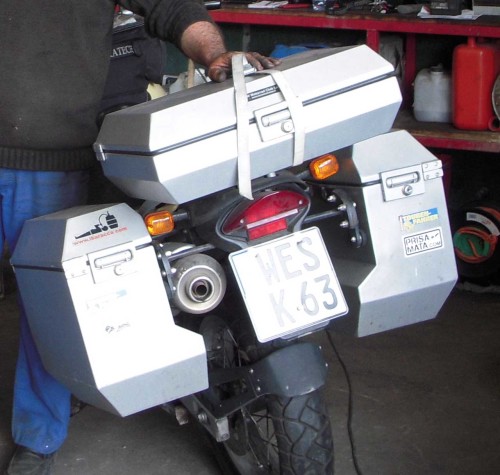
Jupiter’s Boxes. They’ve been all over Europe. Now they can be yours. tsimon@mcn.org
So, to continue, I’m planning to visit friends in France, especially those bits where the wine is, and then at the beginning of September I will go to the meeting at Gieboldehausen where Delius Klasing are presenting my picture book in German. And in a couple of bookshops too, in Hanover and Koblenz. And then back to San Francisco – but wait! There’s more.
Because on the 25th there’s the HorizonsUnlimited meeting at Yosemite – –
And on October 3rd there’s the Overland Expo in Asheville – –
And on October 19th I will be in Colombia to for a two-week tour with Mike Thomsen’s Motolombia – man, I really love that country – and I plan to finish the year off with a week in Chile in November.
You may be wondering what I’m going to do with all that spare time in between. Yes, I’ll have to think of something. I’ll let you know.
Have a lovely summer and please buy my picture book. It’s too good to languish in my shed.
Cheers all.
Ted
Back in 1976 I was riding up the West coast of India towards Goa when I came to Karwar, an interesting fishing port with boats that might have sailed there from 18th century England.
I stopped for a meal at a truck stop and the cook asked me where I was going. I told him.
“Ah,” he said, “Goa going. Nice place. My from is Goa.”
For some reason this phrase, which I thought hilarious, has stuck with me for almost forty years. I can almost hear him talking now.
Goa used to be a Portuguese colony and, unlike most of India, you could consume pork and alcohol openly without shame. It also had fine beaches and already drew holidaymakers, but I was visiting an illustrious British art director called Maxwell who had expatriated himself there along with all his Hi-Fi London sophistication, and seemed rather lonely when I found him.
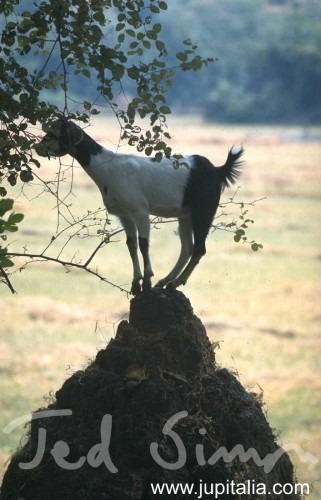
It was the wrong season for fun on the beach, and all I took away from Goa that time was a picture of a goat, but I’ve always wanted to go back and last year I got my wish. From Orangefish Entertainment in Bombay came the invitation to open the second annual India Bike Week, in Goa, all expenses paid.
How cool is that. I mean Orangefish, yeah!
And there was an extra. Would I mind, they asked, riding to Goa from Bombay (you can call it Mumbai if you like) to inaugurate the proceedings. Would I mind a nice, leisurely 400 miles in two days on a pretty fair road in good company? Hell no.
I took my helmet and gloves. I was wearing jeans and a leather jacket, and they found me some boots. From the airport we drove for two hours to a hotel they said was on the outskirts of the city. Bombay was just as chaotic and extraordinary as I remembered it, with the addition of an impressive cloud of sulfurous pollution that hung over everything
In the morning we all gathered in a large parking area for the grand send-off, and that’s when I learned that I was supposed to start the parade on a Harley. Well, one of my best friends rides a Harley and I don’t want to offend him. I wouldn’t say that Harley was the most appropriate bike for India, but hey – it’s a life style, I guess. But THIS Harley was something else. The saddle was about two inches off the ground, the bars were somewhere over my head and my elderly legs wouldn’t rise to the occasion. I gave it a go, tottering around the parking lot in an agony of apprehension and told them: No way.
Luckily there was Jay Kannaiyan, an Indian adventurer who has ridden halfway round the world and is a lot younger than I am, and he volunteered to assume Harley duties, so I was off the hook and they gave me an Enfield Bullet instead.
There were about a dozen of us, most of them Indians, on a variety of bikes. There was even a Ducati which, sadly, didn’t make it though the second day. I had my own “riding buddy”, called Sharang, the brother of Mr Orangefish himself, who was charged with protecting me, and we were led by a big cheerful ruffian called Vir.
Well we set off, rather late, and it took another astonishing two hours to get out of Bombay. In the city itself the roads were pretty good, but then it turned out that Vir had a treat for us. Instead of the boring highway, he had planned a scenic route, and gradually as the scenery improved, the road crumbled away beneath us. It got so bad on that first day that I relapsed into my Colonel Blimp persona, huffing and puffing and grumbling to myself, “How dare they take liberties with an octogenarian celebrity. I didn’t sign up for the Road of Bones,” and so on. By nightfall we were still hours away from the hotel, manoeuvering around potholes and wriggling through bazaars.
“How do you feel about riding at night,” asked Sharang. With icy politeness I declined, claiming my right to sit in the chase vehicle while the mechanic rode the Bullet. The night grew long. There were incidents. At one point we were surrounded by agitated villagers, and I was whisked away like POTUS in a shit storm. We arrived after midnight and – curses – too late for beer.
Next day was much the same. Somewhere about halfway to Goa they are building an airfield. The site lay right across the route we were following, and we had to ride round it. I only remember it because immediately afterwards the road surface changed from terrible to atrocious. We were crossing a broad, barren expanse of land and this abominable road seemed destined to go on forever.
It’s always difficult to do justice to a really bad surface. This one was composed of splinters of asphalt arranged three-dimensionally in layers, left by several generations of road menders, and it resonated perfectly with the suspension of my Bullet to produce the absolute maximum of jarring. If there had been any way at all of stopping, I would have stopped, but what made this purgatory almost unendurable was the Aussie bloke riding behind me.
The night before I had mentioned that the going seemed a bit rough and his face lit up like a pub in the outback.
“I just love this stuff,” he said, and somehow the idea that this fellow behind me was having a whale of a time was more than I could bear. He had great riding posture, sitting beautifully erect and sweeping effortlessly over this road to ruin. Watching him ride was insufferable. I could just imagine his face inside the helmet, grinning from ear to ear.
And yet somehow, amid my spluttering resentment and indignation, I remembered who I was, who I used to be, and why I was there. Despite the horrible road I began to recognise what a privilege it was to be riding this bike and to be doing this “stuff”.
What’s more, I was falling in love with the Bullet. For the first time in forty years I was riding a bike very much like my old Triumph, with no fairing, beautiful handling, and just the right size for it to be part of me and not me part of it. In fact it dawned on me that I was reliving the best time of my life. I really began to enjoy it, and it would be hard to express what a gift that was.
There were many stops along the way, but I could never understand why these particular places were chosen. This one, at least, had an exhibition of the machines Indians have been riding to work on for the last few decades.
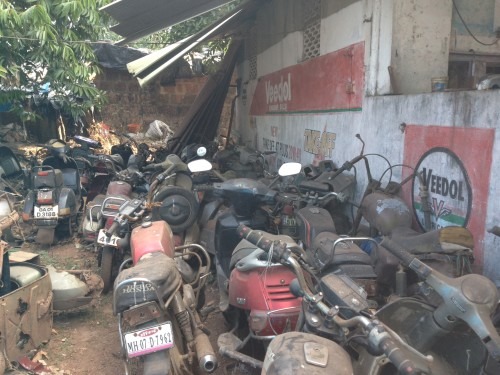
We rode on into the night again, but I had no qualms now, zipping in and out between rickshaws, cows and pedestrians as if born to the trade. We arrived late again, but not too late for beer, and there was rum as well – a lovely smooth rum called Monk, or some such name. And then the Aussie admitted to me that although he did enjoy dirt, these roads were a “pain in the ass”.
On the last morning there were ferries to cross, and coastal vistas to admire.
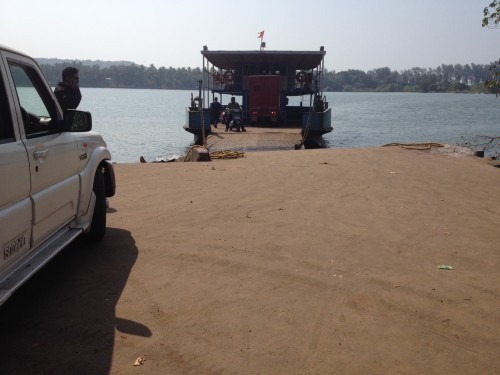
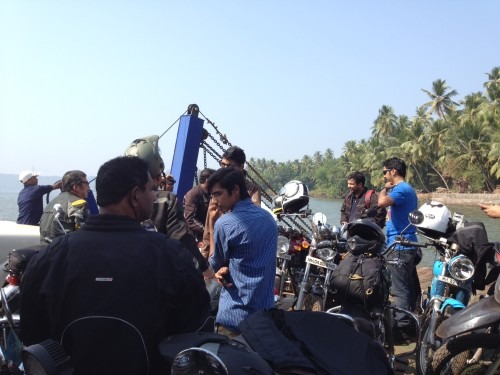
We swept into the festival grounds on the third morning and by this time I was feeling more like Peter Pan than Colonel Blimp.
The Indian Bike Week did not surprise me. There was enormous Harley-type noise from enormous speakers, and I was made to ride up a ramp onto a vast stage lit with enough kilowatts to herald the second coming. And there to greet me and share the honours was Nick Sanders, who does very fast what I do very slowly. He looked very happy in the limelight, wearing a Union Jacket he says was made for Roger Daltrey of The Who. The presenters were whipping up a frenzy of enthusiasm and the general mood was more like a political convention than the kind of biker rallies that I’m used to, but it obviously suited the new generation very well.
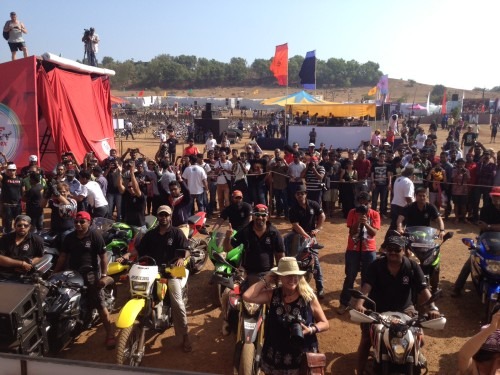
Of course it shouldn’t come as a surprise to me that bikes have become a big thing in India. There is a middle class now that can afford them, and they are not all café racers. Some Indians are using them to discover their own sub-continent, and some, like Jay, have battled through the almost impenetrable thicket of bureaucracy to get the visas Indians must have to travel the world.
Jay is a Jupiter’s Traveller and I don’t doubt that there will be many more from India before long. He certainly saved my bacon. He rode that Harley all the way like a champion though he said it left him pretty sore. I have always maintained that you can go round the world on anything, but that’s not what I had in mind.
Sharang and his brother, Shrijit, became very good friends over those days, and their friendship was tested later because I hung out on the beach for a few days and got into trouble. But that’s another story . . .
– – – – – – – – – – – – – – – – – – – – – – – – –
Note to British readers: I’m looking for a dry space within reach of London where I could store a few hundred copies of Jupiter’s Travels in Camera. My guess is that they would take up about 12 cubic feet, and they might have to be there for while.
Please email me if you can help. tsimon@mcn.org
Also, I would like to go on a little speaking tour in the UK later this year, partly so that I can sell those same books. I’ve been asked often when I’m likely to be over there, so I know there are some who want to meet me. If you would like to help with this I’d be very grateful. Again, email me please, and we can work out the details.
Although Khatmandu is many thousands of miles away I think of it as being next door. I have been there twice, important things happened there and I know the road. When I remember it, follow the streets in my mind’s eye and see the faces I knew, the immense distance from there to here simply melts away and I feel I could slip effortlessly across the divide. The same is true of Melbourne, Nairobi, Santiago, Cape Town, Medellin or Maputo.
But when it comes to places I don’t know, have never been, like say Tahiti or Tokyo or Beijing, the feeling is quite different. What first comes to mind is the huge distance I must travel, the bureaucratic obstacles I must overcome, the cost in time and resources and all the myriad possibilities for pain and pleasure along the way – in other words, the journey rather than the destination.
All of which made my small adventure last summer rather confusing.
It has bothered me for some time that I didn’t know Greece. After all, that’s where Western civilisation began. How could I go to my grave without climbing the Acropolis and visiting the Parthenon? And how about those Greek islands everybody dreams about. And isn’t that where writers I have most admired, Leigh Fermor, Lawrence Durrell, spent so many of their years? I was determined to go while I was still mobile and, after all, I knew the road. I’ve travelled it twice; once in ’77 when Jugoslavia still held most of the Balkans together, and again in ’03 when the memory of the Bosnian war was beginning to fade. Nothing to it, I thought. A doddle.
So I decided to go to Greece and I compiled a list of places I would most like to see. As for getting there, I had my bike didn’t I? What else could I need? My main concern was the big meeting in Northern Germany where I was going to introduce my new book, Jupiter’s Travels in Camera. Picking up the bike in Duisburg has become so routine I hardly gave it a thought. Plane to Frankfurt; train to Duisburg; taxi to Dirk’s shop; there she stands, the old scarred and battered Funduro, and I know Dirk will have gone over her carefully. He isn’t there this time. It’s Sunday, and he’s moved to Düsseldorf, not too far away. The bike is re-registered too, in Düsseldorf, but he’s left all the papers for me.
Then there’s that moment of thrill and apprehension I always feel when I get on a bike after a long time away, and then off we go to a small hotel nearby to deal with the first night of jet lag.
I wasn’t giving Greece a thought. I had some family and friends to visit in Hamburg and Kiel before the meeting. On the last days of August the weather was kind. The meeting went well. I sold a lot of books, and then I started thinking about Greece. It began to rain, but not much, and I started off south. On a perfect surface, 30 miles down the road as I was just about to get on the autobahn from a little round-about at 10 mph, the bike fell over. Just like that. The front wheel simply decided to go horizontal.
I didn’t get hurt, just a little bruise on the ankle, but suddenly my picture-perfect vision of the trip became seriously skewed. There was nothing on the road surface to give the slightest indication why the rubber should glide away. If it could happen once, it could happen any time. Forty years ago I would have shrugged it off as one of those bizarre things, but I was shaken. Shit! I’m 82 years old. Should I be doing this? A large part of me was yearning to go back to the hotel.
The bike seemed to be OK more or less; a broken indicator lens and slightly twisted forks. On the other side of the road, a small bunch of bikers were gathered and came over to help me lift her up. The same thing had happened to one of them, only ten minutes before. I should have been comforted, but I wasn’t. That fellow’s bike had to be towed off to a shop. I could almost wish to be towed away myself. Instead I had 200 miles of dubious weather ahead of me.
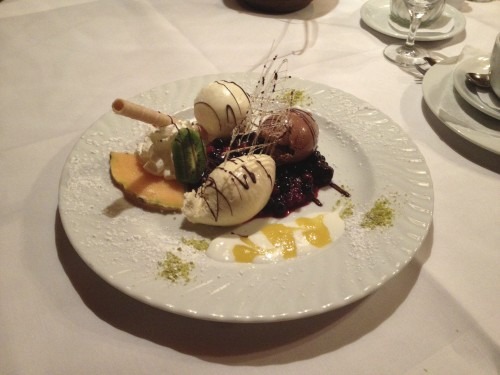
I was gong to Schwabmuhlhausen, the unlikely name of the village where a friend, Doris Wiedemann, lived. Along the way the odometer packed up but otherwise everything worked well enough, and I began to regain my confidence. When I got there the skies opened up and I was pleasantly stuck for two days. We ate at two good restaurants, and I had this delicious dessert at one of them:
On the third day it was still raining so I buckled on my courage and we made plans for me to get another odometer cable from BMW in Munich. A mile down the road the bike stopped. Then I remembered, the bike had a reserve which I hardly ever used, so I flicked the tap across. Nothing happened. I looked in the tank. There was petrol. Shit! Again. I phoned Doris and she went to all kinds of trouble hitching a trailer to her car to rescue me. So we went to Munich BMW together.
When we got there I looked at the bike on the trailer and realised, with a burning sense of shame, that instead of switching to reserve I had switched it to OFF. The full weight of my 82 years descended on me. Doris was very kind, and the chief mechanic didn’t allow his feelings to show.
Perhaps an older man would have decided than and there that enough was enough, but I soldiered on, and in fact everything was fine until I got to Zagreb where I was just leaving a hotel when half a pint of oil fell out of the bottom of the bike. It was Sunday, of course. By Monday afternoon some willing youths had fixed it (though I never properly understood why it had happened). On Tuesday a huge thunderstorm engulfed Croatia. On Wednesday I entered Serbia on my way to Thessaloniki. Halfway down Serbia the motorway ends and it’s back to the old Autoput, a two lane road winding among the Balkan mountains – once Europe’s deadliest highway. I came up it in ’77, riding in the face of a tidal wave of German and Dutch holiday makers desperate to hit the sun-drenched beaches of Greece. The verges were strewn with wreckage left by impatient Beatle and Kombi drivers hurtling full-tilt into the TIR trucks from Turkey.
Now, in September, it was relatively quiet. I pulled over to a petrol pump perched on a shelf carved out of the steep hillside. A happy young woman filled me up, and I parked over by a picnic table thinking I’d get a snack. Two impassive Serbs registered my existence with indifference. I came out of the shop with a chocolate bar, climbed on the bike, kicked back the side-stand, started the engine, let out the clutch, and shot up in the air doing the first wheelie of my long life before collapsing to the ground with the bike almost on top of me.
Never in forty years had I parked my bike in gear. Now at last I knew the reason why. And they call me the Godfather of adventure biking! Oh, how have the mighty fallen!
One of the Serbs, still totally unimpressed came over to help me lift the bike. Apart from twisting the forks a little further the fall didn’t damage her, but the luggage was severely disarranged. On the next shelf up from the pump stood a ramshackle mechanic’s lair, where its grizzled proprietor was holed up, attended by a small boy. He was very skilled with his hammer and, together with an adjustable spanner, he managed to knock everything into a more or less acceptable shape.
Whatever my existential doubts I obviously had to go on and by the time I got to Greece I began again to believe that I might actually survive this journey, but all my bearings had shifted. I was so used to rumbling around Europe without incident that this unexpected sequence of mishaps was deeply shocking. All of a sudden my presumption of easy mobility was seriously challenged. If I could no longer depend on myself to stay out of trouble my world would shrink alarmingly – catastrophically even. To lose that freedom would be, for me, giving in to old age, and there would be no way back.
It was not very sensible of me to plan a journey that would mean travelling north through Europe in October, and I got very cold, wet and windblown for three days doing it, but there were no more incidents. Dirk says I need to get a better bike. I’m thinking about it.
Oh, Greece?
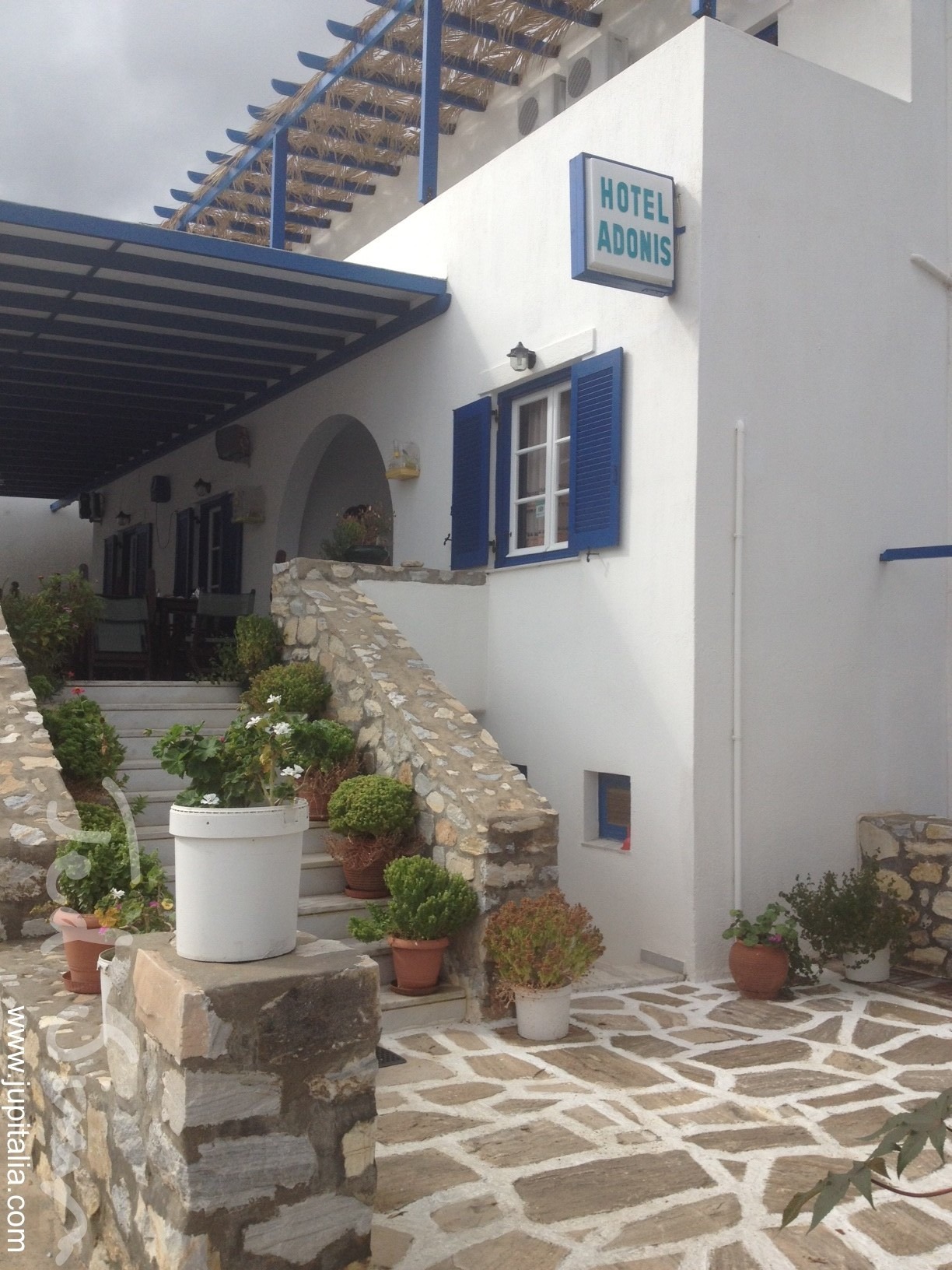
Greece was marvellous. I saw the Parthenon and the caryatids. I took a ferry to Naxos, and spent wonderful days there in Apollon, at the hotel Adonis.
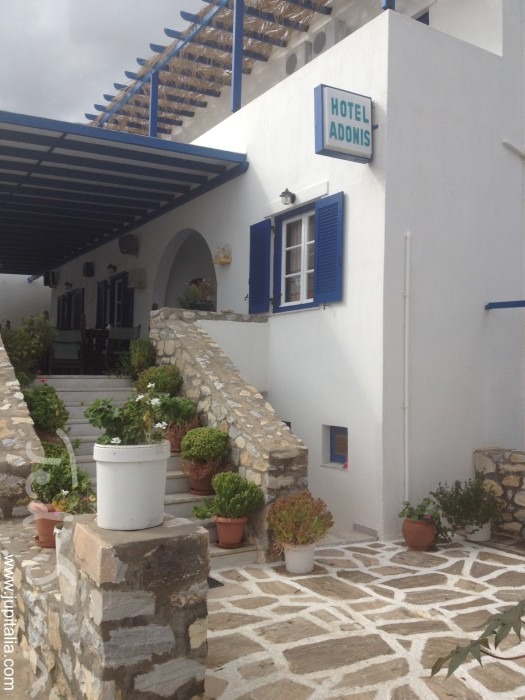
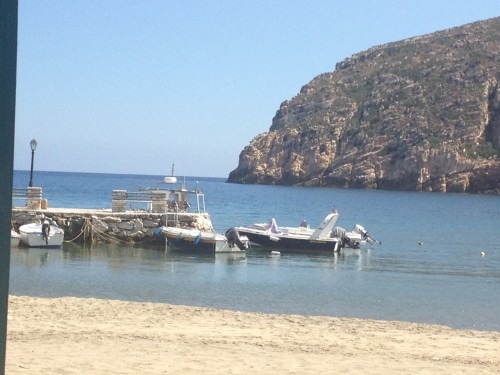
There is a law that nobody can build over three stories, and all the buildings must be white. I am not a fan of laws, but this one is pure genius and the effect all over the islands is lovely to behold. I met great people and had lovely evenings in Thessaloniki and in Athens. I am so sorry that Greece is in such trouble, and I really hate the fact that it’s their northern neighbours in Europe who are administering such painful doses of austerity. All those Germans, Belgians, and Dutch(not to mention the British) have been rushing down there to soak up the sun and the Mediterranean way of life for six decades, and now they want to punish the Greeks for their loose ways. What ingratitude.
Prices are low, and of course I profited from the crisis, but I deserve it, don’t I?
PIC
Just like Obama I’ve been struggling with my IT. I’ve never tried selling a book this heavy before and it introduces postage problems. Here’s how things stand. I have books here in California. Iain Harper has books in England which I signed. He can be reached at Iain@jupiterstravellers.org by anyone n the UK who wants the book signed by me. If you want it dedicated as well, I can do that when I visit London in week’s time. Anywhere else in the world you can get it from me in California. The book costs $45. The postage to most places outside the USA is $30, because it weighs three pounds. Within the USA, postage is $10.
Please note that I won’t be here to send it for most of January. I’ll be home again on the 28th.
There, that was easy, wasn’t it. Why didn’t I do it a long time ago? Because unlike Obama I’m a doddering old fool, maybe?
Ted Simon’s picture book has finally come to fruition. All three pounds of it have popped out of the printer’s womb, and I couldn’t be more delighted. Creating it, over the last six months, has been like living that wonderful adventure all over again. Writing fresh words to accompany more than 300 pictures took me back as nothing else could. And seeing those old Kodachrome slides turn into spread after spread of glorious colour, under the brilliant direction of Erdem Yucel, was truly exciting.
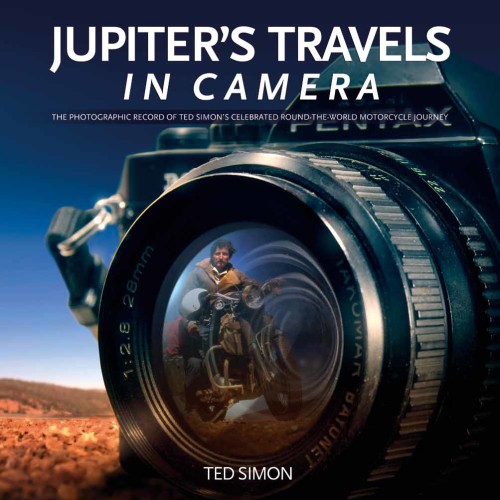
Please forgive a father’s enthusiasm. The book has been a twinkle in my eye for nearly forty years. In the year 2000 it almost came to life, but there were technical difficulties that couldn’t then be overcome. Now at last, and just in time for the 40th anniversary of the journey itself, technology triumphs and the dream has become a reality.
The book is in a square format, ten inches by ten inches, and has 256 pages. It is already on the market. The cover price in the UK is £30 and in the US as close to $50 as dammit, but Amazon of course has its own ideas.
As I write I am actually on my way to the Greek Islands, riding that same old Funduro that I’ve been using – and crashing – in Europe for many years. When I come home in October I’ll have the book on my web site at the proper price because that’s what you pay for my signature and dedication. I have no illusions that Amazon won’t outsell me.
However we, the Ted Simon Foundation, have plans to create a limited number of special editions to bolster our funds, which are currently somewhere close to zero. So if you are looking for a way to help us along, you might want to hold off for a bit. There will be goodies.
Apologies again for a long absence. I’ve been working on a book and these days I don’t seem capable of doing more than one thing at a time (in the writing business, that is).
It’s a book of pictures, otherwise I wouldn’t be done for another six months, but it needed a surprisingly large number of fresh words. The pictures are all from my first journey round the world, and they haven’t been published before because the technology wasn’t good enough to make up for my deficiencies as a photographer. But now things have improved enormously, and the pictures look good in print. To do this job I had to read through my own books again, and I came upon something that seems relevant, because writing for my website is always on my list of things to do.
When I was on the road from Nairobi to Mombasa, forty years ago, I wrote something about lists. My rear inner tube had collapsed (we still had inner tubes in the seventies) because the guy who put it in had pinched it. It happened just outside a little town called Kibwezi, and I was forced to spend a very memorable night at the Curry Pot Hotel.
Most people in Kibwezi walked barefoot or in sandals, but I had not got any sandals yet and had read somewhere about parasites that burrowed into your feet, so I wore shoes and socks. Sandals would have been kinder to my sweltering feet and to everyone else around, as well as saving on socks, but they were too far down on my list.
I had a long list of duties that I meant to perform when I had time. They included notes, letters and articles to write, jobs to do on the bike, and modifications of my various “systems,” and they took priority over sandals. I did once have a pair of sandals but could not wear them because they took the skin off my toes, so sandals went right down the list again.
I allowed only a proportion of my time to things I didn’t feel like doing, since the list of things I ought to do was endless and could easily take all the joy out of life. If at any time I really wanted to do anything on the list, of course I did it regardless of priority, but sandals never came into this category because of the painful recollection of skinned toes. That, by and large, was how I arranged my life. The list was not written down, but in my head, and it tailed off down my spinal column where it sometimes gave me a backache.
So, that was then, but I must admit the way I run my life hasn’t changed a whole lot since.
Now, about the book.
I promised to do a book of pictures back in 2000, and I took money from people in advance to help me go around the world the second time. When I came back I discovered that the book couldn’t be done, and most people took their money back. However a few said they wanted me to keep it, and if you are one of those I’d like to hear from you now.
I’m pretty pleased with the book. It’s called Jupiter’s Travels in Camera and it will look good on your coffee table if you have one (I don’t). You should let me know if you think you want a copy. It will be published a few months from now, in time for the 40th anniversary of my trip, which began on October 6th. I remember it well.
My long-held belief that adventure travel is good for the world in general got a welcome boost last night.
Like most people my age I am an occasional insomniac and some nights I turn to the radio to wile away the early hours. Most of the long wave stuff is a mixture of rantings, fantasies, conspiracies, and miracle cures, but my local public radio station has some surprises and last night I found myself listening to a program called Humankind.
A couple of sociologists were talking about the harmful effects on society of extreme financial inequality, and that, as we know, is most marked here in the States.
Richard Wilkinson, a professor at Nottingham University in England, was particularly persuasive, and he had some nice figures to back him up.
Essentially he argued that a gross imbalance between high and low earners is divisive (well, we know that) and drives people to put the pursuit of money above the pursuit of happiness. In consequence they spend more time working and less time communicating with family and friends.
(Incidentally he had some intriguing studies to show that having lots of friends is good for your health)
For really low-wage earners working several jobs is probably a necessity, but for the great majority, the middle classes, it has more to do with pumping up the image and with fear of losing ground.
The really important thing to recognize here is that they are drawn into this incessant beavering away because they lack confidence in themselves as persons, and confuse their own worth with net worth.
Fearing that they can’t command respect simply by being who they are, they hope to do it by packing ever more horsepower into their garages, and ever more goodies into their houses.
None of this is really news to me. I never cease to be amazed at the importance people attach to stuff. From my own experience I know that anyone who travels any distance in this world comes back much more secure in their own value, and much less interested in the trappings of a consumer society.
The irony is that despite all this frantic activity and consumerism, the wages of ninety percent of Americans have scarcely moved in forty years, while the infamous one percent have become richer to the point of obscenity. Well, all right, this too is an old story, which the Occupiers were retelling raucously a year ago.
But last night I heard some startling evidence of a different connection; although when you think about it, you can see it must be true. It apears that the more unevenly wealth is spread across a society, the more violent and abusive that society becomes.
And one of the causes of this unpleasantness is that people have lost the art of talking to each other about what matters because they spend so little time doing it.
One thing that has always bothered me in America was how scared people are to talk about politics or religion, as though it could lead to bloodshed.
A friend of mine, a Royal Marine, once described the three stages of a discussion in the officer’s mess after the port had gone round a few times: they were a bald assertion, a flat denial, and physical violence. He was joking, but often in America I feel it’s not a joke.
One of the skills a traveller has to acquire to stay out of trouble and to benefit from the experience is the ability to talk to people who have sharply different ideas; usually political or religious ideas, but occasionally ideas of inflicting actual bodily harm. And now, suddenly, I see how important it is that as many of us as possible develop this skill and practice it.
I live in a country where 20 school children were recently slaughtered and 34 people are murdered by gunfire on average every day. While at the other end of the spectrum of violence a bunch of politicians are willing to do great harm to a lot of poor people because they’re too hot-headed to talk to each other. I would make it obligatory for every congressman to travel alone across India or Africa, preferably on foot. They’d come back with a more useful perspective on life.
Meanwhile we have to do it for them, and the more of us doing it and infecting our neighbors with tolerance and understanding the sooner we will be able to dig ourselves out of this pit of greed, and rage, and suicidal consumption.
What a traveller learns to appreciate is the beauty and value of human beings and their natural instincts. In my view, what American workers need above all else, is longer holidays, a fairer slice of the cake, and a lot of friends. Instead of busting a gut for the man.