News from Ted
This might be a good time to imagine yourself in Kathmandu, with no TV.
Friday, 31st, to Pokhara
Into Nepal towards Pokhara. First flat road then mountains rise up steeply before me, a rich red-brown village, houses of adobe, top half white, lower half terra cotta. Frames painted in almost black brown, and intricately fretted wooden shutters. Echoes of Ecuador, Colombia. Poor Nepalis wear shawl or cloth, muddy white, and tight trousers that often look more like ragged bandages. Bare feet, toes splayed, calloused, creviced. Rich Nepalis wear conical hat with design in pink ice cream colours, a suit jacket over long-tailed shirt and tight legged trousers with baggy tops. Jackets always of very dull material. The tops of old-fashioned English suits. (The jackets come to Nepal. The bowler hats and trilbys go to Bolivia). Someone told me that in Afghanistan the secondhand clothes business is literally so.
Road to Pokhara has many broken patches and rises quite high, but weather is perfect. Arrive in mid-afternoon though the town itself escapes me. A local directs me to the lake where I find a colony of small restaurants. “Lakeside, Lake View, Greenlake, Baba, Snowland, Hidden View,” each with rooms attached for about five rupees. Food is served outside on tables under canopies – variations on basic Chinese meals, with buffalo meat (Buff). Many dishes, even the tea, have a vaguely unpleasant taste, which I called Tibetan Aftertaste (TAT). Never diagnosed.
[Here I have to confess to a quite extraordinary lapse on my part. I have since diagnosed the taste. It was cilantro (or the coriander leaf as some call it), which I had eaten happily in South America, but not since. Now, in Pokhara, I didn’t recognise it, and so I didn’t like it. It shows me just how subjective taste can be.]
The population consists mainly of slightly blissful Westerners, and sharp, dedicated Nepali boys who seem to run the whole show. The latter are multi-lingual, gifted calculators, and shrewd conversationalists, but their most impressive feature is that they never solicit to the point of hustling. They DO take No for an answer, unlike their Indian counterparts.
Behind the front row of best places overlooking the lake are other cheaper huts for tourists.
I met Collin, the Australian maths teacher on his BMW. He is designing a raft to float down the Murray River. With him is a Kansas Peace Corps guy, newly commissioned, full of his coming project (a water system) with an amazing vocabulary of Mid-American expressions that sound close to blasphemy out here. I learn from him that there are five stages in the realisation of the individual, culminating in the person who has formed his own value system and is able to apply his intelligence to realise his objectives.
On a later visit we meet a couple in Snowland. He has ginger beard, morose expression, glasses and little woolly hat. She looks like an off-duty nurse. She conducts both sides of their conversation, telling him what his likes and dislikes are, discussing the merits of various dishes in the light of his tastes and physical needs, and then orders for them both. He said: “I’ve had enough grease for one day.”
Saturday, December 1st, to Kathmandu
Lovely ride. Much of it along a river. 120 miles. 5 hours. Good road except for the last section climbing up to pass into Kathmandu Valley. Visit British Embassy to find Dudley Spain. He’s not there. I’m recommended Kathmandu Guest House. Then go to Freak Street and Durbar Square, to see if Carol spots me.
[Somewhere along the way – probably in Delhi –I made contact with Carol, who had been travelling independently, and we’d arranged to meet in Kathmandu. I was expecting to find her there.]
Met Gavin Fox, and we meet again at 7pm at Swiss Restaurant for dinner. Just after eating Carol sees me through window and comes in looking like a Russian princess. We are so delighted with each other that poor Gavin is embarrassingly de trop.
We go to Carol’s hotel where Lorenzo is staying – also Australian – whose partner was knifed when they were camped out on a trek. Then we go back to the K.G.H
Sunday, 5th December
Leave K.G.H. to go to Lalibala Guest House.
[The Lalibala had a large, gated yard where bikes and other vehicles were safe, and we met an exotic mixture of travelers there, including a young English couple on a bike, Meg and Eliot, whom I visit to this day, almost fifty years later.]

The Lalibala Guest House, 1976. John Murray surrounded by BMWs. But where’s my Triumph?

There it is, with me doing my Grouch Marx impression
Follows: A week of hunting for permits, visas, boots, etc. [We decided to do the Annapurna trek.]
Visit Swayambu Temple – where monkeys slide down the handrails.
Starting the trek, December 13th
10am from Shining Hospital along valley of strewn pebbles and boulders through villages and Tibetan camp, slowly uphill.

Some confusion at first crossing. Dave comes, and goes to Dhanpur, and we climb steeply for 1200 feet, to Nandanda. I have a really hard time climbing with the pack, but no lasting pain. Arrive 5.30. Great views. Marriage ceremony greets us at last step, led by two men with vast alpine horns, and bride covered in a litter. B&W pix. Passed women in shoulder litter, carried like backpack, in the valley.

Marriage procession in Nepal

Words fail me
14th, Nandanda
Long night. Before dawn a small dog outside does barking exercises non-stop. Up at first light to catch Annapurna and Machapuchare. And the sunrise. Dark stooping figures of women with a child between, barefooted, shawled and loaded with baskets and head straps. They are chattering loudly. Who wants to change their lives? Think of Cudlipp and his “Poverty of Aspiration.” Pompous phrase. Who gives a fig for his opinions and beliefs? It’s his power they listen to. How could he know what they need? {God often speaks through crooked mouths} [Cudlipp was a famous and on the whole admirable editor of the Labour-orientated Daily Mirror. Can’t think why I took him on this way.]
Later a band of pack donkeys passes below lodge window which overlooks square dalle roof and stone street. Ponies have cockades and strips of carpet to protect flanks from harness. They all wear bells of many different tones and pitches, and the combined sound makes a wonderful river of sound flowing ––––––.
Mahendra lodge. ‘Peanut tea’. Saw sunset from rise. Slept in loft. Sewed up Carol’s pouch on stoop. Carol took pack on to Kare, Lamle, Chandrakot, then down steeply to Birethanti.

Long suspension bridge. Checkpoint. Lorries. Because Ghorepani tomorrow is high and distant we go on to Tirkedange – a tiring last haul up about 1500 ft. Map is wrong here, and first village which ought to be Hille is in fact Sudami. At T there are already several people – two Japs and a young Aussie with a very hearty manner.
We sleep on the floor here. Just after we arrive a vigorous young man comes in with a lightish pack on his back – tennis shoes, neatly pressed trousers – an almost theatrically athletic entrance. He almost immediately starts playing with the children, and has a very familiar manner, but because I take him to be a Japanese trekker it’s not until he changes into shorts and a T-shirt and busies himself about the place, I realise he’s the father. He has walked from Pokhara that day, while we are tired after taking two days. [In fact, Pokhara is much closer than Kathmandhu]
Sleep on mats, but the Aussie has spilled Raxi on one, and I breathe it in. [Raxi is a local liquor]

I’ve come up the West coast to the capital where, as usual, I look to Lucas for help and shelter. Here, word for word, is what I put in my notes.

Often, In India, it seems impossible to get away from people, and yet . . . . . . . .!
New Delhi, Monday 27th November
Swiss couple very flattering outside American Express. Give me address in Geneva and invite me there. Lucas friendly (after funny business with wrong number} and I’m installed in a dusty dancehall on 3rd floor. Itch at night and I make another discovery. It’s lack of loving. Self-induced need for caresses and sensual feeling. And I tie it up with my feelings for Carol versus Jo. Painful but fascinating.
My correspondence always leaves melancholy shadow. Pat’s letter needs answering, but how? I start, then give up in disgust. It’s all ego – what I think, and feel, and want, etc. Why should anyone be interested in my researches into myself – or how I want to run my world. How can I deal with this if I’m to continue to value myself.
Tuesday
Morning motorcycle maintenance. No clearance on inlet valves. Too much on one exhaust (right side, and blackening in rocker box.) Points OK. One pint oil used since Bombay (900 miles) Clean air filter, top up gear box and batteries.
Rush to bank. $714 there.
Afternoon meet Gaekwad. Interesting figure. Talks about his plans for cultural centre at Baroda. Slow to thaw, but affable and invites me back. Later visit. Opulent clothing I rich, dark hues. Baby mouth. Talks about politics as a theatre, the need of rapport with audience, understands needs of artists, etc.
Wednesday
To Kanpur. Long, hard ride. Trouble with lorries, and pick up stones again but the one time I was ready to throw one, couldn’t brake in time to get hand free. Fantasise a whole series of events involving encounters with lorry drivers and Law. Also melancholic about Pat’s letter. Feel misunderstood. Last night when I tried writing to her found my letter overloaded with ego and wondered if I am obsessed by my own precious reactions to everything.
Kanpur an unwelcoming town. Very busy and big. The Orient Hotel. English-speaking son of owner. The British always used to be in here. Place as run down as can be, but two splendid billiard tables, splendidly placed at the heart of it. Indian swells playing. One like ‘Roland’ without monocle – he never bends – glides across the floor, shoulders set in check tweed jacket with cardigan below. Other in classic white Indian– long jacket and tight trousers baggy round the crutch, with camel hair jacket over the top and big shawl for going out – lock of hair fixed over forehead and long narrow sideburns – very full of himself – the Prince of Kanpur – lots of whispering and conspiracies, and pairing off for intense conversations – tense scene round the telephone – illegal drinks half-concealed (it was ‘dry day’ in the bar) – cries of “Well” at a good shot. Little bursts of English with the degree of affectation that we once applied to French phrases – a fascinating scene and right in line with my fancies about turn of century Europe being relived in India.
Out for walk to watch (a) a train of buffalo carts creeping silently through the night, to shouts (more like barks) of swathed drivers, and the half-loving thwack of stick on hide. Dormant figures lie in heaps of sacking. Must be returning to villages after selling goods (b) pathetic man in threadbare cotton shivering and praying to a demonic red god lurking the shadow of a tiny stone temple by garage. (c) Rickshaw driver curled in seat, wracked by continuous coughing (d) jobless teacher begging – “you have one recourse – to give me something for food – I haven’t eaten all day. For humanity’s sake” – that last harsh appeal still echoing with my own dismal response, “You’ll have to sort yourselves out.”
The Mall, past Queen’s Park, then canal, then railway crossing. Big advertisement shows couple in swimming things, framed by huge message: STOMACH GAS AND SEX PROBLEMS Consult Dr. etc.
HIND’S Tailoring College, and the tiny door leading up to it.
To Gorakhpur, Thursday November 30th
Over the Ganges, and it’s really got something, this river.
Much later, astonished to see passing me in the opposite direction some men looking harassed and carrying a man in a litter at a slow jogging pace along a long road past sugar cane. The man is dressed in full Western suit, tie, etc. – young.
Bearers have pale blue cotton headdress. Another empty litter follows. They are travelling down a long, tree-lined road, and I’m too rushed (and surprised) to take a picture – which would have meant riding back a way and waiting.
This must have been after Faizabad where I stopped for the breakfast I’d promised myself in Lucknow. Lucknow seemed very grand, huge empire buildings, parks, but somehow I got through to the other side without seeing a place.
Faizabad much tighter, more crowded, bazaar town with old arches. Stopped in square and had eggs. Young Sikh comes to introduce himself, talks about the importance of his family in the town. Father came from Punjab at partition time. First made living as a photographer, then became cinema owner. Have two cinemas and was planning a third big one, but borrowed too heavily and was forced to sell his interest in order to repay. Now is trying again. Son took me to his house up a side street, gave me tea and sweets made for a recent wedding ceremony. Wanted to interest me in old coins. Says he has to sell them because Govt might find them and accuse him of hoarding. “Black wealth”. Exaggerated, I thought.
In Gorakhpur stayed in probably the best hotel in town. Had good meal, although the first seat I sat in collapsed under me, and I fell over backwards. First a drug salesman introduced himself, recommended A & D vitamins. Then the cable company engineer came over, thinking I was his age. Astonished by my real age. [He was 28. I was 45.]
We talked about reasons for growing old. Constant concern with money, he thought. Trying to keep the same level of living. We walk to the chemist’s shop. Boy brings out a tin of vitamins, half full. Expiry date 1975. [It is now 1976] Brings out another tin. 1978. 4 paise a pill. As we walk away talking about difficulty of finding people to take management decisions, it occurs to me that the boy is probably taking his own decision now – to transfer pills from one box to another. The man invites me to stay at his home in Delhi.
In Gorakhpur I discover there is a direct route to Nepal. Not marked at all on my map. Goes to Natawawa – Sonauli, very close. Beautiful weather, hot sun, cool air. On way see two more litters, both completely covered by crimson canopies. Bearers in same pale blue headcloth.
Border in morning. Then first problem. Have no visa. Why? All my visa info is from my journey’s outset, but of course had no plan to visit Nepal. However, can get visa at police post in Barawa, 4 kilometers away. And pay sixty-odd rupees. Which means changing dollars at bank.
First stage in story of frustration.
More to come. See you next week.
Friday
More lorries, front wheels collapsed, nose-dived into ditches and culverts.
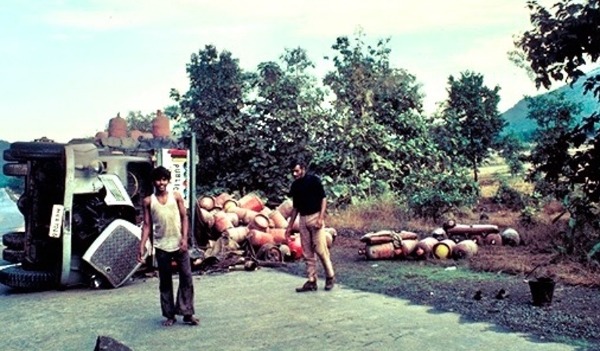
Tribals with three camels, each with upturned bed on top of their belongings. Women leading them had each breast separately wrapped in pink muslin slung over top of sari at midriff. Cows with horns [pointing] in every direction, like the printed characters in Hindi writing. In Ahmedabad a sudden outbreak of handcarts – everything gets pulled or pushed by people instead of animals. Two women heaving one towards me, wore the same-coloured clothing of reds and yellows, and both had their heads and faces completely wrapped in saffron muslin. These wildly energetic but faceless creatures make a very strange impression. And the tribal women really are energetic – they fling every part of their bodies into what they’re doing.
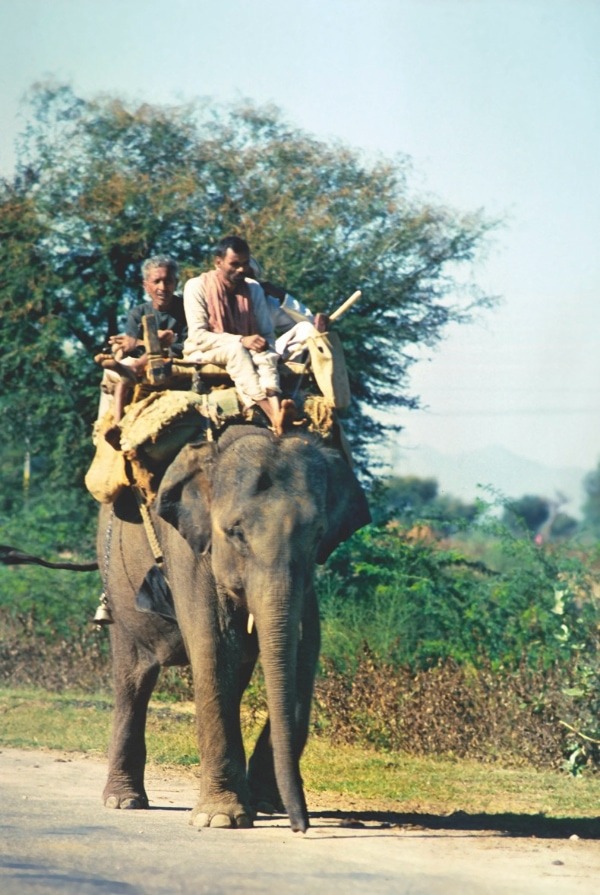
Two enormous elephants coming towards Baroda – the rider is level with those on top of a truck’s cab. Biggest I’ve ever seen. After Ahmedabad leave Gujarat for Rajasthan. Clothing styles change immediately. No longer a single sari but a voluminous skirt, and a cloak which billows out behind and is caught up at the bottom. Usually bright, plain colours, mustard yellow, blue, burgundy, etc. The state line comes just before a range of desolate, stony hills, and road winds amongst them. Here for the first time boys make threatening gestures (memory of Ethiopia). Mountain people, life here looks barren. Herds of goats, sheep and some camels. First camel carts take me by surprise – brown, wooly animals.
Also I begin to see dead dogs by the roadside for the first time in India. Bunches of cactus live roadside – narrow green fingers. Many fortresses on hilltops – the roughest, least valuable land is always most protected. Havens for the proud, rebellious, and I suppose least ingenious and adaptable. Stone walls run like seams up the mountain sides.
20 kilometers from Udaipur on impulse decide to try a bungalow. Man in jacket and dhoti, with gold earrings like old sailor, attends me. No food. I walk 100 yards to village. One row of small shops. Brahmin sits cross-legged behind ––––– tins of grains, –––––, potatoes, with scales. No eggs, no vegetables.
“This is very small village, near big city. Eggs are not available.”
Cigarettes. Packet of biscuits. Get out stove and boil some rice. Mix with soya. Not very successful. Herb tea. Then another walk in dark. Group of men conversing. Children chattering. Further along some figures squatting close together in road, shrouded in robes, almost invisible. When trucks pass get up and move. Then return. Radios playing in various houses. Batteries waning. No electricity.
Agonising night, skin pricking all over my body. Again and again I get up. Is it insects, or me? See nothing, hear nothing. A kind of hell, and I’m fearful of it continuing.
Have a strange dream in which I’m reconciled with Connor Walsh. [My business partner in a magazine which I edited in 1967 who eventually accused me, unjustly, of undermining his authority and made my job impossible.] In the morning have a vague sense of these residual bitternesses being connected to this skin condition.
However, I feel OK. Eat a couple of biscuits and continue to Udaipur.
Saturday

The picture summed up the extremes of India: The mother with two infants preparing food in a filthy street under one sign promising “modern amenities,” and another all the delights of Bollywood, and all outside the walls of the city, Udaipur.
Udaipur has an extensive city wall with parapet and bastions. Take one picture.

The fortress above Udaipur.
Mountains are slowly sinking into a flat sea of soil, and only peaks protrude now, with more workable land between. Corn, pulses, and other vegetables.
The Rajasthan man is very distinguishable, smooth brown warrior faces with down-curving moustaches (as in Mughal paintings) Richly coloured head-dresses, tightly wrapped trousers, woolen jackets and sweaters, sandals tip-tilted. All carrying short sticks.
Land flattens further towards Ajmer.
Camels everywhere. Wonderful to watch. Great padded feet swinging over the road. Heads swaying – how do they support their heads? The design seems structurally unsound. And the shafts and harness shooting up at a giddy angle to bed down on the hump – one expects the carts to become airborne. Who told me camels can tow four time the weight of an ox? What attracts me so much to camel country? That’s where I feel a special excitement – not the tropics. I love the hot sun striking through cool air.
Temperate climates give peace – tropics torpor or discomfort and a sense of being permanently immersed. Which of my ancestors lived in the Middle East?
Ajmer. Open town. Tourist bungalow. Pleasant meeting with Germans, Brazilian, Australian, Chilena, Heather Matthews and the two Swiss jewelry collectors. Mike, black clothes and beard, happiest running down Nepal or Ceylon. She, self-conscious about the tirades. The other two girls revived all my pleasure of South America – listening to Spanish and Portuguese, talking about Chile – and “Hio.” And later about Australia. Dinner at Honeydew. And a too quick beer at back of Wine Shop {Why Wine?) Take a “tonga” ride. Go to bed in trepidation – fear of the itch – but it’s not too bad this time.
––––––––––––––––
Men in suits should be purposefully employed. When they hang about vaguely they leave a sinister impression, as of Mafia. This accounts for my uneasiness when several suited Indians hung about at the Lucas backyard in Delhi. Yet they were only Indians doing their nothing – in suits.
Sunday
Morning conversation outside the camper van. Exchange addresses with Brasilleira. Off to Jaipur. Swiss promise me a good road, and it’s medium. Now, however, the houses show signs of Government patronage. Water pumps, clinics and stuff. Fields bordered by tall rushes. Camels ploughing. Three men on elephant. Make a real effort to photograph people. Jaipur at midday. Find the Rajdhane hotel. Cubicle room for 12 rupees, but hotel is sweet, prettily kept outside, with a merry staff.

Jaipur Palace
After a nap, walk three hours to the stunning terra cotta centre of this “rose city.” 17th century town planning. Is this the most impressive main street I’ve seen? Wonderful palace façade. Cheeky people. Public urinals yet! Dine at Nero’s, at same table as Nigerian ‘clinical psychologist’ and colleagues. Back to Hindi, and bed.
Monday
Morning ride to Delhi, and this time the road is really good (except where it runs into a small mountain). Make astonishing discovery that speedometer doesn’t work over 40mph. 42 = 45, 45 = 50. No wonder I was hammering out of Bombay. Bad news for new pistons. Was I lucky?
Stopped halfway for biscuit and cigarette, sitting on a stone looking out over fields, sun very hot on my back. Two lads stop and chatter round the bike. I avoid them, but they can’t resist seeking me out.
“Where you dwell?” asks one.
“England” I say, and “Where do you dwell?”
“Diarrhoea” he says, or something similar.
“Have you come to look at me?” I ask, smiling faintly. To my surprise he is embarrassed and turns quickly away. First time in India I find a respect for privacy, and I’m almost sad to let him go.
PS: To Bill Shanklin, wherever you may be, thank you for your surprise gift. I did as you suggested and bought a wonderful bottle of St Emilion Grand Cru. We savoured it almost down to the dregs. Merci beaucoup.
In case you haven’t been following me during the last year or two, I am reproducing, word for word, what I wrote in my notebooks on the journey that led to my books, Jupiter’s Travels and Riding High.
I arrived in India at Madras (now called Chennai) earlier in 1976 and have been travelling round the south of India and Ceylon (now Sri Lanka). It’s November now, and I’m coming up the coast towards Poona (now Pune). When I was young it was still possible to hear old Empire hands launch into conversation with: “When I was in Poona . . .“
But before we get to Poona I have some rather nice pictures I wanted to show you earlier, when I got back to the coast at Karwar. It was a fishing village, and the boats were not only beautiful, but it seemed to me that they wouldn’t have looked any different 200 years earlier.

And this one

And then there was this excellent goat in Goa

[I was beginning to make notes of how the clothing had changed as I went along.]
Tamil Nadu, buff cotton round head, loosely, shirts and dhotis.
Hill stations, trousers, cloth wrapped round head over ears, usually woolen scarf.
Maharashtra, topi, jacket and trousers.
Women, same saris, but tied for working in North Karnataka and Maharashtra so that their legs show from thigh down. South more prudish.
Also in Maharashtra some groups wear turbans of purple, orange, etc.
Riding south in Tamil Nadu, narrow tar roads, patches on patches on patches, like sealed corrugations. Few cars, but lorries an buses, all spew out diesel smoke, never look in mirror. Road generally raised above surrounding paddy where ox teams are churning up the mud after last harvest. – men in loin cloth only, seeming very primitive and close to the gleaming wet soil. Women in lines of thirty or more, advancing, bent double, across fields planting paddy – saris brilliant. Oxen often have enameled horns of marvelous shapes, sometimes tipped with brass. Heads high, yoke resting between neck and hump, each one in line with a wheel. Men walk alongside ploughing teams on road carrying their ploughs, indicating that the labour of carrying is not a conscious problem.
[So now, back on the road from Kolhapur to Poona]
A fascinating challenge adjusting to speed differences between animal, pedestrian, cyclist and motor traffic. Maximum safe speed 30 mph. Occasional vigorous outbursts of swearing at buses and trucks cutting in as I overtake – or overtaking each other at my expense. Too hot for jacket. Bike boils in villages, particularly when I get lost in some bazaar street. For the first time horn is essential. Are pedestrians dreaming or deliberately contemptuous. Gopi, later, says that after the war, about the time of Independence, the people resented traffic as a symbol of the rich, and their leaders encouraged them to claim the roads for themselves and their animals.
What do ox carts carry? Baskets, coconuts, wood, grain and straw.
Poona
[Went to visit Lucas, my sponsor. Now called LucasTVS, a joint Indian company, which still exists today. They suggested I visit Perfect Motors.]
Perfect Motors. Mr. Ekbote. Perfectly air-conditioned office, approached by ratty staircase. Mr. E gives me spirited pep talk about India’s progress.
[I asked him if he had visited England.]
His contretemps with Her Majesty’s Immigration.
“Do you intend to stay in UK?”
Mr. E: “What a stupid question. Do you think I’d tell you if I did?”
“You are insulting the Queen’s uniform.”
“I don’t care what uniform you’re wearing. If you ask a stupid question … etc., etc.”
In Germany he tells his friends about Indian technology. They are frankly disbelieving. He points to their fan (Do they have fans in Germany?) and says, “It’s made in India.” Unscrews cover to prove it. Lots of other gadgets too. Mentions that India is probably doing a deal with Dassault for the Mirage, although still supposed to be on Mig 22. Says he knows because specifications of various sub-contracted parts have changed. Sends me to see Bharat Forge Co. and Bajaj Scooters.
Says India has one year’s stock of grain (admits storage facilities inadequate but now being built.)
[I hear stories of mountains of grain under plastic being consumed by rats.]
India has trading surplus. Is repaying the capital on World Bank loans. Big business is selling consultancy abroad. Technology in telecommunication is high, etc.
Go to Poona Club. In evening go for a ride along Laxmi Street. Amazing congestion. At last find my way round a circuit and back. Buy map. Carburetor playing up. Float valve is obviously sticking on low throttle. Had to clean it out again at TVS.
In Bharat Club meet two metallurgists who make sintered metal components. Were in Lichfield. One is manic, the other silent. Invited to dinner following day by two lots. One half Portuguese, the others, Sikhs. Neither ever turned up. Went to M&S house to have dinner. M puts on a sort of show of sophisticated living. Boasts of his pal in Bombay with flat behind the Taj. Promises to introduce me. Never see him again. (BO!?)
Friday 12th
Morning of batteries. After lunch to forging company. Seminal experience, like the Jain school. [Another vast dark space full of smoke lit by fire.] Staggering sights of men in long black fireproof gowns and goggles working at huge steam hammers three times their height. The hammer lunges down constantly, and withdraws, like cobra swaying, waiting to strike. Manhandle lumps of red metal with long tongs, twisting it across the die from one hole to another and Wham! Wham! Wham! The hammer strikes, almost seeming to do so of its own volition – as though in some sort of complicity, but dangerous, uncertain, like wild beast barely trained, elephant, killer whale.
I feel all the old excitement of men releasing great energy and mastering it that must have excited the minds of the early industrial revolution.
But how much of this is my projection? How much is really there? What do the faces show? Grim. Impassive, but not bored. Not even specially fatigued, and they’re on top of it.
[I remember talking to one of them. Very proud of his job, seven days a week. Pretty sure he told me they got one day off a year.]
Saturday 13th to Sunday 14th
Lazy days watching cricket, reading, writing a bit.
Monday 15th
Early away to get a look at Bajaj Scooters before going to Bombay. At factory was kept waiting an hour before a substitute for Mr. Jain could be found to take me round the works. “Mr. Jain is not in his cabin.”
[Bajaj, made the best auto-rickshaws in India as well as scooters. It is still thriving today.]
Met the export manager instead. He was an impressive fellow. Revealed that production for domestic market was rigidly limited by Government. Bajaj has “nine-year order backlog,” though other firms make scooters and can’t sell them. Govt insist that no-one shall become too big and wipe out employment by economies of scale. Bajaj makes 320 per day (including three-wheelers) can rise to 400.
En route [to Bombay] procession, in pairs, with saffron flags and cymbals, women carrying food, apparently going a long way.
Later a family coming back, with lacquered chests on heads.
Road not bad until Thana, where Bombay island begins. Barges unloading sand from dredgers, a huge activity, mountains of sand all moved by the basketful on a woman’s head. (She’ll put it on her head just to go five paces). Anyone who wonders how the pyramids & temples were built need only go to Thana now.
Awful lorry-infested crossings, the expressway to Bombay. One ghastly estate of rehoused slums along roadside.
Leaving Bangalore behind I ride back down to the west coast.
To Mangalore at 10am. Road good and bad, but much traffic. Often 40 – 45 mph. But last section bad, and overall average 25 mph. In M’lore at 5.45. To see Mr. Srikant. Stiffening steering head worrying.
Thursday, November 4th
Regreased steering head with new balls. Noticed that front brakes might need relining. Renewed brake cable. Met Ramkrishna at Chinese restaurant. Persuaded me to stay at Moti Mahal for 25 rupees.
Excused myself from Srikant. Spent evening with Ram and Arwand, brothers. Not bad. Lots of respect and adulation for my ego. Noisy room. Indians love to shout in hotels at midnight, and no furnishings to absorb the noise. In the mornings, of course, it’s even worse. When they throw up, one after another, in the echoing bathrooms. Don’t know which is worse – the rantings or the retchings.
5th Friday
Leave Mangalore 7am. Easy road. 20 miles out a Bullet overtakes me. Obviously to play games. Two up, in khaki clothes, driver wears army helmet, straps flying. “Idiots,” I think. Then pillion turns to grin at me. It’s Ram and his younger brother, famous Bullet rider of M’lore. They’ve been waiting since 6 am for me to come past. That accounts for his strange call in the morning. When I did come by the garage, caught him with his trousers down. Took them 20 miles to make up 4 mins lead. We have breakfast. Again they pay. Their attitude to me reminiscent of Raoul & Mercedes in B.A. [Buenos Aires – a long time earlier]. I seem to be recovering my charisma.
Coastal road very attractive. Density of population is noticeably reducing. Inland hills. Occasional beaches. Coconut and paddy. Turn off to Jog Falls, comes nicely just as I think of it. Climb up is delightful. Paddy terraces, villages below road, so you look down on roofs. Usually one big house of sophisticated construction with great tiled roof. Others round it. Building material is slabs of stone-clay aggregate carved out of natural deposits where road cuts into hillsides. Women carrying slabs on heads.
On coast road passed people going to market, heads loaded with earthenware, forage and green stuffs, baskets, and women carrying heavy bundles of branches, moving in a half run, hips switching extravagantly from side to side to keep load at level height.

Jog Falls is almost dry. Three streams tip over the edge, bouncing down 960 ft. Meet in a horizontal band of prismatic light. In full flood, shapes and figures in motion dance on the rock face.
Stop on the way down to cook rice and coffee. Not a soul passes until last moment. Then two men descend. One leads a buffalo (rope tied round horns) and carrying a sick sheep in sacking slung over his shoulder. Seems like a heavy load. Man behind is walking free with some animals. Why don’t they share the load of the sheep between them.
My idea about people as monkeys recurs. Fiddling with ideas (like the monkey with coins) curious, intrigued, aware that something could be done with them, but never quite getting them to work.
Down to Karwar at twilight. Fishing town. So many buildings occupied by various branches of bureaucracy – Police, PWD, Dep. Director of Fisheries, Customs and Excise, Port Authorities, Internal Waterways, Family Planning, School, Hospital, Collector, etc, etc.
Assistant says, “Your native place? From?” I tell him.
“Goa going?”
“Yes.”
“Nice place. My from is Goa.”
Delicious fish. Hotel along the road, good standard but very noisy. Indians don’t have any idea about acoustics.
November 6th To Goa
[Ten years earlier I had been a magazine editor and knew most of the stars of that world but had never met Max Maxwell, a much-admired art editor. I knew he had retired to Goa, on Arjuna Beach. I went to find him there. He received me well and I stayed several days. This description was never intended for publication. PW was a journalist I’d known.]
M’s resemblance to Paul W. can’t be denied, so that has to be discounted. His mouth is even greedier and lunges out like an excavator. Like PW in manic-depressive phases, I think, but has had the good fortune to harness his energies to appropriate ends, and avoids complications like poison (which they are, to him). Interesting that he has no perspective on this and doesn’t realise that he is a particular type whose solutions must also be idiosyncratic. By pushing his solutions to the limit, he excludes the world yet craves what the world provides. Currants without the cake.
Leads him into wild contradictions. Plans to move to even more remote spots, while almost begging for more company.
[In fact he DID understand himself very well. He did move to ever more remote places, but plunged back into the mainstream regularly and much more successfully than I had imagined possible because he was able to command a high price for his services. From Goa I rode inland.]
November 9th, To Kolhapur
Pearl Hotel.
November 10th
[In the morning, I am seized by a businessman called Shetti who invites me to his house for breakfast.]
Shetti. Ironmonger and hardware. House. Fluffy white terrier. Wife. Little daughter with grimace. Half smile, half fear. Walls.
[The walls I see in Indian houses are bare and echoing. I wonder why? Meet others, a brother, an architect, and his wife who insists I must stay with them.]
“Kidnapping” by architect’s wife. His brother, the bank clerk. Bharat Opel. Breakfast.
[They want to show me around.]
Drive to village. Old fortifications. “King’s” house. Walk to fort.
Sadhu in cave. Long hair shot with gray. Saffron gown. Legs folded under cushion. Lies on upholstered bed, with garlands hung from frame. In front are mats. He has wide grin with one middle tooth missing. Shifts his legs about as though the strings were broken. Has vicious bitch to guard him. Shrine behind bars. Dog goes for boy. He retreats, crying. Two women on mat telling Sadhu their problems. His remarks about Californians who stayed two days. “We can learn from foreigners about going from one job to another quickly,” whatever that means.
[Strange to get lesson in economics from a Sadhu.]
Sugar cane. Jaggery making. Boilers, fires, groups of women in same-colour saris drawn up between legs. Man wearing Topi – (Nehru’s hat) Nomadic tribe. They cut the cane.
[Shetti needs some kind of bureaucratic permission from an official at a government rest-house, We drive there but he is “resting” and unavailable. Come back later.]
Back to rest house. The big shots are there. Stifling atmosphere of reverence. Endless waiting for lunch. N.Z versus India at Bombay [Cricket.]
Boy serving lime-soda with salt. Soda making machine.
[My new friends are all Jains. This is the first time I have met or even heard of the Jain religion – the fourth largest in India. They have things to show me.]
Long ride back. Shetti drives – abominably. To the Jainist temple and charity school.
[They are determined to show me as much as possible about Jains. We drive to Bhaubli.]
15 miles, growing dark. On right we pass a camp of nomads in bivouac tents., a sudden and surprising flurry of movement among closely packed tents in open space, animals, coloured turbans, women, utensils. Wish I’d stopped the car and taken a picture. Yellow sky and sun. To village. We stop to leave a message.
To temple and school. Religious Disneyland. Models of Jain sites all over India. (North?) The nephew is most earnest and fatuous in his observations and questions. Little models of modish couple and limousine. 24 gods. Here’s one of them – a single block of marble. Naked. Limbs wrapped in creepers. Also pictures of him engaged in various classic struggles. Indian wrestling. Wrestling in water. Some other kind of fighting. He loses and begs his protagonist to be satisfied. Opponent insists on pursuing the battle to the end. So the God inflates himself and is pictured with his opponent raised above his head, prior to being dashed to the ground. A violent picture of a God of non-violence.

The Jain temple. Shetti is in the middle, the architect behind him.
His simple story is told also in models. He is a prince about to be married in all splendour. As he passes on his howdah, he sees a pen of sheep and asks what they are there for (as if he didn’t know). They are to be slaughtered for the feast. He renounces the bride, position, everything, and goes to the forest. (to practice austerities? As the Mahabharata has it)
We go to see the school dormitory. 600 boys are boarded here, from poor families. Walls are yellow painted brick, belongings hung on wall, mats rolled up. Boys are shaven, in shirts and shorts. Then to the ‘mess.’ Long gloomy barn, smoke in rafters and all boys cross-legged on floor in 4 lines the length of the building, each with plate and gold anodised water cup. Other boys come down the line, spooning out food. 3 brick fires with glowing charcoal at other end, where chapatis are made, produce smoke and an infernal touch.
A teacher is there, mild looking, wavy hair brushed down, spectacles. “I was a student here so I am thoroughly familiar with the routine.” The mild words have a disturbing force. I’m overcome by the imagery and all its Victorian associations. Obviously I am feeling and seeing something entirely different to what my companions feel. I want to ask if the boys are free to leave, or whether they must complete the course. Several times the question is misunderstood. At last it gets through.
“If they want to run away we can’t stop them.” They laugh at my mention of parents. No, they aren’t all Jains. Other boys, if they’re particularly bright, can get in too. Their idea is that this is a brilliant opportunity for poor boys to make good. Old boys, they say, have become big men in Bombay and Calcutta.
[Shetti brings us back to Kholapur, and dinner, with just the men.]
“Nowadays our wives can eat with us but in fact they never seem to.”
Arun Patil (Contractor) 6th Lane, Rajarampuri, Kolhapur.
Indian dogs – treacherous. Shetti’s dog actually licked the sweet breakfast goo off my fingers – before biting one of them.
Indians can put up with the shrillest barking.
Simon’s Hypothesis: Every physical law has its Sociological Counterpart
Treating people as particles – under compression. Forming bonds, clusters, crystalline structures, polymers, generating heat.
Next week: Goa Going.
Keep well, and avoid as many climate catastrophes as you can. I blame Trump, of course.
[It’s November 1976 and I’m working my way slowly up the west coast of India. In Bangalore, Gopinath invited me to accompany him on a visit to a friend of his with a coffee plantation in Chikmagalur, which was also Indira Ghandi’s constituency. I only got to know the friend as Cyril.]
He’s a passionate man, and a very striking figure as he appeared on his verandah the night we arrived. He was wearing a silk robe over a long sarong and the effect exaggerated his height. He is very dark-skinned, with a coal dust blackness and his eyes are often bloodshot or rather misted with red. At first his natural authority masked his simplicity.
[We talked a lot about politics and Indira Ghandi’s Emergency.]
A discussion, with Cyril. Again, vehement opposition to E. More power has increased corruption at high levels. Confused examples of inefficiency of new credit policies for poor.
Cyril says money is borrowed for wrong reasons. Not bullocks but weddings. Only local moneylenders can assess risks and hope to recover. But I think he gets his interest rates wrong. Wife corrects him. Moneylender rates are 22% per month – not per year. He says government requires 50% of negotiated salary increases to be paid into Government accounts at 4%. After three years they release a fifth, + interest accruing to state on borrowed capital, lent out at 16% = 39% State makes 19% profit and keeps capital.
[Well, that’s what I wrote. Maybe you can make sense of it, because I can’t.]
Another discussion with Cyril, again about opposition to Emergency. More power has increased corruption at high levels. Confused examples of inefficiency of new credit policies for poor. Says money is borrowed for wrong reasons – not bullocks but weddings. Only local moneylender can assess risks and hope to recover. But I think he gets his interest rates wrong. Wife corrects him. Moneylender rates are 22% per month – not per year.
He says Government requires 50% of negotiated salary income to be paid into Government accounts – at 4%. After three years they release a fifth. Interest accruing to State at 16% = 39%. State makes 19% profit and keeps capital.
[I confess I don’t understand any of this now. I’m not sure I understood it then either.]
Both Cyril and CR make the point that Indira could have done all she is doing in the last eight years without Emergency. Say she’s getting black on her closest associates. I reply that she may have wanted to but was opposed by those same associates. Now she either controls them or goes. They say evidence is that she has clearly fallen to the temptations of power. That her head is turned, that she has no ‘head’ – “Indira, the mother of all springs,” and “Indira, the fountainhead of India.” And then there’s her son!
But again I say, what’s the alternative?
Cyril falls back on his own position. “I’ll do what I can in my own domain to improve things. I borrowed money to buy this place, but I borrowed more to build new lines [In India “lines” meant rows of dwellings for workers] to electrify. There’s a crèche, soon I hope to start an adult night school. One day I want a hospital here. And let the politicians go to hell.

A fuzzy Gopi on Cyril’s coffee estate in Chikmagalur
Not stupid – he picks up more than Gopi in political areas – but is impatient of complications. A man who has worked hard and prospered and can’t see why the same easy formula shouldn’t work all round. He has born his crosses also (psoriasis is one) and those regrets ………………. he can’t reconcile, he dissolves in drink. Not every night, perhaps, but quite often. Perhaps very often. Joyce drinks with him. Would she contradict him? No. Would he be ashamed to tell a lie in front of her, say, about giving up drink regularly for Lent? Yes, I think he would (though many Indians would not). But if it were a case of giving it up except for these occasions, however rare or frequent when obligation required him to join his guests, etc.?
Both mother and daughter stayed up with is until 2.30am. Both were certainly bored stiff. Whether they knew it or not. In support or in protest?
How many Indians call somebody else “Master.” Why is that better than an African calling somebody “Baas?”
Gopi is a terrible snoring machine. However bad I may be, he is surely in a different class. The one reason I’m glad to leave. It’s hard to keep respect for someone who keeps you awake at night, unless you can tell him. I’m afraid to tell Gopi – he seems vulnerable – but the secret diminishes us. However every once in a while, he overwhelms me with some lucid outburst about some foolish aspect of life and quite captures me. It’s so rare to hear a witty phrase – but so few speak English well enough.
Green (or grey) pigeon shooting. Off into the coffee bushes. Swarms of children following. Birds sit on highest branches but choose trees with light foliage, so their silhouettes are easily seen. Lovely plumage. Sad slaughter. Delicious pickings. Saw bee hives on tree. Great black objects hanging from branches.
The manager thought I didn’t know what honey was – he called it tree ghee, and sent me a bottle marked:
‘HONEY – sweet fluid gathered by bees from flowers’
Think he must have access to a dictionary.
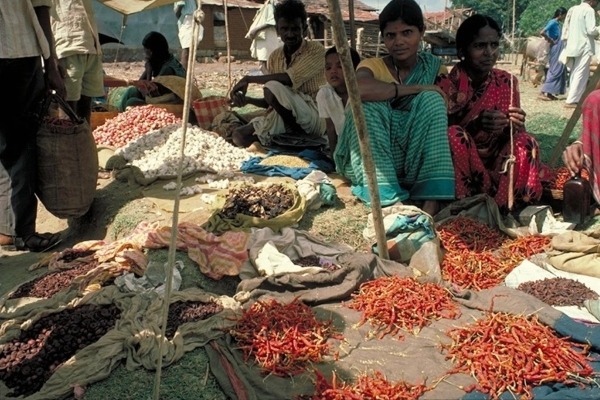
At a spice market
Chikmagalur name of district – town. Kadur Club is old British presence. Remained exclusively white until 1967, when I believe Donald Graham [presumably the president] took down the Royal portraits against Cyril’s protests.
The story of the maintenance of the road. Should be joint. But others have Jeeps and don’t care. So Cyril does it all. Once when Cyril was away a tree fell across the road and had to be sawn up and moved.
The fellow down the road asked Joyce for ten men. She said they were all at work, although if he went to the lines and offered some money he might find some who would accept.
A nice example of a dilemma. Cyril takes this stuff in his stride. Joyce is the stickler. Which is right? To get people to do things they find uncongenial, or let people get away with it, and rely on their natural good will to make it up some other way. Neither system works well unaided. Indeed it’s the human interaction that succeeds, not the method.
Tuesday 2nd
Back to Bangalore. Tilluk came round to house. We went to club while Gopi did his business. Met two Indians who make wine. Tasted it – like Sanatogen. In fact that’s what it is. Acid grape corrected with sugar. They say it’s just (a matter of) fermentation temperature. I doubt it. “India is a great garden. You can grow anything here.”
Later to Peacock Restaurant. Air-con. Disco nights. White Russian woman with ophthalmic goitre. One twenty-six-year-long swan song. Ravaged face. Tilluk’s cool goodbye. Indians are so affected by parting that they can’t control – so they have to anaesthetize.
Wednesday 3rd
The last surprise. A whip-round [organised by Gopi] collected 350 rupees, stuffed in a window envelope, with the 100 rupee note showing through. Also, I see the round robin letter, which suggests similar treatment elsewhere. Very embarrassing. But lovely of them. Bless the B.M.F.C.
[The Bangalore Malayalee Family Club still exists today. Bear in mind that I could easily survive on 10-15 rupees a day.]
Sunday, October 24th, 1976
To Mysore. Help the Germans down the hill, holding their bike with my brakes and engine. [I wish I could remember how we did this.] Then in wildlife reserve my first wild elephant wanders across the road. In Mysore, at govt. guest house, meet three Indians and wives. We go to Brindavan Gardens, under the dam, 10 miles out. Very impressive, but too gaudy for perfection. Afterwards to hotel for dinner. Vegetarian, chapati (poroti?) Very good. Fascinating to see mother feed her baby with her fingers. How much significance there is in the handling of food.

A working elephant at Mysore Reserve
Went out to see a Hindu film. Two male stars playing out endless series of fantasy situations – sort of Indian version of “Help” Richard Lester-ish. Went home after interval.
Monday 25th, to Bangalore
Pleasant ride through flat land, along road shaded by vast trees. Karnataka most irrigated state in India. Nicely received by Jacob at Lucas’s. Then D.H Storey’s wife gets me put up by Persian students across the road.
Poverty is not as alarming as expected. Opinions of emergency fairly divided.
[The whole time I spent in India, President Indira Ghandi suspended the country’s normally functioning democracy with a Declaration of Emergency. It became a temporary dictatorship. There was talk of forced sterilisation of men. Government servants in a vast bureaucracy were made to come to work on time. There were obvious improvements, and some less obvious horrors.]
Sugar cane grower in Bangalore (says he) can’t get labour. They “don’t want to dirty their hands.” Yet labour groups work on roads. Women work in paddy fields everywhere. Old India Hands say there has been much improvement.
Slogans everywhere. [On billboards. Indira’s program was known as P.]
Let 20 point P be our charter
20 pt P is blueprint for success
Efficiency should be our watchword
Dicsipline (sic – or cis?) is the need of the hour
Consolidate 100 gains of E
Talk Less Work More
Nation’s prosperity is sum total of each citizen’s effort
I.Ghandi says: Foreign newspapers attack E because they don’t like to see India succeed against inflation where they fail.
Generally adverse criticism is put down to envy and sour grapes.
Bangalore. Since Mannar things have been getting steadily better. Gradually the last traces of backache have faded. Only in Primrose Road, when I considered PH’s letter, and wrote my replies, did I feel a sense of strain, and since then an occasional excitement at having taken an irrevocable stand.
[I went to the Lucas office in Bangalore who received me very generously. However, there was a letter from Peter Harland at the Sunday Times saying the paper didn’t want to support me any longer. I wrote back that I would continue with or without their help.]
I was impelled to clean the situation for myself. Probably the letter was unnecessarily acid, and in a business sense, unwise. But I am not in business, which is another way of saying that I don’t want to maintain transactions with society when they degenerate.
[In previous conversations with Harland (who was always sympathetic) I learned that there was a faction in the newspaper office that wanted to cut me off. Apparently, they had now succeeded.]
The situation in the Sunday Times office has for me the smell of corruption. Have I injured anyone? For all I said in the letter is talked about openly in PH’s office. But he will not be sure that I haven’t passed it on. Too bad. I shall be satisfied with any outcome.
Now I feel good, excellent, even wonderful. In this frame of mind I notice that I think of my future more in terms of the ranch option than the house. Yet Jo is closer than Carol now. I have opened a conflict in myself which seems to offer no prospect of resolution. How will it be resolved?
[At Lucas’s I was introduced to a car dealer called Gopinath, or Gopi for short – and he was short and pop-eyed to boot, but very entertaining and enthusiastic about my travels.]
Gopinath’s amusing account of Indian bathroom habits. The peasant is used to shitting away from the house in unsanitary conditions. He expresses his disgust by the violent retching noise and the mess he makes. For him, henceforth, bathrooms are dirty places to be treated with disrespect – a custom passed on from parent to child. Regardless of changing conditions (Father to son? How do women behave?).
He does not explain why it should have been disgusting in the first place – unless it’s because the night soil was removed by the lowest caste and the association therefore is untouchable. The left hand symbolises “shit.” How odd to carry with you at all times this reminder of your own excrement. Carried to its logical conclusion the left hand should be encased in a surgical glove or plunged into a pocketful of carbolic.
Discussion with Chief Reporter of Prajavani newspaper. He believes that E [The Emergency] is thoroughly bad: That press freedom is vital, but that electorate is blind and not influenced by press. Easily manipulated by corruption and demagoguery. Believes in unity (i.e. apparently opposed to devolution) but against uniformity. That Indira is seeking absolute power for its own sake. Can offer no alternative, only a return to pre-Emergency state. Talks of slums of Bangalore. First there was a rehousing scheme. Now abandoned because votes are more easily controlled in slums. What are these slums? 150 of them – say 150,000 people.
Tilluk [a new acquaintance] and I stroll around a ‘slum’ – a collection of village houses – maintained with pride and cleanliness – frequent cow-dunging. [Cow-dung is believed to have cleansing properties] Pathways lined with granite slabs. Roofs well tiled. Corporation has moved them. i.e. given land alongside and told to rebuild. But spokesmen say they got no help with money or materials. Forced to sell cows and other possessions. But new houses are being built. And labour is apparently in demand. Conditions in these communities are relatively good. As we stroll, I’m reminded of Iguatú [A village in the impoverished north of Brazil I had visited].
What’s the difference? I’d say things are better here.

Pictures from Iguatú

And now a Pontification:
Next week, it seems, we enter a new era, as Trump and Musk ascend to the presidency of the USA.
For some time now I have felt as though I were hanging on to the top of a wall by my finger tips.
Soon I shall have to let go, and I have no idea what’s below me – if anything.
Does that sound hysterical?
Especially if I add that nothing will particularly change for me personally.
There is no immediate threat to my comfort or survival.
So why this sense of doom?
It’s the same feeling, I imagine, that I share with people living in Glendale, California, who were going about their usual business this week, while their Hollywood neighbours were being burned out of house and home.
With luck the wind will turn and they’ll survive. But it’ll be a long time before they feel safe, if ever.
Americans – most of them –have delivered the world to a man who has promised to break all the rules, and drag us back into the nineteenth century, a time of great wealth for some, extreme poverty for many, when war was the way to settle differences. His promise to end the war in Ukraine will probably mean preparing the way for more European wars in the future. Meanwhile Musk is keen to see a civil war in Britain, and a neo-Fascist government in Germany. No doubt he will also be a friend to Marine Le Pen, our own neo-Fascist here in France.
There is a ray of hope. Trump is a liar. Well, that in itself is not exceptional. All politicians must, necessarily, lie in order to please a wide range of people with different expectations. But Trump’s lies are in a class of their own. In the first place he’s a bad liar, who gets caught out. And secondly, he lies to enrich himself, and that is where I see some hope – that he is lying now about what he plans to do, that his threats are just to soften up the opposition. After all this noise about changing the world, annexing Greenland, dumping Ukraine, firing his own bureaucracy, running trade wars, breaking up the European Union, maybe in the end he will be satisfied by feathering his own nest and rewarding his rich cronies. I could look forward to a day when he and JD, Clarence Thomas, Sam Alito et alia, sail away in a Super Dooper Yacht, with Nigel Farage as Chief Steward and Mitch McConnell doiing the laundry. While Musk, of course,will be on his way to Mars.
But the REALLY bad news is that, one way or another, we will lose four years to deal with the climate crisis, and even more than four years if his fossil-loving friends really “drill, baby, drill.”
The heat is coming. I may even live to feel it. I guess that’s what’s below me when I fall off the wall.
I’m back in India, and from Madurai I rode out of the state of Tamil Nadu into Kerala, and across the Cardamom Hills through Kodaicanal to the West coast at Cochin.
Colombian country. Neat agriculture. High coconuts, bananas. Last stretch to Cochin in dark, on wrong road. Wet. Potholes. Red buses. Corporation guest house. 7 rupees. Sea Face Hotel. Volga Rest. 5-rupee note.
[I met some Europeans who were devoted to India and the Beatles. They sang a lot.]
Astor, Lydia, Candissy, and ? . . .
“Thank you, Lord, thank you.
Love is the force
That will force the course
Of India. . . . . India.”
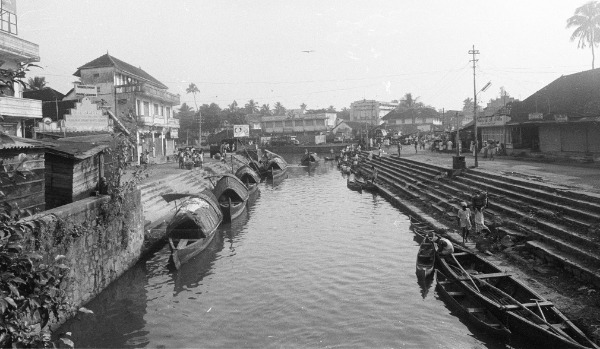
A scene at the old port of Cochin
Dutch church in Cochin. Tanker terminal. Junk rigged barges. Yeasty beer.
October 18th
[On my way to Ootacamund, known to British colonialists as Ooty, a hill station high enough to be cool in the summer.]
Hand-made highways of India. Gang of women in saris circling round roadbed with baskets of earth [on their heads] Man in dhoti and shirt, looking at watch.
Police line roads in villages. Police lieutenant waves me on, sourly. Cavalcade of old cars with state pennant on bonnets comes past other way. Who?
Bamboo clumps, very high. Village sewing machines. Change money in Palghat. Difficulty with signature. Through Coimbatore – busy commercial town. Then up into jagged ridge of Ooty. First through groves of very tall, thin, graceful palms, which are betel trees. Climb up is similar to Kodai but more population up there, first Coonor, then Ooty.
Meet Hans-Georg and Irmgaard [Bohle] on little Enfield struggling up hill. Introduce me to Indo-German unit. Herr Schultz (an effeminate anthropologist) and then Fritz Reich and his wife Elena and son Christian. Fritz is the last of the project which started 8 or 9 years ago with a large group looking for ways to help the potato growers – either by rescuing the potato harvests from blight and golden nematodes or finding better alternative crops. Problem: growers crop up to three times a year, no rotation. Alternative: cabbage. Best yield from Japanese variety – up to 40 lbs per head – but unsaleable.
[What can you do with a 40lb cabbage? This story remains my best example of what happens when well-meaning westerners try to help without knowledge of the circumstances. But they found a better alternative.]
Now a German Weisskohl, more practical (cf; Findhorn). But Indians expected too much from project, dissatisfied, and Germans, disappointed, are withdrawing. Set up one of the world’s finest soil laboratories – now in Indian hands.
[I kept in touch with Hans Bohle throughout his later life. He became an eminent professor at the University of Bonn. His speciality was food security. About twenty years ago I asked him when he and his colleagues had known the world faced a climate emergency. “Oh, fifteen, twenty years ago”, he said, “maybe more”. He died, too young, in 2014. There was an English entrepreneur in Ooty too.]
Nigel Stewart: Nottingham – Boots chemists. To Pakistan. Squeezed out. Returned to Notts with Parsee wife. No good. Went to Kashmir. Found work selling and promoting pesticides. War got in way. Was made Director for plant protection. Kashmiris connived to get rid of him. First blocked his pay. Then got him made Director of Mushroom Promotion. Then wiped out other appointment. But he got a mushroom industry going with help of a German expert. After two years couldn’t stand climate and atmosphere. Came to Nilgiris to start up alone. Starved of capital. After five years wife died. But plodded on. Still loses money – but makes it up on horticulture, etc. But mushroom plant is halfway to completion and capital is promised.
Mushrooms: Horse stable manure and straw. Gets his from Army stables. 3.5 tons at a time. Add 2 tons of water. Stack it in long mound. And turn it over every two days. Add urea, calcium, phosphate, sulphate, reaching 150 degrees F. Ammonia breaks down straw. Temperature kills unwanted organisms. After three weeks ammonia all gone (fatal to mushrooms} Stuff spread on sterile surface to cool, then packed in trays, or sacks. And a bottle of sorghum colonised by mycelium from cultures grown from a selected mushroom spread over each tray. Kept for three weeks as mycelium propagates, then covered with an inch of sterile soil. (In his case it’s the final compost product kept for a year after cropping). Another three weeks in special sheds , and mushrooms begin to come up. Up to five “flushes” at intervals of ten to 14 days.
He now sends 6 Kgs by air to Bombay daily. 30 rupees a kilo. Is looking for a mushroom expert from UK who may be able to feed in £100,000 more in time, to build a canning factory.
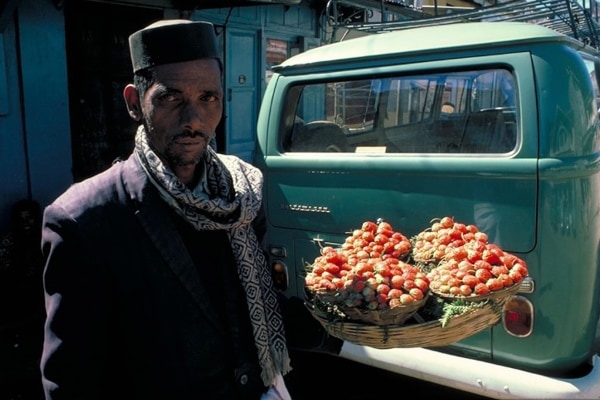
Strawberries for sale in Ooty
In evening, with Germans, we visit Mrs. Widemayer, to join her Deevali celebrations. She ios a Toda tribeswoman who got some sort of medical education and married a resident German. She has become leader and spokeswoman for her tribe and lives in a fancy house uphill. There were children of all ages, and various older dependents, and we had fireworks. Afterwards, the kids did songs and funny sketches. I drank Jägermeister. It was very cold outside.
Saturday. October 23rd
We went to breakfast in town. Forgot to mention yesterday’s breakfast on lawn outside Glyngarth House. Sun and flowers and a load of food. Lovely time.
Today went to silver shops and went mad. Bought at three shops. Little spaces, low ceilings, owners sit behind low counters of wood and glass with silver inside. Painted wooden furniture. First shop is pawnbroker. He has sweet betel smile. Shows a pair of lovely ankle chains. Wants 1.20 rupees per gram. Agree on 1.10. Weight 90 grams. 100 rupees. Next shop is bigger. Old man with cloth round head lounges back. Young man in Western clothes does selling. All 1 rupee per gram. Has heavy necklace of silver rope with ten amulets strung, and silver pendant on heavy chain. Also, waist rope four ft long, child’s heavy bracelet with clasp, another light open anklet, a silver and wool dolly to hang from belt. Altogether weighs 320 grams. Pay 310 rupees. Third shop much smarter, two young men, very businesslike, have heavier necklace and light one with silver pearls. 150 rupees. Buy last two lots and take booty back to house. So pleased I decide to go back in afternoon. Buy ankle chains and more bits (including clasps) from second shop. Another 80 rupees. 640 rupees all told. $US 71.
Take my winnings to Fritz’s house to show. Glyngarth House is a very roomy two-storey house with fancy tower, stairwell at one corner. Fine wooden floors, joss sticks burning. Toda embroidery on walls. Elena gives me tea. Likes the silver. Fritz returns. We talk about life, processes of enlightenment. He is 37, recently discovered the burden of anxieties under which he laboured and is trying to shed them. Came from East (Thuringen) where father had land and lost it. He is a nervous man with many propitiating habits – quick smiles, wry grins, snorts and hesitations, etc. Inclined to explain things in terms of Christianity – weight of guilt. We seem to arrive at a good understanding, but it may be wishful thinking in part. Later Hans-G and Irma arrive. Conversation continues through and after dinner. Discuss possibility that an attitude of mind we take for granted may be totally absent [in India]. It’s the same concept, basically, which I found short in Latin America. A willingness to combine with others in a practical, commercial way for the general good. Indeed the idea of ‘general good’ itself seems not to occur. The Nilgiri farmers do not help each other.
On the way up to Ooty I stopped and watched the monkeys. Had idea of comparing men with monkeys. Some people give us the impression of being as limited as monkeys in their approach to social problems. Seem to lack the vital concept that gives activity a higher meaning. Watched the monkey at Mannar playing with two coins. He rubbed them together, chewed them, struck the ironwork with them, moved them around – nothing happened. Ingenuity without purpose.
In the Indian family there is relatively less scope for individual discovery. Children are held close to parents all the time. Great care is taken that they do everything in the proper way. Small wonder if it later doesn’t occur to them to look for their own solutions, still less that they don’t combine to find solutions. It is easy to propose schemes that would open children’s minds, but they all depend on the powerful presence of ‘enlightened’ adults. Otherwise nothing short of a major disruption of the social fabric can produce the necessary condition – with such painful, wasteful results. Time, of course, and slow pressure might achieve better result, but is time now an impossible luxury?
Interesting to try to see ourselves in as revealing a perspective as we see others. We are monkeys too, struggling for elusive concepts. Must remember that the habits which block our vision are dear to us. They comfort us. We don’t want to lose them. Often they are what we live for. Love, bacon and eggs, Sunday by the telly, possession of our children.
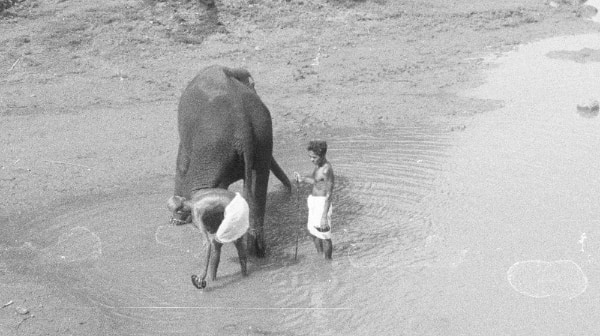
Bath time for elephants
Happy New Year Everybody.
I’ve been riding round Ceylon (Sri Lanka) and I’m back at Mannar waiting for the ferry to Rameswaram, India, but the weather’s against me and I’m still feeling feverish.
14th October
Rain is really punching down in the night. The garden has become a lake. The varnish on all the stairs is sticky. Pools of water on the floor. Write to Tony and Mum and walk to the post office. Then get back to feel feverish again. Decide to take tetracycline. Soon afterwards, vomit (having drunk Coca-cola). Think I might have typhoid. Get scared and get driven to hospital as emergency. Doctor greets me with great amusement.
“What do you want,” he asks. “Medicine, or to be admitted?”
“I want to know what’s wrong.”
He can’t stop grinning.
“You’ve got a fever.”
“Why?” I ask.
“The climate,” he answers. “Take a Disprin and it will go.”
“That’s what I’ve been doing for three days.”
“Cough,” he demands. I give him a couple of coughs.
“You see,” he says. “You’ve got a cough.”
It’s so ridiculous I have to smile too.
He still thinks it’s a huge joke. He asks several questions but doesn’t listen to the answers. But he’s convinced there’s nothing wrong with me, so I begin to believe at last it’s nothing very much. Back to Rest House much embarrassed.
Soon afterwards astonish them by going fishing in the rain. A fish takes away the hook, it comes down in a torrent, and I slosh back to change. Through afternoon, with two more Disprins, begin to feel better. Mr Ratnavale calls on me. My heart sinks, but he’s better today – not so overawed without his weighty companion. Eventually he walks off into the rain and comes back, unsolicited, with a packet of five Capstan cigarettes [a popular British brand]. Very sweet. Has wife and three kids in Jaffna. Means to travel overland to Europe. Give him the ST address, without explaining what it is.
Fun with the monkey on the chain.
Now great wind blows up outside. Will tomorrow be stormy?
Walked round the Portuguese fort. 17th Century. Impressive size.
15th October
Busy night. Great storm blowing, with sounds like gunshots, among others. Between nine and midnight I must have sweated a lake. Both sheets wringing wet and mattress too. Tried to make do with towel and sarong, but mattress too wet and had to change mattresses and put on trousers and blue vest. In morning both these were damp too. The tetracycline must have helped me chase the fever out, so I’ll go on with it for four days.
It occurred to me that the ferry could hardly have docked last night, and this morning at the bus depot someone confirmed that it was anchored a mile offshore. “Maybe this afternoon, maybe tomorrow morning.” I imagine I’ll be here another night yet.
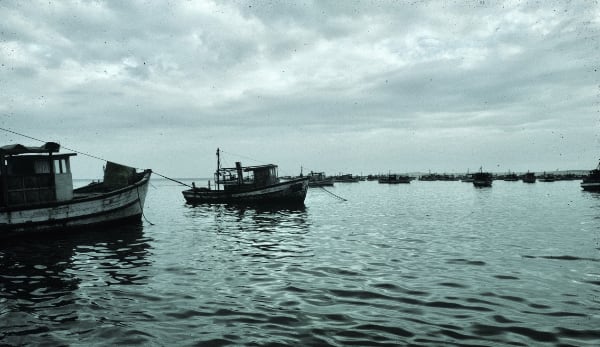
View from the pier at Mannar
Go to pier. Sea very rough. One fishing boat breaks anchor line – tossing about on the other line, spewing out broken fittings, which poor owners are combing off the beach.
Ferry is in, discharging passengers but customs very slow. Captain puts to sea empty, afraid that sea may cause ship to break the pier. No ferry today – maybe tomorrow morning. Meet odd couple from Bolton via Bangladesh.
Ads in the Ceylon telephone directory:
Grow ARLINGON COWPEA – it’s a fine substitute for dhal.
To get 100 bushes of paddy per acre: Grow improved varieties: Disinfect Seed Paddy:
Apply fertilisers: Weed the fields: Control Insect Pests.
Short conversations reduce engaged calls.
Please listen for the dial tone before dialling.
It is a DELIGHT to possess a coloured telephone.
Grow your own vegetables. Obtain top quality seeds in 25ct packets from the Dept. of Agriculture.
Start your own poultry flock. Buy day-old chicks.
Mr. X, Lawyer, Politician and Drunk. First heard talking on the telephone:
“Do you know who you are speaking? What is this? Don’t you know who I am? I am the chairman – (of something or other).”
Then afterwards a long, impassioned declaration – “I do not ask a favour. All I am asking is natural justice. Just give me natural justice – etc., etc.”
Later falls asleep on the ‘opium couch ’next to arak and soda. But at this stage I don’t know that he’s a drunk. At first in conversation he seems to promise liveliness, a few phrases, a gleam in his eye, he actually hears what I say first time – but soon the concentration slides. He has a vendetta with the acting captain of the ferry – has been persuaded to withdraw complaints against him in the past (long past). Now he calls him an incompetent blunderer.
“My clients on the lower deck. ….. ” (Fishermen). Soon mentions his weakness for drink – his wife’s troubles and forbearance, alternately humble and arrogant. Ends by trying to persuade the Bus manager to send the bus to the Rest House to pick his party up for the station. Hi sons run the air services from Jaffna (he implies great influence.) Endless inconclusive flights into political theory, history, philosophy, religion, all trailing off into nonsense. Mr. R. – friend of the famous – joins as a willing chorus. The two American Jews add a further fragmenting influence. Degenerates into a futile discussion of train, bus, boat and plane schedules. All nonsense – hold the fort as long as I can – then supper. Mr. R keeps his eye on me waiting for me to finish. I drag it out. The others stumble out into the stormy night. Mr. R gets the message (at least he gets that kind of message) and I’m alone again.
Was one word of wit spoken? No. Not by me or anyone. My thoughts are all locked up, to flutter behind bars and fall exhausted to the ground. Thoughts about sport & politics – the relevance of Jane Austen’s dialogues to those I’ve just heard – about the barrenness of this life, in which never a book is seen.
“The Sinhalese are a great and noble people – but (and said quite seriously) they are stupid. The Tamils are clever, cunning. The Sinhalese are stupid, but I love them.”
“I am a world citizen.”
“Listen to what my daughter has written to me. She says, ‘You can go on drinking. Just give two years to finish my course, then you can go on your pension or kill yourself’.”
October 16th – Rameswaram to Madurai
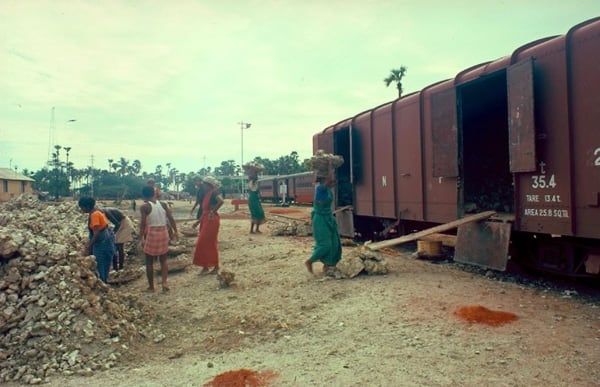
Railway sidings. Grass village. Boys building sand temples. Steam engines. Family approaches from village – to load lime on to wagon. Took pictures.
Sinhalese music seems to play on the same notes as Turkhana songs. But where T is a descending fifth, S rises to next octave.
The porters at Tallaimannar singing work songs as they push the goods wagons along the pier. Chorus and solo verse. Chorus rapid syllables on one note.
Glass of Nescafe in Madurai 1.20 rps (=10p)
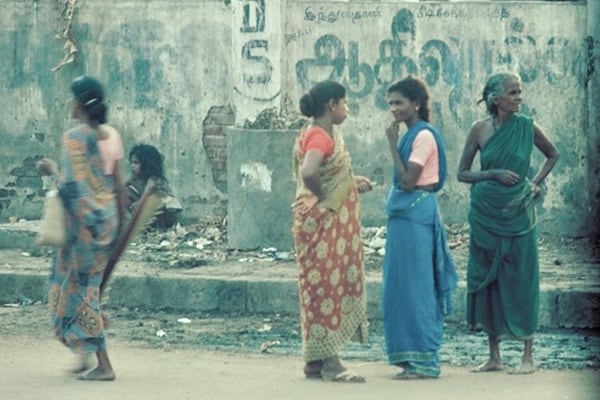
Ladies with rubbish. The boys have gone.
Watching kids play around overflowing rubbish bin across road. Round it and in it. One boy has just shat in the loose stuff on the ground. Big sow meanders round it. Am reminded of the story of Mr. Dodd’s dustheap.
[Many years ago I discovered this 19th-century account by James Greenwood: Journeys through London or Byways of Modern Babylon. Fascinating reading. Women and girls spent all their days working on heaps of domestic rubbish yet were remarkably healthy and vigorous, as attested to by Dr. Guy who later founded Guy’s Hospital.]
Young bank clerk takes me to the cinema to see: “The Burglars.” Omar Sharif. Belmondo. Very bad.
Says Madurai has special people called Shakti who don’t like spending money.
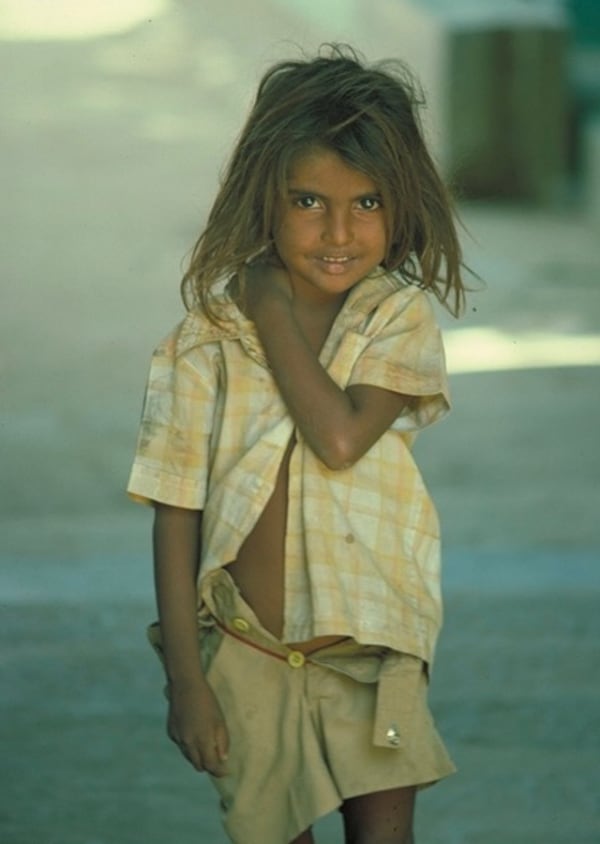
Well, that’s all for now. Christmas is coming, and I don’t know about the goose but I’m feeling fat just thinking about it.
I wish you all a Very Merry Holiday. You may not hear from me until the New Year, and there’s bound to be some good news, surely – so Here’s to a Happy New Year, too and let’s make the most of what’s left of this one.
CHEERS EVERYBODY!
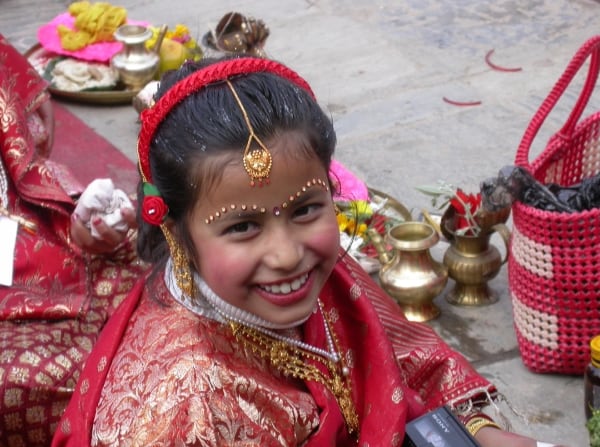
I’m leaving you with the happiest picture I could find – from Nepal.
I’m in Ceylon, having visited one of the best known sites, Sigirya, a fortress created out of a phenomenal rock formation.
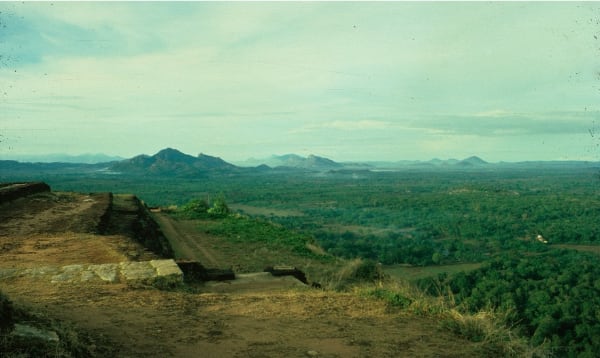
The view from the top of the fortress was extraordinary. There were carvings, but little that my uneducated mind could explain. The next day I left the Rest House (and the German sisters).
October 11th – To Puttalam
On shore of a lagoon. Junction town. Single row of huts, some tiled, some thatched. Small veg market had chiles, kohl-rabi, cabbage, carrots, tomatoes, limes, eggplant, potatoes, yams, etc. In short an excellent variety. Fish market, a small raised cement platform, thatched, had good fish too. Some puppies stood around it. One was so thin and failing that it was scarcely more than a head. Watched some crows on a roof – one had a fruit in its beak but could hardly eat it , since as soon as it put the thing down to grip it with a claw, another bird unencumbered, would threaten possession. It had a younger companion also which simply screeched with open beak and got a couple of morsels for its pains.
By the shore was a thin strand of sand littered with all kinds of rubbish. Again the crows attracted my attention and one – an obviously inferior one – was hanging about behind the others. At one point it raised a claw and put it pleadingly on another bird’s back – twice. The other bird flew away. The mangy one was left alone. Then I noticed a dog, a bitch with distended udders, licking something between its front paws. It was a puppy stretched out on the rubbish, head back and oozing blood. The mother looked up so mournfully.
These small examples of life and death on the rubbish heap moved me and depressed me profoundly. Since Colombo I’d been viewing the world through discomfort and fever with a deliberately jaundiced view. I saw the profusion and luxuriance of the tropics as a terrible mess, buildings as mildewed wrecks, human effort as futile. The people seemed tedious to me, an endless procession of M&S shirt tails hanging over sheets – with facile smiles signifying nothing if not envy and ingratiation. Only the older women impressed me in spite of myself, with the fineness of their features and slim, handsome carriage. The road was murderously bumpy, the traffic foolish. Several times in Ceylon I’ve saved my life by noticing another driver when it was his obligation to notice me. People stop quite suddenly in the road for no apparent purpose., and without indication. I think there is a powerful amount to be said against tropical paradise and I should be grateful for these fevers perhaps. The yearning for temperate home must have been overpowering in early adventurers when they fell sick.
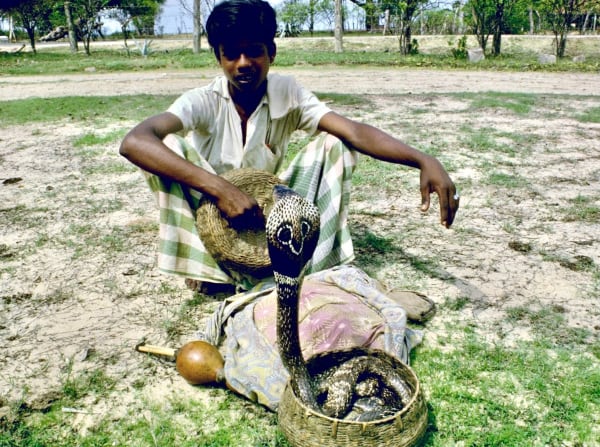
At Puttalam I got hot tea and an extra sheet and tried to sweat it out. There was plenty of sweat, and in the morning I thought I’d won. I rode the 46 miles to Anaradhapura (after photographing a cobra) and sat among the ruins for a while.
A young man came and, by the brilliant tactic of not asking me for a single thing led me to offer him my address. I walked barefoot to the big Dagoba (or whatever). The dome is solid and covered with cement – has little to say to me. There’s a crack where it was once struck by lightning, and a new lighting conductor runs down the side. There’s also a maze of granite pillars sticking out of the ground. The lad says this is the ground floor of a seven-storey building in which a hundred monks prayed on each floor, all in their solitary cells. If true it’s an amazing notion – what a hum must have gone out from that box. Enjoyed also the moonstone outside the temple. Elephant, horse, lion, buffalo.
From A on the road to Mannar. And at the main junction was already feeling the fever again. Had a drink and some Disprin at the rest house. Disprin is becoming part of my diet. Rest of journey went well, no more rain. In the morning. I rode through a maximum downpour for maybe 15 minutes – and the jacket is a success.
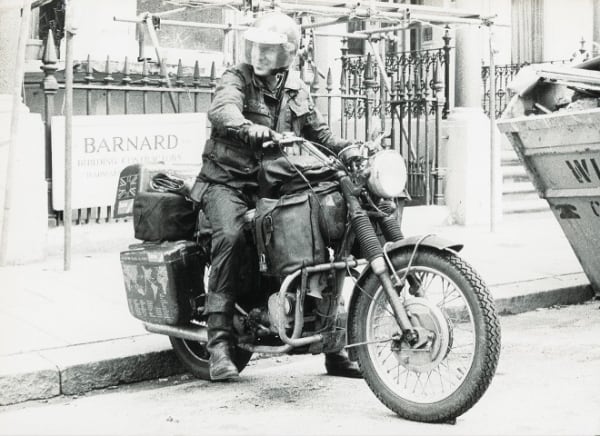
[Somewhere – in the USA I think – I’d acquired a leather Belstaff outfit. I was still wearing it when I got back to London]
At Mannar got the same room at the guest house. Went straight out to fish off the bridge, thinking how nice to be alone, but a great company of betel chewers lined up alongside me. I managed to live with it however, and got the great excitement of a catch. The fish felt very strong and for a while I couldn’t move it at all – after its first run – then slowly I inched it in. It was a stingray. Very exciting to see it come out of the water. Not really so big – maybe four pounds – with a beautiful mottled brown back – a rather human mouth and two eyes on top. One of the men cut off the tail and showed me the spike which lies alongside the tail close to the root (not as I imagined at all) Took it back proudly to the rest house. The cook said he would fry it for me – but as a fish, he said, it was not famous.
Two men on the bridge started talking to me. It annoyed me at the time, and I must have shown it.
“Your native land, please?” “Are you a university graduate?” “How much does this, or that, cost?” They came afterwards to the Rest House and I had to sit and take tea with them. One was the medical officer for the area. And the other (Mr. Ratnavale) is a clerk of some sort. They have so little to say and understand so little of what I say that it’s largely a ritual. Whatever I said, Mr. R’s face would express perfect wonder and enlightenment, and say “I see,” as though everything was now clear. But the MO did describe symptoms of typhoid which gave me a bit of a scare next day.
That strange Scots family also turned up.
Rest House man told me a series of superstitions – full bucket, empty bucket. If a monk crosses your path when you set out, forget it. If the gecko chatters as you step out of the house – also forget it. If you run over a cat, you’ll have an accident. Woodpecker’s noise is a bad omen.
Also says Tamils smell different. If they use a towel, you won’t be able to. He says Sinhalese and Europeans are much closer.
PS: The response to my offer of a reduced price on the Camera book has been very welcome. If you’ve left it too late, I will still take your orders on Sunday 15th, but after that it will back to normal. Thank you.
