
From My Notebooks In 1974: Andrade’s Story
16th August 2026 |
Rio, August
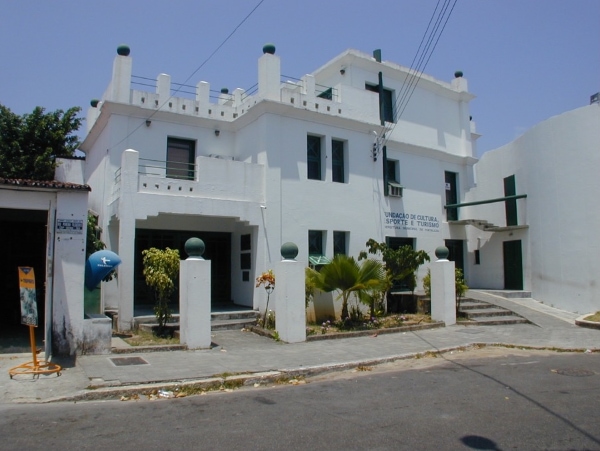
The police station in Fortaleza where I was locked up has become (25 years later) a cultural centre after many cosmetic changes. It used to bristle with antennae.
[My imprisonment/detention in Fortaleza was Kafkaesque, in the sense that I was locked up in an office where, during the day, all normal office procedures took place. There was a plump young blonde secretary at one desk, and the head of a drug squad (Toxicos) at another. A handful of agents, three or four men, one woman, hung around waiting for a call. I watched them all from my place, standing at the wall. There was only rarely a spare chair. If I wandered too far from the wall a fierce older agente pushed me back. Otherwise, they all behaved as though I didn’t exist. At the end of the office day the desks were locked and pushed to the wall. Everyone went home. The door was locked and I was left for the night with a pile of three straw mattresses. The first days were the worst, when I really thought they might do away with me. The atmosphere got gradually easier, and in the second week when it seemed most probable that eventually I would be freed the female agent, who spoke reasonable English, began to talk with me. It was then that a young shipping clerk was locked up with me and, the following night, we first made the acquaintance of a lawyer named Andrade. I wrote his story into my notebook much later, when I was in Rio. This is exactly how I wrote it.]
ANDRADE’S STORY
He looked utterly defeated when I first saw him, and all the more pathetic because he was so well dressed and groomed and obviously accustomed to comfort and respect. Superintendent Xavier brought him in one evening, saying “You can stay here, if you like, but you can’t converse with these,” meaning us, the clerk from Maranäo and me.
Andrade mumbled something about not needing company, and they left the room. It was his mouth I remember most. It seemed to have imploded, and his head looked like a tin full of steam after it had condensed.
Where he spent the night I don’t know, but the following day, a Saturday, he was back looking more controlled. For me, who was living in a regulated squalor, he was a phenomenon. He had his hammock, a new looking, brightly coloured affair, which he slung across a corner of the room. Unlike us, he had obviously been forewarned. We didn’t speak for a while, but eventually we were talking quite freely. [But only in Portuguese which I was gradually picking up.]
We played two games of chess with the cardboard pieces on a board drawn on the back of a large brown envelope. He had already told his story to the clerk, but it went too fast for me, and I persuaded him to tell it again slowly. I don’t know how he managed it, but he conveyed to me a vivid picture of the main event which was the beginning of the tale.
It seems that in some way the brother of the Governor of Såo Paulo had betrayed or slandered him, and he came to the Governor’s palace to protest and receive satisfaction. He charged the brother to his face with his slimy behaviour, and the brother replied in terms which Andrade could not tolerate. He therefore gave the brother a punch on the nose. Th brother then drew a gun and Andrade fell sprawling on the marble floor with a bullet through his calf. However, as he lay on his back, propped up on his left elbow he was able to draw his own gun and he shot the brother once in each shoulder and once through the leg. Andrade pulled up his trouser leg to reveal a whitish shin. On the right side halfway down was a scar like a halfpenny. On the back of the calf was another. The scars gave him great satisfaction. He said that, as a result of this incident, he was unable to make a satisfactory living in Såo Paulo. He lost his job as a lawyer in the state government, and doors were closed to private practice. He was said to have been politically undesirable. [The shooting occurred in 1964 after the military coup.]
In 1970 he left S.P. and came to Céara, a sufficient distance away to outrun the slanders. In Fortaleza he built up a new reputation, became involved in the creation of important enterprises (water treatment, Parque de Pais?) Then he became associated with the director of Larousse for Céara, and was instrumental in making it the most successful branch of the business in Brazil. The HQ was in Såo Paulo and in 1973 he was suddenly dismissed, just before Christmas. The principals refused to see him, and he decided not to take any action for loss of earnings, etc. Some months later his former boss in Céara was also dismissed and accused of fraud. This man invited Andrade to help him prepare a case against Larousse, but in the meanwhile, A had discovered that it was his boss, whom he had considered to be his greatest friend, who had denounced him to Såo Paulo as a swindler. A instead gave evidence for the firm against his boss.
Now he himself had been arrested and told that a criminal process begun against him years ago in S.P. had been to trial and he had been convicted in his absence and sentenced to five years. He was now waiting to be sent to prison in S.P. He seemed quite without hope.
That evening his son, a young man in the expensive casual clothing that rich sons wear in Brazil, came with pieces of roast chicken on a plate with a cloth knotted over it, and a bag of other odds and ends. They embraced and talked. A left the room and came back into the room bouncing with optimism, smiling broadly. His son and his friends had discovered that there had never been a judgement against him, after all. The whole thing was a wicked lie disseminated by his enemies. The truth would emerge and he would be free again.
I found it as difficult to believe now in the rosy future he painted as I had been to share in the black despair of a short while earlier. But because he was so exhilarated, I congratulated him heartily and pretended to share in the wonder of it all.
What we were experiencing, however, seemed a long way from what I could accept as reality, like his keen earlier interest in ways of escaping from the police station. [He said that compared with the prison in S.P. this was very easy: I wondered how he knew, but didn’t ask him.]
The euphoria lasted for a day, through Sunday. On Monday morning I saw them, he and the clerk, standing oddly near the wall with the sun in their faces, as though they would be lucky to see it again. He was taken to other offices, and I didn’t speak to him again. I saw him though when he came to collect his hammock and other things, and his face had once more collapsed into bitter dejection.
When I got out myself Mario [a priest] brought me a newspaper which described how Supt. Xavier had winkled this crooked lawyer Andrade out of Fortaleza High Society and sent him packing to S.P. where he had been sentenced for various frauds.
Much later, looking at a map of Såo Paulo, I was surprised by the large number of streets named after different men all bearing the name Andrade.
The heat is getting to me. I dread to think of the future. Isn’t it Kafka all over again that at a time like this a stony-faced villain makes us waste our wealth on munitions.
Another dive into the relative innocence of the past next week.