
From My Notebooks In 1974: Rio to Brasilia
23rd August 2026 |
August 21/22
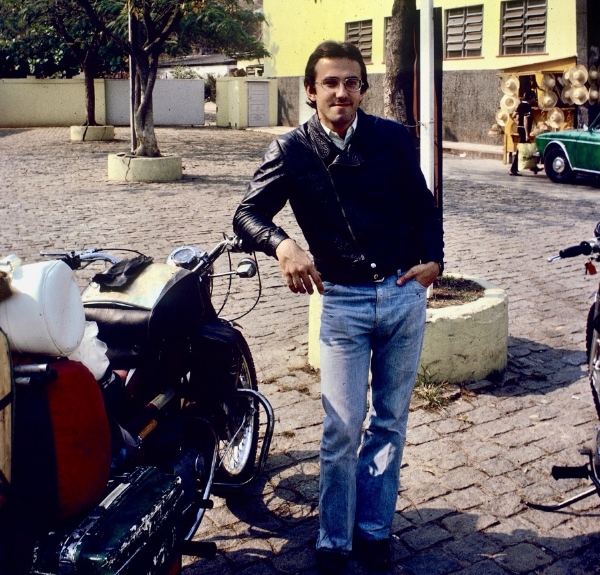
Full-sized motorcycles were extremely rare, and extremely expensive in Rio in the seventies. I only met one rider, Antonio, and we became friends. I think his was a Norton.
Somebody in the military government must have thought it worth trying to persuade me that they were the good guys. They booked me two nights at the Hotel Nacional and bought me a bus ticket there and back. The bus was very luxurious, better than a plane, 16 hours overnight and I arrived in the morning. Brasilia, built from scratch by Niemeyer, was quite bewildering. This is what I wrote.
Down, round, under, up, round, over, W/3, L/2, Zones, Sectors, blocks, giant inhabited sculptures loom up, swim past and drop again into the great areas of empty lawn. Here’s the gymnasium, seats 10,000 people in pretty coloured plastic bucket seats for prize fights, ice shows, Johnny Mathis. Here’s the church – immense cube of blue glass panes and fluted ceiling. Here’s the cathedral, a wigwam of concrete spatulas supposed to represent the crown of thorns, with no pews, only a scattering of marble blocks in one area and metallic angels floating in space, picking up distant laughter like a vast ear trumpet. Here’s a residential area – three kinds of apartment – cheap, middle and expensive, from 800 Cruzeiros to 3000 a month. The government housed in regimented rows of greenish dominoes glowing like sophisticated electronic hardware, a guard of honour for the twin towers that zoom up at the end of the avenue, seat of the congress.
“Small politicians with no specialised knowledge. Criticised for being unable to debate sensibly with the technocrats..”
[I meet my interlocutor – a high-ranking diplomat.]
Under a triptych depicting a mysterious cataclysm, a comet or saucer swims fish-like over a Latin township of spires and compressed humanity, releasing a gloomy doom, soaring away from the rubble and fleeing insect figures, strange background for a conversation with a diplomat imbued with the tough unsentimental talk of technocratic dictatorship.
“This is a government supported and protected by the army. Oscar Wilde said there is no such thing as a good or bad book – only well written or badly written. We cannot afford discussion and debate of moral issues. It’s a luxury we cannot afford while people are starving and dying.
“A third of the population is illiterate. We hope to end this in ten years. The real revolution was in 1972 when the budget for education was 4% of GNP; [I think he meant GDP] and the military budget was 2.5%. but still it is not enough.
“We have not abandoned land reform, but it is no use taking a peasant from the North-east and putting him down on a strip of land in Amazonas without help or advice. In on or two years he will turn his land into sand.
“It is not really land reform. We call it colonisation. Do you know how much all this costs? We must find the money. So we are doing everything to make the south richer, so that money can be used to develop the north. We are in a capitalistic world and cannot escape it. Everywhere the world is becoming more capitalistic. Russia. Even China. ‘And the capitalistic countries are becoming more socialistic. I believe the world will eventually become one country through capitalistic interdependence. That is how the poor will be saved. But it will take many generations.
“We work very hard here. We take no vacations. For me or anyone else here to take a month’s vacation is unthinkable. While there are poor people we have to think of them.”
Could you compare Brasilia with the pyramids – the ultimate in technology, aesthetics and grandeur, raised over thirty million illiterate peasants? Here the monument is dedicated to them, but it is still the pharoic family in residence.
“Perhaps they will be proved right,” says Her Majesty’s First secretary when I meet him. “Brazil is making great economic progress. Has a big foreign debt but has no difficulty servicing it. We’ve got Germans, Chinese, Japanese and Arabs all wanting to invest. Argentina used to be the most advanced country in South America. Since I went there 12 years ago it has stood still. Now Brazil is ahead. There is no end of discussion and debate in Argentina. I remember a friend rushing up to me at election time in BA, his eyes glowing. ‘I’ve just formed a party,’ he said. It was the 19th party to put up candidates. The Brasilians tend to look down their noses at Argentina.”
(Nucleo Bandairante)
The first buildings of Brasilia still stand a few miles outside the city proper. Made of wood, two floors high, like frontier town. Other satellite towns have sprung up, in the case of one growing around existing town. Brasilia shimmers in a bowl, distantly, like futuristic image.
“Where are you from?
“Maranhao, Ceara. We like it here. Prefer to live in Brasilia. Got a good job. Driving for the ministry.”
“And you?”
“I’m from Goias, originally from Austria. Study Geology. Brasilia is lovely to look at but terrible to live in. Nothing to do but work.”
This sculpture is called “A Woman and her Shadow.” Bronze figure pursued by black ghost writhing with tentacles. The sculptor had cancer and knew it. Here’s another of hers. “Mermaid and Octopus.” But finely made.
The room for ceremonial treaty signing in Itamaraty has an 18th century jacaranda table belonging to Brazil’s first diplomat, bowed down at the centre by the weight of many elbows, many treaties.
This is the biggest unsupported ceiling in South America, and this is probably the biggest tapestry (although there’s one at the UN building, isn’t there?)
Itamaraty stands in a cool green pool cradled by thin concrete arches – delicate and beautiful – the showpiece of the government – by Niemeyer.
At the Nacional Hotel the hunters come to breakfast with James Bond briefcases (still?) all geared up – it’s in the way they walk, stand, talk to each other, all unnaturally bright.
And at night, hunting the hunters, in evening gown and green velvet smoking jacket, two society artists shamelessly advertising their appeal with clippings from featherweight journals and lists of featherweight patrons. Lord and Lady Antonia Fraser, Baron Thyssen and his lovely Baroness (which one?)
“Yes, we churn it out. We believe in flooding the market – we make a good living, thank you – you’ll find our work in the best hotels and airports, and us too. He carves wooden panels, she paints primitives, 1000 Crzs upwards.
On the grass lawns, between lanes of traffic, peasants earn their Salario minima hoeing at weeds in brightly colourd clothes, moving slowly in rows of three or six. Nobody seems to know what the Salario minima is (except them, of course). Is it 280, 320, 360?
Anthropologists say that eventually there will be no more Africans. Will there be any whites?
Of course!
Next week, away from Rio and the journey gets going again, at last.