
From My Notebooks In 1974: Chile and the Pacific Ocean
15th November 2026 |
Having escaped death without even knowing it, I continued blissfully to the coast and my first view of the Pacific Ocean.
October 31st
The road was lovely in the morning. It escorted the river to the Pacific, coming closer all the way until at last, after teasing it with several crossings, they ran hand in hand to the sea. I arrived at Pucatrihue at 8.15. The place was barely recognisable as such. A house here or there. But the posada [hotel] had a sign up in yellow, hand painted. I went on a way along the coast, to a tunnel, but realised I’d passed it. Went back. Maid answered. Two dogs barked at me. She invited me in. Offered me breakfast. Then came back to tell me that they couldn’t change my money. Disaster. [The junta had made it illegal for private citizens to trade in foreign currency. Penalties were very harsh.] She was short, chubby, straight black hair, a trifle severe, in apron and head band. She suggested that the police in Bahia Mansa might help since they had a jeep and must have petrol. I was very upset – had set my heart on staying and could see no way. Half hoping she might think of something, or at least offer me a coffee I prolonged the agony but it was useless. I rode back to the Bahia Mansa road.
My sadness could not survive the pleasure of the countryside. I have suffered from a surfeit of scenery on this trip and yet from Bariloche to here it has lifted my heart. This is how I imagine 18th century England at its best. Clear cool water rippling over stones, flat grassy banks, trees leaning over for shade, every artefact made of wood, no cement, no asphalt, scarcely any iron, few vehicles, an occasional person, birds, scent of blossom and pine, light breeze under hot blue sky, rustic bridges, empty beaches smelling of seaweed.
A man in heavily darned brown corduroys, jacket and old trilby is fishing in the sea from the beach with nylon line wound round an empty oil can – the most efficient substitute for a rod. But that’s later. Now I arrive at Bahia Mansa. The Carabineiros are halfway down to the sea. A stocky fellow who might well be German, receives me politely. I explain my troubles. He ponders the matter weightily, but he is obviously going to try. Perhaps, he says, the hotel at Maicolpue will be able to change money. It is bigger than the one at Pucatrihue and is owned by Germans. He himself could do nothing, he was not going into Osorno today and tomorrow was feria. Good God, a national holiday. All Saints Day, November 1st. How much petrol did I need? Three litres. Did I have a can? Yes. He took it off and came back with four or five litres. Now he seemed pleased to have helped me. Could I do nothing for this, I asked? No. He asked a few questions about the bike and waved me goodbye.
So I went on to the next bay south, Maicolpue. This was more of a resort. A few dozen wooden houses faced the sea on a steep hillside, all painted in fresh, vigorous greens, yellows, orange and blue, and all shapes and sizes.
[I slept on the beach that night and in the morning went in search of the German hotel.]
November 1st
Herr Witmer was supervising repairs on the gutters of his Hosteria. I asked if I could speak German to him. It’s all the same to me he replied in Spanish. So I told him in Spanish that I wanted to change money, and he answered politely that he couldn’t. So I went down again to the beach, rode along the shore a little way and made my breakfast of fried eggs, bread butter and coffee, sitting on large boulders looking out at the Pacific and watching the fishermen plying their oil cans, sending a steady stream of live bait into the ocean from a plastic bag and getting, so far as I could see, nothing in return.
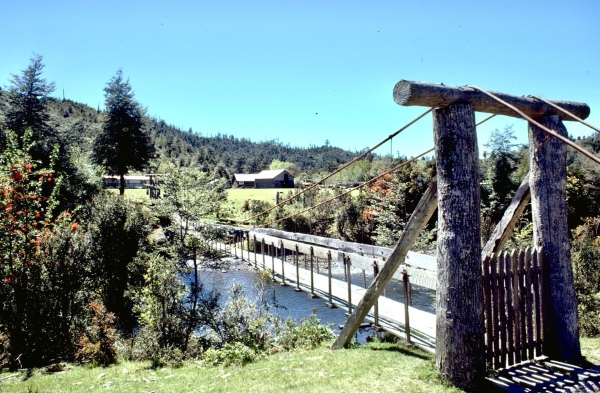
I washed up, repacked my things, (small petrol stove, plastic baby’s bottle full of condensed milk, non-stick frying pan, pepper and salt in film cannisters, butter, steel mug, etc.) and set off slowly back to Osorno to enjoy the countryside. It was a rought, stony surface, and without the hydraulic dampers the rear suspension was far too springy. But the spectacle was glorious. Again I stopped, to look at a bridge across the Rio Trallanquin – a suspension bridge for private use. Across the river grass, with three cows, bushes and trees at river bank – one tree with bright red blossom that I saw everywhere – all so lush, so peaceful, so sweet smelling – like milk.
In Osorno I took the guidebook’s advice, but Hotel Rouq refused to answer its bell. Why not try the Gran said a boy, it’s much better. I went there thinking it didn’t look all that Gran. They shoved the ‘fiche’ at me and filled me in the register before I could ask the price. They seemed surprised that I should care, and said it rapidly several times. It sounded like 1,800 escudos. I didn’t pursue it since I knew I would stay anyway. What’ the dollar worth, I asked? They didn’t seem to know that either. And asked around a bit, but I got another vague figure with seven in it. Went out on to the plaza to look in shop windows. One of the first things I saw was a blue enamel chamber pot for 1,800. Then the money changers opened shop (at 3.30) and I got $40 worth at 1,350 to the dollar. At this rate the Gran is very cheap indeed I thought and knew I must have it wrong. I went on walking to see how prices ran. They were very chaotic.
There were funny old-fashioned things there. All manufactured and canned stuff was expensive. Monstrous concrete affair with cross on top. Wooden clapboard houses, old and dusty. But neat girls, all dark. (Guide [famous South American Handbook] talked of blonde girls – didn’t see a single one). Went back to hotel. Slept. Went out again. Piano music broadcast from centre of the Plaza, but meanwhile found out what the room costs – 2,600 escudos, $9.5 or £4. Went to eat at Otto’s. Left it till 8.30 because guide says dinner is never served before 8. Was hurried along by supercilious waiter who said they closed at 9. Brought me a bottle of red wine at 2,500 esc. And had the cork out before I’d even worked out how expensive it was. It was a good wine, but hell! That meal – consommé, pork chop and fruit called chirimoya in orange juice – cost 7,500 – or £2.10. With coffee and cheese sandwich at lunch I’d spent half my $40 in one day.