
From My Notebooks In 1974: To Chile
8th November 2026 |
After ten days with the Wesleys I tore myself away to cross over the Andes to Chile.
October 30th
Left Wesleys at 11.30. Rode a few miles and came back for plastic butter pot. Rode off again a few more miles, and came back again for waterproofs. [This always seemed to happen when I stayed anywhere for any length of time. Always very embarrassing after all those fond farewells.]
Road out to La Agostura is a sensational ride past Lake Nahuel and, later, anther one. Most utterly beautiful – transcends the prosaic. Drawn physically to it, roll in it the way a child rolls down grassy banks and tries to fit into the ground. Pine trees here. National Park. Later, on the pass itself no conifers but a tall deciduous-looking tree with light green foliage (Spring – maybe new leaves?) Banks of snow all about, but road surface all right – some kind of clogging gravel, makes good non-slip top. Later coming down into Chile very unpleasant ripio – as in Ethiopia – lots of coarse loose stones – many slips and slides and very unsafe feeling. But vegetation changes dramatically on Chilean side. Now big ferns and bamboo type plants – and the forests are choked with creepers and six-foot high undergrowth.
Finally, country opens out into lush, fertile, well fenced and worked dairy land. There’s a big lake and a river. Then to my great relief, about sixty kilometres before Osorno, the ripio ends and asphalt begins. There are milk churns of the old English type and oxen ploughing, or drawing carts.
[No mention in my notebook of the heavily military border post, with displays of weaponry supposedly seized from left-wing “terrorists.” But no problems for me. First town, Osorno, is rather sleepy. Arrive too late to buy anything or change money but I wandered around looking into shop windows.]
The shops still sell suspender belts, individual stockings, and garters for men – and lots of braces.
I was bound for Pucatrihue on the Pacific coast because Teddy Wesley had told me to go there [to a small hotel he knew]. But from Osorno the road was a fairly stony one, and I found myself riding straight into the setting sun. In Chile the setting sun is no modest disc, no dying ember. It is as hot and liquid as a midday sun in June. I could see scarcely anything – the peak of my helmet afforded me a slice of road as thin as a microtome. Most annoying of all I could tell the countryside was beautiful. I eventually stopped to camp rather than continue.
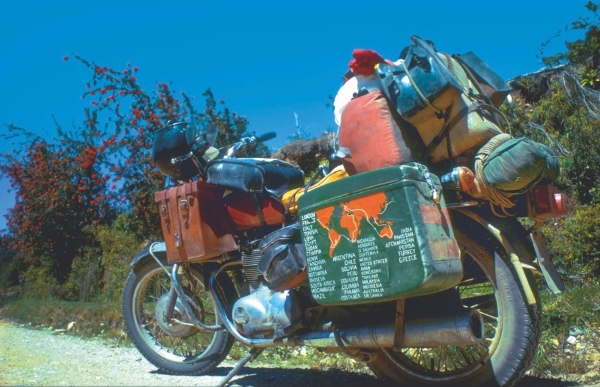
On the road to Pucatrihue: New bags at front, camera bag over the cylinder, old bags over the jerry can, and the white Ballet Ashcar hold-all on top which caused much confusion among young macho men at petrol stations. Hammock and mosquito net over rear light.
I camped by a river on a grassy slope leading down from the road which crossed the river on a wooden bridge. As I cooked my dinner (steak, rice sardines, wine, coffee, bread and butter) cloud had covered the sky almost obliterating the full moon.
October 31st
Woke up at 6.15 and unzipped the tent flap to see what kind of day it was. A drop of condensation fell from inside the tent into my eye. Sky was blue. The loose planks rumble and the first morning bus passes soon after dawn. Get up, comb my hair, catch the bus in seconds flat – no, that’s just a passing fantasy. My boots are outside the hut, next to my plastic jerry can. It has about 3 litres of petrol in it. The bike is under a sheet of clear plastic bequeathed to me by some students from BA. who joined me on my journey to Mar del Plata. As I take the tent down (it’s very wet, dew on the outside, condensation inside) a man on horseback comes down the slope. He wears a woolen hat and a sub fusc poncho, and his stirrups are carved out of wood like decorated clogs without heels. (The bronze ones came with the conquistadors and are prized antiques). He speaks to me in a sing-song Spanish which I would not ordinarily understand, but he has a speech defect which slows him up so that I could catch the drift of it. He asks me if I slept here last night. He seems vastly surprised by that, but the motorbike rouses no interest (apparently). [Later I learned that under the dictatorship anyone found sleeping out could be shot on sight.]
Did I see a horse? At first I say no. Then I remember that just as I was going to sleep I hear an animal galloping away. I told him and added that it had not crossed the bridge.
“Entonces,” he said, “it must have gone the other way.”
He thanked me and rode off, but across the bridge, so I assumed he hadn’t thought much of my information.
By 7.30 I was packed and ready to leave. I put the three litres into the tank and calculated I had enough petrol for about 75 Kms. I was about 40 Kms from Osorno and 25 from Pucatrihue. Now I had to decide whether to risk finding no petrol or money in Pucatrihue or to return to Osorno.
I went on, of course.
After all I had dollars and pesos. And two eggs, bread and butter.