
From My Notebooks In 1974: Mozambique
17th May 2026 |
Here I am, in Lourenço Marques, waiting for my ship to sail to Brazil. I can hardly contain my excitement.
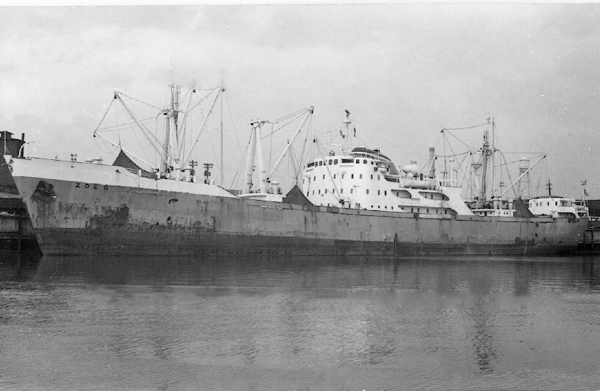
The Zoe.G – my rusty home for ten days as I sail into the jaws of the Policia Federal
May 3rd 1974
Tomorrow, I sail for Rio and leave Africa behind.
It’s the end of a journey that started in a war and ended in a revolution. In the aftermath of the Portuguese coup, Laurenco Marques simmers with a gentle excitement fueled by daily political demonstrations. Students flash their eyes and wave manifestos. Old colonials clench their jaws and let their veins stand out. But life here is lazy and generally agreeable. Nobody wants trouble and there would be no reason to expect it, if it weren’t for that old, hideous nightmare that poisons the atmosphere and haunts the sleep of white men all over southern Africa, a dream of black men in tribal frenzy swarming through the jungle night thirsting for colonial blood. That is what distinguishes between life in the north and south of the Zambesi.
I spent six weeks and dawdled 4000 miles in Kenya, Tanzania and Zambia from the hot and thorny dustlands of the north to the ranches and mealie fields of the south. I met doctors, businessmen, farmers, missionaries, govt. advisors, teachers, all sorts. There were complaints, of course. Grumbling about shortages, and endless stories of African follies and inefficiency. But I did not meet a single European among the 37 I spent time with who wanted to leave. Nor did I meet an African anxious to see them go. They are known to each other now. For them, African and European alike, Idi Amin is a tragi-comic aberration, a black Mussolini.
[Amin was President of Uganda. His regime was noted for the sheer scale of its brutality.]
South of the border all this changes. There is fear and pugnacity. Endless talk of terrorists and racial problems. Amin is the universal example of what to expect from African rule. Time and again I was asked what trouble I had had in the north. Disbelief, even disappointment that I had had none. The first white man I met in Rhodesia was a butcher at Victoria Falls. He sold me a fine fillet steak for 15 new pence and said: “Surely you believe as I do that we are the victims of a world-wide communist conspiracy.”
[White Southern Rhodesia, still nominally part of the British Empire, was holding out against Black independence.]
Travelling alone on a motorcycle along a vast and unfamiliar continent seemed a hazardous enterprise. The prospect frightened me more than I dared to admit. When the Middle-East war broke out on the very day I left London it seemed like the worst omen. Now, 14,000 miles and seven months later I know this is the most rewarding adventure a man could hope for. My faith in human generosity has never been higher. I doubt there is any individual, sage or savage, I would not look to for help.
Alone, dusty, tired, unarmed and openhanded I have found no-one who would refuse me. Long after I stopped thinking of myself as a hero I have received endless respect, envy, and compliments on my “guts.” Perhaps I’ve been lucky, perhaps more cautious than I realise, but I conclude that whatever safety there may be in numbers, it doesn’t rival the impunity of a man on his own in a good frame of mind.
Only once did my journey look like coming to a sudden end. When four men manhandling the bike between two ferry boats, came within an ace of dropping it and its precious load to the bottom of the Nile.
Everywhere the way has been opened to me. My entry into Egypt was a positive triumph. It should never have been allowed. Every consul en route insisted it was impossible. The 1000 miles of highway from Tripoli to the border buzzed with soldiers and police. Countless times I was stopped and my passport examined (sometimes upside down), My visa expressly forbade me to cross the frontier overland. Yet I was welcomed as though the Egyptian army was expecting me and I was whisked through the most complicated formalities I’ve ever known with a glass of tea in my hand. My joy was so great that I became careless. Later that night I lost all my loose cash and papers on the road outside Marsa Matruh. A genuine disaster, but after two hours combing the road I found the all-important documents under a bush where a thief had discarded them. The £20 in cash was gone, but my relief was too great for it to matter.
On the recently tarred “hell run” from Dar es Salaam to Lusaka I overtook Chinese convoys by the dozen – olive-green trucks stenciled with Chinese ideograms – and caught glimpses of the railway they are building to link the copper belt with the East Coast. It was as neat and picturesque as an oriental print. Chinese labourers in straw hats, caricatures of inscrutability, were working on the gradients and viaducts in their hundreds, but they were the only people in Africa with whom I could make no contact.
At Victoria Falls I tried to break the blockade by riding across the Livingstone Bridge but I was firmly repulsed and had to take the usual 100 mile loop round into Botswana and back to Rhodesia. At the Kazangula ferry I met a party of South Africans crossing into Zambia on South African passports. Later, in South Africa, this news was met with astonishment. Most South Africans are convinced that their passports have made them prisoners in their own country. A trip to Zambia would do them a world of good.
Ironically it was the South African border that gave me the most trouble. First I was declared a “prohibited person” for not carrying a return ticket, in spite of liberal proof that I meant to travel on around the world. I was forced to lend the government £220, interest free, but there was more to come. I was carrying a sword, a quixotic mission for a friend in Cairo who wanted it delivered to his brother in Brazil. A chubby Afrikaaner wanted to confiscate it. We argued and a colleague leaned over and whispered, “Why don’t you ask your father?”
Dad was the Customs boss. They all gathered to admire the weapon, a ceremonial sword made in Birmingham, while he tried a few practice strokes with it.
“If we let you take this in, how can we stop the natives from having them,” he sighed.
Then they agreed that it could be sealed into its scabbard. I shall never forget the son dancing with pain as he splashed molten sealing wax on his thighs and his clean white gym clothes. In exasperation he cried: “Usually we have a native to do this sort of thing.”
Three times he told me I would go “straight to jail” if the sword were lost or stolen or the seals broken.
When I left South Africa, nobody even looked at it, but I had a hell of a job getting my money back.
Even so, I found South Africans to be good people – black, white and coloured. I’ve been there two months looking for a passage to Rio, and in the end it’s only apartheid, and the fear behind it, that ruins an otherwise splendid country. An easy thing to say but the only thing worth saying.
The latest issue of a South African Farmer’s Weekly advocates building a wall “like the Great Wall of China” clear across Africa from coast to coast. It’s the farmers, mainly Afrikaaners, who keep the Nationalists in power. No wonder a coloured friend in Port Elizabeth kept repeating, “Man, these Dutchmen are so stupid.”