
From My Notebooks In 1974: On the Zoe.G
31st May 2026 |
From Lourenço Marques my ship had to sail south and round the horn of Africa.
Thursday, May 9th, 10th, 11th
Sail along the coast [Mocambique, South Africa.] Calm sunny weather. On the 12th mountains of Cape Town barely visible in shrouds of mist. Then into Atlantic. Albatrosses. Small trawler. Disabled liner, listing to starboard, towed by tug. Chess games [with whom?]
Sunday 12th
Jog day. [‘Jog’ was a nickname for my girlfriend Jo. It was her birthday.]
Fine, clear, calm. Start a letter in which I falsely declare that we will meet in the same latitude that day. But I believe it so it stands. What counts? Fact or belief. The fact, after all, is only a belief ratified by consensus. In an infinite number of conjectural worlds we believe the one that gives us the greatest material dominium. In recent times it has seemed as though nothing can stand in the way of this system. It is the logical extension of the animal which reacts (we suppose) only to pain. In seeking to enslave nature we have enslaved ourselves to a system which makes all other forms of experience subordinate to a negative principle – the absence of discomfort. Perhaps this is why modern society is often called ‘hollow.’ In fact there is ample evidence to show that people are unsatisfied by ‘progress.’) But being slaves of the system, they can only fight fire with fire, and are burned all the more.
Contemporary strikers are abused for their irrational behaviour, in pursuing a factional advantage which reduces the common good. They are the levelers of our society.
[Britain is in turmoil. Coal miners are striking. My diary wanders off into wild political and philosophic speculation.]
The South Atlantic
Blue. Long swells, 100 – 200 feet. Mild, scattered cloud.
Bird life. Several large species, similar to albatross, wingspans up to a metre. Some with bodies and wings brown above, some white bodies, brown wings. Some with additional white markings on wings (the biggest). Also a medium-sized dark bird in groups. And once a flock of a dozen or so tiny birds, glinting, white, too small and bright to distinguish, skimming the waves on an opposite course to ours.
The Zoe.G
Deadweight 7000 tons. Displacement 4000. About 400 ft long. The main accommodation is amidships above and alongside the engine room. There’s a main saloon in which officers eat, with one long table down the middle and two shorter ones each side, all parallel to the keel. The portside table has a tablecloth on it, permanently, and is never used. I think it’s for passengers. The other small table has a knitted black–grey cover and is used for coffee, tric-trac and ash trays. Also the daily news sheet from Athens.
Saloon has double doors and 4 ports opening onto a gallery across the ship which is one level up from the deck. Above it is a second level and the three levels are joined by two gangways, one each side. The saloon faces back (astern). Forward of it are two corridors, all wood-paneled, with cabins opening off. The cabins have names like Corfu, Xanthos, etc. but the nail holes from the letters of the previous names, when the ship was Swedish, are still visible. Although the ship was much neglected it is clear that it could still be made quite sumptuous by old-fashioned standards.
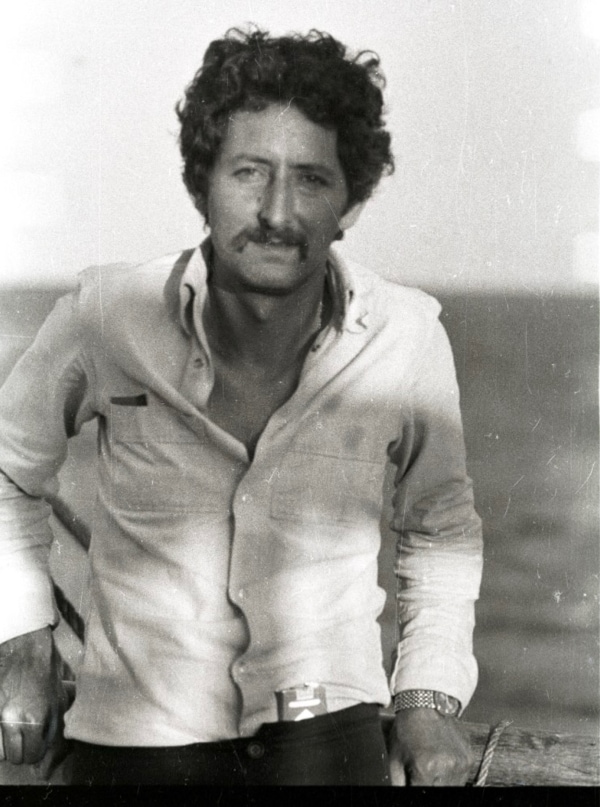
Me on the Zoe.G
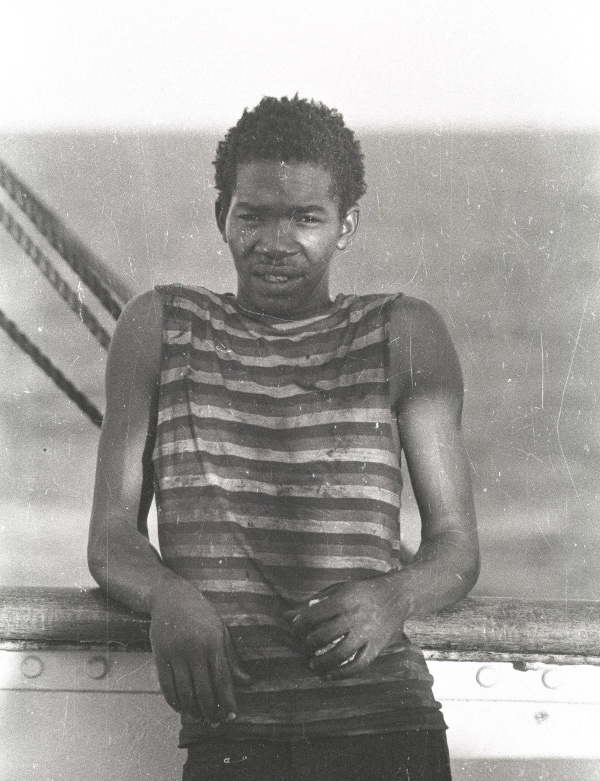
And here’s the deck hand who took the picture.
There was originally accommodation for twelve passengers, but now the crew uses most of this space (if not all). The two corridors lead to a sort of foyer from which a staircase rises, dividing in two and curling off left and right to meet a landing. About all this there is a touch of Thirties splendour, the Trocadero, Quagllno’s. The staircase throngs with ghostly celebrators in paper hats. It faces glazed double doors with frosted glass designs leading to the Mykonos Lounge, which has a bar and soft furniture. Now occupied only as an office. The officers live in style and space that was never meant to be. Atop of the stairs are the owner’s quarters (to port) and the captain’s quarters. I imagine them to be of similar size, although the captain has a private stairway up to the bridge, which is above both quarters. The owners’ (and I don’t suppose any of the owners have ever slept in it) has a living room, bathroom and double bedroom. The living room has two tables bolted to the floor with brass mountings. And several wall cupboards. All have roll-top type doors. There’s a refrigerator and above it a drinks cupboard.
[This where I’m quartered – but there were no drinks in the cupboard.]
Four windows. Each window in the ship is hinged with four screw-type fixings in heavy metal to clamp it to its frame. Bathroom has large twin basins, a lavatory with a broken seat, a bathtub with shower and curtains. Tub is dirty and has no plug. Shower only has one jet. Curtains torn. Door has warped and split into two layers of veneer and ply at the upper corner and won’t shut. All glazed surfaces are blue. Must have been very smart once. Beds are bunks, but good mattresses on sprung frames. One under windows, (three altogether) one against wall. Dressing table recessed, mirror with folding wings.
Up through the middle of this block the engine room rises, tapering towards the top, housing several big boilers, heated presumably by the exhaust gases from the diesel. The gases and hot air escape through a faired cowling like a vast eccentric blancmange, which is the evolved shape of the old funnel. On either side of this is a bell-shaped air intake, portside facing astern, starboard facing forward and out at an angle to catch slipstream from the funnel. The engine room itself is a great mysterious cavern. The door opens onto the deck below the saloon door. Looking down, it drops away, layer upon layer as in a cutaway model to the bottom of the ship, which seems improbably deep. In the centre of the picture are eight huge valves, in line in blocks of four, the rockers packing down on the valve stems, the springs like coiled pythons, monstrous images of my own diminutive [motorcycle] valves.
Ship has five hatches – of which the first is raised above the forecastle, the deck being of welded steel, pockmarked by rust and dents, and coated with paint like a custard skin. Other decks are wood, caulking half gone. A lifeboat each side.
Every now and again a siren whistle calls the telephone in the engine room.
Crew of thirty – twelve officers, Captain, First, Second and Third mates, Chief engineer, Second and two Third engineers, apprentice engineer, Radio officer, Electrical officer.
Before I sign off, here’s a little bonus (or penalty maybe?} Not required reading.
I had always planned to use the Atlantic crossing from Africa to the Americas to learn Spanish. It is one of the very few events I planned for this otherwise formless meander round the world. Rather than carry extra weight through Africa I thought I would get the book I wanted in Cape Town but as it turned out I was lucky to find any book at all. I visited all the big bookshops. From Stuttaford’s to Juta’s, to the Pilgrim and Makaus, the CNN and the Academy and the other big shops near it I trudged. All were sold out. None of them could tell me why. But there was an explanation, and that lay in the State Visit of the President of Paraguay. The first head of state to grace (or disgrace) the shores of the republic since heaven knows when, if ever.
This astonishing event did more to emphasise South Africa’s political isolation than anything in recent times. I don’t know whether Stroessner deserves his infamous reputation as the junta boss who hit on the horrible notion of offering a tax and extradition-free flag of convenience to international heroin smugglers. But it is a fact that he is notorious, and South Africa’s English opposition press was not slow to publish all the grisly accusations amassed from American news magazines.
The Nationalist Government however, as is its invariable wont, crashed on regardless of ridicule. But who spoke Spanish? I imagine the Afrikaaner Diplomatic Corps, buying up all the language books and performing its duties most solemnly by midnight oil, grinding through the declinations of obedicir: to obey. Either that or Vorster was determined to do his utmost to protect his new pal from public obscenities in his own language.
I prefer the first explanation because it promises a new and unexpected etymological wonder – Spanish spoken with an Afrikaans accent.
I did finally secure the last remaining copy of a Spanish textbook. Not the one I wanted but, as it turns out, a very good one called Spanish Made Simple (W.H.Allen: £1.00)
The theme of the book makes its first tenuous claim on my attention in Chapter Three, when I am introduced to Mrs Adams, a London businesswoman eager to learn Spanish, and her teacher, Seńor Lopez, a Spaniard living in London. To cries of “Buen suerte” and “Buen viaje” I set off to accompany Mrs Adams on the road which leads to a practical knowledge of the Spanish language.
It is clear from the start that Mrs Adams is not to be trifled with. She has four children, a ten-room house in the suburbs, and an office on the fifth floor of a very big building in Oxford street. Furthermore she has an agent in Madrid and she imports objetos de arte and otros articulos. Like all really successful business people she is well behind the times, and she is satisfying an insatiable provincial nostalgia for Torero dolls and Costa Brava wineskins, long after London has moved on through Djelabas, Afghan rugs, Dhotis, Mantras, and Vietnamese grass.
In another important respect Mrs Adams shows her mettle because she has acquired a husband who has sired the children, pays the mortgage on the ten rooms (out Wimbledon way, I fancy) and makes no other intrusion on her life except for brisk chats at breakfast time about the bills and the children’s schooling. Mr Adams is therefore free to devote herself exclusively to her business (objetos de arte) and her hobby (Seńor Lopez). To set the seal on this triumph of convenience she also has a maid to open and close doors.
The action now proceeds apace. Seńor Lopez, a formidable if old-fashioned pedagogue, makes a whirlwind series of arrivals and departures at Wimbledon, exhausting the maid, but contenting himself at first with a flurry of formal greetings and other bourgeois courtesies.
However he has now established himself securely as the one who wears the pantalones in the Adams nest. Gradually they now unfold their mutual passion for Spanish cooking, Talavera pottery, Basque dances, and counting from one to a hundred. Mrs Adams is succumbing steadily to Seńor Lopez’s charms. And leans more and more heavily on his worldly Latin words, while he ingratiates himself with constant flattery and attention.
After ten chapters she is seeking his advice on tummy upsets, while he has already penetrated her office to give his opinion on the latest consignment of articulos. The future could look bright for the sly Iberian. (Mr Adams can undoubtedly afford alimony) but there is a fly in his ointment. Mrs A’s pretext for these constant meetings is a projected visit to Spain. Now suddenly for Seńor Lopez this prospect assumes a dangerous reality, for in Madrid she is to meet her Spanish agent, a younger man. Seńor Lopez has no illusions about his countrymen, and when she shows him the letter she has written to Madrid it is easy to hear, through his urbane congratulations on her syntax, the sighs of a tortured heart. For her letter is signed, Jane Adams, the first time her immaculate business two piece has been sloughed off to reveal the maidenly creature beneath, and not for Seńor Lopez – por suppuesto – but for that sneaking Madrileno, Rufino Carillo, the Spanish Connection.
Seńor Lopez is desperate and in chapter nineteen he defies his mature years with a reckless visit to Wimbledon on a stormy night. The rain is coming down in cantaros (buckets) and the maid opens the door to find Seńor Lopez soaked to the skin and shivering. Normally Mrs Adams receives him in her salon but now it seems his wild gamble has paid off. Jane Adams herself rushes into the hall and leads the sopping Seńor upstairs. No doubt recalling how Jane Russell once infused her warmth into the icy body of her lover (they have discussed the cinema in chapter 15) he leaves his teeth to chatter and follows hopefully, but for the moment Mrs Adams makes do with tea and rum in the dining room.
So far the action has been fairly conventional. Something of a farce perhaps with those endless comings and goings and cries of Hasta luego, but with gathering satirical undertones for the discerning ear.
Chapter 20 disposes utterly of such fantasies and little conceits. With the savagery of Psycho it massacres every burgeoning bud of sentimentality, pulls out all the sops. In three relentless sentences the foolish edifice of ârticulos and dolores de estomago is brought crashing (cayendo) to the ground.
“All life long (todavia) Mrs Adams and Seńor Lopez are sitting in the dining room.”
“All life long (todavia) they are chatting and drinking tea and rum.”
“All life long (todavia) it is raining.”
How can I begin to describe the effect of those three hammer blows. Todavia, todavia, todavia. Henceforth all is fantasy, dreamed up along with the trappings of a spurious culture by two inadequate figures spiritually marooned in a Wimbedon dining room and supporting their ceaseless prattle on an infinite supply of tea and rum, the perfect concoction for futility.