
From My Notebooks In 1974: Port Elizabeth
26th April 2026 |
I’ve come several thousand miles since Johannesburg and the bike is showing disturbing symptoms. I have already asked Lucas in Jo’burg for parts, and hope to get things fixed in Port Elizabeth, at Lionel’s shop.
Friday 19th April
Into Lionel’s first thing. Call Joe’s [in Johannesburg]. They have the parts. Just delivered [from England] but they won’t get to P.E [Port Elizabeth] today. Decide to re-sleeve damaged barrel and have the new parts sent on to Nelspruit. This means I have to go to Nelspruit before crossing into Swaziland, otherwise that whole “prohibited person” business again.
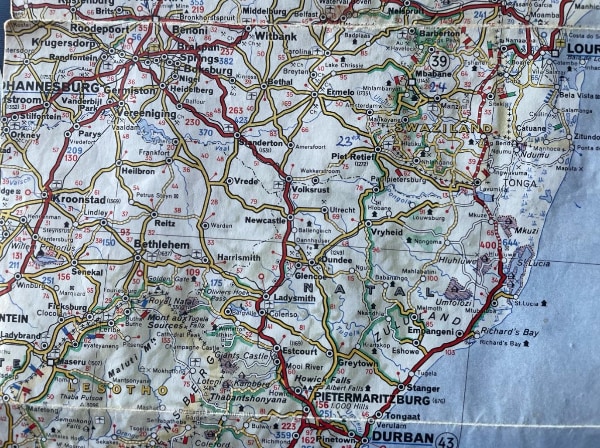
[Here’s a section of the only map I had at the time – one of the three maps by Michelin that covered the whole of Africa, so the scale is huge. You can just spot Nelspruit at the top, on the road from Jo’burg to Lourenço Marques. But I dipped down into Swaziland on my way to visit Anthony’s sister, “Small”]
Armed with letters for the pay desks I visit the Oceanarium and the Snake Park. Snakes in profusion. Strange demonstration by black snake warden in high leather gaiters, with cobra snapping at his heels. His voice soars and swoops without relevance to the words. Feel sorry for the puff adder which is pinioned ruthlessly for every demonstration. “Poison fangs. Nasty fangs. Sharp as a nail.” When he finishes with the snakes, he tosses them into the water where they squirm angrily.
Tropical house is full of beautiful birds. Most stunning are the toucans (Sulphur breasted) with beaks like pop art. The dolphins are delightful and impressive – weight up to 500 lbs, and when one leaps through a hoop three ladies in the front row are drenched by water. Dolphin whistles are very clear and convincing. Also two huge aquariums, and that particularly ogreish fish with thick white lips set in permanent snarl.
2pm. The barrel returns. I help to reassemble and don’t prime the pump: Result: No oil. It’s already too late to leave. I ask Yussuf, John and Lionel to have a drink with me. Wham! It hits me. We can’t drink together. The apartheid comes home to me. Yussuf invites me to his house, ten miles away in coloured estate called West End. Wife is very bright and pretty in scarlet boiler suit. She teaches in coloured school. Has niece in Brompton Hospital [in London]. Miss Bilby. Yussuf is very strict Muslim. No alcohol and normally doesn’t smoke. We have curry. No cutlery. Strong nostalgia for Sudan as we eat with our fingers. Then to hall with friends to play badminton. Yussuf is passionate about apartheid. “Dutchmen are stupid. Can be anything he wants because his skin is white.” Hoots his horn at white girls in protest. His resentment is lively and profound. Others dissolve their bitterness in religion. (cf: Priests Royal.)
[Royal Priesthood ministries still thrive in Durban, but then it was a way for Blacks to assert their dignity and individuality under a crushing regime.]
Saturday 20th
8.30 at Lionel’s again. (Have spent Rand 16.50 at Red Lion but good value by S.A. standards). Ready to leave by 12.30 with 30 litres of petrol – ten over the legal limit. Weather has become cold and cloudy. Air is frosty. Mean to sleep out but am unable to resist comfort of hotel at Komga when I find caravan park closed (costs one Rand anyway). Royal Hotel, Komga, is pleasant. Food is good. Owner is Alf Gunn and hairy-faced wife. They “traded” in the Transkei for twenty years before buying hotel.
Sunday 21st
Leave at 9 as Alf (all in white) leaves to play bowls. Big game in S.A.
Into the Transkei. Beautiful hill country, with huts everywhere, with compounds made of earth mounds planted with lovely flowering plant- flower is pointed and red, foliage deep green. Square plots of maize. Many horses, and riders reminding me of Judy’s grooms. [Judy, a friend in Cape Town] All Khosa [or Xhosa, tribal name]. Took pictures of African houses at Butterworth, and later of goats and village called Queque (with clicks). [I wish I could find those pictures.] Dried out sleeping bag, determined again to sleep out. Once more icy air deters me, and also those long hours of darkness. Into Balmoral Hotel at Kokstad. Girls ask me “Are you going to the Roof of Africa?” Say I’ve come from there – but they’re talking about a rally of some sort.
Talk to Xhosa from Cape Town, travelling as servant of an elderly Englishman, who represents a clothing firm. He is intelligent and articulate about black man’s problem – tells me about the Priest Royal. Started by white hippy in Cape Town after a film of something similar from the US. The top priest sits in a chair in a hall. Other sit on the ground after crossing themselves. They pray for equality and practice it among themselves. If a policeman comes in they pray furiously until he’s gone. There is a Priest Royal in Durban too, but they all call themselves Priests Royal. This fellow has widowed mother and six brothers. The eldest disappeared abroad and has not written since. This fellow works to send his young brothers to school. He still remembers it was a Friday in 1965 when his elder brother left a letter and walked out of the house. The letter said: “You will never see me again. But don’t worry. It’s alright.” His brother worries though whenever he hears a terrorist has been captured.
While riding through the Transkei I am made to look again for comparisons between these lives and more familiar ones in Europe. The white South African, it seems to me, builds his entire apologia on the persuasive assumption that the black people in their customs and origins are incompatible with white society and therefore must be kept apart until they have learned to want the same things as us, and are prepared to do the same things to get them. On this tacit presumption of a separate sub-species rests the entire apparatus of racial government.
The principal characteristics of the black man, as described by white employers, are: Laziness, stupidity, mechanical ineptitude, drunkenness, prolonged absenteeism, a tendency to be overcome by an inexplicable melancholy leading to total unreliability and dishonesty. He is also said to be loyal, humorous.
I don’t know how he would differ from an English labourer of, say, the early 19th Century, who went to work far from his wife and family. On Judy’s farm, it seemed to me that the longer serving grooms responded to her as any British farm worker of the old days and lived in much the same way.
It will be said, that’s all very well, but it’s only fifty years ago that they were painting up and slaughtering each other. Even now different tribes will tear into each other given a chance. Look at that recent affair at the mines, when all of the Basuto’s left.
Well, look at Scots, Irish Skinheads, football crowds, Mods & Rockers, motorway pileups, etc.
How different is life in a Transkei village from the generations before Cider with Rosie? Well, of course the cultural aura is quite different.
Balmoral Hotel, rambling hotel with many rooms on two floors, lounge with hot coal fire, big dining room with many pillars decorated with yellow flowers. Waiter in yellow livery. Young Xhosa posing beneath flowers laughs shyly across room. Food is tasteless but plentiful.