Articles published in May, 2026
From Lourenço Marques my ship had to sail south and round the horn of Africa.
Thursday, May 9th, 10th, 11th
Sail along the coast [Mocambique, South Africa.] Calm sunny weather. On the 12th mountains of Cape Town barely visible in shrouds of mist. Then into Atlantic. Albatrosses. Small trawler. Disabled liner, listing to starboard, towed by tug. Chess games [with whom?]
Sunday 12th
Jog day. [‘Jog’ was a nickname for my girlfriend Jo. It was her birthday.]
Fine, clear, calm. Start a letter in which I falsely declare that we will meet in the same latitude that day. But I believe it so it stands. What counts? Fact or belief. The fact, after all, is only a belief ratified by consensus. In an infinite number of conjectural worlds we believe the one that gives us the greatest material dominium. In recent times it has seemed as though nothing can stand in the way of this system. It is the logical extension of the animal which reacts (we suppose) only to pain. In seeking to enslave nature we have enslaved ourselves to a system which makes all other forms of experience subordinate to a negative principle – the absence of discomfort. Perhaps this is why modern society is often called ‘hollow.’ In fact there is ample evidence to show that people are unsatisfied by ‘progress.’) But being slaves of the system, they can only fight fire with fire, and are burned all the more.
Contemporary strikers are abused for their irrational behaviour, in pursuing a factional advantage which reduces the common good. They are the levelers of our society.
[Britain is in turmoil. Coal miners are striking. My diary wanders off into wild political and philosophic speculation.]
The South Atlantic
Blue. Long swells, 100 – 200 feet. Mild, scattered cloud.
Bird life. Several large species, similar to albatross, wingspans up to a metre. Some with bodies and wings brown above, some white bodies, brown wings. Some with additional white markings on wings (the biggest). Also a medium-sized dark bird in groups. And once a flock of a dozen or so tiny birds, glinting, white, too small and bright to distinguish, skimming the waves on an opposite course to ours.
The Zoe.G
Deadweight 7000 tons. Displacement 4000. About 400 ft long. The main accommodation is amidships above and alongside the engine room. There’s a main saloon in which officers eat, with one long table down the middle and two shorter ones each side, all parallel to the keel. The portside table has a tablecloth on it, permanently, and is never used. I think it’s for passengers. The other small table has a knitted black–grey cover and is used for coffee, tric-trac and ash trays. Also the daily news sheet from Athens.
Saloon has double doors and 4 ports opening onto a gallery across the ship which is one level up from the deck. Above it is a second level and the three levels are joined by two gangways, one each side. The saloon faces back (astern). Forward of it are two corridors, all wood-paneled, with cabins opening off. The cabins have names like Corfu, Xanthos, etc. but the nail holes from the letters of the previous names, when the ship was Swedish, are still visible. Although the ship was much neglected it is clear that it could still be made quite sumptuous by old-fashioned standards.
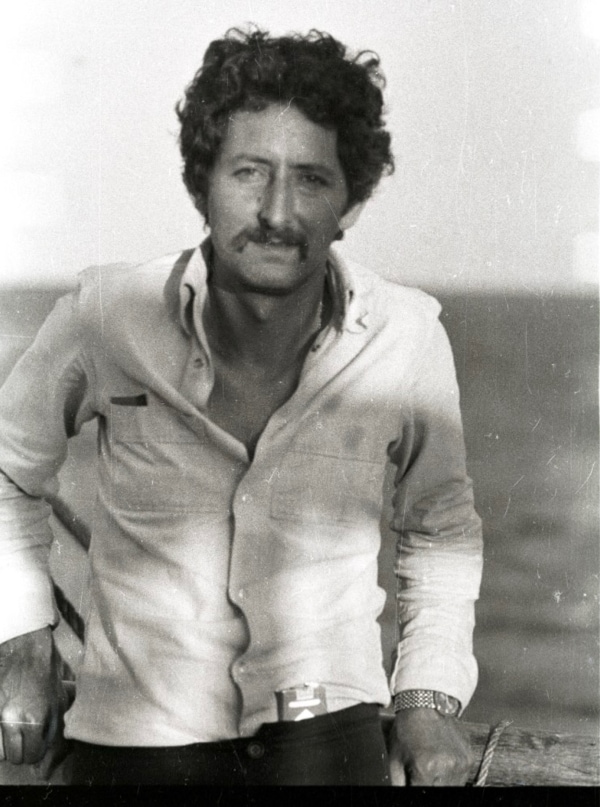
Me on the Zoe.G
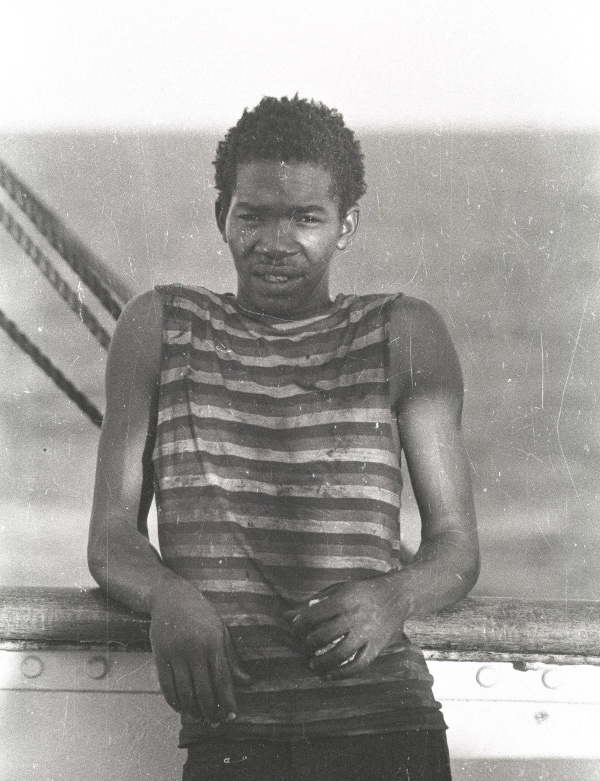
And here’s the deck hand who took the picture.
There was originally accommodation for twelve passengers, but now the crew uses most of this space (if not all). The two corridors lead to a sort of foyer from which a staircase rises, dividing in two and curling off left and right to meet a landing. About all this there is a touch of Thirties splendour, the Trocadero, Quagllno’s. The staircase throngs with ghostly celebrators in paper hats. It faces glazed double doors with frosted glass designs leading to the Mykonos Lounge, which has a bar and soft furniture. Now occupied only as an office. The officers live in style and space that was never meant to be. Atop of the stairs are the owner’s quarters (to port) and the captain’s quarters. I imagine them to be of similar size, although the captain has a private stairway up to the bridge, which is above both quarters. The owners’ (and I don’t suppose any of the owners have ever slept in it) has a living room, bathroom and double bedroom. The living room has two tables bolted to the floor with brass mountings. And several wall cupboards. All have roll-top type doors. There’s a refrigerator and above it a drinks cupboard.
[This where I’m quartered – but there were no drinks in the cupboard.]
Four windows. Each window in the ship is hinged with four screw-type fixings in heavy metal to clamp it to its frame. Bathroom has large twin basins, a lavatory with a broken seat, a bathtub with shower and curtains. Tub is dirty and has no plug. Shower only has one jet. Curtains torn. Door has warped and split into two layers of veneer and ply at the upper corner and won’t shut. All glazed surfaces are blue. Must have been very smart once. Beds are bunks, but good mattresses on sprung frames. One under windows, (three altogether) one against wall. Dressing table recessed, mirror with folding wings.
Up through the middle of this block the engine room rises, tapering towards the top, housing several big boilers, heated presumably by the exhaust gases from the diesel. The gases and hot air escape through a faired cowling like a vast eccentric blancmange, which is the evolved shape of the old funnel. On either side of this is a bell-shaped air intake, portside facing astern, starboard facing forward and out at an angle to catch slipstream from the funnel. The engine room itself is a great mysterious cavern. The door opens onto the deck below the saloon door. Looking down, it drops away, layer upon layer as in a cutaway model to the bottom of the ship, which seems improbably deep. In the centre of the picture are eight huge valves, in line in blocks of four, the rockers packing down on the valve stems, the springs like coiled pythons, monstrous images of my own diminutive [motorcycle] valves.
Ship has five hatches – of which the first is raised above the forecastle, the deck being of welded steel, pockmarked by rust and dents, and coated with paint like a custard skin. Other decks are wood, caulking half gone. A lifeboat each side.
Every now and again a siren whistle calls the telephone in the engine room.
Crew of thirty – twelve officers, Captain, First, Second and Third mates, Chief engineer, Second and two Third engineers, apprentice engineer, Radio officer, Electrical officer.
Before I sign off, here’s a little bonus (or penalty maybe?} Not required reading.
I had always planned to use the Atlantic crossing from Africa to the Americas to learn Spanish. It is one of the very few events I planned for this otherwise formless meander round the world. Rather than carry extra weight through Africa I thought I would get the book I wanted in Cape Town but as it turned out I was lucky to find any book at all. I visited all the big bookshops. From Stuttaford’s to Juta’s, to the Pilgrim and Makaus, the CNN and the Academy and the other big shops near it I trudged. All were sold out. None of them could tell me why. But there was an explanation, and that lay in the State Visit of the President of Paraguay. The first head of state to grace (or disgrace) the shores of the republic since heaven knows when, if ever.
This astonishing event did more to emphasise South Africa’s political isolation than anything in recent times. I don’t know whether Stroessner deserves his infamous reputation as the junta boss who hit on the horrible notion of offering a tax and extradition-free flag of convenience to international heroin smugglers. But it is a fact that he is notorious, and South Africa’s English opposition press was not slow to publish all the grisly accusations amassed from American news magazines.
The Nationalist Government however, as is its invariable wont, crashed on regardless of ridicule. But who spoke Spanish? I imagine the Afrikaaner Diplomatic Corps, buying up all the language books and performing its duties most solemnly by midnight oil, grinding through the declinations of obedicir: to obey. Either that or Vorster was determined to do his utmost to protect his new pal from public obscenities in his own language.
I prefer the first explanation because it promises a new and unexpected etymological wonder – Spanish spoken with an Afrikaans accent.
I did finally secure the last remaining copy of a Spanish textbook. Not the one I wanted but, as it turns out, a very good one called Spanish Made Simple (W.H.Allen: £1.00)
The theme of the book makes its first tenuous claim on my attention in Chapter Three, when I am introduced to Mrs Adams, a London businesswoman eager to learn Spanish, and her teacher, Seńor Lopez, a Spaniard living in London. To cries of “Buen suerte” and “Buen viaje” I set off to accompany Mrs Adams on the road which leads to a practical knowledge of the Spanish language.
It is clear from the start that Mrs Adams is not to be trifled with. She has four children, a ten-room house in the suburbs, and an office on the fifth floor of a very big building in Oxford street. Furthermore she has an agent in Madrid and she imports objetos de arte and otros articulos. Like all really successful business people she is well behind the times, and she is satisfying an insatiable provincial nostalgia for Torero dolls and Costa Brava wineskins, long after London has moved on through Djelabas, Afghan rugs, Dhotis, Mantras, and Vietnamese grass.
In another important respect Mrs Adams shows her mettle because she has acquired a husband who has sired the children, pays the mortgage on the ten rooms (out Wimbledon way, I fancy) and makes no other intrusion on her life except for brisk chats at breakfast time about the bills and the children’s schooling. Mr Adams is therefore free to devote herself exclusively to her business (objetos de arte) and her hobby (Seńor Lopez). To set the seal on this triumph of convenience she also has a maid to open and close doors.
The action now proceeds apace. Seńor Lopez, a formidable if old-fashioned pedagogue, makes a whirlwind series of arrivals and departures at Wimbledon, exhausting the maid, but contenting himself at first with a flurry of formal greetings and other bourgeois courtesies.
However he has now established himself securely as the one who wears the pantalones in the Adams nest. Gradually they now unfold their mutual passion for Spanish cooking, Talavera pottery, Basque dances, and counting from one to a hundred. Mrs Adams is succumbing steadily to Seńor Lopez’s charms. And leans more and more heavily on his worldly Latin words, while he ingratiates himself with constant flattery and attention.
After ten chapters she is seeking his advice on tummy upsets, while he has already penetrated her office to give his opinion on the latest consignment of articulos. The future could look bright for the sly Iberian. (Mr Adams can undoubtedly afford alimony) but there is a fly in his ointment. Mrs A’s pretext for these constant meetings is a projected visit to Spain. Now suddenly for Seńor Lopez this prospect assumes a dangerous reality, for in Madrid she is to meet her Spanish agent, a younger man. Seńor Lopez has no illusions about his countrymen, and when she shows him the letter she has written to Madrid it is easy to hear, through his urbane congratulations on her syntax, the sighs of a tortured heart. For her letter is signed, Jane Adams, the first time her immaculate business two piece has been sloughed off to reveal the maidenly creature beneath, and not for Seńor Lopez – por suppuesto – but for that sneaking Madrileno, Rufino Carillo, the Spanish Connection.
Seńor Lopez is desperate and in chapter nineteen he defies his mature years with a reckless visit to Wimbledon on a stormy night. The rain is coming down in cantaros (buckets) and the maid opens the door to find Seńor Lopez soaked to the skin and shivering. Normally Mrs Adams receives him in her salon but now it seems his wild gamble has paid off. Jane Adams herself rushes into the hall and leads the sopping Seńor upstairs. No doubt recalling how Jane Russell once infused her warmth into the icy body of her lover (they have discussed the cinema in chapter 15) he leaves his teeth to chatter and follows hopefully, but for the moment Mrs Adams makes do with tea and rum in the dining room.
So far the action has been fairly conventional. Something of a farce perhaps with those endless comings and goings and cries of Hasta luego, but with gathering satirical undertones for the discerning ear.
Chapter 20 disposes utterly of such fantasies and little conceits. With the savagery of Psycho it massacres every burgeoning bud of sentimentality, pulls out all the sops. In three relentless sentences the foolish edifice of ârticulos and dolores de estomago is brought crashing (cayendo) to the ground.
“All life long (todavia) Mrs Adams and Seńor Lopez are sitting in the dining room.”
“All life long (todavia) they are chatting and drinking tea and rum.”
“All life long (todavia) it is raining.”
How can I begin to describe the effect of those three hammer blows. Todavia, todavia, todavia. Henceforth all is fantasy, dreamed up along with the trappings of a spurious culture by two inadequate figures spiritually marooned in a Wimbedon dining room and supporting their ceaseless prattle on an infinite supply of tea and rum, the perfect concoction for futility.
Finally my ship, the Zoe.G, is ready to sail from Lourenço Marques for Brasil. It’s eight o’clock and dark.
L.M. Wednesday, May 8th
The pilot appears in the doorway of the captain’s cabin. A dark, bearded figure in a heavy coat. He seems shrouded in darkness and mystery. A portentous figure.
“Are you ready, Captain? “The boat has been shivering gently for hours, a soft, almost inaudible rustling in the paneling. Like the breath of a sleeping child, flowing and ebbing, flowing and ebbing. The Captain, in cream shirt and grey flannels with a zip that won’t quite close, has been like any office worker in a humdrum business tapping out tedious letters on a clapped-out Standard typewriter, and filling in forms. The agent’s clerk in charge of the manifest has noted the loading for fuel, water, the expected time of arrival in Fortaleza, the draught fore and aft and the anticipated mean draught at Fortaleza. He is a tall, graceful Portuguese Indian with a liquid charm and a wry smile which carries a permanent suggestion that behind the apparent reality of the moment is an altogether different and more significant reality which promises little good. We have been discussing the future of Moçambique after the coup.
“There will be trouble,” he says. “You will see. You will hear about it. there will be bloodshed.”
Politely he listens to my arguments, but they carry no weight, and don’t convince me either.
“I was four years in the army fighting this war. I left university to go to the army. When I finished I gave up university. There was no time anymore. It was necessary to put my feet on the ground. Now I am married. I have children. Am I going to go back to the army now? We can fight this war 4,8,12, 16 years but we will have to give it away in the end.”
The pilot puts an end to the talk. Amade (his name) uncrosses his legs and smiles encouragingly at me as though it were I who faced the miserable uncertainties of Africa. We shook hands and he jumped ashore from the rail.
“Go up on the bridge,” he said, “You will see it better from there.”
The pilot is on the bridge with the captain. Above them is another open deck around the funnel which is exuding steam like a simmering kettle. Far below me Amade is at the quayside. At last the stern is cast off and begins to part, very slowly, from the quayside. I hear the whistle and chatter of the walkie-talkies. Already the stern has swung clear of the bows of the next ship in line along the quayside. Amade gives a last wave and turns away to walk across the sidings, away from the lights into the shadows of the yard, over the coal black dust, back to the town. I’m going to Rio. He’s going nowhere. An immense sadness reaches out to me and then fades as he moves out of sight among the goods wagons.
The ship has now swung out at thirty degrees to the quay and crossing to the other side I see why. A long tugboat is hauling the stern out into the harbour – the “Chamite” – a throbbing power-house of energy.
Suddenly excitement rushes up in me with a flush of adrenalin. From this angle I can see the full line of vessels stretching out in both directions as far as I can see. . A magical sight. All brilliant, glowing, like a thousand lanterns, tantalising, inviting, promising joy, like department stores at Christmas time, like a giant festival, a fairground. Nothing gladdens the heart like lights shining in darkness. I am so overjoyed that I leap up and down and shout. Heaven knows what the Captain down below makes of my antics. The tug lets go of the stern now, and its bulbous padded nose slides along the side of the ship and rams into the bows, chugging again, swinging round to complete a full circle until at last we are pointing out to sea. Behind me the funnel belches exhaust, and the Zoe.G’s Burmeister engines take up the strain. The journey has begun, and the tugboat slips away, streaking away to port, flaunting her power, her work done.
Ahead of us a trail of blue flashing buoys perforate the black water and leads us out past other floating fairylands at anchor in the bay.
There are several elements in this scene which I have not isolated but which combine to produce this sense of elation. First of course the prospect of Brasil. Every development brings that continent nearer. Then the pleasure of seeing massive objects in effortless motion, on water or in air. Then the lights, which provide an outline, illuminate a few planes and recesses, but leave the rest to the imagination. In every respect there is a benign magic at work, shaping the world for my special pleasure and benefit. I’m also impressed by the size of the harbour which seems immensely long. Counting the ships I can see there are more than 12 tied up (including the space left by the Zoe.G.) but the impression is of a far greater number. All the squalour and ugliness of the docks has disappeared, and it is pure magic.
The ecstasy endures for perhaps five minutes. The ensuing misery for perhaps 24 hours. In the morning I feel fine – it seems that yesterday’s magic will protect me from sickness, and with confidence I sit down to bacon and eggs at 7 am. The sky is cloudy, and the sea is swelling. By ten there is a gale blowing, and the sea has grown even more. My uneasiness has grown with it. Now the ship is see-sawing and rolling heavily, and I am pitched into full-scale sea sickness which I have never experienced before. There is only one place on the ship where I can bear to stand, on the starboard gangway at the pivotal point of the pitch. Here at least the possibilities for violent motion are reduced by one. By burping and belching constantly I can hold on to my stomach but evidently I can’t stay here all day and night. I decide to try lying down in the cabin. The effect is instantaneous and disastrous. The process which begins there is quite irreversible. My stomach goes into a floating wobble as though completely detached from its moorings, something grips my throat, my mouth fills with saliva which seems to be pouring out of it and reminds me of a beast of prey. There is time to get out to the rail. The vomiting is accompanied by an involuntary noise, and the sound of this ugly, croaking despairing noise issuing with my breakfast is perhaps the worst part of the experience. The palpitations continue. Then there is a period of beautiful peace. During the rest of the afternoon I resume my place on the gangway, watching the sea. The ship is swinging and rolling wildly now. The sea is in turmoil – lumps of black water with white crests rushing about in aimless fury, colliding with each other. The wind whips up a spray. The clouds discharge their rain. The two meet and for a while the sky and the sea merge into the same element, a swirling fusion of wind and water. It is impossible not to think of the sea as alive. Now I understand the origins of Neptune, the sprites. There is a life force at work here. The waves are merely cloaks for devils tearing about below the surface, the crests are a froth whipped up by their tridents.
The Zoe.G. is about 300 feet long and weighs some 4000 tons. She rides up on a swell and falls again through an angle of thirty degrees. When she comes down she hammers the sea with her bows and the sea rushes off screaming pain and vengeance. Where the Zoe.G. has hammered the sea, livid bruises appear, patches of the palest blue where the ships’ hull has smashed air and water together so hard that they remain entangled in the wake of the vessel as far back as one can see. Still the fury mounts. Every inch of water is covered with a lacy foam flying across the surface. Looking down into it makes you want to hold on to everything very tightly, because nothing could survive in that cauldron.
By dinner time it occurs to me that some soup might help. But it’s fish soup, and as I eat it I know it’s no help. Soon after I’m violently sick again. In the peace that follows I get into bed. The motion of the ship now declares itself in the purest geometrical forms. I feel myself tracing out patterns through the mattress. The most spectacular movement is the corkscrew which drills me down into the bed. Several doors are flying about and have to be secured but at last, inevitably, I sleep. The next day is clear and blue. The sea is calm, although the ship can still swing quite far in a gentle sea. Still I feel queasy and nervous of a recurrence. I’m resigned to three days of sickness but that seems like an eternal prospect. Since it began I have not been able to get my mind off it for more than five minutes. It is mentally and physically exhausting. I dare to eat a grapefruit. Nothing awful happens. Later I pick out what’s left of an over-ripe avocado. Still no disasters, but no real relief either. The mess boy tries to persuade me to have lunch. Says it’s better to eat. I refuse him and mean to keep off food until the next day. But at dinner time (5.30} on an impulse I go in and sit. What I’m more afraid of than the food is the effect of sitting down inside. But it seems better now. I eat a plate of sliced tomato. With each mouthful I feel stronger. It’s too good to believe. The main course arrives. Roast lamb full of garlic and a heap of greasy roast potatoes, but nothing can stop me. I eat the lamb. Delicious. Even a beer. Seems crazy. It’s over.
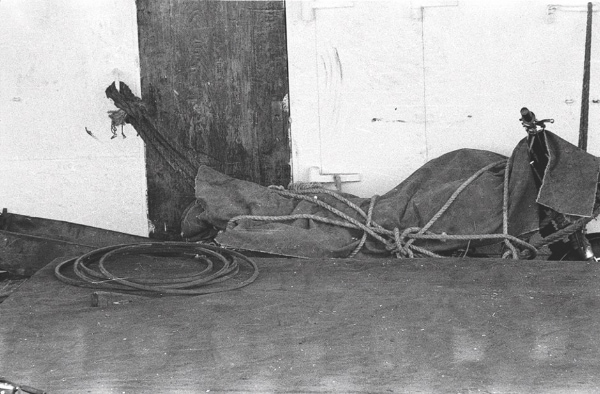
My bike was strapped up on deck under a tarp – a sad, huddled object. Later I took half a teaspoon of salt out of the carb.
Next week: Life on the ocean wave.
Here I am, in Lourenço Marques, waiting for my ship to sail to Brazil. I can hardly contain my excitement.
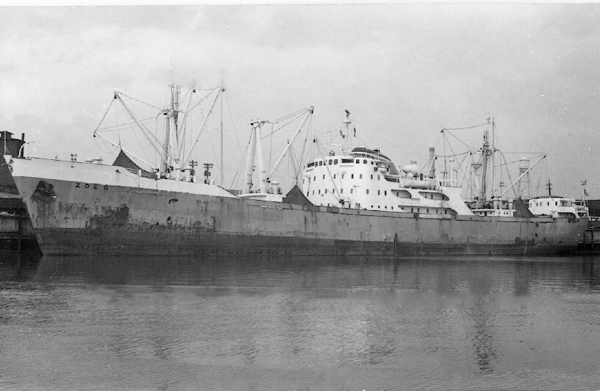
The Zoe.G – my rusty home for ten days as I sail into the jaws of the Policia Federal
May 3rd 1974
Tomorrow, I sail for Rio and leave Africa behind.
It’s the end of a journey that started in a war and ended in a revolution. In the aftermath of the Portuguese coup, Laurenco Marques simmers with a gentle excitement fueled by daily political demonstrations. Students flash their eyes and wave manifestos. Old colonials clench their jaws and let their veins stand out. But life here is lazy and generally agreeable. Nobody wants trouble and there would be no reason to expect it, if it weren’t for that old, hideous nightmare that poisons the atmosphere and haunts the sleep of white men all over southern Africa, a dream of black men in tribal frenzy swarming through the jungle night thirsting for colonial blood. That is what distinguishes between life in the north and south of the Zambesi.
I spent six weeks and dawdled 4000 miles in Kenya, Tanzania and Zambia from the hot and thorny dustlands of the north to the ranches and mealie fields of the south. I met doctors, businessmen, farmers, missionaries, govt. advisors, teachers, all sorts. There were complaints, of course. Grumbling about shortages, and endless stories of African follies and inefficiency. But I did not meet a single European among the 37 I spent time with who wanted to leave. Nor did I meet an African anxious to see them go. They are known to each other now. For them, African and European alike, Idi Amin is a tragi-comic aberration, a black Mussolini.
[Amin was President of Uganda. His regime was noted for the sheer scale of its brutality.]
South of the border all this changes. There is fear and pugnacity. Endless talk of terrorists and racial problems. Amin is the universal example of what to expect from African rule. Time and again I was asked what trouble I had had in the north. Disbelief, even disappointment that I had had none. The first white man I met in Rhodesia was a butcher at Victoria Falls. He sold me a fine fillet steak for 15 new pence and said: “Surely you believe as I do that we are the victims of a world-wide communist conspiracy.”
[White Southern Rhodesia, still nominally part of the British Empire, was holding out against Black independence.]
Travelling alone on a motorcycle along a vast and unfamiliar continent seemed a hazardous enterprise. The prospect frightened me more than I dared to admit. When the Middle-East war broke out on the very day I left London it seemed like the worst omen. Now, 14,000 miles and seven months later I know this is the most rewarding adventure a man could hope for. My faith in human generosity has never been higher. I doubt there is any individual, sage or savage, I would not look to for help.
Alone, dusty, tired, unarmed and openhanded I have found no-one who would refuse me. Long after I stopped thinking of myself as a hero I have received endless respect, envy, and compliments on my “guts.” Perhaps I’ve been lucky, perhaps more cautious than I realise, but I conclude that whatever safety there may be in numbers, it doesn’t rival the impunity of a man on his own in a good frame of mind.
Only once did my journey look like coming to a sudden end. When four men manhandling the bike between two ferry boats, came within an ace of dropping it and its precious load to the bottom of the Nile.
Everywhere the way has been opened to me. My entry into Egypt was a positive triumph. It should never have been allowed. Every consul en route insisted it was impossible. The 1000 miles of highway from Tripoli to the border buzzed with soldiers and police. Countless times I was stopped and my passport examined (sometimes upside down), My visa expressly forbade me to cross the frontier overland. Yet I was welcomed as though the Egyptian army was expecting me and I was whisked through the most complicated formalities I’ve ever known with a glass of tea in my hand. My joy was so great that I became careless. Later that night I lost all my loose cash and papers on the road outside Marsa Matruh. A genuine disaster, but after two hours combing the road I found the all-important documents under a bush where a thief had discarded them. The £20 in cash was gone, but my relief was too great for it to matter.
On the recently tarred “hell run” from Dar es Salaam to Lusaka I overtook Chinese convoys by the dozen – olive-green trucks stenciled with Chinese ideograms – and caught glimpses of the railway they are building to link the copper belt with the East Coast. It was as neat and picturesque as an oriental print. Chinese labourers in straw hats, caricatures of inscrutability, were working on the gradients and viaducts in their hundreds, but they were the only people in Africa with whom I could make no contact.
At Victoria Falls I tried to break the blockade by riding across the Livingstone Bridge but I was firmly repulsed and had to take the usual 100 mile loop round into Botswana and back to Rhodesia. At the Kazangula ferry I met a party of South Africans crossing into Zambia on South African passports. Later, in South Africa, this news was met with astonishment. Most South Africans are convinced that their passports have made them prisoners in their own country. A trip to Zambia would do them a world of good.
Ironically it was the South African border that gave me the most trouble. First I was declared a “prohibited person” for not carrying a return ticket, in spite of liberal proof that I meant to travel on around the world. I was forced to lend the government £220, interest free, but there was more to come. I was carrying a sword, a quixotic mission for a friend in Cairo who wanted it delivered to his brother in Brazil. A chubby Afrikaaner wanted to confiscate it. We argued and a colleague leaned over and whispered, “Why don’t you ask your father?”
Dad was the Customs boss. They all gathered to admire the weapon, a ceremonial sword made in Birmingham, while he tried a few practice strokes with it.
“If we let you take this in, how can we stop the natives from having them,” he sighed.
Then they agreed that it could be sealed into its scabbard. I shall never forget the son dancing with pain as he splashed molten sealing wax on his thighs and his clean white gym clothes. In exasperation he cried: “Usually we have a native to do this sort of thing.”
Three times he told me I would go “straight to jail” if the sword were lost or stolen or the seals broken.
When I left South Africa, nobody even looked at it, but I had a hell of a job getting my money back.
Even so, I found South Africans to be good people – black, white and coloured. I’ve been there two months looking for a passage to Rio, and in the end it’s only apartheid, and the fear behind it, that ruins an otherwise splendid country. An easy thing to say but the only thing worth saying.
The latest issue of a South African Farmer’s Weekly advocates building a wall “like the Great Wall of China” clear across Africa from coast to coast. It’s the farmers, mainly Afrikaaners, who keep the Nationalists in power. No wonder a coloured friend in Port Elizabeth kept repeating, “Man, these Dutchmen are so stupid.”
I set out for Rio, but that’s not where I ended up. Follow my notes next week. Again, I want to emphasize these are notes just as I wrote them at the time.
I arrived in Lourenco Marques at the end of May, and made contact with the shipping line that had agreed to take me to Brazil on the Zoe.G. I struck up a very good friendship with the shipping clerk, who was of Indian descent. He wasn’t sure when the ship would leave and I had to hang around. I spent a lot of time in a coffee house called Raja’s.
Walking the streets of LM on Friday evening, a mysterious and most exciting bonus. Was attracted by the floodlights over the stadium thinking some game might be in progress. Turned the corner between the stadium and the brewery and noticed a stench of urine. A pretentious tablet set in a cement block like a gravestone announced the name of the street, and it had become an unofficial pissoir for people caught short at the bus stop round the corner. There was no game, just a few players shooting practice shots at goal.
Wandered on further down to the station, and saw this building for the first time, with its bulbus baroque cupola centred over the pale stone façade, a piece of pure Lisbon dropped from heaven on the shore of Africa. A perfect example of neo-classical proportions blown just beyond the limit, like over-ripe fruit. A heroic stone mother figure, symbolically bearing the burdens of Portugal, faces the station with a sorrowful look. She might be welcoming newcomers to her colony, or she might just as well be wishing she could take a train and get the hell out of there. Incidentally, it is through this terminus that the Zoe.G’s cargo of copper arrived, having trucked all the way from the Zambian copper belt through Rhodesia.
[Breaking all the sanctions.]
According to the shipping clerk who handles the ship’s manifests, there’s no doubt of it being Zambian rather than from Zaire, because it’s being openly handled by Anglo-American (Oppenheimer’s company) So that finally puts the stamp of authenticity on all that hearsay.
Walking back up to Raja’s place I experienced one of those sudden and revealing shifts of reality that make travelling ultimately worth doing. There was a sort of market or depot area, with Africans packing up lorries with empty crates and so on. Four men were hauling on ropes to tie down a high load, and began chanting as they pulled. It was an ordinary enough scene at first, until the chant took hold. In three time, a run of four notes in the first bar, then one note, and pause.
But of course, this in no way resembles the sound or the rhythm which had internal subtleties of resonance and emphases. It swelled hypnotically invading me completely, more compulsive and convincing than anything I’d heard before, partly because it was more musical. What made me realise it’s peculiar power was that while I listened, and for a while after, it quite cancelled out the familiar European atmosphere of the city, and then, quite quickly, although I clung to it as best I could, it faded away and I was left with just the hollow form, empty of feeling.
It was then that I understood how inimical the African culture might be with ours – and how miserable we should all be if that sound were to fade forever, as it did for me, and leave nothing but a tinkling Western version of a forgotten sound.
Raja’s café chairs have pneumatic seats, like Citroen suspension in reverse. You sit and it lowers you gently a couple of inches.
[Wanting to buy a pair of shoes I met the white owner of the shop and he invited me to a drink at his club. He had had been called up to fight the Frelimo, and told me about it I managed to get it down on paper.]
“It’s bladdy three and a half years. That’s a bladdy long time. Bladdy two and a half years in sequence. I tell you. We were losing men all the bladdy time, man. Maybe one man a day. Well, there’s maybe four bladdy lots like our fuckers. So that’s four bladdy men a day, so in a bladdy week, or months, and for six or seven bladdy years and you see we lost a lot of men and that’s what Spinola wants to stop.”
“But the bladdy worst was we couldn’t bladdy fight the fuckers. They had bladdy grenades and Kalashnikovs and bazookas, and bladdy mortars behind, and they would kill some of our fuckers and then they bladdy run away. We could only bladdy get them with helicopters, but when we bladdy ask for helicopters, they come bladdy 24 hours later.”
“Walking 40 bladdy miles in a day looking for the fuckers. But when we find them we can’t shoot them. We got to bring them back to question. That’s no bladdy good. Not the Navy men, though. They were bladdy good. They landed and bladdy shot everything. They didn’t bladdy care if it was us or the bladdy enemy. They kill anybody. You just get out of the bladdy way.”
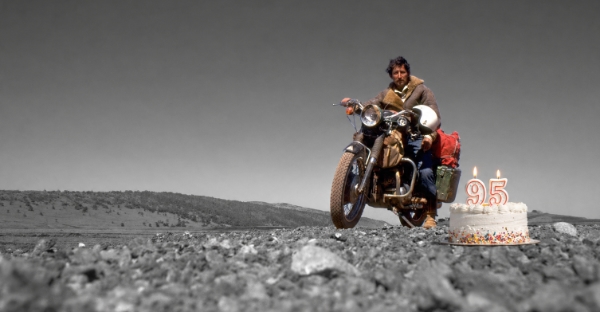
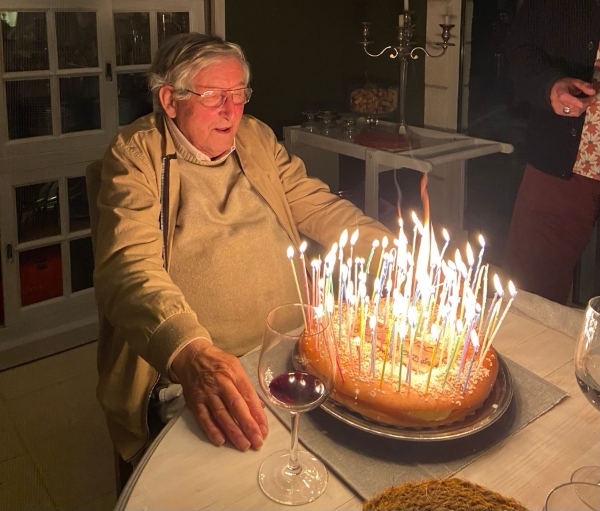
[Somewhere during those days my 43rd birthday came and went. Last week my 95th also came and went, but this time with great eclat. My very good friend Guillaume invited me to his home for a party, and he and his wife Estelle found a way to pack 95 candles on to a cake. They were the kind that relights itself, so it took all the pathetic puff that I have to put them out.]
Bye-bye. See you again next week.
I left the Balmoral Hotel (which is still there today) to go back down to Durban, on the coast. Before leaving I parked my bike at the back of the hotel and left the engine idling while I checked on the oil pressure, which was still behaving oddly.
Monday, 22nd April. Kokstad to Durban.
Boy at hotel dancing to the rhythm of the engine as I look for oil pumping. He is almost concealed in a doorway – kitchen boy – hands bouncing up and down.
Monday morning, descend from Transkei into sugarcane belt, miles and miles of it. like grass magnified, leading to coast. Dirt road is short cut to High Flats. Look down on a section of country with strange contours, like a sheet of dough collapsed over a bed of nails. Innumerable small peaks of grassland with folds and drapes, all dimples, not a single flat bit. When I stop on road, passing Africans linger and watch, as though waiting for something (a handout, a miracle, a phenomenon of some sort?) Thinking – what’s it like to work in these cane fields? What a different view of the country I would have then.
Durban is warm and I’m grateful. Big port, several dozen ships in harbour. Drive straight to Mutual Beach Centre where Corinne (Peter Harland’s contact) lives – top of a vast block. Flat is smartly furnished. Her ex-husband is there, and her daughter. Drink too much coffee. Smoke too much, talk over the same topics, trying to make them sound bright and novel. What is there to see in Durban? She says it looks very attractive, but there’s nothing there. That same false allure that all cities show.
On to Gillits, 23 miles inland on the Moritzburg freeway. [I had promised my London agent, Pat Kavanaugh, that I would visit her mother.]
Pat’s mother and her husband, Sidney O’Brien, a pilot in the harbour. Nice man – a bit of Bill in him. [Bill was my stepfather]. Pat has many of her mother’s features and mannerisms. See the photograph on the cover of a Cruise O’Brien hotch-potch about Ireland. Stunning picture. Son Mike is spotty, stiff, awkward, enthusiastic, archeological, keen on looking things up. We try to locate the Karoo bird, but result is inconclusive. [A bird I saw somewhere coming south.]
I’m very tired, fragmented, spent. Grateful for hospitality.
Tuesday, 23rd. Gillits to Piet Retief.
Call at Renolds for chain. [Another sponsor: Lucky to find one at Gillits]
Then climb up escarpment, through rock-strewn, rising and falling, ground. First time in South Africa see Africans in full tribal dress – the Ndebele, I think. Women wear hats of bright cloth stretched over discs, coloured aprons, bangles on arms, legs, neck.
The scene reminded me of:
(a) An imaginary idea of red Indians living in their country
(b) Pastoral 18th Century paintings. Remember huts on platforms carved out of hillsides; the proportions of the rocks, the ring of outcropped sandstone holding life and sun in a benevolent bowl. Cascading landscape.
Keate’s drift; orange and apple sellers at roadside. Pix.
[I’ve lost those pictures. They may have been spoiled by the police, later in Fortalesa. There’s no mention of my going to Nelspruit for the parts I had sent on. It’s fifty-two years ago and my memory fails me. From Piet Retief I rode into Swaziland, now called Eswatini, where I stayed for a few days on a pineapple farm. It belonged to the family of some friends I’d made in Cape Town. After that it was a short ride to Maputo, which was then still called Lourenço Marques, a major port in Moçambique. The Portuguese still held Moçambique as a colony but were fighting a losing battle against the native Frelimo army. While I was there the white Portuguese government of Moçambique revolted against Lisbon. Soon after, they also surrendered to the native Frelimo. My ship, the Zoe.G, sailed for Brazil in the midst of this turmoil.]
Laurenço Marques.
Bushy faces, Jesus faces, slim-tailored shirts with buttons popping across youthful chests. Jeans slung anywhere from waist to crotch on heavy brown leather belts. Little shiny leather purses on loop handles.
Or soldiers on interminable military service with Steve McQueen haircuts. Students gather round café tables, eight at a time and fold in like petals of a flower, exclusive, intense, introverted. Primitive people face out at the world. Older people too. Find myself now very aware of the extraordinary self-consciousness of young men, who behave as though they were the cynosure of a thousand eyes which are weighing every move and every expression, waiting for the first faltering step, loss of direction, failure of acceptance. (And I remember the pain outside).
[I arrived looking for a hotel. I had heard of a place called the Carlton, and asked the first person I saw.]
He wore a short, tight red sweater and flared trousers with turn-ups, the colour of strawberry ice-cream running down the inside of a dustbin. “Hi man, how you doin’, I’m sure glad to meet you. Sure man, we’re all friends here. We don’t care about the colour here. I’m just at school, sure. But I’m in the bar here, fuckin’ plenty of businesswomen. Plenty, sure. Businesswomen from Moçambique, sure.”
His face was a smooth brown sixteen years or so under a wooly black fleece, and his breath boasted of spirits. He didn’t stop talking, and his three companions gathered about him fascinated by the trick they hadn’t mastered. One was a white Portuguese with a sensitive face, despite the loss of two front teeth, and the others were whispy in-between kids.
“Oh, you want a room, to sleep. Sure, I can show you. Great place, all South Africans up there. That one you talkin’ about is shit, man. That all Portuguese shit, shoutin’ and noise. I can take you alright, maybe fifty ‘scud. [Escudos] I don’t know. It was three months ago. We were smoking too, man, you know, grass, green grass, you know what I mean?”
We set off along the streets, darkened, fairly deserted, a ragged band, and as we walked one after another they opened their trouser flies and sprayed the pavement and the walls with a wide arc of silver piss.
Across the Republica and up two blocks we turned into an anonymous doorway and up green and brown stairwell to the first floor. Two Africans sat in chairs with their backs to the wall facing the stairs with a table between them. The nearest one had earlobes with big holes in them for hanging up big ornaments, but he wasn’t wearing them tonight being in his business suit. His skin was hard and dry and close pored like old walnut. He wouldn’t speak English though he plainly understood it. His price was 120 ‘scud for a night. For Portuguese it was only fifty, but for South Africans and lesser foreigners it was 120. That was a fixed price, h said, the same all over and couldn’t be altered in any circumstance.
I looked at what I would get for 120 ‘scud and saw four army beds in a nine-foot square cell. Each one was 120 ‘scud (unless you were Portuguese) which meant he was looking for twelve pounds a night, plus a free meal for his insects. The enormity of it had me laughing as I led my uneasy party down the stairs.
“Whisky breath,” I noticed, retained an equivocal stance on the matter. He protested that all peoples should be treated alike and that economic discrimination was a gross injustice, could hardly persuade me to accept the terms, but would have done well enough out of it, I suppose. There was a wistful sorrow at my guffaws, but I was relieved at being able to walk off with total conviction, in spite of being tired and a shade fed up.
So he led me to the place I had first wanted to go to, which was fifty yards or so from where we first met. Here I got a double room for myself with all the fixings for 90 ‘scud, and a good restaurant downstairs. I gave him 20 ‘scud because he said he wanted to eat. His white friends stood by and kicked his feet.
The Carlton Hotel and Restaurant. Next door is the Bar Luisa. Coming attractions. Portraits of the girls. Could have been picked from any bus queue, but there was a touching sincerity in their efforts to look like brides. Carlton has a separate ablutions building attached to main block by glazed corridors. White tiled bathrooms on left – lavs on the right. Said to be the oldest hotel in town. Girl bars have curtains across the doors. Nothing to compare with the Sunshine.
Well, I turned 95 on Friday – another surprising milestone on a path I never expected to see. It’s all a bonus, and to think that I might even outlast Trump!