Articles published in July, 2026
Still in Rio, enjoying the patronage of the wealthy.
Rio de Janeiro, Friday July, 12th
Tonight Maria-Luiza and I are to go to a Macumba service in Petropolis. We leave early to get to ML’s first lesson at 10am. [ML teaches ballet.] On the way we pass the façade of an enormous hotel built in a sort of mock Tudor style. She says that inside it is the perfect Grand Hotel of the American twenties/thirties. Mean to see it if possible.
[We are staying overnight in Petropolis with ML’s sister and family, including husband Chris and their young children, Arturo and Marcia.]
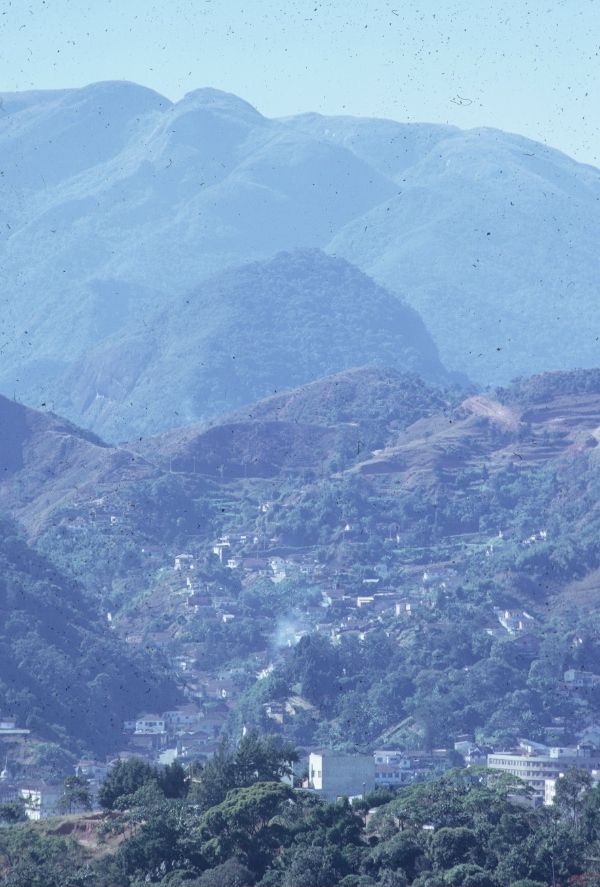
Arturo and I drive up to viewpoint over Petropolis and take a few pictures. The city is tucked away among hillsides and almost hidden by trees. Chris, ML’s brother-in-law, says Petropolis is 90 kms long but I don’t believe anything he says. His son Arturo and, especially his daughter Marcia are sadly addicted to food. In afternoon she took tea – 3 big bread rolls with butter, several sweet biscuits, and cups of tea with enormous scoops of sugar. She is very fat – her trouser zip is always undone, and it’s gruesome to watch her eat. They are eleven or twelve years old. I hope it works out. Nothing to be done, I feel, because the eating is certainly compensating for something else which probably has something to do with Chris’s difficult character. He is clearly obsessed by his Englishness, of the middle-class military variety – blazers, whiskers, grey flannels, whisky, and outright lies about silly things like drink, guns and so on. Has an 0.45 pistol, “It’s the only real man-stopper I know.” Claims he shoots it off in the night, to frighten prowlers. I bet if he does it’s not more than once a year. Thinks American negroes and Africans are the same. Has irritating habit of saying things like – “You know what you should have done, don’t you?” and waiting for some sort of acknowledgement of ignorance. Then utters a quite fatuous remark. But in spite of all this he’s not unpleasant, and one could quite like him. But to live with him would be disastrous.
[ML and I leave for the Macumba service – An afro-Brasilian cult in which individuals are possessed by gods, such as “Ishoo”]
At the top of a winding road, past walking couples of modified African appearance, a single-storey building of brick and cement with steel frame windows. Inside divided into two halves by low wooden barrier with openings in the middle and at the walls. On the entrance side several rows of benches – left for women, right for men. At the near end a counter with shelves for bottles, packages and candles, materials suitable for rites, or “obragacāoes” and a small office. At the far end a shrine in a recess, lighted green, with grotto-type décor. The floor here is parquet. The benches are already full. A mixed audience of poorish people in their best clothes. Young men in white, short-sleeved jackets and white trousers and sneakers hang about like hospital interns, but instead of a stethoscope round their necks they wear a string or two of beads.
Women line the wall of the “dance floor” wearing flounced white dresses with no waist, and white cotton trousers, ankle-length and quite tight. Round their middle they all have a length of some coloured print cotton, and white headcloths tied at the back to hold in their hair. On the floor in front of the shrine is a bowl and a candle (or maybe the candle is in the bowl with farofa) and there’s a jug next to it with cachaça. In the far corner two men sit, with a drum each, and two others each have an instrument of two metal cylinders with loose grains inside to rattle like maracas (oddly reminiscent of the cafesinho machines men carry strung round their shoulders in the streets). There is a microphone, and the speakers are in the audience’s half of the room. There is also a woman to lead the singing, and an elderly man.
The ceremony starts with the men and women, forty or so, shuffling round in a wide circle to an African chant or song. The elderly man calls the changes. They stop and kneel on the floor to sing another song, heads bent low. All this first period is apparently to entice the reluctant spirit, or ‘saint’ to come down. Soon a wild-looking woman with long reddish hair (quite old) comes on to the floor wearing a voluminous gold skirt, calf length. She walks with a nonchalant swagger and puffs on a cigar. She has a mischievous half-smile on her lips. As she passes us a young man in the benches comes over to kiss her hand. She accepts the homage casually and proceeds to the shrine. Various men prostrate themselves before her, and some girls are picked out to assist her. All the arrangements are made in a very matter-of-fact way. No effort is made to impart any sort of reverence or solemnity to the various stages of the ritual, and the participants often chat to each other as they might in the street or a shop. The lady in gold is apparently standing in for the elderly man. Her job is to persuade the ‘saint’ (Eshoo) to enter her, and he is getting too old to take the strain. She kneels or squats before the shrine as the singing and shuffling continue, and various functionaries move around her. Another man of some authority walks round inside the circle swinging an incense holder, and the participants bathe their hands in the billowing smoke and rub them over their faces and heads. He looks at them all, one by one, in a meaningful way.
After a while “Gold” gets up and takes steps backwards repeating a word which seems to indicate that the ‘saint; has come to her. Then she swaggers about the floor. The personality of this ‘saint’ is that of a sympathetic but mischievous and greedy man. Other women also embody other ‘saints’, like the one who looks upwards and makes a whooping noise, like frogs in the night. She is “Ogoon” who owns the forests and other natural phenomena. Another one owns the sea. Another is the warrior. Another owns the main diseases, like leprosy. They all some cheroots.
Some members of the audience have previously asked to speak to Eshoo and they carry numbered tickets. They are asked on to the floor and a circle of hands is formed round them to complete a “current.” The red, blue and green strip lights are switched off. (The dominant colour is green.) Th dancers begin to twitch, writhe, and utter little shouts or yelps. Some go into quite violent, shuddering fits, shouting and screaming. They are there to absorb the evil from the communicants and they do it with a will. The various ‘saints’ stroll around, taking a hand now and then to intensify the effect, or to calm down too violent an hysteria. This is then repeated with other sections of the audience. Later a special session is held for a child and his parents, and tw concentric rings are formed, the members of the inner ring surpassing themselves in their paroxysms and shouts.
At one point in the ceremony (before the arrival of the saint) there is a period of quiet during which a cracked record of Ave Maria is played over the speakers – at another point some popular Chopin – orchestrated “Tristesse.”
But I did not feel there was any idea or intention that the participants should at any time feel alone with a god or spirit or that, by some act of piety, self-denial or restraint make themselves better people. The spirits are themselves possessed of all sorts of contrary traits, and it seems to be understood and accepted that this is nature, human, superhuman or subhuman and nobody could want to change it. Obviously here there is less guilt. You join in and either obey or give orders according to the role allotted to you, and the rest of the time you do whatever you feel like doing. The concessions made by Macumba to Catholicism are not at all convincing. On the other hand the ritual itself is presumably a great deal less potent performed in these surroundings than in some forest clearing or on a tropical beach. A visitor there (who said he was a son of Ishoo) told us that child and parents getting the special treatment were his relatives and that it was a great privilege. He himself was an honoured friend of the house, but he too pains to explain that this was not his religion, since he followed a different branch of Macumba. These variations all deal with the same basic vocabulary of saints, but the emphases and rituals differ, and in his branch, for example, it was not possible to call on Ogoon, whereas here it was. Hence the special ceremony.
All these different branches, however, unite occasionally when funds permit, to have a great ecumenical feast called “candomblé” where much food and drink is passed.
Today, Saturday, we had thunderstorms and it rained. Halleluya. Fires to the West, fires to the North. We’re fortunate. Only 35 degrees Celsius. Others have 40. Of course, climate change is a hoax – so the fat man says. One day the fat lady will sing.
See you next week.
Rio de Janeiro, July 3rd
Arrived the day Brazil was eliminated from the World Cup. Stepped into Baby’s flat, such priceless art, to struggle out of my clothing.
[Well, that needs some explaining. Before I left London a friend of mine, Roy Round the ballet photographer, gave me an introduction to a wealthy man in Rio known as “Baby” Bocayuva. He subsidized a ballet company run by his ballerina wife, Dalal Ashcar. I arrived after dark and unannounced at his apartment in Ipanema after a long ride. I gave Roy’s name and was instantly received with delight as I struggled out of my filthy clothes standing on a valuable carpet surrounded by world class art. That, in contrast to my reception in Fortaleza, was what defined my perception of Brazil.]
July 4th
Lunch with M.Luiza at Carreta. Introduced to Ballet Dalal Ashcar.
[To compensate me for being locked up in Fortaleza they adopted me. Baby gave me the use of a small apartment. Dalal deputed one of the teachers, Maria-Luiza, who everyone called Lulu, to take care of me. “Caretta” was a restaurant with sublime steaks.]
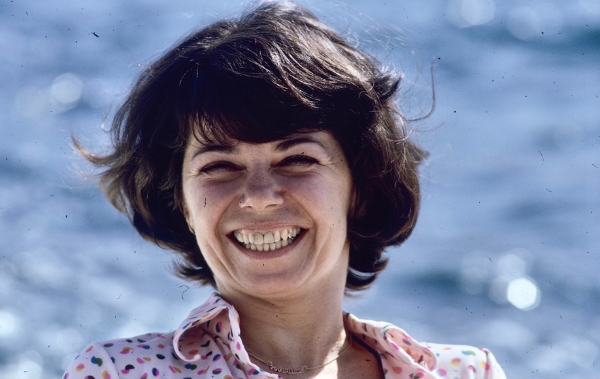
Maria-Luiza or Lulu – my guardian angel in Rio
July 5th
Morning to Baby. Visited quarry at Ibrati. Biggest in Brazil. [The source of his wealth.]
There follows a list of all the people I was involved with during the following month: Baby, Dalal, three sons, (daughter in Paris, daughter-in-law’s father is Faust at L’Express – an important left-wing newspaper in France). And a baby son by Dalal. Lulu, Holly, Gill, Antony, Christine, Miriam, Jandira, Manuel, Markus, Ben, Le Professeur, Alci, Marcia, Kubitschek (ex-President of Brazil), Barbara, Maria-Estelle, Maria de Gloria Chagos, Adolfo Bloch (big newspaper proprietor – Globo) Lucy Bloch, Geraldo, Ylen Kerr, Antonio Carlos, Esmeraldo & Tito Ryff (Apt 301) Elena and Renato, Lulu’s mother, grandmother, sister, brother-in-law, nephew and nieces, godmother, Déa (Buzios), Bob Alexander, Roger Austin, Axel Galles, Mike Sarne, David Zing.
Places
Ipanema, Leblon, Gavea, Botafogo, Copacabana, Flamengo, Corcovado, Boa Vista, Avda Brasil, R.Alfandega, Yacht club, museum, Barra de Tijuca, Lagoa, Batabui, Cabo Frio, Buzios, Petropolis, Vassouras, Araros.
Events
Quarry, Bauhaus, “Pippin” (a show), Dinner and talk with Kubutschek, visit to Manchete, Lunch at Botafogo, Bank of London, Alfondega at Galleão, Ballet of Oscar Arrais, Churrasco at Bambui, Visit to Vassourras, Arraras and electric carver, morning on Ipanema beach, night with Christ., Buzios, mussels, Mrs Ferguson, Macumba at Petropolis
[Was invited to take a trip across the Bay. Achille Markov, the Swiss ballet master, resembles Danny Kay, with pointed white leather pumps.]

Achill Markov, the ballet master, with Holly, Lulu (and me of course) crossing the bay, followed by the best shrimp dinner of my life.
Rio de Janeiro, July 11th
Meant to finish piece for S.T. Woke at 8.30 (later each day). Went across to market and thought to buy a steak. The “filé mignon” was “acabo” – finished. I asked for something else. He was a surly man and might have been handing me shoe leather. It looked as if it was off the loin. An Englishwoman warned me that anything but filet was really for stewing. She’s nuts. It was delicious (relative to my expectations) and tender. Filet is 22 cruzeiros a kilo, and now I work it out, I find this meat cost the same. That’s 62 pence a pound. Eggs are 4.50 a dozen = 2p each (big, hard shells. Butter costs over £1 a kilo.
Cheese also costly. But 6 limes for 5p; big avocado for 9p; oranges for 1p – 3 cruzeiros a kilo; rice a bit more. Salario minimum is 320 cruzeiros a month = £5 a week.
[I tried hard on my journey to keep tabs on the cost of living for ordinary working people. For the moment I was in the lap of luxury, but it was all fantasy. It could and would vanish the instant I moved on.]
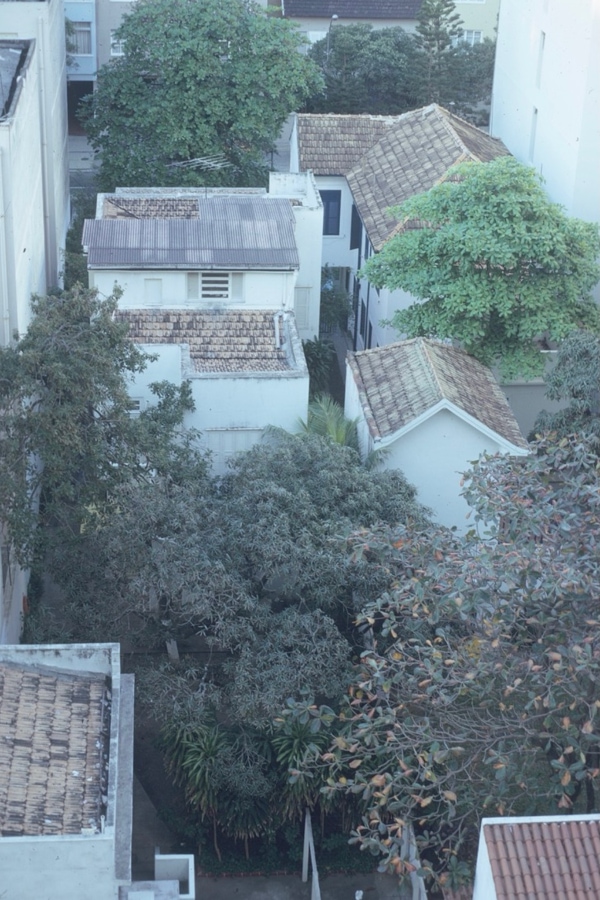
The view from “my” apartment window in Leblon.
Sat in front of window to eat. Beautiful day, fog has cleared, men working on high rooftops and sunning themselves. Looked at my work for half an hour and gave up. Laundry has lost my “Colorado beetle” vest. I hope they find it. He speaks some English.
“Are you American?” he asked. “No English.” He confirmed it. “You are English? Good. Americans are shit!” What does he know about either?
Marcia [Kubitschek’s daughter] has talked to her father about seeing me. He wants it to be next week. The ST has not called yet. It’s the one problem, and it costs a fortune to compensate for. What’s more, it encourages waste, I’m sure.
She (Marcia) has made me a temporary member of the Country Club, and a card is to be left for me at the [dance] studio. She thinks the prices there are quite cheap, and no doubt comparable food elsewhere would be twice the price, but I still shan’t be able to afford it, except as an extravagance. It crossed my mind that the facilities might turn out to be a gift, and I couldn’t decide what to do in that case. I shall have to dip a toe in the water and see how hot it is.
Went for a ride instead to Barra, Tijuca, looking for way up to Boa Vista. Saw the boys on their boards sitting out to sea waiting for a ride. It’s quite true they do seem to be worshipping some invisible deity on the horizon. One small boy has developed a way of spinning his board back over the crest to stop. Another came out towards me wearing black flippers. He placed them carefully on a rock to dry. Then, out of the sand he hooked his goggles and tube, then sandals and finally a vest, all buried from sight. A bit of wood with a skewer in it was also part of his outfit.
At last found the road up. In the folds of the hillside the vegetation is interspersed with bananas. There are also little four-petalled flowers in red & blue all over the side of the road. Passed a house of concrete actually shaped like the prow of a big launch.
First there’s a sign saying Alto Joã. Then an unsigned road and another marked Joã. When you’ve been to Joã (and halfway round Brazil) and come back to the same junction it seems reasonable to take the other road and suppose that Alto is a place and not a description of Joã. Took long winding road to Vista Chinesa. Looks down on the Lagõa and Copacabana, like an architect’s model, because the lagoon is like glass. The city is really squeezed between the mountains with many tall blocks. It is made to be seen from the air.
In the shrubbery in front of the mock Chinese pagoda saw a little hovering bird, busy among a bunch of blooms. Magic is just seeing something as though for the first time. Afterwards comes the business of explaining and exploiting.
From there down to the lagoon, petrol and a free cafesinho. Lulu, at studio, goes off to see psych. [She was in therapy] Holly talks to me. Then Lulu invites us both to Carreta – the churrascaria – in the same street. H is very stubborn and English behind her balletic flutter. Lulu all too compliant. I get a distinct feeling that between them I have been maneouvered. I don’t in the least mind it.
Strictly speaking these are not travel notes. I have done my best to make them comprehensible, but not very successfully I’m afraid. More next week. Enjoy the heat. Cheers.
I’d like to think you missed me last Sunday, but I apologise for not popping up as I usually do. I was preparing for a visit to England where I spent two days at the monster ABR meeting, talking and selling books. At the last minute there was too much to do. Now I’m in trouble because I find I’ve left behind the notes I was going to use for this Sunday, so it looks like you won’t hear anything new from me again for another two weeks.
The Adventure Bike Rally at Ragley Hall is truly astonishing. As someone who has been taking his biking pleasure mostly as a solitary figure crossing an empty landscape, the idea of spending two days with 20,000 other bikers should have been rather overwhelming, but the event is so extraordinarily well organised that I never felt oppressed. On the contrary, how could I not have felt pleasure at seeing such a huge audience for my talks. I gave them a lecture on philosophy (a favourite subject for bikers, as you know) because I have actually read, to the last page, “Zen and the Art of Motorcycle Maintenance.” And that was on the last day of the heatwave that had everyone frazzled. The applause was deafening. Make what you will of that!
I don’t want to leave you with nothing to read, so here’s a diary entry from Sri Lanka that I published a long time ago.
Cheers,
Ted.
From My Notebooks In 1976: Ceylon
I’m in Ceylon, having visited one of the best-known sites, Sigirya, a fortress created out of a phenomenal rock formation.
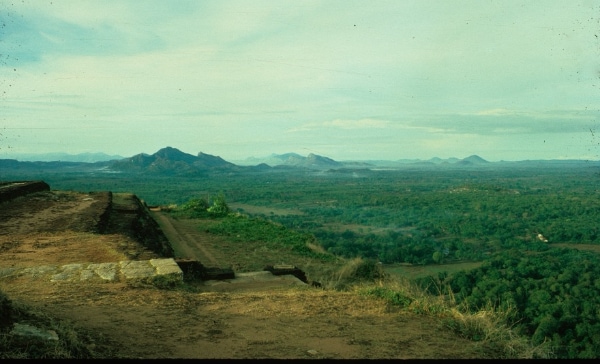
The view from the top of the fortress was extraordinary. There were carvings, but little that my uneducated mind could explain. The next day I left the Rest House (and the German sisters.)
October 11th, To Puttalam
On shore of a lagoon. Junction town. Single row of huts, some tiled, some thatched. Small veg market had chiles, kohl-rabi, cabbage, carrots, tomatoes, limes, eggplant, potatoes, yams, etc. In short an excellent variety. Fish market, a small raised cement platform, thatched, had good fish too. Some puppies stood around it. One was so thin and failing that it was scarcely more than a head. Watched some crows on a roof – one had a fruit in its beak but could hardly eat it , since as soon as it put the thing down to grip it with a claw, another bird unencumbered, would threaten possession. It had a younger companion also which simply screeched with open beak and got a couple of morsels for its pains.
By the shore was a thin strand of sand littered with all kinds of rubbish. Again the crows attracted my attention and one – an obviously inferior one – was hanging about behind the others. At one point it raised a claw and put it pleadingly on another bird’s back – twice. The other bird flew away. The mangy one was left alone. Then I noticed a dog, a bitch with distended udders, licking something between its front paws. It was a puppy stretched out on the rubbish, head back and oozing blood. The mother looked up so mournfully.
These small examples of life and death on the rubbish heap moved me and depressed me profoundly. Since Colombo I’d been viewing the world through discomfort and fever with a deliberately jaundiced view. I saw the profusion and luxuriance of the tropics as a terrible mess, buildings as mildewed wrecks, human effort as futile. The people seemed tedious to me, an endless procession of M&S shirt tails hanging over sheets – with facile smiles signifying nothing if not envy and ingratiation. Only the older women impressed me in spite of myself, with the fineness of their features and slim, handsome carriage. The road was murderously bumpy, the traffic foolish. Several times in Ceylon I’ve saved my life by noticing another driver when it was his obligation to notice me. People stop quite suddenly in the road for no apparent purpose., and without indication. I think there is a powerful amount to be said against tropical paradise and I should be grateful for these fevers perhaps. The yearning for temperate home must have been overpowering in early adventurers when they fell sick.
At Puttalam I got hot tea and an extra sheet and tried to sweat it out. There was plenty of sweat, and in the morning I thought I’d won. I rode the 46 miles to Anaradhapura (after photographing a cobra) and sat among the ruins for a while.
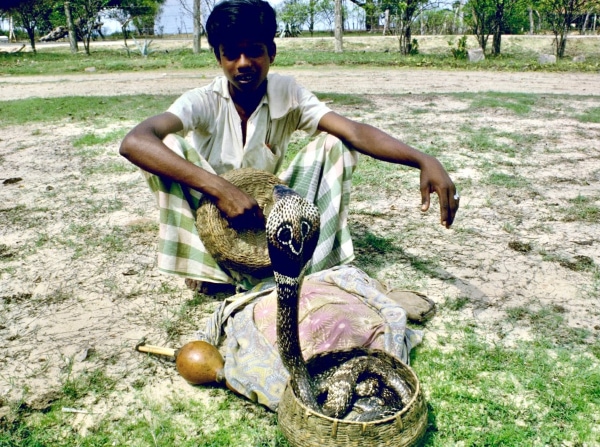
A young man came and, by the brilliant tactic of not asking me for a single thing led me to offer him my address. I walked barefoot to the big Dagoba (or whatever). The dome is solid and covered with cement – has little to say to me. There’s a crack where it was once struck by lightning, and a new lighting conductor runs down the side. There’s also a maze of granite pillars sticking out of the ground. The lad says this is the ground floor of a seven-storey building in which a hundred monks prayed on each floor, all in their solitary cells. If true it’s an amazing notion – what a hum must have gone out from that box. Enjoyed also the moonstone outside the temple. Elephant, horse, lion, buffalo.
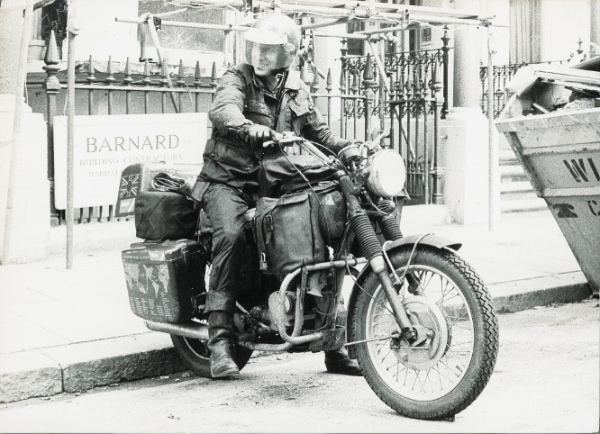
From A on the road to Mannar. And at the main junction was already feeling the fever again. Had a drink and some Disprin at the rest house. Disprin is becoming part of my diet. Rest of journey went well, no more rain. In the morning. I rode through a maximum downpour for maybe 15 minutes – and the jacket is a success.
[Somewhere – in the USA I think – I’d acquired a leather Belstaff outfit. I was still wearing it when I got back to London.]
At Mannar got the same room at the guest house. Went straight out to fish off the bridge, thinking how nice to be alone, but a great company of betel chewers lined up alongside me. I managed to live with it, however, and got the great excitement of a catch. The fish felt very strong and for a while I couldn’t move it at all – after its first run – then slowly I inched it in. It was a stingray. Very exciting to see it come out of the water. Not really so big – maybe four pounds – with a beautiful mottled brown back – a rather human mouth and two eyes on top. One of the men cut off the tail and showed me the spike which lies alongside the tail close to the root (not as I imagined at all) Took it back proudly to the rest house. The cook said he would fry it for me – but as a fish, he said, it was not famous.
Two men on the bridge started talking to me. It annoyed me at the time, and I must have shown it.
“Your native land, please?” “Are you a university graduate?” “How much does this, or that, cost?” They came afterwards to the Rest House and I had to sit and take tea with them. One was the medical officer for the area. And the other (Mr. Ratnavale) is a clerk of some sort. They have so little to say and understand so little of what I say that it’s largely a ritual. Whatever I said, Mr. R’s face would express perfect wonder and enlightenment, and say “I see,” as though everything was now clear. But the MO did describe symptoms of typhoid which gave me a bit of a scare next day.
That strange Scots family also turned up.
Rest House man told me a series of superstitions – full bucket, empty bucket. If a monk crosses your path when you set out, forget it. If the gecko chatters as you step out of the house – also forget it. If you run over a cat, you’ll have an accident. Woodpecker’s noise is a bad omen.
Also says Tamils smell different. If they use a towel, you won’t be able to. He says Sinhalese and Europeans are much closer.
