Articles published in August, 2026
Friday, August 30th
My last night in Rio. Lulu, Holly, Esmeralda and Tito, and Gill Anthony gathered at “Amigo Fritz” to say goodbye. Shrimps and corn. Old sayings. Antonio came too. This morning left Rio at 7.30 (saying goodbye to Jandira for second time).
With Antonio – his clutch cable had broken, my front brake was still soft. We made a sorry pair in the Rio traffic. Saw Copacabana, Flamengo, for the last time. Then up the mountain to Petropolis where he said goodbye. We’d had breakfast and I took pictures on his Pentax. Was tempted to call on Lulu again in Petropolis but didn’t. Climb to Petropolis made engine oil smoke, didn’t realise I was pushing it so hard. 3,500 feet going up non-stop.
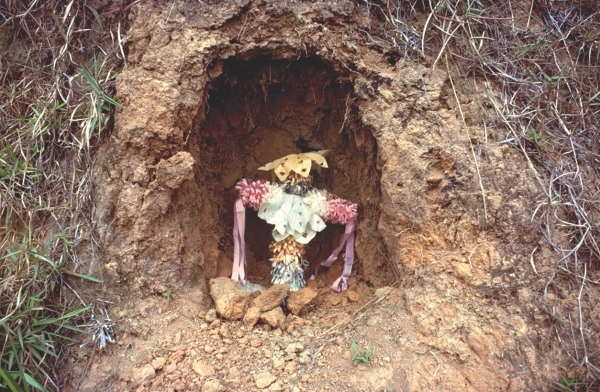
A roadside shrine
Determined to sleep out in hammock, and from 4pm looked for suitable place. Eventually found rising ground beside road to take bike off the road. Fell over once. Camouflaged bike with branches, and slung ‘rede’ [Portuguese for hammock – pronounced like ‘hedge’] between two trees at top of clearing by cow fence. Cooked tea, farofa and bananas. Heard crunching sound behind me, like distant cart crossing gravel. Looked round and saw great blaze of crackling grass and brushwood. Thought it would engulf me too but much relieved to see it was on the other side of the road, with wind blowing away. Took great care with my cigarette ends. Night was successful on the whole though traffic was noisy and got chilly in the morning. Trouble is still that the darkness lasts too long. Need either light or company.
[I wanted to explore inland before going south, and headed for Congonhas, a famous church.]
Saturday, 31st
Got up at six. Dawn was a lovely rosy spectacle. Little blue hummingbirds came by – and stopped a while. Called “kiss birds” in Portuguese. Enchanting and apparently unafraid. Rode on to Congonhas – lovely church, painted wood, like circus or fairground. Very joyful – birds chirping and flying under the ceiling. The 12 Apostles are quite striking and much more lively than most such sculpture. The stand around in an almost naturally haphazard manner (and remind me a little of Greek – Roman – Cyrene). Bought a stone egg, a soapstone carving and five coffee spoons with stones in handles.
On to Ouro Prêto. Bigger place. Found some students of geology, or mining, and they let me stay the night. In evening the square is lovely. Met two characters in front of top church where paintings and quick jewelry are sold. Also boy who does prints of town, which he also sells in Rio and Bahia as well as here. Says it’s a living. Other character with a bit of Paul Winstanley about his face and, I imagine, something about his circumstances told me stories about the town. The two churches with the same name. One for the whites, one for the Africans. And how the saves were freed by a slave who first bought his own freedom, then made a lot of money and came back to buy freedom for the others. They in turn repeated the process so that many were freed. They built a fortress to protect themselves of which the walls remain, complete with defensive apertures. Other character made jewelry and spoke dreamily. Another squatted and carved flutes from bamboo.
Saw a squad of DOPS [drugs] police arrive on Harley Davidsons. Geological museum has solemnly draped coffin containing the cinders of a Brasilian geologist (Goreix?) who died in France in 1919 and was exhumed in 1970 and sent back to Minas. There are xeroxed copies of the order to exhume and a sort of waybill to transport the remains to Brazil. The Brazilian and French flags droop behind the coffin, very theatrical and not unfunny.
September 1st
From Ouro Prèto to Tiradentes. San Jâo del Rei. Had my boots shined after 51km dirt road. Saw other little humming birds, this time black and white. Passed men on horses with wide-brimmed hats, Spanish style. Determined to sleep out again. Found a small dirt road and followed it. African talked to me and suggested the station where a quiet telegraphist, all alone, let me sling the hammock over the station platform. After rice and sardines, made tea. Slept very well. Hot milk in the morning. Quiet on the station bench at night. Then went back to “posto” on main road to drink some beer and fetch fresh water. Long walk through empty land under moonlight. Train came through at 3am but hardly disturbed. Occurred to me, on dirt road, to call my novel “A Private Staton.” I had no idea, of course, that I would sleep that night in a private station. [Chronology is hard to follow now.]
Have spent very little money but bought 33 cruzeiros of souvenirs in Congonhas.
[Money was an important factor. I had always intended to travel in poverty, believing that would be the best way to understand the world around me. There was always tension between me and the Sunday Times because, being what they were, they usually chose the most expensive way of supporting me (tyres, parts, funds, communications) and then complained about the cost.]
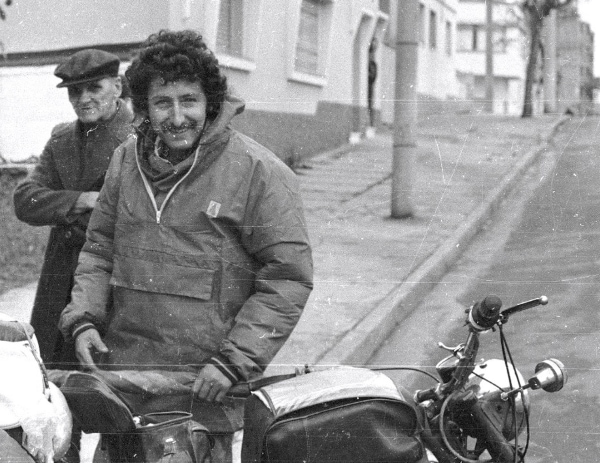
September 2nd
A colder day. Got to Sâo Paula at 3.30. Found José do P. without too much difficulty at 4.45. [I was planning to meet with my Egyptian friend, Amin Simaika, and his brother so that I could hand over the sword I had been carrying from Cairo.] The brothers drove up at 5. Extraordinary, really, to see Amin, looking the same, with pop eyes, burnished face, little moustache over the lip. Brother very hospitable, with loving Brazilian wife. No sooner settled than phone call from Rio. Lulu rang about telegram. Valerie Walker would bring it, together with other things I stupidly left behind. Everything sorted itself out too well. We talked endlessly about what the brothers would do in Brazil, about making money to escape from Sâo Paulo to a country place. Aziz works at three jobs a day – used to work five. Is a radiologist. Wife is Marilda. Have two apartments.
[As well as the sword, he also entrusted me with $2000 cash to take out of Egypt for him.]
Amin sent $35,000 by strangers like myself, in similar amounts, and lost only one amount of $200 sent with a man he had known for 20 years. Still very nervous, agitated. Noticed for first time that he expresses himself physically in very Egyptian poses, body bent slightly forward, arms gesticulating, but in frozen frames and with something of the quality of figures on a frieze. Looks always run down, but when I challenged him to run up hill his legs pumped him up much faster than I could go, and there is much power in that tortured frame.
Aziz described humorously his search for a wife. Recommendations. Even a marriage bureau.
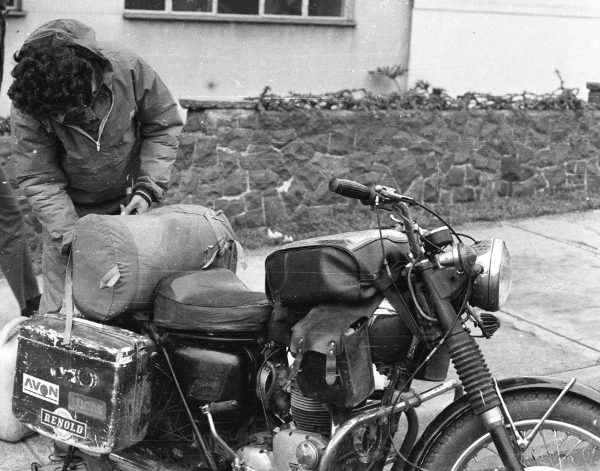
Tank bags, type 2, made in Nairobi. The final version was built by Sr. Quiroz in Argentina
That’s all for now. I’m off to London this weekend for a fancy do at the Royal Automobile Club., and then to a gathering of the faithful at Gieboldehausen so I might have to miss a week. But I will be back.
August 21/22
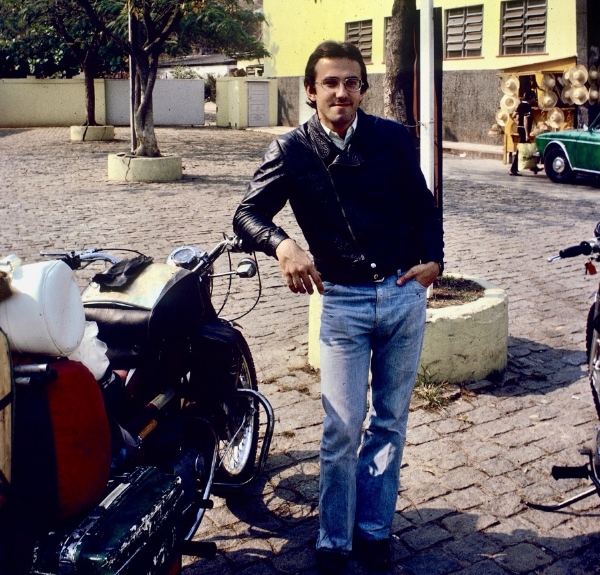
Full-sized motorcycles were extremely rare, and extremely expensive in Rio in the seventies. I only met one rider, Antonio, and we became friends. I think his was a Norton.
Somebody in the military government must have thought it worth trying to persuade me that they were the good guys. They booked me two nights at the Hotel Nacional and bought me a bus ticket there and back. The bus was very luxurious, better than a plane, 16 hours overnight and I arrived in the morning. Brasilia, built from scratch by Niemeyer, was quite bewildering. This is what I wrote.
Down, round, under, up, round, over, W/3, L/2, Zones, Sectors, blocks, giant inhabited sculptures loom up, swim past and drop again into the great areas of empty lawn. Here’s the gymnasium, seats 10,000 people in pretty coloured plastic bucket seats for prize fights, ice shows, Johnny Mathis. Here’s the church – immense cube of blue glass panes and fluted ceiling. Here’s the cathedral, a wigwam of concrete spatulas supposed to represent the crown of thorns, with no pews, only a scattering of marble blocks in one area and metallic angels floating in space, picking up distant laughter like a vast ear trumpet. Here’s a residential area – three kinds of apartment – cheap, middle and expensive, from 800 Cruzeiros to 3000 a month. The government housed in regimented rows of greenish dominoes glowing like sophisticated electronic hardware, a guard of honour for the twin towers that zoom up at the end of the avenue, seat of the congress.
“Small politicians with no specialised knowledge. Criticised for being unable to debate sensibly with the technocrats..”
[I meet my interlocutor – a high-ranking diplomat.]
Under a triptych depicting a mysterious cataclysm, a comet or saucer swims fish-like over a Latin township of spires and compressed humanity, releasing a gloomy doom, soaring away from the rubble and fleeing insect figures, strange background for a conversation with a diplomat imbued with the tough unsentimental talk of technocratic dictatorship.
“This is a government supported and protected by the army. Oscar Wilde said there is no such thing as a good or bad book – only well written or badly written. We cannot afford discussion and debate of moral issues. It’s a luxury we cannot afford while people are starving and dying.
“A third of the population is illiterate. We hope to end this in ten years. The real revolution was in 1972 when the budget for education was 4% of GNP; [I think he meant GDP] and the military budget was 2.5%. but still it is not enough.
“We have not abandoned land reform, but it is no use taking a peasant from the North-east and putting him down on a strip of land in Amazonas without help or advice. In on or two years he will turn his land into sand.
“It is not really land reform. We call it colonisation. Do you know how much all this costs? We must find the money. So we are doing everything to make the south richer, so that money can be used to develop the north. We are in a capitalistic world and cannot escape it. Everywhere the world is becoming more capitalistic. Russia. Even China. ‘And the capitalistic countries are becoming more socialistic. I believe the world will eventually become one country through capitalistic interdependence. That is how the poor will be saved. But it will take many generations.
“We work very hard here. We take no vacations. For me or anyone else here to take a month’s vacation is unthinkable. While there are poor people we have to think of them.”
Could you compare Brasilia with the pyramids – the ultimate in technology, aesthetics and grandeur, raised over thirty million illiterate peasants? Here the monument is dedicated to them, but it is still the pharoic family in residence.
“Perhaps they will be proved right,” says Her Majesty’s First secretary when I meet him. “Brazil is making great economic progress. Has a big foreign debt but has no difficulty servicing it. We’ve got Germans, Chinese, Japanese and Arabs all wanting to invest. Argentina used to be the most advanced country in South America. Since I went there 12 years ago it has stood still. Now Brazil is ahead. There is no end of discussion and debate in Argentina. I remember a friend rushing up to me at election time in BA, his eyes glowing. ‘I’ve just formed a party,’ he said. It was the 19th party to put up candidates. The Brasilians tend to look down their noses at Argentina.”
(Nucleo Bandairante)
The first buildings of Brasilia still stand a few miles outside the city proper. Made of wood, two floors high, like frontier town. Other satellite towns have sprung up, in the case of one growing around existing town. Brasilia shimmers in a bowl, distantly, like futuristic image.
“Where are you from?
“Maranhao, Ceara. We like it here. Prefer to live in Brasilia. Got a good job. Driving for the ministry.”
“And you?”
“I’m from Goias, originally from Austria. Study Geology. Brasilia is lovely to look at but terrible to live in. Nothing to do but work.”
This sculpture is called “A Woman and her Shadow.” Bronze figure pursued by black ghost writhing with tentacles. The sculptor had cancer and knew it. Here’s another of hers. “Mermaid and Octopus.” But finely made.
The room for ceremonial treaty signing in Itamaraty has an 18th century jacaranda table belonging to Brazil’s first diplomat, bowed down at the centre by the weight of many elbows, many treaties.
This is the biggest unsupported ceiling in South America, and this is probably the biggest tapestry (although there’s one at the UN building, isn’t there?)
Itamaraty stands in a cool green pool cradled by thin concrete arches – delicate and beautiful – the showpiece of the government – by Niemeyer.
At the Nacional Hotel the hunters come to breakfast with James Bond briefcases (still?) all geared up – it’s in the way they walk, stand, talk to each other, all unnaturally bright.
And at night, hunting the hunters, in evening gown and green velvet smoking jacket, two society artists shamelessly advertising their appeal with clippings from featherweight journals and lists of featherweight patrons. Lord and Lady Antonia Fraser, Baron Thyssen and his lovely Baroness (which one?)
“Yes, we churn it out. We believe in flooding the market – we make a good living, thank you – you’ll find our work in the best hotels and airports, and us too. He carves wooden panels, she paints primitives, 1000 Crzs upwards.
On the grass lawns, between lanes of traffic, peasants earn their Salario minima hoeing at weeds in brightly colourd clothes, moving slowly in rows of three or six. Nobody seems to know what the Salario minima is (except them, of course). Is it 280, 320, 360?
Anthropologists say that eventually there will be no more Africans. Will there be any whites?
Of course!
Next week, away from Rio and the journey gets going again, at last.
Rio, August
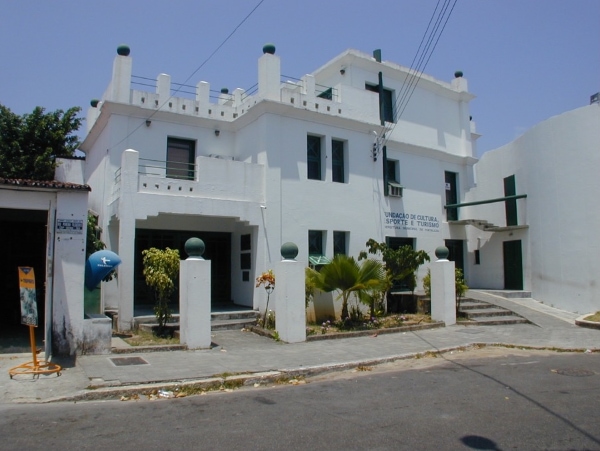
The police station in Fortaleza where I was locked up has become (25 years later) a cultural centre after many cosmetic changes. It used to bristle with antennae.
[My imprisonment/detention in Fortaleza was Kafkaesque, in the sense that I was locked up in an office where, during the day, all normal office procedures took place. There was a plump young blonde secretary at one desk, and the head of a drug squad (Toxicos) at another. A handful of agents, three or four men, one woman, hung around waiting for a call. I watched them all from my place, standing at the wall. There was only rarely a spare chair. If I wandered too far from the wall a fierce older agente pushed me back. Otherwise, they all behaved as though I didn’t exist. At the end of the office day the desks were locked and pushed to the wall. Everyone went home. The door was locked and I was left for the night with a pile of three straw mattresses. The first days were the worst, when I really thought they might do away with me. The atmosphere got gradually easier, and in the second week when it seemed most probable that eventually I would be freed the female agent, who spoke reasonable English, began to talk with me. It was then that a young shipping clerk was locked up with me and, the following night, we first made the acquaintance of a lawyer named Andrade. I wrote his story into my notebook much later, when I was in Rio. This is exactly how I wrote it.]
ANDRADE’S STORY
He looked utterly defeated when I first saw him, and all the more pathetic because he was so well dressed and groomed and obviously accustomed to comfort and respect. Superintendent Xavier brought him in one evening, saying “You can stay here, if you like, but you can’t converse with these,” meaning us, the clerk from Maranäo and me.
Andrade mumbled something about not needing company, and they left the room. It was his mouth I remember most. It seemed to have imploded, and his head looked like a tin full of steam after it had condensed.
Where he spent the night I don’t know, but the following day, a Saturday, he was back looking more controlled. For me, who was living in a regulated squalor, he was a phenomenon. He had his hammock, a new looking, brightly coloured affair, which he slung across a corner of the room. Unlike us, he had obviously been forewarned. We didn’t speak for a while, but eventually we were talking quite freely. [But only in Portuguese which I was gradually picking up.]
We played two games of chess with the cardboard pieces on a board drawn on the back of a large brown envelope. He had already told his story to the clerk, but it went too fast for me, and I persuaded him to tell it again slowly. I don’t know how he managed it, but he conveyed to me a vivid picture of the main event which was the beginning of the tale.
It seems that in some way the brother of the Governor of Såo Paulo had betrayed or slandered him, and he came to the Governor’s palace to protest and receive satisfaction. He charged the brother to his face with his slimy behaviour, and the brother replied in terms which Andrade could not tolerate. He therefore gave the brother a punch on the nose. Th brother then drew a gun and Andrade fell sprawling on the marble floor with a bullet through his calf. However, as he lay on his back, propped up on his left elbow he was able to draw his own gun and he shot the brother once in each shoulder and once through the leg. Andrade pulled up his trouser leg to reveal a whitish shin. On the right side halfway down was a scar like a halfpenny. On the back of the calf was another. The scars gave him great satisfaction. He said that, as a result of this incident, he was unable to make a satisfactory living in Såo Paulo. He lost his job as a lawyer in the state government, and doors were closed to private practice. He was said to have been politically undesirable. [The shooting occurred in 1964 after the military coup.]
In 1970 he left S.P. and came to Céara, a sufficient distance away to outrun the slanders. In Fortaleza he built up a new reputation, became involved in the creation of important enterprises (water treatment, Parque de Pais?) Then he became associated with the director of Larousse for Céara, and was instrumental in making it the most successful branch of the business in Brazil. The HQ was in Såo Paulo and in 1973 he was suddenly dismissed, just before Christmas. The principals refused to see him, and he decided not to take any action for loss of earnings, etc. Some months later his former boss in Céara was also dismissed and accused of fraud. This man invited Andrade to help him prepare a case against Larousse, but in the meanwhile, A had discovered that it was his boss, whom he had considered to be his greatest friend, who had denounced him to Såo Paulo as a swindler. A instead gave evidence for the firm against his boss.
Now he himself had been arrested and told that a criminal process begun against him years ago in S.P. had been to trial and he had been convicted in his absence and sentenced to five years. He was now waiting to be sent to prison in S.P. He seemed quite without hope.
That evening his son, a young man in the expensive casual clothing that rich sons wear in Brazil, came with pieces of roast chicken on a plate with a cloth knotted over it, and a bag of other odds and ends. They embraced and talked. A left the room and came back into the room bouncing with optimism, smiling broadly. His son and his friends had discovered that there had never been a judgement against him, after all. The whole thing was a wicked lie disseminated by his enemies. The truth would emerge and he would be free again.
I found it as difficult to believe now in the rosy future he painted as I had been to share in the black despair of a short while earlier. But because he was so exhilarated, I congratulated him heartily and pretended to share in the wonder of it all.
What we were experiencing, however, seemed a long way from what I could accept as reality, like his keen earlier interest in ways of escaping from the police station. [He said that compared with the prison in S.P. this was very easy: I wondered how he knew, but didn’t ask him.]
The euphoria lasted for a day, through Sunday. On Monday morning I saw them, he and the clerk, standing oddly near the wall with the sun in their faces, as though they would be lucky to see it again. He was taken to other offices, and I didn’t speak to him again. I saw him though when he came to collect his hammock and other things, and his face had once more collapsed into bitter dejection.
When I got out myself Mario [a priest] brought me a newspaper which described how Supt. Xavier had winkled this crooked lawyer Andrade out of Fortaleza High Society and sent him packing to S.P. where he had been sentenced for various frauds.
Much later, looking at a map of Såo Paulo, I was surprised by the large number of streets named after different men all bearing the name Andrade.
The heat is getting to me. I dread to think of the future. Isn’t it Kafka all over again that at a time like this a stony-faced villain makes us waste our wealth on munitions.
Another dive into the relative innocence of the past next week.
Still enjoying the luxuries of Rio de Janeiro, making the most of my very highly connected friends. I have been waiting for a chance to talk to an Ex President.
August 2nd
Finally had meeting with Kubitschek. Mild mannered man, surprisingly un-monstruous. In fawn suit. Flat featured, grey-eyed, a faded tan colour. With him was a stocky fellow in casual academic disarray suitable to middle-aged professor of economics at Rutgers University, N.J. His calling card smelled strongly of pipe tobacco and announced him as Robert Alexander. K and I spoke French, which Alexander, it later transpired, hardly understood.
I said I had not been able to locate the “centre of gravity” of Brazil. Of course I meant by that an area of consensus on what values the country as a whole should be guided by, and a debate on what methods were mot suitable. He chose to take me more literally and retold history since the Vargas dictatorship (1930-45). Described his own accession, as Governor of Minas Gerais, in the face of great pressure from three separate military bodies, Army, Air Force, Navy, which he resisted with his own loyal police force (30,000 men?) The story of the founding of Brasilia was more picturesque, according to Marcia. At a meeting in Goias he was posed the question: “If you insist on following the constitution to the letter, then you are presumably going to build Brasilia. His response was an immediate and intuitive YES.”
His successor, he says, was a fool and a disaster who was committed to Communists. The military intervention was welcomed by the people, who didn’t realise it was there to stay. Now, he says, there is no foreseeable end to it, and it is a terrible police state.
SUDENI – organisation begun in K’s time to generate some prosperity in the interior, with roads and dams.
Alexander says one thing. Before K Brazil was a nation of pessimists. After K they believed in Brazil and it’s future. K is the most important Brazilian of the Twentieth Century.
August 11th
During past week:
Visited Jill at her home [who was Jill?]
Saw Bloch’s production of “Pippin”. [A musical. Bloch owned major newspaper “O Globo.”]
Dined with Kubitschek, Bloch, ex-Governor of Rio, etc.
Wrote and posted 1st half of Brazil article.
Spent afternoon on beach with Baby, Dalal, and Lulu.
First researches into route through South America:
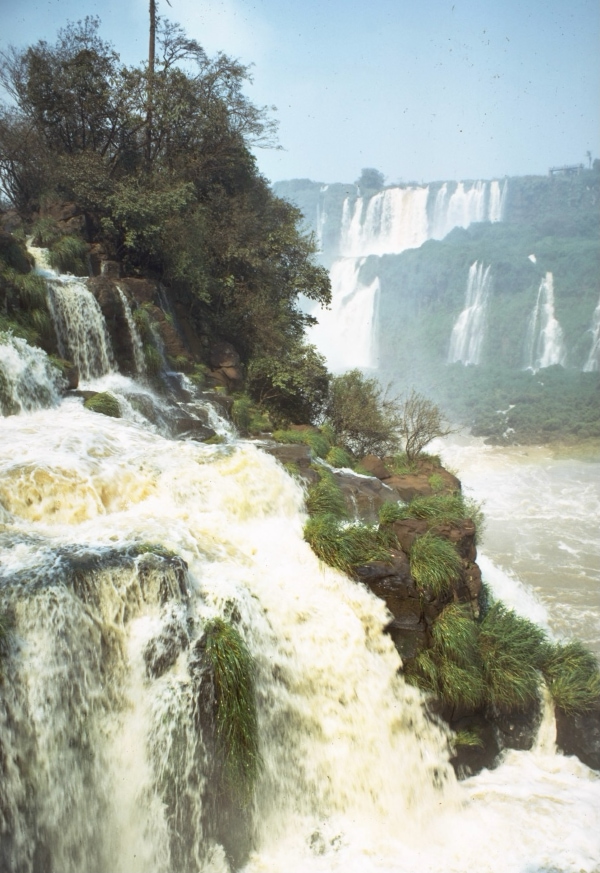
IGUAÇU described in guide as greater than either Victoria Falls or Niagara. Perhaps best to go into Argentina there and miss Paraguay. See falls from Argentina.
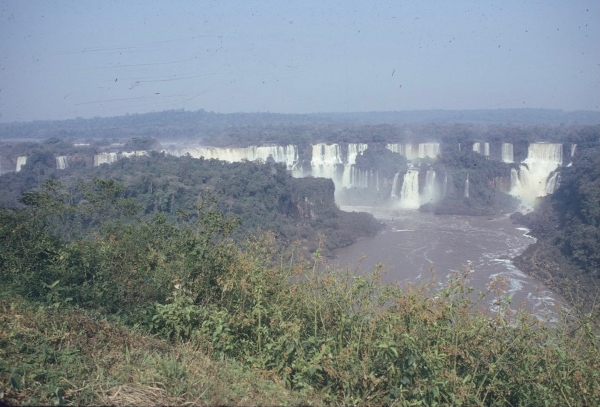
Take road to Posadas through Missiones Province and see remains of early Jesuit missions – San Ignacio, – Corrientes across Parana to Resistencia – via Santa Fé, Rosario to Buenos Aires.
Across Pampa to Bahia Blanca – Neuquen – Bariloche. Lake district, glaciers, mountains, etc. Lake Nahuel Huapi.
Across Andes to Osorno (mostly paved) Up Highway to Santiago. Back into Argentina to Cordoba. North through Salta to Bolivia. Road from Bolivian border at La Quiaca to La Paz is rough but passable in dry weather (up to November.)
From La Paz round Lake Titicaca into Peru to Puno. Then on Central Andean Highway to Cuzco – and Macchu Picchu. From Cuzco there’s a road S.W. down to PanAmerican Highway at Nazcar, but no information about it. The Andian route to Lima is described as very bad and with the precipices on the wrong side.
Rough estimate of times:
1 month from Rio to B. A (including stays.) 1 month from B.A. to Salta. 1 month from Salta to Panama.
August 12th
Began my efforts to release the wheel from customs. [The front wheel was damaged by my various falls. Meriden offered to replace it. I don’t recall why in Rio where customs were notoriously difficult.]
Marcia asks Geraldo who sends me to the despachante Ivan. He passes me off to a ‘convalescent’ who appears to understand that it must be done quickly and that I must know what it will cost. The whole week went by without my knowing anything at all and finally on Friday I was asked to sign forms and pay a ridiculous 2000 cruzeiros. I refused and called Brasilia.
[After my detention in Fortaleza the Foreign Ministry tried to make amends, inviting me to Brasilia. and offering assistance if I needed it.]
Next Monday the whole process will have to begin again, and hopefully Ivan and his merry men won’t feel obliged to obstruct it out of spite. The money story also continued – since I went to the bank without my passport and although the dollars are now available, I couldn’t have them. Eventually collected on Friday.
Nixon’s resignation has sent the dollar up from 6.5 to 7 and it may go higher.
Next week: The Saga of Andrade.
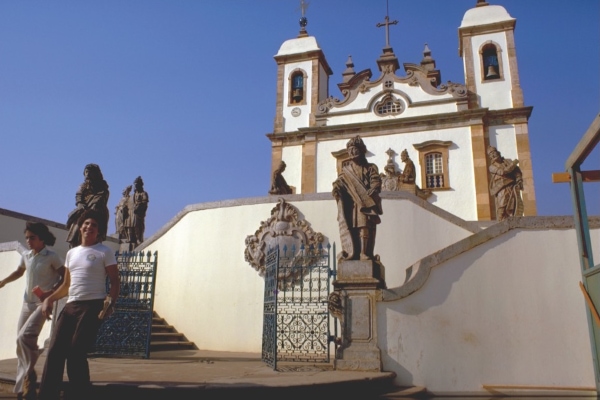
The beautiful chapel at Congoñas. The apostles stroll around outside.
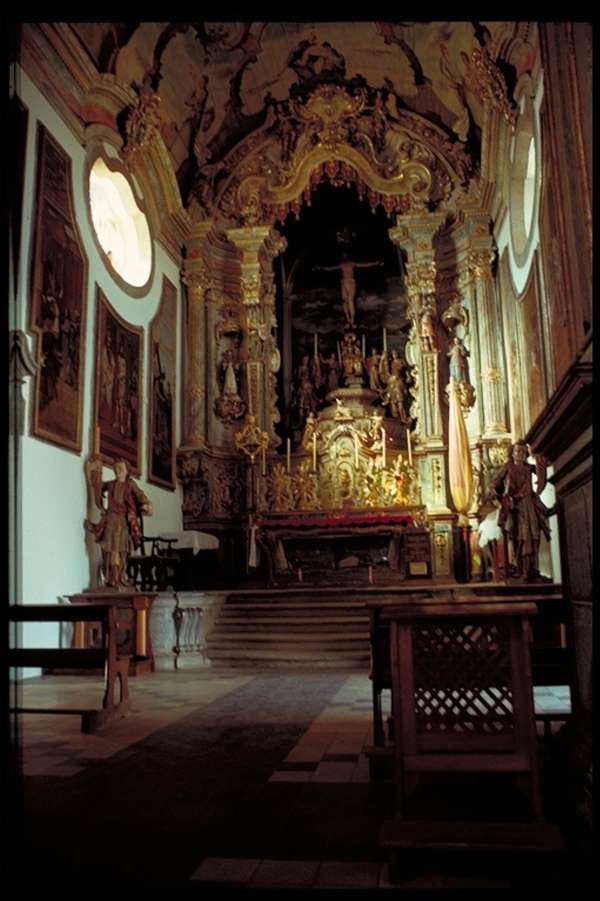
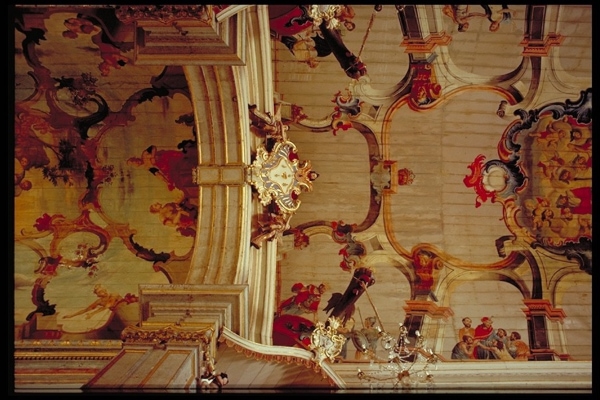
Still in Rio, travelling around with Lulu but dealing with a consequence of my prison diet. This is not for the squeamish.
July 20th
Went to visit Lulu’s grandmother in Vassouras, about 75 km inland from Rio. Countryside hilly. No level land at all. River Paraibo.
We visited a colonial house preserved as a museum. It used to be occupied by a rich spinster who was in love with a Parisian couturier (so it is said) but was forbidden to marry him. The house has a simple, almost flimsy appearance from the outside to a European eye, being made of wood with little concern for keeping out non-existent storms and freezing weather. The rooms are arranged around a patio – big rooms, beautiful floors and imported furniture (oak chairs commissioned in large quantities). There were papers and exercise books in a cupboard – essays in French and English, copied out painstakingly. The newspapers were of mid-nineteenth century – with classified advertisements for slaves. One was selling a 12-year-old, suitable to receive caresses. Another asked for information about a runaway girl, describing her mannerisms – holds her head on one side – looks two months pregnant.
July 22nd
[For some time since the rice and beans of Fortaleza I had been suffering from unpleasant symptoms up my arse.]
Day dominated by appointment with doctor. Adolfo Milech, Youngish man with merry conversational manner. Face connects with Slav name. Strong “Punch” nose, wide full mouth on flat plane of face. Surgery on 4th floor of big block in Copacabana. Ground floor a labyrinth of split levels, escalators, glass shop windows, 4th floor wood panelled corridors, like discreet tunnels, Receptionist a smart but motherly woman about 40 knitting behind small desk in a cube-shaped space, with small pieces of reproduction furniture.
The doctor chatted happily about his dissatisfaction with censorship and repression [Remember: Brazil was a police state.] He didn’t like it since living in the States. It’s hard sometimes to resist the impression that these opinions are offered to pre-empt like criticism from foreigners (as in South Africa.) Unfair probably.
The business wasn’t too humiliating, thanks to his recognition.
July 24th
Hospital for rectal examination, Santa Casa de Misericordia – built as hospital 200 years ago. New one with 400 beds going up now near airport. As a building though this one is much more inviting than English Victorian hospitals. Several doctors involved in process – four plus Milech. The examination was very uncomfortable, verging on pain – or at least a sort of abdominal sensation which is intolerable (though pain is not really the word.) I was surprised at the location of the feeling near the front of my belly, and only understood it when I saw the length of the stainless steel tube used to conduct the light and the instruments (about 12”). Went on a bit too long. They found internal hemorrhoid which I’ve apparently had for some time (Huh!) and much inflamation. They pulled out some shit to examine – with shouts of triumph (“Teng fes!”) for parasites. But again their good humour saves the situation. The specialist wore tight-fitting long-sleeved polo-necked vest and groovily flared white trousers, but revealed loose flesh falling over his waist band. All of them had white shoes.
Friday July 26th
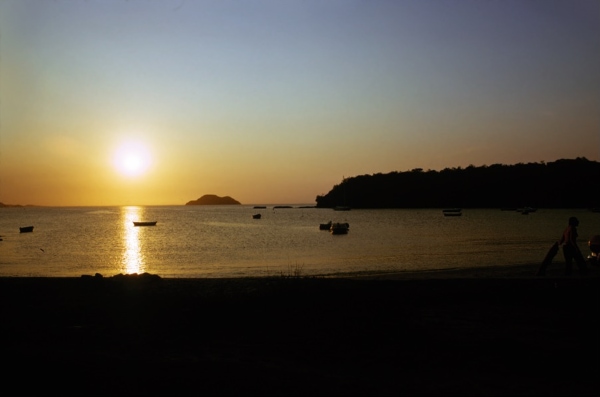
Drive to Buzios [A very fashionable resort on the coast north of Rio. Because of the way the coast curls round you can watch the sun setting over the Atlantic.]
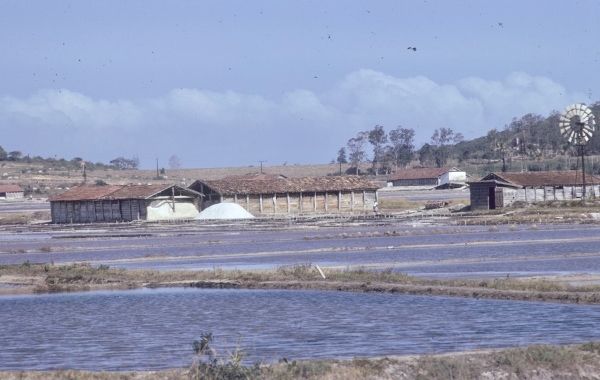
Drive North up the coast over the Niteroi bridge (10crz) Passed salt business, long wooden shacks with tiled roofs for storing salt. Men raking it out in heaps. Windmills to pump sea water from lagoon. Shrimps on slivers of bamboo (6crz a 100) for 1 or 2 crz each. Eat them whole (headless) with lime juice.
Buzios was small fishing village – whole area owned by two families. One has big house on it’s own small beach. Other has new house on other side of Buzios. Buzios itself has a dozen or so smart bldgs and one or two original cottages. White plastered brick, rough hewn posts 8” square, from eucalyptus. Often a lot of wind. Many other small beaches. Bardot came here a while ago, got the fashion under way. Very expensive now. Lulu has bit of land 15 X 60 metres on other side of peninsula – worth £10,000 now.
Michael Sarne [Sixties pop idol] has house in Buzios. Passed me on beach, smiling, but I didn’t recognise him. An elderly friend of Lulu’s lives further round the beach. Travels a lot. Only once had an English lover. Met him at Moet & Chandon chateau. After they’d made love she said she was surprised how good he was. He was the “unique Anglais de ma vie.” He replied, with heavy English accent, “Ne soyez pas ridicule.”
There’s also a Miss McGregor, widow of a man who used to go to the office every day leaving her enough money each week to maintain their modest house. She had no idea what he did at the office. When he died she asked the lawyer, timidly, whether he thought she could afford a visit to relatives in England. He regarded her with astonishment. It turned out he owned the “Light Company” in Rio [All of Rio’s electricity.] “Madam, you can do anything you like,” he said. It was a complete surprise to her that she had become a ‘milliardaire.’ Now she leads a totally and unselfconsciously lavish life in Buzios.
There’s more about all this in the book, of course, including my problems with Hemingway. Next week, my meeting with Kubitschek.
