Articles published in November, 2026
Having escaped death without even knowing it, I continued blissfully to the coast and my first view of the Pacific Ocean.
October 31st
The road was lovely in the morning. It escorted the river to the Pacific, coming closer all the way until at last, after teasing it with several crossings, they ran hand in hand to the sea. I arrived at Pucatrihue at 8.15. The place was barely recognisable as such. A house here or there. But the posada [hotel] had a sign up in yellow, hand painted. I went on a way along the coast, to a tunnel, but realised I’d passed it. Went back. Maid answered. Two dogs barked at me. She invited me in. Offered me breakfast. Then came back to tell me that they couldn’t change my money. Disaster. [The junta had made it illegal for private citizens to trade in foreign currency. Penalties were very harsh.] She was short, chubby, straight black hair, a trifle severe, in apron and head band. She suggested that the police in Bahia Mansa might help since they had a jeep and must have petrol. I was very upset – had set my heart on staying and could see no way. Half hoping she might think of something, or at least offer me a coffee I prolonged the agony but it was useless. I rode back to the Bahia Mansa road.
My sadness could not survive the pleasure of the countryside. I have suffered from a surfeit of scenery on this trip and yet from Bariloche to here it has lifted my heart. This is how I imagine 18th century England at its best. Clear cool water rippling over stones, flat grassy banks, trees leaning over for shade, every artefact made of wood, no cement, no asphalt, scarcely any iron, few vehicles, an occasional person, birds, scent of blossom and pine, light breeze under hot blue sky, rustic bridges, empty beaches smelling of seaweed.
A man in heavily darned brown corduroys, jacket and old trilby is fishing in the sea from the beach with nylon line wound round an empty oil can – the most efficient substitute for a rod. But that’s later. Now I arrive at Bahia Mansa. The Carabineiros are halfway down to the sea. A stocky fellow who might well be German, receives me politely. I explain my troubles. He ponders the matter weightily, but he is obviously going to try. Perhaps, he says, the hotel at Maicolpue will be able to change money. It is bigger than the one at Pucatrihue and is owned by Germans. He himself could do nothing, he was not going into Osorno today and tomorrow was feria. Good God, a national holiday. All Saints Day, November 1st. How much petrol did I need? Three litres. Did I have a can? Yes. He took it off and came back with four or five litres. Now he seemed pleased to have helped me. Could I do nothing for this, I asked? No. He asked a few questions about the bike and waved me goodbye.
So I went on to the next bay south, Maicolpue. This was more of a resort. A few dozen wooden houses faced the sea on a steep hillside, all painted in fresh, vigorous greens, yellows, orange and blue, and all shapes and sizes.
[I slept on the beach that night and in the morning went in search of the German hotel.]
November 1st
Herr Witmer was supervising repairs on the gutters of his Hosteria. I asked if I could speak German to him. It’s all the same to me he replied in Spanish. So I told him in Spanish that I wanted to change money, and he answered politely that he couldn’t. So I went down again to the beach, rode along the shore a little way and made my breakfast of fried eggs, bread butter and coffee, sitting on large boulders looking out at the Pacific and watching the fishermen plying their oil cans, sending a steady stream of live bait into the ocean from a plastic bag and getting, so far as I could see, nothing in return.
I washed up, repacked my things, (small petrol stove, plastic baby’s bottle full of condensed milk, non-stick frying pan, pepper and salt in film cannisters, butter, steel mug, etc.) and set off slowly back to Osorno to enjoy the countryside. It was a rought, stony surface, and without the hydraulic dampers the rear suspension was far too springy. But the spectacle was glorious. Again I stopped, to look at a bridge across the Rio Trallanquin – a suspension bridge for private use. Across the river grass, with three cows, bushes and trees at river bank – one tree with bright red blossom that I saw everywhere – all so lush, so peaceful, so sweet smelling – like milk.
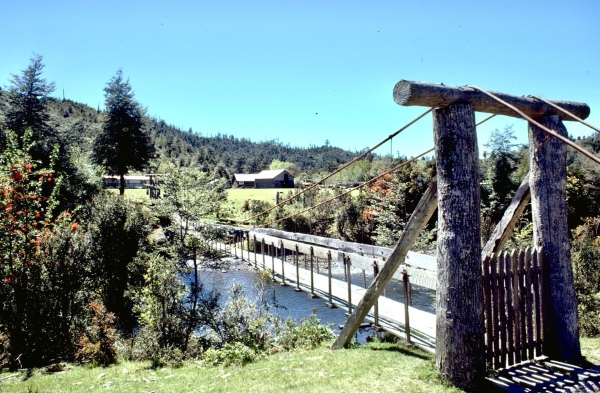
In Osorno I took the guidebook’s advice, but Hotel Rouq refused to answer its bell. Why not try the Gran said a boy, it’s much better. I went there thinking it didn’t look all that Gran. They shoved the ‘fiche’ at me and filled me in the register before I could ask the price. They seemed surprised that I should care, and said it rapidly several times. It sounded like 1,800 escudos. I didn’t pursue it since I knew I would stay anyway. What’ the dollar worth, I asked? They didn’t seem to know that either. And asked around a bit, but I got another vague figure with seven in it. Went out on to the plaza to look in shop windows. One of the first things I saw was a blue enamel chamber pot for 1,800. Then the money changers opened shop (at 3.30) and I got $40 worth at 1,350 to the dollar. At this rate the Gran is very cheap indeed I thought and knew I must have it wrong. I went on walking to see how prices ran. They were very chaotic.
There were funny old-fashioned things there. All manufactured and canned stuff was expensive. Monstrous concrete affair with cross on top. Wooden clapboard houses, old and dusty. But neat girls, all dark. (Guide [famous South American Handbook] talked of blonde girls – didn’t see a single one). Went back to hotel. Slept. Went out again. Piano music broadcast from centre of the Plaza, but meanwhile found out what the room costs – 2,600 escudos, $9.5 or £4. Went to eat at Otto’s. Left it till 8.30 because guide says dinner is never served before 8. Was hurried along by supercilious waiter who said they closed at 9. Brought me a bottle of red wine at 2,500 esc. And had the cork out before I’d even worked out how expensive it was. It was a good wine, but hell! That meal – consommé, pork chop and fruit called chirimoya in orange juice – cost 7,500 – or £2.10. With coffee and cheese sandwich at lunch I’d spent half my $40 in one day.
Strange arithmetic, but making the money last was a constant preoccupation.
Next week begins my ride up the North-American Highway – the Pan-Americana.
After ten days with the Wesleys I tore myself away to cross over the Andes to Chile.
October 30th
Left Wesleys at 11.30. Rode a few miles and came back for plastic butter pot. Rode off again a few more miles, and came back again for waterproofs. [This always seemed to happen when I stayed anywhere for any length of time. Always very embarrassing after all those fond farewells.]
Road out to La Agostura is a sensational ride past Lake Nahuel and, later, anther one. Most utterly beautiful – transcends the prosaic. Drawn physically to it, roll in it the way a child rolls down grassy banks and tries to fit into the ground. Pine trees here. National Park. Later, on the pass itself no conifers but a tall deciduous-looking tree with light green foliage (Spring – maybe new leaves?) Banks of snow all about, but road surface all right – some kind of clogging gravel, makes good non-slip top. Later coming down into Chile very unpleasant ripio – as in Ethiopia – lots of coarse loose stones – many slips and slides and very unsafe feeling. But vegetation changes dramatically on Chilean side. Now big ferns and bamboo type plants – and the forests are choked with creepers and six-foot high undergrowth.
Finally, country opens out into lush, fertile, well fenced and worked dairy land. There’s a big lake and a river. Then to my great relief, about sixty kilometres before Osorno, the ripio ends and asphalt begins. There are milk churns of the old English type and oxen ploughing, or drawing carts.
[No mention in my notebook of the heavily military border post, with displays of weaponry supposedly seized from left-wing “terrorists.” But no problems for me. First town, Osorno, is rather sleepy. Arrive too late to buy anything or change money but I wandered around looking into shop windows.]
The shops still sell suspender belts, individual stockings, and garters for men – and lots of braces.
I was bound for Pucatrihue on the Pacific coast because Teddy Wesley had told me to go there [to a small hotel he knew]. But from Osorno the road was a fairly stony one, and I found myself riding straight into the setting sun. In Chile the setting sun is no modest disc, no dying ember. It is as hot and liquid as a midday sun in June. I could see scarcely anything – the peak of my helmet afforded me a slice of road as thin as a microtome. Most annoying of all I could tell the countryside was beautiful. I eventually stopped to camp rather than continue.
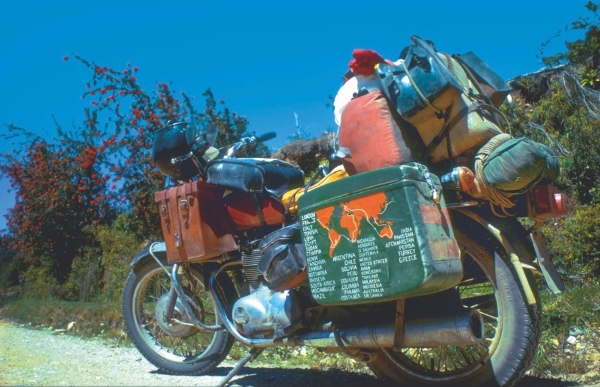
On the road to Pucatrihue: New bags at front, camera bag over the cylinder, old bags over the jerry can, and the white Ballet Ashcar hold-all on top which caused much confusion among young macho men at petrol stations. Hammock and mosquito net over rear light.
I camped by a river on a grassy slope leading down from the road which crossed the river on a wooden bridge. As I cooked my dinner (steak, rice sardines, wine, coffee, bread and butter) cloud had covered the sky almost obliterating the full moon.
October 31st
Woke up at 6.15 and unzipped the tent flap to see what kind of day it was. A drop of condensation fell from inside the tent into my eye. Sky was blue. The loose planks rumble and the first morning bus passes soon after dawn. Get up, comb my hair, catch the bus in seconds flat – no, that’s just a passing fantasy. My boots are outside the hut, next to my plastic jerry can. It has about 3 litres of petrol in it. The bike is under a sheet of clear plastic bequeathed to me by some students from BA. who joined me on my journey to Mar del Plata. As I take the tent down (it’s very wet, dew on the outside, condensation inside) a man on horseback comes down the slope. He wears a woolen hat and a sub fusc poncho, and his stirrups are carved out of wood like decorated clogs without heels. (The bronze ones came with the conquistadors and are prized antiques). He speaks to me in a sing-song Spanish which I would not ordinarily understand, but he has a speech defect which slows him up so that I could catch the drift of it. He asks me if I slept here last night. He seems vastly surprised by that, but the motorbike rouses no interest (apparently). [Later I learned that under the dictatorship anyone found sleeping out could be shot on sight.]
Did I see a horse? At first I say no. Then I remember that just as I was going to sleep I hear an animal galloping away. I told him and added that it had not crossed the bridge.
“Entonces,” he said, “it must have gone the other way.”
He thanked me and rode off, but across the bridge, so I assumed he hadn’t thought much of my information.
By 7.30 I was packed and ready to leave. I put the three litres into the tank and calculated I had enough petrol for about 75 Kms. I was about 40 Kms from Osorno and 25 from Pucatrihue. Now I had to decide whether to risk finding no petrol or money in Pucatrihue or to return to Osorno.
I went on, of course.
After all I had dollars and pesos. And two eggs, bread and butter.
Did I survive, like W.C. Fields, “on food and water alone?” Come back for next week’s thrilling instalment.
Meanwhile raise a glass with me: America has come to its senses.
Friday October 18th, and camping at Piedra del Aguilla
Piedra had a row of jagged rocks behind it on the left, a few houses, a police post where the policeman was tending his garden, and some shops and houses on the right indistinguishable from each other. All whitewashed and quite neat looking. Found a butcher – young man in a small room with a few half carcasses of mutton in a fridge. Bought a few ribs and the kidney and went to another shop next door to get eggs. Same man appeared behind the counter. Also got half bottle of white wine. Then went off behind the rocks to find the river, along a dirt road about a kilometre away, where it crossed a stream which was a tributary to the Limay, itself tributary to Rio Negro. The stream was milky with lime, and burbled through a corrugated iron duct under bridge. There was a bank, like a shelf, with grass and trees where I pitched my tent.
Made a fire in a shallow hole and dug some green sticks into the ground to lean across the fire on the lee side to carry the mutton.
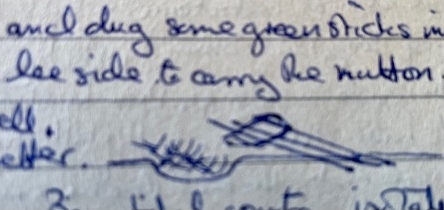
My primitive little illustration
Since the wind was steady it worked well. Next time I shall develop the idea better.
This camp was a great success. Beautiful country, isolated. Only disadvantages were, no shelter from icy wind, and water too muddy to be appetising.
Saturday 19th
Breakfast of kidneys and chopped mutton cooked in butter, with bread and coffee. Back to Piedra del Aguilla, through a shallow flood, to gate where man waited to let me through. He asked for the time and for a moment I suspected him of wanting my watch. These last days I’ve been going through a paranoid phase, anticipating trouble, writing righteous letters to Triumph and Duckams [sponsors] plotting revenge, etc. But the mood affects me far less than it would have done, say a year ago.
The journey from Piedra del Aguilla to Bariloche is marvelous. Desert hills rising and falling, rock escarpments, dusty lime-green tundra. [This road is famous for the fantastic shapes of the rocks alongside it.] Stopped to take pictures near ruined stone building. On delayed exposure, dashing between camera and bike, would have been very funny to watch.
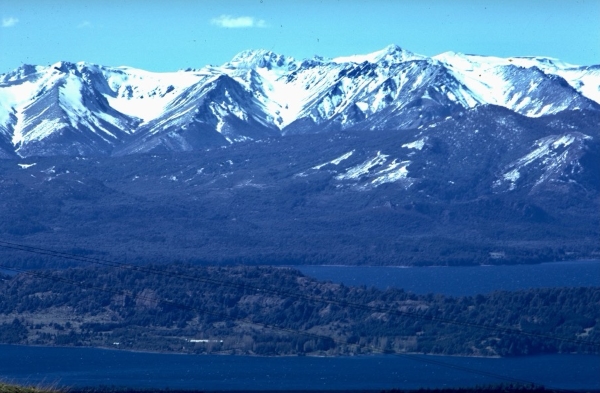
Then the first snow appears on distant peaks.
[I had an introduction from a student called Jorge whose uncle had a hotel in Bariloche.]
I found Jorge’s uncle in his hotel and got tea and directions to Wesleys.
Sunday 19th to 30th
Stayed with Wesleys – just day to day. Teddy Wesley, wife Leo, sons Kevin, Robin, Rocky and Tom. Have business making candles – “Vellas Leo” – Km 15, Ruta de Llao Llao. Formerly had chickens. He is 56, was in commandos in war, born Argentina, descended from Wellesley [Duke of Wellington]. Wears conquistador beard, reddish brown hair, small glittering greenish eyes, slow smile and detached expression. All exhibit behaviour I associate with big families. Rocky has belligerent sociability, wears his sideburns longer than he should, has petulant lips. Tom is said to have dyslexia and still can’t write properly. He has horses to hire out. He and Rocky are still at school – Rocky because he lost a year in Europe.
Staying with them is Hermione Green, chubby girl whom I thought at first to be part Indian or Eskimo. She does wax crayon drawings of prototypical waif girls and old gauchos, and sells them for 250 pesos each, when she can be bothered. (£6 at the time). Also teaches English in afternoons – paid same amount per week of teaching.
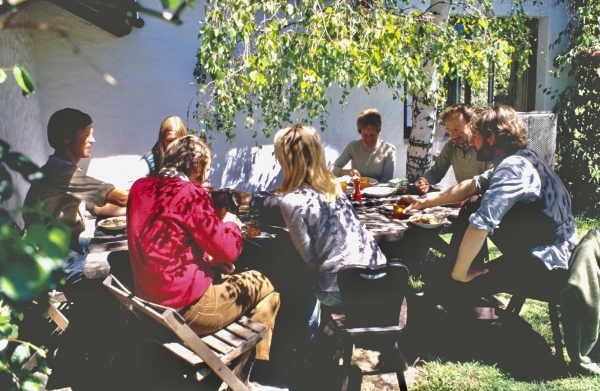
The Wesleys at lunch. Their life struck me as quite idyllic. They were hugely hospitable.
They live on the edge of Lake Nahuel Huapi. On other side of the property is Lake Moreno. Between them and Bariloche is Puerto Moreno. At Llao Llao is a loop of road which goes round the Grand Hotel Llao Llao (once in Peron’s first time a fabulous place) and past it’s gold course, then to L. Morena and back. Called the Circuito Chico.
Skiing mainly at the Cerro Catedral a mountain with three needles which can only be seen from other side of Bariloche. (Teddy climbed one once.)
[They introduced me to the crème de la crème of Bariloche.]
Hotel El Casco – Ruth and Alfred. He from Stuttgart, she from Berlin. Each previously married but separated by war. Her husband was held in Russia. His wife took refuge in Sweden. Both marriages failed. They met and married – and left all their families in Germany to go to Argentina. Gradually their daughters came of age and visited them. One married at the Atomic Plant – but he died of a brain tumour. Then she married there again and another daughter did the same thing. Their hotel is very splendid and personal. Roses on the pillow, chocolate on bedside table, very plushy restaurant.
She, in Wagnerian gowns looms over his neat but crippled body (in black tie when I first saw him). Polio as a boy.
Andrew, the Polish ski instructor, lives a disreputable life in his home-made house on a windy shore of the lake. H makes a presentation of himself, eyes faded blue (Leo’s also) and tells scurrilous stories about people and their private lives, putting a folksy significance on their behaviour. i.e. The woman who threw herself from a window was “because he couldn’t satisfy her;” Most suicides, he says, are due to sexual reasons; He stinks from far away, etc. He worked on the Polish ship ‘Batory’ [Once famous in the Cold War.]
Bariloche offers skiing from May to September, climbing, horses, canoeing on the Limay, Wonderful lakes, mountains, forests. Chocolate and candles. Wesleys have ground on Limay between river and hills. Everything is a dusty lime-green on the way to Piedra. Poplars for windbreakers. [Teddy took me there to try out an idea he had for generating electricity from fast flowing river.] We experimented with turbine model on oil can.
[The most interesting stories in Bariloche came out of the famous Atomic Research Laboratory established there before the second world war. At first, it attracted Jewish physicists escaping from Nazi Germany. After the war it attracted Nazi physicists escaping justice. They were all said to get along with each other extremely well.]
Next week, to Chile, now another military dictatorship.
