News from Ted
If you remember, I came through the US border at Nogales with remarkable ease. It was late afternoon on a Saturday in May of 1975. I was tired after a day of riding through hot Mexican desert. My bike was limping along and would only run on full choke. I had no real sense of the distances I would have to cover in America and imagined myself to be practically there – in Los Angeles, that is. I stopped as soon as I could after about thirty miles. My notes became very sketchy, and need fleshing out to make sense.
To Rio Rica – campsite. Met young guys – one Viet vet – to girl friend’s house – soup, sandwich. Beer. Slept in hammock. Next day couldn’t get gas – man gave me some from truck. Talked about trying to get work – made it sound difficult.
Rode on through Tucson, Phoenix, into Mojave Desert.
Surprised at distance without gas – at desert itself – as hot as Mexico. Wind and sand. But the freeway made it seem less hostile. The Colorado River took me by surprise. Took a $3 berth at a KOA site by riverside. Much friendship and hospitality (beer generosity) – swam in river.
This was my first introduction to the snowdrop community – I was amazed by the RVs with their huge awnings, Astroturf and white picket fences. I can still remember how delicious was the ice-cold Coors. It never tasted so good again.
Next day more desert and high crosswinds made life quite difficult.
The bike would only run well at about 50 mph, so I was limited to the right lane, leaning over to compensate for the wind. The big trucks passing on my left cut off the wind abruptly, giving me some bad moments until I learned to deal with it.
Into LA – but it wasn’t.
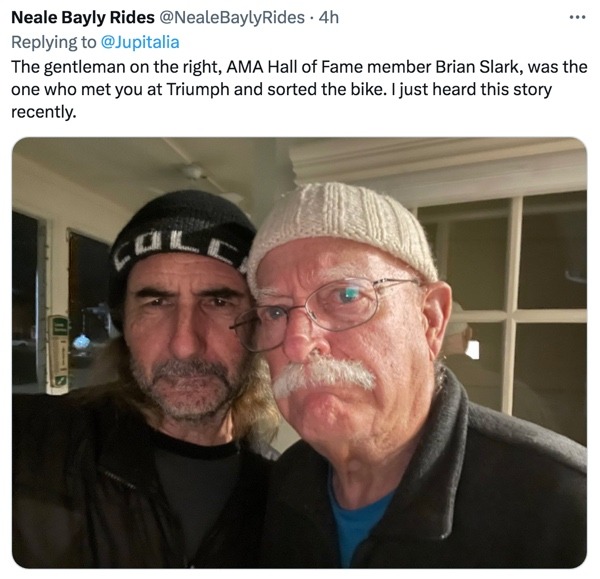
I must have had an address for the Triumph offices in Duarte, but I had no idea that Duarte was a separate city. A young Englishman called Brian Slark received me with a handshake and a beer.
Just the other day Neale Bayly sent me a picture of Brian as he is today, from the Barber Museum in Alabama.
At this point I think it best to repeat what I wrote in Jupiter’s Travels:
I looked around Triumph’s prosperous offices with an optimistic eye, anticipating some sort of unspecified “good time.” Sure I wanted a beer, and a shower and a chance to change my clothes and even to rest for a bit, but what I really wanted was company, nice enthusiastic, appreciative company. As a Hero I naturally assumed that people would be tumbling over themselves to accompany me. All the keen athletic executives in the front office were extremely cordial. All the pretty girls at their stylish mahogany veneer desks smiled very nicely at me, but as the minutes passed my bright eyes glazed over. I wasn’t making contact. In spite of all the niceness, I knew they couldn’t really grasp who or what I was, and maybe, even, they were too preoccupied with other matters to care.
I must have been a strange sight. The desert sun had burned me very dark and printed a goggle pattern on my face. My shirt was threadbare, and my jeans were shredded across the knees and awkwardly patched. My hair was unfashionably short and disheveled, and I was a bit crazy at the thought of having actually arrived. I imagined myself to look quite romantic. After all, I was the real thing, but their nice, orderly eyes gradually convinced me that I was a bit of a mess, and the best thing I could do was go and clean up.
The credibility gap widened into a yawning chasm and never closed. They were unfailingly nice to me, and materially generous. They took the bike into their workshop and promised to give it all the care that could be lavished on it. They gave me another bike, the same model, to use in the meanwhile. They took me to a hotel about ten miles away and booked me in at their expense and left me there until the next day.
My hotel room was at ground level and had thick glass sliding doors instead of windows, with two sets of curtains. I had a square double bed with freshly laundered sheets every day. At the foot of the bed was a big color television set. There was a writing desk, itself quite a decent piece of furniture, and in the drawer was a stack of stationery and leaflets describing all the hotel’s services and telling romantic tales about its supposed history. I read them all avidly.
The bathroom had apparently been delivered by the manufacturer that morning. Everything in it was still wrapped or sealed by a paper band guaranteeing 100 per cent sterility. Not even the boys from homicide could have found a fingerprint in there.
They kept me there for ten days, a slave to luxury. That’s all for now. May I remind you that Jupiter’s Travels in Camera makes a really gorgeous Christmas present. If you ask me nicely I’ll knock $10 off the price for the holiday season (enter the discount code askingnicely when you checkout before 18th December.)
Two weeks ago I buried myself in the past to avoid the present, and today I can’t see any point in coming back. Almost anything I might have to say about current events would almost certainly provoke fury and outrage. So please join me again in 1975.
I had just crossed into the USA, limping along with a sick engine to Los Angeles where I hoped to get help.
Nothing had prepared me for the culture shock when I got there. After a week or two I wrote about it for The Sunday Times. They gave me a full page, and a bit more, and I can’t think of anything better to offer you now. It’s a long read, but I think it stands the test of time, so here it is:
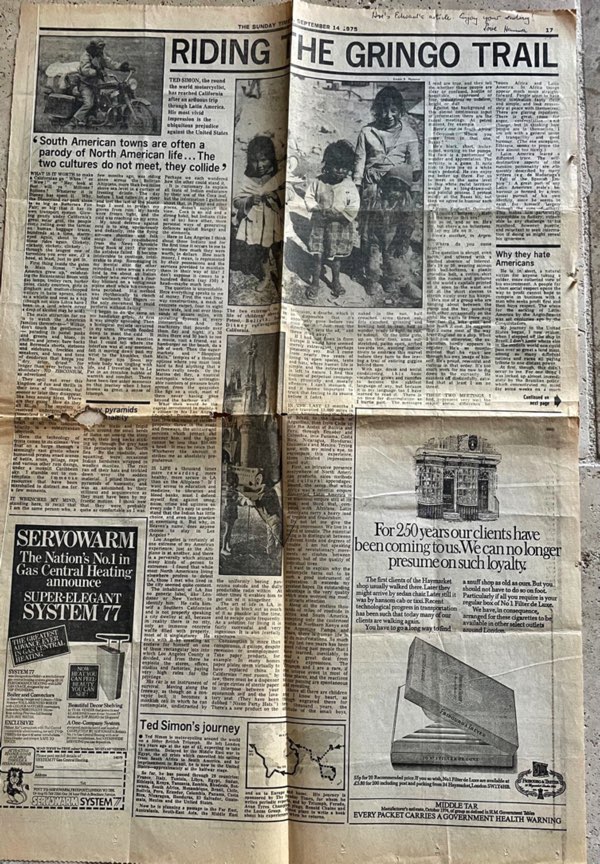
What is it worth to make a Californian go “wheee!” or ‘wow!” or “Hey, look at that, will ya.” Millions? Billions? Whatever it is, Disney has spent it. Why, the Disneyland carpark alone is as big as Battersea fun fair, so big that it has its own transport system. Flowing gently under California’s great solar grill, the people come rolling over the tarmac on human baggage trains, hundreds at a time, starry-eyed again, about to take those rides again. Clickety, clickety, clickety, clickety… through the longest row of turnstiles you ever saw, £2 a head, just to get in.
First thing inside the gate is Main Street “where America grew up,” celebrating the Bicentennial Boom with gas lamps, trolley cars, barber poles, candy counters, girls in gingham and mutton-chopped waiters in baize aprons, clean as a whistle and neat as a nip (though not since Libya have I been in a land where never a drop of alcohol may be sold).
The main attraction for me is to watch the American families themselves – “Wilbur, don’t touch the gentleman” – parading in pastel pinks and greens and blues, in chiffon and jersey, bare backs and Bermuda shorts, Stetsons and sideburns, freckles and sneakers, and tons and tons of deodorant that keeps you “dry, drier, driest” for longer than ever before with absolutely NO ZIRCONIUM as advertised.
They spill out over the kingdom of fun and thrills in their tens of thousands but sooner or later they disappear, like bees among hives. Where are they going? How do they all fit in? The mystery is resolved underground, for Disneyland is an illusion floating on an illusion, and the heart of all this laboured hilarity is a subterranean labyrinth.
Here the technology of trivia comes to its climax. You float on a barge through a seemingly vast grotto where humanoid pirates enact scenes of battle, arson, pillage, rape, and various other rum doings, under a moonlit Caribbean sky. I stumble out to contemplate the immense resources that have been marshalled to distract me for a few moments.
It wrenches my mind, standing here, to recall that I am the same person who, a few months ago, was riding alone across the Bolivian Altiplano, more than two miles above sea level in a curtain of freezing drizzle. The day before, I had fallen in a river and lost the last of the plastic bags I used to protect my gloves from rain. My hands were frozen tight, and the cold was reaching up my arms.
My usual defence against cold is to sing, uproariously and defiantly, into the flying air – sea shanties and folk songs dimly remembered from the News Chronicle Song Book of 1937. For once the antidote failed. It became intolerable to continue, intolerable to stop. Rummaging in my mental attic for other remedies, I came across a story told to me about an Italian climber who survived a four-day blizzard on a vertiginous Alpine shelf while his companions perished. His method was rhythmically to clench and unclench his fingers – the only movement he could perform without falling.
I began to do the same on my handlebar grips. At first it was simply agonising. Then a biological miracle occurred in my arms. Warmth flooded down to meet the cold. It was such a precise reaction that I could tell where the interface was at any moment, felt it moving down past my wrist to the knuckles then the fingertips. Soon my whole body was tingling with life, and I travelled on to La Paz in an invisible bubble of warmth and comfort. There have been few other moments on the journey when I have known as great a sense of triumph.
On the bleak and frigid plain around me small herds of llama sat among the stony scrub, their long necks sticking up through the grey haze like periscopes in the North Sea. By the roadside, also squatting, were occasional Indian herdsmen wrapped in woollen mantles. The rain ran off their hats and trickled down over the sodden material. I pitied those grey pyramids of humanity and was as astonished by their stillness and acquiescence as they must have been by my frantic motion. I think now that they were probably quite as comfortable as I was. Perhaps we each wondered how the other could stand it.
It is customary to explain all feats of Indian endurance by their use of the Coca leaf but the information I gathered about that, in Potosí and other places, doesn’t support that view. Coca is an aid and a strong habit, but Indians (like all of us) have other more personal ways of generating defences against hunger and the elements.
Here in Los Angeles, I think about those Indians and, for the first time, it occurs to me to wonder how much they were worth in dollars. How much money, I mean, is represented by their possessions and the services provided to maintain them in their way of life? I don’t suppose it comes to a hundred dollars (fifty pounds) a head – maybe much less.
The question is unavoidable. Here, everything speaks to me of money. First the vast freeway constructions, a mesh of concrete carpet, four to eight lanes wide, laid out over thousands of square miles, with spiralling flyovers at every intersection. And the machinery that pounds over them day and night; it’s thirty miles there and thirty back to see a movie, visit a friend, eat a hamburger on the beach, do a job of work. Then the supermarkets and “Shopping Malls,” temples of a thousand options where you must look hard to find anything that a person really needs. Or the Marina del Rey, a nautical metropolis where unimaginable numbers of pleasure boats sprout from the quaysides like figs on a stick, most of them never having gone beyond the harbour wall.
What then would be the capital investment to maintain a citizen in his Los Angeles lifestyle? Divide the population into the value of rateable property, throw in the roads and freeways, the utilities and services which protect and succour him, and the figure cannot be less than 50,000 dollars a head. It may be twice that. Whichever the amount, it strikes me as utterly preposterous.
Is life a thousand times more rewarding, more healthy, more secure in LA than on the Altiplano? If I want access to education and medicine, to libraries and blood banks, must I defend myself first against smog, noise, crime and ugliness on every side? It’s easy to understand that the Indian has little choice, and even less practice at exercising it, but why in heaven’s name does anyone choose to stay in Los Angeles?
Los Angeles is certainly at one extreme of my American experience, just as the Altiplano is at another, and there is a perversity which attracts many kinds of person to extremes. I found that, while most North Americans living elsewhere profess to detest LA, those I met who lived in this city seemed quite content.
The inhabitant of LA has no generic label, like Londoner or New Yorker, to identify him. He calls himself a Southern Californian and is not properly speaking a city dweller at all because, in reality, there is no city, only an immense concrete waffle filled with property, most of it single-storey. He deals with in by creating an enclave for himself on one of those rectangular lots into which Los Angeles County is divided, and from there he exploits the stores, offices, studios and factories, paying very high rates for the privilege.
His car is an instrument of survival. Moving along the freeway, as though on a conveyor belt, it becomes a monkish cell in which he can contemplate, undistracted by the uniformly boring panorama outside and the dully predictable within. At other times, it enables him to get out of it altogether.
The art of life in LA, in short, is to block out as much of it as possible all the time and to escape quite frequently. As a solution for living it is fairly successful and very ingenious. It is also fearfully expensive.
Consumption is more than conspicuous, it gallops, despite recession or unemployment. Take paper products. In many homes paper plates seem virtually to have replaced china. In Californian “rest rooms,” by law, there must be a dispenser of large circles of sterile paper to interpose between your squeamish self and the lavatory seat (they have been dubbed “Nixon party hats”). There is a new product on the television, a douche, which is so disposable that it has apparently gone before you use it. “Just read the directions,” says the ad, “and throw it all away.”
If I had just flown in from Europe, it would have seemed merely extravagant (perhaps pleasantly so). But I come from nearly two years of living in open spaces, tent and hut, where human life is simple and the extravagance is left to nature. I find this custom of perpetual consumption physically and morally offensive. I can’t stomach it and it seems important to me to track that feeling to its source before it fades.
In the last fifteen months I have travelled 15,000 miles in Latin America from the north of Brazil to the south of Argentina, then from Chile up into the Andes of Bolivia and Peru, through Ecuador and Colombia, into Panama, Costa Rica, Nicaragua, Honduras, Guatemala, and Mexico. Trying now with my mind’s eye to encompass this experience, three related impressions stand out.
First an intrusive presence everywhere of North American products, sales methods, and cultural appendages; second, the sense that, while Africa was a colonial empire, dismantled, Latin America is an economic empire still at its peak; and third that, compared with Africans, Latin Americans carry a heavy load of trouble and frustration.
Do not let me give the wrong impression. We live in a world of trouble. The essential thing is to distinguish between different kinds and degrees of trouble. I am not speaking here of revolutionary movements or clashes between nations, but of the quality of individual lives.
I also want to explain why the motorcycle turns out to be such a good instrument of exploration. It exceeds my greatest hopes. Its outstanding advantage is the very quality which once worried me most: it attracts attention.
Along all the endless thousands of miles of roadside in Africa and South America, excepting only the cauterised wastes of northern Kenya and the Argentine Pampa and Chaco, there is human life in all its manifestations. So much of my last two years has been spent riding past people that I have learned inevitably to read a great deal from people’s expressions. The Triumph and I are a rare if not unique event in most of these places, and the reactions to our passing are spontaneous and revealing.
Above all there are children and I know by heart, as though engraved there for 10,000 years, the attitude of the small boys, naked in the sun, half crouched, arms thrust out, fists clenched, grinning and howling half in fear, half in wonder, ready to fight, to run, to submit. Or the little girls, up on their toes, arms outstretched, palms open, arched towards me wanting instinctively to embrace this marvel before they turn to flee leaving a trail of enticing giggles behind them.
With age, dress and social conditioning, this basic vocabulary grows and ramifies to become the subtlest language of any but, because it is my language too, I have learned to read it. There is no time for dissimulation as I hurtle past. The messages I read are true, and they tell me whether these people are clear or confused, hostile or hospitable, oppressed or free, industrious or indolent, bright or dull.
Against the background of this almost continuous input of information there the casual meetings. At petrol stations for example.
Here’s one in South Africa:
“Ooooooh! Where you come from in that one, baas?”
He’s black, short, boiler-suited, working on the pumps. His face is a pantomime of wonder and appreciation. The servility is a game. It suits him to have me on a white man’s pedestal. He can enjoy me better up there. For us to meet on the same level in this white racist territory would be a long-drawn-out and painful process. I protest at the baas bit, but then we agree to humour each other.
“From England? Ooooooeeee! No! I couldn’t believe…Huh! All the way in this one?” And so on, and so on. He’s sly, but there’s no bitterness. I’d lay my life on it.
Here’s another, in Argentina:
“Where do you come from?”
The question is abrupt, even harsh, and uttered with a studied absence of interest. He’s 19 or 20, wearing salmon-pink bellbottoms, a plastic crocodile belt, a cotton shirt with the names and pictures of the world’s capitals printed on it, open to the waist and cut at the short sleeves to stretch nicely over his biceps.
He’s one of a group who are hanging about between the pump and the bar, punching each other occasionally on the arms. He wants to know only how fast the bike goes, and how much it cost. He suggests that I came most of the way from England on a ship. When I tell him otherwise, the explanation hardly appears to register. He’s so muscle-minded that he can’t see through his own image of himself. He’s proud, resentful, and curious, in that order. It’s too much work for me now to dig down to the curiosity. He saunters off disdainfully satisfied that at least I am no threat.
These two meetings, I find, represent very well the major social difference between Africa and Latin America. In Africa things appear much more straightforward. People seem to have their motivation fairly clear and simple and look reasonably at peace with themselves. There are glaring injustices. There is great cause for anger, confrontation and change, but in thinking how people are in themselves, I am left with a general sense of tranquillity and good humour (the one exception, Ethiopia, seems to prove the rule almost too nicely.)
Latin America leaves a different trace. The self-destructive aspects of the mestizo personality are eloquently described by many writers (e.g. Madariaga’s “Fall of the Spanish Empire”). A great part of any Latin American male’s behaviour is formed by a continual pursuit of his own identity, since he seems to exist for himself largely through the eyes of others. This makes him particularly susceptible to flattery: vulnerable to any challenge to his manhood, however puerile, and reluctant to seek information if doing so might reveal his ignorance.
He is, in short, a natural victim for anyone taking a colder, more collected view of his environment. A people for whom social respect opens the way to profit cannot hope to compete in business with a man who seeks profit first and then buys respect. The scene for the sacking of Latin America by the Anglo-Saxons was set centuries ago by the Conquistadors.
My journey to the United States began, I now realise, when I stepped off the ship in Brazil. I don’t know where else in the modern world one could pass over so great a landmass, among so many different nations and races all paying tribute to one distant power. At first, though, this didn’t occur to me. For one thing, I was locked up almost immediately by the Brazilian police which concentrated my mind for some weeks on a much closer and more frightening power. For another, motorcycling Gringos are a rarity in the north-east, and people did me the courtesy of asking where I came from without assuming that I was a North American.
I was 2000 miles further south in Rio before the prejudice became unavoidable. Then I was on foot, in a laundry, looking for some clothing that they had lost.
“Are you American?” the man asked, with his own peculiar brand of American accent, and an expression which showed that he was ready to jump either way. I said I was English.
“Good,” he said eagerly, jumping off the fence onto my side. “Americans are shit.”
If I had said I was American, he would probably have told me about some relation of his living in New York.
It didn’t occur to me to protest. I am no stranger to prejudice. The Libyans are contemptuous of the Egyptians. The Sudanese despise the Ethiopians. Africans have little good to say for Arabs, and none at all for Asians. Whites turn their noses up at blacks. A fine old Tunisian peasant entertained me handsomely in his mud hut and then, sipping coffee within two feet of me, told scandalous stories about Jews (I am half Jewish, whatever that may mean) and claimed to be able to smell all Jews from a great distance.
There is no shortage of prejudice between nations and races in South America either. It exists between Indians and mestizos, between Chilenos and Peruanos, Argentinos and Brasilleiros. Even in Brazil itself, supposedly a melting-pot of races, the rich white south is openly content to have few black skins to darken the view, and it is all too clear everywhere that the whites are on top of the pile and mean to stay there.
Yet none of this compares in generality and virulence with the prejudice against the United States, its power, its policies and its people. Whether expressed by thousands of people chanting slogans, or by hypocritical asides from the Spanish gentry; whether directed at dollar diplomacy, the US military, the CIA, or Yanquis and Gringos in general, it is heard everywhere as the one unifying idea in Latin America.
It is hard not to share the resentment. South American towns are often a parody of North American life. Shiny curtain-walled banks loom over hovels. In countless decrepit streets a brightly enamelled Coca cola or Pepsi cola sign juts out above every single doorway. Village shops are stocked less with what the peasantry needs than with what American technology produces. Everything has this lop-sided, disjointed feeling. The two cultures do not meet, they collide, and in spite of themselves Latin Americans know they haven’t the force to resist.
They never had time, or the inclination perhaps, to evolve their own independent systems. And yet, unlike the subjects of the British Empire in Africa, they were always nominally in charge of their own destinies. The gap between the myth and the reality was far too wide to bridge, and corruption was the only possible consequence. Nobody I have met in government or law really believes this process can be reversed. I am bound to say that I much prefer the consequences of British rule in Africa to what United States economic domination has done for the Americas.
The Latinos are quite imaginative enough to perceive the humiliating position they occupy vis a vis the “Gringos.” Their accumulation of rage and resentment is sad to observe, and sometimes personally unpleasant. On the West side of the continent, where the so-called Gringo Trail of tourists begins, I was spat on once from a lorry, had mud thrown at me twice, and heard the mocking cry of “Gringo” all the way from Bolivia to Panama and beyond. How I wished then I’d remembered to bring my Union Jack with me.
The British, in fact, are now perfectly placed in South America to enjoy maximum respect and affection. A once great nation reduced to “harmless uncle” status, we suit the psychological needs of Latin America very well. It’s half a century since the pound gave way to the dollar as the major source of foreign investment. There are nostalgic references to the railways we built, the polo tournaments we play, the shops and clubs we opened, and much flattery of London as the best city to live in.
I was fortunate to follow the Royal Yacht’s progress along the coast of Central America (at a respectful distance) and saw how well the old royal magic still works. By popular consensus, we are now all that the North Americans are not. We are civilised, sensitive to the feelings of others, clear of speech and clean of habit, and of course imbued for ever with the spirit of fair play. We are also comfortably old-fashioned.
The impression is helped along by the British communities which still remain. I had never thought to hear again the clarion voice of the ante-diluvian English girls prep school conclude a sentence with a ringing “What!” across the dinner table.
On the playing fields of the Bogota Sports Club I played my first full cricket match in 25 years. And in a smart hotel 10,000 feet above Lima, a tweedy English couple entered for dinner, each with a bull mastiff on a lead. Scanning the room, the gentleman loudly enquired of his spouse, “Same hole?”
For a traveller in search of space and beauty, South America is a heart-stopping experience. Everywhere I saw places where I felt I could cheerfully spend the rest of my days. Like the Atlantic beaches between Bahia and Rio, the luscious farmlands above the Parana River, or the lower slopes on either side of the southern Andes. I revelled in the spectacular fertility of the Colombian valleys and mountains, and countless other times felt myself in complete harmony with my surroundings.
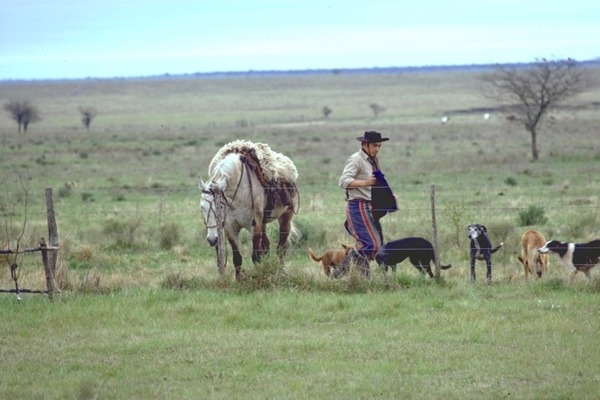
Most of the time I had been moving alone through great vistas of plain and mountain, and it is to these memories that I am most drawn, rather than to the cities. For one who wants to live an economic, hard-working, balanced life in a natural environment, the world still seems to have room enough. I have at least a year of travelling left before the journey brings me back to England, but already I am impatient to stop, to put down roots and grow things. I am totally convinced now that this is the only healthy way to go.
For nearly two years I have been self-sufficient with what I carry on the motorcycle. I am delighted to discover how little a person needs, or even wants, as long as the mind and senses are kept open to the excitement that life itself has to offer. It is this knowledge, finally, that made the ride into Los Angeles such a bruising shock. I see the American consumer as an addict in the grip of a habit at least as, and vastly more expensive than, the Indian’s Coca leaf. It’s a habit which the planet cannot support for ever, certainly not for all its inhabitants.
But worse than that, it seems such a pity that all those resources, all that effort and ingenuity and promise of freedom, which people in Africa and Latin America envy so much, should lead to a sea of waste paper and a desperate attempt to get people to recycle their aluminium beer cans.
Good day everybody.
The news in general is so awful that I’m ignoring it, and finding some peace and pleasure in going back into my journey notes again. It’s May in 1975, and I left you last in the beautiful town of Guanajuato, but the USA looms large on the horizon of my thoughts.
From Guanajuato I reckoned that I was three days away from Nogales and the border. There was no denying that I felt the pull of it. After almost two years on the road, I knew my curiosity and enjoyment of the passing scene was beginning to fade. I was tired and couldn’t help longing for an undemanding environment where I could hand my problems with the bike over to someone else and simply relax. Triumph had offices in Los Angeles and would be expecting me. I became more and more fixated on getting there.
From Guanajuato the road led through Leon to Guadalajara.
Monday: Breakfast in Leon. Chocolate cake and coffee. Hot day. Arrived (in Guadalajara) at lunchtime. Ernesto Renner meets me at a fish restaurant. (He must have been one of the many friends of friends. I can’t remember him now, but thank you Ernesto) He has a bus business. Tres Estrellas de Oro. Little office with electric kettle, coffee and Carnation milk. Room full of new beds and mattresses in plastic. He is much younger than I anticipated. Puts me up for the night and sends me to the Kri-Kri where I chill out to records of acid rock and the blandishments of willowy waitresses in toy aprons.
Tuesday: Culiacan-Los Mochis-Navajoa.
The big disaster. After Culiacan the jacket blows off.
For those who don’t know, the jacket was an original RAF bomber jacket worn by my girlfriend’s father, when he flew Lancasters over Germany. She gave it to me to wear, and it was priceless. I had used it throughout my journey so far. But northern Mexico was unbelievably hot and for once I couldn’t wear it. I tied it down over my luggage – and lost it.
I was devastated.
The loss sets off a strange train of thought, to do with abandoning Jo. Coldly I contemplate it as a natural consequence, weigh the feeling. Think of the jacket as a sentimental burden. The decision to stop looking for it is a protection from the pain of a prolonged parting.
Wednesday: At Los Mochis, much advertised to me, I find nothing to please. Find the sea miles away. – a strange Fellini beach – abandoned beach restaurants haunted by drunken merrymakers – a sign prohibiting litter and immorality and, near it, a vast heap of beer cans, etc. Dirty water, warm as soup.
Thursday: On to Navajoa. Prices are now sky high. Stop at motel where she has no linen. Just for use of room she won’t take less than 70 pesos. I refuse. In town at last I find the Colon – built like a prison wing, two floors, gallery, gates barred. But clean and high ceilings. The trouble with the bike has now become acute – chronic misfiring od right hand cylinder. Spend morning trying to find faul – discover the Zener is kaput. Put a hot wire from switch to coil, but no improvement. Then I find that with choke fully in it runs smoothly at 50mph. But I’ve lost my screwdriver and pliers. The heat on the roads is scorching – forearms burn – altogether I feel that events are conspiring to keep me south of the border – and I am now seething with impatience to get into the States.
On corner of the street near the hotel is a big bar where a lot of men drink draught beer at a counter. They are all well-dressed, smart. Strike up conversation with my neighbour. Seems content with life. Plenty of work, though prices are rising. Someone comes by with a device that measures machismo – two electrodes that you hold in each hand, and a dial to measure the flow of current. Not knowing what it is I take the two, rods and get shocked. My companion tucks his hands under his armpits to hold on better.
From my position at the bar I can watch, through the mirror, some men at tables near the counter. One group of four catches my attention – they are playing dominoes – and with a sense of mounting shock rising within me, as often happens with a sudden realisation of danger or excitement, I become aware that one of the men is ME. Or, simply put, he is physically very close in his hair, mustache, features, colour, etc , but his expressions and mannerisms are as close a reflection of mine as I can imagine. The effect is entrancing. He is in great good humour, joking, gesturing, smiling a lot – tending to dominate the mood of his table as I do myself when that particular confidence moves me. I studied him for a long time to see whether I could judge how I liked him, and whether others seemed to. It seemed inevitable that he would notice me but as best I could tell he never did. It’s strange now to feel that my life continues in Navajoa even though I move on.
There’s live music, the barman is very professional, there are large and small cervezas – 2.50 and 3.50 pesos. The big chunky glasses come frozen and frosted from a refrigerated cupboard. He challks the beers up on the counter in a zigzag – WWWW . The system can lead to arguments.
Friday: To Hermosillo. Spent the morning fiddling with misfiring. This part of Mexico is not of great interest. A reduced version of US affluence around. Oh, but there are some endless arid areas, and a few times off the side of the road was a fenced off area designed to become a poblaçion for resettled people – presumably from the city – unfortunately like concentration camps. Shades of Oscar Lewis haunt me again. [Google Oscar Lewis – he’s interesting.]
The bike continues to run well but only at one speed – 50mph – guzzling gas.
Saturday: To Nogales and the US border.
Mentally preparing myself for a rough time at customs. When I get there I’m surprised to find that there’s no Mexican exit post, only the great complex of US customs, multi-laned entrance like toll gates or a supermarket checkout. Buy a large, iced orange drink with my last pesos, and then dive in. The reception is the opposite of my last experience at Brownsville five years ago.
Dips his hand casually into a pannier, then says “OK” and sends me to immigration.
“What can I do for you?” asks the officer.
“You can let me into your fair country,” I reply.
“That’s good to hear,” he says. “We don’t hear that much these days. How long would you like to stay?”
“How long can I have?”
“I asked you first.”
“Well, three months should be fine.”
“OK.”
Sweet memories south of the border…
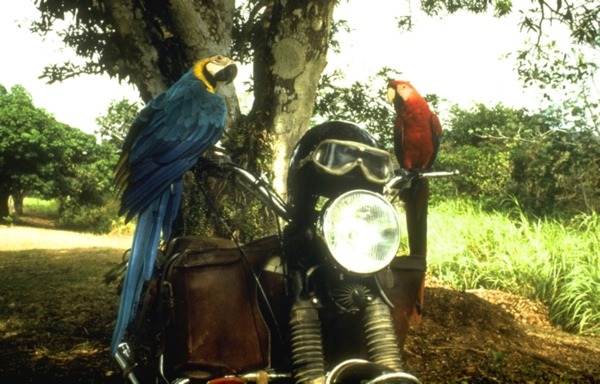
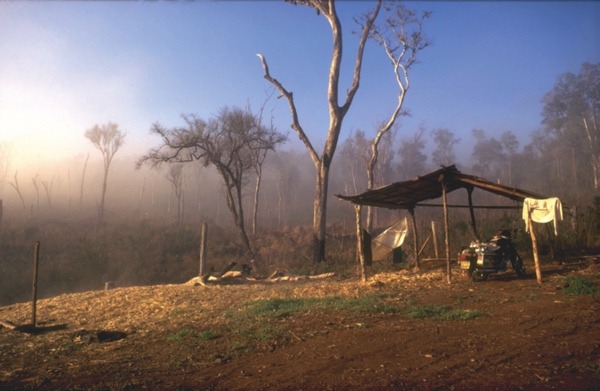
Still in Oaxaca 1975, I was going to continue with extracts from my notebooks as I moved on through Mexico to the USA, but I find them harder to transcribe. Compared with the bare-bones existence of the Andean lands of “No Hay” Mexico seemed quite prosperous, but the prosperity was an illusion. It was created by the availability of goods from the USA which only a few Mexicans could afford.
I arrived in Oaxaca at lunchtime and found it full of Gringos.
“Find a vegetarian restaurant with rooms, called ‘Pices’, opened some years before at the prompting of US visitors.. Meet a Gringo who lives in Oaxaca and trades Indian stuff to (American) stores. He has a small eagle he offers to show me but doesn’t return.
Instead, I meet three other Gringos: A disillusioned screen writer and wife, and a highly nervous dislocated person who walks with short arthritic steps and flits disturbingly from topic to topic, anxious to communicate, fearful of boring, hard to follow. He’s a law school student, probably the victim of a breakdown. He too is planning to trade hammocks. The others are into blankets. Christ, everyone’s at it!”
The hotel had an outside shower with the water heated by a small wood-fired boiler. There was a small stack of firewood. The guest lights the fire and goes on adding wood as long he or she wants more hot water. I was taken by the simplicity of it.
“There must be things to see here but now my interest in Spanish towns is satisfied by a glance at the facades and an hour in the plaza. Church interiors disappoint, and it’s the general disposition of buildings and spaces that please, or otherwise. The Cartesian arrangement of Spanish towns is very apt for Spanish thought, echoing their ideals or wishful thinking. They would like everything to be orderly and just but are hopelessly exposed within these rigid frameworks.”
Well, that’s what I wrote at the time. I don’t know if I agree with myself now.
“On towards Mexico City. Uneventful ride. Stopped to look at small village, but less interesting close up. Went to another to get water from a tap. Took pictures of church and children.
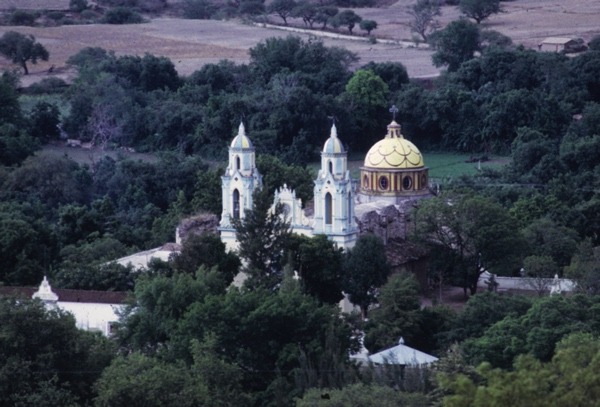
Later followed a path uphill towards micro-ondes (short wave) transmitter to sleep away from the road. Was attended by peasant and his son as I made camp. Others on bikes had been here before me. The man had worked in California (as a bracero) and been badly treated but was evidently pleased to see Gringo visitors. Had my usual dinner, though Oaxacan chorizos were starchy and inferior.
Next morning mother and son came to visit, with tortillas. I offered tea and cheese. Rode on to Mexico City, but now one cylinder is smoking badly.”
In Mexico I was hoping to find Bruno at his girl-friend’s house, and got thoroughly soaked while looking for it. but he had left for France three days earlier. She and her friends let me stay while I found a mechanic called Cojuc, who did some work on the bike. I knew that if I could make it as far as L.A everything could be taken care of there. On a Sunday in June, I left for Guanajuato.
“Easy ride. Good roads. But beginning of valve trouble (still unknown). Begin to experiment again with plugs, under flyover bridge. Very hot. Set off expecting more rain, but country looks dry and sky is clear. The ride into G. is astonishing, because of the endless vaulted tunnel that winds round the top of the hill apparently beneath the foundations of the town to shoot up eventually into the heart of it, by the plaza.. Altogether as impressive an example of preservation and restoration I have seen – (Ouro Prêto, Salvador, Cuzco, Paita, Antigua).
Good feeling. Strange that I’ve never realised before how much more self-respect a city or town has when there’s a university. There’s a graduation party in the square. Small group playing – girl with tambourine, two guitars, drums. Stands all around the dance floor with chile achile, choklo, tacos, and ice tubs full of soft drinks. Watched a cockroach make its way unscathed among all those scuffling feet – a lesson in probabilities.”
I remember that a shiny new bus drove up and disgorged a party of high school kids from the US. The girls all wore shorts and it was the first time in probably six months that I had seen a naked leg. I found it shocking, and almost obscene. The Mexicans around me, who always covered their legs, must have seen this many times, and were unaffected. Another cultural lesson.
I left you last week in Guatemala on my way north. Already in Gringo country – more and more influenced by American tourists and commerce, and I became unreasonably upset that the word “American” now only means the USA. After all I’ve been in America for almost a year. And yet I’m beginning to long for the comforts that I imagine waiting for me when I get there.
To Mexico
May 24:
Rode on towards frontier, where weather improved marvelously. Now very enjoyable. Saw large, cleared space round a pylon and camped in a corner of it. Boy gave me wood for fire – pine saplings – I collected kindling. Cooked onion and tomato and grilled chorizos. Very good. Then rain began. Moved into tent. Boy said many Gringos camped here.
Next day girl came to visit. Would I sell her my (newly purchased) plastic? No. Then later gave her a rather tattered piece.
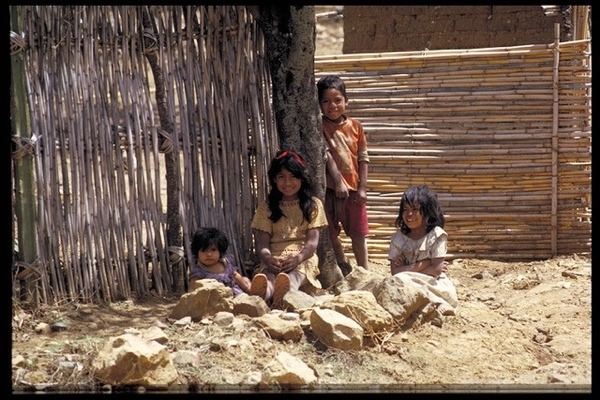
Mexican girls in 1975
Rode to frontier through a narrow mountain pass, very steep defile, impressive, and expressive of history. Know nothing of its history but can sense the drama of the pass.
Weather now beautiful.
Frontier crossing fairly straightforward but for the Mexican agricultural inspector who confiscated my onions and made me eat my orange (lousy!)
His assistant was burning a heap of vegetables with a flame thrower. I asked him if he knew how to cook. He let out a single burst if mirth, then closed up again. They also sprayed my bike, but not my boots though I offered them.
Had I known the geography I would have stayed near there but rode on into the mountains to find it getting very cold and wet. San Cristobal de las Casas, which would have been a natural place to stop, was wet and inhospitable.
I rode past, reluctantly, but soon was forced to stop by a terrible downpour.
Took shelter in a small café where some boys were waiting to play football. There were two jukeboxes and a travelling repair man with a wonderful switch to his hips. His type also drives buses. (I cannot think what I meant by that!).
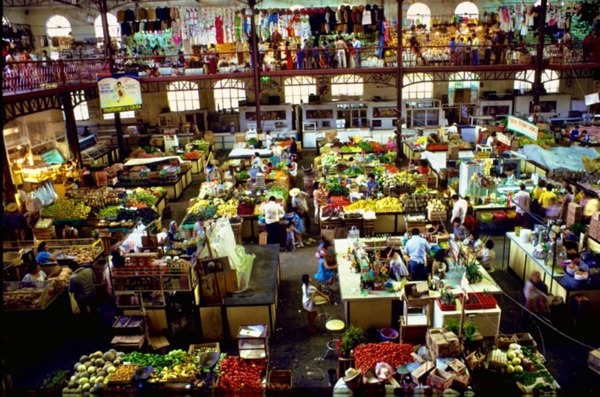
The market at Tuxtla Gutiérrez
At last rain stopped and I drove on to Tuxtla to find a hotel. Hotel Jardin, a rabbit warren round a courtyard in disrepair. 30 pesos.
Old German man in his wooden, screened reception box. Walked round town. Seemed quite prosperous. Ate surprisingly well at Los Arcos.. Best shrimp since Rio and good fish. But prices are beginning their inexorable climb up.
From Tuxtla there is still much mountainous country. I still have the option of turning off to Vera Cruz and consider doing so but it seems to me that if there is rain it will be heaviest on the Caribbean side.
The road fortunately circumnavigates most of the storms (what memories from Africa that revives).
And then, suddenly, I’m at the top of an escarpment looking down on perfectly flat land far below. I can see the road straight as an arrow pushing on to Tehuantepec.
Here it is very hot and sunny. I stop to drink and buy food in the market, determined to sleep out again. The Indians here (according to the South American Handbook)) are a matriarchal society and look it. In the market they are very shrewd and catch-peso. An egg here is 1.20 and over there 0.75.
On I go, running out of petrol and coasting to the petrol station. The tank only takes 12 litres.
A little way along, up the hill a path leads off among bushes to place for a tent. All is very peaceful and pleasant. The stars are out, but for some reason I am nervous about people. I hear a strange “Pssst” sound from my bed and struggle into trousers to see who’s lurking. The sound continues but moves too quickly to be of human origin. Must be an insect – the Psst bug. Back to bed, still unsure, and now buses and lorries are making a terrific din. Distant flashes of lightning and then, quite suddenly, enveloped by a powerful storm, wind threatens to blow the tent away and I cling to the tent poles for dear life as lightning crashes down round me. Then just as suddenly all is peace and quiet again. Fall asleep at last.
Next day is fine. It’s not far to Oaxaca and I arrive at lunchtime.
And I found the picture with the goggles, but I’m not wearing them, for good reason probably.
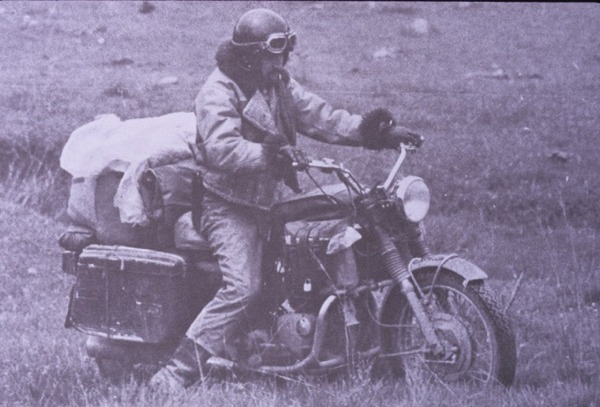
The last time I regaled you with extracts from my notebooks I had crossed Honduras to Copán, on the border with Guatemala on my way up through Central America to the USA. Sadly, I was beginning to long for those first world comforts.
And, so it goes on:
Left Copán at 9-ish. Emigration is in the town. Transit is at the border. The two older girls left at 5 for San Pedro Sula where they fly home. The younger ones were on a micro bus going to the border. Transit took another dollar off me. I pushed them into giving me a useless receipt. On the Guatemala side, the army was represented at a roadside desk by a small, fat man with a bristle (how commonly that’s so). He was in a class of his own though.
“How do you say in English” he said in English “when you have too much in the night?”
“Hangover” I said.
“Hamburger?” he said.
“No, hangover!” and I wrote it out for him.
I HAVE A HANGOVER
“I have a hamburger,” he read. He was entertaining us both.
When he asked for his dollar, and I asked for a receipt he laughed happily.
“Oh no,” he said, “this is for me so that tonight I can make another hamburger.”
For once I didn’t mind losing my dollar. That’s how I like my corruption – honest.
Then there was a police post. An even grosser man, but in uniform, was officiating. He wouldn’t let the girls in because they had no visa, and he couldn’t – or wouldn’t – issue tourist cards. They had to go back on a hundred-mile loop to arrive at the next frontier post at Santa Rosa de Copan – Agua Caliente. I felt for them but there was nothing to be done.
Riding in Guatemala I expected a bad road, but it was quite as good as the Honduras side, but for a couple of easy water splashes.
By now I was in a mood to shorten the journey. At the junction with the asphalt, I should have gone left to Esquipulas but the smooth road to Guatemala City beckoned and I succumbed. It was the beginning of a general crumbling away of intentions, All the planning I did at the Fowlers’ house came to nothing.
At the Capital I nearly came unstuck Took ages to find the Williams’ number (had it in my book all the time, on a card) and then found he was packing up house to move to Paraguay. Kept getting cut off on the phone. But he found a spot for me with Bob Webb of the consulate, and that turned out well.
A new cast of characters now.
Bob Webb, Pat and Greta McCormick, John Rutton (the CARE man) and his nice wife with beak nose, both of German origin. We shot an air rifle, played darts and badminton, went to dinner with an oil man and his family where we sang badly to three guitars and played ping pong. Webb has a maid, country girl with big round eyes, full of superstitions. On my last night there when we had been out and she had gone to spend her day off at Atitlan, Bob locked her out by accident. She had to go to her aunt’s house – a good way off and come back next morning. It upset her a lot, especially having to be out alone at night. I think she said earthquakes are made by the devil.
Visited the market. Very close packed – full of stuff. If only I could see it with fresh eyes. But the profusion of still-unknown vegetables and fruits, the endless variations on woven and embroidered material, left me dazed. If I had a kitchen, if I could ship a ton of stuff home – but this endless looking at things means nothing anymore.
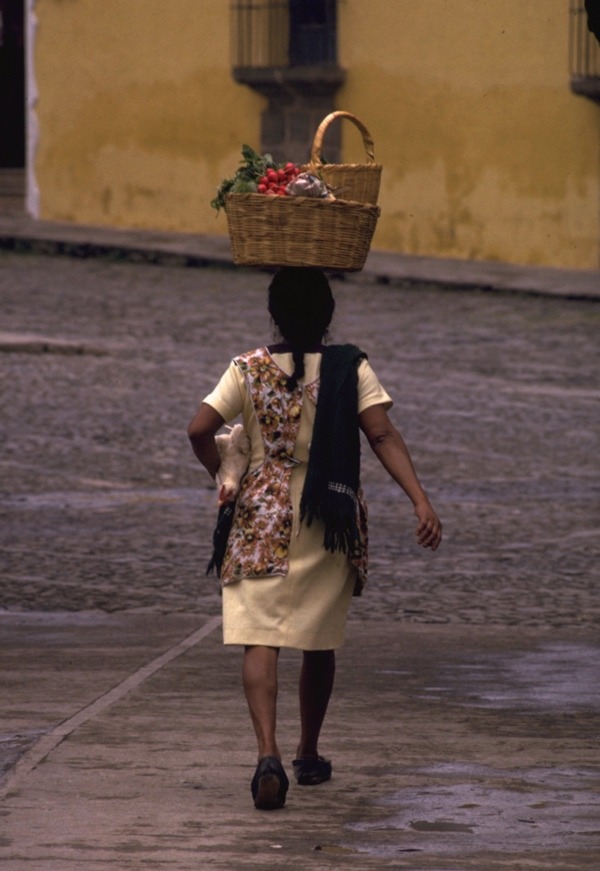
A shopper in Guatemala City
The church also had an imposing interior _ a long narrow aisle, thick square pillars on either side, with oil paintings on each one. The seventy-year-old relief map of Guatemala was a curiosity – fun to look at – and parties of schoolchildren were there to visit. A small group of amusements for children were installed, all made of old car parts, axles, gears, differentials, to turn the roundabouts. Very appealing, human, brightly painted – but all disconnected for some reason.
From Guatemala City I rode on to Lake Aititlan, which was a bowl of mist and rain. Stopped at a Mirador and filled the small hut with my things hung out to dry. Ate sandwiches. (My ”kitchen” is newly re-arranged with shiny new plastic from a very smart supermarket in the city.)
Four Americans stopped to talk. Couple worked for AID. Younger man gave address in Oakland (Berkeley). Suggested a ride from Nepal to Afghanistan. Went on into lakeside town, but all Gringos. Rain threatening. Saw concrete wall with “Las Buenas Nueves” – The Good News – painted on it. Warned there was much hepatitis about. Nothing to keep me there. Rode on towards frontier.
And here my journey very nearly ended, together with my life. I was wearing glass goggles with my open-face helmet. The fog on the lakeside road was almost impenetrable. I was attempting to clean one of the lenses with my fingers and failed to see a big truck charging down on me. We missed each other by inches and the blast of wind almost blew me away.
Somewhere on my computer is a picture of me wearing those goggles and I’ve spent a day looking for it, but no luck.
You’ll just have to imagine it.
Next week, Mexico.
Dear Friends,
It was heart-warming to read of all the kind people – from Orkney to Australia – who toasted my Jupiter anniversary. I myself celebrated by riding my MP3 down the coast towards Spain and, in true Jupiter fashion, got lost and found myself negotiating a goat track in that very rugged country we call garigue. I made up for that though with a wonderful meal at a restaurant that was new to me in a nearby village called Nefiés. The place is called Very’table and you should go there.
I have pictures from all over, but here are just a few. The first is from the Blue Lion in Gray’s Inn Road, where my journey began. You can see the old Sunday Times building through the window behind them.
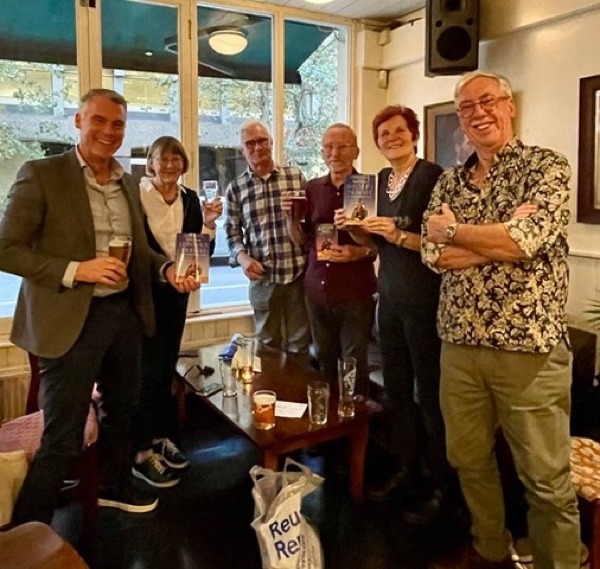
It was Michael Hetherington, on the left, who pulled them all together.
The second picture is from Germany where they did the thing in true Teutonic style.
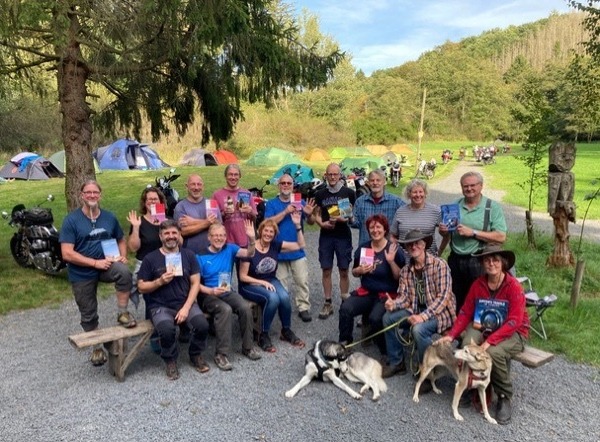
I know them all, but I can’t remember names, so I’d better not try.
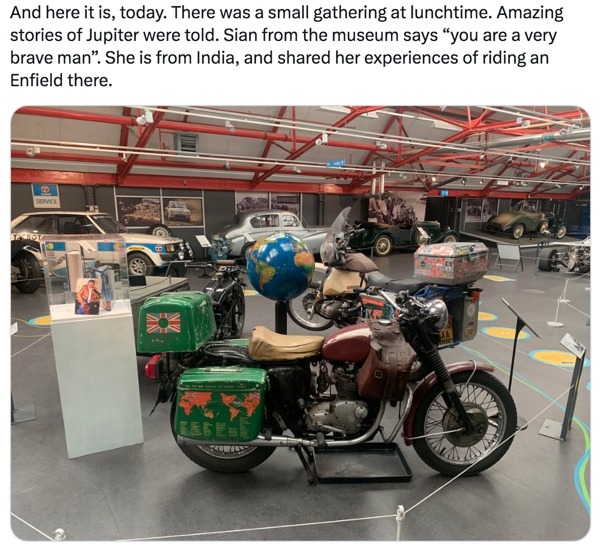
Then my academic friend, Robert O’Toole summoned a group to the Coventry museum, and sent me this:
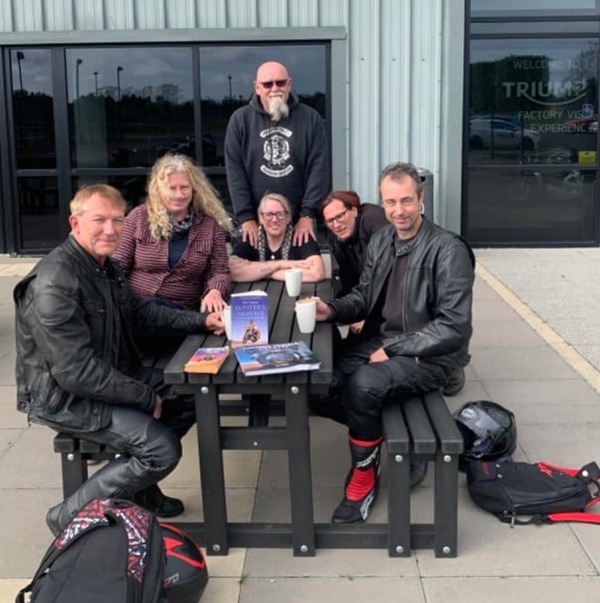
And finally, transplanted from Meriden to Hinckley, from the Triumph factory canteen and organised by Faye Howe, comes a still life entitled, The Coffee Drinkers.
My gratitude and condolences to all the solitary celebrants who hoisted a glass with only my book to accompany them.
Anyway, it was truly wonderful to be remembered by so many people in so many places. Now we can all get on with the more important business of saving the planet.
Hasta Luego. Auf Wiedersehen. Arrivederci, Au Revoir, See Ya’
Cheers,
Ted
We’re ten days away from the fiftieth anniversary of that day.
There was no one on earth I would have changed places with. Or so I thought – until that black night on the pavement of Grays Inn Road, when I stood dripping rainwater, sweat and despair, crushed by the unwieldiness of the monster I had created, and the enormity of the prospect I had invented for myself.
Only three yards away, behind the thick glass doors of the Sunday Times lobby, was the bright and comfortable world that suited most people well enough. I could see the commissionaire, smoothly uniformed behind his desk, looking forward to a pint of beer and an evening with the telly. People in sensible light-weight suits, with interesting jobs and homes to go to, flaunted their security at me and I felt my gut scream at me to strip off this ridiculous outfit and rush back into that light and the familiar interdependence. It struck me very forcefully that if I went on with this folly I would forever after be the man outside in the gutter looking in. For a moment I was lost beyond hope, utterly defeated.
Then I turned away from all that, somehow fumbled my packages away, got on the bike and set off in the general direction of the English Channel. Within minutes the great void inside me was filled by a rush of exaltation, and in my solitary madness I started to sing.
What should we do about it, if anything? I know I’m going to drink something very special. How about you?
UPDATE
Joe Kearns in Dublin suggested people get together to mark the day at various locations around the world.
You can see the list of venues on this page.
It has been so hard to let go. I’ve been promising to do it for a year at least, but even at the last minute, with the money already in the bank, I couldn’t quite reconcile myself to losing the bike.
Drew and Ruth were there with the van, all ready to load but I had to take it off for one last spin around the block and I felt so good on it, no different to the way I’d felt riding to Greece or to Ukraine a decade or more ago.
It had been my European ride ever since Dirk Erker bought it on my behalf, in 1997. Dirk was a master mechanic and a great traveller himself, who rode a lot in Africa. He kept it in his workshop in Duisburg for me and he was the nominal owner for 12 years until he moved to Dusseldorf. By then the bike had a few problems, and it languished at the back of the shop for a while, until some German fans thought it would be fun to resurrect it if I would pay for the parts. Of course I said yes, and in 2017 I rode it, triumphantly, from Bavaria to France. But then my troubles with the French bureaucracy began. They changed the rules, and it was three years before the bike became legal.

Anyway, now the deed is done, and I know it was right thing for me to do.
So, with the help of two handy villagers, we shoved it up the ramp and, after a tearful farewell, it started its journey to a new life in Ireland.
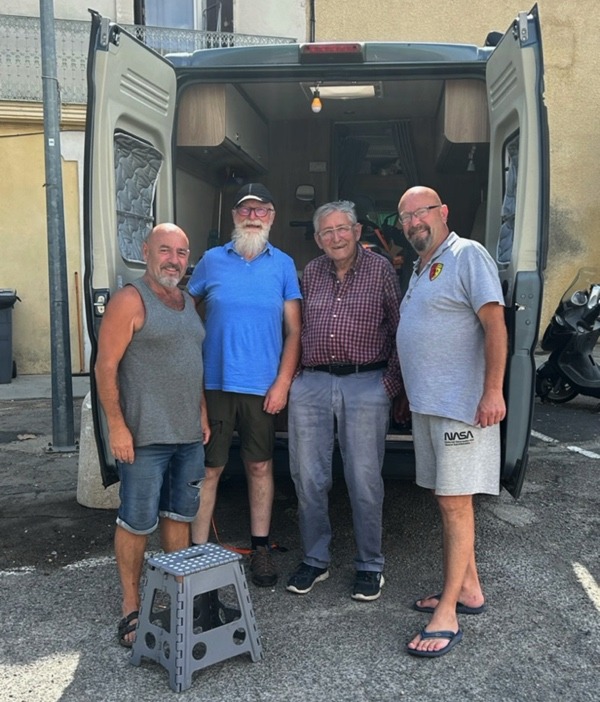
Drew Millar, the happy new owner, is the bearded one. Jean-Marc (left) and his friend are on the outside, and the old guy in the middle – that’s me.
I still have the MP3 of course, and it’s big enough to take me anywhere I want to go. I’ll probably ride down the coast towards Spain someday soon and get a last look at the beach in the tail end of summer. Then I’ll get back to my notebooks, and bring you more memories from 47 years ago, probably from Singapore. I hope you’ll tune in.
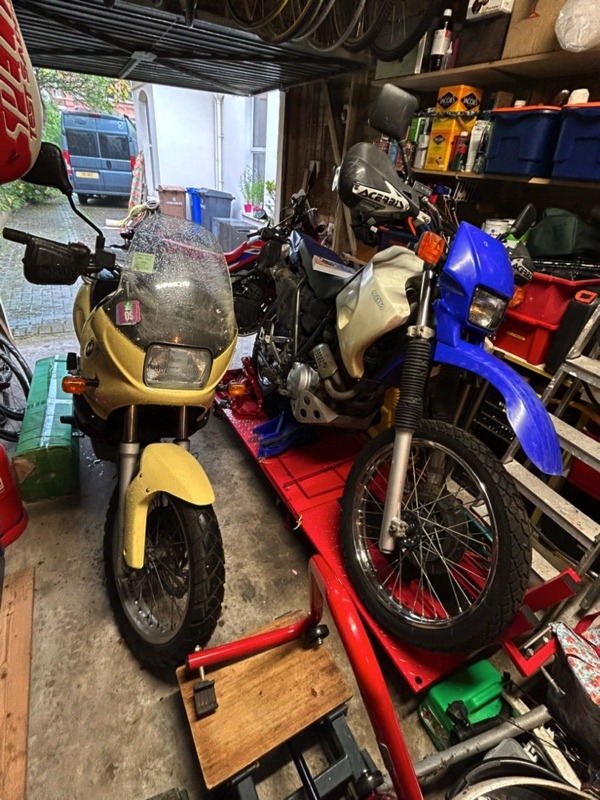
And a new life begins, in Belfast
Next Thursday I will fly to London (Easyjet permitting) to attend Paddy Tyson’s Overland Event, where I’ve been a fixture for many years. Of all the bikers’ meetings it has always seemed to me the friendliest and most relaxed, for many reasons – the wonderful site, the limited scale, Paddy’s obvious passion. There’s only one other I’m as fond of, and that’s the German one at Gieboldehousen – try saying that after a couple of pints – which is held, unfortunately, on the same dates.
But time, my time at any rate, marches on and I suspect that this year will probably be my last visit to Hill End, so if you were thinking of going, please come so that I can get a last look at you.
Like several million others I’ve been struggling through a heat wave for the last couple of weeks, and it sucked the life out of me. I find it difficult to keep up an optimistic view of life unless I’m able to do something even moderately physical, like fixing shelves or digging in a garden, and the heat just turned me into a flaccid and aimless heap.
As it happens I was also trying, at the same time, to make something of the notes I kept when I was riding through India. Of the four books of notes I kept, the notes on India were by far the most comprehensive, and I wrote in tiny script that is quite hard to read now.
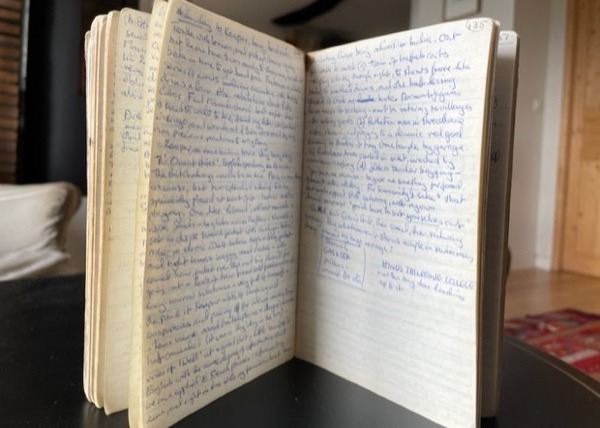
It was very hot in India a lot of the time but I had no problem with the heat. The biggest difference, of course, was me then, weighing 130 pounds and me now at 180. But it’s not just the extra weight I’m lugging around – my entire system was adjusted to the conditions. How far humans can adjust to heat is obviously now the subject of countless studies, because the heat is coming. Probably, as with an epidemic, the heat will first pick off people with other problems, and overweight would be one of them, but I’ll probably get to my natural end before that becomes my achilles’ heel.
Those notes from India are a treasure house. I look forward to many hours this Autumn and winter disentangling them, and if you’re interested, you will benefit from my efforts right here. Let’s stay in touch.
