News from Ted

The picture shows part of a table setting of china that got smashed on its way to Europe. The china was made by Spode, an old English company and the pattern is quite beautiful. It is also comparatively valuable, and was left to me by my mother. She never had much money but every now and then she would treat herself to something like this.
I was shipping it back to France in a large plywood crate, 4 X 4 X 3, which I built myself in Covelo, using screws everywhere. Everything in it was carefully packed in cartons with bubble wrap, and I drove the crate down to San Jose where the shippers, called LA-Dynamic, received it. That was in June.
The crate finally arrived at a car park near my house on October 3rd. The two drivers who brought it helped me unpack it. In fact, it was their job to do so. The crate had been taken off its pallet, and there was no way to get it off the truck without unpacking it first. Evidently it had been opened for inspection, because one side and the top had been taken off and nailed back on. I had put clear instructions to show which side of the crate should be removed first for inspection, but whoever did it ignored them.
When we took the top off the crate it was immediately obvious that something terrible had happened.The crate contained one very nice small piece of furniture, a glass cabinet, and the top of of the cabinet had been ripped off. The drivers took pictures and so did I. As we unloaded it, we could see that the back of the cabinet had also been ripped away, the legs were broken, and the whole thing was almost in pieces.
The cartons had been replaced in a disorderly fashion, and when I came to open them later at home, half the glass, china and pottery, was broken.
The shipper says the damage must have been done by the customs inspection which, they say, is not carried out by customs themselves, but by private sub-contractors. The contents were insured against total loss but the insurance company apparently refuses to consider it a total loss. After weeping crocodile tears the shipper evidently also refuses any responsibility, and all they have offered so far is an email address for US Customs and a promise to provide any documents I might need. Obviously what they hope is that I will just shut up and go away. What am I supposed to do with an email address?
So what I want to know is this: Is it actually possible that the shipper who took custody of my possessions and whom I paid to send them to France, can take no responsibility for what happens to them along the way? Is there a lawyer or a savvy businessman among you who can suggest a way for me to approach this? Isn’t there some basic principle which would over-ride any fine print I might have inadvertently signed?
I am in California for a few days but then I have to go to the OverlandExpo in Asheville and then to France. The total amount of damage is probably no more than three or four thousand dollars in market value, but the Spode is irreplaceable and of course it hurts to lose it.
Any ideas, anyone?
One of the people who once ate off my Spode and remarked how lovely he found it was a German professor of geography called Hans Bohle. We first met in India, in 1975, when I was riding my Triumph through Ootacamund.

He was a young scientist working with a volunteer organisation and trying, like so many young Germans, to wipe out the horrible recent history of his country. He said they were trying to show the Indians how to grow better vegetables and he was full of laughter at the contradictions that were always tripping them up. He said they had managed to increase the size of the cabbages they were growing by eight or nine times, but the whole crop of twenty pound cabbages were left to rot because the restaurant in Bombay that normally bought them refused to have anything to do with these giant brassicas.
Hans is dead now, but he visited me about ten years ago. He had the Chair of Geography at the University of Bonn, and of course climate played a vital part of his studies. He spent much of his time at conferences with other scientists around the globe. I asked him then how long it had been since his colleagues had known about climate change and he said for at least fifteen years it was broadly agreed that we were headed for the inferno if we didn’t do anything about it. So that’s twenty-five years ago from today.
There’s an election here in nine days time and it’s anybody’s guess which way it will go. Everybody knows how I feel about Trump and I am sure America will survive him, but only as long as the planet survives.
Thanks for listening.

These days every time I get on a bike it’s like a new lease of life. Always, before I hoist my leg over the saddle (and hoist is the right word) there is that small tremor of nervousness. Will it be OK? Will I still feel in command? And then the relief of finding that Yes, it feels good. I still belong here.
This time it happened in the streets of Bucharest, outside Mihai’s Pub. Who’s Mihai? It’s complicated. First there were Alex and his partner, Catalina, two incredibly nice young Romanians, who invited me and Elspeth Beard to a festival of adventure travel in the capital of Romania. I have been to Romania before when I was trying to find out where my grandfather once lived. That was a long story and you can read about it in The Gypsy in Me, but I never went to Bucharest. People said it’s not worth the trouble. There’s nothing left of the old city, they said. Ceausescu tore it all down. But here was an opportunity to see for myself, and when opportunity knocks I generally open the door. So here I am in Bucharest and it’s not true. There is still plenty of the old city left, and it’s easy to summon up the feeling of a city that was once compared with Paris, and was always at the crossroads of history, buffeted on all sides by Turks, Russians, Nazis, you name it.

Alex and Catalina – with fish on the Danube
We had a wonderful time at the festival. Alex and Catalina put a huge amount of time and energy into creating it. Elspeth gave them all a tremendous show, and I learned from her that it’s safer to ride as a woman than a man because, as she says, women can pretend to be men, but it’s hard for a man to pretend to be a woman. [I’M JOKING. RESTRAIN YOURSELVES].
So now I am in a big argument with Mihai who says old Bucharest has all gone. Mihai is a tall, very handsome, extremely likable man of Russian extraction who’s a friend of Alex and owns a pub. Actually Mihai is a press photographer and this used to be his office, but where there were once twenty newspapers in Bucharest there are now two, jobs were scarce and the man who owned the building wanted to sell it. So Mihai and his friend decided to buy it and turn it into a pub. I don’t know why. That’s how things happen. They were determined to make it as much like a London pub as possible, and Mihai was very anxious to get my opinion.

Mihai outside his pub. He rides a Ural with sidecar
“Do you have draft beer?” I asked, and went inside to look. Yes, he does, but it’s a newfangled steel tube affair foisted on him by Heinecken and you can’t look over the top of it. I frowned, and Mihai promised to get proper beer pumps on the counter as soon as possible. Otherwise I’d give it five stars. The counter looks very authentic, and has all the right gubbins above it. There’s a very pretty barmaid and, even better, there’s a London bus parked outside. Why, you may ask? Because, in a stroke of genius, they found one lurking in the streets of Bucharest. They brought it to the festival. and when the show was over a chosen few came back here in it. To get it here they had to hoist some power lines into the air, and the bus had to be driven in reverse. And so, after a lifetime with London buses, this is the first time I have ever been in one going backwards.

Here’s a bit of old Bucharest . . . .
We went back to the pub next day and across the street were parked two brand new BMWs, one for Elspeth and one for me Since age goes before beauty I got to choose first. There was a low boxer with a traditional tank, but it’s too cramped for me so I got on the keyless 700 GS with the fancy screen, and there was that little nervous twitch, but by the time I got to the end of the street I had that wonderful feeling again and was back on top of the world. We rode out to the country and I have to admit a lot of the city really is crap – monster Soviet style buildings with bits falling off them – but it’s all fascinating to a visitor. And once out of the city we’re on a lake in a great terraced restaurant with soup and fish and the lovely atmosphere of people enjoying themselves.

. . . and a fantastic sculpture in the centre
If there’s another festival next year I advise you to go. They have very good beer, and excellent wine of all sorts.The country offers quite amazing opportunities for riding and sight-seeing, from the Danube delta to the old haunts of Vlad the Impaler, the painted monasteries, and great mountain scenery. But the best thing about it is the people, and they all seem to speak English. If you’d like to know more send me an email and I’ll put you in touch with Alex.
. . . in luxury I dined.
My night at the Bike Shed was a revelation. It just goes to show what a cool, cosmopolitan lot we are. They’ve turned these railway arches into a very attractive place to meet and eat and relax. I would say, quite honestly, that it was one of the most pleasant and interesting conversions I’ve seen in a long time. There’s a lot of stuff about motorcycles, of course, and some very nice bikes on show in one of the arches, but it’s not shoved down your throat, and you can ignore it if you want.

They had us up a few steps in a sort of gallery, and there were ten of us at the Captain’s Table, which was laid with a black table cloth and dressed for a very nice dinner. Lively intelligent faces all around me asking interesting questions. I’m not saying that bikers aren’t intelligent but you really would never have guessed I was at a biker club. If there was a clue it would have been from Anton who sat on my right, an extremely civilised man of Russian origin with a remarkable display of steel rings on each finger of one hand – I think they were steel. Maybe they were platinum. I should have asked, but I’m almost certain they were purely decorative.
I’m no good with names so I can’t tell you who else was there, but some came from quite a way away. I was flattered, well fed and nicely lubricated.
If I’m in that area again I will certainly drop in. And there are other reasons to be around Hackney and Shoreditch. This is obviously an area that’s going through tumultuous changes. I once lived there, sixty years ago, when I got my first job on the Daily Express. That’s when I stumbled on a wonderful museum called the Geffrye. It’s on Kingsland road, quite close to the Shed, and it occupies a long row of old almshouses, each converted into a living space from a different time in British history – right back to the Dark Ages. I was fascinated by it. The atmosphere was tremendous. I went there again this time, but it was closed for renewal. Instead, laid out on the lovely enclosed grounds in front of it, was a pop-up garden of veggies and flowers, on straw bales, with little bars and tables.


I’m worried about the museum though. I’ve been back several times, and each time there were more signs, more graphic exhibits, more jazz, and it seemed to me they were losing the atmosphere. I hope very much, when I go again, that it hasn’t become sterile.
In an hour I will be driving to the airport at Montpellier, and by six this evening I should arrive at the Bike Shed in London’s Shoreditch. I’ve never been there before. Apparently it’s a super cool biker club, and every now and again they invite worthy people like me to sit at the Captain’s table and be interrogated – in a friendly way, I hope – by the members.
They’ve gone out of their way to make it a stress-free experience, so I hope to be on good form. I’ll tell you more about it afterwards, but I’m looking forward to a great visit.
I only recently learned that Peter Mayle has died, much too young, at 78. David Ogilvy, the advertising wizard, used to call him the Mayle Man but you may know of him as the man who wrote a hugely successful book, A Year in Provence, followed by many others. I knew him long before all that.
It was just after I’d come back from my four-year ride around the world, in 1977. My life – I should say my mind – was in considerable turmoil. I hadn’t yet started to write Jupiter’s Travels and couldn’t get to grips with it. Nothing that I had experienced in those four years seemed real. Although I remembered everything clearly it was only as an observer, as though I were reading a cold government report. To write about it I had to be able to feel again the emotions that those experiences had aroused in me but it all seemed clinical, lifeless. I was close to desperation, because writing the book was all-important.
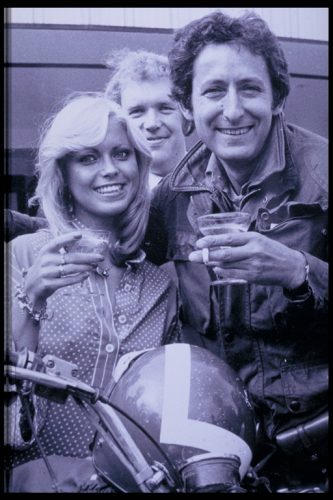
At the same timeI I was torn between two people that I loved and made a terrible hash of it, bouncing back and forth between the two. All the celebrations of my return were behind me. I’d ridden the Triumph back to London, enjoyed the champagne and a cuddle from Miss Great Britain, delivered the bike back to the Triumph factory which was still at Meriden, and come back to France on the new Triumph 750 they’d given me in exchange.
I was back in my 13th century semi-ruined home trying to find some way to reconnect with my memories when I got a message from a friend, Ernest Chapman, to say that he was over on the other side of France, about two hours away, and would I like to visit.
Ernie was a solicitor with an old, very staid firm called Russell, Cooke, Potter & Chapman at Grays Inn, but he had liberated himself from doing the estates of deceased duchesses and had taken on more colourful clients. He became Jeff Beck’s manager, and also on his list was Peter Mayle. He was visiting Peter at Gordes, in Provence, and that’s where I went on my Triumph, looking for some relief.
I stayed with them for a few days and I have very happy memories of that time with Peter, his wife Jennie, and Ernie. They were warm and wonderful company. “You are such good value,” Jennie said to me once, and I never forget a compliment. We ate and drank and laughed a lot together. Then, reluctantly, I got back on my bike, rode down the hill and straight into the path of an oncoming van. It was an inexplicable accident. After four years of riding safely through every imaginable situation I had failed to see a vehicle in front of my eyes.
The rest of that story is in Jupiter’s Travels, including the prophesy that remains a mystery. Like all my accidents so far I was very lucky. The front end of the bike was destroyed, but all that happened to me was that I sat down rather hard on the road. My friends rescued me, we did what we had to do with the wrecked Triumph, and very generously Peter Mayle lent me a small Citroen Mehari with a canvas top.
I kept it through that cold and miserable winter, still struggling to find a way into the book. After a while I took refuge with friends who lived over the hill in a small chateau they had reclaimed from dereliction. Then in early Spring one of my loves, Carol, came to visit me to tell me that she was going to marry someone else. I knew that if I put my mind to it I could persuade her to change hers but I simply couldn’t find the energy to do it. She stayed with me in the chateau for a week and one windy day we drove to my house to fetch some things, including a beautiful Kashmiri carpet I had brought back on the bike. At the top of the hill, as we returned to the chateau, I stopped at a junction where we met a bigger road. On my right was a big enamelled road sign on posts, four feet high at least. Behind the sign the mountain side dropped away steeply among loose rocks and gorse. Suddenly a gust of wind powering up the mountainside behind us lifted the car up over the road sign and dumped it down the mountainside. The car did a complete roll and landed across a boulder which prevented it from rolling any further. Astonishingly we suffered only minor injuries. The car was totalled. The carpet disappeared and was never found.
Peter Mayle was very forgiving. The car was insured and he asked for nothing, but I don’t think he or Ernie ever really believed my story.
Soon after that I found my way into the book, and it took over my life. I lost touch with Peter Mayle after he moved to that village in Provence, and I never saw him again. A pity. I see him still very clearly, full of life and fun. He had exercise machines and was waging war against potatoes, “those little brown buggers,” for fear of putting on weight. I am so sorry he’s gone.
PS: I am writing an autobiography, mostly for my son’s sake and for his son too. My publisher likes it but thinks not enough people would buy it. Would you? If so, please let me know, at tsimon@mcn.org Thanks.
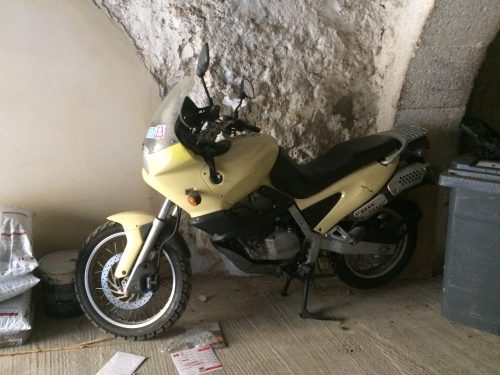
Spring is sprung, as Mr Durante used to say, and I’ve been out on my MP3 to taste it. Unfortunately my yellow BMW still cowers in the corner of my garage, because a rare but violent disagreement with an erstwhile friend has left me with a bureaucratic nightmare, but Hey, shit happens and one day it will be resolved. Meanwhile there’s always the bar around the corner for solace.
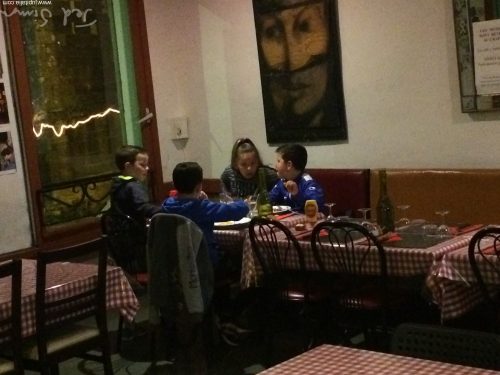
I was there at the Cafe de la Poste last week listening to some super Brazilian songs, and again on Saturday hoping for more music. This time I was unlucky, the singer was ill, but instead I saw something that is very French and all too rare in other countries – four children sitting at a table, eating their dinner and talking to each other like ordinary, civilised human beings. Thought you’d like to see it.
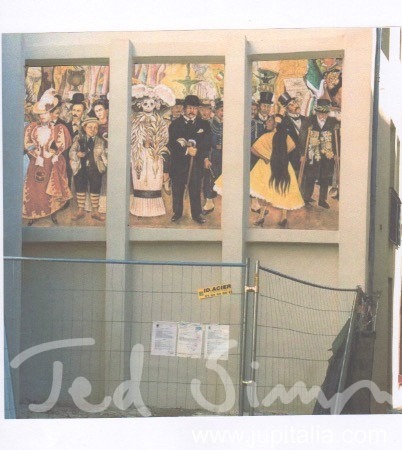
Remember this? Three weeks ago I was on my way to see the Mayor about getting murals up on the wall. Plenty of you thought it was a fine idea. some of you even offered to paint them. And then you probably thought I’d forgotten all about it.
Not at all. The Mayor, Monsieur Bernardi, was in Paris at a congress of mayors from all across France – there are thousands of them – and when he got back he was very busy catching up, but this morning he asked me to come along. And of course he likes the idea. Nothing would please him more, but . . .
The house that burned and was demolished by the commune, even though it is a non-existent virtual house, still belongs to the previous owners. That is to say the ground on which it stood, and the walls where I want to see those murals, still belong to someone. And because that someone was uninsured, and has understandably paid no fees or taxes for years, the actual ownership is rather complex and probably resides with a bank. And so, regrettably, the Mayor is unable to authorise the project until the village eventually acquires the property, which it hopes to do some day . . .
However, it occurs to me now that since he did have authority to paint the walls a lovely cream colour, why could he not authorise another coat of paint that might just happen to be multi-coloured? I shall send him a note. Don’t hold your breath . . .
I did also, as an afterthought, raise the matter of the vanished “epicerie” – or grocer – and once again he was as dismayed as we all are but, once again, there were legal consequences to it’s disappearance which must be dealt with before an effort can be made to encourage someone else to take it on. But there is hope. It is not uncommon for communes to provide help to bring commerce into the village. Alas, I am no grocer. But I’ve got my fingers all knotted up.
I’ve had this idea for a while and I’ve finally decided to do something about it
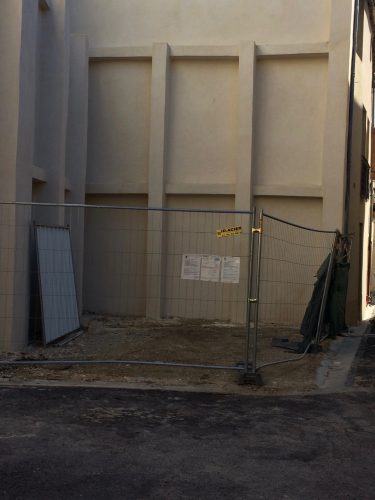
On a corner between my house and the cafe, the commune recently demolished a burned-out building and finally left a wall that was neatly reinforced and stuccoed and looks like this:
So I thought wouldn’t it be terrific if it could look like this:
and I am going to see if the mayor agrees. Of course it would be difficult to get Rivera to repeat his marvelous murals in our little village because he is well and truly dead, but the idea lives on. The government has money for street art and we could have a competition for the best ideas.
I’ll try to see the mayor tomorrow. Wish me luck.
A minor disaster struck our village a few weeks ago. Our only grocery shop – “the epicier” – closed for good. I don’t know why. There were always people in the shop. Anyone fancy opening a grocery shop in a lovely French village? Lots of sunshine. Let me know.
Although the Jupiter journey for which I am best known began in October 1973, the road leading up to it was long and eventful. There were several major milestones along the way. Getting the bike from Triumph was one. Getting a license to ride it was another. But the most significant of them all in those pre-digital days, when newspapers were still the most powerful organs of mass communication, was winning the support of the Sunday Times, and that meant getting the approval of it’s illustrious editor, Harold Evans.
The Sunday Times, like its daily sister The Times (though they were separately owned) was a Very Important Paper, not one you would expect to associate with plebeian pastimes like motorcycling, and it never occurred to me to go there. The tabloid Daily Mirror, an obvious target, said they’d love to support me if I could be back in three months. This was not what I had in mind. There were other, equally uncomfortable offers, but I was lucky enough at the time to have a warm and loving relationship with Pat Kavanagh, a rising star among literary agents. I discussed my predicament with her, and she knew that Harold Evans – improbably – rode a BMW, so she took my madcap idea to him and he fell for it.
So much so that we spent an afternoon together doing a motorcycle training course on an old airfield at Hendon, led by three police sergeants, Farmer, Fittal and Easthaugh. We rode round corners under their watchful eyes. We were instructed to give hand signals and not to rely on those silly little lights, and to ride well out there in the middle and “Command the Road.”
There was a general expectation that I might be around the world and back again in about eighteen months. Harry (as I now know him) gave me £2000, worth about ten times that amount today, and a double-page spread in the paper with a picture of all the bits and pieces I had assembled for the adventure. I carried the picture with me on the journey and it was often more persuasive than any official document.
The journey lasted four years and despite rumblings of disbelief among his subordinates, Harry stuck with me to the end. I still believe it might have been the longest continuous sponsorship in newspaper history. I did get more money along the way, not all of it from Harry, but I was always on the breadline. I calculated later that I had spent, in total, about £5000.
After my return Rupert Murdoch acquired both Times newspapers and persuaded Harry to become the 12th editor of The Times in 200 years. I went on a journey of reportage for him then, but within a year Murdoch revealed his true colours, trashed all the promises he had made regarding the papers and, as I understood it, soon made Harry’s life impossible. I was in Buenos Aires when the first news broke that Mrs Thatcher’s fleet – “La Flota Pirata” – was sailing for the Falklands. Argentines were convinced that it was going to bombard their capital. It was a ready-made scoop for me, but I couldn’t bring myself to do anything with it because I had just heard that Harry had been fired. A day or two later, drawn by morbid curiosity, I watched as various colleagues gathered outside the Intercontinental Hotel – Simon Winchester complaining about something being “absolutely unconscionable” – but I was too disgusted to join in.
Equally disgusted, I imagine, Harry moved to America. Later I met him a few times in New York, but only briefly. As the boss of Random House he published two of my books, “The River Stops Here” and “The Gypsy in Me” but California, where I now lived, was a long way from New York.
So what is all this about?
A few months ago I was afflicted by a powerful stab of nostalgia for New York. My first visit in 1964 had been quite magical. In those days when the Beatles hit America everything British was pure gold, and all my fantasies were fulfilled. George Plimpton, a literary lion, lived downstairs in the house where I stayed and I was in Elaine’s cultural hot-house every other night with a high-ranking Southern Belle on my arm.
I came back there in the Eighties when the city was recovering its pride after the bad years, and again I was inspired by its challenging energy. It’s a city like no other and I wanted to taste it at least once more.
So in October this year I booked a flight and for the first time in ages it was without having a job or a gig to go to. New York is expensive. I found friends to put me up. Marty Sabba’s email handle is “hypnodoc” but he is not a stray from Jurassic Park. He’s a retired psychologist who specialised in hypnotism. He is also utterly devoted to BSA motorcycles, but magnanimously he put differences aside and invited this Triumph-riding heretic to his houseboat which floats at Port Washington.
Another friend agreed that for a couple of days she would shoe-horn me into a tiny apartment she had rented in Manhattan. There were events she thought we could go to – I suffered through a modern opera at the Met – but for me the principal allure was always just to walk the streets. And the cherry on the icing on the cake was the possibility of meeting Harry again.
But by now he was Sir Harold, the knighted husband of the celebrated Dame, Tina Brown. I was 86 which meant, I knew, that he was 89, yet despite his age he was still immensely productive, still working at Reuters, with another new book out. And he spends time regularly with many of the most influential people in America. All that could change a man and I hadn’t seen him in over twenty years. The more I thought about meeting him again the more improbable and unpredictable it seemed, but I fired off an email anyway about having lunch or something and got an email back.
“Love to,” he said.
So here’s what this is all about. I walked into a restaurant on the East side where Harry was sitting and within seconds it was as if we had been meeting and talking every day. But it was better than that because we hadn’t, and it was a triumph of friendship and respect over circumstance, over age, over distance, and over time itself.
We should all know such good fortune.
People with long memories may recall that four years ago, in 2013, I rode my 20-year-old 650 to Greece and had a few minor mishaps along the way (see Greece: A slippery adventure). When I brought it back to the shop in Duisburg where Dirk Erker kept it and maintained it for me, it was a bit battered and the forks were noticeably skewed: Nothing to stop me riding the 3000 kilometres back quite comfortably, but Dirk told me, very firmly, that it was too old.
He didn’t want to work on it any more, it wasn’t worth it, he said, and I should get a new bike. Since he was the technical owner, and there was no way I could register a bike in Germany under my own name I had to give it up.
I can’t blame him. After all I was 82 years old, I’d had a harmless but silly accident along the way, and in Zagreb the bike threw a pint of oil on to the tarmac. I was riding on his insurance. Maybe he was just too nice to tell me he couldn’t risk sheltering a doddery octogenarian any longer.
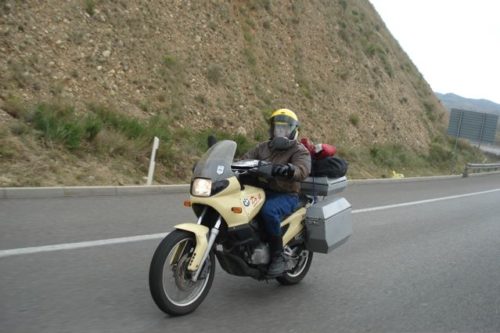
How it was – eight years ago
Anyway I told a friend of mine, Doris Wiedemann, that there was this bike at the back of Dirk’s shop and that it only had 45,000 km on it, and that he was throwing it away, so one of her friends, Horst Anderten, who likes challenges, said he would see what he could do with it. And a few years later he wrote to me:
I removed the Cylinder, cylinder head with all the parts inside, camshaft, valves, shims, springs, decompression parts for the r/h exhaust valve, the piston with rings and so on. I found the piston rings a little bit stuck, after cleaning now free movement. Cylinder bottom and Cylinder head packings are new, Valves are adjusted, all parts cleaned and reinstalled, cooling fluid replaced. Now normal compression at about 8,0 bar. Whole bike cleaned and all parts ( which was removed by Dirk) reinstalled. Also new oil incl. filter, new air filter, new brake fluid and a lot of screws replaced, flashlight temp. fixed….. and so on.
My first thought was just to give the bike away. Then I wondered whether I might ride it again. I dithered. It’s very difficult, at my age, to know what’s realistic and what’s foolhardy. How do you know when you should stop riding? I have had many conversations about this. What are the signals? Reaction time? Physical discomfort? Eyesight? Temperament? All I knew was that when I rode that bike in Europe I had never felt so safe since I handed the Triumph back to Meriden in 1977. Finally I decided I had to ride it again. So I sent Horst money for the parts. The labour he said was for love and beer.
The bike ended up with Doris in Bavaria, and we hatched a plan. Doris would put the bike on her insurance, and then she would ride down to France with me and keep me out of trouble.
Her friends thought she was nuts.
“Just imagine the trouble you could have with an 86-year-old man on a bike,” they cried.
But Doris is a brave woman, with a very solid biking reputation, and she stuck with me, although to be honest we were both a bit nervous.
There was still plenty to do. It needed a tyre, a speedo cable, several rear spokes, a battery, and further efforts to untwist the forks before it could pass the German technical control. Doris and her friends put so much into this project I can’t thank them enough.
Then she took it out on test and it ran well. There was a minor hiccup which stranded her out in the country. Fuel wasn’t getting through. Her friends rescued her, and one of them reckoned he’d fixed the problem.
So I took a train – or rather six trains – to meet her, and three days later, on Friday August 11, we set off under cloudy skies for the south of France.
Quite soon, after maybe 20 km something marvellous happened. I discovered that I felt just as happy and as much in command of the bike as I ever had, as though we had never been separated. I felt forty years old.
Because I had the GPS Doris was following me and she said she was surprised how well I was riding, and there was a stupid grin all over my face.
We took three days, stopping in Belfort and at a camp ground in Roybon. I couldn’t get over how good it felt, after getting used to the MP3 scooter, to be using the gears and to be leaning so much more naturally. It was a revelation.
Unfortunately the hiccup returned and stopped the bike arbitrarily. There seemed no rhyme or reason to it. The fuel would suddenly choke off and the bike would die. I found that if I took the tube off the petrol tap, letting fuel run out, and stuck it quickly back on again, the filter would fill up once more, but it was aggravating and messy. There was no sense to it and we couldn’t come up with a decent explanation.
I’m afraid we didn’t do well with the interruptions, and for once the journey would have been better without them. While i was enjoying my born-again biker experience Doris was feeling very exposed stuck on the side of busy roads and, as always with these things, the roads got hotter and the stops more frequent towards the end.
Still we made it and I at least had a wonderful sense of rejuvenation.
Sadly, it will be a while before I can ride that bike again. First I have to go through the French registration process, but I’ve done it once so maybe it will be easier this time. Wish me luck, please.
Can I remind you that I have books to sell? I think I can honestly claim that they are all worth reading, even the one that isn’t about bikes. The picture book is especially beautiful, having been art-edited by Yucel Erdem, and there aren’t a whole lot of them left. If you find my shop at all confusing, please email me: tsimon@mcn.org
I’m off to the first HorizonsUnlimited meeting in Switzerland next weekend, and the following weekend I will be at Gieboldehausen, a favourite German meeting of mine. I hope I see you somewhere. Enjoy the rest of the summer.