News from Ted
Aspiran, where I live now, is an old wine-growing village in the south-west of France. Estate agents call it quaint and some visitors call it Aspirin as a joke or by mistake. It’s beautiful in the way that everything down here is beautiful because it’s made of stone, with terra cotta roof tiles. Some of the buildings were intended to be beautiful, but most are just houses that can’t help it. The streets are narrow – cars can’t pass each other and I wonder how they managed with horses and carts. I live on the Grand Rue, which was the village High Street once and has several abandoned shops along it. It runs right through the old village from one porch to another, half a kilometre or so with kinks in it. The porches were under the old ramparts because the village was fortified. The houses are three storeys or more, and because the street is so narrow it’s a bit of a canyon – like a New York street shrunk down to model-size – and noise reverberates along it.

The whole of France has recently been menaced by gangs of youngsters on scooters. I was unaware that it was a nationwide issue. I only knew that for weeks now some kids have been using my street as a racecourse, and that they were riding their scooters fast and revving them up to make the loudest possible noise, day and night. Some bigger villages have municipal police. Ours doesn’t. We have a town hall and a mayor, but he can only issue fines. I found it extraordinary that nobody could do anything to stop the little bastards.
A week ago my partner and I went for an afternoon walk down the road when something unpleasant happened under the porch, and it’s taken me until now to write about it. Two scooters came surging up hill towards us. Neither of us felt like stepping aside, and they were forced to stop, revving their engines as they manoeuvered around us.
“You’re making too much noise,” I shouted.
“We don’t give a fuck,” (on s’en fout) said one of them.
The other one raised his rear wheel and spun it at full throttle – How do you like that then?
I suppose I forgot I was a ninety-year-old gent, and put my hand on his saddle in protest.
He got off the scooter, put his face up against mine, and shoved me hard with both hands. I could do nothing to save myself. I fell downhill on my back and they rode off into the sunset.
It took the wind out of my sails, hit me for six rearranged my bones, put me out for a duck, threw me a curve ball, punched me below the belt, knocked the starch out of me, shivered my timbers and left me bushwhacked, prostrate, impotent, floored, flummoxed and forlorn.
HOWEVER
Hope springs eternal, there’s a silver lining at the end of the tunnel, I rose again, Ted Simon Redux (with the help of ibuprofen), back on the horse, Carpe Diem, alive to fight another day and fly the flag – no, not that one, the other one; let no scoundrel claim me as a patriot.
I was the first physical casualty of the new terrorism, and with a medical certificate I could go to the Gendarmerie (which is the police force although it’s actually part of the army) and make a complaint. Now at last something is happening. A police car came with a whirling blue light. People are being shown pictures – Was it him? Or him? – There’s a petition up in the Café de la Poste and the owner, Hervé, gave me a free drink “for medicine.” People are talking about it and maybe something is being done.
My body still feels terrible in the morning but I believe it’s getting better and I don’t think there’s any way to hurry it along. I’m glad it served a purpose. The street is noticeably quieter. I just wish it didn’t have to be me.
I have come at last to the end of “An Interrupted Life” – my life before Jupiter. It has taken me three years and I hope I haven’t taxed your patience too much. The work has been quite absorbing as I rediscovered so much I had forgotten. I also understand much better what happened and why. I am not at the end of this process, and perhaps never will be, but for those of you old enough to have a past to untangle I truly recommend the process. Not only for your childrens’ sake, but for your own peace of mind.
My job now is to turn this into a book, and I know it will take a while. I am sure the book will be longer, but I shall get it done as quickly as I can. I hope you will want to buy it. Be sure to let me know. Thank you for all your encouragement. It has been invaluable.
I will get to the audio version as soon as I possibly can.
A hundred or so people celebrating a birthday across five continents with a cake made in France and an edible decoration made in England . . . . what could possibly go wrong?
Well, the people arrived on Zoom. The amazing edible motorcycle XRW 964M commissioned and, for all I know, tasted by Tiffany Coates in the West country arrived at my house on the appointed day, by special motorcycle courier and world traveller Rolf Lange . . . BUT the CAKE . . . Oh My God . . . where was the cake?
Missing In Action. Tiffany wept. DHL was running around with my cake and didn’t know where to send it. But all was not lost . . . the cake was found 2 days later . . . and we had a second birthday celebration.
Today, it’s just a fabulous memory.
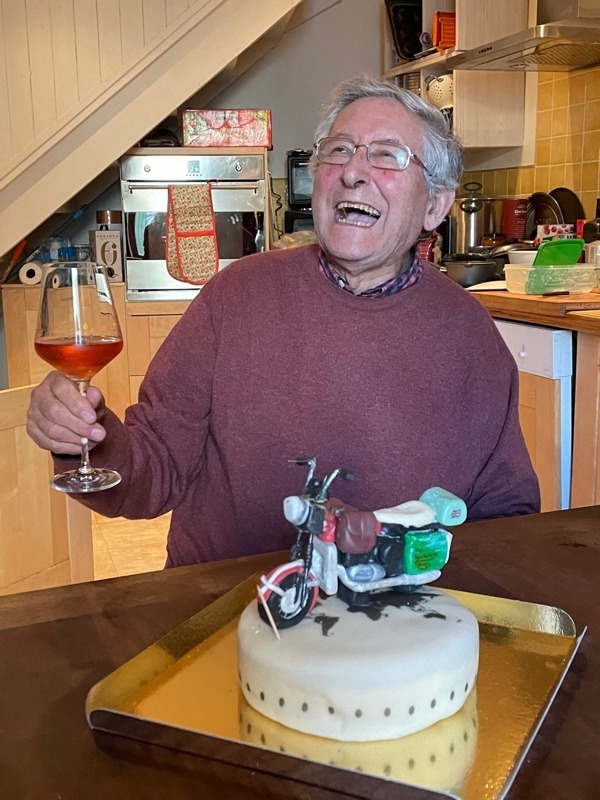
Well, tomorrow’s the day when your favourite anti-hero turns ninety. I know, it’s only a number, but for some reason we have to measure out the remorseless flow of time.
Seven years ago, in California, I had to go to a hospital in Stanford for s diagnosis of some small thing, although I was generally in rude good health, and while there I passed through the hands of a youngish doctor – around forty and a bit supercilious I thought.
He said, “You seem to be in good shape. You’ll probably make it to ninety.”
I remember how shocked I was. “Only seven more years?” I said to myself. And, “Make it?”
Did he think that I would come crawling, encumbered by innumerable illnesses, and collapse across the finish line.
That was just one of the tone-deaf remarks doctors are famous for. Anyway, here I am, as rudely healthy as ever. And I have good news for all of you back down there in the peloton (it’s a bicycle racing term – this year the Tour de France passes through my village).
Things don’t just get worse. They can actually get better. Even physical things.
The only structural defect I have suffered from so far is a bad hip (or gammy leg, as it used to be called.) It’s supposed to go on getting worse until they put a new one in. But mine has suddenly started getting better. And exercise – which I’m not good at – helps.
My current doctor, a very nice woman, smiles sceptically because she knows that only pills can help. She’s wrong, but she won’t listen. They don’t . So I’m telling you instead. And I have previous experience. A few years back I ruptured a tendon at my shoulder. It hurt badly for a long time. She said they don’t repair themselves, but I could have it sewn together again. That would mean months of immobility during which I’d lose whatever strength I have left in my arm. I declined.
Today my arm is as strong as it ever was. I don’t know what happened in there, but the body has a way of dealing with it.
I’ve just come back from three weeks in California, during which I got closer to an ever-growing family, and met a tiny grandson for the first time. Wyatt, he’s called, and he is an amazing bundle of energy and good humour. Everybody seemed to be doing well, in spite of the virus, and without Trump looming above my head the air seemed clearer and sweeter.
I know a number of people have ordered books from me and had to wait for my return. I’m sorry for the delay, but I will get them off today. And I’d like everyone to know that I have now sold enough copies of the picture book to cover the cost of printing and storing them. Thank you all so much, but do go on buying them. Nobody has yet had anything but good things to say about it.

Wyatt
Happy New Year to you. I hope you enjoyed the festive season and that you’re optimistic about 2021 bringing with it a positive change in our collective fortunes.
Here in France, I said bon voyage to 2020 under rather unfortunate circumstances. While celebrating New Year’s Eve with a neighbour, a fire broke out in the kitchen of my partner’s beautiful place next door. We discovered it in time to save half the house, but the damage is extensive. We’re both entirely unharmed and that’s all that really matters.

The aftermath of the New Year’s Eve fire in the kitchen
We’ll be taking sanctuary at my home in Aspiran, and I’ll get back to the next chapter of An Interrupted Life as soon as I’ve replaced my laptop.
In the meantime, my very best wishes to you all.
It’s been ten weeks since I asked the existential question which afflicts all of us from time to time: Is it me or the bike? Is it my state of mind that is making my bike behave badly, or is it my bike’ s bad behaviour that’s giving me the willies? Today I am happy to announce that it was the bike all along.
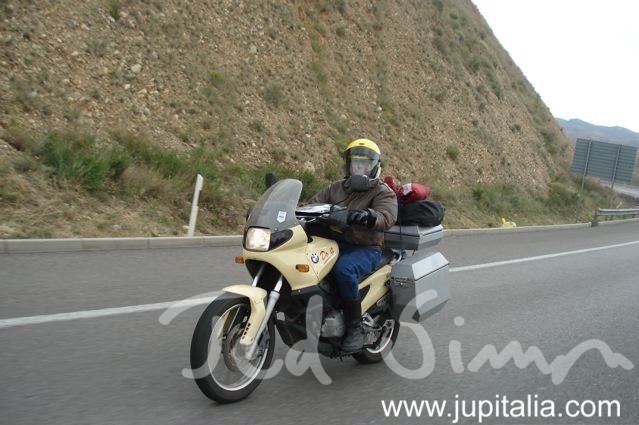
If you remember, I had a BMW 650, which I brought from Germany to my house in France three years ago, when I was 86. It was a long ride and I celebrated the fact that I felt really good, and the years fell off me. The bike also ran perfectly well except that every now and again it stopped. To get it going again I had to pull the fuel line off the tap, spill a bit of petrol, shove it back on again and ride until it stopped again. Nobody could figure out why. Then for one reason or another the bike had to sit in the garage for a very long time, and when I got it out again I was 89.
It was still mysteriously stopping and more often, but worse than that it felt really bad, like I could never find the right gear. So that’s when I put the existential question. Was it me or the bike? Maybe I’m just too old to ride a proper motorcycle. Many people had suggestions about the fuel problem. But it wasn’t a vacuum in the tank, and it wasn’t crap in the tap.
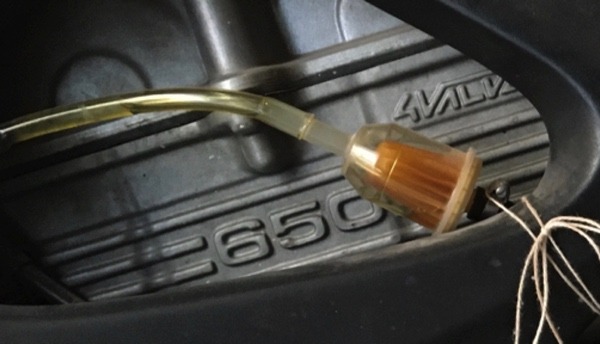
Simon de Burton, visiting me, said he thought the fuel filter might be overheating and vapourising the fuel, so the string was to hold it away from the block. But that didn’t help either.
Well I thought of giving it all up, but I’ve become sentimental in my old age. This bike and I have been through some stuff together, and among other things it was seriously twisted up front, so my right hand always arrived at the destination a little before my left hand. I was quite used to riding it like that, but I thought, as a last tribute I’d get it straightened out. Maybe at the same time the shop will figure out what made it keep stopping.
So. I got it back this week. It’s straightened out and there’s a new front disc. I rode it sixty miles to Bedarieux and back and it felt wonderful. And now that I look at that picture above again, it’s obvious what was wrong, because the filter is empty. Before I brought it from Germany I had never had an inline filter. I didn’t know that it was supposed to be full. The mechanic knew exactly what to do. There was a blockage in the carburetor and he sucked it out with a vacuum. Job done. No charge. If you ever get stuck in my area go to Moto Activ in Clermont l’Herault.
So here, looking rather dorky, is yours truly, on the road again for another year, with nothing to worry about except next Tuesday.

PHOTOGRAPH BY MY NEIGHBOUR M. ARNAL
More interruptions next week. Cheers.
It came as a terrible shock to hear last Wednesday that Harry Evans had died. I suppose it seems odd to be surprised when a 92-year-old leaves the premises, but I honesty felt he would live for ever. Apart from being the greatest newspaper editor in living memory, Sir Harold Evans (to give him his full monicker) was also a good friend. Without his support my “Jupiter” journey could never have been the same. I worked for him briefly just before he left The Times, and he later published two of my books when he was the boss of Random House.
He was 89 when we had lunch together in New York three years ago and I wrote to him early this year hoping to hear that he was well. I told him that I had now reached the age he was then. He replied:
TED
Firmly in my memory is our pic of what [was] needed for a prodigous Journey.
I HAVE already scouted the territory ahead of you….a stripling of 89 indeed.
Keep going!
Harry
Here’s the pic that was firmly in his memory. In black and white, on newsprint, it was often as good as a passport. It’s comforting to know it stayed with him almost to the end. Thanks Harry. I’ll keep going.

There was a time when I was riding in Malaysia towards Thailand that my bike felt really uncomfortable. It was my first long trip on the bike since the accident that shot a lead pellet into my eye. I was nervous, trying to recover the confidence that I had built up over three years of riding, but the bike just felt wrong. I couldn’t account for it, and I couldn’t even describe it. I stopped and looked at the chain – sometimes if the chain was too slack it seemed to have this clunky effect – and the alignment too (I was on a Meriden Triumph 500) but everything seemed OK, so I persevered, and got to Hat Yai.
Next day the bike felt perfect.
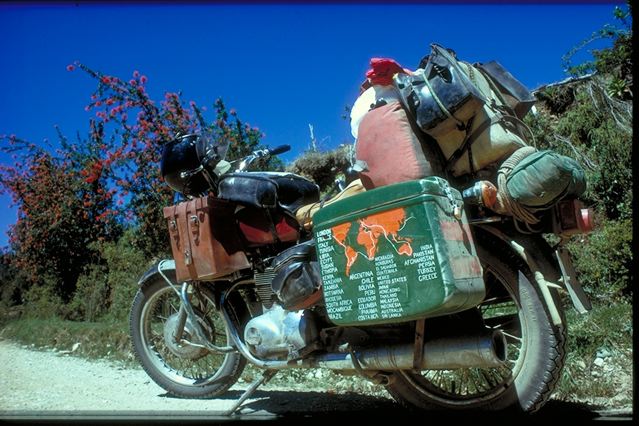
The same thing had happened in Africa, riding south from Mombaça on a pot-holed dirt road towards a frontier. I was nervous. I’d heard that they might give me trouble and even refuse to let me through. Once I got to the other side, the bike felt fine, but I put that down to the smooth asphalt.
From the time I first got that Triumph I couldn’t bring myself to give it a name. To me it was a machine; a valuable, important machine but still just a very clever assemblage of metal parts, nuts, bolts, chains, bearings, and so on. I just didn’t want to get caught up in silly anthropomorphism.
But gradually, over time, I found it hard to resist the idea that the bike had some kind of primitive personality, mainly because it was kick-start. Nothing rouses my ire faster than an engine that won’t start and flailing away uselessly at a kick-starter just makes it worse. However I have to say that generally the bike started promptly and efficiently, and particularly in moments of crisis, such as when a nearby elephant looked likely to take a run at me. At moments like that, when starting or not starting was a matter of life and death, it would be a bitter twisted soul that didn’t say, “Thank you, dear motorcycle.”
So, gradually, the motorcycle smuggled itself into my affections and it got to the point where sometimes I couldn’t be sure whether it was my state of mind that was affecting the bike, or vice versa.
What’s all this about?
Well I told you last month that my BMW Funduro (which I often call Fundador after a Spanish brandy, by mistake) had a problem. It stopped unexpectedly, starved of fuel and the only way to get it going again was to pull the fuel hose off the tap and put it on again. After all the obvious solutions proved negative, my friend Simon suggested the fuel filter was too close to the block and got hot, creating a vapour lock. So I tied a piece of string round the filter to hold it away. And on Tuesday I was all set for a trial run. Obviously it needed to be a hundred kilometres or more and I was nervous. The bike ran beautifully when I brought it here from Germany, but that was in 2017. I haven’t been anywhere on it since, and I’m three years closer to the grave. I’m absolutely fine on the scooter, but there’s always that niggly thought; will I be fine on a proper bike?
Well the bike felt terrible. There was one little sweet spot in each gear, at around 4000 revs, and anywhere else it felt like it was about to fall apart. I gave up very quickly, and drove it back into the garage. Now I’m wondering, how could it get so bad just sitting there. Was it really the bike, or was it me?
I shall have to find out soon. Watch this space or, if you can’t bear it, look away.
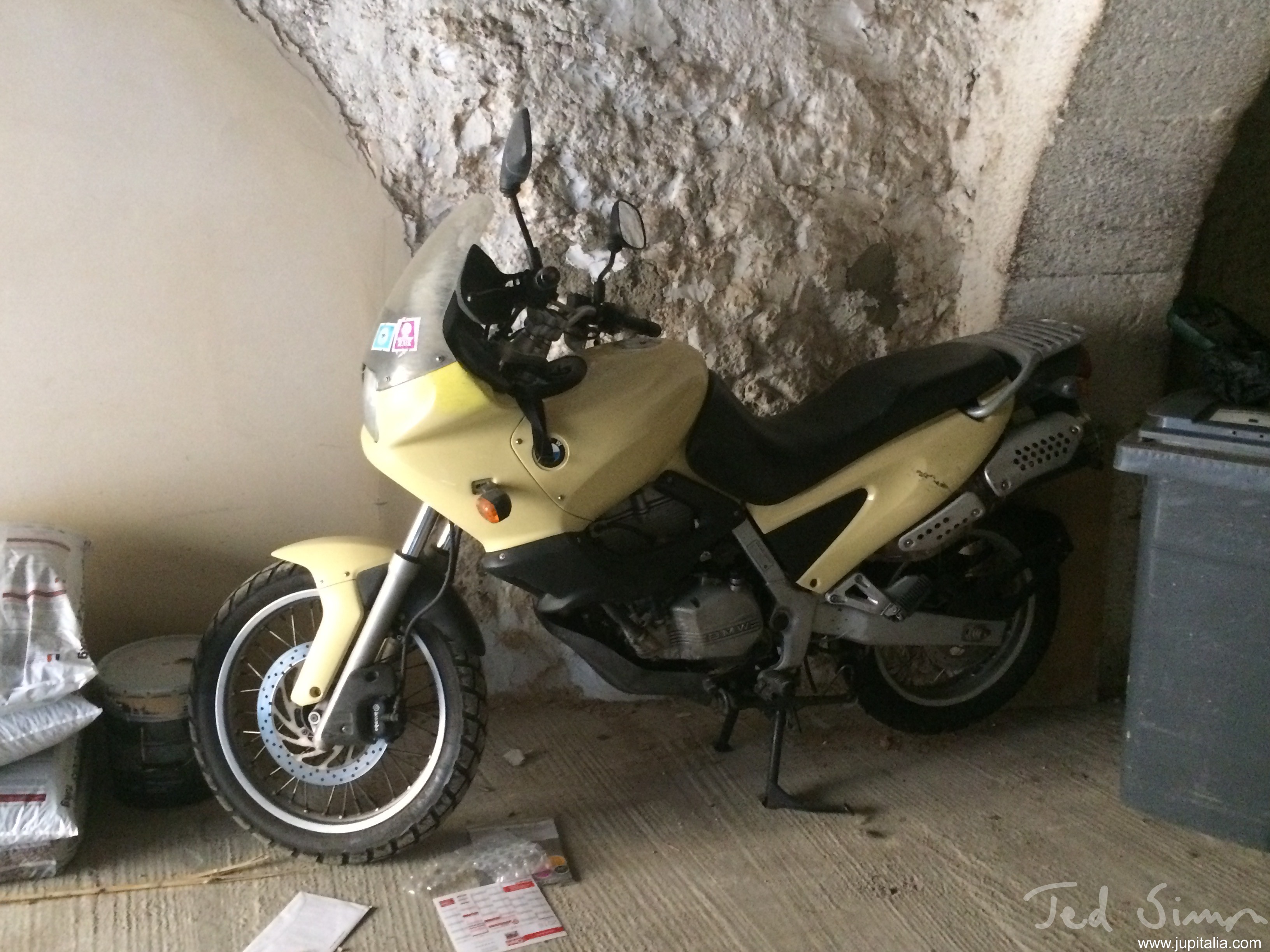
The only thing to mar that beautiful ride from Bavaria to Aspiran when I brought my BMW down to France in 2017 was an erratic but persistent fault in the fuel system. Every now and then the fuel stopped running, and I had to find a spot by the roadside to stop and fiddle. I quickly found out that if I wrenched the tube away from the tap and plugged it in again everything was OK for another fifty or sixty kilometres.
This annoyed me but not as much as it annoyed my travelling companion. She felt herself exposed on the roadside, and she formed the opinion that if I filled up at every available opportunity it would happen less.
I didn’t believe her theory but had no explanation myself. It was not suction from the tank. I rode with the gas cap open for a while but it still happened.
There was no blockage at the tap. When I took off the tube, the gas ran freely. The filter likewise showed no sign of being blocked.
My reluctance to keep stopping for a refill created bad feeling which eventually built up into a full-scale shitstorm, and became what I still think of as the worst thing that has happened to me in my life, although I have no scars to show for it.

Always remember to carry string (along with your umbrella, of course)
The other day, three years too late, a friend of mine called Simon de Burton came by, took one look, and said “Your filter is too close to the engine block. I bet it’s because the petrol is vapourising and causing an airlock.”
That sounds like the perfect and most promising explanation. I have yet to prove it. I shall do so in the coming days, but some of the joy of discovery has already dissipated. Another biking friend, Helmut Heusler, came to visit, and he has had decades of experience as a design engineer for the big German car makers.
He says, “Throw the filter away. It’s quite unnecessary.”
I’ll try to prove Simon’s theory before I do though.
I have never had to deal with the French Gendarmes before. I see them around of course, always very smart and business-like as befits a national police force. Usually I see them in their vehicles, and they are very impressive on their BMW motorcycles. They wear a blue uniform and in the heat of summer here in the south they cast off their jackets and wear broad braces to support their military style trousers, but this does not imply a relaxed or slovenly attitude. I have always thought of them as a force to reckon with. On the one occasion that I was stopped, at random on a roundabout, the Gendarme was very pleasant and polite and joked a bit as he went through the routine of checking my license but you knew it was the velvet glove over the iron fist.
Recently they have been building a new headquarters for the Gendarmerie alongside a road I travel quite frequently and it is finished now, a very fine looking purpose-built establishment flourishing aerials and such, surrounded by a panoply of new houses that I assume houses the agents. All very convincing and I must say it bolstered my impression of a powerful, effective force of rather superior people, well above the municipal police one sees around.

The new Gendarmerie National headquarters of Clermont l’Heraoult
After my recent unfortunate loss through cyber crime I went to the bank to explain how I had been tricked into sending a number of large payments to the account of a criminal in Switzerland and my counselor said that I must report it to the Gendarmes immediately. I have to say I was little nervous and excited at the prospect of my first interaction. I imagined the kind of interrogation they might put me through, thinking that their investigation might stretch across Europe and back to the States where I suffered the final coup de grace. Interpol and the FBI might be involved. I prepared the paperwork as best I could before going there last Friday.
I parked alongside a barricade with stern warnings about this being a military establishment and threatening dreadful consequences to trespassers. It was quite hard to find a way in. I had to guess where the office was. A heavy iron fence surrounded it but eventually I found a locked gate. This being corona virus time there was also a sign to say that it was obligatory for everyone in this establishment to wear a mask. In a place like this that would be an iron rule so I fumbled for my mask, because I don’t normally wear one outside. As I was hooking it over my ears I heard the gate unlock itself. I went through into a sort of holding area locked in on both sides, and then the door of this imposing establishment unlocked itself.
I found myself inside a rather small, dowdy-looking office much like the old offices of yore and my respect for the whole enterprise began to diminish. A young blonde woman in uniform sat behind a pane of glass and looked at me, rather indifferently, intimating that I should say something. Unusually for France she didn’t even say “Bonjour.” She was not wearing a mask. In fact none of the people coming in and out at the back of the office wore masks. I felt like a dick.
“Do I have to wear this?” I asked. She gave me a Gallic shrug. I half removed it
“I have come to report a crime,” I said.
“Oh yes,”
“I have been defrauded out of a large amount of money.”
The telephone rang. She reached for it, gratefully I fancied, and talked animatedly for several minutes. Then she turned to me again.
“You were saying, Monsieur?”
“Somebody imitated a friend’s email address and tricked me into sending four large payments to a bank account in Switzerland.”
She seemed not to understand me. I did my best to explain. After a bit of this she said she would pass me on to a colleague, an older woman with dark hair and glasses who had come in and was now standing in front of me, mask-less, of course.
I went through it again.
“What is this to do with us?” she asked. “It’s none of our business. You should go to Switzerland, Monsieur.”
They were happy to see me leave.
I see the Gendarmes differently now.

Maybe they should go back to where they came from
