News from Ted
While waiting for my new book to arrive from the printer I’ve been going through some pieces I wrote years ago, and thought I’d keep you entertained in the meanwhile. This one appeared in Motorcycle Sport & Leisure twenty-three years ago. I’d been thinking of doing another long journey after living in the USA for twenty years, and it was time to see how it felt now, at the age of 67. The long journey, of course, turned out to be Dreaming of Jupiter.
I was about twenty miles into Poland on the edge of a small town, surrounded by debris and decrepitude, when I saw a café with tables on the pavement under colourful umbrellas. The Poles know how to relax. Some might say they know too well, but I approve. In this I feel the Poles have their priorities right.
It was an unusually hot Saturday in June and I was getting thirsty. I hadn’t ridden far that day; it’s only 40 miles from Berlin to the Polish border – but border crossings and money changing take their toll. So I sprawled gratefully under the shade and reflected on what I was doing there.
It was twenty-five years since I had kicked down on the old Tiger 100 and begun my 78,000 mile journey round the world. Then the Triumph went into a museum and I succumbed to an R65 just to give myself a holiday from motorcycle maintenance. I still have the same BMW and in all these years I have only put 20,000 miles on it. But there are rumours floating about that I might want to go round the world again – not surprising really since I started them. So what would it feel like after all this time? Obviously I needed to hit the road and find out. A rehearsal if you like – but where? After 18 years in the USA I chose Eastern Europe.
Hinckley Triumph lent me the bike. I rode around England’s green and pleasant land selling Jupiter’s Travels and Riding High until I had enough cash for the adventure. Then one fine day in May I took a boat across the Channel, wandered around France, Holland and Germany for a few weeks, and went East.
On the whole it had been a wonderful experience so far, but that particular day did not start well. On my way out of Germany’s scorching and dusty future capital I stopped to refuel, packing in as much gas as the 15-litre tank would hold. Coming back from the cash register I saw an ominous pool spreading under the bike. Petrol was running freely down the side of the engine, appearing from some hidden source below the tank. I turned off the tap. the gusher slowed and stopped. I turned it on, and the petrol ran again. I turned it off once more, moved the bike to a dry place and started the engine. It ran fine. I turned on the tap and petrol ran out again. This was not good. I had no idea what to do. I was NOT going to ride through Poland on a crotch rocket waiting to ignite. On the other hand I had just paid $200 for a 24-hour visa to Russia, valid on Monday only. There was no time to waste on motorcycle mysteries.
In desperation I called ADAC, the German equivalent of AAA, hoping they knew more about Triumph triples than I did. It was a national holiday in a heat wave. They were very busy. While I waited for the man, I took off various bits of fairing to see if I could detect where the juice was flowing from. My efforts were futile, so I screwed everything back on. After ten minutes of impatient waiting I turned on the tap again. As mysteriously as it had begun the hemorrhage stopped. I cancelled the call for help, pretending I’d fixed it myself, and set off feeling rather foolish.
All these things contributed to my thirst and I meant to take a long, lazy break. I had hardly begun on my Orangina when along came a crazy man. This short, shabby peasant ambled up, mumbling, with a loony smile, and I was his new best friend. He was prematurely aged, probably more by vodka than the weight of his responsibilities, and he stood at my table gazing at me with a kindly expression as he gibbered non-stop gobbledygook at me, one calloused hand outstretched, in greeting or supplication. I gulped down my drink, climbed back on the Triumph and headed in the general direction of Gdansk.
I was on a less important two-lane highway, but the surface was quite good and the traffic was light. All around me the Polish countryside was moist and lush. Sheets of water gleamed through gaps in the trees to remind me that in this northern stretch of Europe forests and lakes shared the landscape equally. To tell the truth it was beautiful. There was no industry, only small towns and glorious country.
People sold fruit and fish at the roadside. Along one stretch, where an unusually long lake extended langorously behind a curtain of forest, there were people standing at the mouth of every cart track dangling what looked like long brown sticks from their outstretched hands. They were people of all kinds – young, old, men, women and children, and they dropped behind me as regularly as telegraph poles from a train window. Only after I was long past them did it strike me that they were selling smoked eels, which I happen to relish above most other things but it was too late. One can never go back.
Gradually the heat and humidity built up, and by mid-afternoon I was pretty sure it was going to rain. The sky was a bustling arena of clouds, some silvery bright, some dark and drear, chasing each other through shafts of sunlight. I don’t mind riding through rain, but I don’t choose to. It seemed to me I had come far enough for one day and I started to look for a place.
Near Walcz – which I pronounce “vouch” because the L has a cross on it which I can’t type – I saw a hotel shouting at me from across the road. It boasted a huge sign covered in boxed illustrations of people engaged in Olympic water sports. It was like an IKEA user manual, and behind the hotel, on the edge of a lake, were many sporting types dashing about following the instructions. The driveway to the hotel was protected, military fashion, by a guard house and one of those pivoting poles. A severe-looking couple emerged from the little house, and you could see immediately that their lives centred around this pole. They did not want me to get past it. I drove up and waited while they raved at me. Finally, due no doubt to the superior force of my personality, they raised the pole. I parked and walked to the reception desk, where I met a nice-looking, English-speaking young woman.
The Eastern bloc has a vast army of nice-looking, English-speaking young women. Presumably they all used to spy for the KGB but now they don’t and they are just as nice as before. She told me that a room cost 80 Zlotys. 80 Zlotys is about $25. That would have been very cheap in Peoria, but I was being even cheaper in Poland.
“That’s rather too much,” I reflected sadly.
“Yes,” she said sympathetically, “it is, isn’t it.”
I rode back to the guard house where the two trolls, unable to disguise their glee, raised the pole with alacrity, and I rode on for a few miles. Pretty soon, next to a small shop, I saw a hand-painted sign. All it said was HOTEL, with an arrow pointing forward down a rutted track. A hundred yards further on was a similar sign with the arrow pointing back down another track. My willpower crumbled under the persuasive power of this brilliant advertising campaign and I turned to follow the arrow.
It led eventually to a large building of modern Gothic appearance. From a high peak the roof swept down almost to the ground and from under its formidable overhang little windows peeped out. The first strange thing about it was that the roof was divided in two at the crown. The halves were at least twenty feet apart and it looked weirdly vulnerable, like a crustacean with its soft parts exposed. Under the heavy sky, which was now descending like a lead blanket, I wondered whether some Transylvanian thunderbolt had split the building down the middle.
The other strange things were that it had no name, and that there seemed to be no entrance. I walked around it twice, and finally went in through the kitchen where a not-so-nice looking non-English-speaking older woman received me with rapture and guided me through a culinary labyrinth to find the inevitable nice-looking English-speaking young woman.
“How much for a room,” I asked. She thought for a minute.
“25 Zlotys,” she said. I was sure she had just invented the number, but $8 was fine by me.
“How about dinner?” I asked. She turned to the N-S-N-L N-E-S lady and they chatted.
“25 Zlotys,” she said.
I should have asked to buy the hotel.
Dinner she told me would be at seven because they were catering for a wedding that evening. I said that seven would be fine and went to my room, which contained three single beds, a wash basin and a radio. It was small but cute, walled with naked pine like a ship’s cabin, with a window that peeped through the roof.
Then I went outside to admire the view – the hotel had its own lake with boats and swans and a tennis court – when the N-L E-S young woman appeared. It was six o’clock when she announced brightly, “Your dinner is ready.”
“Why not,” I thought. “At $8 for all this, I should be a slave to time?”
Dinner was also small but cute. It was the same delicious stuffed chicken they would be serving the bridal party, and I was the absent guest. Afterwards I took my umbrella to the store on the road, bought my favourite beer, pronounced Jiviets (you don’t want to know how to spell it) and sat down outside under the awning to drink it. I had barely swallowed three gulps when a crazy man came and sat next to me. He clearly knew me intimately because he muttered secrets into my ear and patted me. It seemed to me later that whenever I sat down to drink in Poland a crazy man would appear, to engage me with a mad monologue of which I understood nothing.
A bolt of lightning shot through the cloud cover and the rain came pelting down. How unpleasant to be trapped in a thunderstorm with a mad man, but – A-HAH – I had my trusty umbrella. With another bottle tucked under my arm I returned joyfully to the no-name hotel, and while nature went berserk outside, I spent the night listening to Cole Porter tunes on the radio.
The moral of this story? Always carry an umbrella. Don’t get on your bike without it.
Next morning I was on my way to the Russian Border.
More next week.

It’s quite hard to explain to others why I persist in wasting my time doing things that other people could do much more efficiently. Take this book I’m publishing as an example. I’ve spent hours wavering between different types of envelope to send the book out in. Should it be bubble wrap? But then the corners might get damaged. Or cardboard? More expensive, but safer, perhaps. There must be a reason Amazon uses them. I bought small samples of each and decided to spend the money on cardboard. I get the envelopes a hundred at a time from some guy called Kurt in Germany. The Amazon man brought the first lot to my door cursing because the village Mayor has torn the road up, and he has to back out down a very narrow crooked street, and it’s raining.
I need a system that will work on the day the books arrive at my door, because they will come, if all goes well, just nine days before Christmas. They’ve all got to go out immediately so that people like you, dear reader, have time to send them on as gifts. And I’ve got to sign them all and write stuff in them. I’ve already got a list of three hundred and I hope it will be closer to four hundred, because that’s the break-even point.
Obviously the answer is to have all the envelopes ready, addressed and stamped in advance. So I’ve been typing out hundreds of addresses on my Mac, and with most of them a note about dedicating the book “To my dear old Auntie Gussie “ or “Keep the rubber side down, Chuck.” And then I transfer the addresses to shipping label templates, and then I run the Avery labels off the printer and stick them on the envelopes, with a Post-it note about Aunt Gussie or Chuck.
All this took a couple of days – there are three hundred envelopes to date – and on the third day I notice that the labels are beginning to unstick themselves. A nightmarish vision of labels flying free in the post office and attaching themselves to other people’s packages of Viagra causes me to spend another day taping the labels down on the envelopes – how inefficient is that? Then someone says, “What about return labels?” Oh. Yes. Another few hours with Avery and the printer, and 300 envelopes. By now the names are getting really familiar; remarkable how many of them are good old Anglo-Saxon names. Where’s the diversity?
Anyway, the idea is that on D-Day I sit at a table, pen in hand while one acolyte to my right holds the book open for my precious inscriptions and the other to my left slips it into an envelope and seals it.
I have yet to find out what happens at the post office when I arrive with three or four hundred small packages. I hope to have them stamped before I get there but I can’t yet figure out how to print the right stamps at home. And what will my credit card say about a sudden 7,000 euro item?
People say: “Why doesn’t he just stick to writing, which he’s quite good at, instead of messing about with things he doesn’t understand?” I don’t have a very good answer. It could be a kind of laziness. I find it a bit boring to do what’s expected of me, but I do enjoy trying things for the first time and understanding them. That’s why I built my own house, and why I started an organic vegetable farm forty years ago, and why I rode a motorcycle round the world before everyone was doing it. I could have hired experts but where’s the fun in that. And anyway, what would I have to write about?
So remember, when the book comes to your door, I’m not just the bloke who wrote it, I’m also the one who stuck on the labels and the stamps. It’s all very personal.

You’ve been wonderful. Almost 200 of you have come through already with orders for Don’t Boil The Canary. And that’s only half the number who said they’d buy it, so I can dare to hope that by the time the books arrive at my doorstep there will have been enough sold to make it all worthwhile.
This week has been like a taste of the Fifties. That’s the last time I did old-fashioned office work, with lists and labels and stacks of envelopes and endless checking, and tea-rings on the tabletop, and heated discussion with the French post office about how to get hundreds of small packages stamped and delivered in one day.
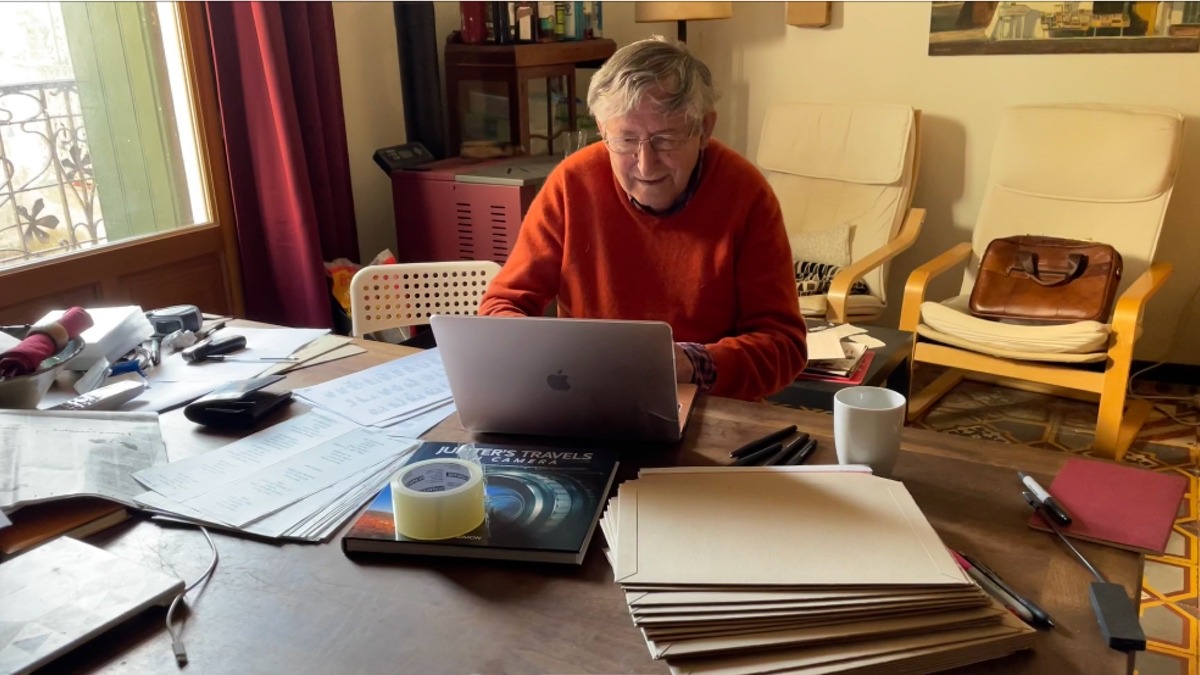
I’ve been promised delivery on December 15. It’s later than I hoped, but still in plenty of time to get it to you and even enable you to send it on before the holiday if you want to. I’ve signed a lot of books in my time but this will be a marathon, especially as so many of you want more than just a signature. I’ve figured out an elaborate system with post-it notes, and with my happy helpers, Ann and Hilary, on either side of me it should go like clockwork. Well it should, shouldn’t it?
If you are among those who promised to buy the book I hope you’ll place an order soon. I want to be sure I’ve got enough supplies to deal with it all, and they might become uncertain as we get closer to Christmas. And need I remind you that Jupiter’s Travels in Camera also makes a very desirable present if you’re looking for something that offers much more than just pictures. What’s more, I’ll put copy of the CD in it for free. It’s much under-rated and offers a huge amount of stuff about the second journey.
Some of you have accompanied your orders with extraordinarily moving accounts of the influence Jupiter’s Travels has had on their lives. I can’t begin to tell you how comforting that is to me and how proud it makes me. This is a time when so many destructive forces seem to be gaining in strength, and it’s hard not to feel helpless in face of them. You allow me to feel that I’ve done my bit, and that we’re all on the same side. For that I am deeply grateful. We have to win, or my grandsons will never know the joys of our wonderful world.

Now that my book has finally gone to the printer I find it hard to believe that it’s taken me almost four years to write. I started on it in 2017, soon after my last visit to New York which was also the last time I saw Harry Evans. He gave me lunch on the East Side at what I suppose was a favourite restaurant since everyone there knew him. Later in the year, with some trepidation, I asked him to read the first 20,000 words which were about my early childhood and the war. He wrote back:
“Ted, I read it all at one go. It is enchanting. Beautifully observed. It will resonate with many who lived it and charm the rest.”
Since he was a truly great newspaper editor and then the boss of Random House his opinion was clearly valuable, and I determined to go on with it, but knowing how lazy I’ve become in my old age I thought publishing it in chapters on my website might keep me going. It worked I guess, but awfully slowly. Harry died three years later, and I still hadn’t finished it. I’m still grieving. I know he would have loved the title.
Anyway, it’s done now, and I’ve promised quite a lot of people that I would do an audio version. There are already recorded versions of Jupiter’s Travels and Dreaming of Jupiter, and they’ve done well. The reader, Rupert Degas, is brilliant and they are both very classy interpretations, but I think this story of my life doesn’t need to be that sophisticated. In fact, I fancy doing it at the kitchen table, and if there are occasional noises, well, so be it. I’ve noticed how rowdy my village street can be sometimes. There aren’t any juvenile scooter sods roaring up and down the street now, partly because the police took an interest after one of them knocked me flat on my back. But it’s the mayor who inadvertently spoiled their game. He has torn up the small square at the end of my road and exposed the village’s entrails.
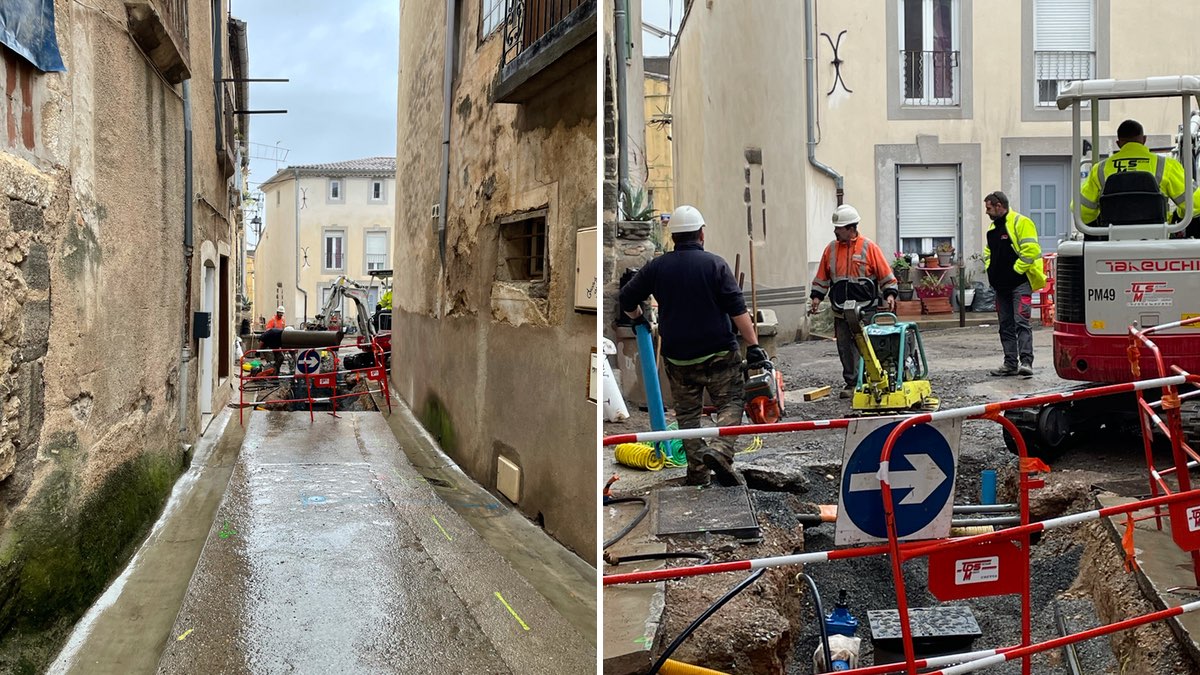
The plan is to renovate and beautify the Placette as it’s called, but for now it’s a mess of deep holes with a quite bewildering substrate of pipes of all ages and dimensions to be pondered over by bewildered workers, although they seem now to have figured it out. For traffic – and drunken pedestrians – it’s a no-go area. We’ve been promised to have it back before Christmas, with water in the fountain as a bonus, but for now there are drills and compressors and things that go bang, and some of that noise might well be recorded for posterity if I go on with my plan.
You may recall that my partner’s house, where I was mainly living, burned down on New Year’s Eve with the guinea fowl in the oven (it wasn’t the oven, and we did rescue and consume the dinner while the house burned). They are still rebuilding it, otherwise that would have been a quieter place to record in. We were promised to have that back by Christmas too, but we all know about mice and men and supply chains. It seems there’s a shortage of windows, among other things.
So along with my book you might get a slice of recorded history, written by pneumatic drill, of the restoration of beautiful old Aspiran. It’s all to come, and more…
The book is ready and about to go to the printer. I am pleased with it, and I’m sure you will be too. Most of you have already promised to buy a copy, and I very much hope I can count on all of you to pre-order it as soon as possible. Here it is – a paperback but with flaps, front and back. And I hope the title amuses you: It’s in the book, of course.
The book will be in my hands well before Christmas. It has 448 pages, which makes it even bigger than Jupiter’s Travels, and the cover price is $25. I will sign every copy you order and, if possible, dedicate it to whomever you choose.
You could say I’m a multi-national but I don’t have a tax haven (pathetic, really) and I am not Amazon either, so the postage to get my book across the water safely is rather high and costs as much as the book itself. Because so many of you have committed yourselves, I will reduce the shipping cost to $20 until Christmas. It’s a bit of a gamble but in my experience I think I can count on you. If most of you come through I have a chance of breaking even.
Most of you I have never met, but a strange thing happens as I laboriously type out the lists of your names and email addresses. Many of them I’ve seen before, and I feel a curious familiarity with you. Although all my books up to now have been published by big companies I have always offered to sign and sell them directly. Many of you have written to me afterwards to thank me for writing them so I recognise a lot of the names. These interactions have been important to me, and I have devoted a lot of time to them, much more than would normally make commercial sense. I think I have a good feel for who you are, and I think you know I’m not in it for the money.
So that’s the deal. Pre-order the book now, or as soon as you can, for expected delivery before Christmas. There will, I hope, be several hundred books to send out quickly, and that involves a lot of work signing the books and addressing envelopes and I want to be ready for when the books arrive.
PRE-ORDER YOUR COPY OF THE BOOK HERE
Here’s the blurb about the book:
“Ted Simon was 42 years old when he began the motorcycle journey that the world knows as Jupiter’s Travels. In a book that was unusually revealing he laid his life and his emotions open to everyone. Yet readers across the globe who have been touched by his openness know virtually nothing about those earlier 42 years.”
“Estranged from his father since childhood, and without brothers or sisters, Ted’s point of reference in the world was inevitably his mother. Yet it was only after she died that he realised how many questions he had failed to ask her. At the same time he became aware that his own son and grandsons were also too involved in their day-to-day lives to think of asking him much about his own life. He resolved to write an account for them, so that they might later know the answers to some of the questions they were too busy to ask. This account inevitably grew into the book to be published this month, under the title, DON’T BOIL THE CANARY.
“Born in 1931, his childhood was dominated by the second world war, and his reminiscences from wartime London will resonate with those who lived through those dark times and enchant those who came later.”
“As the post-war world expanded Ted takes the reader through all the turns and twists of an ever-changing career with an unabashed account of the rich and varied life he led before the journey that defined him.”
It was good of you – quite a few of you – to come back to me with answers to my impossible question; what to do about climate change.
It seems most unlikely that if I were to ride an electric motorbike from Glasgow to Beijing, or the other way round, that I would arrive in time to make a difference. And if I didn’t arrive at all (most likely) it would send the wrong message.
Extinction Rebellion would not take kindly to my doing a burnout in front of the conference hall (thanks Andy) and I might become extinct myself.
Nor, judging by your response, am I likely to raise a million followers to descend on Glasgow, Where would we put them, anyway, and fewer than a million would be a pin-prick. Besides, I’m told, Covid is rampant on the Clyde.
I’m afraid it looks like I’ll just be staying home.
Meanwhile I’ve been rewriting chunks of my book. It’ll be going to the printer at the end of the month and I should have it by the end of November. I think it’ll cost $25 or the equivalent in your currency. I’ll try to keep the postage down.
I’ve changed the title, but I won’t spring it on you yet. Instead here’s the new last chapter, for your reading pleasure.
I asked you last week what I must do about climate change. So first of all I need to apologise for dragging you into this quagmire, when what you really wanted was happy tales of adventure and twisties in paradise.
Secondly I apologise for asking an impossible question.
Eighteen of you were kind enough to indulge me, but we all know that there is nothing I could do or say as an individual that is going to change the course of events. If Greta Thunberg can’t do it, nor can I.
The things some suggest – generally individual choices, small sacrifices, lower consumption – can mitigate, and delay the crisis, but won’t avoid it. Only overwhelming pressure on the politicians gathering at Glasgow this November might have an effect, and that, in my opinion, would mean millions of people physically surrounding them and holding them hostage.
Glasgow in Winter?
Actually the whole idea hardly bears thinking about.
Andy White (Andy Strapz) thinks I could do a burn-out outside the conference. My subsequent assassination by the Extinction Rebellion people would get some publicity, The wrong kind, I think.
Most people think the combination of over-population and over-consumption will eventually make earth uninhabitable and I’m afraid I agree.
Here are a few choice quotes:
Rene van Eynde:
Please don’t do stupid things.
Nothing we can do will alter the future.
Enjoy the years that are left to you.
Joe Lews:
A Tesla has to be driven a hundred thousand miles before it starts to benefit the planet.
Joe Crennan:
Ride your motorcycle to London. In winter rain, cold & hardship that would floor other 90 yr olds (you don’t have to mention the relay of fine hotels & friends along the way to warm your path)
Barge into C4 or the BBC. Someone will give you an audience once you can side step the initial security. Attenborough is in Richmond; easy to find. Pound the pavements with a couple of your books as passports. A retinue of readers will eventually accumulate.
Seamus Gordon:
Just keep writing. You’ve done enough for three or four lifetimes.
Matthew Lee:
Maybe a combination of your fame and Long Way publicity plus ninety electric bikers aged ninetyish led by you on a 90-kilometer ride showing the world that electric transport is the way to go. Sponsored by Harley Davidson of course. I am only in my 69th year, so am not ninetyish! Maybe you could get President Biden on a bike – he looks one hundredish!
Fabio Colpani:
I think you could plan a conference by streaming (i.e. Zoom App) in which you show pictures, tell stories about your incredible travelling around the world. You could ask for a minimal conference registration fee to donate to some organization engaged in some project related to climate change.
Mick McMillan:
Could you ride an electric bike around or back and forward around Glasgow in November? A motorway, you may know cuts through the centre of the city. A fair contingent of local bikeys could more or less be guaranteed to escort on their conventional bikes but perhaps you’d only want other leckie bikes?
Joe Zeller:
A gallon of gasoline weighs about 6.3 lbs but when combined with the combustion air necessary for a ICE to generate power produces about 20 lbs of CO2. That factoid caused me to pause and think. So, my Sunday ride to the coffee shop, a 120 mile RT produces 50 lbs of CO2. Yikes! That caravan of Viagra fueled Harley riders that roll through Tucson bedecked with American flags and MIA POW banners (and the occasional faux Nazi helmet) is creating enough CO2 to smother their grandchildren?
Russell Schuetz:
The World’s population increased by a factor of four (2 billion to nearly 8 billion) in only the last 100 years, 2. Our leaders are always focused on the short term, and long term problems can be left to the next guy, 3. Capitalism is designed to sell us more and more stuff, making sustainability almost impossible, and 4. We have already passed the tipping point on Climate Change (our daughter is a climate scientist, so we get the real scoop) and are snowballing down the other side. … For me, that combination of things is the perfect storm working against a bright and sunny future.
Of all of these Joe Crennan’s idea has a chilly fascination, as a starting point.
If I did the journey to Glasgow in 100-mile increments, and at the first stop there would have to be ten others starting off from somewhere in Europe for me to continue, and at the second stop, a hundred, and so on until there were millions making their way to Glasgow. Well, is that crazy? Who would organise it? Am I insane?
Think about it. Meanwhile, please buy my book.
Cheers
If you read my book Jupiter’s Travels you might remember that as I was riding south through Africa in 1974 I became disheartened about the effect the human race was having on the environment. I compared us to a cancerous growth. I knew nothing then about climate change – I was concerned about our effect on wild life and the environment in general. That was almost fifty years ago.
Two years later, in 1976, coming down from Ootacamund, in southern India, I met a younger German also on a bike. His name was Hans Bohle. He had been a volunteer working to help Indians grow better vegetables. He told me the hilarious story of how successful they had been– they had been able to grow cabbages three, four, five times the normal size. But nobody wanted to buy cabbages that size. They had to be thrown away. It was a commentary on misguided efforts to impose foreign standards.
Although much younger than me he was already on the way to becoming an important scientist studying global human vulnerability to food and water shortage, climate change and so on. He became a Professor and the Chair of the geography department of Heidelberg University but he died too young in 2014. We stayed in touch all those years. Like all such scientists he met frequently with his peers at conferences across the globe. About ten years ago I asked him how long he and his colleagues had known for sure that climate change was a threat, and he said they’d known for fifteen years, at least. That’s twenty-five years ago.
So like many others, thousands, maybe millions, I have been living with this knowledge for a long time now. I have always wanted to do something about it. I have hoped that my books would in some way help to pass on the message, but clearly that was not enough. Now we are at a point where something MUST happen, and I ask myself what must I do. At least a million – maybe more – have read my books. How many of them feel as I do? Is there something I could do to bring our combined sense of urgency to bear.
Very soon, in Glasgow, national leaders will meet, either to save the planet or to trash it. What are the odds? Not great.
A little while back we had the heart-warming story of Captain Tom who, at the age of a ninety-nine walked around his garden a 100 times to raise money for NHS workers. His success was astonishing.
What could a 90-year–old biker do to the same effect? Any ideas are welcome.
I haven’t forgotten you. Some kind people are worried that I might have fallen off my bike or succumbed to the virus. Not at all. I have simply joined the French masses in their delightful habit of taking August off – well, sort of. I have been working at the book, but it’s been hot, and people have been having parties in the streets, and now that we can go back to restaurants again – well, you know how it is.
As I put all those chapters together I find there’s a lot that needs doing, and a lot of stuff to add. Every memory evokes another.
I hope to have all the text finished and proof-read before the end of September and then it will be up to my friends at Interlibros to turn it into a beautiful book.
I am enormously encouraged by the hundreds among you who have promised to buy the book. It makes the work so much easier and more enjoyable to know where it’s going and that it will be appreciated. You can expect it to be finished in November, but I’ll keep you posted.
The news, of course, is terrible and just keeps getting worse, but I haven’t been able to think of anything to do about it, so for now I’ll just concentrate on putting something nice out into the world.
Cheers to all.
Ted
It’s five weeks now since I was knocked flat on my back in the street. There’s no question that this ninety-year-old carcass got severely shaken up. A fractured spine, a bruised rib, and a sprained wrist were just the recognisable consequences. I’ve been X-rayed and scanned, I’ve opioided myself for aches and pains, and I’ve wondered whether I would ever feel whole again, whether this was the beginning of the slow slide to oblivion that obviously has to start some time. So you can imagine my feelings when I got out of bed this morning and stood straight up without a twinge anywhere.
I hope this is good news for others. The body can still take care of itself. Admittedly it was only a tiny fracture – I am not claiming super-human powers – but even little ones hurt a lot. OMG, I might even have taken to drink.
I haven’t felt much like working so my book is slightly delayed, but I’m on to it now. I hope I have something for you to read before they lock us all down again. I’m enjoying the freedom. I’ve already been on a short ride. I’ll go further soon.
Here it is in my garage, raring to go.

I wish you all temperate weather, wherever you are.
