News from Ted

… and obviously I’m not the only one
Overland is one of those words used for promoting everything from socks to Santa, so you could be forgiven if you’ve missed Paddy Tyson’s Overland Magazine, for and about motorcycle travellers. But you won’t be forgiven if you don’t at least look for it now. Paddy, who also has a quite difficult day job, gives birth to this glossy marvel every three months, and it usually sells out.
So, when HorizonsUnlimited were unable to hold their usual annual meeting in the UK last year Paddy thought he’d have a go, and it was a delight. Everybody asked him to do it again, and this year it was even better despite having my picture plastered all over it. Obviously I had to go.
I flew to the UK from Montpellier because my plan was to come back with that scooter I used to roll around the British Isles in 2010 – you know, the one with two wheels in the front. I thought it would be great for nipping around the villages here in the south of France with a baguette across the handlebars, and a box of wine under the saddle.
I just assumed it would be good for a thousand miles to the south of France. I’m always saying you can go round the world on anything, but I confess I was a little nervous. Not about the bike, about myself. Some time, not too soon I hope, I will have to stop riding bikes. I have no idea how I will know when that is. I suppose one day I’ll sit on a bike and it will just feel wrong. Last year I didn’t ride at all. The V-strom needed work, and I didn’t have time to deal with it, so now I couldn’t help wondering . . .
Anyway, I got on the scooter in Godalming where Stephen had sent it to be serviced, and it felt all right. After six years I couldn’t at first remember how it worked, but mercifully it came back to me and I got it to Paddy’s do where he put it on show with my other bigger bikes from 1973 and 2001.
I was never particularly sentimental about my bikes, not even the Triumph. Here and there in the world, women – it was always women -– would want to give it a name: The Bug, or The Trumpet, or even The Green Chainsaw, but I refused to indulge them. To me it was always XRW964M.
But I must admit, that weekend, seeing the Triumph standing there spotlit, I felt a tremendous affection for it. With light glancing off the leather tank bags and the green panniers it looked not just smaller but somehow quite remote from all those other larger beasts. It looked so much simpler and cleaner, before the age of decals. And so accessible. Yet it had done everything those latter day behemoths had done. And it is still the most comfortable bike I have ever ridden.
The meeting was wonderful. Everybody said so, and one big reason was the site. It was at Hill End, just outside Oxford, a piece of ground that has seen children enjoy the pleasures of the outdoor world for many decades. It used to belong to a generous benefactor who bought it in the Twenties and it gradually evolved from an occasional camp to a fully fledged centre for kids to experience nature.
It has often crossed my mind that many children of my generation would never have known the countryside at all had it not been for evacuation in the second world war, and those who found their way here were very fortunate. The manager I met, Selby Dickinson, was extremely glad to have us there, recognising that our enthusiasm for the world at large resonated happily with the fascination for nature that he and his helpers try it impart to children. Some of the older kids were there too, in green uniform jerseys, helping out, making very good coffee, and very obviously engaged in making it all work.
All in all it felt like the beginning of an institution, and I hope Paddy finds it possible to keep it going for many more years.
I had a wonderful break in the middle of m journey down through France. some American friends met me in Beaune, and through their connections with the wine trade, they got me in to meet one of the more elevated wine makers of Burgundy, and taste his ethereal product, but I’m back in Aspiran now continuing my efforts to integrate myself with the French bureaucracy. Well, it’s not so bad, and I shall be very happy to part of such a fine social welfare system.
Angel. Teresa and I are just back from a much smaller but very enjoyable meeting in the west of France, where John Whyman organised a HorizonsUnlimted meeting. It was to introduce a new French translation of Jupiter’s Travels. I’ll write more about it soon.
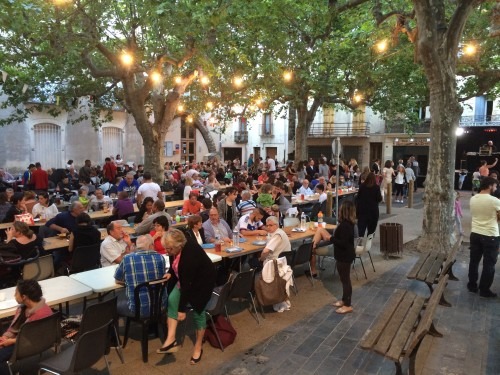
On the night before Quatorze Juillet hundreds of us, in the village of Aspiran, sat down to dinner together under the plane trees with bottles of wine, to eat melon, ham, grilled sausage and lamb chops, cheese and ice cream. It’s a tradition in many French villages and a wonderful way for people to enjoy their sense of belonging to the community.
People who ride motorcycles have (or certainly should have) a much more conscious concern about the risks they are taking than the average motorist, who scarcely thinks about it at all. So the question of risk has fascinated me for decades, and particularly the way in which risk is manipulated for commercial and political profit. Of course the mundane business of insurance benefits from it enormously, but this year especially, on both sides of the Atlantic, fear-mongering has had some spectacular political successes, and the “jihadist menace” throws even more fuel on the fire.
Like many people of my generation, I imagine, I can’t stop comparing the situation in Europe today with my memories of wartime London. For a year, in 1944 and ’45, England was under attack by flying bombs and rockets. There were more than 22,000 casualties from the flying bomb alone, and a high proportion of those was in London where I was living at the time. So through most of my 14th year I was accustomed to the sound of these things flying in overhead, usually at night, and landing somewhere with a big “crump” – usually far away but sometimes frighteningly close.
I never thought that one of them would hit me – although I was once chased down the road, as it seemed to me, by one that came gliding in very low. I was also quite sure that we would win the war and that before long they would stop coming. I suppose I would guess now my chances of being hit were around one in a thousand – I had no way of knowing then what they were. I considered them negligible. I don’t think they affected my behavour much and, for a boy, they added a certain spice to everyday life.
The probability of my being targeted by a jihadist in Europe today must be around one in a million. I am four times more likely to be killed by a crashing airplane, and ten thousand times more likely to be killed on the road. So, much as I felt 70 years ago, I have no fear of being one of the victims of the current “wave of terror” and I also expect that it will be over some time soon unless, by over-reacting, we make it a lot worse.
At the same time as being horrified by the violence and deeply sympathetic to the victims, it is terribly important not to think of this as the end of life as we know it. In 1944 there were concerts in the Royal Albert Hall and all over England. Nobody thought, OMG what if a bomb were to fall on it.
Instead of fearing, uselessly, for our skins we could put a lot more energy into wondering why so many men and women are willing to throw away their lives in a violent gesture, or risk their families in desperate ventures at sea, and what part we in the pampered West have played in all this.
From the tragedy at Nice I rescued one bit of morbid humour.
It was the day the algorithms went horribly wrong. As I read a long account on my Mac of this ghastly rented truck mowing down crowds of holiday-makers the text was interspersed with a series of ads ––– from a car rental company.
Read about the Fire Sale, and then if you want that $10 CD and you’re in the USA, send me $12 (includes $2 for shipping) by Paypal to tsimon@mcn.org. If you’re not in the US send me an email, please.
Not quite, perhaps. More of a moving sale, but fire sure sounds more urgent. I did have a fire here once, in 1991, when my redwood barn burned down, and wasn’t that dramatic. All gone in six minutes. Now that I’m leaving those memories come flooding back.
So, as I search around for things to leave, things to take, I find something I haven’t looked at for a long time – it’s the living record of my second journey around the world, and looking at it again I am amazed at how rich it is, in stories and pictures, almost all of them unique to this medium. For three years I ran a live web site of my journey and it’s an example of what I have been imploring other travellers to do – look at what’s going on around you, think about it, write about it, photograph it, tell the truth.
There are 253 pages of text with 706 pictures from Europe, Africa, the Americas, Australia, New Zealand, Asia and India. It’s easy to navigate – there are calendars to take you anywhere you want to go instantly, and quite a lot about the choices I had to make before I started.
A lot happened on that journey – nine-eleven for one. Even now it reads like history, and it’s quite different fro the book I wrote afterwards, Dreaming of Jupiter.
I have been asking $25 for this CD, but I want more people to see it, so right now if you’re in the USA you can have it for $10, plus $2 postage. If you are anywhere else, just email me and we’ll work something out. I really believe it’s a bargain. If you don’t agree I’ll give you your money back. Can’t say fairer than that.

It has taken me 85 years to discover Verona, but I’m one of those people who like to save the best for last.
What got me there – apart from my new/old Citroen C2 – was an email from Luigi Licci who owns a travel book shop.
Anyone with a book shop will get my attention. Book shop owners are among the bravest, and most endangered people alive, and one should go any distance to find them. YOU will find him on the Via Stella in the heart of the city and the shop is named after Gulliver, who was my inspiration too.
Luigi invited me to enjoy stardom at one of those amorphous public events that I never really got the hang of, but which I liked tremendously. A PR girl in harlequin tights and a denim burqa tried to explain it to me in vain, but I had my shoes shined by an elegant gentleman in top hat and tails, so who needs explanations.
I think it was all about books and travel and motorcycles and Verona, but there were also people selling retro clothes and jewelry. The food was very nicely presented from cleverly converted trailers along the side of a sort of mews that was once attached to the city arsenal. As well as pasta and seafood there was beef from Argentina, which is a very big deal in Italy. I had some (too much actually) and it was pretty scrumptious. Everybody seemed to be doing well except for Giorgo, a short man with a huge tummy, who sat back on the saddle of his ice-cream tricycle. It wasn’t very hot and nobody wanted ice-cream. I felt sorry for him but he seemed happy enough not to have to bother.
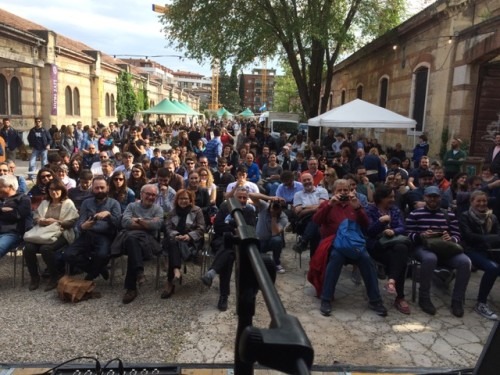
As you can see a lot of people came to listen to me stumbling through a long interview and they seemed to be genuinely interested although it obviously helped that it was the only place where they could comfortably sit. I was interviewed by a notable Italian rider/writer called Roberto Parodi, who also translated for them since I don’t speak Italian (not to mention several hundred other languages).
What people generally want to ask me is how they too can have a journey like mine, and of course that’s impossible for all kinds of reasons. But I understand what lies behind the question and try to do my best. Anyway they all applauded enthusiastically, and I felt very much among friends.
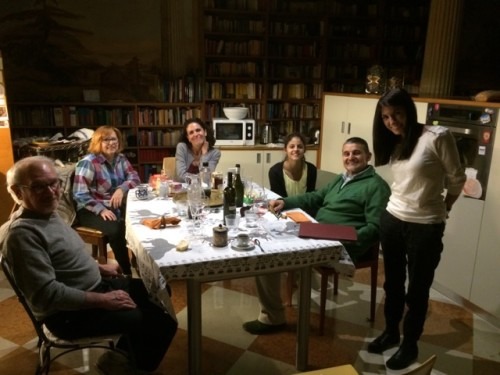
Luigi – he’s the one in the green shirt – looked after me like a son (well, actually more like a grandfather) and invited me into his home to meet his family and friends. Of course I already knew that he must have another source of income because nobody makes money selling books off the shelf, and he was a successful broker in “real life”. So now he lives in the country in a villa with a view that Visconti would have envied. It’s heart-warming to see money put to such a good purpose.

Guiglio Fanton, who writes for Mototurismo, took me on a marvelous sight-seeing tour of the city. Of course all the stuff about Romeo and Juliet is a bit hoky, but there’s masses to see. He showed me piazza after piazza, each one more beautiful than the last, and Verona also has a Roman Arena, only a bit smaller than the colosseum in Rome. That’s Guiglio standing in front of it. (Happy Birthday Guiglio).
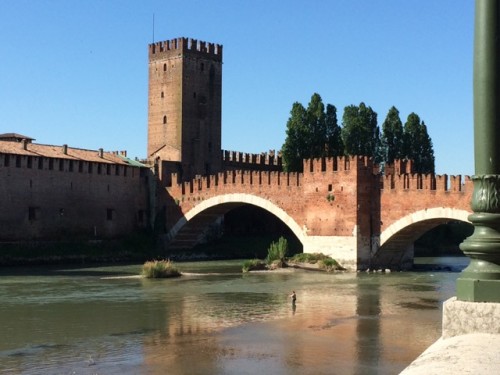
The city sits around a lovely green river that snakes through it. You can see someone fishing in the picture and I watched him make a catch, so the water’s clean, which is not too common in big cities. That huge castle is made, incredibly, from brick. Someone told me that brick absorbs the impact of canon balls better than stone – remember, you heard it here first.
The history, of course, goes back beyond the Romans and is pretty bloody. One member of the ruling family is credited with having slaughtered 11,000 men from Padua at one sitting, but the good old days are over and it’s pretty safe now. Can’t wait to get back.
When you move house all sorts of things float to the surface. Here’s one of them – a piece I wrote for the Sunday Times in 1977, just after getting back. I think it’s interesting to read now, and some of it is not a little prophetic.
It’s easy to look back and think of those days as relatively peaceful and innocent, but that’s not at all how they seemed then.
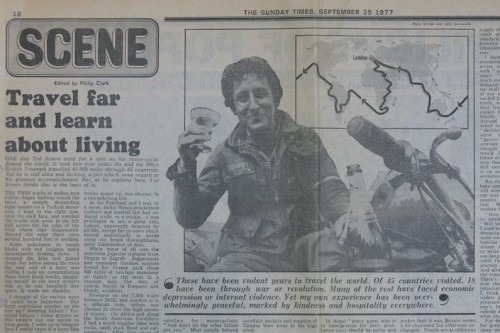
The twin track of molten tyre rubber began halfway round the bend, a steeply descending right-hander on a Turkish mountain. I kept to the right side near the rock face, and watched the tracks veer away to the left and across the far edge of the road where they disappeared. Beyond the edge there were several hundred feet of nothing. Some policemen in rough khaki with red insignia stood nonchalantly looking down. I stopped the bike and joined them. Far below, the rear end of a lorry was visible. I rode on contemplating those fresh black tracks, imagining myself in the lorry driver’s seat as he was launched into space. It made me shudder.
I thought of the various ways it could have happened. One lorry overtaking another on the way up? Steering failure? Terminal fatigue? Some drivers on this Eastern run use opium to keep going. I went on to imagine how I would react if a lorry like that came hurtling round a corner towards me, and paid homage to the dead man by using his example to stay alive. It was one of the methods I employed to survive a 65,000 mile journey on a motorcycle.
On the road from India to England there were endless chances to learn from other men’s’ tragedies. At times one could imagine there was a war on. Seven thousand miles strewn with wrecks. A TIR juggernaut sliced in two, the cab here by the roadside, the container in a river 200 feet away. How could that happen? A new white Peugeot rammed down to chest height under the rear axle of a trailer. Tankers ripped open. Innumerable vehicles upside down. All the way through Pakistan, Afghanistan, Iran and Turkey the carnage mounts up as the traffic concentrates. On the Iran-Turkey border ( a wonderful old-style frontier where you have to pass through a stone gateway) the biggest TIR trucks queue up, two abreast, in a two-mile-long line.
At the Pakistani end I was, in a sense, lucky. Newly proclaimed curfews and martial law had reduced the traffic to a trickle. I was privileged to see a great city, Lahore, apparently deserted by all life except for the cows moving majestically in herds along the broad thoroughfares, quite independent of man.
Worst of all was the notorious Yugoslav Autoput from Skopje to Zagreb. Juggernauts and impatient German tourists bound for Greece pack these 800 miles of two lane monotony as tightly as the meat in a sausage skin. The skin of course bursts in frequent and bloody accidents.
Nowhere on the 7000 miles from Delhi to London is it a difficult ride, unless one chooses to cross the high passes in winter. (In Africa and along the South American Cordillera I had a much tougher time with rocks, sand, mud, flood, and corrugation). After four years of traveling I was glad to have this relatively easy – and often tarred – surface rolled out for me all the way home but, thank heaven, I had also acquired the road sense to survive on it.
Many people who took an interest in my journey consider that my greatest accomplishment was to come back alive. With my mind full of more positive benefits this seems like the least important achievement, though it was done with great effort. But at least it proves that the odds, however bad they may seem statistically, can be defeated. The only serious injury I suffered –to an eye – was due to a fishing accident.
I found the best aid to survival was the old truckie’s motto “drive the next mile”. to which I would add my own corollary for motorcyclists “and don’t let the other fellow get you.” Most people believe that situations can arise on the road which make them helpless victims of chance. I think you stand a much better chance if you believe that everything that happens to you on the road is your own fault. Everything.
The truly astonishing volume of traffic that now surges up and down the Great Orient Expressway has rather overshadowed what used to be called the Hippy Trail. but the Hippies still flourish. The “freak buses” still plough between Munich and Goa, Amsterdam and Khatmandu, advertising stereo sound, free tea and fully collapsible seats. In little rooms in Kandahar, Europeans wearing odd combinations of ethnic dress, from Turkish Depression gear to Gujarati mirror clothes, still fondle polished slabs of compressed hashish and dream about the price on the streets of Paris and Hamburg. And dope-hunting Iranian police still make tourists turn their camper vans inside out at the Afghan border where cornflake packets and supplies of Tampax blow away in the high wind. So it is all the more bizarre to find oneself riding in central Turkey among bountiful acres of white and purple opium poppies, their fat pods ripening for another harvest of morphine base.
The anti-Hippy crusades pursued with gusto by some Asian authorities may have been justified, but seem designed mainly to clear the way for the big spenders of tourism.
What is a Hippy?
“If you are found dressed in shabby, dirty, or indecent clothing, or living in temporary or makeshift shelters you will be deemed to be a Hippy. Your visit pass will be cancelled and you will be ordered to leave Malaysia within 24 hours . . . . Furthermore you will not be permitted to enter Malaysia again”
Signed: Mohd. Khalil bin Hj. Hussein
Dir Gen of Immigration
The above definition would have included me with my tent and jeans as well as a high proportion of the native population.
In Nepal “every guest who is in Immigration for their problames (sic) should be polite and noble behaved, any misbehaved activities and discussion by the guest shall be proved a crime”.
Difficult advice to follow in view of the impolite and ignoble behaviour of the officials there.
However Mother India remains mercifully benign to all comers. A few more people in shabby clothes and makeshift shelters are not going to make much of a dent on several hundred millions in the same state. As long as India is India the Trail will live on.
These have been four crucial and violent years to travel in the world. Of the 45 countries I visited, 18 have been through war or revolution. Many of the rest have faced economic depression or internal violence. Yet my own experience has been overwhelmingly peaceful, marked by kindness and hospitality everywhere.
I have returned to find prices double, the European pecking order changed, and the political complexion of Europe much pinker than it was. Britain seems a bit chastened but otherwise unchanged. People are as oblivious as ever of their relatively great material wealth. I suppose they are right to be, since what we have here is not really important to the quality of life; indeed most of it, to my mind, is a burden. My mother’s garden, about half an acre of lawn, flowers and fruit trees, could accommodate an Indian slum of a thousand inhabitants (not that I suggest it should). I watch her move about in it alone, pruning and trimming, and I imagine she wishes there were less to do.
I used the word slum, but for me that denotes people who have abandoned hope in their squalor. The Indian slums that I saw were not like that.They were scrupulously maintained in the village tradition. Given just a few amenities (a source of clean water within reach, drainage, a supply of roof tiles, they would reach an acceptable minimum standard. Direct comparisons between European and Indian lifestyles are as fraudulent as ever.
I have spent a lot of time wondering how “they” could arrive at some sort of parity with “us”. During these four years “they” have acquired much more power to press their demands. I see no alternative: we shall have to sacrifice some of our abnormal privileges. If we did it gracefully and imaginatively we could benefit a great deal from the sacrifice, but I expect it will be a bitter and bloody business in the end. Around the world I have been asked to defend Britain in her “decline” and have tried to conjure up some notion of a British “genius” at work. Under the stresses of these last years I thought maybe new directions would be found, new social forms experimented with. I see now that this was foolish. We still carry so much fat. There is no sense of change, just an occasional whiff of decay.
But things will change. Having been among the two billions who will demand it I know they are not just images on a screen or on posters for Oxfam. They are real. We will have to accommodate them.
* * * * * * * * * * * *
“How will you ever be able to settle down?” people ask. “Will you want to do it again?” I used to laugh. The prospect of stopping in one place, of doing some real work and living among familiar faces was all I could dream of. The book I have to write has been on my mind too long, but now I realise that until the book is written the journey will still not be over. And already I know what makes the tramp go back on the road. There’s a tingling vista of freedom that is as elusive as it is intoxicating , and it is peculiar I think to those who travel widely alone. There is a wild pleasure in being able to vary one’s behaviour at will, with nobody around to remind you of what you said or did yesterday.
For example, I used to take it for granted that I preferred to sleep on a bed. In these four years I have slept on all kinds of surfaces, wet or dry, hot or cold, in a prison and in a Maharaja’s palace, still or moving, in pin-drop silence or in railway platform bedlam. I now find that I would choose, whenever possible, to sleep on a rug on the ground in the open air.
Why does it matter? To me, enormously. The habits of sleeping, eating, drinking, washing, dressing that I learned in youth had great influence on my state of mind and body. But they are not habits I would have chosen and in these four years they have all changed. In many ways I find that the old ways of dong things were unnecessarily complicated and expensive. Today what I do is much closer to what I am.
It does not take much imagination to see that the same process applies to less tangible but even more potent habits of behaviour. I think I used to make great efforts when meeting people for the first time to impress them. This kind of thing obviously demands a lot of energy and creates a good deal of anxiety as well. If I had tried to sustain it through four years during which I met, practically every day, new people from whom I wanted help, often with no common language to fall back on, it would have made me a quivering wreck. Relax or crack were the only possible alternatives. I managed to relax by abandoning expectations.
“Whatever it is you want” I told myself, “you don’t need.” Whether it was a visa or a pound of rice, or permission to sleep on somebody’s land, I prepared myself in advance to be content with refusal. The result was a revolutionary illumination. I was almost always given what I wanted and at the same time I found I wanted much less.
These personal discoveries once begun, became the foundation for a philosophy which, while in no way startling, is intensely real to me, having arisen out of my own personal experiments.
Towards the end of the journey the power I had built up in this way began to fail. There is obviously a limit to a learning process like this; in my case about three years. After many months in India I began to wish I was home. I knew the wish was dangerous and debilitating. To hurry now would invite the accident I had avoided for almost 60,000 miles
In Delhi I became absurdly frustrated by a delay of two weeks in getting some spare parts. When I finally climbed out of Old India through the Khyber Pass into Afghanistan I experienced a psychological dizziness that astonished me, and kept me in Kabul days longer than I intended. It had a lot to do with the way I had adapted to the pressure of Indian life, the permanent exposure to people, their curiosity, hunger and clamour. Coming out of that was perhaps like decompression for a diver, but earlier in the journey I would have taken the transition in my stride.
On the long route home I made mistakes attributable only to apathy. For the first time I looked for companions to ride with, and used them to support my faltering spirits. And finally, in Istanbul, I lost all restraint and I rode for home almost non-stop, getting to Munich in three days although I dared not take the bike over 50mph.
Somewhere along the way I wrenched my back and so, having spent four years in almost perfect health I managed to arrive home a physical wreck. And my imagination having worked overtime for so long went into a coma. For many days I could hardly recall, with any conviction anything that had happened to me “out there.”
For a while I felt as though those four years had never happened at all.
I’m only two weeks away from moving to France, and there will be much more about that soon. I hope to be riding my little MP3, the one I used to roll around the isles. I’ll be able to go to all those great European meetings, and especially Paddy Tyson’s wonderful event in August near Oxford. But first I need to unburden myself and seek guidance from those who understand my perplexity.
There are people who don’t like me to talk about politics, or religion, or anything else important except bikes. But I can’t go against my nature.
As I prepare to leave California I think more and more of my reasons for coming here in the first place 35 years ago.
It wasn’t really America I was coming too, it was very specifically California, and not even the star-struck beach-boy Southern California that most people envisage when they think of the West Coast, but very much the under-populated land of mountains, streams, forests and bears in the north of the state, where I had spent such happy months in 1975.
I remember clearly that one of the great attractions for me was that it was only a hop, step and jump from South America. The truth is that, but for some real, practical difficulties, I would have moved to Colombia, and I imagined riding down there every now and again.
In those days the prospect of hopping on a bike and riding a few thousand miles through several countries was no more daunting to me than a trip to the nearest Costco. Quite honestly, that is no exaggeration. I was so confident of my ability to negotiate all the little obstacles that might come my way that they didn’t figure in my calculations. It was just a question of taking the time and a bit of money.
Perhaps that’s why I never did it. It was too easy. It could wait. There were other things to do first. I was newly married, with a baby on the way, and was looking for a fresh start in life. It was less than three years since I had come back from my big journey, 18 months since I had finished writing the book, a year since I had married. The idea was that we would begin something new, far away from the problems that had shadowed our life in France.
Of course I did do that Latin journey in reverse, when I went round the world again twenty years later, coming up from Chile to Arizona, but by then a whole new lifetime seemed to have elapsed. In the meanwhile Mexico and several other countries south of the border had come to me.
My valley in California, and indeed the whole county of Mendocino, is full of Mexicans. The fact that marijuana flourishes here naturally attracts some less savoury types as well, but that’s equally true of the indigenous white population. On the whole I have to say that I really like Mexicans. Both here and in Mexico I find them to be very nice people – nicer even than white Americans, and certainly nicer than me, because their niceness is achieved without effort. Watch them in a crowd. They are happier, because they wear their empathy on their sleeves.
And they work hard.
So, as I prepare to leave this country I find myself utterly bewildered in the middle of a quite outrageous and bizarre primary election season, and one of the things that strikes me most forcibly is the farcical nature of the arguments about immigration.
Now that Marco Rubio seems to have gathered strength and looks like having a chance, my only reason for writing this is to point out the absurdity of his position.
His parents were Cuban. They left Cuba for the USA, before the the time of Castro, presumably because they wanted a better life. No doubt they immigrated legally, but there is also no doubt that Rubio would defend all those Cubans who fled Castro’s Cuba and arrived in Florida illegally, to be greeted as heroes. Given a different accident of timing, his parents would probably have been among them.
Almost all those people were economic refugees, just like the millions of Mexicans and others from south of the border who came here to support their families. Yet, according to Rubio, these people from the south are all criminals who should be given hell and sent packing. Cruz is no better, and Trump’s xenophobia is so obviously manufactured (trying to whip up up this anger I’m supposed to be feeling) that it’s beneath contempt.
Right now, Europe is struggling to welcome a few million refugees from the most bitter of wars, where civilians are routinely bombed, gassed, starved and enslaved. Absorbing them is a difficult and painful process. Generally speaking, most Europeans recognize that they have a responsibility to help, but there have been powerful reactions, and demonstrations. Obviously, among these millions, there are bad apples, and there have been some well-publicized crimes committed, which have forced several governments to put new limits on the flow. Nobody yet knows how it will be accomplished.
The United States, on the other hand, has unintentionally absorbed about eleven million people, most of them Latinos, in a relatively peaceful process – people who have adapted well and work hard. They have become a cornerstone of society. There are many who believe that if the undocumented were all magically spirited away (I imagine a sort of Trumpian Rapture) the American economy would all but collapse.
You would think that America – the USA – should be proud of it’s ability to offer these millions a safe life, an opportunity to work hard and prosper, and to contribute to the American economy. Instead we have a trio of bombastic, self-righteous, puritanical (you can pin the labels where they belong) men proposing the most preposterous and unworkable schemes, and screaming in the face of reason.
And the worst of it is that a lot of people seem to believe them. This isn’t a matter of liberal versus conservative. It’s common sense versus lunacy.
It snowed on Christmas morning in Covelo and again on New Year’s Day. Snow in Covelo is a pretty rare event.
I’ll take it as a good omen, which is my usual way of greeting any new phenomenon. It’s worked for me so far.
Since I last wrote about Aspiran a few more people have come in with late contributions, so that’ll be some extra sheets and pillow cases for weary travellers. I have to say I’m beginning to get quite excited about it, although to tell the truth I still can’t quite imagine my life in Aspiran. All I can think of at the moment is all the things I won’t be able to do – like gardening and building; these physical things have been very useful in keeping me fit, but they also serve as displacement activities. Over here in the Wild West whenever I feel I ought to be writing a book I think of a roof that needs fixing or a bed that needs digging, and it’s so much easier to do something than to write about it.
I think what I must do, as soon as I can, is get the use of a small piece of ground somewhere outside the village where I can start a vegetable garden. Then it won’t be in front of my eyes, begging to be looked after, but still there to keep me active.
I have tickets to Paris for March 2nd (my son Will is coming over with me for a few days) and we’ll go down on the TGV to sign all the papers and take over the house. And then . . . .?
It’s quite possible that for the first weeks (or months?) I’ll be going slightly stir-crazy before I get my head into shape. My visits to the cafe will probably be quite frequent, but I do also have Teresa and Angel to keep me connected to the real world, and Patrick has promised me my first game of tennis in several decades.
I should sell tickets for that. The humiliation could be severe.
But of course that will all change as soon as people come visiting, and working. I look forward to that so much.
Thanks, all of you who made it possible. I hope in the end you will find it was all worth while.
Who says bikers can’t speak Latin (badly). Everything around Aspiran used to be Roman, so it seemed appropriate.
The deposit is down. In three months or so the house should be ours.
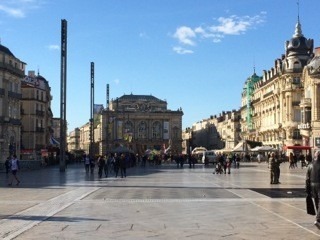
Montpellier – a big and beautiful city, only 40 minutes away
My report is long overdue, I know, but there were nine days of travel, and then there was jet lag. Doesn’t always hit me, but this time it did. I flew to Paris from San Francisco, seven days after the massacre (their massacre, not ours). The plane was half empty but Paris, thank heavens, seemed unchanged. It was cold, and wet, but I had to spend a day there and I treated myself to a hotel just opposite the Gare de Lyon where I was going to take a train the next day. The Hotel Terminus was a bit pricy for me (170 euros) but really nice – quite luxurious. They treated me very well. I went for a long walk along the Seine, and nobody looked at me in case I was a Muslim.
The train to Montpellier next day was my first experience of a TGV, and it was amazing. I used once to drive that 600 mile stretch from Montpellier to Paris and it took all day. To arrive in under four hours, in total comfort, was phenomenal – and because I’d booked ahead it cost me only $50. Just imagine, San Francisco to Los Angeles in an armchair in 3 hours, for $40!
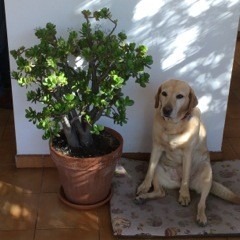
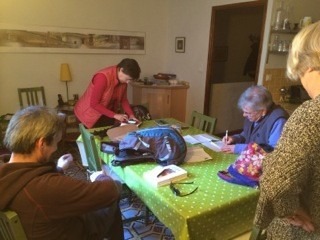 The owners of the house I’m buying came to meet me at the station and carry me back to Aspiran. Patrick and Aileen Naylor are both British. From the day I stumbled upon their house back in September I felt their warmth and friendliness immediately, and that as much as anything made the house attractive to me. When I decided to buy the place, we fixed a date to begin the process, and they invited me to come back and stay there for two nights. They also invited Angel and Teresa so that they could get to know the house they are planning to share with me. So we were all there together, including the dog, Betti. Teresa has a Labrador with a diploma. They are both super qualified to make children feel secure and happy, and they have the same effect on grown-ups.
In France house sales are handled by a Notaire, a combination lawyer/notary, and we spent an hour next morning in the office of Maitre Julien Ducarne, a very grave young man, who determinedly went through the whole ceremony in English. I signed what I had to sign, and put down the 5% that commits me to buy. Then we went off to celebrate at a nearby vineyard, the Coté Mas, which I must say is a pretty nice place, to put it mildly. The food was delicious. Some Americans might find the servings a little skimpy, but if that’s life in France I think I will benefit from eating less.
 Anyway, I got back to California (on another half-empty plane) last Tuesday but had people to see before I could get home again. So we’re now well over the deadline I set for the Aspiran fund, but no matter. We didn’t quite make the 40,000 but I scraped some more money from the bottom of the barrel, and there’s enough to buy the house and pay the notaire.
Sixty-one contributions have come in – some high, some low, mostly in the 100 euro range. The total is 30,972. There’s about 350 in Paypal fees to come off that, but it’s a wonderful achievement and I hope those of you that helped will feel very happy about it and part of the enterprise. The house will be up and running in the Spring of next year. It’ll be bare-bones to start with, but as soon as I can get beds and a kitchen table with chairs, we’ll be in business. I hope some great work will be done there during the coming years, and of course I hope I will have some part in making that happen. Thank you all, very, very much.
If there’s anyone still desperate to get their name on the brass plaque you can squeeze in now, but I shall declare it all officially done and dusted by the end of this coming weekend.
Please don’t bombard me yet with your travel plans. I need to figure out the rules of engagement and there’s still quite a lot to think about, but the main thing is – It’s done. Mission really accomplished.
We are all conditioned to jump to to the tune of the news. As you perhaps know I am buying a house in France and am about to go there to sign the first papers. My flight to Paris is booked for next Monday, and of course when I first heard what had happened there I wondered how it would affect me. But my decision to move back to France is no better or worse now than it was two weeks ago, despite all the horror.
Statistically, in France I will be 15 times less likely to be murdered by gunfire than where I am now (though five times more likely than in the UK), but I also know that these figures are meaningless. I have a huge amount of control over my circumstances and the infinitesimal risk of my being shot to death or blown up is probably no different here in Covelo than it will be in Aspiran.
Somebody recently posted a protest in Facebook – which migrated onto my page – that we are only deeply moved by terrible events that affect us closely, and not by far larger human disasters that occur far away. I’m afraid it’s human nature, and reflected as always in the media. I wrote about it in Dreaming of Jupiter, because I was in Brazil when the planes hit the World Trade Centre. From that distance – cultural as well as geographical – it seemed at first more a spectacle than a tragedy. I knew very well, from my days as a newspaperman, the rough rule of thumb the media used to decide the importance of a disaster; its proportional to the number of dead, and inversely proportional to the distance away.
So Parisians are in profound shock. The people of France, one step removed, in general feel violated. Normally, thousands of miles away here in the States, people would have said “How sad, how terrible,” and gone on with their lives. But this time it’s different because the perpetrators (ISIS, ISIL Daesh, whatever) are on everyone’s radar screen, and so, of course, is the fate of hundreds of thousands of refugees. Most Americans, left to their own opinions, would feel nothing but pity for the torrent of families driven out of Syria by the violence of warfare, but the attack on Paris has become fodder for the spin doctors on the Republican campaign trail.
Nothing could be more repugnant than the way it has been used to pander to the xenophobes among us. Defying all logic, whipping up all the paranoia that is all too latent here, 30 or more Republican governors cry, “Not a single Syrian will cross my threshold.”
Regardless of the fact that this is a futile boast in itself – States don’t have defensible borders – they completely ignore the fact that these were not Syrians who smashed up Paris; these were Belgian citizens who were perfectly entitled, if they wished, to fly to the USA without a visa. Syrian refugees, on the other hand, having gone through who knows what kind of hell to get to Europe, then have to endure yet another year or two of investigation before they even catch sight of the statue of Liberty, a bureaucratic nightmare which is in itself a travesty.
I m not the first to point out what a ridiculous notion it is that ISIS would send it’s murderers on that bitter, dangerous and uncertain trail through Eastern Europe to get to America. ISIS have plenty of money. They clearly have connections. They could as easily fly to Alabama tomorrow.
But no, these sinister Syrian families and orphaned children must be kept out at all cost. Hysteria and paranoia are ugly phenomena in themselves but not nearly so repulsive as the men who manipulate them for their own purposes.
