News from Ted
Here I am, in Lourenço Marques, waiting for my ship to sail to Brazil. I can hardly contain my excitement.
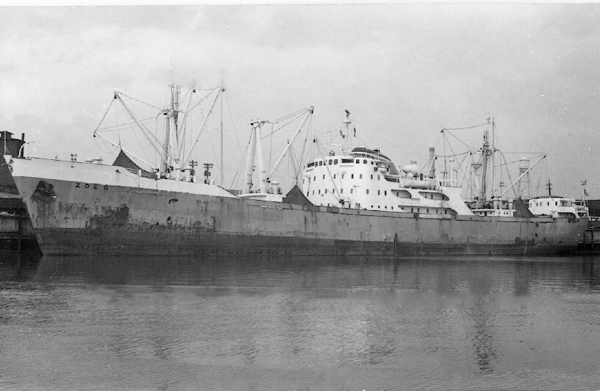
The Zoe.G – my rusty home for ten days as I sail into the jaws of the Policia Federal
May 3rd 1974
Tomorrow, I sail for Rio and leave Africa behind.
It’s the end of a journey that started in a war and ended in a revolution. In the aftermath of the Portuguese coup, Laurenco Marques simmers with a gentle excitement fueled by daily political demonstrations. Students flash their eyes and wave manifestos. Old colonials clench their jaws and let their veins stand out. But life here is lazy and generally agreeable. Nobody wants trouble and there would be no reason to expect it, if it weren’t for that old, hideous nightmare that poisons the atmosphere and haunts the sleep of white men all over southern Africa, a dream of black men in tribal frenzy swarming through the jungle night thirsting for colonial blood. That is what distinguishes between life in the north and south of the Zambesi.
I spent six weeks and dawdled 4000 miles in Kenya, Tanzania and Zambia from the hot and thorny dustlands of the north to the ranches and mealie fields of the south. I met doctors, businessmen, farmers, missionaries, govt. advisors, teachers, all sorts. There were complaints, of course. Grumbling about shortages, and endless stories of African follies and inefficiency. But I did not meet a single European among the 37 I spent time with who wanted to leave. Nor did I meet an African anxious to see them go. They are known to each other now. For them, African and European alike, Idi Amin is a tragi-comic aberration, a black Mussolini.
[Amin was President of Uganda. His regime was noted for the sheer scale of its brutality.]
South of the border all this changes. There is fear and pugnacity. Endless talk of terrorists and racial problems. Amin is the universal example of what to expect from African rule. Time and again I was asked what trouble I had had in the north. Disbelief, even disappointment that I had had none. The first white man I met in Rhodesia was a butcher at Victoria Falls. He sold me a fine fillet steak for 15 new pence and said: “Surely you believe as I do that we are the victims of a world-wide communist conspiracy.”
[White Southern Rhodesia, still nominally part of the British Empire, was holding out against Black independence.]
Travelling alone on a motorcycle along a vast and unfamiliar continent seemed a hazardous enterprise. The prospect frightened me more than I dared to admit. When the Middle-East war broke out on the very day I left London it seemed like the worst omen. Now, 14,000 miles and seven months later I know this is the most rewarding adventure a man could hope for. My faith in human generosity has never been higher. I doubt there is any individual, sage or savage, I would not look to for help.
Alone, dusty, tired, unarmed and openhanded I have found no-one who would refuse me. Long after I stopped thinking of myself as a hero I have received endless respect, envy, and compliments on my “guts.” Perhaps I’ve been lucky, perhaps more cautious than I realise, but I conclude that whatever safety there may be in numbers, it doesn’t rival the impunity of a man on his own in a good frame of mind.
Only once did my journey look like coming to a sudden end. When four men manhandling the bike between two ferry boats, came within an ace of dropping it and its precious load to the bottom of the Nile.
Everywhere the way has been opened to me. My entry into Egypt was a positive triumph. It should never have been allowed. Every consul en route insisted it was impossible. The 1000 miles of highway from Tripoli to the border buzzed with soldiers and police. Countless times I was stopped and my passport examined (sometimes upside down), My visa expressly forbade me to cross the frontier overland. Yet I was welcomed as though the Egyptian army was expecting me and I was whisked through the most complicated formalities I’ve ever known with a glass of tea in my hand. My joy was so great that I became careless. Later that night I lost all my loose cash and papers on the road outside Marsa Matruh. A genuine disaster, but after two hours combing the road I found the all-important documents under a bush where a thief had discarded them. The £20 in cash was gone, but my relief was too great for it to matter.
On the recently tarred “hell run” from Dar es Salaam to Lusaka I overtook Chinese convoys by the dozen – olive-green trucks stenciled with Chinese ideograms – and caught glimpses of the railway they are building to link the copper belt with the East Coast. It was as neat and picturesque as an oriental print. Chinese labourers in straw hats, caricatures of inscrutability, were working on the gradients and viaducts in their hundreds, but they were the only people in Africa with whom I could make no contact.
At Victoria Falls I tried to break the blockade by riding across the Livingstone Bridge but I was firmly repulsed and had to take the usual 100 mile loop round into Botswana and back to Rhodesia. At the Kazangula ferry I met a party of South Africans crossing into Zambia on South African passports. Later, in South Africa, this news was met with astonishment. Most South Africans are convinced that their passports have made them prisoners in their own country. A trip to Zambia would do them a world of good.
Ironically it was the South African border that gave me the most trouble. First I was declared a “prohibited person” for not carrying a return ticket, in spite of liberal proof that I meant to travel on around the world. I was forced to lend the government £220, interest free, but there was more to come. I was carrying a sword, a quixotic mission for a friend in Cairo who wanted it delivered to his brother in Brazil. A chubby Afrikaaner wanted to confiscate it. We argued and a colleague leaned over and whispered, “Why don’t you ask your father?”
Dad was the Customs boss. They all gathered to admire the weapon, a ceremonial sword made in Birmingham, while he tried a few practice strokes with it.
“If we let you take this in, how can we stop the natives from having them,” he sighed.
Then they agreed that it could be sealed into its scabbard. I shall never forget the son dancing with pain as he splashed molten sealing wax on his thighs and his clean white gym clothes. In exasperation he cried: “Usually we have a native to do this sort of thing.”
Three times he told me I would go “straight to jail” if the sword were lost or stolen or the seals broken.
When I left South Africa, nobody even looked at it, but I had a hell of a job getting my money back.
Even so, I found South Africans to be good people – black, white and coloured. I’ve been there two months looking for a passage to Rio, and in the end it’s only apartheid, and the fear behind it, that ruins an otherwise splendid country. An easy thing to say but the only thing worth saying.
The latest issue of a South African Farmer’s Weekly advocates building a wall “like the Great Wall of China” clear across Africa from coast to coast. It’s the farmers, mainly Afrikaaners, who keep the Nationalists in power. No wonder a coloured friend in Port Elizabeth kept repeating, “Man, these Dutchmen are so stupid.”
I set out for Rio, but that’s not where I ended up. Follow my notes next week. Again, I want to emphasize these are notes just as I wrote them at the time.
I arrived in Lourenco Marques at the end of May, and made contact with the shipping line that had agreed to take me to Brazil on the Zoe.G. I struck up a very good friendship with the shipping clerk, who was of Indian descent. He wasn’t sure when the ship would leave and I had to hang around. I spent a lot of time in a coffee house called Raja’s.
Walking the streets of LM on Friday evening, a mysterious and most exciting bonus. Was attracted by the floodlights over the stadium thinking some game might be in progress. Turned the corner between the stadium and the brewery and noticed a stench of urine. A pretentious tablet set in a cement block like a gravestone announced the name of the street, and it had become an unofficial pissoir for people caught short at the bus stop round the corner. There was no game, just a few players shooting practice shots at goal.
Wandered on further down to the station, and saw this building for the first time, with its bulbus baroque cupola centred over the pale stone façade, a piece of pure Lisbon dropped from heaven on the shore of Africa. A perfect example of neo-classical proportions blown just beyond the limit, like over-ripe fruit. A heroic stone mother figure, symbolically bearing the burdens of Portugal, faces the station with a sorrowful look. She might be welcoming newcomers to her colony, or she might just as well be wishing she could take a train and get the hell out of there. Incidentally, it is through this terminus that the Zoe.G’s cargo of copper arrived, having trucked all the way from the Zambian copper belt through Rhodesia.
[Breaking all the sanctions.]
According to the shipping clerk who handles the ship’s manifests, there’s no doubt of it being Zambian rather than from Zaire, because it’s being openly handled by Anglo-American (Oppenheimer’s company) So that finally puts the stamp of authenticity on all that hearsay.
Walking back up to Raja’s place I experienced one of those sudden and revealing shifts of reality that make travelling ultimately worth doing. There was a sort of market or depot area, with Africans packing up lorries with empty crates and so on. Four men were hauling on ropes to tie down a high load, and began chanting as they pulled. It was an ordinary enough scene at first, until the chant took hold. In three time, a run of four notes in the first bar, then one note, and pause.
But of course, this in no way resembles the sound or the rhythm which had internal subtleties of resonance and emphases. It swelled hypnotically invading me completely, more compulsive and convincing than anything I’d heard before, partly because it was more musical. What made me realise it’s peculiar power was that while I listened, and for a while after, it quite cancelled out the familiar European atmosphere of the city, and then, quite quickly, although I clung to it as best I could, it faded away and I was left with just the hollow form, empty of feeling.
It was then that I understood how inimical the African culture might be with ours – and how miserable we should all be if that sound were to fade forever, as it did for me, and leave nothing but a tinkling Western version of a forgotten sound.
Raja’s café chairs have pneumatic seats, like Citroen suspension in reverse. You sit and it lowers you gently a couple of inches.
[Wanting to buy a pair of shoes I met the white owner of the shop and he invited me to a drink at his club. He had had been called up to fight the Frelimo, and told me about it I managed to get it down on paper.]
“It’s bladdy three and a half years. That’s a bladdy long time. Bladdy two and a half years in sequence. I tell you. We were losing men all the bladdy time, man. Maybe one man a day. Well, there’s maybe four bladdy lots like our fuckers. So that’s four bladdy men a day, so in a bladdy week, or months, and for six or seven bladdy years and you see we lost a lot of men and that’s what Spinola wants to stop.”
“But the bladdy worst was we couldn’t bladdy fight the fuckers. They had bladdy grenades and Kalashnikovs and bazookas, and bladdy mortars behind, and they would kill some of our fuckers and then they bladdy run away. We could only bladdy get them with helicopters, but when we bladdy ask for helicopters, they come bladdy 24 hours later.”
“Walking 40 bladdy miles in a day looking for the fuckers. But when we find them we can’t shoot them. We got to bring them back to question. That’s no bladdy good. Not the Navy men, though. They were bladdy good. They landed and bladdy shot everything. They didn’t bladdy care if it was us or the bladdy enemy. They kill anybody. You just get out of the bladdy way.”
[Somewhere during those days my 43rd birthday came and went. Last week my 95th also came and went, but this time with great eclat. My very good friend Guillaume invited me to his home for a party, and he and his wife Estelle found a way to pack 95 candles on to a cake. They were the kind that relights itself, so it took all the pathetic puff that I have to put them out.]
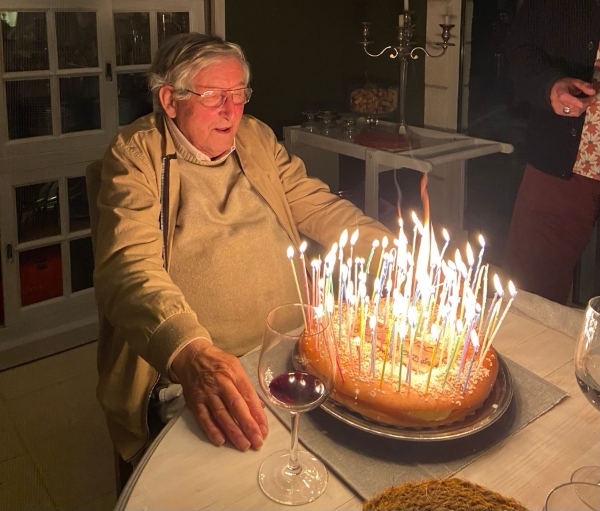
Bye-bye. See you again next week.
I left the Balmoral Hotel (which is still there today) to go back down to Durban, on the coast. Before leaving I parked my bike at the back of the hotel and left the engine idling while I checked on the oil pressure, which was still behaving oddly.
Monday, 22nd April. Kokstad to Durban.
Boy at hotel dancing to the rhythm of the engine as I look for oil pumping. He is almost concealed in a doorway – kitchen boy – hands bouncing up and down.
Monday morning, descend from Transkei into sugarcane belt, miles and miles of it. like grass magnified, leading to coast. Dirt road is short cut to High Flats. Look down on a section of country with strange contours, like a sheet of dough collapsed over a bed of nails. Innumerable small peaks of grassland with folds and drapes, all dimples, not a single flat bit. When I stop on road, passing Africans linger and watch, as though waiting for something (a handout, a miracle, a phenomenon of some sort?) Thinking – what’s it like to work in these cane fields? What a different view of the country I would have then.
Durban is warm and I’m grateful. Big port, several dozen ships in harbour. Drive straight to Mutual Beach Centre where Corinne (Peter Harland’s contact) lives – top of a vast block. Flat is smartly furnished. Her ex-husband is there, and her daughter. Drink too much coffee. Smoke too much, talk over the same topics, trying to make them sound bright and novel. What is there to see in Durban? She says it looks very attractive, but there’s nothing there. That same false allure that all cities show.
On to Gillits, 23 miles inland on the Moritzburg freeway. [I had promised my London agent, Pat Kavanaugh, that I would visit her mother.]
Pat’s mother and her husband, Sidney O’Brien, a pilot in the harbour. Nice man – a bit of Bill in him. [Bill was my stepfather]. Pat has many of her mother’s features and mannerisms. See the photograph on the cover of a Cruise O’Brien hotch-potch about Ireland. Stunning picture. Son Mike is spotty, stiff, awkward, enthusiastic, archeological, keen on looking things up. We try to locate the Karoo bird, but result is inconclusive. [A bird I saw somewhere coming south.]
I’m very tired, fragmented, spent. Grateful for hospitality.
Tuesday, 23rd. Gillits to Piet Retief.
Call at Renolds for chain. [Another sponsor: Lucky to find one at Gillits]
Then climb up escarpment, through rock-strewn, rising and falling, ground. First time in South Africa see Africans in full tribal dress – the Ndebele, I think. Women wear hats of bright cloth stretched over discs, coloured aprons, bangles on arms, legs, neck.
The scene reminded me of:
(a) An imaginary idea of red Indians living in their country
(b) Pastoral 18th Century paintings. Remember huts on platforms carved out of hillsides; the proportions of the rocks, the ring of outcropped sandstone holding life and sun in a benevolent bowl. Cascading landscape.
Keate’s drift; orange and apple sellers at roadside. Pix.
[I’ve lost those pictures. They may have been spoiled by the police, later in Fortalesa. There’s no mention of my going to Nelspruit for the parts I had sent on. It’s fifty-two years ago and my memory fails me. From Piet Retief I rode into Swaziland, now called Eswatini, where I stayed for a few days on a pineapple farm. It belonged to the family of some friends I’d made in Cape Town. After that it was a short ride to Maputo, which was then still called Lourenço Marques, a major port in Moçambique. The Portuguese still held Moçambique as a colony but were fighting a losing battle against the native Frelimo army. While I was there the white Portuguese government of Moçambique revolted against Lisbon. Soon after, they also surrendered to the native Frelimo. My ship, the Zoe.G, sailed for Brazil in the midst of this turmoil.]
Laurenço Marques.
Bushy faces, Jesus faces, slim-tailored shirts with buttons popping across youthful chests. Jeans slung anywhere from waist to crotch on heavy brown leather belts. Little shiny leather purses on loop handles.
Or soldiers on interminable military service with Steve McQueen haircuts. Students gather round café tables, eight at a time and fold in like petals of a flower, exclusive, intense, introverted. Primitive people face out at the world. Older people too. Find myself now very aware of the extraordinary self-consciousness of young men, who behave as though they were the cynosure of a thousand eyes which are weighing every move and every expression, waiting for the first faltering step, loss of direction, failure of acceptance. (And I remember the pain outside).
[I arrived looking for a hotel. I had heard of a place called the Carlton, and asked the first person I saw.]
He wore a short, tight red sweater and flared trousers with turn-ups, the colour of strawberry ice-cream running down the inside of a dustbin. “Hi man, how you doin’, I’m sure glad to meet you. Sure man, we’re all friends here. We don’t care about the colour here. I’m just at school, sure. But I’m in the bar here, fuckin’ plenty of businesswomen. Plenty, sure. Businesswomen from Moçambique, sure.”
His face was a smooth brown sixteen years or so under a wooly black fleece, and his breath boasted of spirits. He didn’t stop talking, and his three companions gathered about him fascinated by the trick they hadn’t mastered. One was a white Portuguese with a sensitive face, despite the loss of two front teeth, and the others were whispy in-between kids.
“Oh, you want a room, to sleep. Sure, I can show you. Great place, all South Africans up there. That one you talkin’ about is shit, man. That all Portuguese shit, shoutin’ and noise. I can take you alright, maybe fifty ‘scud. [Escudos] I don’t know. It was three months ago. We were smoking too, man, you know, grass, green grass, you know what I mean?”
We set off along the streets, darkened, fairly deserted, a ragged band, and as we walked one after another they opened their trouser flies and sprayed the pavement and the walls with a wide arc of silver piss.
Across the Republica and up two blocks we turned into an anonymous doorway and up green and brown stairwell to the first floor. Two Africans sat in chairs with their backs to the wall facing the stairs with a table between them. The nearest one had earlobes with big holes in them for hanging up big ornaments, but he wasn’t wearing them tonight being in his business suit. His skin was hard and dry and close pored like old walnut. He wouldn’t speak English though he plainly understood it. His price was 120 ‘scud for a night. For Portuguese it was only fifty, but for South Africans and lesser foreigners it was 120. That was a fixed price, h said, the same all over and couldn’t be altered in any circumstance.
I looked at what I would get for 120 ‘scud and saw four army beds in a nine-foot square cell. Each one was 120 ‘scud (unless you were Portuguese) which meant he was looking for twelve pounds a night, plus a free meal for his insects. The enormity of it had me laughing as I led my uneasy party down the stairs.
“Whisky breath,” I noticed, retained an equivocal stance on the matter. He protested that all peoples should be treated alike and that economic discrimination was a gross injustice, could hardly persuade me to accept the terms, but would have done well enough out of it, I suppose. There was a wistful sorrow at my guffaws, but I was relieved at being able to walk off with total conviction, in spite of being tired and a shade fed up.
So he led me to the place I had first wanted to go to, which was fifty yards or so from where we first met. Here I got a double room for myself with all the fixings for 90 ‘scud, and a good restaurant downstairs. I gave him 20 ‘scud because he said he wanted to eat. His white friends stood by and kicked his feet.
The Carlton Hotel and Restaurant. Next door is the Bar Luisa. Coming attractions. Portraits of the girls. Could have been picked from any bus queue, but there was a touching sincerity in their efforts to look like brides. Carlton has a separate ablutions building attached to main block by glazed corridors. White tiled bathrooms on left – lavs on the right. Said to be the oldest hotel in town. Girl bars have curtains across the doors. Nothing to compare with the Sunshine.
Well, I turned 95 on Friday – another surprising milestone on a path I never expected to see. It’s all a bonus, and to think that I might even outlast Trump!
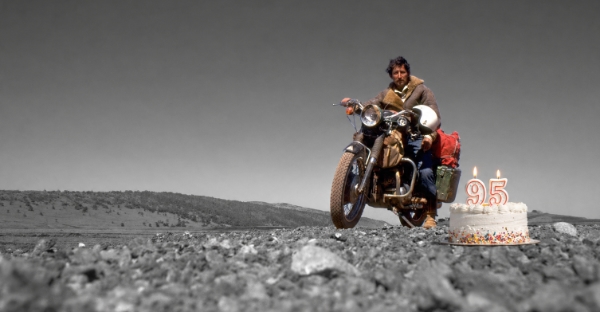
I’ve come several thousand miles since Johannesburg and the bike is showing disturbing symptoms. I have already asked Lucas in Jo’burg for parts, and hope to get things fixed in Port Elizabeth, at Lionel’s shop.
Friday 19th April
Into Lionel’s first thing. Call Joe’s [in Johannesburg]. They have the parts. Just delivered [from England] but they won’t get to P.E [Port Elizabeth] today. Decide to re-sleeve damaged barrel and have the new parts sent on to Nelspruit. This means I have to go to Nelspruit before crossing into Swaziland, otherwise that whole “prohibited person” business again.
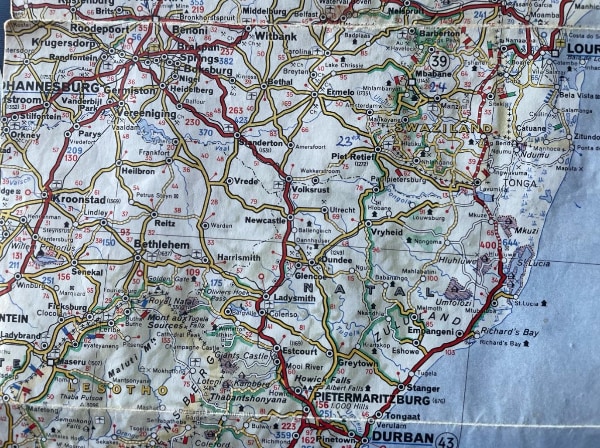
[Here’s a section of the only map I had at the time – one of the three maps by Michelin that covered the whole of Africa, so the scale is huge. You can just spot Nelspruit at the top, on the road from Jo’burg to Lourenço Marques. But I dipped down into Swaziland on my way to visit Anthony’s sister, “Small”]
Armed with letters for the pay desks I visit the Oceanarium and the Snake Park. Snakes in profusion. Strange demonstration by black snake warden in high leather gaiters, with cobra snapping at his heels. His voice soars and swoops without relevance to the words. Feel sorry for the puff adder which is pinioned ruthlessly for every demonstration. “Poison fangs. Nasty fangs. Sharp as a nail.” When he finishes with the snakes, he tosses them into the water where they squirm angrily.
Tropical house is full of beautiful birds. Most stunning are the toucans (Sulphur breasted) with beaks like pop art. The dolphins are delightful and impressive – weight up to 500 lbs, and when one leaps through a hoop three ladies in the front row are drenched by water. Dolphin whistles are very clear and convincing. Also two huge aquariums, and that particularly ogreish fish with thick white lips set in permanent snarl.
2pm. The barrel returns. I help to reassemble and don’t prime the pump: Result: No oil. It’s already too late to leave. I ask Yussuf, John and Lionel to have a drink with me. Wham! It hits me. We can’t drink together. The apartheid comes home to me. Yussuf invites me to his house, ten miles away in coloured estate called West End. Wife is very bright and pretty in scarlet boiler suit. She teaches in coloured school. Has niece in Brompton Hospital [in London]. Miss Bilby. Yussuf is very strict Muslim. No alcohol and normally doesn’t smoke. We have curry. No cutlery. Strong nostalgia for Sudan as we eat with our fingers. Then to hall with friends to play badminton. Yussuf is passionate about apartheid. “Dutchmen are stupid. Can be anything he wants because his skin is white.” Hoots his horn at white girls in protest. His resentment is lively and profound. Others dissolve their bitterness in religion. (cf: Priests Royal.)
[Royal Priesthood ministries still thrive in Durban, but then it was a way for Blacks to assert their dignity and individuality under a crushing regime.]
Saturday 20th
8.30 at Lionel’s again. (Have spent Rand 16.50 at Red Lion but good value by S.A. standards). Ready to leave by 12.30 with 30 litres of petrol – ten over the legal limit. Weather has become cold and cloudy. Air is frosty. Mean to sleep out but am unable to resist comfort of hotel at Komga when I find caravan park closed (costs one Rand anyway). Royal Hotel, Komga, is pleasant. Food is good. Owner is Alf Gunn and hairy-faced wife. They “traded” in the Transkei for twenty years before buying hotel.
Sunday 21st
Leave at 9 as Alf (all in white) leaves to play bowls. Big game in S.A.
Into the Transkei. Beautiful hill country, with huts everywhere, with compounds made of earth mounds planted with lovely flowering plant- flower is pointed and red, foliage deep green. Square plots of maize. Many horses, and riders reminding me of Judy’s grooms. [Judy, a friend in Cape Town] All Khosa [or Xhosa, tribal name]. Took pictures of African houses at Butterworth, and later of goats and village called Queque (with clicks). [I wish I could find those pictures.] Dried out sleeping bag, determined again to sleep out. Once more icy air deters me, and also those long hours of darkness. Into Balmoral Hotel at Kokstad. Girls ask me “Are you going to the Roof of Africa?” Say I’ve come from there – but they’re talking about a rally of some sort.
Talk to Xhosa from Cape Town, travelling as servant of an elderly Englishman, who represents a clothing firm. He is intelligent and articulate about black man’s problem – tells me about the Priest Royal. Started by white hippy in Cape Town after a film of something similar from the US. The top priest sits in a chair in a hall. Other sit on the ground after crossing themselves. They pray for equality and practice it among themselves. If a policeman comes in they pray furiously until he’s gone. There is a Priest Royal in Durban too, but they all call themselves Priests Royal. This fellow has widowed mother and six brothers. The eldest disappeared abroad and has not written since. This fellow works to send his young brothers to school. He still remembers it was a Friday in 1965 when his elder brother left a letter and walked out of the house. The letter said: “You will never see me again. But don’t worry. It’s alright.” His brother worries though whenever he hears a terrorist has been captured.
While riding through the Transkei I am made to look again for comparisons between these lives and more familiar ones in Europe. The white South African, it seems to me, builds his entire apologia on the persuasive assumption that the black people in their customs and origins are incompatible with white society and therefore must be kept apart until they have learned to want the same things as us, and are prepared to do the same things to get them. On this tacit presumption of a separate sub-species rests the entire apparatus of racial government.
The principal characteristics of the black man, as described by white employers, are: Laziness, stupidity, mechanical ineptitude, drunkenness, prolonged absenteeism, a tendency to be overcome by an inexplicable melancholy leading to total unreliability and dishonesty. He is also said to be loyal, humorous.
I don’t know how he would differ from an English labourer of, say, the early 19th Century, who went to work far from his wife and family. On Judy’s farm, it seemed to me that the longer serving grooms responded to her as any British farm worker of the old days and lived in much the same way.
It will be said, that’s all very well, but it’s only fifty years ago that they were painting up and slaughtering each other. Even now different tribes will tear into each other given a chance. Look at that recent affair at the mines, when all of the Basuto’s left.
Well, look at Scots, Irish Skinheads, football crowds, Mods & Rockers, motorway pileups, etc.
How different is life in a Transkei village from the generations before Cider with Rosie? Well, of course the cultural aura is quite different.
Balmoral Hotel, rambling hotel with many rooms on two floors, lounge with hot coal fire, big dining room with many pillars decorated with yellow flowers. Waiter in yellow livery. Young Xhosa posing beneath flowers laughs shyly across room. Food is tasteless but plentiful.
I’m still travelling through fairly civilised country – if you can call apartheid civilised – being handed on from friend to friend, and taking a day off in Hermanus, another delightful village on the South Coast. Just to remind you, these are raw notes – it would take a book to explain what they all mean.
Sunday 14th April
Idleness. Paperwork. Walk on beach with ‘Fred’ – the fat labrador, who waddles off in all directions. Braai in wheelbarrow. Talk to Angela about magazines. To Anthony about “things.” Get address of his family in Swaziland.
Monday 15th
Leave Hermanus at 8.30. Difficult. Felt uneasy about Tessa. Dirt road to Caledon. Very mindful of sprocket. Town before Swellendam noticed loss of power. At petrol station, saw smoke from exhausts. Oil down in tank by at least two litres. Take rockers off before realising that oil return may be faulty. Curse, and reassemble. Oil return seems OK. Pipes stop smoking after a while. Fill up with three litres and take a spare. If piston is seized, what can I do about it anyway? Will try to get to Port Elizabeth. After a short distance engine is swimming in oil. Tighten up rocker box nuts. Keep going. Arrive at Riversdale and go to Wimpy. Grey haired lively gent comes over. Tall, Germanic. In fact old German family of paper makers, originally from Württemberg. At time of Gutenberg – Caxton they went to London, but Thames water was too acid. So they moved to South Africa, where they heard of chalky water flowing from mountains.
He has always ridden bikes – owned 20. Rudge, F.N. (1000cc four in line). Now Honda 4 – 750cc. Says it’s great, in spite of height. Asked me to sleep in their caravan in garden. Very pleasant evening. Cars, bikes. SABC (radio). Chapman (got off with Princess Margaret on Royal tours and was recently eaten by a lion.) [No idea what that was about.]
Flying in war, aircraft carriers (rescued pilots had to buy a drink for entire ship’s company.) Local school with white staff working for coloured headmaster – “If you told them that in the so-called independent countries they’d never believe it. Hell!” His name is Lunnan – or Lonnon – or something, any corruption of London. House in Truta road, Riversdale. Nice strong, smiliing German wife, youthful. Two children at ‘varsity’ in Stellenbosch. Younger girl at school. House big, ramshackle – bathroom in do-it-yourself chaos. Bechstein grand [piano]. Sleep very deep. Breakfast, eggs, and off.
Tuesday 16th
Riversdale to Plettenburg Bay. Check oil en route. Round about full mark – seems quite steady. Plett at lunchtime. Eventually find Jim Williams’ house “Maňana” Put up tent in garden. Cook a mutton chop. Bay is very beautiful. Housing is all posh suburban. People renting for holidays. Mid-afternoon overcast. Decide to buy torch batteries. In town I give Don’s friend Andrew Roberts a ring. Am asked over for a drink. Motley group of middle aged and elderly people have been playing bowls. Big new “West Coast” style house – built from a magazine picture. Rough plastering wasn’t right, says large wife Sally, who poured me an enormous Scotch (and soda) in new glasses, bought for their capacity. Sky is now overcast, and begins to rain. Then heavy wind, lightning, thunder. Only the palsied general and his very composed wife stay to eat. I offer half-heartedly to leave for my tent, and receive half-hearted invitation to stay. The old boy is hard to talk to. Half senile? Half stewed? She (the wife) certainly gets very merry. Clenches her fists over her breasts (she’s 63 and very fat) and cries out her “Valkyrie” passion for her children – shouts defiance of Dr. Spock. [Very influential on childcare at the time.]
One of her daughters is living with John Freeman [prominent British journalist]. The other is Colin Legum’s daughter [Legum was another famous anti-apartheid journalist]. Was she previously married to Legum? She declares it’s a pity her daughters aren’t here – she’d soon have me married off. Something desolate about this great, pretentious space with these two drifting around in it, collapsing with age. The servant lady next morning says they don’t get up till ten, says it with humour and a tinge of contempt. House faces a marshy inlet – there are heron, etc. In morning a cormorant dries out its wings.
7 hp Lister engine produces three and a half Kw. Has an alternator for lights and a generator for batteries.
Wednesday 17th
Ride back to Williams’ house to pack up things. Try oil level and find to my astonishment that it’s back up to top of dipstick, i.e. two pints have found their way back into tank. Very mystifying. Ride on comfortably enough through very comfortable landscape (except where two rivers cut down through tableland – chopped up by erosion like a waffle. In ravines it’s semi-tropical , with baboons, blue gums, and thick vegetation).
Then, after Humansdorp, I stop and something goes rattling around in the crankcase. Dire forebodings. I curse again. Why always short of the mark. Foolish. Why not? But the rattle vanishes as soon as it comes. Whatever it is has settled in the sump. I ride on, holding my breath, and get to Lionel’s Motors [about a hundred miles to Port Elizabeth] without further symptoms – although the oil level has meanwhile dropped right down again. Obviously the pump is not getting it back.
I was racking my brains as I rode to explain the symptoms:
1. Overheating
2. Smoky exhausts when first starting
3. Loss of oil from oil tank
4. Sudden and short-lived loss of oil from rocker boxes, etc.
5. Magical reappearance of oil in tank
I calculated that the best explanation was a moveable blockage in the oil return pipe above the T-junction that feeds the rockers. Then, extra pressure to rockers. No return to tank. Oil forced into combustion chamber via valves. [This last is nonsense]. Anyway, there was no such blockage. The pump was simply not working fast enough – rubbish in it had damaged the seat.
At Lionels the chief workman drains the sump and finds bits of barrel broken off, and the bolt head from one of the flywheel securing bolts. WHY! Is this the way it’s going to go?
Lionel Smith wishes he could get more bikes [Triumphs]. Complains of lack of service from England. Says we’re a second-class nation – but all with good humour.
Walked that evening from Red Lion to Docks and back (3 or 4 miles) Endless, soulless Main Street of super modern, clean high buildings. Not a thing of interest. Life is all locked away. Sign of a divided and insecure society? Street life is a good sign – hence Cape Town street-parties. Streaking also (perhaps?) [There was a craze for people to dash naked through public events, called “streaking”.]
Thursday 18th
No parts from Jo’burg. Talk to Sam Gozzoff [who?] again. He knows nothing. Spend day cleaning up, blowing out oil feed, changing chain and refitting wheel. Greasing rear wheel bearings.
Yusuf is the Malay foreman. Tall and ugly, with long hair and red woolen hat. Two front teeth missing and a strange “sing-song” intonation which makes his English quite unintelligible. Each phrase or sentence is pitched at the same note. The syllables tumble out without emphasis so that the phrase is like a single word. He has a most pleasing personality and a direct, affable approach. He has several other “coloureds” working under him, all long-haired with pom-pom hats, and one white apprentice also. He obviously does his job well and is respected. The white lad, Gary, thought at one time that he should have inherited the job, but Lionel claims to have no colour prejudice and put Yusuf in. Gary seems reasonably satisfied. He says he’s a Christian and does a lot to help the poor. [Apartheid created three classes – white, coloured and black. Coloureds were Indians, Malays, anyone in between.]
There are two Africans also. They are not supposed to do anything but the simplest work – repairing punctures and so on. This is the law, which defines which class can do what work, but the law gets overlooked where possible. One African keeps up a low, humorous monologue directed at one or other of the younger coloured guys – “I don’t want to hear you talking about God. You are the Devil. How can a dirty fellow like you know about God? You are just the Devil.” – or – “You asking me for help? No good all this helping. A man doesn’t always ask for help. A man has to help himself. Why don’t you do your own helping.”
In the “White Males” [bathroom] is an African with his hands in the Castrol cleanser tin. Yussef says “Look at this black man. He is not supposed to be here. If they catch him they put him in –“and he holds up his wrists in imaginary handcuffs. The African is grinning broadly. “I’m not a black man,” he says. “Yes, you are, you are a black man.” “No, no, I’m not a black man” – and so on.
There’s a pleasant conspiracy to defeat irksome laws. Yussef says he is all right with someone like Mr Smith – but it’s a bad country for a coloured man. You don’t get the job your talent merits.”
More next week. Have a good one!
From Pretoria, Lucas arranged to have the bike and myself shipped to Johannesburg. I had an introduction to some friends of Tony Morgan: Don and “Trish” Ord. He was a successful industrialist and also a yachtsman. They invited me to stay with them while I tried to find a passage from Cape Town to Brazil. All the shipping lines were in disarray due to the “oil war ”caused by Nasser’s seizure of the Suez Canal.
The bike went to Jac’s Motorcycle Centre, 218 Market street, run by Sam Guzzoff. Given all the work that was done on the bike everywhere around the world I was not surprised to hear, when the journey was ended, that the Triumph people had been much more fearful for the bike’s survival than mine.
February 25th
Sam Guzzoff, sprightly, middle-aged, Jewish. In green safari jacket and trousers, Rides a Vincent. Takes cine film of birds. Big on amateur filming. Justin the mechanic, fuzz of blond hair, smokes Consulate. Complains a lot, but cheerfully.
Changed main bearings, con rod, pistons, valves, idler gear, oil seals, primary chain, sump filter. Rebored cylinders + 20. All pistons and rings + 20. Hepolite 7:1 compression.
[Eventually Don was able to locate a freighter that would be sailing to Rio de Janeiro from Lourenço Marques, in Moçambique, on April 27th. Meanwhile I explored.]
The Mine Dumps. Impressive slabs of bright orange-yellow, caked residue from the gold mine workings after the cyanide extraction process began – called slime. Previously process was alluvial and left natural sand. The sloping sides are deeply etched by rain rivulets, and in mass they certainly compare with the great pyramids. Great and costly efforts have been made for a decade to give grass a foothold on these spectacular monuments. Some are already green and fade into the landscape, while success with the others cannot be far off. The practical incentive is the dust that flies off them in the wind. For my part, I would greatly regret their disappearance. They are unique in shape and scale and in their astonishing colour. Like vast ingots they seem to be fitting monuments to Jo’burg’s early days. Perhaps my idea of varnishing them would be impractical but I wish an imaginative effort had been made to keep their original appearance. They are to Jo’burg what the Table Mountain is to Cape Town, rising up between buildings or seen as a surrealist back drop at the end of a street in Soweto.
[They are either gone now, or are going. I went on to visit a township exclusive to Africans, called Soweto. It became infamous two years later when police fired on students demonstrating.]
Soweto: regimented rows of brick cottages, single storey, tin-roofed. (like most houses – white or black). With dusty patches of ground, fenced in, blanketing the land. Nurseries are a delight. Children in coloured smocks, happy, orderly, non-destructive – fingering my nose. [Excited by its size – not that it’s all that big, but they see very few Europeans.]
Across the fence, grass ends. Arid patch with brick school and pupils, black girls in black tunics, white shirts, look drained of joy – still life. Houses have running cold water. Mostly electrified. Lights in high clusters, out of reach of stones. A man must have lived and worked in Jo’burg for 15 years to qualify for a house in Soweto. But authority still insists it’s temporary – thus resists any moves that might establish it (i.e. land ownership.} Most facilities provided by charity – swimming pools, nurseries, employment for disabled. Some nurseries built by state (but aided by private funds).
Football stadium. Children rushing with two fingers raised shouting “Up the Pirates”, a football team.
[Don was a keen sailor, like our mutual friend Tony Morgan. I went with him to Valdam.]
The club house. Brick boathouses cum holiday homes. Don’s all-night race in a Soling. Capsized twice. Huge artificial lake – one of so many spreading over Africa. Disturbing thought, but then remember how pleasant are the English home lands, yet how far from their original wild state – every acre worked a thousand years. Could Africa be like that?
Left Jo’burg on Thursday the 20th of March. i.e. 24 days with the Ords.
[I can’t explain why I made no notes during my three-day journey across the Transvaal. It is described in detail in the book, and I still remember it clearly. In Cape Town the Ords had arranged for me to be received by friends and I spent three weeks there.]
Arrive Cape Town, Saturday 23rd of March
Left Cape Town, Saturday 13th April
Spent morning packing. Sunlight on Prince Alfred. Letter to Jo still in typewriter on up-turned breeze block. Still hope, perversely, that she might call. Things spread on carpet. Small boys come to the porch and ask urgently for something in Afrikaans. I answer in English and they look quite disturbed. As they leave I realise they want some of the grape hanging over the door, which are already over-ripe. After a while, one comes back and fixes me with the one word “grape.” I pull down several branches and would have given him more but he decides not to push his luck and leaves with an armful. Eleanor comes by in “bakkie.” Offers to fetch green box from Hout Bay and gives me steak for lunch. While I’m packing, a blonde dolly with little boy in a Mini pulls up. She’s been admiring the Triumph. Do I want to sell it? She’d like to ride it herself.
I call London. Peter’s telegram has arrived saying he couldn’t get through – no reply to either number, which is ridiculous. Ask him to re-route the ticket money to Rio, at Thomas Cook’s or, failing that, to Barclay’s International, which used to be the London and South America Bank. Jo has not been back to him. Sad news. Peter is not going to US till Autumn. Will send carnet to L.M. [Laurenço Marques] c/o Augustratis
[My new friends in Cape Town decided to give themselves a holiday at a house in Hermanus, which is on my route East – about 100 miles on the coast.]
Finally, at 4pm I leave Cape Town – with a feeling for the place that must have been shared by many visitors. On the freeway to Somerset West pass through a pall of pine-scented smoke from a forest fire. Arrive in Hermanus. Louise is frying onions. Guy is asleep. Tessa, Heather, John, Angela, Anthony are still out. Dinner is smoked snoek with rice and salad. Delicious! Lots of Tassenburg [Wine]. Jokes, games, drunkenness.
I’ll be continuing my journey East to Laurenço Marques (now called Maputo) next week.
Leaving the hotel at Louis Trichardt I am hoping to get to Johannesburg, a good day’s ride away, but it’s not to be.
Thursday, February 21st
The unseen fate which has been working itself out inside my righthand cylinder since Alexandria, now manifests itself only 300 miles from Joburg where help is assured.
Just beyond Louis Trichardt the power suddenly falters, and an unmistakable sound of tinkling metal escapes the engine. The power picks up, but I stop to look. No idea what it is. Perhaps the chain has slipped over the sprockets. It’s very loose. Tighten the chain and drive on. Now power begins to fail rapidly until, after four miles, the bike simply stops, in first gear. There’s a strong smell of burning. Was it the clutch? It seems to have seized, because in neutral the bike won’t move.
[As I puzzle over the bike at the roadside, spectators start gathering round.]
Now I’m being really unimaginative, partly, I think, because of the supervision of two friendly Boers in the post office. I take the chain case off but everything is working just fine. Then it strikes me!! I forgot to readjust the rear brake. So, 3 hours later, I’m off again. But the noise in the engine is unmistakably unhealthy. Loud metallic hammering on every other stroke. Is it a push rod, a valve? I think of taking the top off right there. But the temptation to struggle on to Joburg is too great. At Pietersburg I stop again at a garage. Engine oil has vanished. I noticed it pouring out of the breather.
A big black garage proprietor says: “That’s a bad noise there, hey.”
Calls his foreman who identifies it straight away. “Sound’s like piston slap. The piston’s seized.”
“Can I go on with it?”
“As long as it’s not too far. You’ll use a lot of oil.”
It all adds up now, but I still don’t appreciate how serious the damage is because I don’t add the original breaking metal sound to the diagnosis. From Pietersburg to Naboumspruit is 34 miles. I stop to get oil but now the engine is too bad to start properly and I realise I must give up Joburg. It’s 4pm and too late to finish the job. I set up at the hotel and leave my stuff locked up in garage till morning.
Meet Keith Conway, a traveller in pharmaceuticals – small, neat man – could have been a grammar-school boy – bright enough (guess his age at 35). Came to South Africa [from England] ten years ago on contract. Stayed to form import business. Has house worth £34,000. Made up to 750 Rand [about the same in dollars] a month.
“I’d never have got there in England.”
Takes me to drive-in movie – “Jerusalem File” – Nicol Williamson stamping about making a fool of himself. Very low-grade experience. No sense of connection with the screen. Suburban anaemia. Convenience bleeds life grey.
A life of convenience, etc. Worth developing the idea.
Friday, February 22nd
Day spent replacing piston. It has shattered its skirt. Crankcase full of metal. Con-rod scarred. Sump filter in pieces – scavenge pipe seems off centre. Sleeve is ridged. Think of damage that might have been done in there. Now I’m grateful for that old re-conditioned piston. It ought to get me to Joburg. All goes well until I try to fit the gudgeon pin circlip. It drops neatly through the tappet hole into the crankcase. For the want of a circlip my Kingdom is lost. But the second flushing with oil brings it out miraculously through the sump. Next hang-up is refitting cylinder block. It won’t slide over the rings. At last I twig. Those rings from Cairo [I must have meant Alexandria] are oversize. Refit old rings and all’s well.
[There’s some confusion here. The cylinders must have been re-sleeved in Nairobi.]
Do it all up – without scavenge filter – and it starts and runs. Thank heavens I think to check on oil return. There’s nothing coming back. It’s 4pm again. Garage shuts at 6 for weekend. No petrol or oil in South Africa at weekends. Problem of getting into timing cover is too daunting. For one thing, I have to get auto-advance out – and I’ve tried and failed before.
Ring up Lucas and Tish Ord [Don and Tish Ord were friends of Tony Morgan in Johannesburg]. Lucas Managing Director is called Crane. Sounds like a thin version of Mike Pearson [in Nairobi]. They know all about me. Think I’ve missed my boat. Suggest I come in by train. Looks like a weekend wasted. I settle in at the ‘local pub.’.
This night I meet Mike Macmillan. Stout fellow with small, vicious-looking boy. The explanation comes quickly. His marriage is painful. He says he only maintains it for the kids. Has a daughter of seven he calls his doll. She likes his wife. The boy, aged 4, likes him, and he takes him (Ian) on his trips. Buys a bottle of wine at dinner.
Note: I want an auto-advance extraction tool, and a suitable drift for gudgeon pins.
Saturday, February 23rd
After a night’s rest my feeling about the bike changes, I decide to have a go. It proves much easier than I thought. With my “universal puller” I manage to get the auto-advance out. Timing cover comes off easily, and the scavenge pump has metal bits obstructing the ball vale – just as the lad at the Triumph factory said would happen. Put it together again and it works. (But I haven’t checked that the rocker feed pipe is clear. Will this be my nemesis?) Now my only problem is to get petrol – and oil if possible – before Monday.
[South Africa, at that time, was on a strict petrol rationing system during the week, and none at all on weekends. There was a universal 50 miles per hour speed limit.]
No company this evening. Restless, sleepless night, but not awful.
Sunday, February 24th
No breakfast till eight. Then boss’s son gives me petrol. Off I go, for a blissful twenty miles, then all hell lets loose. I stop to consider. Now the other pipe (from the new cylinder) is smoking, but there is awful rattling noise as well. Maybe just the piston again. So off with the pot again. Now I’m becoming quite adept. Takes me four hours including half an hour of sanding and scraping, but after all that the rattle continues. So it’s a bearing. I go gingerly into Nylstrom, six miles away, but Nick the Greek at the Park Café is very friendly and finds a fellow with a “bakkie” [Afrikaans for pick-up] to take me into Pretoria. – using my petrol.
First we visit his house – which he built himself, very much in the style and the finish that Bill [my stepfather] might achieve. He has also built up his own business as a butcher (after being a blacksmith) and suffered a terrible setback when his wife was crushed and near killed in another Datsun when wind blew it over on the highway. After three years she has recovered all but her left leg which is still bound up. She is most cheerful and content with her recovery, and both pleasantly mature people.
Pretoria makes a horrible impression. Mader’s Hotel on Kruger Street is like sleeping in a railway tunnel. No dinner or drinks after 8pm. I’m ten minutes too late and have to go out for fish and chips. But the lively waiter at the hotel has two beers for me, enough to get me dozy and soften the roughness.
Remember the shriveled couple. He in safari jacket and trousers. She in sleeveless blouse, skirt, black framed specs. He has a face mud-coloured by sun and alcohol, grey haired, stooping and slovenly. Beckons me over.
“She likes you,” he says, pointing at the woman. Then after a pause, “You can sleep with this woman tonight.”
I excuse myself. He wanders off. She says, “He makes my life a torment. He is still in love with his first wife. He’s my husband.”
Next week: On to Cape Town
Doing housework on my computer I just now came across this little piece about my reception at the Triumph headquarters on the edge of Los Angeles.
It was 1975 and I had come half-way round the world. They greeted me with laconic enthusiasm.
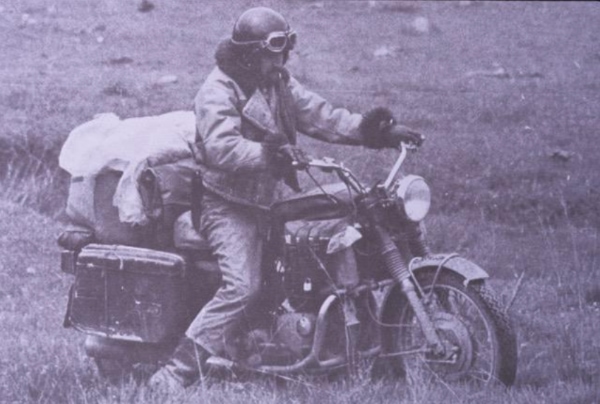
For ten days they looked after me in considerable comfort. They put me up at a quite stylish motel called the Griswold Inn, and they gave me another Triumph to ride while they took my bike apart.
The mechanic who was working on it didn’t care for conversation. He didn’t seem to understand that I had a personal relationship with the bike and that I was anxious to know how and why it had given me trouble.
In particular I wanted to know why I had run through two barrels and various pistons and rebores, but nobody there appeared to find that anything but normal. It was astonishing, in retrospect, that nobody paid any attention to the air filter, which was nothing more than a piece of paper in a perforated box.
Most of my troubles were caused by bad stuff getting into the combustion chamber. I only heard of K&N oil filters after my journey had ended, two years later, but apparently they had already been on the market for one or two years. Presumably they would have made a big difference, but nobody there seemed to either know or care. In fact, the prevailing belief in America seemed to be that Triumphs were only good for a few thousand miles of fun hauling ass before they fell apart.
Anyway, the people in the office were really just waiting for the company to crash around their ears. My mechanic told me he already had a job lined up at Yamaha.
What they did do was try to get a little publicity. And they told me, triumphantly, that they had secured an invitation to the Petersen Ranch on the edge of LA.
Looking it up now I see that there are two Petersen Ranches. One of them is a long-established spread belonging to deeply religious ranchers, devoted mainly to cattle – Holy Cows, I suppose. That is not where Triumph sent me.
The other Petersen was a publisher of mainly automotive magazines who had done well enough to buy his own ranch. Apparently, I was told, there were people there riding dirt bikes who would be enchanted to meet a man who had ridden half-way round the world.
Brian Slark drew me a map to find the place. It was a very simple map with only three or four lines on it. It looked as though it was just around the corner. He didn’t explain that it was a hundred miles away.
It was a time when the highway engineers were experimenting with rain grooves on the freeways and they were not compatible with my tyres. Half the time it felt like riding on a skating rink and when I arrived at the ranch I was very ready for some warm appreciation.
What I found instead was a bunch of overweight, self-important middle-aged men on trail bikes, in suits that reminded me of the Michelin Man. Some of them had been World War Two bomber pilots. Clearly I had not been expected and they took no interest in me at all, until one of them peeled off from the group and asked me where I’d come from. I explained what I’d been doing for the past two years and he said, “Oh, Yeah, I rode down to Guatemala one time.” For him that was probably an adventure to brag about. For me it was a trip down the road.
I had a beer and left.
Back at the factory I did make friends with a couple of mechanics who were working on a bike to break a speed record. One of them, Brent, was a particularly pleasant and thoughtful man and when my time at the Griswold was up and I had my own bike back he invited me to stay with him for a few days before heading North. I seem to remember that they lived in a garage in Paramount. It must have been a very big garage. Thanks to him and his very gorgeous wife, I learned that it was possible to live a pleasant, rewarding life in Los Angeles, after all.
From there, at the end of June, I rode north to San Francisco and, as you may remember, my life took a quite unexpected turn.
With all the tough travelling behind me I’ve still got a long way to go to reach Cape Town, but I’m looking forward to an easy ride, mostly on asphalt. I spent a couple of days in the capital, Salisbury (now renamed Harare) and moved on to a motel in Umtali (now Mutare) on the border with Moçambique. Now I’m following the border down the east side of Rhodesia. I was advised to visit the Black Mountain Inn.
February 18th
From Umtali to Melsetter. At Black Mountain Inn talked to Van Den Bergh [Prop.] about farmers around Cashel [an area in the East of Rhodesia/Zimbabwe.] He tells me there’s one Afrikaaner called Baas M’sorri, He brings his labour in from Malawi on contract. (Malawi provides labour here and in South Africa) When the new labour arrives he puts each one in a jute sack and hangs him on the scales to weigh him. Then his diet is arranged according to his weight. He wears big knee-high boots as protection against snakes in the fields. If he comes across a ‘cheeky mundt’ (i.e. a Kaffir who gives lip) he stands on his foot and grinds it with the heel of his boot until the Mundt says “Baas I’m sorry” – hence the name.
Oom Ben Steyn is Afrikaans farmer – about 500 acres – born on the Trek seventy years ago. Lives as his forefathers did.
“African ladies? There’s no such thing. Just Kaffir bitches.”
The route is certainly a beauty. Rough in parts, though never difficult. Very green. Big granite (?) masses poking out, smoothed off by weather. Alongside the Chimanimani mountain range. Many birds – one with a brilliant yellow back that flaps its wings noisily as it flies and pokes about in the long grass (smallish, plump, black and yellow).
Black Mountain Inn is delightful. Van Den Bergh and wife quit business world – he was export manager for Pye in Far East, then Cambridge – to find different life. Been there only a short time. Says he would never have believed such bigotry could exist – but only in the fringe rural districts, and especially among Afrikaaners.
[All the whites in Rhodesia seemed to realise that Black independence was coming. But when?]
Ven Den Bergh says, “Yes, the Rhodesian whites are flabby. The police are in here getting drunk all the time. The army’s the same. If they ever came up against a really motivated black army, well, they’d roll them up.”
“When first we came here we went to the butcher to get meat for the servants. ‘Oh, you mean boy’s meat,’ he said, and produced this chopped up bone and gristle and sinew. It’s cheaper than dog’s meat. So we thought we couldn’t give them that, and we bought proper steak. Well after a while there was a mutiny because we weren’t giving them the proper meat.”
“Independence? It’ll take about ten years.”
I did pass Oom Ben’s house, but I didn’t stop. Didn’t feel like it. It was a beautiful sunny day – and the chance to ride this route without rain was the main temptation. But I saw him on his verandah, just as Ven Den Bergh promised, though whether he had his binoculars on me I don’t know.
[Four years later the Inn was a ruin, rafters exposed, walls cannibalised for bricks, ruined by Frelimo and Zimbabwe freedom fighters. At Melsetter I came across some Asian immigrants. They showed me their art work, which was novel if not exactly beautiful. It’s done by sticking noodles on a piece of board and spraying it with gold paint.]
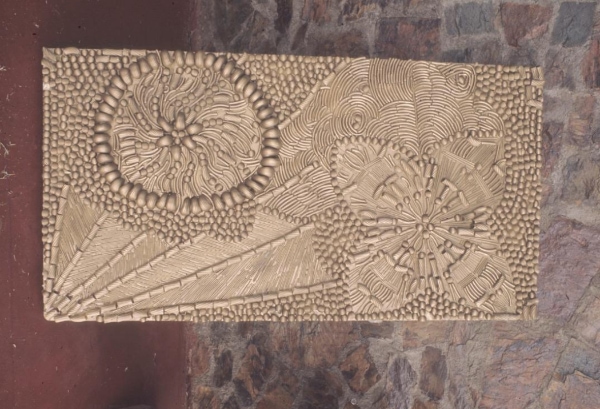
Noodle art
Small boy, 11, says: “You know, the Porks (Portuguese) are funny people, boy! You have to go in secretly and kill a few terrorists and then you tell them on the telephone after.”
Hutchinson (Grandfather was once Governor of The Cape), says” My date is 1980. There’ll be African government by then.”
[He was exactly right.]
[I went on to visit the famous Chirinda forest.]
Seen in Chirinda Forest: Bright red millipedes on rotten wood, three inches long. Small monkey in treetops, and a red squirrel. Trees whose roots seem to intertwine to form the trunk, only merging together at a considerable height, say 60ft or more, relatively close to the canopy. The Big Tree, red mahogany, 200 ft high they say. A liana twisting up full height of the forest. Heard deep “Chuk-chuk” sound. Monkey or bird? Bottle bird which holds same pitch.
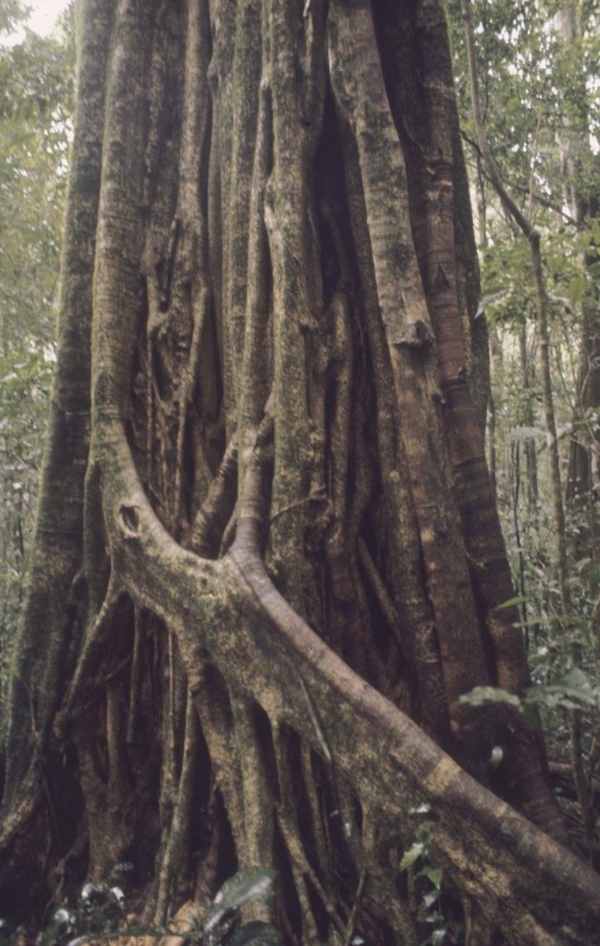
The biggest tree was said to be 200 feet tall.
February 19th, Chipinga to Zimbabwe
Murray McDougal Drive round Lake Kyle. Nice scenery. Dam. View from top of ruins is excellent. Family of Hyrax [Well-furred, rotund animals with short tails – Wikipedia] live up there and will sing for you if you’re lucky. Have white oval markings on upper eyelids. Slept out in tent. Met Joachim from Frankfurt, who has been through South America and Africa (via Congo).
On way stopped at African village in Tribal Trust land. Most attracted by site – rocks and boulders piled in a natural rock garden in immense scale Cattle, goats, maize (and tourism, I suspect). Many hands outstretched. One dumpy lady rushed off for her big copper pot and stood in front of me and put it on her head too hastily because it nearly fell off and she had to stand crooked to keep it up there. The sideways slant to her head gave a comical look to her anxiety.
February 20th, to Beit Bridge
Fort Vic is the exact architectural expression of a tourist trap. Coming in from S.A. its road broadens right out to embrace you and then funnels you in to the snack bars and curio shops.
“Get yourself something unique. Something Arty!!!”
Swirling, towering column of storks in sky on the road to S.A. grouping for the return to Europe.
[The border crossing to South Africa is at Beit Bridge.]
Beit Bridge: I am a prohibited person, because I don’t have a ticket out. I pay over 350 Rand (£250) on deposit, and 2 Rand for their trouble. Get a printed notice telling me I can appeal against being a prohibited person. It seems an odd label to stick on someone you let into your country.
Then the customs. He’s another plump lad in white gym clothes. He has dull blue eyes and a thin voice which swings out of control into upper registers. First he packs me off to pay 50 cents for a road safety token. On my way back I see three of them gathered round my bike. But I’m so accustomed to people gathering round it that I assume it’s mostly curiosity.
“Now Sir,” says Billy the Kid, [trying to adopt a stern voice] “Have you any meat, plants, fire-arms, drugs, books or magazines, cigarettes or tobacco?”
“Yes, I have a book on Christianity.”
“Chris-ti-anity!” He’s incredulous.
I ask him if he’s heard of it, but he doesn’t hear my question.
“Have you anything else to declare?”
“No.”
“Then WHY Sir,” he pounces heavily, “do you not declare the sword?”
Ah, the villain is snared, foiled, as good as beheaded. I never thought of the sword.
He shows me a dagger he took away the other day. He’s proud of it, and the sword is obviously a far greater prize. He speaks of it with awe.
“I shall have to take it away from you, Sir. I am very sorry.”
(He didn’t sound a bit sorry – delighted in fact that his duty could be so rewarding).
I explain about its sentimental value, that it isn’t even mine, and so on. The Kid is reluctant to allow a weakness to develop but his rank is zero – he hasn’t got a single identifying strip on his vest, unlike the broad gold braid on every other shoulder.
“How will I get it back,” I ask.
“We shall see if we can wrap it and send it under seal – and at your expense to Brazil.”
I could tell he was improvising.
“Why can’t I collect it in Customs at Cape Town?”
He felt the ground slipping away. His neighbour at the next desk, who is obviously deputed to keep an eye and ear open for the young whippersnapper if he gets out of control, says, “Why don’t you go and ask your father?”
Father, you might have guessed, is the boss. (“Daddy, I want to be a Customs Officer like you and confiscate my life away!”)
A party collects in his office to inspect the weapon with enthusiasm.
“How can we stop the natives, if we let you in with this?” says No 2.
“See if you can seal it into the scabbard,” says Dad, “and then wrap it up well so no one can see what it is.”
Off we go. The Kid has his orders. He’s happy again. He can carry them out to the last serif of each letter, and with a little imagination he can even add to them.
“Come over here, Sir, please. Now you see, I am going to wire the hilt to the scabbard, and seal it. You see there is a number on this lead seal. If this seal is broken you go straight to jail.
“What would happen,” I ask, “if someone should happen to steal it from me?”
“You go straight to jail,“ we call out in unison.
Then follows the farce with the brown paper, string and sealing wax.
He dances about trying to get the drops of burning wax off his face and legs.
“Usually we get the natives to do this,” he explains.
Finally he attempts to exact a deposit, otherwise “how do we know you will declare it in Cape Town?”
But this is too much for No 2. Who shakes his head, repeatedly.
“You can go,” says the Kid.
[I gathered my stuff together and rode off. It was only a short way to the nearest town.]
Spend night at motel in Louis Trichardt.
Restaurant with glazed kitchen in middle of the restaurant floor. Black cooks supervised by white man. All white guests, of course, looking on as they eat.
[It was my first encounter with apartheid. I was quite shocked. The diners were all perfectly pleasant-looking middle-class people. They thought it quite normal to watch black people imprisoned – because that’s what it looked like to me – in a glass cage, like an aquarium, overseen by a white warder. In the following months I never got used to it.]
Next week, to Cape Town and beyond.
February 8th
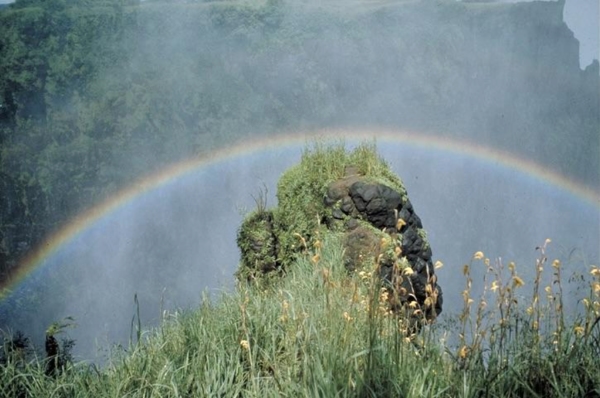
A rainbow spanned the Victoria Falls
Lusaka to Livingstone. Good sunny day with light cumulus, developing to storm clouds in late afternoon but generally off the road. Felt a real sense of the beautifulness of this earth, and as I contemplated the rich pasture land stretching out in all directions to the sound of lowing cattle, and remembered the thousands of miles since Nairobi (and before in Ethiopia) I find it hard to imagine so many people huddled together in Western cities, cribbed, cabined and confined. Thought of the good young men I have met (few girls) who would live peaceful self-sufficient lives out here, not driven to meddle and distort the pattern through mistaken and misshapen idealism.
There is so much fear in the cities, so little faith in the earth. How people love to tell and shudder at horror stories. Africans walk barefoot where a Londoner would expect to be attacked by any of a thousand venomous species. Me too. I’m ashamed of my cautious toe-dipping attitude – and excuse myself by the kind of journey I’m on.
Yet this journey must teach me that man can go free in this world – and the city, which was once a haven and has now become a prison is a habit. Indeed city dwellers, viewed in this light, look like a crowd of old lags, recidivists, huddled together in fear and trembling of the freedom that lies outside.
Remember the couple of Africans who were dancing by the roadside. I snapped my fingers as I passed and they smiled broadly.
February 9th
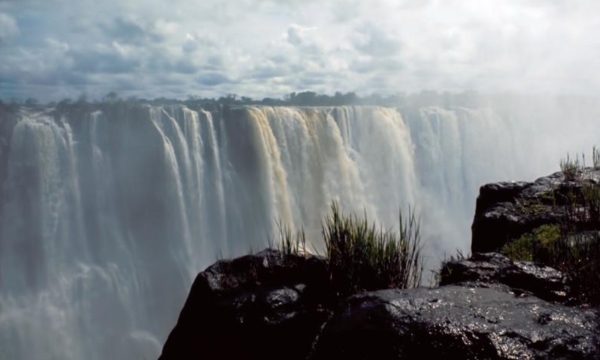
The Falls. The knife edge. Rhodesia – “the enemy”
Late afternoon on the Zambesi. African fishing. One man catching tiny fish. “Whitebait.” One had a bream.
“The Shadow of your Smile,” from a red Datsun pickup. Man who caught several small catfish and bream, and a “croaker” – croaked as he pulled out the hook and snapped off its spines. Bishop bird, and a bee-eater (scarlet bill). Distant grunts of Hippo. Long neck and beak of water bird floating past. Sahimia is weed that floats on the surface of Zambesi, choking up the Kariba Dam.
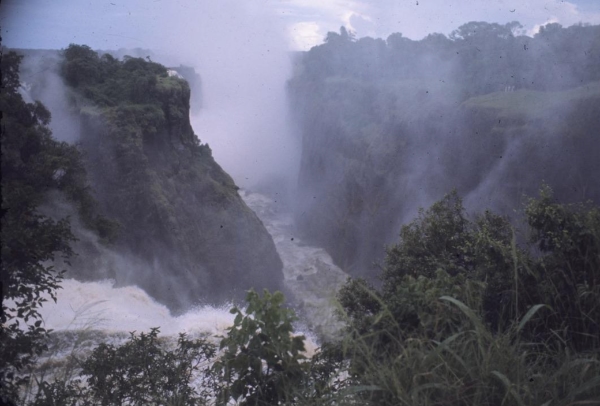
February 10th
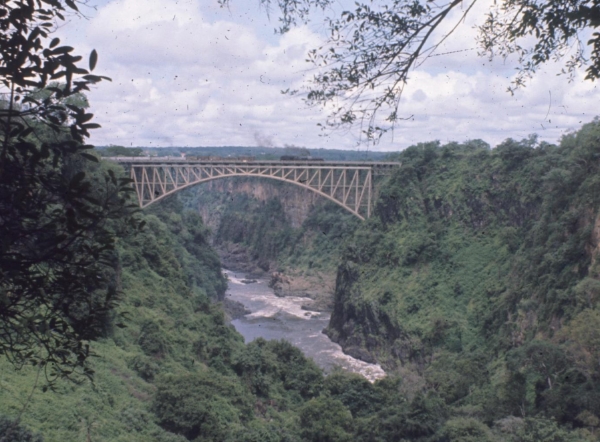
Gentle encounter with official at Livingstone Bridge.
Which side has closed the bridge?
“Both sides.”
[I already knew that the bridge was closed. The only way to Southern Rhodesia was through neutral Botswana, which was reached by driving twenty miles or so downstream along the so-called Kaprivi Strip.]
Away down the road to Kazangula. A highway for Jongolola and Dung beetles. No traffic at all. The ferry, two flat bottomed floats. Group of soldiers sitting on the Zambia side. “No, the ferry has not fallen down.” Botswana immigration – and a glimpse of churned up mud and water where the road out is. Worst fears confirmed. Zambian customs sell me a few Rhodesian coins. Botswana takes them back for an insurance policy, good in SA also though. Off I go, skating on mud. But road improves, and so does my riding. But I’m concentrating so heavily I miss the left turn. After six miles I realise I’m wrong and turn back. Stop at a village, brick huts and singing group. Leader and chorus. Leader has voice like Durante – sings one line, chorus responds, like hot gospel.
Right road soon gets me to customs. Rhodesians in white cotton uniforms – tunic and elasticated shorts. Two men, young and plump, with strained voices. One comes in carrying a gun tight against his chest, like a regimental colour, but as though the slightest movement would set it off.
“Do you have Rhodesian Third Party Insurance, Mr. Simon?”
“No. Can I get it at Victoria Falls?”
“Trouble is, the road from here to Vic Falls is bad. If you had an accident, you might not have a leg to stand on.”
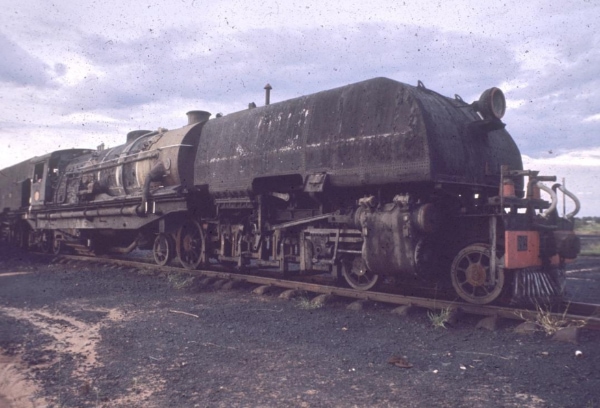
There was a graveyard for famous old locomotives. I can’t remember their name. Can anyone help? I think it began with a G.
Road is bad to worse, but there’s no rain and again I find the dirt much easier to ride. At speed it slides though the little patches of slurry fast enough to get a grip again before much deviation is possible.
See a sable in middle of the road – scimitar horns sweeping back – by arching its back it can kill a lion attacking its hindquarters.
Then little kangaroo type animal – which turns out to be a Springhare. The Falls on Rhodesian side are spectacular view, but there isn’t the intimacy with them that you get on the Zambian side.
February 16th
Salisbury, Saturday. The city, neat as a new pintable, with its well-ordered traffic lanes, freshly painted facades, White men vindicating the much-mocked values of a thousand minor public schools, whose old boys can find here what Britain has so manifestly lost; a decent life for a decent chap prepared to pull his weight (and throw it around a bit too.)
The African in Salisbury is not prominent. He mans the lifts and minds the counters, cooks, cleans and irons, calls you Baas and Sir and keeps his differences to himself. It’s no less British for being ODI and would be even without the prosperous (and surprising) presence of famous British companies like Dunlop and Lyons and Thos. Cook & Sons. Of course, they will explain that it’s not actually Dunlop at all but Dunlop (Rhod) Ltd, or some such fiction.
[Rhodesia, under Ian Smith, was holding out against the inevitable tide of Black independence. Trade between the UK and Rhodesia was supposedly forbidden. Coming into White Rhodesia from Black Africa was a little shocking. I found I didn’t like the white faces I saw; they looked narrow and aggressive.]
I am bewildered. Since Nairobi I have been seeing double – two images – the European idea of Africa superimposed on an African life. At times one image blocks out the other.
Next week: On a long and paradisical road to prohibition.
PS: I thought I’d add a little postscript, to express my concerns, not that I have any particularly brilliant insights to impart. Simply imagine, if you would, that we’re sitting at a bar, or over a coffee table.
It’s just that watching Trump play with his toys I find it impossible to keep quiet.
I am quite certain he decided long ago that Ukraine will have to sacrifice a large chunk of territory, and the sooner the better, so that he can start having profitable transactions with Putin, whom he admires.
Zelensky is just an intolerable nuisance. So anything that distracts the world from Ukraine and Zelensky is welcome.
The two years of the destruction of Gaza – which are as much Trump’s campaign as they are Netanyahu’s – have been very useful in that regard, but people have started looking at Ukraine again, so something else had to be done.
His assault on Iran has certainly been a new distraction, with the additional advantage that in order to rescue the world’s economy from its consequences Trump has been able to let Putin sell more oil and give him a new source of income. We are now at the brink of a huge disaster.
It becomes increasingly irresistible to make comparisons with Hitler. Like Hitler Trump sees himself as a master of the geo-political game, but without even Hitler’s credentials.. The people he has gathered around him resemble, more and more, the Führer’s gang of Goebels, Göring, Himmler, Speer, Riefenstahl, etc.
Meanwhile from Trump’s point of view Western Europe is just a pathetic sideshow, good for pageantry and magnificent state visits, and useful mainly as a scapegoat.
Like Hitler, Trump will surely, ultimately, be his own undoing, but must we all be brought down with him?
