News from Ted
Still enjoying the luxuries of Rio de Janeiro, making the most of my very highly connected friends. I have been waiting for a chance to talk to an Ex President.
August 2nd
Finally had meeting with Kubitschek. Mild mannered man, surprisingly un-monstruous. In fawn suit. Flat featured, grey-eyed, a faded tan colour. With him was a stocky fellow in casual academic disarray suitable to middle-aged professor of economics at Rutgers University, N.J. His calling card smelled strongly of pipe tobacco and announced him as Robert Alexander. K and I spoke French, which Alexander, it later transpired, hardly understood.
I said I had not been able to locate the “centre of gravity” of Brazil. Of course I meant by that an area of consensus on what values the country as a whole should be guided by, and a debate on what methods were mot suitable. He chose to take me more literally and retold history since the Vargas dictatorship (1930-45). Described his own accession, as Governor of Minas Gerais, in the face of great pressure from three separate military bodies, Army, Air Force, Navy, which he resisted with his own loyal police force (30,000 men?) The story of the founding of Brasilia was more picturesque, according to Marcia. At a meeting in Goias he was posed the question: “If you insist on following the constitution to the letter, then you are presumably going to build Brasilia. His response was an immediate and intuitive YES.”
His successor, he says, was a fool and a disaster who was committed to Communists. The military intervention was welcomed by the people, who didn’t realise it was there to stay. Now, he says, there is no foreseeable end to it, and it is a terrible police state.
SUDENI – organisation begun in K’s time to generate some prosperity in the interior, with roads and dams.
Alexander says one thing. Before K Brazil was a nation of pessimists. After K they believed in Brazil and it’s future. K is the most important Brazilian of the Twentieth Century.
August 11th
During past week:
Visited Jill at her home [who was Jill?]
Saw Bloch’s production of “Pippin”. [A musical. Bloch owned major newspaper “O Globo.”]
Dined with Kubitschek, Bloch, ex-Governor of Rio, etc.
Wrote and posted 1st half of Brazil article.
Spent afternoon on beach with Baby, Dalal, and Lulu.
First researches into route through South America:
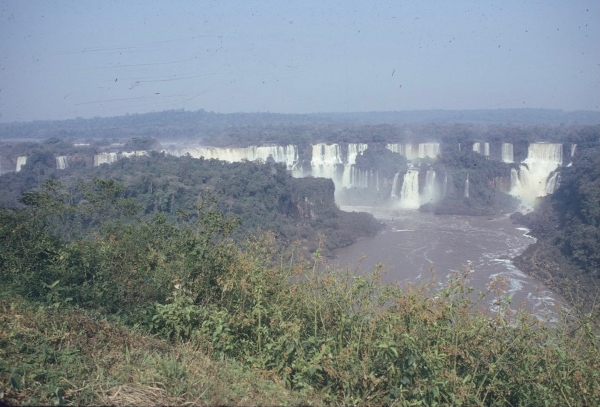
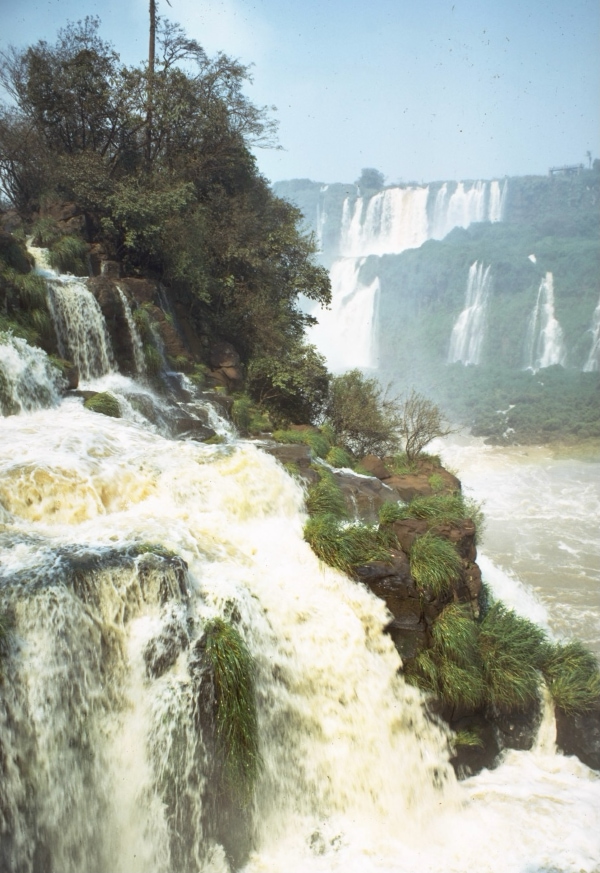
IGUAÇU described in guide as greater than either Victoria Falls or Niagara. Perhaps best to go into Argentina there and miss Paraguay. See falls from Argentina.
Take road to Posadas through Missiones Province and see remains of early Jesuit missions – San Ignacio, – Corrientes across Parana to Resistencia – via Santa Fé, Rosario to Buenos Aires.
Across Pampa to Bahia Blanca – Neuquen – Bariloche. Lake district, glaciers, mountains, etc. Lake Nahuel Huapi.
Across Andes to Osorno (mostly paved) Up Highway to Santiago. Back into Argentina to Cordoba. North through Salta to Bolivia. Road from Bolivian border at La Quiaca to La Paz is rough but passable in dry weather (up to November.)
From La Paz round Lake Titicaca into Peru to Puno. Then on Central Andean Highway to Cuzco – and Macchu Picchu. From Cuzco there’s a road S.W. down to PanAmerican Highway at Nazcar, but no information about it. The Andian route to Lima is described as very bad and with the precipices on the wrong side.
Rough estimate of times:
1 month from Rio to B. A (including stays.) 1 month from B.A. to Salta. 1 month from Salta to Panama.
August 12th
Began my efforts to release the wheel from customs. [The front wheel was damaged by my various falls. Meriden offered to replace it. I don’t recall why in Rio where customs were notoriously difficult.]
Marcia asks Geraldo who sends me to the despachante Ivan. He passes me off to a ‘convalescent’ who appears to understand that it must be done quickly and that I must know what it will cost. The whole week went by without my knowing anything at all and finally on Friday I was asked to sign forms and pay a ridiculous 2000 cruzeiros. I refused and called Brasilia.
[After my detention in Fortaleza the Foreign Ministry tried to make amends, inviting me to Brasilia. and offering assistance if I needed it.]
Next Monday the whole process will have to begin again, and hopefully Ivan and his merry men won’t feel obliged to obstruct it out of spite. The money story also continued – since I went to the bank without my passport and although the dollars are now available, I couldn’t have them. Eventually collected on Friday.
Nixon’s resignation has sent the dollar up from 6.5 to 7 and it may go higher.
Next week: The Saga of Andrade.
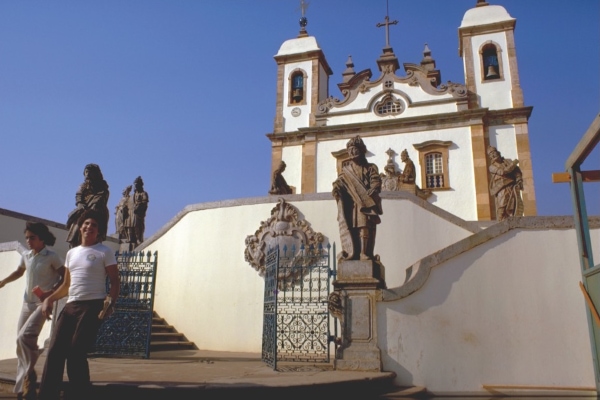
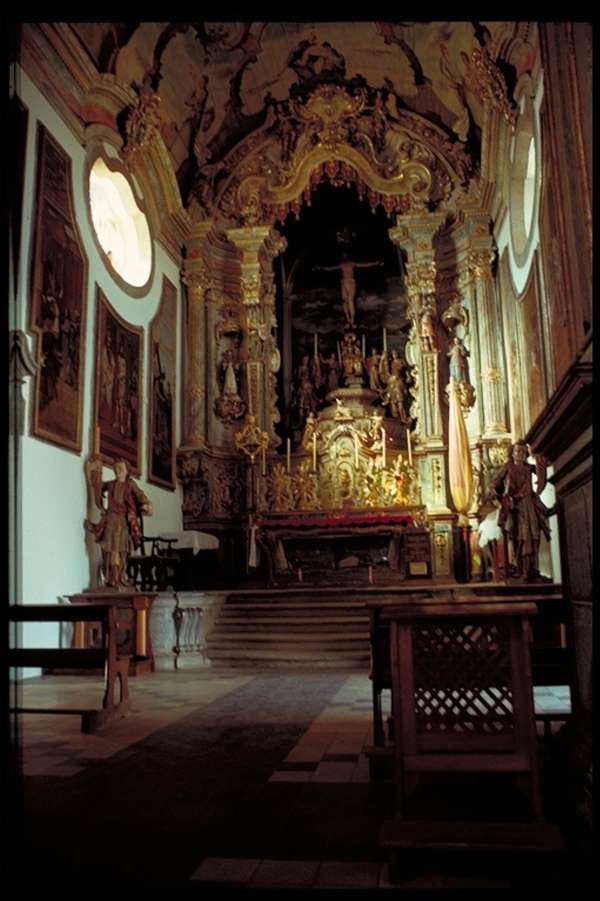
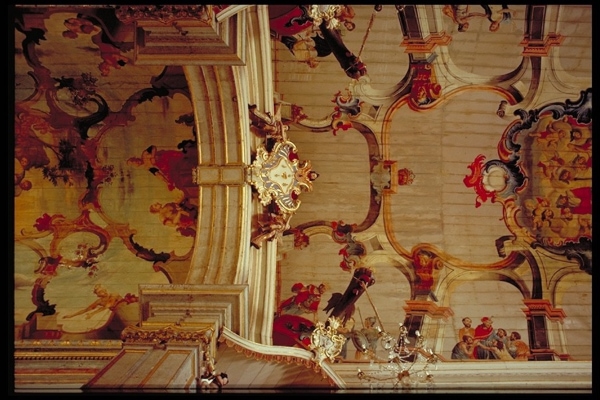
The beautiful chapel at Congoñas. The apostles stroll around outside.
Still in Rio, travelling around with Lulu but dealing with a consequence of my prison diet. This is not for the squeamish.
July 20th
Went to visit Lulu’s grandmother in Vassouras, about 75 km inland from Rio. Countryside hilly. No level land at all. River Paraibo.
We visited a colonial house preserved as a museum. It used to be occupied by a rich spinster who was in love with a Parisian couturier (so it is said) but was forbidden to marry him. The house has a simple, almost flimsy appearance from the outside to a European eye, being made of wood with little concern for keeping out non-existent storms and freezing weather. The rooms are arranged around a patio – big rooms, beautiful floors and imported furniture (oak chairs commissioned in large quantities). There were papers and exercise books in a cupboard – essays in French and English, copied out painstakingly. The newspapers were of mid-nineteenth century – with classified advertisements for slaves. One was selling a 12-year-old, suitable to receive caresses. Another asked for information about a runaway girl, describing her mannerisms – holds her head on one side – looks two months pregnant.
July 22nd
[For some time since the rice and beans of Fortaleza I had been suffering from unpleasant symptoms up my arse.]
Day dominated by appointment with doctor. Adolfo Milech, Youngish man with merry conversational manner. Face connects with Slav name. Strong “Punch” nose, wide full mouth on flat plane of face. Surgery on 4th floor of big block in Copacabana. Ground floor a labyrinth of split levels, escalators, glass shop windows, 4th floor wood panelled corridors, like discreet tunnels, Receptionist a smart but motherly woman about 40 knitting behind small desk in a cube-shaped space, with small pieces of reproduction furniture.
The doctor chatted happily about his dissatisfaction with censorship and repression [Remember: Brazil was a police state.] He didn’t like it since living in the States. It’s hard sometimes to resist the impression that these opinions are offered to pre-empt like criticism from foreigners (as in South Africa.) Unfair probably.
The business wasn’t too humiliating, thanks to his recognition.
July 24th
Hospital for rectal examination, Santa Casa de Misericordia – built as hospital 200 years ago. New one with 400 beds going up now near airport. As a building though this one is much more inviting than English Victorian hospitals. Several doctors involved in process – four plus Milech. The examination was very uncomfortable, verging on pain – or at least a sort of abdominal sensation which is intolerable (though pain is not really the word.) I was surprised at the location of the feeling near the front of my belly, and only understood it when I saw the length of the stainless steel tube used to conduct the light and the instruments (about 12”). Went on a bit too long. They found internal hemorrhoid which I’ve apparently had for some time (Huh!) and much inflamation. They pulled out some shit to examine – with shouts of triumph (“Teng fes!”) for parasites. But again their good humour saves the situation. The specialist wore tight-fitting long-sleeved polo-necked vest and groovily flared white trousers, but revealed loose flesh falling over his waist band. All of them had white shoes.
Friday July 26th
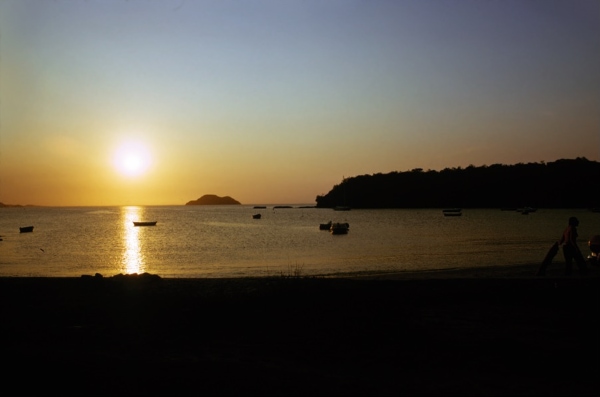
Drive to Buzios [A very fashionable resort on the coast north of Rio. Because of the way the coast curls round you can watch the sun setting over the Atlantic.]
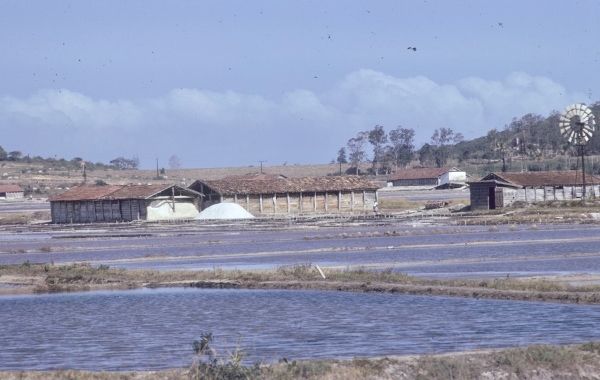
Drive North up the coast over the Niteroi bridge (10crz) Passed salt business, long wooden shacks with tiled roofs for storing salt. Men raking it out in heaps. Windmills to pump sea water from lagoon. Shrimps on slivers of bamboo (6crz a 100) for 1 or 2 crz each. Eat them whole (headless) with lime juice.
Buzios was small fishing village – whole area owned by two families. One has big house on it’s own small beach. Other has new house on other side of Buzios. Buzios itself has a dozen or so smart bldgs and one or two original cottages. White plastered brick, rough hewn posts 8” square, from eucalyptus. Often a lot of wind. Many other small beaches. Bardot came here a while ago, got the fashion under way. Very expensive now. Lulu has bit of land 15 X 60 metres on other side of peninsula – worth £10,000 now.
Michael Sarne [Sixties pop idol] has house in Buzios. Passed me on beach, smiling, but I didn’t recognise him. An elderly friend of Lulu’s lives further round the beach. Travels a lot. Only once had an English lover. Met him at Moet & Chandon chateau. After they’d made love she said she was surprised how good he was. He was the “unique Anglais de ma vie.” He replied, with heavy English accent, “Ne soyez pas ridicule.”
There’s also a Miss McGregor, widow of a man who used to go to the office every day leaving her enough money each week to maintain their modest house. She had no idea what he did at the office. When he died she asked the lawyer, timidly, whether he thought she could afford a visit to relatives in England. He regarded her with astonishment. It turned out he owned the “Light Company” in Rio [All of Rio’s electricity.] “Madam, you can do anything you like,” he said. It was a complete surprise to her that she had become a ‘milliardaire.’ Now she leads a totally and unselfconsciously lavish life in Buzios.
There’s more about all this in the book, of course, including my problems with Hemingway. Next week, my meeting with Kubitschek.
Still in Rio, enjoying the patronage of the wealthy.
Rio de Janeiro, Friday July, 12th
Tonight Maria-Luiza and I are to go to a Macumba service in Petropolis. We leave early to get to ML’s first lesson at 10am. [ML teaches ballet.] On the way we pass the façade of an enormous hotel built in a sort of mock Tudor style. She says that inside it is the perfect Grand Hotel of the American twenties/thirties. Mean to see it if possible.
[We are staying overnight in Petropolis with ML’s sister and family, including husband Chris and their young children, Arturo and Marcia.]
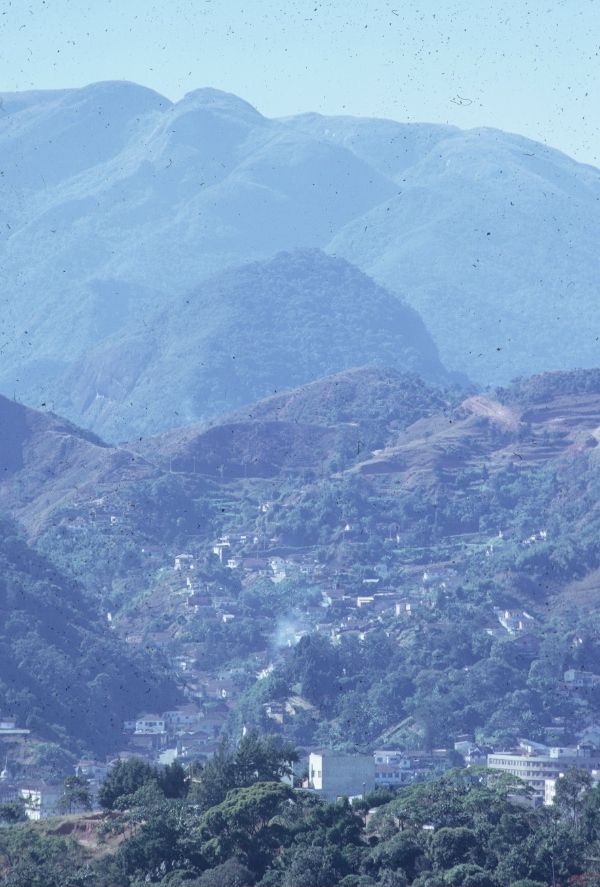
Arturo and I drive up to viewpoint over Petropolis and take a few pictures. The city is tucked away among hillsides and almost hidden by trees. Chris, ML’s brother-in-law, says Petropolis is 90 kms long but I don’t believe anything he says. His son Arturo and, especially his daughter Marcia are sadly addicted to food. In afternoon she took tea – 3 big bread rolls with butter, several sweet biscuits, and cups of tea with enormous scoops of sugar. She is very fat – her trouser zip is always undone, and it’s gruesome to watch her eat. They are eleven or twelve years old. I hope it works out. Nothing to be done, I feel, because the eating is certainly compensating for something else which probably has something to do with Chris’s difficult character. He is clearly obsessed by his Englishness, of the middle-class military variety – blazers, whiskers, grey flannels, whisky, and outright lies about silly things like drink, guns and so on. Has an 0.45 pistol, “It’s the only real man-stopper I know.” Claims he shoots it off in the night, to frighten prowlers. I bet if he does it’s not more than once a year. Thinks American negroes and Africans are the same. Has irritating habit of saying things like – “You know what you should have done, don’t you?” and waiting for some sort of acknowledgement of ignorance. Then utters a quite fatuous remark. But in spite of all this he’s not unpleasant, and one could quite like him. But to live with him would be disastrous.
[ML and I leave for the Macumba service – An afro-Brasilian cult in which individuals are possessed by gods, such as “Ishoo”]
At the top of a winding road, past walking couples of modified African appearance, a single-storey building of brick and cement with steel frame windows. Inside divided into two halves by low wooden barrier with openings in the middle and at the walls. On the entrance side several rows of benches – left for women, right for men. At the near end a counter with shelves for bottles, packages and candles, materials suitable for rites, or “obragacāoes” and a small office. At the far end a shrine in a recess, lighted green, with grotto-type décor. The floor here is parquet. The benches are already full. A mixed audience of poorish people in their best clothes. Young men in white, short-sleeved jackets and white trousers and sneakers hang about like hospital interns, but instead of a stethoscope round their necks they wear a string or two of beads.
Women line the wall of the “dance floor” wearing flounced white dresses with no waist, and white cotton trousers, ankle-length and quite tight. Round their middle they all have a length of some coloured print cotton, and white headcloths tied at the back to hold in their hair. On the floor in front of the shrine is a bowl and a candle (or maybe the candle is in the bowl with farofa) and there’s a jug next to it with cachaça. In the far corner two men sit, with a drum each, and two others each have an instrument of two metal cylinders with loose grains inside to rattle like maracas (oddly reminiscent of the cafesinho machines men carry strung round their shoulders in the streets). There is a microphone, and the speakers are in the audience’s half of the room. There is also a woman to lead the singing, and an elderly man.
The ceremony starts with the men and women, forty or so, shuffling round in a wide circle to an African chant or song. The elderly man calls the changes. They stop and kneel on the floor to sing another song, heads bent low. All this first period is apparently to entice the reluctant spirit, or ‘saint’ to come down. Soon a wild-looking woman with long reddish hair (quite old) comes on to the floor wearing a voluminous gold skirt, calf length. She walks with a nonchalant swagger and puffs on a cigar. She has a mischievous half-smile on her lips. As she passes us a young man in the benches comes over to kiss her hand. She accepts the homage casually and proceeds to the shrine. Various men prostrate themselves before her, and some girls are picked out to assist her. All the arrangements are made in a very matter-of-fact way. No effort is made to impart any sort of reverence or solemnity to the various stages of the ritual, and the participants often chat to each other as they might in the street or a shop. The lady in gold is apparently standing in for the elderly man. Her job is to persuade the ‘saint’ (Eshoo) to enter her, and he is getting too old to take the strain. She kneels or squats before the shrine as the singing and shuffling continue, and various functionaries move around her. Another man of some authority walks round inside the circle swinging an incense holder, and the participants bathe their hands in the billowing smoke and rub them over their faces and heads. He looks at them all, one by one, in a meaningful way.
After a while “Gold” gets up and takes steps backwards repeating a word which seems to indicate that the ‘saint; has come to her. Then she swaggers about the floor. The personality of this ‘saint’ is that of a sympathetic but mischievous and greedy man. Other women also embody other ‘saints’, like the one who looks upwards and makes a whooping noise, like frogs in the night. She is “Ogoon” who owns the forests and other natural phenomena. Another one owns the sea. Another is the warrior. Another owns the main diseases, like leprosy. They all some cheroots.
Some members of the audience have previously asked to speak to Eshoo and they carry numbered tickets. They are asked on to the floor and a circle of hands is formed round them to complete a “current.” The red, blue and green strip lights are switched off. (The dominant colour is green.) Th dancers begin to twitch, writhe, and utter little shouts or yelps. Some go into quite violent, shuddering fits, shouting and screaming. They are there to absorb the evil from the communicants and they do it with a will. The various ‘saints’ stroll around, taking a hand now and then to intensify the effect, or to calm down too violent an hysteria. This is then repeated with other sections of the audience. Later a special session is held for a child and his parents, and tw concentric rings are formed, the members of the inner ring surpassing themselves in their paroxysms and shouts.
At one point in the ceremony (before the arrival of the saint) there is a period of quiet during which a cracked record of Ave Maria is played over the speakers – at another point some popular Chopin – orchestrated “Tristesse.”
But I did not feel there was any idea or intention that the participants should at any time feel alone with a god or spirit or that, by some act of piety, self-denial or restraint make themselves better people. The spirits are themselves possessed of all sorts of contrary traits, and it seems to be understood and accepted that this is nature, human, superhuman or subhuman and nobody could want to change it. Obviously here there is less guilt. You join in and either obey or give orders according to the role allotted to you, and the rest of the time you do whatever you feel like doing. The concessions made by Macumba to Catholicism are not at all convincing. On the other hand the ritual itself is presumably a great deal less potent performed in these surroundings than in some forest clearing or on a tropical beach. A visitor there (who said he was a son of Ishoo) told us that child and parents getting the special treatment were his relatives and that it was a great privilege. He himself was an honoured friend of the house, but he too pains to explain that this was not his religion, since he followed a different branch of Macumba. These variations all deal with the same basic vocabulary of saints, but the emphases and rituals differ, and in his branch, for example, it was not possible to call on Ogoon, whereas here it was. Hence the special ceremony.
All these different branches, however, unite occasionally when funds permit, to have a great ecumenical feast called “candomblé” where much food and drink is passed.
Today, Saturday, we had thunderstorms and it rained. Halleluya. Fires to the West, fires to the North. We’re fortunate. Only 35 degrees Celsius. Others have 40. Of course, climate change is a hoax – so the fat man says. One day the fat lady will sing.
See you next week.
Rio de Janeiro, July 3rd
Arrived the day Brazil was eliminated from the World Cup. Stepped into Baby’s flat, such priceless art, to struggle out of my clothing.
[Well, that needs some explaining. Before I left London a friend of mine, Roy Round the ballet photographer, gave me an introduction to a wealthy man in Rio known as “Baby” Bocayuva. He subsidized a ballet company run by his ballerina wife, Dalal Ashcar. I arrived after dark and unannounced at his apartment in Ipanema after a long ride. I gave Roy’s name and was instantly received with delight as I struggled out of my filthy clothes standing on a valuable carpet surrounded by world class art. That, in contrast to my reception in Fortaleza, was what defined my perception of Brazil.]
July 4th
Lunch with M.Luiza at Carreta. Introduced to Ballet Dalal Ashcar.
[To compensate me for being locked up in Fortaleza they adopted me. Baby gave me the use of a small apartment. Dalal deputed one of the teachers, Maria-Luiza, who everyone called Lulu, to take care of me. “Caretta” was a restaurant with sublime steaks.]
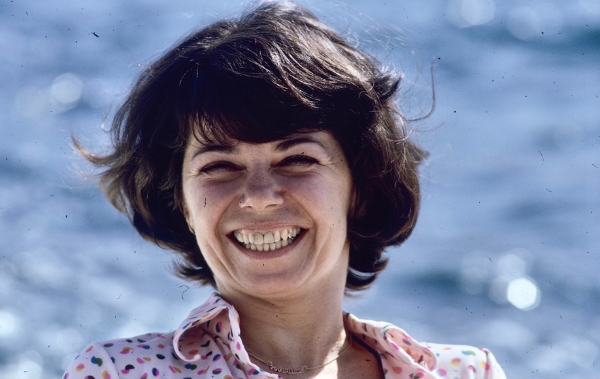
Maria-Luiza or Lulu – my guardian angel in Rio
July 5th
Morning to Baby. Visited quarry at Ibrati. Biggest in Brazil. [The source of his wealth.]
There follows a list of all the people I was involved with during the following month: Baby, Dalal, three sons, (daughter in Paris, daughter-in-law’s father is Faust at L’Express – an important left-wing newspaper in France). And a baby son by Dalal. Lulu, Holly, Gill, Antony, Christine, Miriam, Jandira, Manuel, Markus, Ben, Le Professeur, Alci, Marcia, Kubitschek (ex-President of Brazil), Barbara, Maria-Estelle, Maria de Gloria Chagos, Adolfo Bloch (big newspaper proprietor – Globo) Lucy Bloch, Geraldo, Ylen Kerr, Antonio Carlos, Esmeraldo & Tito Ryff (Apt 301) Elena and Renato, Lulu’s mother, grandmother, sister, brother-in-law, nephew and nieces, godmother, Déa (Buzios), Bob Alexander, Roger Austin, Axel Galles, Mike Sarne, David Zing.
Places
Ipanema, Leblon, Gavea, Botafogo, Copacabana, Flamengo, Corcovado, Boa Vista, Avda Brasil, R.Alfandega, Yacht club, museum, Barra de Tijuca, Lagoa, Batabui, Cabo Frio, Buzios, Petropolis, Vassouras, Araros.
Events
Quarry, Bauhaus, “Pippin” (a show), Dinner and talk with Kubutschek, visit to Manchete, Lunch at Botafogo, Bank of London, Alfondega at Galleão, Ballet of Oscar Arrais, Churrasco at Bambui, Visit to Vassourras, Arraras and electric carver, morning on Ipanema beach, night with Christ., Buzios, mussels, Mrs Ferguson, Macumba at Petropolis
[Was invited to take a trip across the Bay. Achille Markov, the Swiss ballet master, resembles Danny Kay, with pointed white leather pumps.]
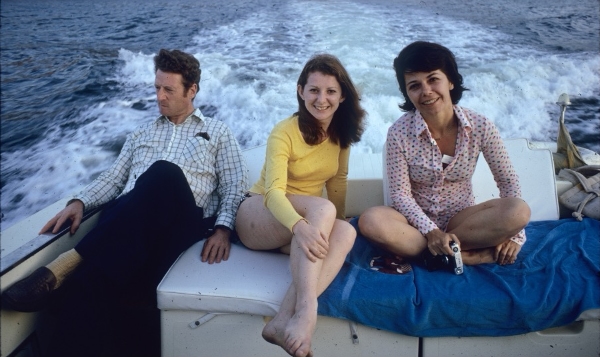
Achill Markov, the ballet master, with Holly, Lulu (and me of course) crossing the bay, followed by the best shrimp dinner of my life.
Rio de Janeiro, July 11th
Meant to finish piece for S.T. Woke at 8.30 (later each day). Went across to market and thought to buy a steak. The “filé mignon” was “acabo” – finished. I asked for something else. He was a surly man and might have been handing me shoe leather. It looked as if it was off the loin. An Englishwoman warned me that anything but filet was really for stewing. She’s nuts. It was delicious (relative to my expectations) and tender. Filet is 22 cruzeiros a kilo, and now I work it out, I find this meat cost the same. That’s 62 pence a pound. Eggs are 4.50 a dozen = 2p each (big, hard shells. Butter costs over £1 a kilo.
Cheese also costly. But 6 limes for 5p; big avocado for 9p; oranges for 1p – 3 cruzeiros a kilo; rice a bit more. Salario minimum is 320 cruzeiros a month = £5 a week.
[I tried hard on my journey to keep tabs on the cost of living for ordinary working people. For the moment I was in the lap of luxury, but it was all fantasy. It could and would vanish the instant I moved on.]
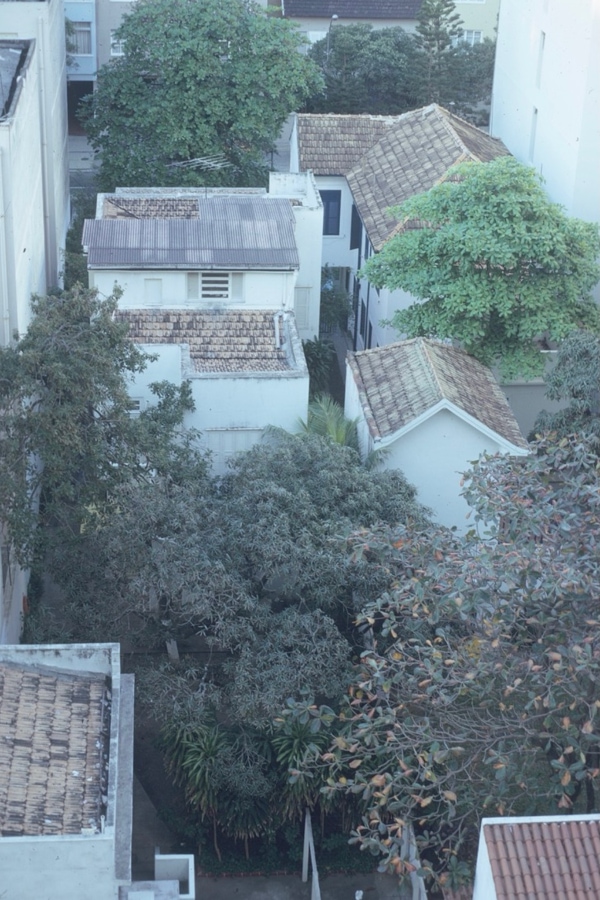
The view from “my” apartment window in Leblon.
Sat in front of window to eat. Beautiful day, fog has cleared, men working on high rooftops and sunning themselves. Looked at my work for half an hour and gave up. Laundry has lost my “Colorado beetle” vest. I hope they find it. He speaks some English.
“Are you American?” he asked. “No English.” He confirmed it. “You are English? Good. Americans are shit!” What does he know about either?
Marcia [Kubitschek’s daughter] has talked to her father about seeing me. He wants it to be next week. The ST has not called yet. It’s the one problem, and it costs a fortune to compensate for. What’s more, it encourages waste, I’m sure.
She (Marcia) has made me a temporary member of the Country Club, and a card is to be left for me at the [dance] studio. She thinks the prices there are quite cheap, and no doubt comparable food elsewhere would be twice the price, but I still shan’t be able to afford it, except as an extravagance. It crossed my mind that the facilities might turn out to be a gift, and I couldn’t decide what to do in that case. I shall have to dip a toe in the water and see how hot it is.
Went for a ride instead to Barra, Tijuca, looking for way up to Boa Vista. Saw the boys on their boards sitting out to sea waiting for a ride. It’s quite true they do seem to be worshipping some invisible deity on the horizon. One small boy has developed a way of spinning his board back over the crest to stop. Another came out towards me wearing black flippers. He placed them carefully on a rock to dry. Then, out of the sand he hooked his goggles and tube, then sandals and finally a vest, all buried from sight. A bit of wood with a skewer in it was also part of his outfit.
At last found the road up. In the folds of the hillside the vegetation is interspersed with bananas. There are also little four-petalled flowers in red & blue all over the side of the road. Passed a house of concrete actually shaped like the prow of a big launch.
First there’s a sign saying Alto Joã. Then an unsigned road and another marked Joã. When you’ve been to Joã (and halfway round Brazil) and come back to the same junction it seems reasonable to take the other road and suppose that Alto is a place and not a description of Joã. Took long winding road to Vista Chinesa. Looks down on the Lagõa and Copacabana, like an architect’s model, because the lagoon is like glass. The city is really squeezed between the mountains with many tall blocks. It is made to be seen from the air.
In the shrubbery in front of the mock Chinese pagoda saw a little hovering bird, busy among a bunch of blooms. Magic is just seeing something as though for the first time. Afterwards comes the business of explaining and exploiting.
From there down to the lagoon, petrol and a free cafesinho. Lulu, at studio, goes off to see psych. [She was in therapy] Holly talks to me. Then Lulu invites us both to Carreta – the churrascaria – in the same street. H is very stubborn and English behind her balletic flutter. Lulu all too compliant. I get a distinct feeling that between them I have been maneouvered. I don’t in the least mind it.
Strictly speaking these are not travel notes. I have done my best to make them comprehensible, but not very successfully I’m afraid. More next week. Enjoy the heat. Cheers.
I’d like to think you missed me last Sunday, but I apologise for not popping up as I usually do. I was preparing for a visit to England where I spent two days at the monster ABR meeting, talking and selling books. At the last minute there was too much to do. Now I’m in trouble because I find I’ve left behind the notes I was going to use for this Sunday, so it looks like you won’t hear anything new from me again for another two weeks.
The Adventure Bike Rally at Ragley Hall is truly astonishing. As someone who has been taking his biking pleasure mostly as a solitary figure crossing an empty landscape, the idea of spending two days with 20,000 other bikers should have been rather overwhelming, but the event is so extraordinarily well organised that I never felt oppressed. On the contrary, how could I not have felt pleasure at seeing such a huge audience for my talks. I gave them a lecture on philosophy (a favourite subject for bikers, as you know) because I have actually read, to the last page, “Zen and the Art of Motorcycle Maintenance.” And that was on the last day of the heatwave that had everyone frazzled. The applause was deafening. Make what you will of that!
I don’t want to leave you with nothing to read, so here’s a diary entry from Sri Lanka that I published a long time ago.
Cheers,
Ted.
From My Notebooks In 1976: Ceylon
I’m in Ceylon, having visited one of the best-known sites, Sigirya, a fortress created out of a phenomenal rock formation.
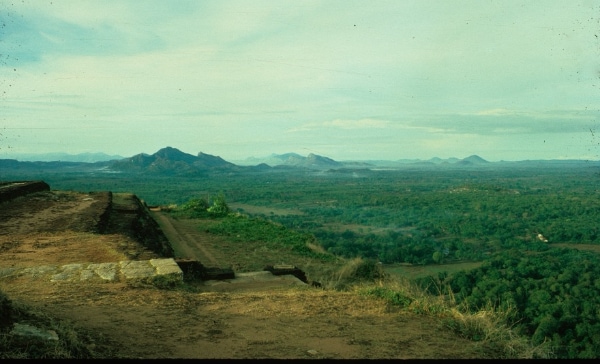
The view from the top of the fortress was extraordinary. There were carvings, but little that my uneducated mind could explain. The next day I left the Rest House (and the German sisters.)
October 11th, To Puttalam
On shore of a lagoon. Junction town. Single row of huts, some tiled, some thatched. Small veg market had chiles, kohl-rabi, cabbage, carrots, tomatoes, limes, eggplant, potatoes, yams, etc. In short an excellent variety. Fish market, a small raised cement platform, thatched, had good fish too. Some puppies stood around it. One was so thin and failing that it was scarcely more than a head. Watched some crows on a roof – one had a fruit in its beak but could hardly eat it , since as soon as it put the thing down to grip it with a claw, another bird unencumbered, would threaten possession. It had a younger companion also which simply screeched with open beak and got a couple of morsels for its pains.
By the shore was a thin strand of sand littered with all kinds of rubbish. Again the crows attracted my attention and one – an obviously inferior one – was hanging about behind the others. At one point it raised a claw and put it pleadingly on another bird’s back – twice. The other bird flew away. The mangy one was left alone. Then I noticed a dog, a bitch with distended udders, licking something between its front paws. It was a puppy stretched out on the rubbish, head back and oozing blood. The mother looked up so mournfully.
These small examples of life and death on the rubbish heap moved me and depressed me profoundly. Since Colombo I’d been viewing the world through discomfort and fever with a deliberately jaundiced view. I saw the profusion and luxuriance of the tropics as a terrible mess, buildings as mildewed wrecks, human effort as futile. The people seemed tedious to me, an endless procession of M&S shirt tails hanging over sheets – with facile smiles signifying nothing if not envy and ingratiation. Only the older women impressed me in spite of myself, with the fineness of their features and slim, handsome carriage. The road was murderously bumpy, the traffic foolish. Several times in Ceylon I’ve saved my life by noticing another driver when it was his obligation to notice me. People stop quite suddenly in the road for no apparent purpose., and without indication. I think there is a powerful amount to be said against tropical paradise and I should be grateful for these fevers perhaps. The yearning for temperate home must have been overpowering in early adventurers when they fell sick.
At Puttalam I got hot tea and an extra sheet and tried to sweat it out. There was plenty of sweat, and in the morning I thought I’d won. I rode the 46 miles to Anaradhapura (after photographing a cobra) and sat among the ruins for a while.
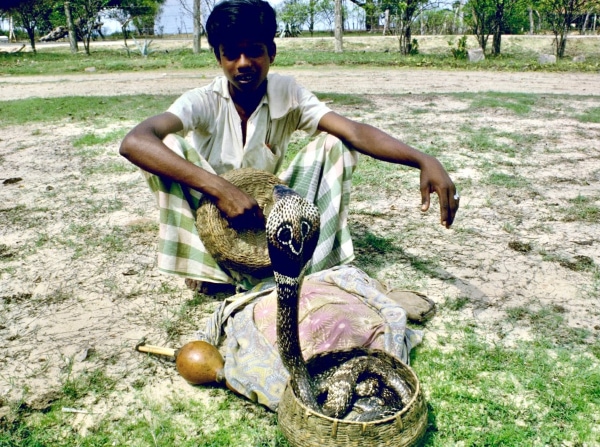
A young man came and, by the brilliant tactic of not asking me for a single thing led me to offer him my address. I walked barefoot to the big Dagoba (or whatever). The dome is solid and covered with cement – has little to say to me. There’s a crack where it was once struck by lightning, and a new lighting conductor runs down the side. There’s also a maze of granite pillars sticking out of the ground. The lad says this is the ground floor of a seven-storey building in which a hundred monks prayed on each floor, all in their solitary cells. If true it’s an amazing notion – what a hum must have gone out from that box. Enjoyed also the moonstone outside the temple. Elephant, horse, lion, buffalo.
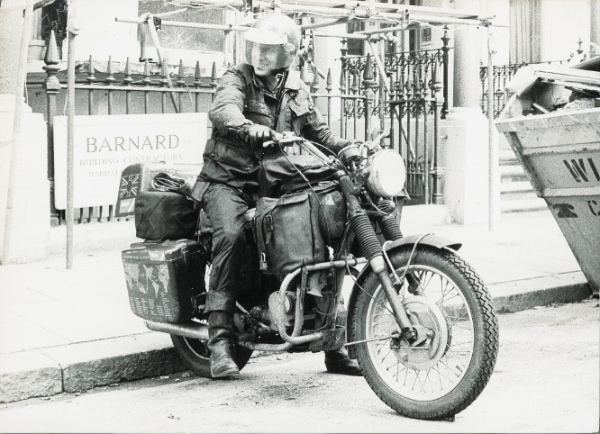
From A on the road to Mannar. And at the main junction was already feeling the fever again. Had a drink and some Disprin at the rest house. Disprin is becoming part of my diet. Rest of journey went well, no more rain. In the morning. I rode through a maximum downpour for maybe 15 minutes – and the jacket is a success.
[Somewhere – in the USA I think – I’d acquired a leather Belstaff outfit. I was still wearing it when I got back to London.]
At Mannar got the same room at the guest house. Went straight out to fish off the bridge, thinking how nice to be alone, but a great company of betel chewers lined up alongside me. I managed to live with it, however, and got the great excitement of a catch. The fish felt very strong and for a while I couldn’t move it at all – after its first run – then slowly I inched it in. It was a stingray. Very exciting to see it come out of the water. Not really so big – maybe four pounds – with a beautiful mottled brown back – a rather human mouth and two eyes on top. One of the men cut off the tail and showed me the spike which lies alongside the tail close to the root (not as I imagined at all) Took it back proudly to the rest house. The cook said he would fry it for me – but as a fish, he said, it was not famous.
Two men on the bridge started talking to me. It annoyed me at the time, and I must have shown it.
“Your native land, please?” “Are you a university graduate?” “How much does this, or that, cost?” They came afterwards to the Rest House and I had to sit and take tea with them. One was the medical officer for the area. And the other (Mr. Ratnavale) is a clerk of some sort. They have so little to say and understand so little of what I say that it’s largely a ritual. Whatever I said, Mr. R’s face would express perfect wonder and enlightenment, and say “I see,” as though everything was now clear. But the MO did describe symptoms of typhoid which gave me a bit of a scare next day.
That strange Scots family also turned up.
Rest House man told me a series of superstitions – full bucket, empty bucket. If a monk crosses your path when you set out, forget it. If the gecko chatters as you step out of the house – also forget it. If you run over a cat, you’ll have an accident. Woodpecker’s noise is a bad omen.
Also says Tamils smell different. If they use a towel, you won’t be able to. He says Sinhalese and Europeans are much closer.
This is Part Two of a dispatch I sent to the Sunday Times after my detention by the Federal Police. If you didn’t read last week’s episode, please do that first:
>>> Fortaleza Part One
At two the team drifted back. There was nowhere to sit. I tried walking about. There was an older sergeant figure with a hard-boiled face. He pointed to the wall. “Fica!” (Stay) he commanded. I protested. Eloquently he mimed a spy taking photographs. His face expressed total disgust. “Fica” he roared and thrust me back to the wall. Nobody raised an eyebrow. At four I was summoned along a corridor and down some back stairs to a cellar to have my own photograph taken, then my fingerprints, each finger and thumb separately, then in groups, all repeated five times. “Do you play the piano?” joked the agent. To me it evoked a quick picture of crushed fingers.
By six I was alone again, with another dish of rice and beans. The hours stretched ahead endlessly. It rained. I noticed two walls were very damp. I tried taking my mind off my predicament but couldn’t. There was nothing to do but think. I slept with a second mattress on top of me to keep off the wet draught.
Saturday began without hope. The office remained empty. There was no work there on Saturdays and as the minutes piled up into hours I slipped further into dejection and fear. Fiercely I studied my prison. I counted the floor tiles (1,520 including fractions). Then the tiles on the wall (1,108). I invented escape plans. Then it occurred to me that perhaps I was expected to escape. What better pretext for doing away with me altogether? This led easily to the notion that perhaps I was being observed and I began to look surreptitiously for a concealed camera or spy-hole.
Only two events interrupted the day. Rice and beans at twelve, and a strange radio message at four. It blared out loud and clear from the second floor. Each phrase was carefully repeated, so that I could understand several words and the general drift. The words were “Ingles . . . Marcello . . .to Rio . . .then . . . to Inglaterra.” The operator replied that he now had the “films of Africa and the coast.” The films could only be mine. The priest in whose company I walked around Iguatú was known as Marcello. I could no longer doubt they had convinced themselves of his guilt and deported him. The little hope I’d kept alive evaporated. I felt sure they suspected me of subversion. They “knew” something was wrong about me. (No.1 confirmed this to a third party later saying, “he smells.” But they would never find evidence. There was none. Eventually, I felt, they would be bound to try to force some out of me and that process, once started, might be irreversible.
Over the next six hours I came to terms with the idea. and wrote a letter to one of the two people I love most (on a scrap of paper I’d saved) and felt calmer as though I had talked to her. That evening Fortaleza had its heaviest cloudburst in 60 years. Water came through the roof and walls, and gurgled in the drains below.
Then the hatch opened and a bearded face appeared, framed in it.
“British?” it asked. I nodded. “Mathews,” it said. “I’m the British vice-consul in Fortaleza.” Nothing I’ve ever heard sounded so sweet as those few words. Spectres which only a few moments before had born down on me with stifling weight shrivelled and faded in the presence of Her Majesty’s representative. God bless consuls everywhere. Mathews could do little to alter the course of events but it was enough to know I could no longer vanish without trace. He tackled his duties squarely and insisted on telephoning No.1 at home. He was told that I was involved in “something very big,” which would be explained on Monday. Meanwhile I was only being retained “with full rights.”
I described what such privileged retention was like and begged him to fetch clothing and shaving things from Sâo Raimundo, and above all news of what was going on. Mathews was tired after a long journey but he slogged out to the parish and came back with some things and the welcome news that everything at São Raimundo seemed perfectly normal. No police had been there yet. Pleased but puzzled I let him go home to sleep.
He came back just before lunch on Sunday with some Agatha Christies from the twenties and told the “agente” on duty that I was permitted to go out to eat. As though amazed that I hadn’t thought to ask myself the agent said, “Of course” with a wide smile and we drove together to a restaurant on the beach. The moment I stepped into the sun for the first time in three days was a physical shock. My clothes had been saturated with moisture. I had a heavy cold and was slightly feverish. The sun boiled the water vapour off me in seconds. I felt it reach into my bones. Only then did I realise what an unhealthy hole I’d been locked up in. We sat at a table with a white cloth, looking across at the sea, eating good food, drinking cold beer, and I couldn’t help feeling the whole ordeal had ended. In fact it had just changed gear.
Altogether it was 12 days before I was released. There were endless pretexts and procrastinations, and I came to resent bitterly the wanton abuse of my life but I soon learned it was useless to complain. None of the agents appeared to place any value on personal liberty. The Consul’s intercession had broken through their indifference and some of the younger agents were interested now and tried to talk but were clearly bewildered by my impatience. An English-speaking girl came to chat at lunchtimes, and I tried to explain my anger at being imprisoned. She laughed at the idea. “Everyone is in prison,” she said. “Fathers, husbands, children, they all make prisons.”
On Wednesday Mathews left Fortaleza for four days. He had been “guaranteed” that my fate would be resolved before my return. No.2 insisted that he was still waiting for routine replies to his cables.
At lunch on Friday I was walking with a policeman when a black limousine rushed up alongside and slithered to a halt, Chicago style. The driver shouted and gestured wildly, ordering us into the car, and then shot off, spinning his wheels on the wet cobbles, in the direction of Sâo Raimundo. “This is it,” I thought wearily. Then, as suddenly, he took a sharp left turn and we were in front of the police station again.
We were rushed into No.1’s office, where he was standing, talking on the telephone. He paused and said, “The secretary at the Ministry of Foreign Affairs wants to talk to you.”
He went on talking and I heard him say I had been in custody four days.
“Eight days,” I said angrily, raising eight fingers. He ignored me. I had a long civilising conversation with the diplomat in Brasilia. I felt sure that his involvement would end my detention.
After the call N0.1 became quite effusive, slapping me on the back and practising his English as we left for our separate lunches. In the afternoon everything seemed to be happening. The Consul appeared a day early, with a Scotsman from the Bank of London. They went in to see No.1 and then came to talk. They seemed confident I would be out that day. Then Mathews went back alone and returned with the depressing news that they were still determined to hold on to me. I was outraged and cursed long and loud. Then he told me: “They say they are after another Englishman for subversion, and he has the same names as yours but in a different order. “In my more fanciful moments I had wondered whether there could have been another Englishman going about to explain the strange fragments of information I had heard. But with the same names?
On Tuesday afternoon I was finally delivered into the hands of the Consul, with the Bank of London acting as midwife. I had been put back on rice and beans the previous day and during the last 24 hours had nothing to eat.
The priests received me back into Sâo Raimundo with great good humour. My belt was still under the fridge, exactly as I’d left it. There were many stories to tell, and they told theirs with scabrous joy. If one didn’t know, one could mistake them for a rather high-class construction crew. When my cold died I got dysentery, and by the time I felt well enough to leave I’d been in Fortaleza more than a month. Was it worth it? One of those Irish stories seems nicely relevant. A stranger, lost in the heart of Ireland, asks the way from a passing local, who struggles with directions and becomes more and more confused himself, until admitting defeat, he says: “You know, if I were you, Sorr, I wouldn’t start from here at all.”
When I booked my passage on the Zoe.G I knew only that it sailed to Rio de Janeiro. Later, once on board, I discovered that it would first call in at Fortaleza, a city in the far north of Brazil. Though it had a population of a million I had never heard of it – an indication of my ignorance. I also did not know that Brazil was a police state, in the grip of a relentless dictatorship. I decided to disembark in Fortaleza and ride the 1,300 miles down to Rio.
Fortaleza, May 14?
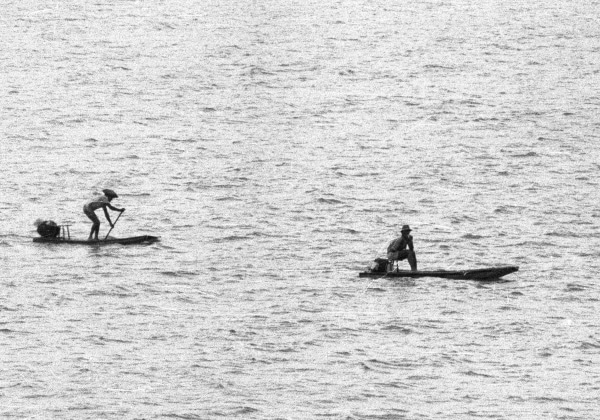
The ship drifted in passing fishermen on the most primitive craft, little more than floating boards.
Then the ship docked. My bike was spirited away to customs. Two policemen came on board and questioned me about my Scuba gear. They were convinced I must have diving equipment. I stayed on board two days while the ship was unloaded and while I visited the town my cabin was searched.
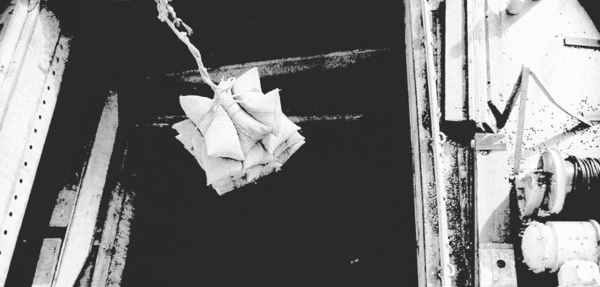
The ship was delivering cashew nuts from Africa, and I watched them being hauled out of the hold.
Communicating through telex The Sunday Times suggested I make contact with some priests in Fortaleza and visit a flood catastrophe inland. I followed their advice and took some pictures.
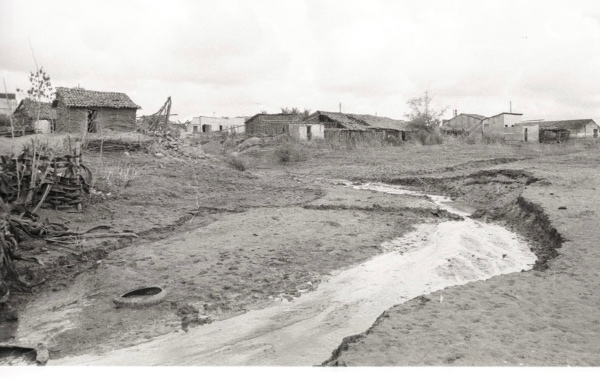
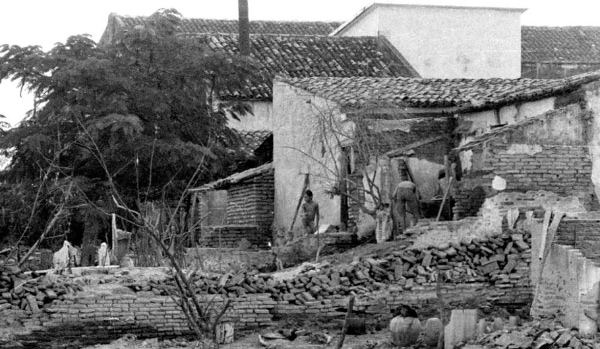
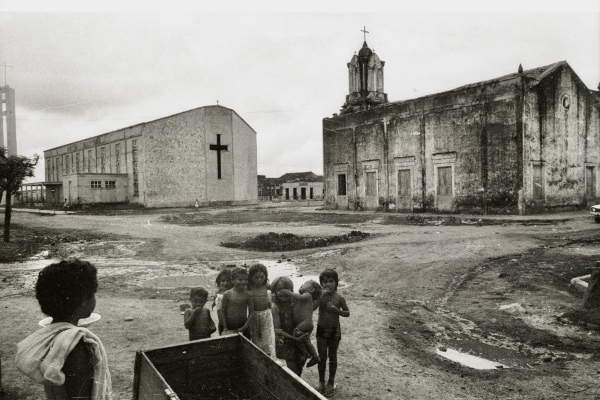
When I returned I was “invited” to the police station. Several weeks later I wrote the following piece for the Sunday Times. Here is Part One.
Obviously I should have been locked up long ago. The Brazilian police have shown me to myself in an alarming new light as a person who’s very being excites suspicion and alarm.
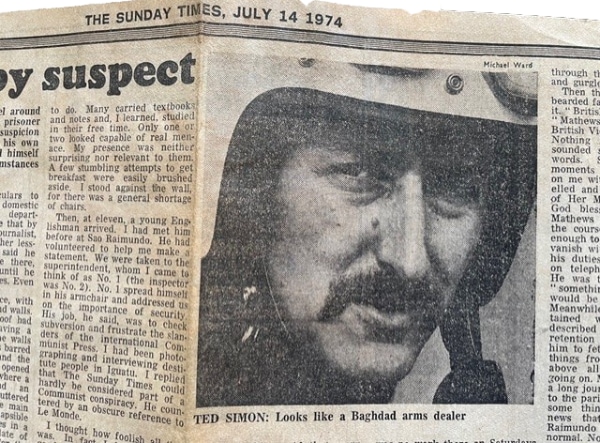
The suspect was apparently born in Germany , of a German mother and a Romanian father. Yet he carries a British passport (with no indication of naturalisation) and lives in France. Physically, however, he looks more like an arms dealer from Baghdad and his passport contains several pages of Arabic script which might as well be a prescription for exploding coconuts. He claims to be traveling around the world on a motorcycle but when asked why can offer no credible explanation. His arrival in Fortaleza on a Greek freighter is inexplicable and unheralded since he has a paid passage to Rio. He presents himself as a tourist but immediately engages in a fierce telex exchange with his masters in London who machinate under the code name “Thomsonews.” They instruct him to join forces with a network of missionaries from Ireland who are vaguely affiliated to another organisation, unknown to the Federal Police at this time, called Oxfam. Under these auspices he slips out of Fortaleza at night by bus (?) to Iguatú, scene of a recent flood disaster and a hotbed of counter revolution. There he interviews flood victims and photographs them and their devastated homes. Two days later he makes the seven hour bus journey back to Fortaleza.
I was not so much seized as invited into captivity. I had long stopped expecting trouble. The first two days the police buzzed around me like flies. Then came the Sunday Times telex about the Irish fathers, Oxfam, and the floods at Iguatú. It smacked strongly of “journalism”, an association I preferred to avoid, and I was fairly sure such conspicuous communications were monitored. However, the police assured me I was “free to go anywhere.”
By now the priests in Fortaleza had invited me to stay. They are well established in the area of Sâo Raimundo with a large college, a church and a number of community projects. They have other groups in many parts of the country, including Iguatú, and one of their number was returning there after an illness. I went with him, by bus, and came back two days later.
The message waiting for me back at São Raimundo was casual and innocuous. Would I call at the Maritime Police office and ask for Samuel. I went the following afternoon. Samuel was the youngest and most sympathetic of the police who had talked to me at the docks. He apologised for the bother and said the Federal Police simply wanted to ask some questions for the record. We drove in a police car to their office behind the cathedral, a white plastered villa webbed over with aerials. We waited for an hour and a half and I didn’t think there could be much to worry about. Then I was taken into an office where several people were waiting. Opposite, across a desk, sat a short belligerent man who attacked me angrily right away. “You have been taking pictures in Iguatú. Are you a journalist?”
I have made a point on this journey of not traveling as a journalist. This adventure is a personal one and not a professional exercise. The Sunday Times does not employ me to investigate newsworthy situations, it helps me in return for an account of some of my experiences.
But behind this truth lurks ambiguity. I have been a journalist, and for emergencies I carry documents and an older passport identifying me as such. These I keep separately, with a reserve of cash in a money belt, and that belt was among my things at Sâo Raimundo.
Having arrived in Brazil as a tourist I was determined to stay as one, and I denied the charge. I cheerfully admitted taking pictures, and with genuine curiosity asked why not? But they were not there to answer questions.
Samuel was ordered to take me back to São Raimundo and fetch my cameras, films, everything. The affair was beginning to look serious. As we approached the crumbling outskirts I tried to form a plan. I thought I should keep those other documents to myself or they would create worse confusion. The house was empty, but I knew where the backdoor key was. I mumbled in English and dashed round the side of the house. Samuel waited patiently while I let myself in at the back, got the belt out of my room and slipped it under the dining-room fridge. Then I let him in through the front door. Samuel was probably the most intelligent of them all. He wasn’t worried because he’d taken the trouble to talk to me. He knew damn well I wasn’t a threat to Brazil or anyone. Unfortunately he didn’t explain earlier that the one thing that would have soothed his chief was documentary proof that I was a journalist. When I found that out it was too late.
The Inspector of the Department of Political and Social Order (DOPS) had been quiet at our earlier meeting. He received us in his office, took the films, rocked himself gently in his padded chair and broadcast my exotic particulars to Interpol and a variety of domestic Brazilian intelligence departments. I began to realise that by refusing the label of journalist I had made room for other less comfortable labels. He said he would have to keep me there, perhaps for the night, until he had replies to his inquiries. Even then I was surprised.
I was taken to an office, with desks, chairs, tiled floor and walls. Once an open patio, a roof had been raised over it, leaving a three-foot space above the walls open to the air. Iron grills barred the exits to the street and the back. A shuttered widow opened on to the reception area where a military policeman and an “agente” stood duty. Shuttered double doors led into the main building. There were collapsible beds with straw mattresses in a corner. I was given a plate of rice and beans and left for the night.
I had nothing with me but my wallet, and the shirt, trousers, shoes and socks I’d arrived in. My shoes were still soaked from the day’s tropical downpour. In the night the wind blew surprisingly cold and damp. From a communications room on the second floor, morse code and telex chattered through the night. I cheered myself that they were bringing information that would release me.
Next morning I was allowed to the bathroom and looked longingly at the shower. There was no towel so I washed my face and dried it on lavatory paper. Then I waited in the office. At about eight the staff arrived. They seemed amiable enough though they ignored me completely. The office houses two departments, DOPS and a drug squad called Toxicos. Two attractive secretaries took their seats. Young men gathered, lounging about, chatting, playing with guns and handcuffs, 332 waiting for something to do. Many carried textbooks and notes and, I learned, studied in their spare time. Only one or two looked capable of real menace. My presence was neither surprising nor relevant to them. A few stumbling attempts to get breakfast were easily brushed aside. I stood against the wall because there was a general shortage of chairs.
Then at eleven a young Englishman arrived. I had met him before at São Raimundo. He had volunteered to help me make a statement. We were taken to the Superintendent, whom I came to think of as No.1 (the Inspector was No.2). No.1 spread himself on his armchair and addressed us on the importance of security. His job, he said, was to check subversion and frustrate the slanders of the international communist press. I had been photographing and interviewing destitute people in Iguatú. I replied that the Sunday Times could hardly be considered part of a communist conspiracy. He countered with an obscure reference to Le Monde.
I thought how foolish all this was. In fact I had formed a good impression of the government’s efforts to relieve the miseries of Iguatú’s homeless. I had seen them temporarily housed and fed as well as might have been expected. I had seen the beginnings of a very promising self-help housing project supported by Oxfam with some impressively ingenious brick-making machines. The land had been granted by the able and energetic governor of the State of Ceara, who had also mobilised the army effectively to repair flood damage and distribute free grain and seed stocks in the rural areas.
We were swept in to see No.2 who asked more questions. I was sad to find that the priests also were suspect. Eventually No.2 composed a three-page statement in triplicate which seemed truthful and harmless enough to sign. Only with the pen in my hand did I discover how strained I was. The pen refused to do what I asked of it. My first attempt was such a mess I had to cross it out and start again. Even the ninth signature was an awkward travesty of my usual mark. Then No.1 reappeared and the mood became quite genial. A day or two would set me free, he said, and repeated that he was waiting for replies to routine enquiries. Meanwhile I would be escorted out for meals if I wished. I asked for a towel, a razor, some clothes and something to read. My friend was due to return home to the next state but promised to let the British vice-Consul know where I was.
I returned to the office and waited to be taken to lunch. My shirt, once white, was grey and sticky from sweat and humidity My face had two days’ bristle. The office cleared for lunch and I was left locked in. After half an hour an orderly came with a bowl of rice and beans, and my morale took a sickening lurch. Clearly nothing said that morning was to be believed. The whole euphoric event seem to have been orchestrated to get my signature and send the Englishman away happy. The Consul? The Englishman had been late for his bus. The police had offered to drive him to the bus station. They could easily say “Don’t worry. You’re late. We’ll see to it.” The priests would be unable to help and that, I realised, disposed of my links to the outside world. It was buttoned up. I was in the hands of professionals.
Next week: Part two
Along the way through Africa I occasionally wrote small essays or mini-reports. A major issue of the day was Southern Rhodesia’s refusal to accept that an all-white government was not sustainable. Britain having divested itself of empire could not afford to be sheltering a white colony, and Ian Smith’s efforts to go it alone led to heavy sanctions. In theory British firms were forbidden to trade with Rhodesia. This is what I wrote:
In practice life on both sides of the Zambesi curtain proceeds moderately well in spite of economic difficulties. On the face of it, the Rhodesians do better. They are inordinately proud of their sanction-busting prowess. British brand names, like Dunlop and Lyons, flourish. I’ve seen machinery newly arrived from Britain, and Rhodesia now manufactures much of what it once imported. But the sanctions, which seemed so feeble are becoming deadly in their long-term effect. While the farmers can hold out well enough, the business community shows signs of quiet desperation. Several times I heard the same story. Shortage of foreign currency, combined with an average 50% extra cost involved in intricate importing procedures are causing stagnation. While Africans can make do (as can the Arabs) with a subsistence livelihood, white Rhodesians are used to high consumption and leisure.
As an interesting sidelight, several Rhodesian women I spoke with took perverse pleasure in telling me that their divorce rate was the highest in the world.
My journey offered an unusual opportunity to experience both sides of a confrontation. A story that illustrates the absurdity of the border closure – the price of high-sounding principles The Chinese contract to build the Tan Zam railway. Part of the price to Kaunda is a delivery of maize. This is produced in Zambia by African farmers – and European growers. To stimulate the African sector KK gives them a preferential selling rate. Instead of increasing the yield the yield drops. It turns out that the African grows only as much as he needs to cover his costs. Result is that Zambia must import maize to settle its obligations to China. The only source of maize is Rhodesia – but direct import is out of the question. So, it is brought in though Botswana. The price in Rhodesia is $3.50 a bag, but Botswana levies a heavy duty to cash in on its neighbour’s troubles. By the time it gets to Zambia it costs double the price. So Zambia is paying a colossal premium to provide China with Rhodesian maize (There is no evidence that the Chinese choked on it.)
The cob is, of course, a vital ingredient of African life. It’s an interesting plant – being flagrantly bisexual. The male half exhibits itself with a flourish at the uppermost tip with a flower (often seven or eight feet high) that sheds pollen. While the female component protrudes more coyly from the stem with bunches of fronds which collect the pollen as it drifts down from above and develops into the cob, packed with corn.
Much expertise is involved in getting the best hybrid, and on both sides of the Zambesi the producers of seed maize are under great pressure to keep up the quality. I talked to experts on both sides. In Zambia an agricultural scientist – a white man who likes it here – said the government had set standards for seed maize that were the most exacting in the world. In Rhodesia a seed maize farmer was equally certain of his truth. The hybrid In Zambia, he said, depended eventually on Rhodesian expertise and since the border closure had degenerated to such an extent that compared with the Rhodesian variety it was hardly better than a weed.
These distortions and misconceptions, present across all the borders I’ve crossed, reach absurd proportions here. To many Rhodesians, Zambia is a land of economic chaos riddled with terrorism and ruled by proxy from China as part of a world communist conspiracy to destroy Rhodesia and ultimately South Africa.
[What actually happened? Instead of making some kind of reasonable accommodation with Tom M’boya, Smith hung on to the bitter end and gave way to Mugabe who pretty much destroyed Rhodesia’s brilliant farming economy. Well, that’s how I saw it. Now, back on board . . .]
When I first took my things aboard back in LM, the Zoe.G was all I had ever imagined a Greek freighter to be, from early readings of Greene and Ambler. The sight dented my morale severely for 24 hours. Evidently she could float but it seemed only a matter of time before the rust gave way somewhere important and let the sea in. I couldn’t see a clear painted surface or a glint of polished brass anywhere. Under the night loading lights the decks were littered with debris except where a great hole gaped. Far below in the hold some Black men where chanting and moving sleeper-sized bars of metal. There didn’t seem much of a cargo.
Now, after several days at sea the gale seemed to have had a cleansing effect. The captain of the ship was Fotius Fafoutis. All his officers, with the exception of the Philippino radio operator, are Greeks. They speak little or no English. I am the only passenger and I do not, as they used to say, “have Greek,’ Morning, noon and night I sat in the saloon watching the faces and listening to the talk. Food is consumed in silence. There is much time on shipboard, and it would be wasteful to duplicate diversions.
The faces generally have a mournful, introverted aspect, emphasised by the Greek talent for running to seed. Bristle and sweat, deep furrows and tangled hair, grubby singlets, grimy nails, the greasy remnants of last year’s shore-going best. Then, with the food almost gone, the talking begins. Usually the electrician started it, the first mate joined in, then the chief engineer, then one of the third engineers, in order of the different degrees of loquacity. The speech transformed them. Once animated their eyes flashed, intelligence illuminated their faces, they discarded their shirts for the robes of a Greek Forum and judging by their rhetoric they might have been debating the existential issues of our time, but Captain Fafoutis explained that the subject matter was cars, girls, furniture, girls, and more girls.
[Furniture?]
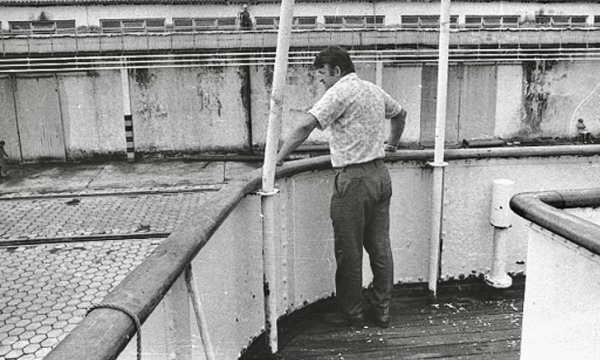
Captain Fafoutis overseeing the loading
“It’s a bad life,” he said. “Far from home and family. Children grow up, you don’t see them. And in port looking for girls. Then three months for worrying. The smallest trouble is gonorrhea, the worst syphilis. Is no good. But when seaman goes home and decide to stay on shore, in three months he looks for another ship. He can do nothing. No work. And go to sea again because is better than nothing.”
But the captain has his wife with him on board.
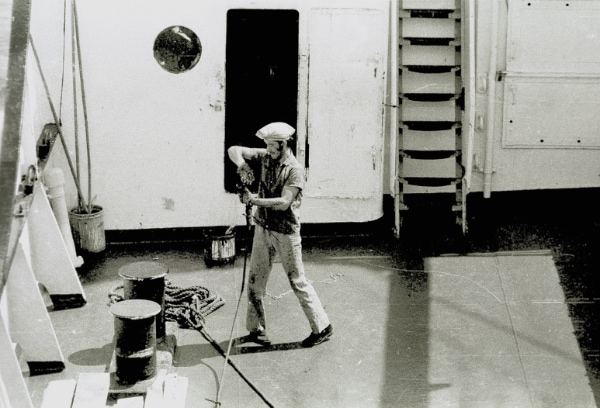
Painting over the rust – it never stops
I’ll see you again next week – same boat.
From Lourenço Marques my ship had to sail south and round the horn of Africa.
Thursday, May 9th, 10th, 11th
Sail along the coast [Mocambique, South Africa.] Calm sunny weather. On the 12th mountains of Cape Town barely visible in shrouds of mist. Then into Atlantic. Albatrosses. Small trawler. Disabled liner, listing to starboard, towed by tug. Chess games [with whom?]
Sunday 12th
Jog day. [‘Jog’ was a nickname for my girlfriend Jo. It was her birthday.]
Fine, clear, calm. Start a letter in which I falsely declare that we will meet in the same latitude that day. But I believe it so it stands. What counts? Fact or belief. The fact, after all, is only a belief ratified by consensus. In an infinite number of conjectural worlds we believe the one that gives us the greatest material dominium. In recent times it has seemed as though nothing can stand in the way of this system. It is the logical extension of the animal which reacts (we suppose) only to pain. In seeking to enslave nature we have enslaved ourselves to a system which makes all other forms of experience subordinate to a negative principle – the absence of discomfort. Perhaps this is why modern society is often called ‘hollow.’ In fact there is ample evidence to show that people are unsatisfied by ‘progress.’) But being slaves of the system, they can only fight fire with fire, and are burned all the more.
Contemporary strikers are abused for their irrational behaviour, in pursuing a factional advantage which reduces the common good. They are the levelers of our society.
[Britain is in turmoil. Coal miners are striking. My diary wanders off into wild political and philosophic speculation.]
The South Atlantic
Blue. Long swells, 100 – 200 feet. Mild, scattered cloud.
Bird life. Several large species, similar to albatross, wingspans up to a metre. Some with bodies and wings brown above, some white bodies, brown wings. Some with additional white markings on wings (the biggest). Also a medium-sized dark bird in groups. And once a flock of a dozen or so tiny birds, glinting, white, too small and bright to distinguish, skimming the waves on an opposite course to ours.
The Zoe.G
Deadweight 7000 tons. Displacement 4000. About 400 ft long. The main accommodation is amidships above and alongside the engine room. There’s a main saloon in which officers eat, with one long table down the middle and two shorter ones each side, all parallel to the keel. The portside table has a tablecloth on it, permanently, and is never used. I think it’s for passengers. The other small table has a knitted black–grey cover and is used for coffee, tric-trac and ash trays. Also the daily news sheet from Athens.
Saloon has double doors and 4 ports opening onto a gallery across the ship which is one level up from the deck. Above it is a second level and the three levels are joined by two gangways, one each side. The saloon faces back (astern). Forward of it are two corridors, all wood-paneled, with cabins opening off. The cabins have names like Corfu, Xanthos, etc. but the nail holes from the letters of the previous names, when the ship was Swedish, are still visible. Although the ship was much neglected it is clear that it could still be made quite sumptuous by old-fashioned standards.
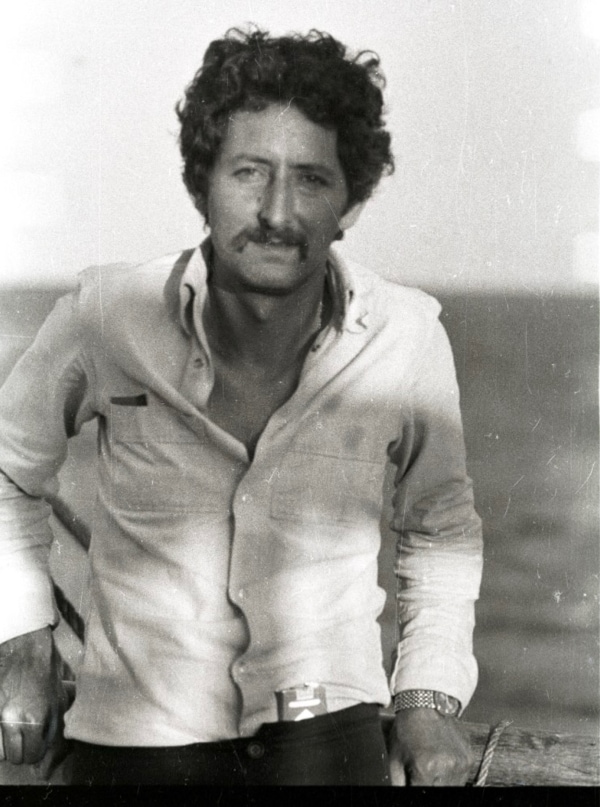
Me on the Zoe.G
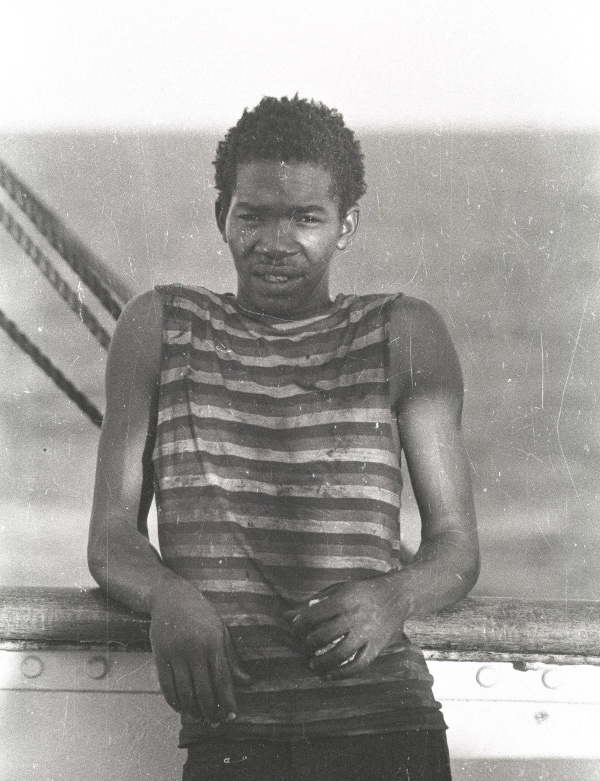
And here’s the deck hand who took the picture.
There was originally accommodation for twelve passengers, but now the crew uses most of this space (if not all). The two corridors lead to a sort of foyer from which a staircase rises, dividing in two and curling off left and right to meet a landing. About all this there is a touch of Thirties splendour, the Trocadero, Quagllno’s. The staircase throngs with ghostly celebrators in paper hats. It faces glazed double doors with frosted glass designs leading to the Mykonos Lounge, which has a bar and soft furniture. Now occupied only as an office. The officers live in style and space that was never meant to be. Atop of the stairs are the owner’s quarters (to port) and the captain’s quarters. I imagine them to be of similar size, although the captain has a private stairway up to the bridge, which is above both quarters. The owners’ (and I don’t suppose any of the owners have ever slept in it) has a living room, bathroom and double bedroom. The living room has two tables bolted to the floor with brass mountings. And several wall cupboards. All have roll-top type doors. There’s a refrigerator and above it a drinks cupboard.
[This where I’m quartered – but there were no drinks in the cupboard.]
Four windows. Each window in the ship is hinged with four screw-type fixings in heavy metal to clamp it to its frame. Bathroom has large twin basins, a lavatory with a broken seat, a bathtub with shower and curtains. Tub is dirty and has no plug. Shower only has one jet. Curtains torn. Door has warped and split into two layers of veneer and ply at the upper corner and won’t shut. All glazed surfaces are blue. Must have been very smart once. Beds are bunks, but good mattresses on sprung frames. One under windows, (three altogether) one against wall. Dressing table recessed, mirror with folding wings.
Up through the middle of this block the engine room rises, tapering towards the top, housing several big boilers, heated presumably by the exhaust gases from the diesel. The gases and hot air escape through a faired cowling like a vast eccentric blancmange, which is the evolved shape of the old funnel. On either side of this is a bell-shaped air intake, portside facing astern, starboard facing forward and out at an angle to catch slipstream from the funnel. The engine room itself is a great mysterious cavern. The door opens onto the deck below the saloon door. Looking down, it drops away, layer upon layer as in a cutaway model to the bottom of the ship, which seems improbably deep. In the centre of the picture are eight huge valves, in line in blocks of four, the rockers packing down on the valve stems, the springs like coiled pythons, monstrous images of my own diminutive [motorcycle] valves.
Ship has five hatches – of which the first is raised above the forecastle, the deck being of welded steel, pockmarked by rust and dents, and coated with paint like a custard skin. Other decks are wood, caulking half gone. A lifeboat each side.
Every now and again a siren whistle calls the telephone in the engine room.
Crew of thirty – twelve officers, Captain, First, Second and Third mates, Chief engineer, Second and two Third engineers, apprentice engineer, Radio officer, Electrical officer.
Before I sign off, here’s a little bonus (or penalty maybe?} Not required reading.
I had always planned to use the Atlantic crossing from Africa to the Americas to learn Spanish. It is one of the very few events I planned for this otherwise formless meander round the world. Rather than carry extra weight through Africa I thought I would get the book I wanted in Cape Town but as it turned out I was lucky to find any book at all. I visited all the big bookshops. From Stuttaford’s to Juta’s, to the Pilgrim and Makaus, the CNN and the Academy and the other big shops near it I trudged. All were sold out. None of them could tell me why. But there was an explanation, and that lay in the State Visit of the President of Paraguay. The first head of state to grace (or disgrace) the shores of the republic since heaven knows when, if ever.
This astonishing event did more to emphasise South Africa’s political isolation than anything in recent times. I don’t know whether Stroessner deserves his infamous reputation as the junta boss who hit on the horrible notion of offering a tax and extradition-free flag of convenience to international heroin smugglers. But it is a fact that he is notorious, and South Africa’s English opposition press was not slow to publish all the grisly accusations amassed from American news magazines.
The Nationalist Government however, as is its invariable wont, crashed on regardless of ridicule. But who spoke Spanish? I imagine the Afrikaaner Diplomatic Corps, buying up all the language books and performing its duties most solemnly by midnight oil, grinding through the declinations of obedicir: to obey. Either that or Vorster was determined to do his utmost to protect his new pal from public obscenities in his own language.
I prefer the first explanation because it promises a new and unexpected etymological wonder – Spanish spoken with an Afrikaans accent.
I did finally secure the last remaining copy of a Spanish textbook. Not the one I wanted but, as it turns out, a very good one called Spanish Made Simple (W.H.Allen: £1.00)
The theme of the book makes its first tenuous claim on my attention in Chapter Three, when I am introduced to Mrs Adams, a London businesswoman eager to learn Spanish, and her teacher, Seńor Lopez, a Spaniard living in London. To cries of “Buen suerte” and “Buen viaje” I set off to accompany Mrs Adams on the road which leads to a practical knowledge of the Spanish language.
It is clear from the start that Mrs Adams is not to be trifled with. She has four children, a ten-room house in the suburbs, and an office on the fifth floor of a very big building in Oxford street. Furthermore she has an agent in Madrid and she imports objetos de arte and otros articulos. Like all really successful business people she is well behind the times, and she is satisfying an insatiable provincial nostalgia for Torero dolls and Costa Brava wineskins, long after London has moved on through Djelabas, Afghan rugs, Dhotis, Mantras, and Vietnamese grass.
In another important respect Mrs Adams shows her mettle because she has acquired a husband who has sired the children, pays the mortgage on the ten rooms (out Wimbledon way, I fancy) and makes no other intrusion on her life except for brisk chats at breakfast time about the bills and the children’s schooling. Mr Adams is therefore free to devote herself exclusively to her business (objetos de arte) and her hobby (Seńor Lopez). To set the seal on this triumph of convenience she also has a maid to open and close doors.
The action now proceeds apace. Seńor Lopez, a formidable if old-fashioned pedagogue, makes a whirlwind series of arrivals and departures at Wimbledon, exhausting the maid, but contenting himself at first with a flurry of formal greetings and other bourgeois courtesies.
However he has now established himself securely as the one who wears the pantalones in the Adams nest. Gradually they now unfold their mutual passion for Spanish cooking, Talavera pottery, Basque dances, and counting from one to a hundred. Mrs Adams is succumbing steadily to Seńor Lopez’s charms. And leans more and more heavily on his worldly Latin words, while he ingratiates himself with constant flattery and attention.
After ten chapters she is seeking his advice on tummy upsets, while he has already penetrated her office to give his opinion on the latest consignment of articulos. The future could look bright for the sly Iberian. (Mr Adams can undoubtedly afford alimony) but there is a fly in his ointment. Mrs A’s pretext for these constant meetings is a projected visit to Spain. Now suddenly for Seńor Lopez this prospect assumes a dangerous reality, for in Madrid she is to meet her Spanish agent, a younger man. Seńor Lopez has no illusions about his countrymen, and when she shows him the letter she has written to Madrid it is easy to hear, through his urbane congratulations on her syntax, the sighs of a tortured heart. For her letter is signed, Jane Adams, the first time her immaculate business two piece has been sloughed off to reveal the maidenly creature beneath, and not for Seńor Lopez – por suppuesto – but for that sneaking Madrileno, Rufino Carillo, the Spanish Connection.
Seńor Lopez is desperate and in chapter nineteen he defies his mature years with a reckless visit to Wimbledon on a stormy night. The rain is coming down in cantaros (buckets) and the maid opens the door to find Seńor Lopez soaked to the skin and shivering. Normally Mrs Adams receives him in her salon but now it seems his wild gamble has paid off. Jane Adams herself rushes into the hall and leads the sopping Seńor upstairs. No doubt recalling how Jane Russell once infused her warmth into the icy body of her lover (they have discussed the cinema in chapter 15) he leaves his teeth to chatter and follows hopefully, but for the moment Mrs Adams makes do with tea and rum in the dining room.
So far the action has been fairly conventional. Something of a farce perhaps with those endless comings and goings and cries of Hasta luego, but with gathering satirical undertones for the discerning ear.
Chapter 20 disposes utterly of such fantasies and little conceits. With the savagery of Psycho it massacres every burgeoning bud of sentimentality, pulls out all the sops. In three relentless sentences the foolish edifice of ârticulos and dolores de estomago is brought crashing (cayendo) to the ground.
“All life long (todavia) Mrs Adams and Seńor Lopez are sitting in the dining room.”
“All life long (todavia) they are chatting and drinking tea and rum.”
“All life long (todavia) it is raining.”
How can I begin to describe the effect of those three hammer blows. Todavia, todavia, todavia. Henceforth all is fantasy, dreamed up along with the trappings of a spurious culture by two inadequate figures spiritually marooned in a Wimbedon dining room and supporting their ceaseless prattle on an infinite supply of tea and rum, the perfect concoction for futility.
Finally my ship, the Zoe.G, is ready to sail from Lourenço Marques for Brasil. It’s eight o’clock and dark.
L.M. Wednesday, May 8th
The pilot appears in the doorway of the captain’s cabin. A dark, bearded figure in a heavy coat. He seems shrouded in darkness and mystery. A portentous figure.
“Are you ready, Captain? “The boat has been shivering gently for hours, a soft, almost inaudible rustling in the paneling. Like the breath of a sleeping child, flowing and ebbing, flowing and ebbing. The Captain, in cream shirt and grey flannels with a zip that won’t quite close, has been like any office worker in a humdrum business tapping out tedious letters on a clapped-out Standard typewriter, and filling in forms. The agent’s clerk in charge of the manifest has noted the loading for fuel, water, the expected time of arrival in Fortaleza, the draught fore and aft and the anticipated mean draught at Fortaleza. He is a tall, graceful Portuguese Indian with a liquid charm and a wry smile which carries a permanent suggestion that behind the apparent reality of the moment is an altogether different and more significant reality which promises little good. We have been discussing the future of Moçambique after the coup.
“There will be trouble,” he says. “You will see. You will hear about it. there will be bloodshed.”
Politely he listens to my arguments, but they carry no weight, and don’t convince me either.
“I was four years in the army fighting this war. I left university to go to the army. When I finished I gave up university. There was no time anymore. It was necessary to put my feet on the ground. Now I am married. I have children. Am I going to go back to the army now? We can fight this war 4,8,12, 16 years but we will have to give it away in the end.”
The pilot puts an end to the talk. Amade (his name) uncrosses his legs and smiles encouragingly at me as though it were I who faced the miserable uncertainties of Africa. We shook hands and he jumped ashore from the rail.
“Go up on the bridge,” he said, “You will see it better from there.”
The pilot is on the bridge with the captain. Above them is another open deck around the funnel which is exuding steam like a simmering kettle. Far below me Amade is at the quayside. At last the stern is cast off and begins to part, very slowly, from the quayside. I hear the whistle and chatter of the walkie-talkies. Already the stern has swung clear of the bows of the next ship in line along the quayside. Amade gives a last wave and turns away to walk across the sidings, away from the lights into the shadows of the yard, over the coal black dust, back to the town. I’m going to Rio. He’s going nowhere. An immense sadness reaches out to me and then fades as he moves out of sight among the goods wagons.
The ship has now swung out at thirty degrees to the quay and crossing to the other side I see why. A long tugboat is hauling the stern out into the harbour – the “Chamite” – a throbbing power-house of energy.
Suddenly excitement rushes up in me with a flush of adrenalin. From this angle I can see the full line of vessels stretching out in both directions as far as I can see. . A magical sight. All brilliant, glowing, like a thousand lanterns, tantalising, inviting, promising joy, like department stores at Christmas time, like a giant festival, a fairground. Nothing gladdens the heart like lights shining in darkness. I am so overjoyed that I leap up and down and shout. Heaven knows what the Captain down below makes of my antics. The tug lets go of the stern now, and its bulbous padded nose slides along the side of the ship and rams into the bows, chugging again, swinging round to complete a full circle until at last we are pointing out to sea. Behind me the funnel belches exhaust, and the Zoe.G’s Burmeister engines take up the strain. The journey has begun, and the tugboat slips away, streaking away to port, flaunting her power, her work done.
Ahead of us a trail of blue flashing buoys perforate the black water and leads us out past other floating fairylands at anchor in the bay.
There are several elements in this scene which I have not isolated but which combine to produce this sense of elation. First of course the prospect of Brasil. Every development brings that continent nearer. Then the pleasure of seeing massive objects in effortless motion, on water or in air. Then the lights, which provide an outline, illuminate a few planes and recesses, but leave the rest to the imagination. In every respect there is a benign magic at work, shaping the world for my special pleasure and benefit. I’m also impressed by the size of the harbour which seems immensely long. Counting the ships I can see there are more than 12 tied up (including the space left by the Zoe.G.) but the impression is of a far greater number. All the squalour and ugliness of the docks has disappeared, and it is pure magic.
The ecstasy endures for perhaps five minutes. The ensuing misery for perhaps 24 hours. In the morning I feel fine – it seems that yesterday’s magic will protect me from sickness, and with confidence I sit down to bacon and eggs at 7 am. The sky is cloudy, and the sea is swelling. By ten there is a gale blowing, and the sea has grown even more. My uneasiness has grown with it. Now the ship is see-sawing and rolling heavily, and I am pitched into full-scale sea sickness which I have never experienced before. There is only one place on the ship where I can bear to stand, on the starboard gangway at the pivotal point of the pitch. Here at least the possibilities for violent motion are reduced by one. By burping and belching constantly I can hold on to my stomach but evidently I can’t stay here all day and night. I decide to try lying down in the cabin. The effect is instantaneous and disastrous. The process which begins there is quite irreversible. My stomach goes into a floating wobble as though completely detached from its moorings, something grips my throat, my mouth fills with saliva which seems to be pouring out of it and reminds me of a beast of prey. There is time to get out to the rail. The vomiting is accompanied by an involuntary noise, and the sound of this ugly, croaking despairing noise issuing with my breakfast is perhaps the worst part of the experience. The palpitations continue. Then there is a period of beautiful peace. During the rest of the afternoon I resume my place on the gangway, watching the sea. The ship is swinging and rolling wildly now. The sea is in turmoil – lumps of black water with white crests rushing about in aimless fury, colliding with each other. The wind whips up a spray. The clouds discharge their rain. The two meet and for a while the sky and the sea merge into the same element, a swirling fusion of wind and water. It is impossible not to think of the sea as alive. Now I understand the origins of Neptune, the sprites. There is a life force at work here. The waves are merely cloaks for devils tearing about below the surface, the crests are a froth whipped up by their tridents.
The Zoe.G. is about 300 feet long and weighs some 4000 tons. She rides up on a swell and falls again through an angle of thirty degrees. When she comes down she hammers the sea with her bows and the sea rushes off screaming pain and vengeance. Where the Zoe.G. has hammered the sea, livid bruises appear, patches of the palest blue where the ships’ hull has smashed air and water together so hard that they remain entangled in the wake of the vessel as far back as one can see. Still the fury mounts. Every inch of water is covered with a lacy foam flying across the surface. Looking down into it makes you want to hold on to everything very tightly, because nothing could survive in that cauldron.
By dinner time it occurs to me that some soup might help. But it’s fish soup, and as I eat it I know it’s no help. Soon after I’m violently sick again. In the peace that follows I get into bed. The motion of the ship now declares itself in the purest geometrical forms. I feel myself tracing out patterns through the mattress. The most spectacular movement is the corkscrew which drills me down into the bed. Several doors are flying about and have to be secured but at last, inevitably, I sleep. The next day is clear and blue. The sea is calm, although the ship can still swing quite far in a gentle sea. Still I feel queasy and nervous of a recurrence. I’m resigned to three days of sickness but that seems like an eternal prospect. Since it began I have not been able to get my mind off it for more than five minutes. It is mentally and physically exhausting. I dare to eat a grapefruit. Nothing awful happens. Later I pick out what’s left of an over-ripe avocado. Still no disasters, but no real relief either. The mess boy tries to persuade me to have lunch. Says it’s better to eat. I refuse him and mean to keep off food until the next day. But at dinner time (5.30} on an impulse I go in and sit. What I’m more afraid of than the food is the effect of sitting down inside. But it seems better now. I eat a plate of sliced tomato. With each mouthful I feel stronger. It’s too good to believe. The main course arrives. Roast lamb full of garlic and a heap of greasy roast potatoes, but nothing can stop me. I eat the lamb. Delicious. Even a beer. Seems crazy. It’s over.
My bike was strapped up on deck under a tarp – a sad, huddled object. Later I took half a teaspoon of salt out of the carb.
Next week: Life on the ocean wave.
