News from Ted
It is noticeable that I was much more concerned with the condition of the bike, now, than by what was going on around me. A chronic problem with the Tiger 100 was the tendency of the rocker caps or pushrod covers– often called “hot cross buns” because of the grooves on top – to come unscrewed and loose oil. Loctite was supposed to be the solution, but since they had to be removed from time to time there could never be a permanent fix.
I’m now leaving Kandahar on my way to the frontier with Iran.
Thursday, May 19th
To Herat. Long ride. 130 miles (?) Oil is now pouring out. At Sangan Hotel with Holst again. Two days. 1st day try to cure leaks with silicone rubber donated by Mark Fry, US biker on BMW. Doesn’t work.
Second day, more thorough job on push rod covers. Seems to work. The pelicans. The Mosque. The fastest horse-drawn carts yet.
Sunday, 22nd
To Mashad. [Iran.] The frontier. Hell on both sides. To camp site. Lost the Holsts again.
[What I remember now of that frontier was tourist cars and trailers being almost dismantled by customs officials looking for drugs, with storms of paper products (toilet, tissue, towels) blowing across the landscape.]
Monday, 23rd
Stay in Mashad, tinkering and trying to finish letter to Carol. Holst arrives, having lost his gear lever before the frontier yesterday.
Tuesday, 24th
Breakfast meeting with so-called maths teacher who takes me to the Magic Carpet Shop. Then off. Cross desert and mountain pass to rain and Gorgan. Different world – really Slav. Night on cement balcony over bus depot. But OK finally.
Wednesday, 25th. To Gorgan
[Somewhere – I can’t remember how – I got an introduction to a family called Havranek, at Rasht on the Caspian coast and I headed that way rather than to Tehran.]
Beyond Gorgan weather starts breaking up. Towards mountains (Elburtz) some rain. Passes in cloud. On other side, first rich black soil in a long time. Rice fields. Towns have a more European look. Gorgan in rain. At 2nd hotel small man with bristled aging face insists I can have a room. How much can you pay, 200?, 300? Hopeless of getting anything cheaper I agree. But he is not to do with hotel. A truck driver who worked as a young man on BP rigs nr Aberdeen. Eat a chalo Kabab Morg (chicken) and he buys me a tumblerful of vodka, to be taken with pickled garlic. And there is not a bed except for 400 rials. But he rings the Tourist Home. Eventually go back there. And after showing me rooms at 200 or more, shows me bed outside on terrace above bus station, for 70, paid in advance. But bed is comfortable. Next day I drive out through the baksheesh barrier. Old gent in brown hunting clothes with stick is chanting a haunting song, and begging. In restaurant men eat like king-pigs while women huddle abjectly outside in drizzle.
Thursday, 26th. To Rasht
From Gorgan to Rasht along coast. Holiday villas all the way – in all styles. Much unfinished building, small resort towns, with railed-in parks, flower gardens. Coastline not very attractive. Much rain, which consolidates over Rasht. How will I find Havranek? Settle on going to biggest hotel I can find and trying for telephone number. But Iran Hotel receptionist knows him. Two Germans translate. All is well.
Mud on my boots, on my visor, in my eye. One well-directed spray from passing truck and I have to stop. A perfectly opaque screen forms instantly. I wondered why I had the Belstaff suit. Now I know. It’s disgusting on the outside but lovely to be inside. The bike is smothered. Not since the Altiplano like this. Geography is full of surprises – some nasty – never anticipated. Such filthy weather. Is it all the Caspian? And the mountains. My chin feels as though it’s been skinned by a thousand little knives. The huge TIR juggernauts roll on, pushing the air around. I look up into the cabs as I try to pass. It’s a different world in there. A young, blond man in shirt sleeves sits as tho’ at his office desk with blank eyes. Is there music and constant running coffee in there? They run in fleets. P.I.E. Hungarocamion – advertising offices in Budapest, London, Malmo, Zurich – with phone and telex numbers. Always at a steady pace 60 or 70 mph. Impeccable driving – signals. Paintwork and canvas. The rest of the traffic buzzes around them like bees around a beer.
Dino’s brother once abandoned a tour bus full of ladies at Qazvin (where they had no right to be) and ran off with the money. Hi family had to settle the scandal.
Melh Bank – big horseshoe shaped hall. But people here want to do business, It goes fast. Despite comments of Havranek family.
Conversations about We and They – always suspect. In Persian cafes the chairs are all set sideways at table with their backs to the wall.
4 nights, 3 days with the Havraneks. Lots of booze, wine, cigarettes.
[Surprisingly I don’t mention the caviar – of which there was plenty. A cherished memory.]
2 days of slight feverishness. Did I come off the malaria pill too soon? Third day OK. Dino & Maggie arrive on third day. Dino gets his Yamaha trials bike out. Very strange feeling. Light, high, very close ratios, hard to change, 450 cc single cylinder, no fly wheel.
Sunday, 29th
To Tehran. Easy run, but big climb among dusty green hills, and rivers, expecting to go over top and down again, but it’s a plateau. Very cold at first. Through Qazvin. Then the main artery, but its not so bad. Hop onto freeway but get kicked off by police after 20 miles. “Get”, he shouts, pointing. “Get. Get.”
British embassy in huge walled enclosure. Consulate like prison gate. Wait an hour for opening (Was lucky. Closes Friday and Saturday). At first they say No clearance. Then find telex message. 15 minutes and the renewal is done. And Amexco has the money from Tony, plus a letter. So to stay with Judy and Davoud Ismaeli and their daughters. Dino & Maggie are there too. We go to eat at Jap place (huki) and then to see Papillon. Sleep well on carpet. Breakfast with girls, then off to town. After bank.
Monday, 30th
To Zanjan, and once again rain and mud. Tea in small tea house full of avuncular Persians and song birds in cages. Share bedroom for three. 110 rials.
Tuesday, May 31st
On to Tabriz. Clear day. Roads are very good. Countryside is beautiful, pastoral, running between ranges. At Tabriz buy Turkish money, then on to escape huge raincloud. Stop 20kms on for lunch. Then to Marand. Remarkable town in great bowl of rock. Vertical faces all round with square building seemingly glued to rock.
Man in road said “Hello. Fuck off.” Got sucked into new hotel. Room for 200. Ill-favoured man kept on at me about shit. “Tourists like shit. I have shit. My brother is in police,” etc. I’ve come to hate that conspiratorial grin – the most potent of the various ways in which all the sharp youths all over the world try to establish instant intimacy.
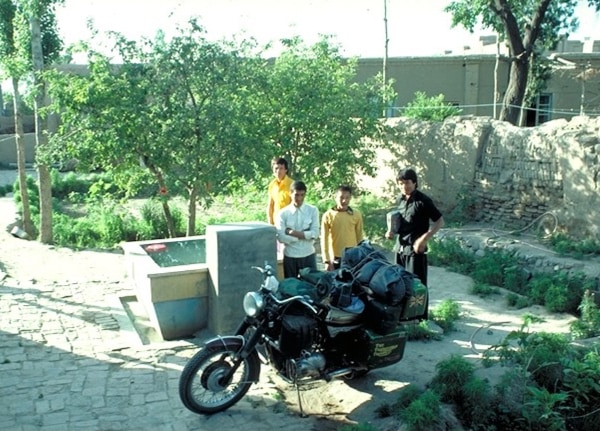
Somewhere along the way – probably after Marand – I was invited into a family home for the night and enjoyed what I assume was a perfectly traditional Iranian evening and night, sleeping on rugs rolled out from cupboards in the wall. Wonderful hospitality.
Next week’s will be the last of this series of notes. After that I will be in the UK, visiting first Nick Sanders’ rally in Wales and later Paddy Tyson’s wonderful Overland Event near Oxford. So, until next week…
As seen from Europe, in those days (maybe still today) Afghanistan seemed a very distant country, but for me then in Kabul, France seemed just around the corner. Having to cross Iran and Turkey and the Balkans to get there seemed to offer no problem at all – how different my attitude from when I started in North Africa. The exigencies of travel didn’t bother me, but after three and a half years on the road I was tired, and glad of company to lift my spirits. Ted Holst and his oriental companion were also going my way and a loose relationship with them was comforting.
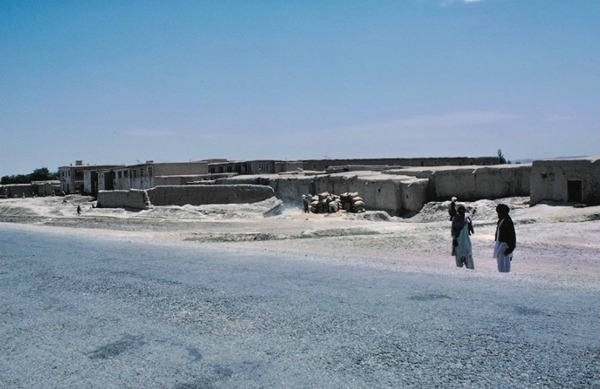
Scenes from Afghanistan
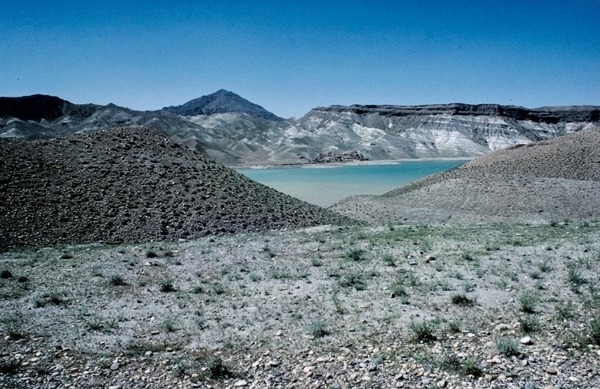
On the road to Kabul
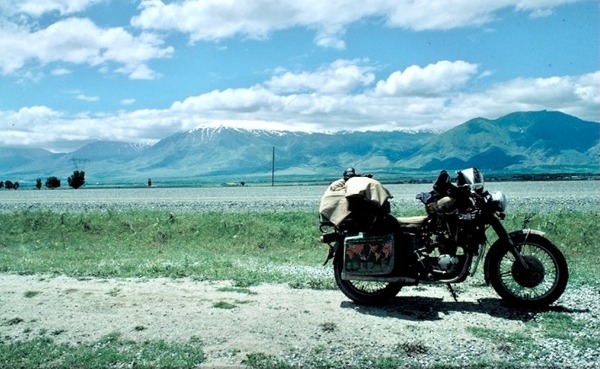
My first poppy field
Tuesday, May 17th
Met Holst and Mina-san again in the Miami restaurant two nights ago. Yesterday we ate dinner at Sikris – getting a lift in a Mercedes from young man whose wealth had not saved him from the army. Meal was too rich. Ted was very sick. I was less so. From what? Mina later became sick, and hers lasted longer. Yesterday I called consulate. Afghan employee called Dona. No reply yet. Most of my week in Kabul has been spent recovering my centre of gravity. Had been unable to find myself.
[An anthropologist friend in London had recommended that I visit an American, Louis Dupree, in Kabul. Three years later he was still there – an established luminary, very much a Southern Gentleman – living in a house with Nancy Hatch. He was welcoming. Also at his house I met again Peter Wass whom I had met in Nairobi, when he gave me the elephant hair bracelets for his sister in Queensland.]
Particularly bad last Friday on my first visit to Dupree’s house. (Louis and Nancy Hatch). The five o’clock follies. Louis talks like a man who hopes his words will hold the sky up. – “hot as pussy on a Saturday night in a mining town,” his elaborate Southern metaphors are overdrawn. He specialises in iconoclasm but it’s not quite profound enough – not integrated. Second visit on Monday was much better for me. Extraordinary meeting with Peter Wass. He interrogates Dupree on Africa in general. What crops, etc, in particular. They are sparring. Both are basically contemptuous of each other but maintain a wary respect. Wass admits to trying to do good. Dupree claims to have given it up (when I labelled them as agents of progress.)
They discuss – we discuss – the effects of taking roads to the villages. Brings the city entrepreneurs direct to the peasants, who are no match. The despised middleman is cut out, but he was the buffer and has his uses.
Louis castigates the Helman dam and irrigation project. He says it is silting up – ‘not administered’ – i.e the Afghans now in charge don’t do it properly. (It’s a US project but they didn’t carry it right through.) He prefers many small catchments on a village scale. His slogan is “take the politics to the villages.”
Wass is part of a UK project to stabilise wheat prices in the general area. Once based in Beirut – now in Amman, where he and Diane live. “We fight furiously once a fortnight but thank God we have a normal marriage” – referring to his sister and Brian Adams.
Nancy does a guidebook.
At Embassy my first meeting is with Ian Hughes – Acting vice-consul, probably the Security/Intelligence man. Very bland, close and maladroit. “Funnily enough I read your piece about Australia in the magazine.” No comment. Are you busy? I ask. Rather, he says, with all the Hippies. After work? I prompt. Pretty tied up, he says. Are you staying a few days? Then I’ll probably see you around town, he says brightly. Wants nothing to do with me. I do see him around town once on Sunday morning in the impossible dark suit and high white collar, with the Embassy Land Rover, picking up smart tourists in Afghani coats – for the church service perhaps? Or to visit the jail? I am not psychologically fit to mix it with him and let it go by. They all behave as though an armed coup was imminent.
At the Green hotel heavily carpeted public rooms. English woman approaches me. Crisp upper-class style, but no courtesy. (“Show this man the bathroom”) She wants 30 Afs to [illegible]. I say I think 10 Afs is normal. “Good luck,” she says, and turns on her heel and strides off. Business is abrasive in Afghanistan.
[I had a fancy to buy a Russian samovar.]
The samovar hunt. In and out constantly. Once I’m offered one for $45. Next day it’s refused. Another time I’m offered another for the price. When I go back to get it the brother says, “No it’s not ours. I’m just repairing it for some Germans”. But the shops are loaded with goodies. Inlaid pistols, jugs, trays, mugs, knives, rugs, teapots, ‘lunch boxes’, etc. At the Kabul Hotel – a $10 bonus. Followed by rain and bedbugs. The Sikhs at the Khoresan constantly trying to diddle me out of a dollar and finally undercharging me. The Istanbul; 24hrs restaurant, and the splendid Abdul, whom I took for a Turk, perched cross-legged behind the counter with his high domed head and utterly cynical expression, though less cynical in fact than his young partner full of bonhomie and greed.
Today at consulate again., but no message. Dona says they’ll refer clearance to Teheran. So I set out for Ghazni [about 100 miles] to catch up with Holst.
The over-friendly man in the US car who leads us too fast into town.
“You want a ho-tel? Come on!” His room for 120 Afs. “Special student price.” Hah!
The robes worn by women – finely pleated. Underneath, often trousers and shoes by St. Laurent – quasi.
Russians walk leaning forward from the waist, shoulders back.
Traffic police dressed like Germans – in grey one-piece suits. With lots of straps and belts. Was it Calcutta where the police wear a harness to support an umbrella?
Ghazni:
Hotel with Persian name. Wide street of dirt. Horses and carts dashing past, full gallop. Later find Holst at campsite. Next to Col. Gregory’s broken down Comex bus (Commonwealth Expedition.) Fleet of seven buses named after Commonwealth places. Ie. Ontario. Old style enthusiasm. Finale at Wells Cathedral service.
Then comes Das Rollende Hotel. [A German invention seen on the road: A bus with a trailer that sleeps 39 people.] Thirty-nine cells in three layers. A heap of diarrhoea 3 yards from the entrance with a piece of toilet paper, attached like a flag.
It is assumed that because people enjoy themselves, what they are doing must be OK. People enjoy themselves in war. The hardships are what weakens their enjoyment. The trick is to get them to volunteer their money and themselves in the first place.
Great dust storm blows up – lasts for an hour. Then clear night.
Wednesday, 18th
To Kandahar. Lose Holst. Find Aria hotel. Comfortable. 25Afs. Lungful of Hookah hash smoke nearly kills me. Frenchman, hair in long black ringlets and black lace shirt with trim mustache and beard like decadent young blade of 18th Century. [He was fondling and polishing a brick of hash to smuggle through Iran and Turkey. I thought it better not to mention it in my notes. I always wondered whether he made it through, having seen “Midnight Express”]
Still with the brothers at Jhellum Bridge.
May 8th
The breakfast ceremony is a continuation of yesterday. Parathas, French toast. Hamid ever watchful, suggests that paratha leaves a burning sensation in the stomach. Too much food?
I take two family portraits. The hookah is out of place – the wrong kind for Pathans. A Punjabi policeman insinuates himself with it. My mistake. Hamid is patient, but disapproving.
During the day beginnings of a great lightness of the spirit, a reawakening of joy. At the border I watch each step with suspicion, hope, anxiety barely concealed – like one escaping from a maze. What are the indications? Fewer people, more space, less detritus as the watching multitudes recede. Now there are individuals, recognisable people.
Road to Rawalpindi. First much eroded land, then farmland. R has a very well-ordered look – at least in the cantonment area. At Intercontinental [Hotel] I drop in and ask for Clifton. [Who? I don’t remember him.]
“Yes, he’s registered,” but has gone to Taxila by car. I am not going to risk an anticlimax while the going is good. I leave a note, and on to Peshawar.
Good roads. 50mph. Over the Indus where a huge fort dominates a confluence (as at Mulhausen?) At Peshawar find myself outside the Intercon. again. Ask here for cheap hotels. Very helpful. List of four. Dean’s; John’s; Park; and Sharazad. Starting at 135 rps to 35rps.
Doorman has hennaed beard. Outside Nazeer is taking the air. I talk to him. He offers me hospitality. Everything pours out of him in a burbling stream of words. His life, his romances, his poetry, the praise that has been heaped upon him, his career at the hotel, the army. He needs only an audience. I know I must ration him. Escape to eat at Al Shiraz. There I meet the owner’s son, a man of considerable conceit, barely contained, in blue tunic and trousers. A minerologist, who prospects for ores and gems. He does not believe in God. He has travelled. He understands the international political scene. He knows there is a plan afoot to disrupt Pakistan though he doesn’t know where its headquarters are. In the meantime he always makes his own track, because where there is a man-made track people will always have reported anything there. On the other hand people are very ignorant of the possibilities. He found diamonds where some villagers were living and showed them. They had seen them but were not interested. He always takes company on his treks, but only to divert himself. They trek 35 miles a day. He never leaves a mossy stone unturned. My flattering attention earns me several cups of tea from fine china.
(Footnotes: Looking at a shaven Westerner in the Istanbul. “Bodhgaya is a long way to go for a haircut,” and, “The truth is a matter of degree.”)
Peshawar: Two stories, narrow wooden balconies protruding in old houses. Narrow alleys winding uphill. Kebab roasting, fanning charcoal, cow meat on display, impassive detached faces. Fairly quiet.
Arif on sexual starvation: “The Indians were our slaves” – to explain the low value they place on individuality.
“Indians are very superstitious.”
“Prostitution must be allowed, otherwise prostitutes will mingle with society and corrupt the innocent.”
“Children must be taught to fear their elders. I have made my children afraid of me. Deliberately.”
“Our women are naturally modest. They do no wish to mingle with strangers, particularly men, so they do not go out of their home aimlessly.”
“Now there are women doctors, lawyers, etc. and girls get a better education. The men do not resist too much.”
He climbs the mountain opposite every morning and night. All is very deliberate, to prepare for the next moment. No room for surprise. Is that why visitors are made so welcome? The village elder was there. I was asked to account for Hippies. There was some spitting through the lattice work of the beds, and Arif washed his mouth out on to the floor.
At first he was wearing crumbled blue shirt and trousers. Later changed into white trousers and top with waistcoat and skull cap. We ate mutton boiled and fried, in sauce with onion. Also some egg fried and roti and tomato.
Monday 9th
To Dara.
Tuesday 10th
To Kabul, through the Khyber Pass.
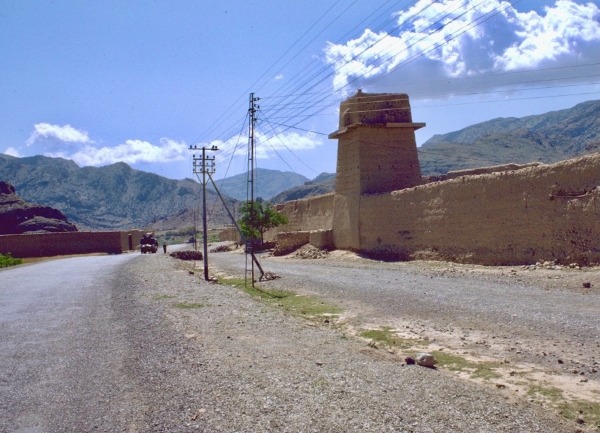
The famous Khyber Pass
Not impressive at first but later as I stop to take pictures some hostility. Frontier not too bad. $10 insurance.
[I arrive in Kabul.]
I’m looking for milk in Chicken street. The shop sells yoghourt, sausage, bread and milk. “Have you got fresh milk?”
“How much do you want? A glass?” I hesitate.
“Two glasses?” A pause.
“No milk,” he says and turns away. Not physically, but I cease to exist.
“One glass then,” but he is not aware. He walks through me, very close, to argue (is he arguing?) with a man across the road.
“But you said . . .” and he’s in full spate. On the doorstep I turn to face him, to make him pay attention. Impossible. I am not there. What a strange power. I’m outraged, indignant, humiliated (so often) I could hit him. That’s all. There seems to be no other response. Hit – – or run. I run – – at walking pace, reflecting, trying to overcome my seething resentment. On my bed, lately infested with bed bugs now lying on their backs below and still feebly brandishing their limbs, I am thinking about the uses of power. Should a person develop all his capacities to the full? Then power, backed by the threat of physical violence, is one of them. (At the same time, disturbed by the litter of things around me I am fiddling to reduce their number. Why does it make me uneasy? Am I occupying too much territory? Am I afraid of retribution for this aggressive act? Or am I afraid that if I’m attacked I shall not be able to get my things together in time to escape? I would have to stand and fight. Same thing, fear. And as I think about it, I know it, because I feel the dread adrenalin.)
What if the use of violence is denied. Does that mean there is no power? Think of the legless cripple on the highway. What power he had, on his trolley, laughing in the face of the world, taunting it, defying it to do him more damage. The power in his face, square, lined, cut to short bristle.
And the other, of Pondicherry, like the stillest black hole on the pavement, sucks the whole universe in.
Suddenly I’m excited by what these two cripples offer and represent. Power and love, though both are denied any physical means to fulfill what they express or attract. Everything could be said in terms of these two. Did I really understand Grass? [Gunter Grass?]
At last all the parts are together. I’ve said goodbye to Carol, expecting to be with her again in Europe, and I’m ready to leave Delhi for the border.
From Delhi, May 5th
Sprocket, chain and tyres on. Try to flog old parts, in vain. In State Bank involved in dubious transaction with Frenchman, who wants to double his cheques by losing them. I get what I want – unless the dollar bills are false. To Carpet Co. and Mani Prabakhar. Pay $40 deposit on carpet. Etc. Now midday. Undecided at house, I hang about a while, then pack. Hariom and Kari arrive and closet themselves. I decide to go.
Two awkward farewells. At 3.30, on the road. A last injection of 93 octane at the flyover. By 6pm I’m 90 miles along the highway and breathing again. Stop at Chatravarty Lake Tourist complex. Shunted from the far side of the road to the “Tourist Oasis”. Here a tent (big one) and bed with linen for 5 rps.
Buy a fresh frozen fish. Cook rice. Drink beer. Feed myself (and dog). Sleep. Get out. Sleep again. Get extra cover. Sleep again. All OK. Puri for breakfast. Leave at 9. Ride fast. Have three narrow escapes with buses. Driven off road on both sides – and forced to fall by rickshaw driver. Feel a destructive resentment working in me – and realise I must cool it – or die. Take a rest and go on more sensibly. Amritsar at 4pm.
I’m resisting all impulses to digress, to Simla or elsewhere. Rehearse conversations with people who say, “What a pity you didn’t see Kashmir.” Choose Ed as protagonist. Why? Youth Hostel greets me. Swiss traveller just came through border by bus. So that means OK. Tomorrow I’ll cross.
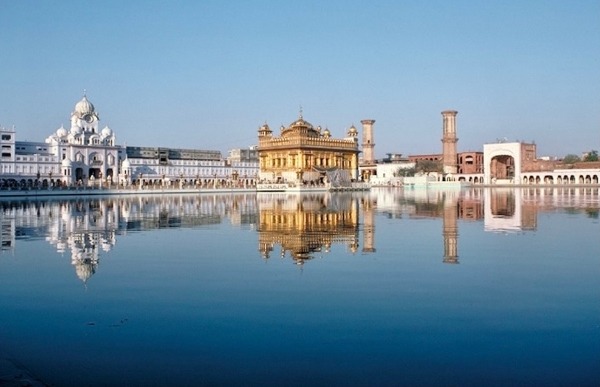
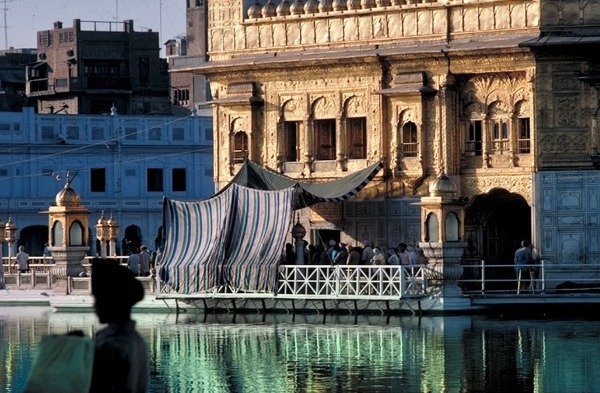
Find rice and beer. Then Golden Temple. Golden casket. Shirted Sikhs with spears, ancient ones with ancient rifles hugged to their chests. Inside, a small group of musicians – singer, tabla, harmonium – are amplified across whole lake and surrounding colonnades. Marble floors, inlaid. All exudes great air of probity, cleanliness, people at home with each other. At diagonally opposite corners, ladies serve copper dishes of ices water.
May 7th, Saturday
Last breakfast [in India]. Two boiled eggs, tea and a wafery bread shaped like palmiers.
To border – passing Emergency signs still planted firmly. [Gandhi lost the election, so Emergency is over.] The one I didn’t photograph: “Save the Poor. Support Prohibition.” Crossings fairly easy. Then long wait for obligatory police escort. He rides in bus ahead of me and it’s to save us from the army, not the rioters. Lahore is deserted but for buffalo herd moving apparently without guidance. Yesterday 2 or 22 people died after a curfew break to visit mosque. Now total curfew again.
We foreigners make a curious crowd in this vast, deserted space. Ted and his Jap. girl can’t find money to change. They’re sent to Intercontinental, three miles, but I’m eager to leave the atmosphere. How lucky to have bought those 100 Pak. Rupees in Nepal. The road is very broad and straight, tho’ seems to be going East rather than North. But it is night.
Stop for tea and get address of a curious man in shiny navy-blue pyjamas. His companion puts his finger on his throat and goes through the motion of the ‘strong man’. Then I get to the Jhellum toll bridge. Have just been planning my night. Flashback to Tahir and M’sud Khan. [Two Pakistani brothers I knew as a schoolboy.] Thought to invade some general’s quarters. But Hamid, the elder of a group of Pathans, takes me in.
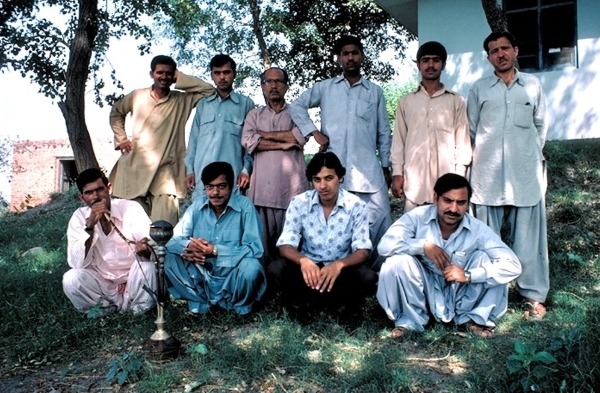
Hamid and the brothers had the business of operating the toll bridge over the Jhellum river. Quite unbidden, Hamid – top right – assumes the job of feeding me and making me comfortable for the night.
Makes up a couch for me. Brings me tea. Prepares bathroom. Another couch outside. More tea. Infinite courtesy. Much quotation from Coleridge, Einstein, Freud, Shelley, Persian poets, copies of “The Psychologist” from 1951. Dinner of roti and dahl. A walk on riverbank. A massage. A bed prepared. Great sense of peace by riverbank. Traffic hardly noticeable. Many birds. Castor oil plants.
Then, once in bed, under net, discomfort grows to an itching catharsis, as traffic roar becomes overwhelming. Eventually, after tossing and scratching for hours, give up. Faithful Hamid is there. He says it’s bed bugs. Prescribes kerosene. Tends me like a patient. Change beds, bedding, and at last sleep.
That book of Materia Medica by Adolphe Lippe MD. Calcutta 1935.
Last night: “How were the inert gases discovered? What new discoveries did this lead to? Where is God? I say that God keeps moving. In the 19th Century He was in chemistry. In the 18th in botany. Where is he now?”
Hamid is [like] an Irishman. “Now wouldn’t you say, Sir, that medicines are very dangerous? Where did you get this mosquito net. Sir. It is very marvellous. I have never before seen the moon in so many colours.” And I was expecting to be asked how much it cost! Goodbye India.
He said he hit his head many times as a child, which damaged his memory. He can’t recall his first five years, and this is a compelling urge in him. Studies homeopathy and natural medicine.
Next week: Back to the beginning.
Most of us “developed” people are in record breaking heat waves. Every single oil-producing state is ramping up production. I watch the human race committing suicide, and I am powerless. Might as well rob a bank. Thank goodness I’m 94.
The election is over. Indira Ghandi has gone. The Emergency and its regulations are over and profiteering is back in fashion. Meanwhile I’m in Delhi, waiting for news from London, waiting for parts (including a new sprocket without which I can’t hope to get home). Anyone who has travelled a longtime through dodgy parts of the world will know the demands made on patience. Usually I prided myself on being good with that, often turning delays into advantage, but this time lost my famous composure. Increasingly it seemed likely that the frontier with Pakistan might be closed, making it impossible to leave. As the temperature rose, I tried to keep my cool.
April 19th
Today got hold of a little theme – Survival of the Fittest – but for what. For selling to suckers at the highest price. Wills Flake Filter now up from 1.50 to 1.75, but no reason. Just that the change of Govt. gives license. Papers report that the trains are no longer running on time. “Chain pulling” is the reason given. Ticketless travelling on the increase, now that ‘Heavy Penalty’ no longer includes sterilisation.
Last night Ricardo and Sharafat played ragas. Tonight a TV recording session with Alikhan. In spite of this I wish I could get out of Delhi and on with it. Trouble in Pakistan is mounting. I’m eager to go.
[“So how do you like my India” – Agra]
[“Dear gentleman, this is India” – Sombalpur – Raipur]
Begin composing letters to my sponsors but decide to leave it. If I never heard from any of them again I’d have to look after myself anyway. Why make strife? So at Alikhan’s a called Lucas and there’s a cable about a package at Indian Airlines.
Recording (taping for the satellite) is pleasant but long-winded, and technically dull. Getting a feeling of the group now – Kari, Hariom, Kalidas, Sharafat. Saw Alikhan lose his composure for the first time, in our driving back, he was obviously in a hurry. Then the tabla player needed a lift to a taxi. We nearly went under a truck (well, I thought so) and later he went in opposite direction. I said I was going to a restaurant and regretted it when I was asked to eat at his house. Thoughtless of me. Silence is better.
Why didn’t Davies write a letter? Where’s PH’s letter? Why no word from Triumph? These things still mystify me.
April 20th
Pursuit of the package. There isn’t one. When it comes the airline will inform Lucas. The day passes in telling each other what we will do and what we have done. & the plot has grown to include a school friend cum customs agent. A letter to PH via B.Airways – cannot reach him before Saturday, meaning Tuesday. As I write this I plunge once again into the whirlpool of speculation, doubt, despair, defiance, anger, which wipes out all tranquility. I am full of ultimati, pronounciamenti, manifestos, and I always in my mind end up by marching off stiff-necked and bitter to my solitary destiny leaving all this useless human riff-raff behind.
Now this is a common problem with the ST, etc, but that alone doesn’t account for the number of times I find myself, in daytime contemplating the satisfaction of hitting someone hard. Usually the target is a motorist of some sort who I imagine is threatening my life with his folly. But I notice that when a lorry driver really does threaten me, I don’t waste much time concocting fantasies about him. The cathartic nature of the event seems to discharge the energy that fuels resentment.
Why am I so full of distrust and bitterness towards others? Because they won’t behave as I believe they should. Why is that? They don’t respect their obligations towards me. Why don’t they? Because they have lost interest in me, don’t care, think I’m foolish, lightweight, unimportant. If any one of them flatters me, pleads for my indulgence I offer it immediately and feel like a king. I’m less interested in positive results than in maintaining my self-esteem. The process brings constant anxiety. To protect myself I reduce my dependence on others to a minimum, which leads me into an unconventional life. This makes me more interesting to others and my ego receives a boost all round, but I can’t live as a hermit, and the fewer people I depend on the more intensely I depend. And eventually I’m undermined by that same fundamental hollowness. I have no sense of service to others though I have talked about it. (To Jo. eg). My mantra has been that what’s good for Ted is good for the world. Eventually others are forced to disagree.
A kite circles in the sky, a grand night, a great bird. But the kite is preoccupied by the pursuit of carrion and is harassed and irritated by small birds and parasites. If it could fold its wings and never fly again it would do so. If it could become a chicken.
At Delhi airport. Note the ancient Sikhs, like Father Christmas, driving taxis and scooters. They race along. Have been doing it since the motorcar was invented.
The airport/flying game is the biggest toy we’ve invented. It stretches us beyond our limits.
Some reflections suddenly about my journey, visualising the earth’s surface as I experienced it, without aid of maps or altitude figures. What does it matter if the Andes are at 12,000 feet. They are just very high. The way to travel is to go and ask along the way. The world unfolds from day to day, not as a preconceived journey to a tourist brochure. What have I gained from visiting the hallowed shrines of tourism? And when it comes to man-made marvels, better one Iguaçú than 100 temples. Even that unknown cascade near Eden overshadows the Taj. Certainly a great part of it all has been to set my mind at rest that there are no transcendental marvels that by their existence/presence change one.
Why do I resist describing the evil people do to each other, that is the cruelty of callous indifference or intolerant zeal? (i.e. Emergency excesses, Brazil versus Indians, etc) because I take it as an inevitable matter of fact. Who since World War can doubt what people are capable of? But the good people do, that surprises me. That’s worth talking about. And conditions which favour or deter human goodness are of supreme interest.
And the evil? Springs not from the heart but the mind, disturbed by the family, or lack of one.
May 1st
Carol goes to Agra. I sleep. Wake up. Go to Roberto’s. Michele and Bernhard are there. M&I engage in a Franco/English breakfast chat about politics and the role of the left in the new situation. I am totally devoid of interest, ideas, energy. None of it makes any sense to me. Am I as exhausted as I feel, or is it only the subject matter? What do I know about Indian village life? After all these months, nothing. And I don’t think M does either.
Endless time in Dehi does not pass, but revolves, the same time again and again. The weather builds to a torrid climax and breaks into daily thunderstorms.
The first break in the deadlock with England comes on Friday 22nd, after I have written, telexed and phoned to all and sundry. A cable from PH: The tyres are on Air India for 24th. On 23rd we talk and I let it flood out. He promises to get it all together. Now I discover that Meriden has used Air Parcel Post. On Monday morning the Foreign Post Office – a fruitless search. On Tuesday, at Lucas, the Waybill Number. Then Carol’s cable that she flies in that night. At first I’m horrified. The complications now seem overwhelming. Where will she stay? A-114 is under siege by the landlord. I feel I’m only just able to hang on myself. I see that Carol’s arrival will cost money, time and energy that I don’t seem to have. I can’t see beyond it, then in the depth of depression I see that the only thing to do is to enjoy it. With Sekhar I go to the airport – but too late to do anything. One of his school chums makes absurd remarks about getting the customs in an hour. The other fellow, Jagaranan, to his credit, is more sober. I take S to his house – the one that didn’t exist on Sunday – because he told me 8 282 instead of 8-282. Back to Palam and C flies in on the first evening Airbus from Bombay. I do enjoy it.
Days and nights with C on the floor of A-114.
Much coming and going, shopping, visiting, Thunder breaks. Phone connection succeeds. Cool. All seems good. Parts coming airfreight. But again Waybill number fails. C leaves on Monday night. Stormy ride to airport. Tricky but finishes well. I’m almost emptied. Then Tuesday afternoon from Kalidas’ house I get Waybill No. To airport. No sign of package. But I dramatise. At last they [Air India] discover it – having cocked up. Like a last fling at some fateful attempt to frustrate me. Still. Customs are on holiday. Next morning, Wednesday, I get my package, in two hours, sweating through every stage.
Sharafat’s father has arrived. Now very fragmented at house.
26,300 miles. Oil changed at 26,000.
Next week: To the frontier.
After I’d broken my leg in Kenya in 2001, I had to find somewhere in Nairobi to recover from the operation and I was helped a lot by Christopher Handschu, a German biker, tall, blond and dyslexic, who had settled there. He gave me a bed and helped me with work I felt unable to do myself. Here he is, on the ground outside his place, but 24 years later I’ve forgotten what it was that needed fixing.
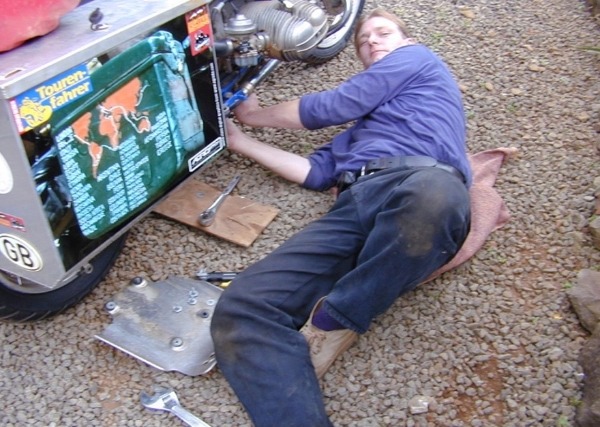
Christopher Handschu
Anyway, after I left he was able to start a hostel for travellers like me, called The Jungle Junction. I believe it had/has a good reputation. Last week, I got this letter from him.
Dear Simon,
Trust this find’s you well!
And thank you for always sending me your notes from your diaries. A grate way to encourage a dyslexic to read!
Today I would like to ask for your help!
After you leaving Nairobi, we started “Jungle Junction” and we are grateful that we have been able to offer travelers in Nairobi an oasis for 22 years.
Through a Public fund raiser we are hoping to finance the move to new premises, after our lease was terminated.
Would you agree to shear the Fundraiser link on your Mailing list?
Your consideration would be highly appreciated.
Thanks in advance Christopher Handschuh.
=-=-=-=-=-=-=-=-=-=-=-=-=-=
Jungle Junction
Langata – Karen/Hardy
Kongoni Road (JJ’s)
Kenya – Maps Google: http://goo.gl/maps/XyHxO
S: 1° 21.767″ E: 36° 44.438″
+254 (0) 722 752 865
=-=-=-=-=-=-=-=-=-=-=-=-=-=
So I wrote back saying I’d like to help, and he replied:
Thank you Ted, for your positive response.
I would not ask for assistance, if the situation would not be dire. It is hard for me to aske for Help – on the other hand i will not give up without a fight.
Sorry for the late response, was in bed with the Flu.
This is the link to the fundraiser. https://www.mchanga.africa/fundraiser/118438
Attached kindly find accompanying letter.
Your affords are appreciated, and if you have any suggestions on how to broaden the fundraiser, would love to hier them.
Kind Regards,
Chris Handschuh
=-=-=-=-=-=-=-=-=-=-=-=-=-=
Jungle Junction
Langata – Karen/Hardy
Kongoni Road (JJ’s)
Kenya – Maps Google: http://goo.gl/maps/XyHxO
S: 1° 21.767″ E: 36° 44.438″
+254 (0) 722 752 865
=-=-=-=-=-=-=-=-=-=-=-=-=-=
And here is the letter:
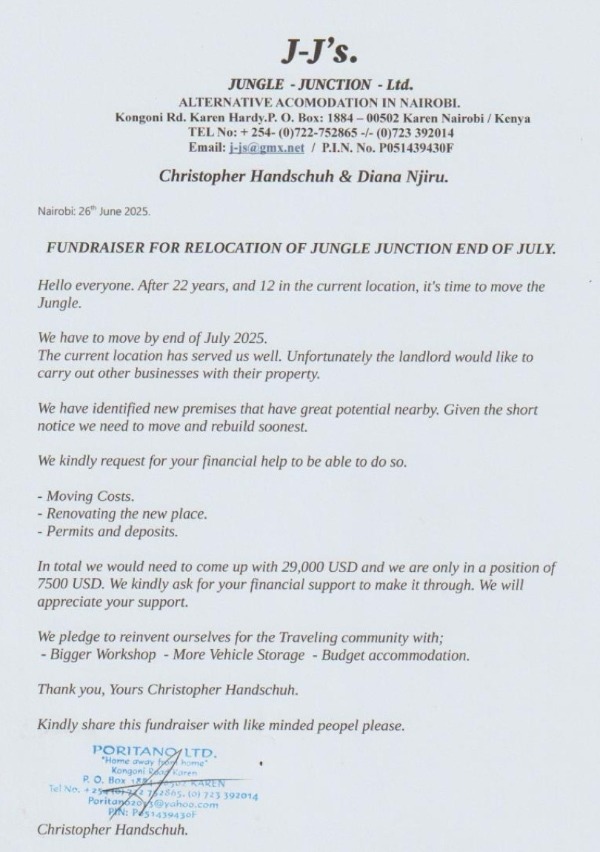
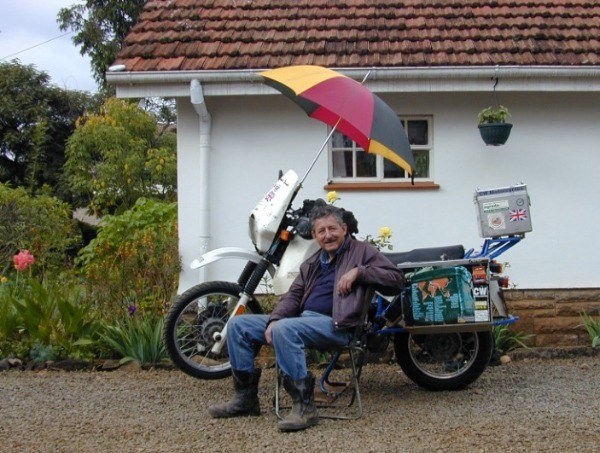
Outside Handschu’s home in May 2001
Thanks. See you next week – through the haze.
After witnessing that horrific tragedy of the girls under the cartwheels, I go back to my hotel.
April 10th, Agra
At Shiraz Hotel the chickens hang by their necks like small people under a neon tube over a little stage decorated with pink tinsel. Fish, chops, sausages, all smeared in the same pinkish paste, laid out below chickens. Sikhs with rosebud mouths mix beer and whisky. What would the Sikhs do in prohibition? After eating I want to wash my hand – I carry my hand – there’s a loo and a washbasin. A man is standing in the doorway aiming a jet of urine at the lavatory bowl. He sees me standing there uncertainly.
“I am making water,” he informs me. “You wish to do so?”
The whole of India seems of a sudden funny and ludicrous. And if it should cease to be funny, God help us.
The income tax employee at the tea shop, in ecstasy because “our rights have been restored.” He was [had been] in Australia. Apart from minor differences of custom he sees no difference between Australians and Indians.

On the road to Delhi
April 11th, Delhi
Arrived today from Agra. First to Lucas, to phone Macarthur, but he was going to Lucknow. Baroda [The Maharajah: I had an introduction, after sleeping in his palace] was due in the following day.
So I went to A-11 [Amjad Alikhan’s house] and found it as I’d left it. The concerts had been cancelled again, but as luck would have it there was another that very night. Not till I arrived did I understand that it was arranged by a set of Sikhs called Nandaris who consider themselves the only pure ones, wear only white (colours are profane) and are great patrons of the arts. Their Guru sits on the stage on a red rug (apparently plastic) with his elders ranked behind him all impeccably white with a splendid array of beards (unbound). Behind him to his left a barrel of [illegible] sat with a long white horsehair fly whisk. He held the brass ornamented handle against his right shoulder, frequently whirling it above and in front of the Guru’s head (though there were no flies, of course) and gazed at his master with evident rapture, seemingly oblivious to the music. An oriental court.
Two brothers sang, and how wonderful to encounter, at its very best, ways of using the human voice which one never dreamed of. Human versatility seems endless, and the variety of ways we find to express our emotions infinite.
Alikhan broke a string in concert, and again I was astonished at his composure in fixing it – but realise now that nervous anxiety is such anathema to Indian music that it must be got rid of very early in the game.
Hariom and Sharafat are being very nice about taking me in. My main problem is that I can never get our plans straight. One vital factor is always missing and I, at one point, got quite paranoid thinking I was being deliberately misled. In fact, there is a tendency for people to tell you as little as possible and not to anticipate your needs. So you may be invited somewhere, but have to ask for each detail of where, when, how, with whom, etc. If this happened in Europe you would have to conclude that the invitation was not meant, but a polite fiction only.
[I have to assume, at this distance in time, that I did somehow convince myself that the invitations were genuine.]
April, 17th
A nice day doing nothing with Kalidas. (Oh, I fixed my steering in the morning, discovering that the handlebars were wrongly set). We went to an art gallery where one of his father’s paintings was displayed. Liked it. A very fat man lay on a daybed, having his legs massaged. He looked up at me, gleaming, and said, “How are you? What are you doing these days?” He beckoned me to the couch as though inviting me to join the massage. His younger brother later appeared and said firmly that it was cheaper to travel by cargo boat than by plane, though of course you then had to pay for your food. All nonsense, but he had to have something authoritative to say and brooked no contradiction.
They were all retailing the political gossip about Sanjay and Maruti. Evening at K.D’s house. We talked and smoked, then “Come. There are some people you’d like to meet.” His father, a single man, and a couple. The second man was most wearyingly affected in the academic manner. They made the barest of perfunctory remarks to me, then talked to each other in Hindi. An exercise in patience. Later, the Don made the most excruciating remarks about the father’s painting as he showed them. The paintings were pretentious. He himself was commendably silent. The food was excellent.
I like Kalidas, he’s young and articulate, but spreads himself very thin. At the gallery a man with breasts came in – he belonged to a sect which castrates itself. But his voice was very male.
Delhi, April 18th
Last night I dreamed it had snowed in Calcutta. I went to scoop up some snow to drink thinking, Ah. Pure water – and had put it in my mouth before realising that only the surface was white, below it was coal black – I understood that it had absorbed all the dirt in the air. It was not specially disagreeable. There was another dream in which I lusted mildly and lovingly after a girl with prominent breasts which she presented even more prominently in a special sort of bra. But they only acted as labels, as it were, denoting a particular type of cool and comfortable personality which I I’ve often thought might be easiest for me to live with. But they have never shown themselves to be particularly interested in me. In this dream she was comfortably involved with someone else. I was merely the voyeur. There was another sequence involving something floating in a lake, a table in a tent with a tiger which was supposed to submerge itself occasionally and some man who was professionally involved with this phenomenon was urging us (me and who?) to witness it. We did and something went wrong with the tiger, but I don’t know what. I was also at the counter of a bank (one with windows) having my tongue examined, again with some warm female companion. My tongue was heavily coated, sand I went into a sort of whirling delirium, waking up to find that Sharafat was playing a skirling sequence on sitar, as practice.
On different days I have: Reset tappets (loose!); Tried to stop rocker box oil leaks; fixed steering head; cleaned spare chain; oiled cables; changed oil. A nasty rattle on deceleration from chain case has me worried, but more oil in there has mostly got rid of it. Was it just dryness? Nervous now about transmission. Also reset L.H exhaust pipe.
Peter’s promised letter still not arrived, but Gopi writes to say Carol will return there on 21st.
Daily visits to Sweets Anil at the D.C. Market for little snack, Lassi and tea. Bothered by a semi-permanent sensation in the bowels – not an ache, just a presence. Not quite right since Ranchi.
Reading Miller’s Nexus. A bit disappointed.
News Flash: Ted Simon isn’t perfect after all. Next week, true confessions.
I’ve left the East Coast and started my journey back to Delhi. It’s April and already very hot. At first I found it was only bearable to ride some parts by night, a risky enterprise.

Amjad Alikhan’s student playing scales on his sitar
April, Jabalpur
There was a sprinkling of rain last night. Now, after Seoni, a full scale thunderstorm at dusk. And with the dirt shoulders of road wet more trouble with lorries, and one wild skid which leaves me miraculously vertical, and the curious mixture of relief and indignation. I write this after a good night’s sleep. I feel the fatigue in my arms.
In Jabalpur a beer behind a wine store with some Sikhs, and a late comer who is overcome by emotion. Shows me two addresses in East Ham and pays my 14 rupee bill. I admire this ability to make passionate gestures on the spot, though I don’t suppose he expected me to leave so suddenly. Another fellow on a scooter talks about the farm he has bought as a hobby, and how he plans to train monkeys to shoo off neighbour’s cattle. He talks fondly about Australia.
I feel quite woozy after the beer, but once again I find that as soon as I’m in the saddle my mind and body settle easily to their task.
The book assumes a sort of structure –
Africa: The exorcism of fantasies and fears, and a new basis for equilibrium in the world.
South America; A testing ground for newly discovered strengths, physical and psychic.
North America: A flowering of qualities leading to new indiscretions and tests of a different kind.
Australia: And back into the world of opulence and corpulence and “couples” – both easy and impossible.
S.E. Asia: Nemesis. Collapse of the myth, and beginning from scratch, but more carefully and with a better idea of resources and possibilities.
India: And the beginnings of a conscious spiritual structure.
Leaving Pithora a bit hastily (if it hadn’t been for the argument about money I might well have stayed the night). At Jabalpur I realised I’d better go to a hotel. The Sikhs sent me to Clarkson’s (should have guessed) and the gentleman farmer led me there. I was so besotted by the Sikh’s 14 rupee gesture, and tiredness and folly that I didn’t ask the price of the room.
Even if it’s 25 or 30, I thought the 14 rupees would take care of it. Even when the bearer switched on an air conditioner I didn’t suspect – it made such a ghastly groaning sound that I switched it straight off again. There was a radio and a phone. I was lucky they didn’t charge 145. As it was 45 shocked me. The breakfast scene was a long room, with Indian businessmen throbbing with self-importance, and giving me the glare which to me still means “How can such an animal have got amongst us?” Are they all imagining me, like the Indian singer in Illustrated Weekly (1st week, April) wiping my bottom with paper?
After arguing 5 rupees off the bill, set off into the rain-cooled air. The monkey trainer had promised to visit me before office but failed to appear.
First part of journey to Katni ordinarily pleasant. After Katni road became a minor one which struck off across a deserted, rocky scrub – very empty and hot-looking, though air still cool. Unhappy about the bike, so thoughts of a breakdown here. Have water and rice. For a moment I think, “You can perish in India.” It’s a joke.
[Dating back to Australia: “You can perish in the outback.”]
In fact, it’s a beautiful landscape, rust and dust coloured, rising and falling, savannah really. A nature reserve apparently. Halfway, at Pappai, stop for tea. Nice tea-house scene. One old man holds forth, giving an imaginary account of me and my travels. Others watch me avidly, but with less grasping curiosity than in towns. Some respect is still there. The man next to me, in white shirt and trousers, speaks English but won’t. After a little he gets up and sits somewhere else and ignores me in a rather obvious way.
Khajuraho

A profusion of eroticism clothes the walls of the temples at Khajuraho
Three groups of temples, airport, 3 smart hotels, a village. PWD etc, and Madya Pradesh Hostel. Sleep on grass. Meet Liz McCloud (Dorset and Cambridge) Two visits to main group of temples. B&W at 64ASA. Irritated and stimulated by Texan Simeon – “Jumping Jack” who produces a pure Ayn Rand philosophy. Difficult to argue with logically. Why? The flaw is the same for all ideal systems. They don’t correspond to human nature.
Touched by group of laughing women anointing their idol with pigments, flowers and water, chattering and singing. Very innocent.
Agra, Sunday, April 10th
Arrive just before a rainstorm. Bike rough again. NB: Famous worries about steering head races unfounded. All dealt with by dabs of grease under the steering head lock. When I think of all the jarring, ratting and jerkiness I’ve endured all these hundreds of miles.
To the Taj. Yes, it’s beautiful. Most impressed inside by the sounds that swell and fade in the dome – like a million sad whispers adding up to a cosmic sigh. It rises and falls, it seems, almost independently of the level of noise at ground level, yet any particularly loud voice is heard briefly above the other echoes before sinking into the common pool. People come in determined to make their mark, young men drunk with power, young women drunk with hope, and where they would chisel their names into the marble if they could, they fling their challenge in the air. And immediately everything that was sharp, personal, assertive in the sound is lost and it becomes a mournful ghost joining the legions of ghosts. This phenomenon has very powerful effect on me.

Leaving I pass round the edge of the enclosure, colonnaded galleries in red stone (someone, I see, quarried south of Panna). Quantities of stone slabs are stacked and masons are cutting new panels to reface the galleries.
Walking back to fort. The fort is closed because 120 ministers from foreign countries are visiting. Asked Army official and was surprised to get answers readily. Were they army or police?
Do we also close these places to public for visiting dignitaries’ sake? I suppose we do. Just an annoyance.
In town, walking in bazaar, ox carts, horse carts, hand barrows, cycles and rickshaws, m/cycles and pedestrians thrash about. One horse-drawn cart was moving with more pace and noise than usual. The driver, a young man with patterned red cloth round his head, tunic and lungi, was looking pleased with life. His cart was heavy with men and sacks of grain but his horse was bigger and more temperamental than the others and he was forcing a dashing pace up the hill through the crush. The horse was tossing its head from side to side, twisting between the shafts.
I don’t know how often it happens. Three little girls, hardly two feet off the ground, dressed like old-fashioned dolls, clinging together, fell in a bundle under the cart wheels. I watched the wheel rise up and rise onto the bodies, all three of them, and then roll back. Astonishing and shocking sight. Men came from the shops to pick the girls up. The driver got down and literally raised his arms in supplication to Allah. His passengers hurriedly paid him and faded away. Two of the girls seemed able to walk. The third lay in a boy’s arms, with bright blood rising from her mouth. An adult man was telling the boy to do something. The boy just grinned as though he thought the whole thing was foolish. The man shouted and gave him a push, and the boy went up the road, none too quickly and still grinning with the small body. Later, outside the Dipty X-ray clinic I saw another man take the girls and ride off on the back of a scooter. What chance, I wondered. There are so many of these tiny bundles of humanity living their lives down there on the street surface, far below adult notice. How many are snuffed out like that. Mustn’t exaggerate. Can’t quite grasp the essence of this event. Something extremely familiar, natural or right in that wheel on those small bodies – as though it were potentially present all the time and I just happened to see it then. Something in that phrase “an accident waiting to happen.” There have been cartwheels and little girls in long dresses for so many thousands of years – an automobile accident is science fiction by contrast.
Next week, to Delhi and on the way out of India.
Thanks for your help with the French edition. It is now available to buy on the website here.
(Scroll down for the English translation)
Enfin, Les Voyages de Jupiter est de nouveau disponible en Francais, et vous pouvez l’acheter ici, sur mon site web. Cette traduction a été publiée pour la première fois par Albin Michel en 1980, avec un grand succès, en grande partie grâce à l’invitation de Bernard Pivot à son émission télévisée emblématique Apostrophe. Le soir suivant mon passage à la télévision, j’ai dîné dans un restaurant près du Panthéon et, lorsque je me suis levé pour partir, presque tous les clients du restaurant m’ont applaudi. C’est le moment où je me suis senti le plus honoré publiquement.

Le livre comporte 598 pages, avec une préface de l’éminent historien Claude Manceron, qui était, par hasard, mon voisin à Saint-Privat. Il comprend 32 pages de photographies en couleur.
Il est disponible directement auprès de moi, signé et dédicacé si vous le souhaitez, pour 29,00 euros, affranchissement compris, en France uniquement. Pour l’usage de ce site, le prix serait exprimé en dollars US 35.00. Si vous habitez hors de France, ecrit moi directement a tsimon@mcn.org
At last, “Les Voyages de Jupiter” is back in print, and you can buy it here on my web site. This translation was first published by Albin Michel in 1980 to great success, largely because Bernard Pivot had me on his celebrated TV show “Apostrophe.” The night after I appeared on television I dined at a restaurant near the Pantheon and as I rose to leave almost everyone in the restaurant applauded. It is the closest I have ever come to being publicly honoured.
The book has 598 pages, with a preface by the distinguished historian Claude Manceron, who happened to be my neighbour in Saint Privat. It includes 32 pages of colour photographs.
It is available from me, signed and dedicated if you wish, for €29.00, postage included, in France only. For the purposes of this site the price will be expressed in US dollars 35.00. If you live outside France please write to me directly at tsimon@mcn.org
Once in Calcutta I made my way to the Salvation Army Hostel, known as the Sally-Ann, by recommendation, where I made friends with Jacqueline LePrince from Paris and Eric Hansen, from San Francisco who had been helping at Mother Theresa’s home.
[Eric wanted to take spices home, so we went to a spice firm and said we were thinking of importing spices. We were given several large bags as samples and were shamefully pleased with ourselves.]
Spices from: K.C. Dutta (Spice) PVT Ltd, 255 M.D. Road, 2nd floor, Calcutta 700. 070
Prices: Haldi. (Tumeric) 9rps/kilo: Dhania (Coriander) 11.5 rps/kilo:
Jeera (Cumin seed) 29.25 rps/kilo
Slight fever back again. Compared it to having two images out of focus, as in bad colour printing – “out of register” – sense of there being two simultaneous existences which have shaken loose. The body turns, but the soul lags behind. The whole idea of soul leaving the body at death might come from that. See page 31 [Staying with Adrienne] Go on from this to other forms of detachment.
Tagore writes about the spiritual tradition of Ancient India, the pursuit of purity. Leading to the discovery of the one-in-all, and the release from self. He speaks of India as though she were uniformly devoted to this search. Observation, alas, contradicts this idea, at least today. It may be the best place to go and lose ourselves, but the majority here are clinging as tenaciously as any to what little they have, and to their traditional forms. The easy fatalism of a once luxuriantly forested and underpopulated land has led to the present predicament . . . . .blah, blah.
Pithora PWD April 6th
Calcutta was hot, sticky, and I never really got used to it. The explosion in my belly from the lunch before Ranchi is followed by an even more unpleasant immovability. (I over-reacted with the Lomotil. Should have left the beautiful machine alone). So I did very little in Calcutta except let Jacqueline LePrince trail me about – she made several remarks about my docility. There was the futile excursion to Tagore’s house, and Bel [??????] Moth where all we achieved were some chores at the tailor and the railway station.
There was the enormous steak at The Other Room, too big by far for my poor stomach.
The [Military] Tattoo. The ridiculous queues and the even more ridiculous battle for survival once inside – while dogs jumped through fiery hoops, and while motorcyclists dared death. Also two days at Lucas and an oddly equivocal Raj Pande [Boss previously met in Assam.] (who could I suppose be having trouble at home).
Mother Theresa’s Home for the Destitute and Dying makes you wonder why you didn’t start one up yourself – until you think about the beginnings of it. Now it’s rather better ordered and more pleasant than the average railway platform. Tube and plastic beds, raised on the left, floor level on the right, very close together, much smaller than I pictured it.
Rick Eager, who lost himself to two Nepalis, and whom I lent 250 rupees. His involvements with Calcutta police, which I heard about from Eric Hansen in Puri, so many passports stolen, so much dysentery.
And the Sally-Ann “big nurse”, married to a Misi tribesman, with daughter, who has a poor opinion of world travellers, and wishes she could get back to working with real children.
The silly proprietress of the two-star Fairlawn Hotel, and the incredible scene over the soda water. [I was disappointed because there were no bubbles. I pointed this out. She threw a fit.]
“Nobody has ever complained about the water before. And you’re not even staying with us. There has never been any sickness from water. We get it from the Saturday Club.” (The clincher).
She managed to go on for quite a while but said no more. Oh yes, “My husband was a regimental …something or other.” So obviously the soda water has got to be OK. I could go upstairs and complain to him she said, heatedly, but her staff politely deflected me.
Next day the bar was closed “for a dry day.”
Was glad to get out of Calcutta, without having really experienced it, neither its enormousness, nor its detail.
Howra Bridge is rather awful. On the way out I ran dry and later broke the chain (on the connecting link). Too much heat. Stopped from 12 to 3, and met a somewhat reasonable “science graduate” at a Sikh shop. Had my tea bought for me by a truckie. Almost went straight to Sambalpur, wavered right up to the Xroads, then went to Puri meaning to go to Konarak. Glad now I didn’t. Slept most of the time (between trying to dislodge my bowels) and fought occasionally with the sea. Had Phil from Milwaukee in my room, a very boring teenager who liked taking things. Jack the Dane turned up same night. Curious blend of softness and violence – still in the pupal stage of conversion. Tends to treat people as mindless – aftermath of self-realisation?
Funny episode in the tali restaurant “I don’t approve of Fanta and Coca-cola drinking,” when I couldn’t eat the lunch he had offered me.
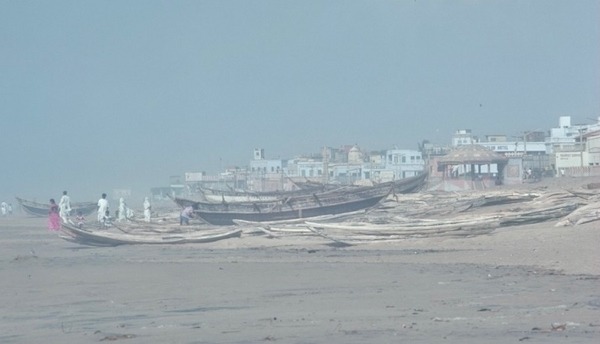
The beach at Puri – before the cyclone
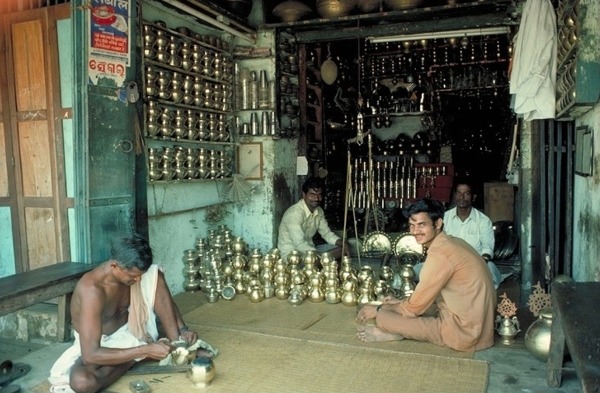
To Konarak on Monday. Bought brass.
[I bought two brass balances: up to 500gms + weights, 65 rps and 250gms + weights, 40 rps. Don’t ask me why; I still don’t know.]
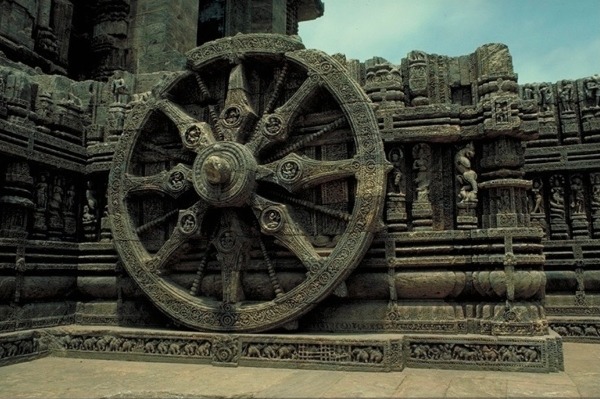
The original Jaganath – at Konarak
Short but worthwhile visit to Sun Temple. Eric in the IB. Then all night ride to Pithora.
Left Konarak for Delhi with 24,400 miles. [Reading on the clock since Los Angeles.]
More thoughts about the book. “You’re a real man,” would lead to personal doubts about sex and gender. Must be careful not to make gratuitous confessions. Thoughts about how an environment – say a TV studio – conditions behaviour. A saint could handle it – I guess that’s a reason for practicing austerities in the forest. Coming to India is a contemporary equivalent for Westerners, though the austerities are thrust upon is.
Have had the horrors about this cross-country ride. The journey to Puri made me realise that it was already much hotter in central India than I’d thought possible at the beginning of April. Air is superheated. Faster I ride the hotter I get. Like air from a blast furnace. The rear sprocket is a toothless mess, and have forebodings about the bike. Tyres are getting close to bald, specially front tyre. Often my mind conjours up clairvoyant’s prediction and I use them to crystalise my anxieties. Forget who put it into my mind to travel at night, but now it seems the only way. Thus breaking a rule for the journey. My sensitivity to the bike is extreme. And I imagine variations in sound and feel. A tinny quality to the engine sound, Hollow rattling in the transmission. And an alarming wobble at slow speeds as steering head deteriorates.
What is there to occupy the mind at night – for the mind craves occupation. Inevitable thoughts about the future, and much struggle against expectations. But generally I’m keeping my mind on the job. No serious lapses of concentration. Bar one, when I was too intent on reading a milestone to notice the big rocks laid out on the road. Hit one and am lucky, though wheel rim is bent somewhat. A million diversions on the highway – for culvert construction – driving off into sandy hollows.
On second night, after Pithora, stop in Raipur and drink lassie with two student eye-doctors who insist on paying. Raipur has an impressive look about it. A little further on is Bilai – biggest steel works in Asia, spread out below me from viaduct. Occasional hellish glow as slag is tipped.
A new cinema hall stands brightly in the middle of nowhere. – all the promise of the old Odeons in the Thirties. A while later, stop to rest by roadside. See one rear box hanging crazily by one rubber mounting. The patent lock had sheared off. More trouble in store. Don’t have the wit to remove the broken part which later shakes off. Much trouble with lorries on the narrow sections, particularly with lights. However, making faster progress than expected. Over 500 kms each night brings me to Jabalpur on Wednesday evening (after a day stop at Seoni in PWD [Public Works Department bungalow] where I argue about 8 rupee bill and pay four after ostentatiously “closing the book”.
Also, the Care official there, who says, “We are helping the Govt of Maharashtra to set up a nutrition programme.” He is a good advertisement for nutrition; sleekly obese.
“You are from?”
“Do you mean today, or originally?”
“No, no,” he says, irritably. “You are from?”
How could this mean anything but “Your native place?”
My impromptu train ride to Delhi from Gaya to listen to Amjad Alikhan play his sarod in concert was frustrated when the concert was cancelled. Trying to make something of all the effort I decided to first take the train to Benares, before returning to Bodghaya. Benares, also called Varanasi, is the holiest of Indian cities on the Ganges.
Monday 14th (The Ides of March)
Peter Wells, the New Zealander met at Delhi on the train is an odd fish; super naïve and sophisticated at the same time. Very young, but with the impassivity of stone – no, less life and more despair than stone. Has been traveling a while– S.E Asia, USA, Mexico, Europe, etc. Worked in North Sea. Likes to take risks and defy authority. Says he enjoys it. Races bikes. Was studying biochemistry. Now determined to find out how cells respond to influence of moon, stars and planets. He strikes me as being in a state of shock. I’ve been thinking again about the disadvantages of too ambitious a first journey. One can be too young to travel? He got caught on a bus in Kabul at twenty degrees below with only his shirt. Has been ill ever since.
We wandered around Varanasi together. I was uneasy because I made every decision. He bought a shirt that didn’t suit him (bright tomato colour) and clung to me a bit.
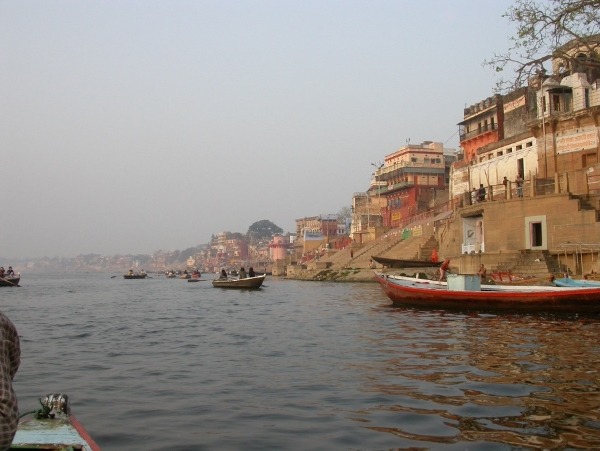
The Ganges at Varanasi (Benares)
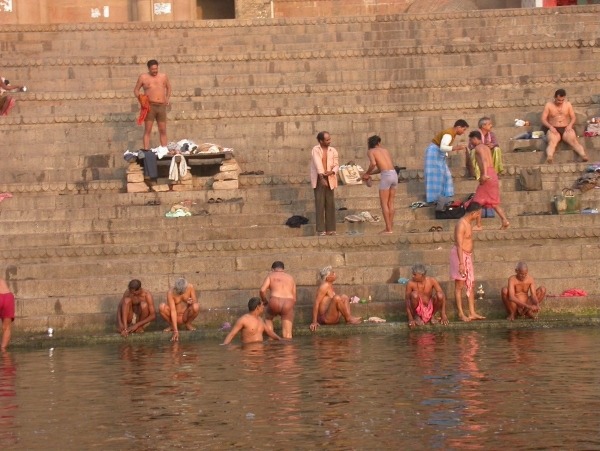
Tuesday 15th
The river boat at Varanasi brought one extremely shattering moment. I see something floating (so much floats; garlands, bits of wood, dead dogs, etc ) Something with a crow sitting on one of its protuberances. Closer, I thought oddly of the knees of a camel sticking up, a ginger colour and hairy. It was a corpse lying on its back, toes, knees and face protruding from water. Crow was sitting on nose and eating the face. Body in attitude of grotesque comfort, lying back in the Ganges. Very moving because it was the materialisation – incarnation – of all the feelings that underly Benares, as though the thought streams met and in the intensity of their interaction caused this body to appear briefly and float past. I thought immediately of Death in Venice – and now I think how often a time or place is infused with secret meanings which yet never manifest themselves. This corpse was the manifestation of Benares. As rare as it is commonplace.
[Peter Wells took a picture of the corpse and, much later, sent me a print which appears in the Penguin edition of Jupiter’s Travels.]
The train to Gaya – perhaps my best Indian train. Crowded, but I was lucky to have the rubber [What on earth was that!] to sit on. Elderly pilgrim couple squatting at my feet. She toothless, stoic, red sari, curled up incredibly small. Knotted into one corner of her sari, a 5 paise coin, which she carefully replaced by a sprinkling of chewing tobacco. He is in euphoric mood, shaven with long whisp of hair on the back of his skull. He has his canes and flags. Once or twice he and his companions let loose great shouts of exultation and incantation. As we rattled over the Ganges bridge, they tossed tiny blossoms from the window and he looked out at the river like one who was seeing his home for the last time, solemn, beyond tears or emotion, trying to fix the moment.
Wednesday 16th
First day of polling in the election. Janata flags everywhere. [Janata was a block of parties opposed to Indira Ghandi’s Congress Party]
Everything is slowing up as the heat grows. Bodhgaya is hotter, calmer. I take the cabin where the quiet tattooed German stayed with the American speaking Oriental girl (the one who had that amazingly trivial conversation with red-haired Deborah over the laundry one day). The second night, when I was less tired, grew into a cavern of sounds and feeling. The beetles were chewing away at the bamboo poles in the roof, sounding louder and more voracious with every hour. The mosquitoes’ whining was intense. I felt oppressed and close to death, felt sure I would die – not in a physical way, but a sort of death of the soul, maybe. Perhaps the ego can only flourish in a temperate climate, where the extremes of nature don’t constantly remind one of one’s fragility.
The East produced the Buddha.
The West replied with the armchair.
Thursday, 16th
Owls swooping into the neon light to snatch a frog from my feet.
Friday March 17th
[I met a Thai monk called Amray who persuaded me to move briefly to another vihar maintained by Nalanda monastery which was joined to the 2000-year-old university of the same name that had been in ruins since 1190. I knew nothing of it at the time. One might say what a wasted opportunity, but ignorance was a price I had to pay to travel through so much of the world.]
Arrived at about 10am. Warm greeting from Amray. The ‘prefect’ is a Laotian ex-monk. He fixes me up with a bed at one end of the prayer hall. Free lunch at the “Thai Kitchen.” Very hot during the day. Many mosquitoes. First evening at 8.30 lying on my bed as monks come in and chant the Sutras for half an hour. Pali is a very melodious language. Very long words, but seemingly succinct. The work of the Institute is carried out in English and Pali. The prefect is very scornful of it. There are three hundred students on the rolls, but only a handful turn up. Lots of them are not even in India. They learn lumps of Pali scripture by heart and get their degree (MA) which is hardly worth anything in reality. Both electricity and water fail frequently.
Reading Miller raises a sympathetic storm in my mind as I stroll round the “cloister,” but the memory fades. Stars are brilliant.
Dogs are an important part of society and in their bestiality and trivial tempers seem to be there expressly to remind us of the perils of bad Karma.
Actually, on another occasion, observing birds, it seems to me that this whole system of grading species according to superiority is a blatant example of the human ego trip.
What would be so terrible about being born a bird or an animal. Actually, the concept is absurd.
What eagle in its right mind would want to be born into the slums of Los Angeles? One hopes that human beings had more dignity in the Buddha’s time.
In afternoon I take Amray to Bihar Sharif [about 50 km away] to get his tax clearance form. It’s a great test of equanimity. Two hours in the office while a Brahmin with a palsied hand and a face engraved with counterfeit cares, fiddles with papers. Two assistants take a tea over the road and buy me one. Talk quite nicely to me. Afterwards I watch him (the assistant) struggling to talk with his lower lip cupped to stop the betel juice from running over onto his paperwork.
[After a few days I left to make my way to Calcutta via Ranchi, where I stopped to have lunch in a relatively expensive restaurant. The food gave me dysentery and I was forced to stop and squat in a field, where I wrote this Ode to Ranchi water.]
The food in Bihar is rather bizarre
You should not stray far after lunch in Bihar
Not even as far as the local bazaar
For none can outrun the food in Bihar
Well, that’s what I wrote in March 1977.
As I told you last week, I have just received copies of a new edition of Jupiter’s Travels in French, and I need to get the word out. If those of you who live in France could suggest the names of magazines or web sites I should contact, I’d be grateful.
