News from Ted
Just like most bikers who have travelled any distance in the last forty years or so I have been well aware of the existence of Touratech.
When I first saw some of their products back in the early nineties – tank bags, boxes, countless clever devices – it was with a very strange and confused mixture of emotions, part admiration, part envy, part regret and part contempt.
I had been riding round the world for four years with none of this stuff, I told myself, and I was proud of having contrived what I needed for myself as I went along with plastic and elastic and bits of this and that: And what about those majestic leather bags, hand stitched in Argentina, that sit astride the tank in the museum today. Of course it’s true that I was happy enough to accept Ken Craven’s fibreglass boxes but still, I would have invented something.
In my mind it was this bare-bones approach to travel that was an essential part of the experience. I was a purist. Just a man on a reasonable bike, wearing recognisable clothes; not a hi-tech phenomenon beamed down from Star Trek.
And then, contradicting myself, I thought if anyone was going to invent stuff to take on a bike through Africa it ought to have been me. I was full of ideas. I should have been Touratech; and then I saw how ridiculous I was being, that the world would go on, with or without me, and I turned to other things.
So when I came to the Touratech Event last weekend, all that history made it especially interesting to me. If you haven’t been yourself, the factory is in an unpronounceable village, Niedereschach, in the Black Forest area of south Germany and is far and away the biggest business there. It was their nineteenth Travel Event, which normally attracts enormous crowds – 17,000 in ’23 I was told – but because it rained comprehensively the entire weekend only a few thousand of the hardiest riders attended.

The hardiest bikers – damp but undaunted
I was invited because I was to be inaugurated as an Honorary Fellow. Being British it’s hard not to laugh, but the heart of the matter is very serious indeed. A strikingly tall and photogenic rider called Dieter Schneider has created something he called the Fellows Ride to combat depression.

The trophy – actually my first ever
It doesn’t surprise me at all to learn that riding a bike is a great antidote to depression, and he organises rides to help overcome what must be a very debilitating state of mind. So even if I couldn’t ride to the event – it was really too far for my scooter – I was all too happy to encourage all those Jolly Good Fellows. Dieter is determined to spread the word beyond Germany and if I can help I will. It’s a Jolly Good Idea.
That was only one of my opportunities to face the crowds this year. I have been enticed to appear yet again at the Adventure Bike Rider Festival at the end of the month. It’s another mammoth event that takes place at Ragley Hall, in Warwickshire. With any luck I’ll have Billy “Biketruck” on the stage to insult me with his fabricated tales of my appalling behaviour. I plan to get back at him this time. And of course I’ll be signing books as well.
I should have been signing books at the Touratech event too. The German translation of my Canary book was supposed to be ready but unfortunately it didn’t get to the printer in time. However, I’m promised that it will make its appearance at the big event, the MRT they call it, in Gieboldehausen at the end of August. I used to go to this meeting regularly, ever since a couple of guys, Ralph and Wolfgang, started it back in the nineties. I remember riding from Sospel, above Nice, to get there in time. I believe it was the longest non-stop ride I’d ever done, around 1,400 Km, and it started on mountain roads in a heavy fog. But I’ve never been interested in endurance riding. I have friends who do “Ironbutt” stuff but, with respect, I think they’re nuts.
And now, going even further back:
FROM MY NOTEBOOKS, Ceduna, Australia 1976
André’s Story
(Word for word, as promised, two weeks ago)
In 1939 he worked in an aircraft engine factory in Paris. (Gnome et Rhone). Then, at least as a skilled man, you earned two or three times what the rest got. He had no father. Was responsible for his mother and family. Lived between Porte d’Italie and Porte d’Orleans. Came war. He stayed at work – reserved occupation. Went on working during occupation. Says the British abandoned France. Promised twenty divisions. Sent only two, and they started the war. Then was trying to escape from romance with an older woman. Took offer of a job in Warsaw. Then another in Russia. Was promised Gaulloises. When they didn’t arrive he protested and resigned. German officer tried to bully him into staying, but A insisted and was given travel papers home via Köln – was even able to visit his uncle there, a POW there, and take him stuff. Then he “disappeared” – – In 1958 he left France in disgust for Australia. Had married a woman, had two children (now both in Australia) but she had mental trouble. Now has no more relations in France. Protests too much. Other reasons for not wanting to go back? In his opinions and personality he reminds me of Papillion’s character.
Next week, the Nullarbor at last.
March 19th to 26th, Adelaide
Our hosts John and Judith Brine were academics who enjoyed our company, as we did theirs, and they looked after us for a week while we explored the city. There was plenty to see but I made only one short note.
Visit to Art Gallery. A quiet mood. Aboriginal bark paintings. The Pleiades and Orion in a T and Oval shape respectively. Some good Australian landscapes, by H.J. Johnstone, John Glover, Heysen, Walter Withers (all 19th Cent.) Some Dutch – a cavalry battle, bulbous white horse glistening like swollen intestines.
Adelaide is the last big city on the south coast before getting to the other side. We set out on:
March 27th and 28th to Laura and Wilpena
Averaging 63 mpg. Spoke gone in the morning. Very brown flat land. Grain silos and sheep trains drawn up at sidings. Big grey and white gums. 50 miles between towns going towards Flinders Range. Melrose seemed a pretty town, just beyond us last night. Hawker was a surprise, but is a tourist outpost, with two grandiose hotels, one now derelict (Grand Junction and Royal) – or were they in Quorn? Will check today. Took wrong road from Hawker for a few miles – under construction. Then 30 miles to Wilpena Pound Nat. Park. Shop. Wine. Stew. Galahs. Sweet-smelling pines and gums. Roseate sky. Walk in the Pound. Kangaroos and babies. Fine woods. Derelict house with graffiti.
March 29th, from Wilpena
Hard ride back to Quorn (Grand Junction Hotel).
[The hotels were in Quorn after all.]
Port Augusta power station, all in smog. Amazing in all this space to see small town in smog. On to Whyallah. Turns out to be a steel foundry (BHP) and almost nothing else. Next pt. on coast is Cowell, another 64 miles. Long ride and turn off on a whim to Lucky Bay. Dirt road. Little row of holiday houses on the coast. Great heaps of sea grass on the beach. Little sign of life. Bed down behind some scrub bushes in the white sand. Grilled steaks, cabbage and potatoes. Perfect bed with net cover.
March 30th
Up with the sun. A man put his gill net out and caught a dozen whiting in half an hour. Gave us two for breakfast. Delicious. On to Port Lincoln. To Cowell, to sharpen knife at butchers. Stopped first at Port Arno where found a man who sold cockles. Then decided to move more slowly round the coast and really do the fishing seriously. So turned off at Port Neill. Quiet holiday resort., Two adjoining bays, one with long jetty. Houses all locked up, likewise caravans, pretty green park, with attendant Scotsman and white tomcat. Spent the rest of the afternoon fishing off beach in rough water but no sign of anything. So went over to jetty towards sundown. Felt a few knocks on the line, but nothing much. Tried the silver lure, but still nought. The Scotsman told Carol there were no whiting here. Only a few Toms – or Tommy Ruffs – which are a small herring-like fish with yellow dashes on their sides.
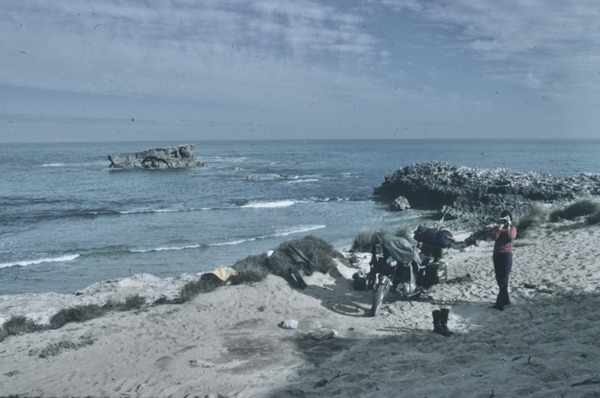
Somewhere near Venus Bay
March 31st, Wednesday
600 miles from Adelaide and two thirds of a pint of oil gone.
First thing after love, i.e. at 7am, to jetty to try again. In first light sea is beautifully illuminated. Can see bait on the bottom (sand among the grass) and also the Toms swishing about. Gradually I learn where they’ll pick it up – i.e, floating and in motion about halfway down and so, painfully slowly over a period of three hours catch four little Toms, and lose two off the hook. But it’s a beginning, and they make a breakfast. We had just finished eating when a young man came to ask if we’d help move some furniture.
“There’s five bucks in it!”
“Not half!!”
The furniture is made of cardboard and is moving into a plasterboard house. Job takes fifteen minutes. Lucky Country.
From Port Neill to Lincoln, long and straight. Huge granary, grain loader, rail head. Spent winnings on a cask of Coolabah and tied plastic bottle on the back. Took wrong road to Coffin Bay but came back to it after eight miles. Big bush fire filled sky with fiery smoke. Sparse, dry country. Scrub. Brown sheep. Coffin Bay, three miles of road, a small town with lots of holiday houses spreading from it. Jetty and series of interconnected bays. We camped on a beach beyond houses on dirt road. Shallow cockle bay. Towards evening, Andy Spiers, the new ranger for the newer Yangie Reserve drove up with wife Helen and three children, and a surf boat. They later invited us to lunch the following day. We had a beautiful night under the net. Went cockling in the morning.
Thursday, April 1st
Caught a sprat from the jetty. Rain clouds formed. Lunch with Andy and Helen. Then rode through the reserve to Avoid Bay, to catch a big one off the rocks. It took the tail off my bait. Then I lost bait hook and sinker in rocks, twice, and cut my foot trying to retrieve them. Stone is volcanic, sharp and friable. Back to Andy’s at night. Listened to his tapes. Then home to tent.
Friday, April 2nd
Weather still cool and damp. Went on to Venus Bay with four lamb chops. Camped on bluff overlooking most rugged coast. With mile-long rollers breaking on rocks. Took pics. Made good fire, in spite of strong wind and had lovely meat and sautéd potatoes. Very warm and comfortable behind bush.
April 3rd
From Venus Bay to Ceduna. Through fifty miles of bad dirt road. Then good road. Said caretaker at Venus (his wife feeds the pelicans, 24 of them) it’s what the Nullarbor is like when it’s bad.
[Ever since Melbourne we were haunted by the prospect of the Nullarbor road, three or four hundred miles of it, across the huge waterless wasteland that divides the south of Australia.]
To Streaky Bay. The café with the couple dressed up in little white numbers – like McDonald’s. Nothing again for 70 miles. Then André’s Garage [in Ceduna] and invitations from A. for dinner. Wife Helga from Munich – the ultimate “Level Gaze” as Carol put it. Children Bernard and Andrew.
[Next weekend I will be at the Touratech travellers’ meeting in the Black Forest, where they want to put me on the stage and make a fuss of me, so there probably won’t be another episode that Sunday. The following weekend, still in Ceduna, and André’s strange story.]
Edging along the south coast towards the Nullarbor
The Rises, 3rd to 13th March
The Handbury family made us feel at home on their sheep station, and even allowed us to earn a little money doing labouring work. I learned a lot, but my most vivid memory was of watching the foreman kill and dismember a sheep. It was done with amazing speed and precision. We stayed for ten days, and I made very few notes.
Helen’s manner a trifle odd at times. Paddy the kindly, strapping younger brother. Ted Jagoe, ex-jockey, Farm hand or foreman?
Worked to make a little money, clearing sticks from paddocks under the big blue gums. Then we cleared out an oat silo together. Hard and itchy work. But had wonderful meals, lovely room.
Fishing. Red fins and one glorious salmon trout, plus a turtle.
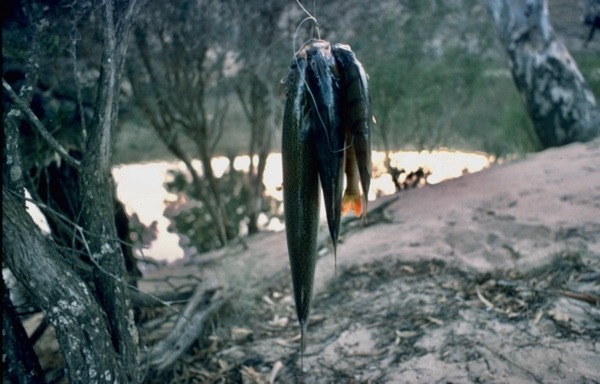
My first catch: two redfins and a salmon trout
On Monday (a holiday) we went sailing on lake Natimuk – and went out on the trapeze on Tony Mitchell’s boat.
On the big paddocks a sheep occasionally dies, debilitated by worms.
Saturday 13th MacArthur
From The Rises, left late, 1pm, Went 70 miles in great heat, stopped at MacArthur for drink. Saw a 28lb conger eel being trailed by two boys on a stick. Looked like a long grey stocking stuffed with jelly. To park, free. Put up my gazebo of tubes for first time – works quite well, but obviously now the sheet should be made to fit it better. One of several lads came to borrow a fork.
Back later, three of them, with a carton full of beer bottles. We talked and drank, and they left a bottle for us. A little later three possums came to roam around. One was particularly tame. All lowered themselves head-first into litter bin.
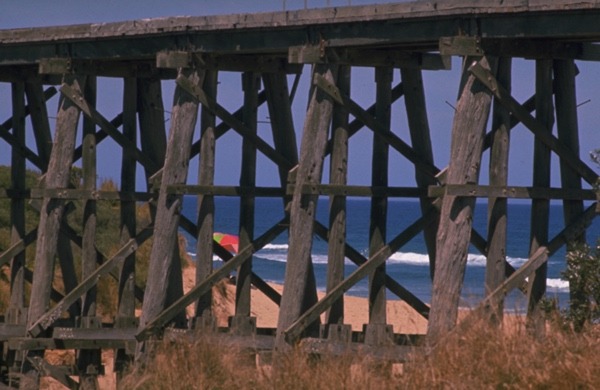
Trestle bridge on south coast
Sunday 14th Port Fairey
Phillip Pilgrim & his ’52 Vincent Rapide, with the Vincent Owners Club at Port Fairey. Amazing coincidental meeting with my Melbourne mechanic friend. Carol gets to ride in a sidecar. I get advice about forks and spokes (heavy duty)
Monday 15th from Mt Gambier
Long straight roads near the coast through endless plantations of Pinus Radiatus from 196 to 1976 some being cropped now. Softwood Holdings Ltd. Crossed state line. Gained half an hour. Beach before Beachport, loads of kelp, collected spherical shells. On to Robe, past lakes (George, etc.) Swans. Theosophy centre. To Robe. Camped on beach. Fished off jetty. Caught one sprat. Ate good dinners at Robe Hotel, slept in perfect little bay, but at 3am heavy sea mist came and got us scrambling for cover. Slept on under lean-to against bike. Woke at 6, good exciting night. Dried things, breakfasted. Talked French, packed. Adjusted timing (LH plug sooty). Big moon hanging over horizon.
Tuesday 16th from Robe
From Robe to Kingston. Little but scrub and sheep. Then along north side of several dry salt lakes, the Coorong National Park, big dunes in the background, Malley trees and succulents. Wandered in over sand and salt to find big ramshackle house with derelict-looking property around it (perfect for heroin lab) but we got no further. Miles to the sea.
Ninety miles of this, then Meningie on Lake Albert. For sandwich lunch. Three ladies from Sydney returning from Adelaide Festival. V Good they said.
From Meningie to Murray Bridge, having remember that Mari gave me names there. Forgot, though, that they were the ancient man/young woman couple. (32.34.29 phone for Bill and Peggy Graton at M.B.)
Wednesday 17th Murray Bridge
A conventional house with a good well-ordered flower and veg. garden. Peggy is the librarian of Murray Bridge – 7000 volumes, about one per capita. A physically self-effacing woman, non-descript clothes, a wad of blue tissue clipped on to the left strap of her bra, but not fastidiously concealed (a mastectomy?) – busy getting things done in the kitchen before a journey to Adelaide. Like any working wife. Then Bill returns. Assume at first that he’s her father. Sparse hair almost white, but covering the crown of a well-shaped hard-tanned head. Features clean, skin clear, though much folded, slightly bowed, trousers hung high on braces – bright eyes, an easy laugh. He’s able to recount events of 25 years ago as though yesterday – but seems to have a good focus on the present. Was a dairy farmer – appears to have enjoyed much success and respect. Read and absorbed as much as possible on the subject. Built stone house (German stone mason) but insisted on concrete foundations, lintels and ties. Says super-phosphate does not leach out, though lime does, according to Rothampstead. Obviously their relationship is very good, though marriage is a convenient word for it.
Murray River water – too thin to plough, too thick to drink.
Thursday 18th to Adelaide (Addleyade?)
But first to Hahndorf – founded 1830s by a German sea-captain and his passengers. All Lutherans escaping persecution. Saw a few attempts to recover early atmosphere. Museum and art gallery in old board school. Interesting paintings by Ruth Tuck of figures, faintly obscene behind lace curtains. Relics of early settlers – lace-trimmed petticoats, baby carriages, etc. Some pottery and jewellery sold there is good. Otherwise, little to recommend.
Hilly country around Adelaide, freeway, then looking down on city and ocean beyond. Into city centre along broad streets to railway station. Had a couple of pizzas then phoned John and Judith Brine and were immediately invited to their vine covered villa on the edge of the city. Heavy polished wood, wainscoting a foot high, Immensely thick brick walls, vines screening the windows, etc.
We spent almost a month in Melbourne. Much of the time I was working on the bike and looking for a ship to take us away from Australia. With Darwin destroyed by a typhoon, I felt the least I should do to be able to say I’d seen Australia was to ride the two thousand miles across the south to Perth, but finding a boat was difficult. One ship would have taken us all around the Philippines to Bangkok but it was too expensive. Another would have had us travelling with racehorses to Djakarta but that fell through. Finally the only acceptable choice was the Kota Bali, a small cruise ship sailing out of Fremantle to Singapore. It cost $200 each, bike included, still a lot of money at the time.
Looking for an antidote to Okker, I was bowled over (a suitable metaphor for cricket-crazy Oz) by the art in the Melbourne Gallery. My notebook lists Sidney Nolan, Perceval, John Brack, Arthur Boyd, Justin O’Brien, Russell Drysdale, Charles Blackman, and I even made tiny sketches of the paintings I admired most.

I see I also visited Kodak, probably trying to get my film processed, but I don’t know if I succeeded. Having to carry all my exposed film around on the bike was a persistent worry.
I see I made a mistake earlier in these notes. We did stay a full month in Melbourne before I was ready to leave.
Friday, February 27th
Melbourne to Colac. Road to Geelong, past docks, competing petrol stations, and along the freeway. Geelong ancient wool port, then to join the Ocean Road. A triumph. Quite as lovely as the Hwy 1 [in California] and much more deserted. To Lorne and Apollo Bay. (Fish & Chips). Then through attractive hills and forests to the hot inland grazing country and to Colac where found Chris at his parents’ house waiting for Karen [friends made in Melbourne]. Went to pub to meet Stephen the publican who owns two pubs and vaguely reminds me of Tom Merrin [a ruffian from my newspaper days] Then back for chops and a cold night ride to Gellibrand and their home – ten acres, fibreboard house on a rise with sheds and then steep slope to small river with some acres of potatoes cultivated with their permission by Vic, a perfect potato grower who calls everyone sheriff. Chris is big, blonde, complacent, affable. Karen pretty, dark, contained.
Back to Lorne on Sunday for the day, where I fished with his rod. He had caught a trout the night before.
Monday we looked for work. Saw several farmers and Dept. of Agriculture. [Presumably we failed.]
Wednesday, March 3rd
Colac to Apollo Bay, Port Campbell and Balmoral.
From Apollo Bay across the headlands, dirt and lush sub-tropical veg. most beautiful. Stopped for dynamiting of tree on road. Coast continues. Bare grazing land. Sandstone bluffs and great sandstone pillars carved out by the sea.

A few of the Twelve Apostles
Carol’s headache disaster. [She had a migraine attack. We were on our way to Matt Handbury’s parents at “The Rises” but she couldn’t continue. We spent hours above the cliffs as I massaged her head and neck until she felt able to go on.]
Convalescence at Port Campbell. Man from Berkshire. BMW rider from Perth (Hunchback?).
Four hours to Balmoral. Long cold ride through the night, just managed to find petrol in time. Caramut Hotel, where we phoned.
From Balmoral, over bridge left on to dirt road, to find house all lit up to welcome us. Such nice people.
I marvel at Carol’s stamina and our determination to get there. Perhaps we had no option. I would never have imposed the ordeal upon her. There’s so much my notes don’t tell.
First, thank you all so very much for your many birthday wishes. I truly appreciate them.
I made a bad mistake in last week’s pages. I said that Melbourne’s famous newspaper, “The Age,” belonged to Murdoch. Untrue. It is and always has been quite independent of Murdoch, and my error is possibly due to my own mild obsession with him. Not everything belongs to Rupert Murdoch. Although we have never met, and he has certainly forgotten the one time we spoke 55 years ago, he has been a fairly constant presence in my life.
In 1969 I was editing an issue of the Observer colour magazine in London and I chose to make “influence” the theme. I made a list of people I thought most influential, and planned to ask them whom they thought were most influential. Rupert Murdoch had just landed in England from Australia. He was making a lot of noise, having acquired two newspapers, The Sun and The News of the World, and he was stretching his wings. I phoned him to say we thought of him as having growing influence, and all I remember him saying, quite pleasantly, was “Don’t be silly.” He wanted nothing to do with it.
In 1975, when I was riding through Ecuador, I met and spent some time with Matt Handbury, a young man on a BMW, who happened to be Rupert’s nephew. He was on a long, unfocused journey trying to decide whether to shelter under his uncle’s umbrella or live an independent life. His mother Helen was Rupert’s sister. He told me that when I got to Australia I should visit their sheep station, The Rises, and – he added – I should also go to see his grandmother, Dame Elisabeth Murdoch in Melbourne. He gave me addresses and telephone numbers and so here I was, in Melbourne.
The political scene in Australia had just gone through unprecedented turmoil, and the Murdochs were nothing if not political, so it could be interesting to meet the Dame now. I phoned, and she invited us to come and have lunch at Cruden Farm. We went on the bike, of course. This is what I wrote:
The road from Melbourne to Frankston was along the East side of the bay. At first it comes inland a bit from St Kilda, where the massage parlours earn constant shy allusions – small villas, painted in rather bright distemper colours, windows painted over and the street numbers in large figures a foot or more high as their principal recognition points; where the smart movie houses (Palais and National) were showing classic movies every night (Borsalino & Co, Delon: Day of the Locusts: Death in Venice), and Leo’s Spaghetti Bar did a generous bowl of Spag Carbonara for 60 cents, on Fitzroy Street, among cheaper hotels (Nightly: Miss Sammi Davis) and cafés and Luna Park on the beach.
So the Nepean Highway, which is a continuation of St Kilda’s road goes out to Moorabin through “Autoland” and then past the Lucas factory on the right, to the more leisurely resorts along the coast where nautical sports keep their dinghies and yachts.
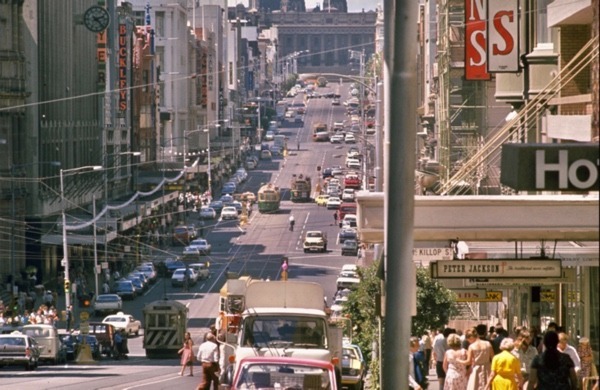
Downtown Melbourne in 1976
Cruden Farm is about three miles inland, not a lot of land but sufficient for the house to be well back from the road on a long drive. Stone house, old English, early 19th century perhaps, the Dame appearing at upstairs window saying “I’m just changing. Go in please, make yourselves comfortable.”
Polished wood, piano, delicious aroma of baking, When she comes down she’s a slighter figure than one expects of a Dame, wearing a simple calico dress (frock?), spectacles, easy light-limbed walk (she is presumably in her middle or late sixties.) We talk at first about the election – her son’s change of heart, her criticism of “The Age” for changing its attitude to Liberal in the last days before the election.
[“The Age” was Australia’s greatest newspaper, and Graham Perkin it’s famous editor. He favored the Labor Party but died suddenly before the election. “The Age” changed allegiance, to the Liberal Party, which was distinctly conservative.]
She (the Dame) felt that Perkin would have stuck to his guns. She is herself a convinced Liberal. It’s difficult though, on reflection, to believe that she would have been able to sustain a different opinion from the men. Keith Murdoch was her husband. Geoffrey – Matt’s father – is a son-in-law, daughters Helen and Rachel (married to John Calvert-Jones). She really believes that Labor was ruining Australia, and that Rupert was reluctantly convinced of it.
Rupert I didn’t meet but saw on TV – a broad-faced, cuddly person with a legend of ruthlessness about him. She pooh-poohs the ruthlessness, says talk of his power mania is foolish, that he’s just not like that to meet. Like so many people, she can’t distinguish, at least in her own son, the difference between a personal affectation of ruthlessness, and the ruthless consequences of rational business decisions taken in boardroom vacuo.
We sip white wine with cheese biscuits – the proper kind that are soft and crumbly and taste of cheese and salt, and the Dame talks easily, beginning each sentence by opening her mouth wider than usual and aspirating the first vowel, a curious mannerism that seems appropriate to her generation and reveals the schoolgirl in her.
We are both flattered by her attention – she is perfectly courteous and seems to pay real attention to what we say. At first she tends to address her general questions to me (about Australia, Australians, etc.) but I turn them over to Carol and the Dame picks that cue up very easily. Calvert-Jones arrives with the coffee – he has a rather obsequious attitude to her – I was surprised to hear later that he was a general’s son. Much later, at The Rises, we heard that he had been surprised by the amount of time she had lavished on us.
He showed us around the grounds, a fine old stable with horses’ heads carved on the post heads, and an ornamental garden.
She came out at the end to see us off, and clambered onto the pillion seat to see what it was like, showing suspenders and stocking tops and knickers, and was very sprightly about it, though when she caught my glance at her deshabille she seemed, for a moment, frozen in anger, as though afraid she’d gone too far.
We’re on a circular drive, in front of the house. Big tree has fragments of honeycomb fallen at its base, and Calvert-Jones seems unnecessarily nervous of them.
House has some leaded windows, and colonial white pillars of wood which always seem so unsatisfactory to me where they meet the joists they support.
Perhaps the essential point about Cruden is that the life it describes is so divorced from the Australia we have got to know – as different as upper-class used to be in England.
A few years after my journey had ended Rupert Murdoch acquired both The Times and The Sunday Times newspapers and he offered Harry Evans the editorship of The Times, an offer he couldn’t refuse.
I was in something of crisis at home so I took an assignment from Harry as a roving correspondent of The Times. I was halfway down South America, in Argentina, just as Margaret Thatcher sent her naval armada to the Falklands. I was in a great position to report the story, as Argentinians went into conniptions about the “pirate fleet” they thought was coming to shell Buenos Aires. But Murdoch chose that moment to sack Harry for not doing as he was told, and I didn’t have the stomach to continue. So I went home to the ranch.
Since then, Rupert, together with his gang at Fox News, has become a monster. I am as likely to blame him as I am to blame Trump or President Pudding for all the ills of the world. He’s the same age as me. We’ll see which of us outlasts the other.
PS: I have a new character in my rogue’s gallery. Along with Vladimir Pudding, Porky and Percy K.Pistachio, I welcome Benny Notonyernellie. (Brits might make more sense of this one).
Sunday, January 11th
From Coonabarrabran. Very quiet on the roads and in the towns. Passed along a section of dirt road to Cudal. Stopped a while to talk and look at parrots. Beginning to realise how many there are – oddly enough there are more to be seen in the South than in the North. The grey ones with red breasts and heads are everywhere – Galahs – and another, even more gaudy, is common too. Found one by roadside and took feathers as a sample.

The Galah
Country made strong impression. Rolling pasture for hundreds of miles – seemingly in all directions. Towns, particularly Canowindra (owin = oun) have a more evolved look, the older hotels with spacious balconies of decorative ironwork and good proportions are well-kept.

Canowindra in 1976

The Garden of Roses
A weather-beaten gent. stood by the bike, waiting to talk to me. He had a mild, humble manner, said he’d done some gold-mining himself and though he’d never travelled he read about foreign places, especially where there was mining.
“How is it in Peru?” he asked. He’d heard about that. I enjoyed being with him for a while.
The Pembertons received us kindly. She has a strong, vital personality but he’s rather burned out (deaf and drinks a fair bit). Carol observes how often one or other partner is a wreck. They built the home fifteen years before – a big expensive place – she was very sensitive about the state of the lawn. We slept in the girls’ room – single beds on opposite sides of the room (“You don’t mind sharing a bedroom?”) She told us at length about Glenice’s [the daughter] surprise wedding, and Christopher [husband] didn’t get a very good press. She’s going out to visit them in Salvador.
Monday, 12th
At Clunes, on the road from Canowindra to Cowra, with family called Young. Son Ian, daughters Rebecca, Margaret, Sue, Letitia. Rode up to house along avenue lined with immature trees. House, of brick, seemed fairly new. People seen through windows stretched out in easy chairs.
Ian had just come back to garage on his Agricultural Yamaha and I rode up there to talk to him. Pleasant, almost sweet young man, sideburns, reddish hair very thick on forearms, wearing toweling shorts – his expression reminded me of John Clarke, from my childhood. Talked to us forever, while we still sat on our bikes like dummies, although it was obvious that we would be able to stay on the land. At last he fetched his father. The whole family came out and we talked for a good while in the evening light, with the Galahs swooping and screeching in the gum trees. (they kill the biggest trees by stripping their bark).
The father offered us the use of a disused cottage at the back of the property, near the sheep-shearing shed. Ian accompanied us there and we thought that would be the end of it, but then we saw headlights approaching, slowly, halting at each set of gates. The girls arrived with beer, salad, orange juice and a bottle of Coke. Very generous.
13th – 15th, Canberra, but no notes.
16th To Kosciousko Park, the Snowy Mountains
We’ve spent four days in the Southside Caravan park and it’s time to leave. The magpies are strolling around as usual – exceptionally bulky birds in their tattered black suits with flashes of white underwear showing through. They have a strangely musical chant, like squeaky machinery but at a very sophisticated level, and look very much at home among the campers. Said goodbye to the Beissmans, young Germans – he a welder/fitter/turner, she an optometrist. They’ve lived nine months in Australia, with tent and Land Rover and plan to go on working like that to buy land and build.
Weather was perfect for riding, blue sky, hot sun, cool air. Up into Snowies – above 5000 feet – bought steak and few veg at Adaminaby. Admired the wild flowers and gum forests, and the dams and switching stations. Day ended gracefully in a forest clearing, where we swept away leaves and twigs to make places for the bed and the fire – a good stone fireplace – to avoid any chance of a forest fire. Only sad note was Carol’s increasing discomfort with what later seemed to be a cyst, together with various aches and pains and glandular swelling. We also had little money and had forgotten it was Friday – so a weekend of difficulty unless Carol’s theory of easy money changing was born out.
Saturday 17th
Woke up at dawn. Aching night, but clear and cool. Carol went for a walk. Found a little beetle on helmet visor – brown with speckles and toy feet. Left a little turd and flew off. Wonderful to watch it gear itself up for flight, with the slightest movement of wing cases, pacing back and forth on the edge of the plastic (like that bizarre Southern priest we saw on TV preparing to smash bricks with his forehead.)
Set off to complete the circuit of the Snowies – the threatening dirt road climb was not as bad as it might be. Road winds up and down over creeks named after Groggin and Swiggin – a veritable Hobbit land. Filled up from stream water, took some pix, went over the top (at Leather Barrel) and came down to Lake Jindabyne where a wily Italian took 40 cents for a coffee, and Carol’s theories began to seem unfounded. On to Cooma where further efforts to change money proved futile. I kept up a sort of bloody-minded indifference for a while, letting her do the running in and out of motel offices. It had annoyed me the day before when I pointed out a bank and she had not wanted to go in. Sometimes I resent being forced into a position of having either to insist on some point or having to suffer again the consequences that I already went through on my own a year or two ago.
Decided to go on to Eden anyway, with only 90 cents. At Merimbula saw a likely motel and got $15 off the proprietor. In Eden drew up outside the Australasia for a drink – and was hailed by a tall man with one leg, and some others. They were a work camp building a house for an Aboriginal family. They asked us to join them, were very friendly, wanted us to go back with them for “tea’ but Carol really exhausted so we bought food (chicken) and ate it in the pub with wine and beer to relax. Then rode back to the school where the kids were living (right next to park where we intended to camp). They were going to sleep on the beach with a fire. Though often illegal, they thought their numbers would prevail. It was a bit of a performance getting down there, and we were a bit overtired to be much entertained by the resident “performer” singing about old ladies locked in the loo – and the foggy, foggy dew. But eventually, despite a few mosquitoes, it was a good night.
Sunday, 18th
Morning was beautiful. Beach was glorious, water was cool and heavenly. Collected shells – a film canister full – and came back to the house where most of them were packing up to leave. The house was unfinished and some of the principal people were staying behind.
In the afternoon we were taken to the swimming falls they had discovered about 20 miles inland where a river has worked its way through a great rock in a series of falls and cavities more beautiful than anything I’ve seen on that scale.
19th to 28th
We stayed with them – Tim Seale, Kevin Goode, Chris, Brian Spillsbury, Helen, Judy, etc, to help finish the house. I drew a floor plan on the inside back cover of my notebook.

In a church hall we were joined by a reinforcement from another camp. The difference in tone was quick to appear. Three men, two women, churchy over-age pranksters, not very “mellow” as Carol would say.
Had much difficulty working with flimsy materials, fibre board, asbestos, pacific maple moulding and skirting – light as balsa, all walls and ceilings out of true, doors featherweight but monstruous size to ceiling so that inhabitants dwarfed (to reduce damp in roof – lets hot air flow out) floor of fibre-board sanded down. Banks give 15 years life to these houses for mortgage purposes.
Wednesday 28th
Carol’s uneasiness continued through the night (another cancer dream) but in the morning we were able to talk it out better. She feels that I don’t value her, think her contribution is of insufficient value (intelligence, articulacy, says she was learning from me ways to discuss and question – that the “movement” language was not sufficiently broad to deal with everything) while I said it disturbed me to find myself constantly provoking her uneasiness by references in passing (as yesterday when I asked people whether they would prefer travelling through India alone or in company.)
It’s true that I am still profoundly suspicious of women, and I do anticipate that they will “pull the rug out” – and of course this suspicion breeds uneasiness in me, etc., etc. So we talked about expectations, good and bad.
Today will pursue the problem of parts for the bike, and perhaps approach “The Age” (Murdoch’s Melbourne newspaper) to see if they’ll take some stuff from me for money.
What I need for the motorcycle
Pistons, standard plus 20 LC
Spokes, Q.D. wheel, RH side
Petcock RH side
Gearbox oil change
From 30th January to 18th February we stayed in Melbourne, St Kilda, with friends. Most of those days I spent in Frank Mussett’s shop working on the bike. Described at length in the book. Here’s a note, for gearheads, of what was done:
Change – two inlet, one exhaust valve
Pistons to 7:1 Hepolite
Re-sleeve barrel to standard
Removed and inspected oil tank. New washers
Replaced original oil pump. Found other had badly worn seats
Removed rotor, expanded core and replaced with new tab washer (I’ve forgotten what this means).
Replaced wrong chain from Renold and fitted new one.
Front fork reassembly with missing seals and washers. Compressed springs using old oil seals as spacers.
Removed rear wheel, replaced missing spokes and rebuilt wheel with rim the right side round
Re-riveted speedo gear box
Washed and packed wheel bearings – added missing spacers to hub assembly and refitted
By Friday 13th the work was done, the bike was ready, and I was searching for a ship to take us from Perth to somewhere in East Asia. Meanwhile we visited museums and had lunch with a Dame.
See you next week, I hope.
1879 was a year in which the British Empire confronted some 4000 Zulus at the Battle of Rorke’s Drift, with tales of heroism and a splurge of Victoria Crosses to excite the British public. It was also the year in which George Lucas launched his bicycle lamp, which might seem of relatively little importance. Nonetheless his lamp, mounted on the front wheel of penny-farthings, went on showing the way through darkness long after the battle was history. His was a small one-man business, selling oil and other things from a cart in the streets of Birmingham, but his lamp, which he called “King of the Road,” was the foundation of a business which came to flourish throughout the Empire and was still a household name when I began my journey in 1973.
All Triumphs were fitted with Lucas electrics and, because they had offices and workshops in most of the big cities along the route I had planned, they agreed to help by allowing Avon to send me new tyres at various places along the way. So I came to know the Lucas culture well, in Nairobi, in Cape Town, in Rio and Santiago, in Los Angeles, Sydney, Melbourne, Penang, Madras, Bangalore and Delhi, and I paid courtesy visits even when there were no new tyres to fit. The managers were very old-school British businessmen, jacket-and-tie, belonging to the right clubs, occasionally inclined to grandiosity, very much wedded to the idea of Empire even though it had been dismantled around them. All the jokes and sarcasm among bikers – “Prince of Darkness” was the most current epithet – didn’t seem to impinge on them at all, and although I had my share of trouble, I think the criticism was generally unfair. More often problems arose from connectivity, and Triumph had to share the blame. In any event they seemed unaware of the encroaching doom and were always generous and helpful to me. So in Brisbane too I made contact with Lucas.
Carol, I, and the bike arrived in Brisbane on the morning of January 9th by train. I must have done some phoning beforehand, because we were invited to have lunch that day. The manager’s name was Gribble. Here is what I wrote:
Friday 9th
Brisbane at 12.30. Lunch with Gribble, a firmly fat man, fawn trousers, light brown shoes, white shirt stretched over his chest and belly. When I heard him over the telephone he reminded me of all the other Lucas men, and I thought of portly tolerance and good humour, and a good steak.
He greeted me with a necktie folded in his palm – a token of his extraordinary powers of anticipation – for me to wear in the club. He showed no pleasure, it isn’t his style. He prefers an impassive stance and delivers verbal blows unheralded by expression. The effort to maintain this poker face cause a muscle at the corner of his mouth to twitch a little and adds a slightly sinister cast to the general blandness. He has a butcher’s face; square, fleshed, opaque.
He started the conversation immediately by his hatred for Germans, all Germans. He loathes them, despises them, won’t allow one across his threshold. “There are only two kinds of German . . .” dramatic pause “ . . as Churchill once said, they’re either groveling at your feet or lording it over you.“
He continued with a terrible tale of punishment inflicted on some putative Nazi in Nigeria before the war, who said Heil Hitler and was foolish enough to leave an outboard motor on his, Gribble’s, property.
The motor was pitched directly into the sea. The Nazi came to remonstrate.
“ ‘I shall give you exactly ten seconds to get out of here,’ I said, but he stayed one second too long. I was wearing African army boots, you know, the ones with laces up to here, and on the eleventh second “ – Gribble lost his cool and became ecstatic – “I kicked him where it would do him most good, and pitched him out into the street.”
Gribble’s adjutant in Nigeria, when he was commissioned, was Quintin Hogg – later Lord Hailsham.
[Hogg, who had a distinguished war record, cut short by injury, later became a man of considerable importance in British politics and was almost Prime Minister. Read Gribble’s account in that light.]
He told a story of how he “unmanned” Q.H. He delighted in the word “unmanned,” repeated it several times. It was some foolishness about not having asked the C.O’s permission to marry.
“I don’t know what he’ll say,” quavered Q.H. according to Mr. Gribble.
“The best way to find out is to ask him,” said G.
In all his stories the protagonist makes strident or pathetic remarks in a silly voice, and G snaps them smartly to account with the pithy voice of reason and courage.
At one point Gribble evidently blundered into some perilous enterprise with his men and was lucky enough to get away with it. He rationalises that since the enemy would never expect such impudence (stupidity?) it was tactically brilliant to perpetrate it.
What upset Carol most was how Gribble taught his servant to refer to himself as “a gentleman’s personal gentleman.” In Australia, I imagine, there might be some kudos in some quarters to have actually had an officially legal black slave. When he joined the army, a regulation was promulgated that all officers’ servants had to be soldiers too. The black man promptly (and voluntarily according to G) joined up.
Quintin Hogg approached Gribble in the officers’ mess. “What do you suppose your fellow said he was when I gave him the attestation?”
“Gentleman’s personal gentleman,” replied G. [With satisfaction.]
He claims that the Germans rendered him childless. Did they kill his child, or render him sterile? I don’t know.
The vital point is that his stories, all perfectly acceptable in their time, seem gross today. Yet he has preserved his attitudes unchanged – and they are apparently still valid currency here.
[Gribble was the only insufferable Lucas man I met. The others, as I’ve said, were true gentlemen, but nice with it.]
We escaped from Gribble at about 2.30 and rode off to find the New England Highway, through Ipswich – nothing special – along the Cunningham Highway and past the National Park where there were fine forested hills, and up to Warwick where the N.E. Highway begins. Here we looked for vegetables, but the shop was a travesty (beans at 45 cents and not much else) so we got a steak (1lb 2ozs for $1.10 – very good rump). A heavy shower caught the bike while we were there. Then we went on for a way and found a gate into a field.
At first, difficult, Carol was nervous being on private land. Then we found we had no matches. I rode off to find some, and came back to find her calm, and lit a fire. Then it went very well. We slept out, there were a few mosquitoes, and I didn’t sleep much, watching the wind sweep the clouds away, and listening to odd sounds, and feeling Carol’s presence very lovingly.
This is hilly country at about 3000 feet: a cool area where sheep graze and apples grow. Stouthorpe, Tanterfield, etc. All Italian fruit growers.
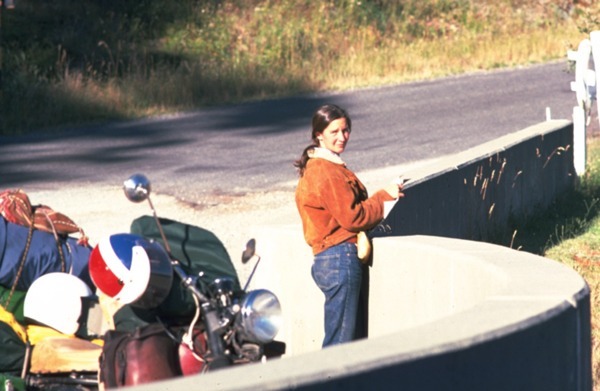
What was that you said?
Saturday 10th
Blue sky with bars of white cloud. Cool, rather English countryside. Tanterfield a busy town, full of life. Had a poor lunch but enjoyed the place. Armidale is obviously the most prestigious of these “New England” towns, with the main street blocked off to make a pedestrian area, but no life – all home at lunch. After Armidale many ups and downs, but mostly downs, with safety ramps on the steeper descents, then into great heat of Tamworth. Old thin guy, called Walt, who owned village store and burned his sawmill for the insurance to build a new motel opposite, where we had a beer. Carol came out with a beer and a packet of crisps (SMITHS CRISPS) saying how gross it was, and that someone had said something about arses, but she wasn’t sure it was aimed at her.
In Tamworth I stopped to fix my helmet and passed a man in a half-shell helmet on a tiny bike with an even smaller tank. Turned out to be a 1934 Velocette, and he an old-time m/cycle mechanic who had restored it. Said he’d worked on them for 13 years (as a race mech. I suppose).
At Tamworth we took off on the Newell Highway, into big flat land where an increasingly strong wind blew, ‘till it was quite hard work to stay upright. Going West in the setting sun – with dust clouds in the air – like N. Nebraska, said Carol. Nearly a hundred miles of that, but some relief towards the end as ground rose and wound among hills before coming down into Coonabarrabran where Coolcappa turned out to be name of the sheep station where the Pembertons (?) lived. 800 acres of wheat, 2500 head of sheep, 600 head of cattle, etc. (10,000 or more acres). Earlier passed slaughterhouse, with shed for skins to dry out (like tobacco). Passing the cattle in the fields, it can be odd to reflect that each cow goes to support one person in the city for a year.
The Pembertons, it turns out, are people I heard about in Central America. Next week, if we’re lucky, parrots and Pembertons. Cheers!
I think I mentioned a while back that I’ve been to Mexico. Got back two weeks ago. I flew into Mexico City and from there made two trips, one north to Mazatlán to see two dear friends from California whom I miss, the other south to San Cristòbal to see my German cousin’s daughter who has a house there. She’s a doctor, married to a doctor, and their two sons are doctors so it’s obviously important to keep in with them.
In Mazatlán it turns out I have a fan called Hector Peniche, who not only rides motorcycles but also happens to run a very fancy restaurant called Hector’s Bistro. He started his career in London as a pastry chef (I think I got that right, Hector?) where he met his wife Victoria, also a pastry chef, who comes from Worcester, in England. They married and came to Mazatlán to start a restaurant in a small, rented place; but they were so good at it that a wealthy customer decided to back them, and they now have a whole block humming away, with the bistro and a café. I ate there twice and it’s not to please him that I say the food was wonderful.

Hector’s place
Victoria rides too, and Hector showed me a lovely, retro-seeming new BMW parked outside that he had just bought for her, but a forgot to take a picture of it, or her (she’s lovely, by the way) so the best I can do is a picture of Hector himself. Here he is:

Hector Peniche
Later we all went to a tiny cinema called El Retro, where I gave a slide show for about fifty people.. I’m very out of practice and did the show really badly, but everybody claimed to have loved it – which is not an uncommon experience. Once, back in the nineties, when I was still using Kodachrome slides and a projector, I did a show at a BMW rally somewhere in the American South. Just before it started the cassette tipped over and all the slides fell out. There was no time to sort them – all I could do was stuff them back in any old how, so I never knew what was coming up next. The audience was delighted and kept me in pizzas and beer for the rest of the show. [“It ain’t what you do, it’s the way that you do it.”]
In the old colonial centre of San Cristòbal, as in Mazatlán, the low facades of the houses disguise the fact there is usually a large area of ground behind them with one or more larger houses and gardens.
Outside in the street the houses look like this:

But inside, behind these modest facades . . .

. . . are big properties like my cousin Christine’s house and garden.
San Cristòbal de las Casas, to give it its proper name, is a wonderful old town, with a great climate, but I got there too late in life.
At 7000 feet I discovered that at my age my tolerance for altitude has vanished. I was breathless the whole time I was there, and really only comfortable sitting down. Where is the man who was once quite happy coming down to Potosí from 15,000 feet in Bolivia? Not only that, but I suffered the indignity of a tummy bug coming back to Europe. I have always prided myself on my gastric fortitude and I’m humiliated.
In fact the last time I can remember losing it was when I squatted in a field in India, in the state of Bihar, 47 years ago. That’s when I composed my most memorable poem:
One should not stray far,
After lunch in Bihar,
For the food in Bihar is rather bizarre.
Not even as far as the nearest bazaar,
For none can outrun the food in Bihar.
When I came to check in to my flight at the airport hotel, Aeromexico offered me a business upgrade at a price I couldn’t refuse. I snapped it up because it meant I could spend my last six hours in Mexico waiting in their business lounge. But it was not like any business lounge I’ve ever lounged in – it was more like a works canteen, a huge noisy barn of a place full of people eating off paper plates. Well, I’ve nothing against people having fun, and I have no reason to blame my condition on the one mouthful I took of the “bife” and rice, but it was not nice.
The flight home however was very comfortable.
PS: I hear that Vladimir Pudding leaned on his buddy and drone supplier, Pistachio “Percy” Kameni, to persuade HIS buddies, at Hamas, to start something awful and take the world’s eye off Ukraine. Probably rubbish, but it certainly worked.
Here, at last, what you’ve been waiting for – the tale of the croc’ hunter.
We are in far north Queensland, where we had just caught a mud crab, but I forgot to note how utterly delicious it was. Huge clumps of white flesh. Never had anything like it since.
So, on again, word for word . . .
Monday 5th January, 1976
We are advised to leave while the going’s good. The tractor repair guy has returned and says Cooper’s Creek is still down. It’s beginning to rain after a dry night. Bill comes with us on his trail bike to help in case I get stuck, and we move gingerly off. As far as the creek the going is tolerable and this time I ride through the creek unaided. Bill waves and turns back, and we go on into worse adventures on clay slopes, eventually falling over in a puddle – but no damage, and Carol takes it well. The rain goggles are a disaster – fog up inside like all the others, and the lens also falls too easily out of the soft frame. At speed perhaps the airstream might help, but it’s at slow speeds, stumbling through mud and potholes that one wants to see best, and can’t. The answer is to wear nothing. Brakes, likewise, will only dry out at speed.
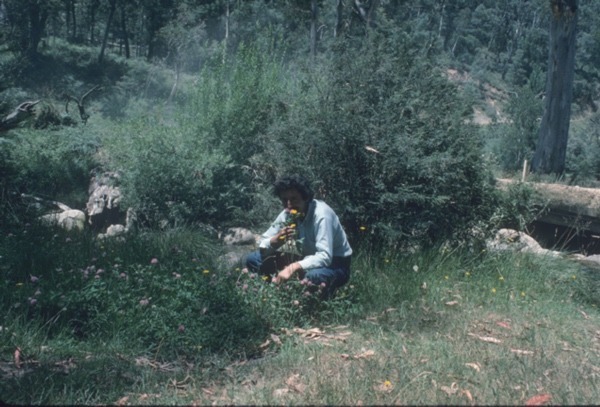
Ted in the Bush, smelling the flowers
Back at the ferry, not realising it was Susie passing us coming over, we get into conversation with the one-legged ferry man. A wispy fair beard, a saucy expression, he talks about his life as a crocodile hunter – up to $20 for a “freshie” – double for a “saltie” – he had one 16ft saltie that brought $240 for the skin. Said he’d never go after one of those again. Too big to land in the boat, they had to skin it in the water, attracting shoals of small shark (water very shallow) which lacerated their legs. H says there were three of them shooting together – both the others are dead. One turned out to have been a convicted rapist who’d killed a man, and was eventually shot dead after killing another. The other was his wife’s brother, who died of septicemia. His own leg he lost to cancer, but after it had been badly mashed up. Croc shooting, he claimed, wasn’t all that dangerous, nor that rewarding. “You get wages and a half, but you’re doing what you like best. If they opened it up again I’d be off in the morning.”
It seemed like a brave boast, but perhaps not. The shot is all-important – a target of 6” diameter at relatively short range, and if you know your job you won’t often have to swim to collect the corpse. Says there are plenty of freshies left to build up the population, now that they’re protected, but there aren’t enough salties left to keep a man in wages.
One of his favourite places is Bourketown, in Queensland. There’s a pub, and very little else. The walls and floor are all at an angle, from being hit by storms, and when it floods the clients have to row themselves to the thunderbox at the bottom of the yard. A Yank was the host, but he got a bit “Tropo” and after periods of sanity he would become violent in the Wild West manner, punch his clients across the bar, and come down the stairs with guns blazing. They put him away, and then the pub was hit by a “whirly-whirly.”
Another character he knew who was “Tropo” had a pet white cockatoo which he used to put on trial for misdemeanors – the case for and against was considered carefully before judgement. At the time it was doing twenty days for chewing a shoelace.
Tuesday 6th
Back in Redlynch. The green frogs on the doors, windows, leaping impressively, all sizes. The huge cane – 8ft or more – mosquitoes of different sizes and pitch – the croaking in the river – covered with floating vegetation – the big, brown bush pheasants settling down on the cane field.
[The cane trains – a complete railways system to serve the sugar mills – counted 200 hundred baskets south of Sarina.]
Brian Adams decides to give us three of the four bracelets to take away with us. Carol buys a tongue to eat for dinner. A convivial evening, each describing his own building.
Wednesday 7th
We planned to go to Green Island but missed the boat through laziness, compounded by Brian’s kitchen clock.
Went to Cairns and Atherton Tableland, to Kuranda and half-way to Mareeba. Dinner with Brian and Anne, then train at 10pm.
[Apparently we then took a train back to Brisbane to avoid riding the same roads back. I remember nothing of this now. The train took two days. We arrived in Brisbane on the 9th.]
–––––––––––––––––
PS: Vladimir Pudding has been putting the lights out in Kharkiv for a couple of days and nights. We really must do something to stop him. If you have a congressman, please write to him.
For a year or so I have been digging back into the notes I kept on my journey round the world in the Seventies. Here they are, word for word, as I wrote them.
1976, and it’s a New Year in Australia
Friday, January 2nd
Finished working on the bike in the morning. Went into Cairns to get food and see Botanical Gardens. Teak, Sausage tree, Rain tree. Fine variety of hens and cockatoos.
Finally talk to London that night, to Peter Harland’s secretary, Jean. She says she will try to get Triumph to send pistons to Melbourne.
Saturday, 3rd
Off to Cape Tribulation at about 11am. Some rain. Good road as far as ferry beyond Mossman. Then wonderfully bad dirt road through gathering rain forest, dipping into coast gullies, creeks, torn up rock surfaces, sandstone of every shade of brown as closely leaved as puff pastry. We travelled close to a small truck with about 8 young men, women, boys, girls, all in swim trunks, up to the Cape for the weekend. They followed us along the road up to the notorious Cooper Creek, a wide river with a thick pebble bed that has to be negotiated along an arc swinging downstream and then up again. Carol took a lift across on the truck. I followed, but finally stopped near the opposite bank in a trough left by car wheels as they urged their load onto the bank. Three of us pushed it out and as I poured water from my boots and exhausts, they all went swimming in the creek, where I later joined them. Most delicious cold water with a deep green tinge to it as though stained by the reflection of the rain forest all around. From there we rode on looking for the sign for Noah’s Creek. But Carol’s directions were vague and she thought the drive-in was after the creek. We eventually crossed a bridge of squared off tree trunks, and she’d caught of glimpse of something before the bridge that might have been the white Toyota described by Brian – but I went on until we came to another formidable creek. At this point I would, reluctantly, have gone back to look had a car not driven up with a man and two children. We asked him and he said it was further ahead. It never occurred to us to doubt him as he was going there himself to repair a tractor. So once again I set off into two feet of water, got stuck, was pulled out, emptied my boots, and waited a while as the man drove off. Almost immediately a Landrover came after across the creek to ask us whether the other driver knew he was losing oil from his sump. They (a local couple) pointed to the oil on the road, we said no, and they drove off after him. We set off too to find them again coming out of a sidetrack to the beach (where the first truck load were camped). They said they’d thought their man might have gone down there.
“Oh no,” we said. “He’s going to Noah’s Creek to mend a tractor.”
They smiled.
“Noah Creek is back there by the bridge. He’s already passed it.”
Stupefied, we laughed and felt foolish, and I turned to face the creek again. This time I managed the crossing unaided while Carol watched petrified as it seemed I might go over the edge of the stone ridge built up by the current and disappear altogether.

Ozzie dirt
At Noah Creek we found Bill (U.S.) and Sonia (disinherited Canadian heiress) who live there, and Susie, who owns it with her husband David, who was out in the forest beating the bounds of his property with John Bisset. They were tracing the blazes made in 1898 and not seen since – most of the trek involving cutting the way with machetes.
Sonia is a very combative lady who needs to tell everybody what to do, how to do it, and then what they are doing is either wrong, stupid or dangerous. Apart from that she longs for sympathetic company. Bill is a very young guy hiding under a beard, who’s been to places and has a smattering of this and that, but not much seems to have rubbed off. He talked about Mexico and being ripped off – and said the same of Asia.
David and John appeared from the forest, David with his shirt ripped from neck to waist – like actors in a cheap adventure movie. Perhaps because D is a designer his black beard looked unconvincing. John had blonde hair, a wispy moustache, and a gammy leg, something to do with racing cars.

An Ozzie spider
Sunday, 4th
We slept on mattresses in the back of the tractor shed – built very neatly by Brian. It rained on the tin roof more heavily and loudly than I can ever remember.
We volunteered to walk to the store at Cape Tribulation to fetch whatever there might be in a rucksack. We walked the first mile to Arsenic Creek, admiring the forest around us – and walking into it a little way, trying to avoid the Stinging Bush and the Wait-a while. The S.B. has very fine needles on the underside of its leaves which break off in the skin and hurt for a month. One wonders why a plant should be equipped with such a vengeful and unpractical weapon. The W-a-W has long tendrils with fish-hook thorns at close intervals in sets of four, which attach themselves to anything. There are ferns growing out of trunks, all 20 feet or more high; lianas of all dimensions swinging down, looping round branches; creepers encircling everything; staghorn plants bulging from the crotches of tall trees many feet above, encircling them with a fringe of leaves. Later, on the beach we found a tree whose roots stood four feet above the surface in an almost vertical cluster, like pipes running down into the soil.
Blue fruit like a stone egg. A small purple one, the Davidsonian Plum, dark purple with juicy red meat and three stones, very edible.
At Arsenic – or strychnine as some call it – we met yesterday’s campers splashing about, and later they overtook us and gave us a ride to the Cape – a magnificent, and apparently unique view. This is the only place where the rain forest still runs to the edge of the ocean.
The Hewistons have an 800-acre plot of it from ocean to high ridge.
At the store a tubby middle-aged man was kneading dough with a machine (which Carol didn’t know was possible). He kept repeating that he’d come there to escape the rat-race. [Escapees are always having to account for themselves] Said I reminded him of a cop in Cairns on the drug squad. Heroin is floated ashore in large quantities on this coast, he claimed, and said he’d picked some up himself. Wife and children all seemed very happy to be there. Most people, though, say the rain eventually gets too much for them and they have to get away for a respite. ’74 was a very dry year, didn’t rain till January ’75 – but ’75 has been fairly wet all through.
Towards evening we went out with John in an aluminium dinghy to lay down two crab traps he’s made from netting.

We floated past the mangroves, with their contorted roots rising out of the mud like writhing ghosts, looking down into tannin stained water to avoid sand bars and submerged logs. The traps were placed under the mangroves in about 3ft of water and tied to the branches above by a line. The bait was small, rotten mullet. Within an hour we’d got one crab – dark, massive claws that can cut off a finger or a toe. The females are thrown back. Males show a triangular mark underneath (Check that!)
Next week, conversation with a crocodile hunter.
