News from Ted
There was a time when I was riding in Malaysia towards Thailand that my bike felt really uncomfortable. It was my first long trip on the bike since the accident that shot a lead pellet into my eye. I was nervous, trying to recover the confidence that I had built up over three years of riding, but the bike just felt wrong. I couldn’t account for it, and I couldn’t even describe it. I stopped and looked at the chain – sometimes if the chain was too slack it seemed to have this clunky effect – and the alignment too (I was on a Meriden Triumph 500) but everything seemed OK, so I persevered, and got to Hat Yai.
Next day the bike felt perfect.
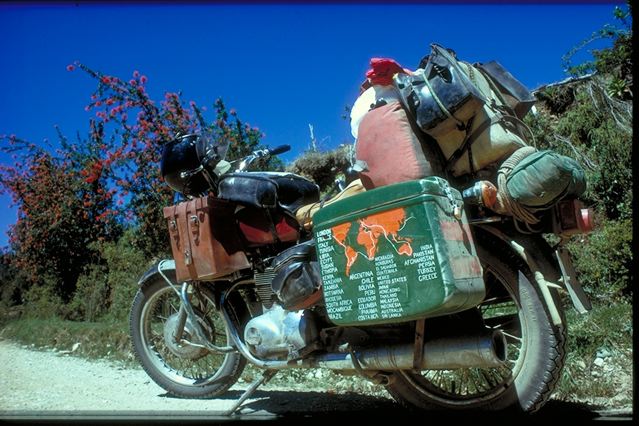
The same thing had happened in Africa, riding south from Mombaça on a pot-holed dirt road towards a frontier. I was nervous. I’d heard that they might give me trouble and even refuse to let me through. Once I got to the other side, the bike felt fine, but I put that down to the smooth asphalt.
From the time I first got that Triumph I couldn’t bring myself to give it a name. To me it was a machine; a valuable, important machine but still just a very clever assemblage of metal parts, nuts, bolts, chains, bearings, and so on. I just didn’t want to get caught up in silly anthropomorphism.
But gradually, over time, I found it hard to resist the idea that the bike had some kind of primitive personality, mainly because it was kick-start. Nothing rouses my ire faster than an engine that won’t start and flailing away uselessly at a kick-starter just makes it worse. However I have to say that generally the bike started promptly and efficiently, and particularly in moments of crisis, such as when a nearby elephant looked likely to take a run at me. At moments like that, when starting or not starting was a matter of life and death, it would be a bitter twisted soul that didn’t say, “Thank you, dear motorcycle.”
So, gradually, the motorcycle smuggled itself into my affections and it got to the point where sometimes I couldn’t be sure whether it was my state of mind that was affecting the bike, or vice versa.
What’s all this about?
Well I told you last month that my BMW Funduro (which I often call Fundador after a Spanish brandy, by mistake) had a problem. It stopped unexpectedly, starved of fuel and the only way to get it going again was to pull the fuel hose off the tap and put it on again. After all the obvious solutions proved negative, my friend Simon suggested the fuel filter was too close to the block and got hot, creating a vapour lock. So I tied a piece of string round the filter to hold it away. And on Tuesday I was all set for a trial run. Obviously it needed to be a hundred kilometres or more and I was nervous. The bike ran beautifully when I brought it here from Germany, but that was in 2017. I haven’t been anywhere on it since, and I’m three years closer to the grave. I’m absolutely fine on the scooter, but there’s always that niggly thought; will I be fine on a proper bike?
Well the bike felt terrible. There was one little sweet spot in each gear, at around 4000 revs, and anywhere else it felt like it was about to fall apart. I gave up very quickly, and drove it back into the garage. Now I’m wondering, how could it get so bad just sitting there. Was it really the bike, or was it me?
I shall have to find out soon. Watch this space or, if you can’t bear it, look away.
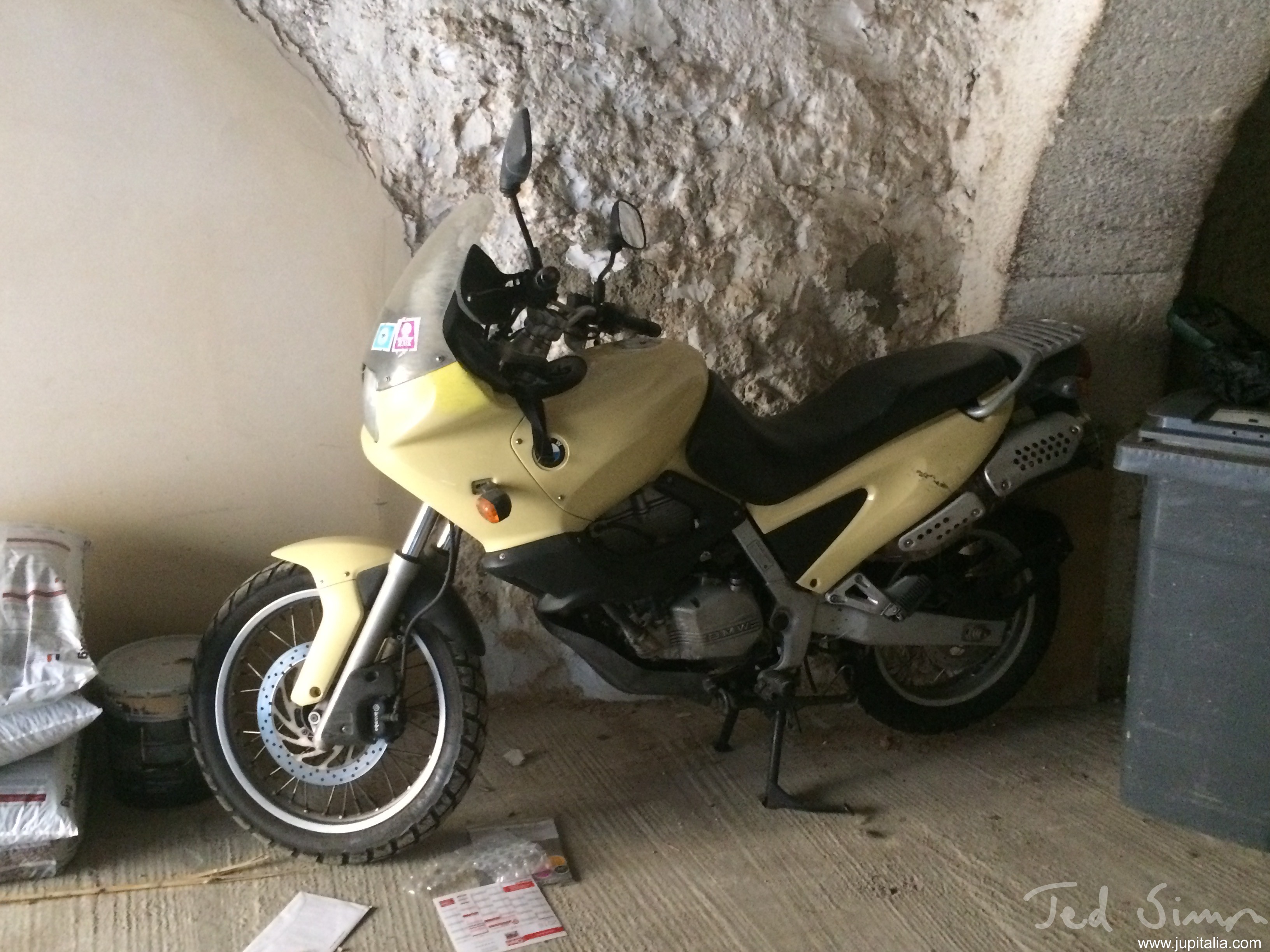
The only thing to mar that beautiful ride from Bavaria to Aspiran when I brought my BMW down to France in 2017 was an erratic but persistent fault in the fuel system. Every now and then the fuel stopped running, and I had to find a spot by the roadside to stop and fiddle. I quickly found out that if I wrenched the tube away from the tap and plugged it in again everything was OK for another fifty or sixty kilometres.
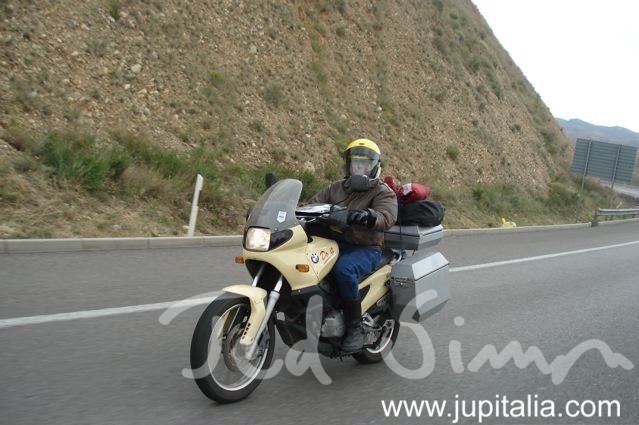
This annoyed me but not as much as it annoyed my travelling companion. She felt herself exposed on the roadside, and she formed the opinion that if I filled up at every available opportunity it would happen less.
I didn’t believe her theory but had no explanation myself. It was not suction from the tank. I rode with the gas cap open for a while but it still happened.
There was no blockage at the tap. When I took off the tube, the gas ran freely. The filter likewise showed no sign of being blocked.
My reluctance to keep stopping for a refill created bad feeling which eventually built up into a full-scale shitstorm, and became what I still think of as the worst thing that has happened to me in my life, although I have no scars to show for it.

Always remember to carry string (along with your umbrella, of course)
The other day, three years too late, a friend of mine called Simon de Burton came by, took one look, and said “Your filter is too close to the engine block. I bet it’s because the petrol is vapourising and causing an airlock.”
That sounds like the perfect and most promising explanation. I have yet to prove it. I shall do so in the coming days, but some of the joy of discovery has already dissipated. Another biking friend, Helmut Heusler, came to visit, and he has had decades of experience as a design engineer for the big German car makers.
He says, “Throw the filter away. It’s quite unnecessary.”
I’ll try to prove Simon’s theory before I do though.
I have never had to deal with the French Gendarmes before. I see them around of course, always very smart and business-like as befits a national police force. Usually I see them in their vehicles, and they are very impressive on their BMW motorcycles. They wear a blue uniform and in the heat of summer here in the south they cast off their jackets and wear broad braces to support their military style trousers, but this does not imply a relaxed or slovenly attitude. I have always thought of them as a force to reckon with. On the one occasion that I was stopped, at random on a roundabout, the Gendarme was very pleasant and polite and joked a bit as he went through the routine of checking my license but you knew it was the velvet glove over the iron fist.
Recently they have been building a new headquarters for the Gendarmerie alongside a road I travel quite frequently and it is finished now, a very fine looking purpose-built establishment flourishing aerials and such, surrounded by a panoply of new houses that I assume houses the agents. All very convincing and I must say it bolstered my impression of a powerful, effective force of rather superior people, well above the municipal police one sees around.

The new Gendarmerie National headquarters of Clermont l’Heraoult
After my recent unfortunate loss through cyber crime I went to the bank to explain how I had been tricked into sending a number of large payments to the account of a criminal in Switzerland and my counselor said that I must report it to the Gendarmes immediately. I have to say I was little nervous and excited at the prospect of my first interaction. I imagined the kind of interrogation they might put me through, thinking that their investigation might stretch across Europe and back to the States where I suffered the final coup de grace. Interpol and the FBI might be involved. I prepared the paperwork as best I could before going there last Friday.
I parked alongside a barricade with stern warnings about this being a military establishment and threatening dreadful consequences to trespassers. It was quite hard to find a way in. I had to guess where the office was. A heavy iron fence surrounded it but eventually I found a locked gate. This being corona virus time there was also a sign to say that it was obligatory for everyone in this establishment to wear a mask. In a place like this that would be an iron rule so I fumbled for my mask, because I don’t normally wear one outside. As I was hooking it over my ears I heard the gate unlock itself. I went through into a sort of holding area locked in on both sides, and then the door of this imposing establishment unlocked itself.
I found myself inside a rather small, dowdy-looking office much like the old offices of yore and my respect for the whole enterprise began to diminish. A young blonde woman in uniform sat behind a pane of glass and looked at me, rather indifferently, intimating that I should say something. Unusually for France she didn’t even say “Bonjour.” She was not wearing a mask. In fact none of the people coming in and out at the back of the office wore masks. I felt like a dick.
“Do I have to wear this?” I asked. She gave me a Gallic shrug. I half removed it
“I have come to report a crime,” I said.
“Oh yes,”
“I have been defrauded out of a large amount of money.”
The telephone rang. She reached for it, gratefully I fancied, and talked animatedly for several minutes. Then she turned to me again.
“You were saying, Monsieur?”
“Somebody imitated a friend’s email address and tricked me into sending four large payments to a bank account in Switzerland.”
She seemed not to understand me. I did my best to explain. After a bit of this she said she would pass me on to a colleague, an older woman with dark hair and glasses who had come in and was now standing in front of me, mask-less, of course.
I went through it again.
“What is this to do with us?” she asked. “It’s none of our business. You should go to Switzerland, Monsieur.”
They were happy to see me leave.
I see the Gendarmes differently now.

Maybe they should go back to where they came from
Just keeping up to date on the various ways in which the French Bureaucracy challenges our ingenuity. I have received a registered letter from Nantes.
The government office at Nantes is well known to everyone, including the police, as a black hole. It is where you send applications for a change of driving license.
The letter, paraphrased, says, “Sir, on the 9th of July, 2018, we received your application to change your British driving license for a French license. We have examined your request. However, since your request was made, you have renewed your license, and since your current license is not the same as the one you sent us 14 months ago, we cannot make the exchange. Please accept our most distinguished consideration.”
My current license will be valid for three more years. I wonder if the people at Nantes will be able to hold on to my new application until that too has expired. Is there a Guinness record in the offing? I’ll keep you posted, unless I too have expired.
It’s not like me to have nothing to say.
I sit here at my computer and all sorts of disconnected ideas are flitting around like fish beneath the surface but they can’t break through, as though they were trapped under a sheet of ice.
Nothing seems worth saying when the two countries I am connected with by language and history are both now governed by flamboyant frauds, each one intent on bolstering his ego by leading his country to destruction.
And as if that weren’t bad enough one of them, Mr Trump, seems quite willing to risk universal extinction as well.
Still, for the time being, life does go on. After three years of waiting, some potential writers have taken note of my offer of hospitality and advice. At the beginning of the year I had Malcolm Dunkeld here for a few days. He was kind enough to say that my comments were ” extremely valuable.”
Christopher Lee is coming to visit next week with a view to spending more time here later. He says he’s determined to find a way to elevate his travel experiences so that they energise and excite others. Derek Mansfield plans to come at the end of the week with the same thing in mind. And Mark Holmes, who attempted to rejig his life by riding off on a Triumph Rocket, has sent me a book which he thinks could be improved.
So it’s beginning to look as though my purpose in buying this house with all its bedrooms may be tested. Meanwhile others come to visit. Catherine Germillac left this morning after a couple of nights here. She’s been in Corsica and Sardinia , still on her famous 125cc Desirée, which she rode all over the world years ago. Yesterday she went to see one of the great historic sites in this part of the world, the mediaeval village of St. Guilheme-le-Désert. The village itself was crowded with tourists, but high above it is a ruined castle which is supposed be out of bounds – so of course she scrambled up there. The panoramic view she captured on her phone was extraordinary. And I’m the stupid guy who forgot to ask her for the picture.
Instead, all I have to offer is a picture of our new shop. Yes, at last, we have our Epicerie again and it’s a great resource. So now Aspiran has it’s baker, it’s Café and it’s grocer. Some things get better.
You can just see the shop at the far end of my street. 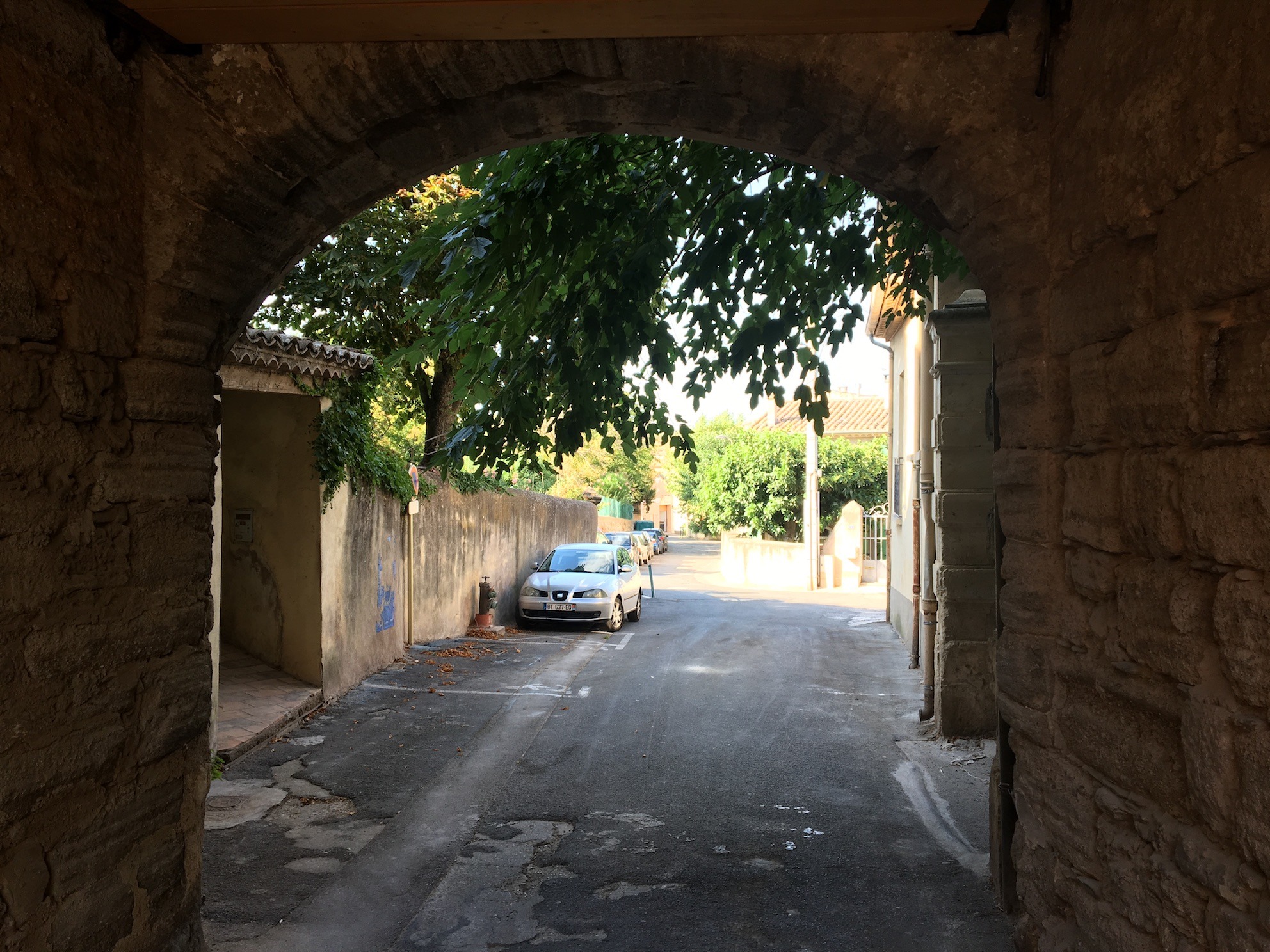
Ah, there it is.
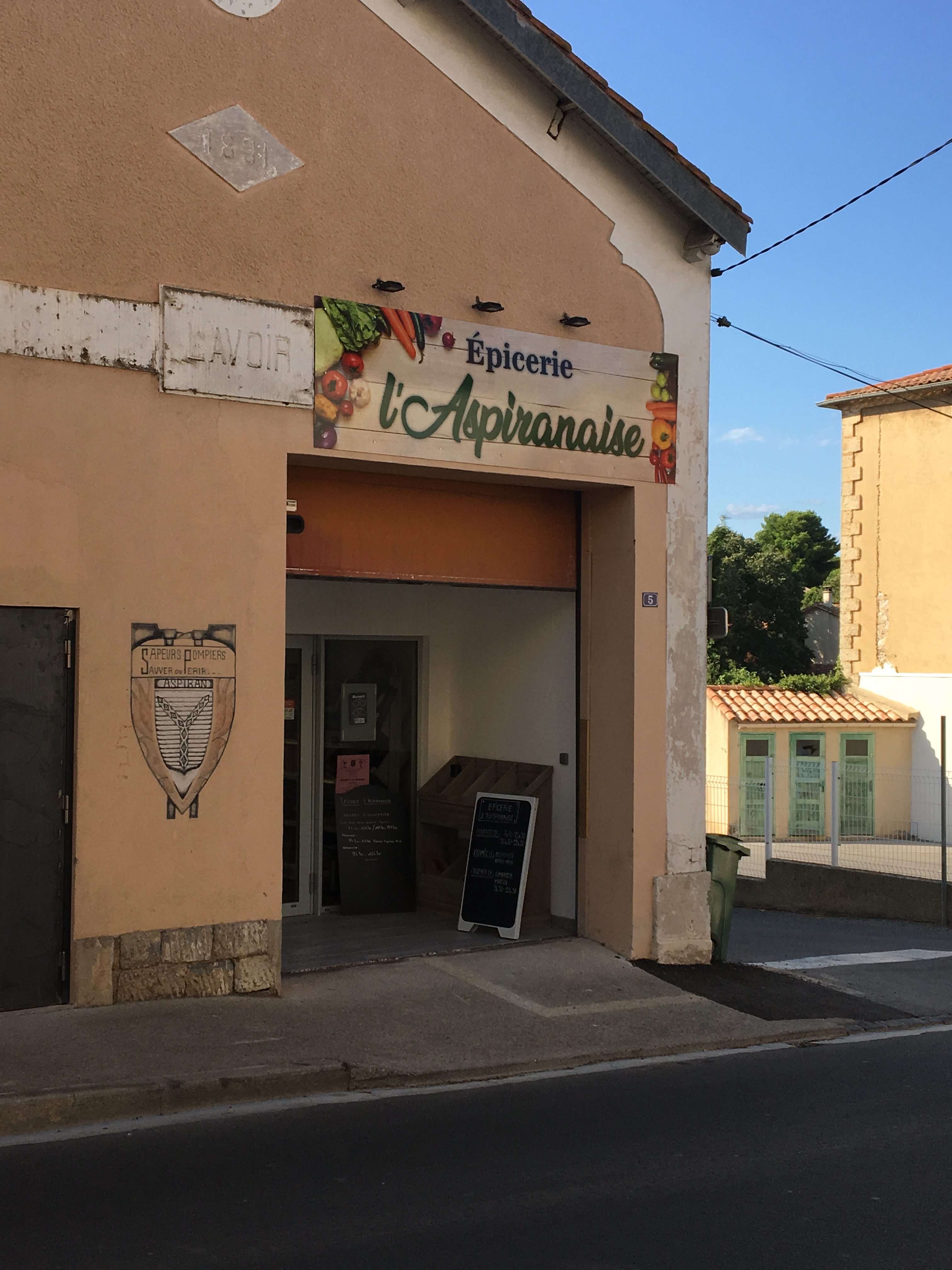
It used to be the fire station
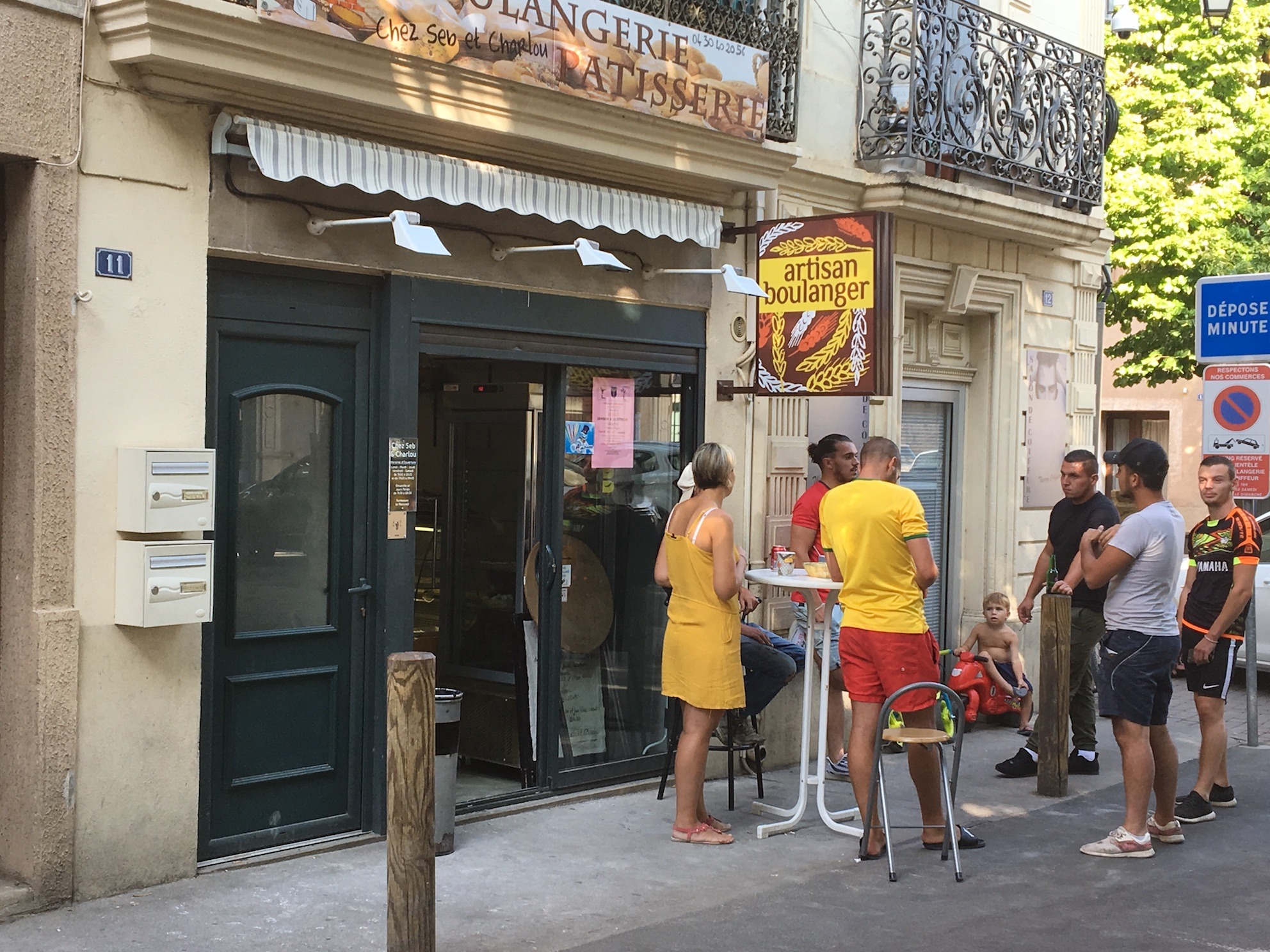
Here’s the boulangerie
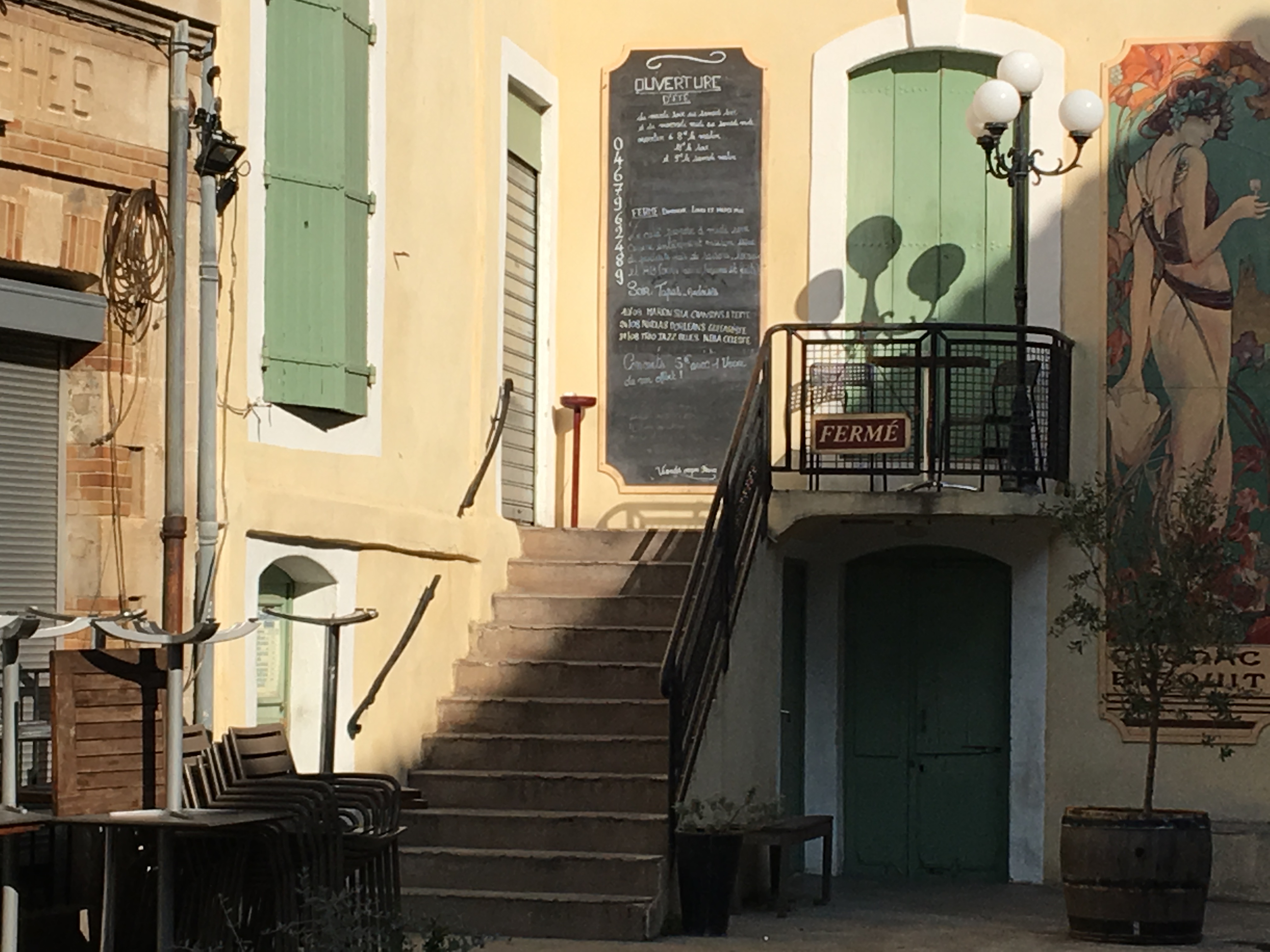
And here’s the café / bar, but it’s shut on Mondays.
but you can buy soft drinks at the Tabac/post office
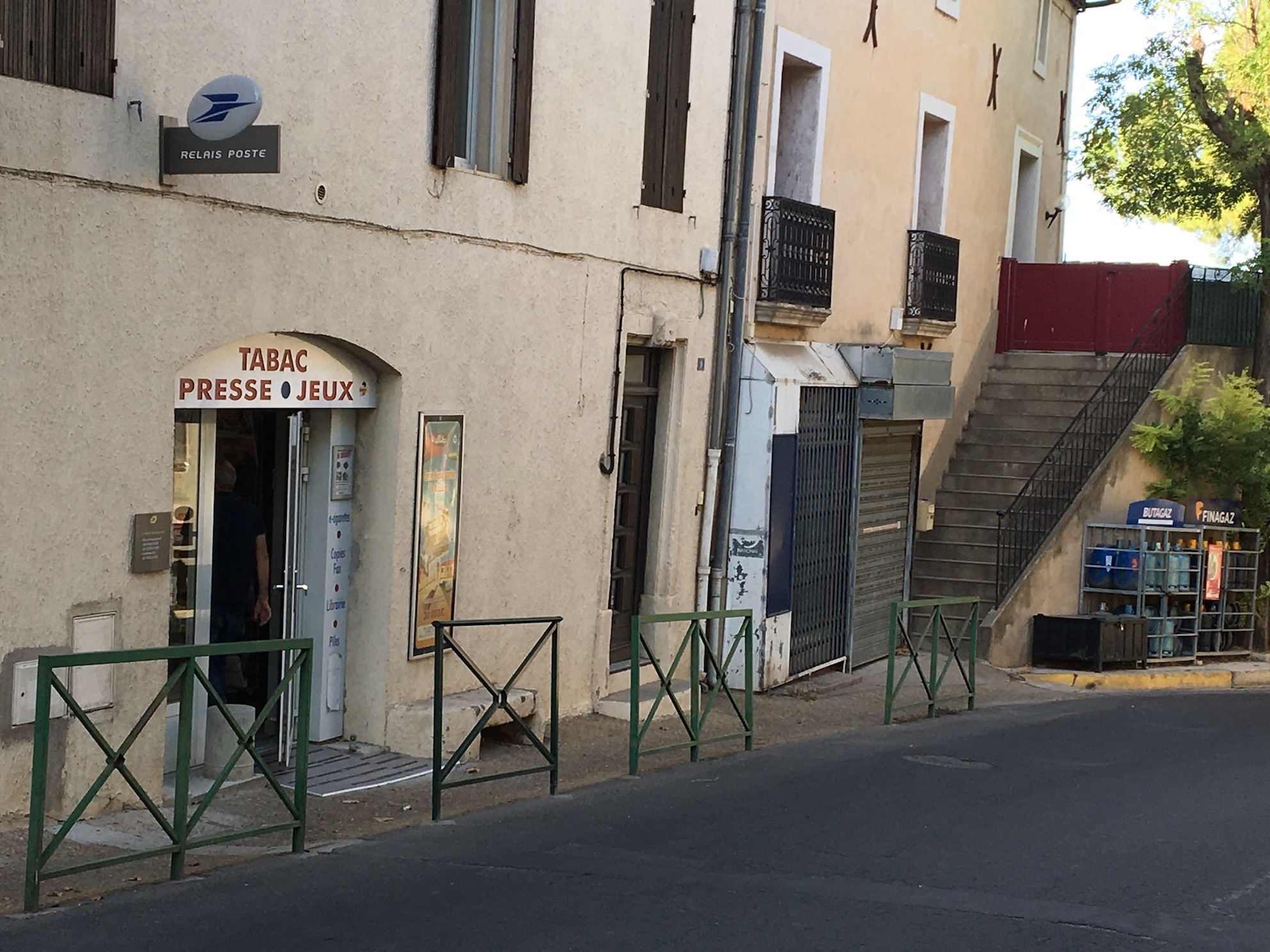
So you see, we’re a thriving little village (sort of)
For ten years now I’ve been going to Arizona in May to face sand-storms, mud, wind, rain, snow and even occasional good weather (I’m kidding: there was lots of good weather, but it’s the other stuff you remember). And the reason for taking such risks with my health and good humour is to be among several thousand other fools like me worshiping at the feet of Apollo, who must, I think, have been the God of Adventure.
It’s called the Overland Expo and it’s an assembly of all the daftest vehicles you’re likely to see, from millionaire multimogs to all-terrain strollers. I came to love the crew that runs the show, through all kinds of adversity. In particular the Land Rover guys, like Duncan and Andy and Graham and Chris, who thrive on mud and disaster. And I really admire Roseann and Jonathan Hansen who started the whole crazy thing.
Anyway, I go there to talk. That’s all I do. I used to do it with pictures like everybody else, but somehow instead of helping, the pictures just got in the way. For some reason people like listening to me. I don’t usually know what I’m going to say – one thing just leads to another – but this time I DO know. I’m going to talk about fear, and how to make it work for you.
The idea came to me when I took my bike out for a spin round my village today. It was only a short ride, but it was the first time this year and for me it was quite significant. The truth is that when I haven’t been on a bike for a while I begin to wonder whether I’ll ever get on one again. Every year it takes a little bit more courage to believe that I still belong on the back of this old warhorse. The problem is age, old age. Perhaps a few of you are already thinking about it. To stop or not to stop, that is the question.
I’ve just been visiting in England, meeting new people. It’s not long before they discover how old I am and sooner or later someone asks, very politely, “Are you still riding?”
Of course I say “Yes,” but I’m fudging it really, because that was last year.

I took that picture of my bike here in the garage under my house, where it’s been gathering dust for many months. It’s the same one that cost me a fortune and a friendship to bring to France, and I’ve hardly used it. I do a lot of work in my garage and the bike keeps staring at me. In two weeks I will be 88 years old. I’m very aware that many people would say a man my age has no business riding a motorcycle, so I have that to contend with as well.
“I’ll have to take it out soon,” I told myself, but I kept putting it off and I have to admit I was scared. I was afraid that when I got on it I wouldn’t feel safe, that I’d get the message, “It’s over”. For someone who spent many years on the road with nothing but a bike for company, that thought is ultimately depressing.
So today I took my fears out of the horror film category, and put them to use. I took the bike on the road and In no time at all I felt fine, and I’m good for another year.
You can’t seek adventure without taking a risk. And if there’s risk you’d be a fool if you didn’t have some fear. The trick is to make it work for you. I learned a lot about that during my four years around the world. We’ll have lots to talk about. I hope some of you can be there.
Nathan Millward, who is unquestionably one of my favourite characters, has been doing a gig at the motorcycle show in London for a number of years. It consists of putting people on a small stage at one end of this vast arena to tell stories about their travels. He’s run through most of the top attractions in the motorcycle world and this year was finally reduced to me. I played hard to get at first, but he said OK, piss off then, so I quickly changed my tune and bought the air tickets in a hurry, something I later came to regret.
Having called my bluff, Nate could have made me grovel but instead he couldn’t do enough for me. He fixed up a hotel right next to the show for three nights and got a mate of his, an IT wizard called Brian Goodbourn, to fetch me from the airport. He told me thrilling stories, all virtual of course, all the way into town. Here’s the picture he sent me to know him by.

The Motor Cycle News people who run the show believe in fruitful disruption, so they put our stage about 100 yards away from a live race-track, where small bikes roar around in circles at 9000 revs, and a commentator with a mike brings the races to a thundering conclusion about every fifteen minutes.
Of course, as seasoned travellers used to shouting at the natives, we easily rode above their interruptions. This obviously annoyed MCN so every now and again they would take a sports bike engine up to maximum revs right next to us at the McGuiness Bar, but nothing could dim the beauty of our tales.
However, things did begin to go strange. Our books were displayed on flimsy tables that were actually constructed from matchwood, and my books are heavy. I layed them out across the surface of the hardboard top to spread the load but eventually the inevitable happened. Somebody leaned on them, and the whole thing collapsed. Not a disaster, you might think, but I happened to have my hand under the table as it fell, and it took some little bits of finger with it, producing a liberal helping of blood.
The first aid station was a long way away – I would have called it second or third aid – but I am not squeamish. I soon found some paper napkins to mop up the blood and to wrap around my bleeding digits, but there was blood on the books and that did, at first annoy me. Then a realized that far from damaging the books, it might actually improve them.
Would not my most fervent fans be delighted to have a little bit of me along with the book, as a sort of sacred relic? When I announced from the stage that I had books marked with my own precious essence there were loud guffaws of mirth, but when I sat down again the bloody books were quickly snapped up.
My publisher, who happened to be visiting me at that moment was flabbergasted and gobsmacked. In all his years of marketing books he had never thought of offering the author’s blood as an inducement to buy. It will be the saving of many a small bookshop. There is no way Amazon can replicate it, and we can look forward to some bloodthirsty scenes at Waterstones and WHS.
Well things calmed down for while. About three weeks ago a fellow called Peter Ryder, who obviously also rydes, asked to buy a print of one of my pictures. I’ve never done this kind of thing in the past but I told him that if he cared to have a bunch of prints made at my expense he could have one of them for free, so now here comes Pete with a big cardboard envelope of gorgeous prints. I chose two pictures, printed A2 size – that’s 24” by 16”. This is the obvious one:

I did some smaller ones of this one too, at £8 a throw.
Then I had big prints made of this one as well.
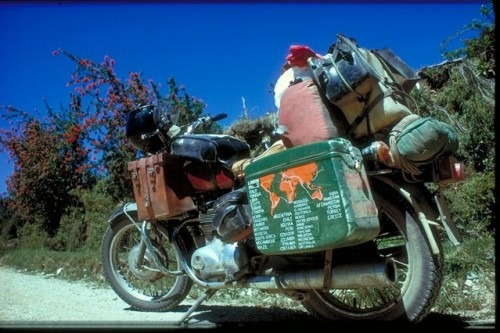
To my astonishment, the one with me in it sold out quite quickly at £20, but I only sold two of the other one. Curious because I actually prefer the one of the bike, but that just shows what a shy and modest person I must be. Anyway, this seems to be something people like so I’m thinking of printing some more. Let me know if you’re interested.
So things went along merrily until the show closed. Then came the dénoument, and it was swift and deadly.
Nate and I were strolling to the exit. Contractors were tearing down their exhibits. Suddenly a shot rang out and I fell to the ground. Several people standing around, including Nate, were certain I’d been assassinated and looked around wildly for the shooter.
As for me, I hurt my knee quite badly on the concrete floor, so it took me a moment to get up and reassure everyone that I hadn’t been hit. We never knew where that explosive noise came from, but I have one more reason to be glad to be alive.
That wasn’t the end of my troubles. My knee really hurt, so I had to get a cab to the airport. Then more stupidity. That air ticket I rushed into? I got the month wrong on the return half, so I got stuck at Gatwick. So I hastily booked an airport hotel, and again got the day wrong and had to spend half an hour on the phone listening to jolly Butlins-style music to get my money back.
The moral of the story? I must be getting old. But my blood’s good.
I’m off to London tomorrow, to spend three days at the motorcycle show at ExCel. I’ve never been to one before, surprisingly, so I can’t tell you much about it, but I’m the guest of Nathan Millward who rode a postman’s bike from Australia to England a while back and is one of my favourite people in spite of himself.
I’m pretty much guaranteed to have a good time. I only have to talk for half an hour each day, and that’s answering questions, so I reckon I’ll hold out all right. I’ve got books to sell and this time, just as an experiment, some big posters that people seem to like putting up on their walls. This is one of them.
As Brexit looms over me like a dreadful curse, every visit to England seems more and more like the end of a golden era. Everyone’s fed up with it, but I can’t help thinking about it.
A few days ago I was asked to do a TEDx talk at Warwick and I chickened out – sort of – partly because it sounded like a lot of work, but mainly because I’ve never been any good at doing scripted speeches and I’m getting too old to fail.
Still, I couldn’t help wondering what I might have said. The theme was “Architects of Tomorrow”, and since I am not an architect (although I love designing and building my own stuff) I assume the larger meaning of those who might be designing a future world. Well, I wonder if it’s not a bit ridiculous asking an 87-year-old to divine the needs of a future generation. True, Buckminster Fuller was still at it when he was my age, although the resemblance ends there.
My first reaction to the title was that it was rather hubristic. If there is one thing we should have learned by now it is that you can’t create an environment for the next lot to occupy and expect them to appreciate it. Look at the record. Look at what happened to those brilliant, colourful tower blocks we put up in the fifties. Look at Chandighar, Le Corbusier’s famous celebration of concrete in India, which the inhabitants have done their absolute best to disguise as a tent city by covering it with fabrics, posters, and graffiti.
I am not saying that these endeavours were without merit. They certainly served a purpose, for a while at least, but they do show how impossible it is to anticipate what large numbers of people in the future will find amenable or inspiring.
However, assuming that the theme of these talks is meant more generally than in terms of bricks and mortar, the thought that we could today imagine and create a better future for the next generation seems quite foolish. We have only to observe, right now, in Europe and America, the extraordinary mess we are making for our own younger generation. The sad truth seems to be that the calibre of the people we have elected to prepare for the future is simply inadequate.
In our own case, in Britain, the imbalance between north and south (to put it at it’s crudest) has been obvious throughout my lifetime, and yet our politicians have never seriously tackled this dangerous instability until finally one of them, in an act of consummate folly, put a match to the powder keg. Much the same blind arrogance characterises affairs in the USA, and there are echoes of it everywhere, prompted by the very difficulties that require us to pull together rather than fly apart.
If we are to put our energy and creative talents into anything, it must be into improving ourselves. We need to be led and instructed by better people, better politicians, and of course by that I don’t mean people with better qualifications or more expensive educations. I mean people with a grasp of the diversity and complexity of the world we live in, who recognise the impossibility of separating ourselves off from its problems and the fact that we are all in it together.
The combination of population growth, drastic inequalities and the information revolution is already having lethal consequences, and in combination with climate change will quite possibly lead to our extinction unless somehow we fashion better people to show us how to resolve these tensions.
The British have always been great travellers and on all my big rides I’d say I encountered more Brits than people of other European nationalities. How can that be compatible with the sense of a creeping xenophobia we see in Britain today? I don’t think we’re generally afraid of foreigners, or find them distasteful. From what I’ve heard it might have more to do with large numbers of unskilled workers behaving badly because they are trafficked and exploited by criminal gangs. In which case policing the gangs might be better than closing our borders, but that is a quite uneducated opinion. What I want to see is a body of elected politicians and government officials with the will, the determination and the humility to sort these things out. Those are not the people I hear pontificating about Brexit.
All my emphasis in the second half of my life has been on the virtue of exploratory travel, as a means to finding some perspective on life and an appreciation of the beauty of the planet we inhabit.
It drastically tempers the desire to acquire stuff or to impose oneself on others. It greatly diminishes fear and anxiety, and powerfully reinforces the belief that people, for the most part, share common values and desires, and that it is generally safe and usually a pleasure to be amongst them.
If such an idea were not utterly absurd, I would wish everyone could travel as I did and discover in themselves their own natural compatibility with humanity. I have yet to meet travellers who do not report on the warmth and generosity they are offered by people everywhere, and always inversely proportional to their wealth.
Perhaps we should send our budding teachers and politicians out into the world with the modern equivalent of a begging bowl before we entrust them with our future and the future of our children.
They wouldn’t be so concerned with acquiring wealth, shoring up their self-importance and intriguing in the pursuit of power.
The architects of tomorrow need to do most of their work on themselves, to head off the catastrophes looming over us and ensure that there actually will be a tomorrow.
Considering how much I have always loved Christmas it amazes me how little I can remember of the eighty or more I must have enjoyed, the plethora of presents that have been showered on me, and the sumptuous feasts I have gorged on. Christmas for me is a license to indulge in all my worst characteristics, laziness, gluttony and greed. And therein, perhaps, lies the answer. After three days of unremitting consumption how could I be expected to keep track of all the handkerchiefs, socks, scarves, ties, Ronson lighters, cuff links and cigarette cases, that were shared out between us.
The first Christmas present I can actually remember getting was a banana, a rare and precious object in war-time Britain, when I was 12 years old. The next Christmas that left a trace was in Germany, probably in 1948, when my aunts and my grandmother lived in a hut outside Hamburg, having been bombed out of the city. My aunts were given to loud and joyful singing and there were many cakes and biscuits baked with honey.
The next one to leave an impression was my first Christmas in the RAF. There were no presents, but by tradition the Ossifers – sorry, Officers served us lowly AC Plonks with our roast beef, Yorkshire pud and two veg. After that there is a great chasm of forgetfulness until I set off on my bike in 1973. Heaven only knows how many people I am wounding with these careless words, how much careful thought was lavished on objects that I have dismissed from my memory. I no doubt deserve what’s coming to me, which is puzzling because so far what’s been coming has been pretty nice. But there was one awkward Christmas on my trip around the world, that I can remember pretty well.
In late December of 1974 the high road across the parched foot hills of the Argentine sierras was hotter than anything I could remember, hotter even than Sudan. The views were spectacular. Foxes and armadillos crossed my path. There were also police checkpoints everywhere , playing their part in the army’s dirty war against left-wing dissidents. My papers confused them but they gave me no trouble. Then I came down to the main road to Tucuman where the sky turned grey and it started to rain.
The road into town was slippery with mud from tractors hauling sugar cane to the refineries, and the drivers looked tired and drunk, and filthy from the mud sprayed by car tyres, which soon covered me too. A tourist office in the central plaza found me a cheap hotel. I parked the bike outside and wandered around in the night looking for somewhere to eat. An immense open hall beckoned – lurid lighting shone down on billiard tables ranged down the middle, men playing dominoes down the right and a short order bar on the left dishing out steaks. A clamour of voices and the slap of dominoes on plastic table-tops echoed down from the ceiling. To me it sounded mechanical and joyless, a reflection of my own spirits which had been deflated since leaving Santiago and Malú four days earlier. The parting was as traumatic as it was inevitable. She retreated into her upper-class refuge and pulled up the drawbridge, and that was that. After being in the thick of love and politics, I was adrift.
When I got back to the hotel in Tucuman they told me a car had knocked my bike over, and they had picked it up for me. The boxes were slightly disarranged – nothing serious, but it seemed to fit into a pattern – and I took the bike into the hotel lobby overnight. I was generally nervous about the bike. I was riding with a new cylinder block and pistons, installed in Santiago, and I was afraid I might have pushed them too hard climbing into the sierras.
Christmas was just two days off and I had promised myself some relief from my worries. A few months back in Villaguay an autocratic elderly lady of the Anglo-Argentine tribe had promised me respite with her daughter Judy who was married to a colonel in the Ejercito del Norte – the Army of the North. They were stationed in Salta, just a day’s ride further north on my way to Bolivia. I had only to present myself at the barracks, she said, to be warmly welcomed and plied with the good things of life. Surely I could look forward to a few days of pleasant, undemanding distraction.
In the morning as I rode north the rain gave way to sun and stifling heat. I got to Salta in early afternoon and found the barracks quite easily. Everyone in Salta, it seemed, was very aware of the army. However, as I inquired at the gates of the garrison about the colonel’s wife I saw faces assume that peculiar stiffness people put on to hide embarrassment, because it turned out that the colonel was now Judy’s ex-husband.
Probably I should have sensed that the signs were not auspicious, but I was too invested in my dream of a Merry Christmas to turn tail and run. Calls were made and Judy eventually appeared. She was a tall, handsome woman with a friendly handshake but a distracted manner. It should have been obvious to me from the start that I did not fit easily into her plans but I couldn’t just let go.
“I’d better take you to my place,” she said, so I followed her car some way out into the country. The house was in a nice setting, but in a state of total disorder. I soon found out why.
“Tomorrow I have to move out to an apartment in town. We’ll have to find somewhere else for you. Will you be all right? I have to go back into town now.” And off she went.
I was beginning to get the message, but tomorrow could take care of itself. There was work I wanted to do on the bike so I took it into the garden and unpacked all my stuff.
We did our best that night to make friends. The maid cooked some good food, and I had rather too much Old Smuggler whisky which caused me to sleep late. I woke at eleven to find a note with a sketchy map telling me how to get to some people called Lloyd Davies for lunch by twelve.
There was no time to pack again. I rode the naked bike about half a mile along a dirt road when suddenly and implacably it stopped dead. At that moment Judy drove up wondering where I was. She did a good job hiding her irritation as I pushed the bike laboriously back to the house. Then in her car we went to lunch with an elderly couple of Welsh extraction, with a grown up son and daughter, Jeremy and Anne.
Eventually it was decided that I should stay with them that night. Jeremy drove me to Judy’s house where I started looking for the problem with the bike and after an inconclusive hour or two Judy drove up again to take me back to the Welsh house and in the car asked me what I thought of Anne because, she said, she and Anne were rival lovers of the same important newspaper proprietor in Salta.
When we got to the Welsh house it turned out that the Christmas Eve dinner was at another house belonging to a crusty old man called Tansley, so Anne drove me there and, on the way, asked me what I thought of Judy. I began to wonder what role I was expected to play in this amorous tangle.
Tansley’s house was big and splendid, but everything was running down. His most fascinating possession was an enormous billiard table, built around one huge and immensely heavy sheet of Welsh slate which he said had crossed the Atlantic three times. One time too many, apparently, because the slate was “sagging” and no longer served. I took it as a symbol of the way the whole Anglo-Argentine community, which had been so prosperous, was losing its grip. Conversation was stilted and archaic, and the young man, Jeremy, seemed particularly rooted in the world of P.G.Wodehouse.
On Christmas morning the Lloyd Davies invited a small group of Anglican missionaries to offer a service. Beaming relentlessly and evangelical to the core, they arrived with a little portable harmonium and performed a clockwork service in which the word of God was driven home with a sledge hammer. It did me no good. I was now completely without will or direction – no transport, no connection with my things, I just fell into a torpor.
Christmas lunch came and went. Then dinner. I assumed that sooner or later someone would either invite me to stay or drive me away. The parents were slated to leave for Australia the next day and the mother began to make it obvious that she expected me to leave the house too. I don’t think she thought me a proper influence. The daughter, however, insisted on the side that I take no notice. My uneasiness continued. The following day also passed in total inaction as the family saw itself off at the airport. That evening Anne drove me to Judy’s house to collect my things. It was too late to tow the bike but next morning a servant took me to Judy’s house to fetch it.
We had a long tow rope, and I fed the free end loosely round the forks to the handle bar where I could easily let it go. Just before we got back a woman in a small red car, obviously befuddled, drove straight over the tow rope. I told Jeremy the story, thinking it was funny.
“Of course, what you should do when being towed,” he said. “is to pass the line round some suitable central part and out to the bars . . . . “
I finally located the electrical fault – burnt out connections, as was often the case – and with the bike running again my spirits revived. We did eventually find ways to enjoy ourselves. I found other interesting people in Salta, including a geologist with a gold mine ,but I never met the newspaper proprietor.
It was good of them all to put up with me. Christmas is what you make of it.

Thanks to all of you who commiserated with me on the shipwreck of my mother’s crockery. After all’s said and done there seems not much I can do about it, being so far away from the action, but I still hold a slender hope of some small relief. However, I’m getting over it. Christmas is coming.
Speaking of which, those who care for me have been chastising me for wasting the opportunities of the season. They say, and I’m forced to agree, that my books make scrumptious Christmas presents but my shop is in disarray. Now that I live in France all the postage prices are different and so far it has been beyond me to make the shop work. I’m just going to lay it all out here in simple language. Of course I will sign and dedicate the books – that after all would be the main reason for getting them from me.
So, here goes:
All the prices are in US dollars. If your currency is euros, divide the dollar price by 1.13. If your currency is pounds sterling, divide the dollar price by 1.3
Jupiter’s Travels costs $25
Riding High costs $20
Dreaming of Jupiter costs $25
Rolling through the Isles costs $20
Now for the shipping
If you live outside Europe (USA, Canada, Australia, etc):
The postage for one book is $30
The postage for two or three books is $40
The postage for all four books is $60
If you live in Europe but outside France:
The postage for one book is 15 euros
The postage for two or three books is 16.80 euros
The postage for all four books is 21.50 euros
The Camera book is a heavy picture book and costs $50. There aren’t many copies left and it is a beautiful book, though I say so myself (it wasn’t designed by me).
Outside Europe the postage is $40.
In Europe the postage is 16.8 euros
The CD, Jupiter Returns, which has the whole day-to-day record of my second journey round the world, is available for $15. Und die CD habe ich auch in Deutsch.
En plus, mon livre “Les Voyages de Jupiter” a été réédité en France, et si vous le voulez signé avec dédicace, ecrivez s.v.p.
Please email me with your orders and any questions you might have.
tsimon@mcn.org
