News from Ted
The notes, exactly as I wrote them, going west across the Pampa.
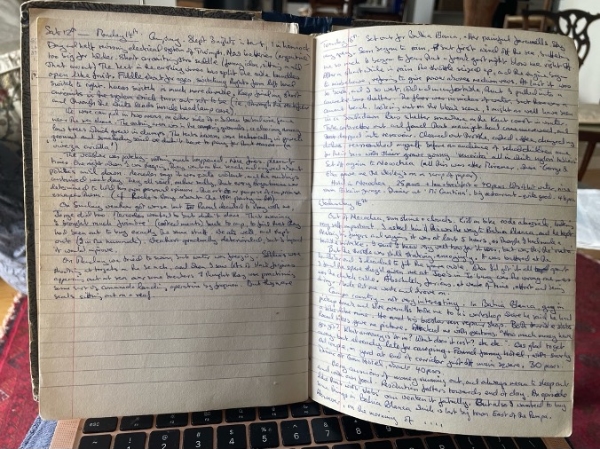
Tuesday October 15th
Set out for Bahia Blanca, after painful farewells. Sky very grey, soon began to rain, but first wind off the sea, buffeting me so much I began to fear that a freak gust might blow me right off. After a short while in rain the throttle seized up and the engine began to misbehave, refusing to give power above medium revs. At last, it was so bad and I so wet and uncomfortable, that I pulled in to a concrete bus shelter. The floor was in inches of water, but there was a cement bench looking out over the bleak scene. I might as well have been in a Southdown bus shelter somewhere on the Kent coast in winter. Took the carburetor out and found that main jet had come unscrewed and dropped into reservoir.
Cleaned out throttle, cooked coffee, changed my clothes, reassembled myself before an audience of school children come for their bus with their grave young ‘seňorita’ all in white nylon tabliers. Set off again to Necochea (all this was after Miramar where George and Elsie gave me the Wesley’s on a scrap of paper}.
[“George and Elsie” were an elderly British couple met at a petrol station, entranced by my adventure, who insisted I find “the Wesleys” when I got to Bariloche. Just one of those brilliant introductions I almost ignored.]
Hotel in Necochea. 25 pesos + tax + breakfast = 40 pesos. Lots of hot water, nice room. Bike in garage. Dinner at “Mi Cantina” – big restaurant, quite good, 48 pesos.
Wednesday 16th
Out of Necochea. Sunshine and clouds. Kid on bike rode alongside looking very self-important. I asked him if this was the way to Bahia Blanca and he kept shaking his fingers and saying it was at last five hours, as though I had made a terrible mistake. I said I knew very well how far it was, but was this the “ruta”.
But the throttle was still sticking, annoyingly. It was battered at the handlebar end. I decided to fit the spare cable. When I’d got it all apart I found the spare they’d given me at Joe’s in Jo’burg was the wrong one – as was the clutch cable. Absolutely furious at waste of time and effort and being dirty. Made the old one work and drove on.
Campo country – not very interesting. In Bahia Blanco guy in pickup truck and blue overalls took me to his workshop where he said he had a bike like mine. He and his brother ran a repair shop. Both terrible slobs. Raced bikes. Gave me picture. Attacked me with questions: “How much money have you got? What currency is it in? What does it cost? etc., etc. Was glad to get away, but already late for camping. Found funny hotel with surly old couple, in yard at end of corridor, just off main square. 30 pesos. Dinner at Gran Hotel, about 40 pesos.
Very conscious of money running out, and always mean to sleep out and cook food. Resolution falters at end of day. An episode like that with ‘slobs’ can weaken it fatally. But also I wanted to buy some things in Bahia Blanca which is last big town East of the Pampa.
However, on the morning of …..
Thursday, 17th October
It turns out to be a National Holiday to celebrate Peron’s first coming to power, and everything was shut. Soon after Bahia Blanca the Pampa began. First thorn trees, then scrub about three feet high. Stopped to make some breakfast. Sun high and hot and hazy. Constant wind blowing from NW across and against me. Occasional tumble of weed. Fences on both sides. Posts ten metres, stays one metre apart. Oil pipe alongside road, slightly raised. Grasses browned, few cows and a carcass or two. Hawks. Some small constructions here and there.
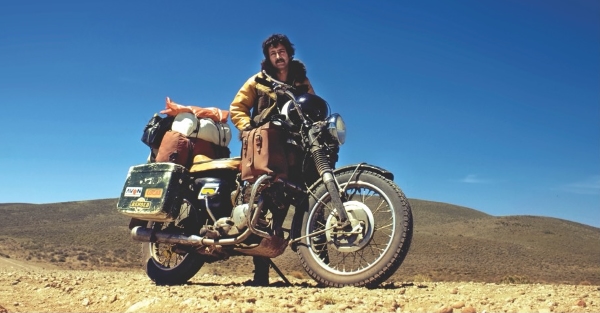
Somewhere west of the pampa
Pampa is 300 miles across and 600 to 900 miles long. La Pampa is name of province.
Came out of pampa into General Roca. First, trees to break wind for orchards. Then commerce. Italian names. Ribbon development. Road signs, shacks and urban debris. Stayed on camp site at General Roca. (after pandering to local police). Small patch of ground, littered and surrounded by slums, with camp building locked. Went down road away to restaurant for dinner.
Friday 18th
Left General Roca expecting to get near to Bariloche, but a little way along felt the air go from rear tyre. Only had the old tube – Nairobi to Buenos Aires (Pirelli). No new tubes came with the tyres to B. A. In changing the tyres I pinched the spare and perforated it in four places. Had to replace original with a patch and now left without a good spare. Took hours to do. As I was finishing a man drew up in has car and came over to talk. He had travelled on a bike some years before to Säo Paulo. He gave me water to wash my hands. Talked about the kind way he had been received and treated on his travels – said he thought it was because people all wanted to travel but, not being able to, did it vicariously. He was always ready to help and bringing a handful of banknotes from his pocket thrust them towards me with a smile. “Here” he said, “if you need it take it.” There was quite a lot. Maybe 10 pounds worth, and he certainly meant it, but I couldn’t take it. I could hardly feel that destitute.
How marvelous though to have a fistful of money thrust at you by a complete stranger. It cheered me up tremendously.
He recommended a camping site at Plottiers, small place 15 km past Neuquen, I set off again, it was now 1pm, feeling very hot and a little dizzy from the sun. Felt I should stop and refresh myself somewhere and also get some oil. Got to ACA station a little way along. They sent me elsewhere for Shell oil. Couldn’t find it, meanwhile engine behaving oddly, losing power rapidly. Eventually couldn’t get it above 2nd gear and was full of dreadful fears. Then back at ACA station it hit me hard. I had tightened the chain and forgotten to adjust the rear brake. Exactly what I did in South Africa. Felt a great relief and very foolish.
Shops were still closed at Plottiers, so I decided to ride on to Piedra del Aguila. More like desert now. Polaroid goggles came back into their own. Some fleecy cloud had formed in the south, and a thin veiling of white was spreading out fanwise to north. It consolidated, but further west I could see belt of duck-egg blue, and by the time I got to Piedra I was in sun again.
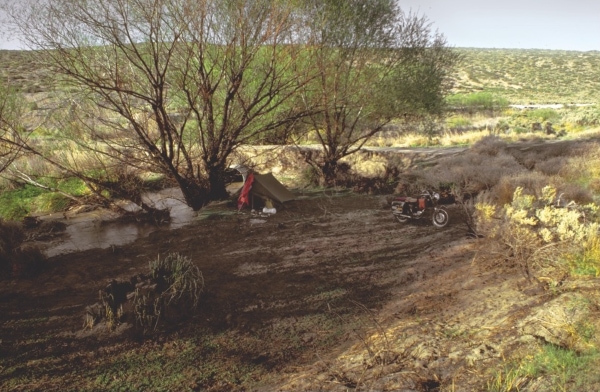
Camping at Piedra del Aguila
Next week, the glorious Andes open up for me.
In Buenos Aires an X-ray put my fears of lung cancer to rest; did some reconstruction work with a friend on the flying jacket which was worse for wear; and made friends with some students.
Friday October 11th
Yesterday had cholera and typhus jabs, in little clinic on the waterfront. Doctor entered the typhus on my card before I’d had it, so I had to have it. Man in suit (administrator?) said. don’t have typhoid jab because chloromycetin pills will cure it rapidly. Said I’d buy some. From there direct to Androgue to help Anniken finish the jacket. Sewing the thing together was difficult. I did nothing much myself but give moral support. She made a project of me and gave me gloves. Leather took time. Husband Dan O’Connellis 5 generations Argentine from railway workers. Have three daughters (in green school uniforms). He is sales manager for Dunlop. She is occupational therapist. Looks exactly like Twit [her brother in England who had a very pronounced aristocratic nose] which is disconcerting. But she is bright. Spent night there, then to Martinez to pack. Clinton and Stella have really become friendly. He was amused by the piece in El Pueblo in Villaguay, which said I was related to him. Gave him some books to take to hospital. [He was having a hip replacement.]
Raoul was on the phone, but I thought the weather not good enough to be worth the trouble of arranging to take him since he could go by car.
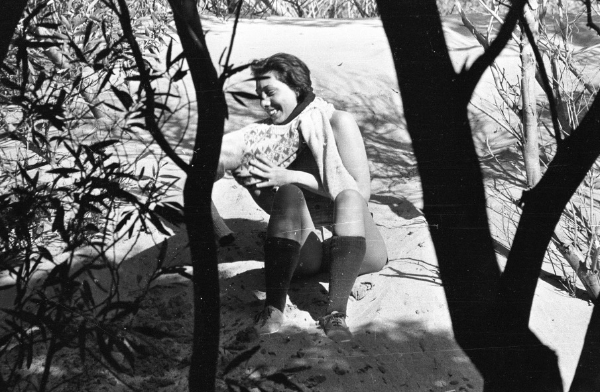
Hebe, one of my student friends, at the camp site in Mar del Plata
So I set off for Mar del Plata at 12. Got out of BA at 1.30. The road was very busy with weekend traffic all going my way. The people of BA treat the road to M de P as a racetrack 400 km long. They drive dangerously, to each other and specially to me. In the afternoon it began to get cold, and the last hour was freezing. I sang to take my mind off the cold. It worked. Got to M de P after dark but thought all I had to do was find Hebe’s flat. Got there to find a piece of paper stuck on the door saying they had gone to the Municipal Camping and giving confusing directions. I asked downstairs and was sent along the coast to the lighthouse. (Foro). After asking again I found it, but the camp site was big and full of people. I was lucky to find them (and to find the gloves which I dropped on the ground.)
In BA I went with Mercedes, Hebe, and Pacco to the Colon theatre for a concert. Claude Frank – Beethoven Piano Concerto No.1 and a symphonic piece. Histrionic young conductor, placid orchestra, perfect acoustics, said to be second only to La Scala. Afterwards to dinner at Basque restaurant with a sooty tree growing up in glass cage. Then to fashionable café on big avenue where everything was still going on at 3.30 am.
Also to assado at country cottage, and round BA on a Sunday. Mercedes (M de Menendez) in early twenties, reddish hair, pale complexion, slim. Jorge Fernandez her boyfriend lean, dreamy, light brown hair, wispy beard, his brother Pacco willowy, slightly camp without meaning to be, features compressed and extruding. Hebe tall, pretty, dark, full lips with corners on them in profile, strange nose, very broad at the bridge. Raoul Guerrero dark, intense, passionate, His girl – pretty, commonsense, working. Mercedes was very complimentary, and said the others also felt very impressed by me. Her praise was most eloquent and so, later, was Raoul’s. I don’t think it’s the views I express, so much as my behaviour which impresses them. Often, now, when the sympathy has been established and I am tempted to put into words the feelings and ideas that underly my behaviour I feel myself losing my way in generalities and facile remarks. Better to say less. It’s a great consolation to me to feel that my presence can have much value to others – I must be conveying much more than I realise by my manner – and, I suppose, by my omissions, when I see what a vocabulary of involuntary affectations young people use to keep their limbs and features busy.
I’m tempted to add that people in BA made less of an impression than people in Rio. Perhaps that’s not a valid comparison.
The British Embassy in BA – new. Great blocks of concrete, iron bars, bullet-proof glass. God knows what built-in security measures. Chargé d’affaires drives around with bodyguards.
Glyn Evans [from the embassy] strangely effete girl, insulated against experience. Finds Argentines stuffy and boring. We go to dinner at a noisy trattoria by the docks (it’s traditional) with another Second Secretary at the embassy called ––––– ? who IS boring and pretentious.
Saturday 12th to Monday 14th
[The small group of Argentine students I had come to know wanted me to go camping with them on the way to Bahia Blanca which was on my route.]
Camping. Slept two nights in tent, one in hammock. Day and a half revising electrical system of Triumph. New batteries (Argentine) too big for holder. Short circuiting thro’ saddle. (funny idea – sitting on all that current). The heat in the earthing wires has split the cable bundles open like a fruit. Fiddle about for ages switching lights from left hand switch to right. Lucas switch is much more durable. Keep finding short circuits in the system which turn out not to e (i.e. through the rectifier and through the white leads inside the headlamp case.)
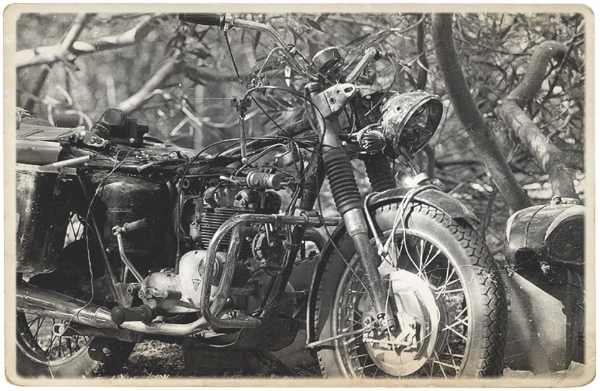
Electrical spaghetti – need I say more!
We were camped in two areas on either side of a broken barbed wire fence near the sea shore. The eating area was in the camp grounds, a clearing among low trees which grew in clumps. The tents however were technically on private ground and somebody said we didn’t have to pay for that reason – a “viveza criolla.”
[Conceptually, viveza criolla is a sort of cleverness, a cunning determination to defy authority and ignore rules, but do so sneakily, surreptitiously, and successfully. At its best, it is a playful deviousness, a tongue-in-cheek humour for all to enjoy; at its worst, it results in a complete lack of social responsibility, morality, and widespread corruption. A good description from an unattributed source.]
The weather was patchy – nothing much happened. Nice fires. Pleasant times. One night when I was sleeping they went on the beach and argued about politics until dawn. Mercedes says it was quite iolent, and the rumblngs continued next day. They all said rather sadly, that every Argentinian was determined to stick to his own personal opinion – the art, or purpose, of compromise escapes them.
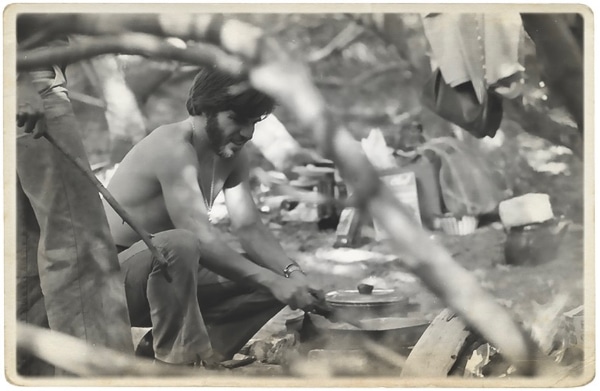
Here’s Raoul, serving breakfast – these were not my most brilliant photographs.
On Sunday the weather got worse but Raul decided to stay with me. Jorge did too. Mercedes wanted to but didn’t dare. That evening I brought much “fiambre” (cooked meats) back to camp, to find that they had been out to buy exactly the same stuff. We ate well and slept out (I in the hammock). Weather gradually deteriorated, but I hoped it would improve.
On Monday we tried to swim but water was freezing. Soldiers were shooting at targets on the beach, and when I saw lots of black figures appearing out at sea over the breakers I thought they were practicing some sort of commando landing operation by frogmen. But they were seals, sitting out on the reef.
Next week: Along the coast and acrosss the Pampa – throttle trouble in a bus shelter, and a hasty but very lucky introduction.
I started my journey with two canvas bags slung across the tank. Apart from catching fire off the exhaust pipe, they could obviously be improved upon.
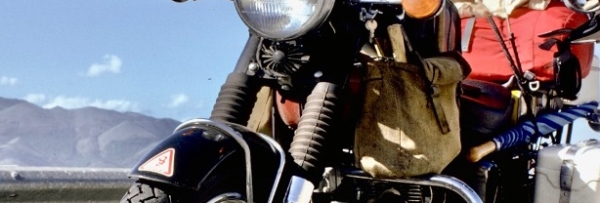
In Nairobi I got two leather boxes made – better, but still not great.
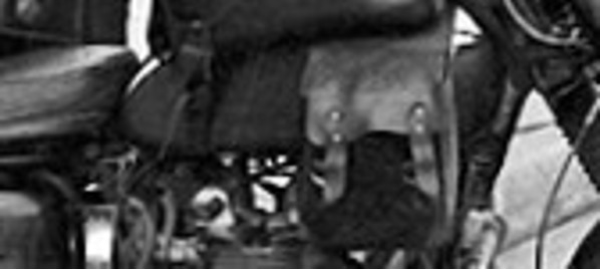
In my mind I designed bags that would really fit the contours of the tank and carry much more. Argentina seemed like a great place to have them made.
Thursday, September 26th
Weather was fine, Friday too. We went into Villaguay to buy things, to take Stella to the hairdresser and to see about leather bags. First leather shop was rather smart and formal looking, and I was quite glad when they said they couldn’t start for a fortnight. We went to another, called Quiroz, which was exactly what I had imagined. A workshop full of bits, straps, saddles, boots, scraps of leather, gaucho belts, all higgledy-piggledy. And old men with aprons and Dickensian faces surrounded by Dickensian machinery for stitching and punching.
Quiroz said he would do the tank bags in a minimum of 15 days. I knew it was foolish to involve myself in such a long wait, but I couldn’t refuse. He too my cardboard model and struggled with it My experience warned me that he would mess it up in my absence, but intuition made me feel safer with him than usual. He said he would probably charge 50,000 pesos. Or about £12.
On Saturday it was still fine and Clinton went in again with Babs to get more maize seed. But the weather was still fine, and Babs didn’t take her things with her.
On Saturday the storm started all over again.
We were cut off once more, this time for a full week, while about 4 inches of rain fell. One of Clinton’s bulls ws killed by lightening. (Last year a neighbour lost 32 cows all lined up against a wire fence and fried by the same thunderbolt. The whole village came out to carve them up). One of his pedigree bulls, the new one, developed a hernia. A milk cow gave birth far too young – still born, and possibly made cow sterile. Other minor irritations. Considering Clinton is going to have the top of his leg cut off as well, I think he puts on a good show. [I assume it was a hip replacement.]
We had some rousing discussions about “foreigners,” “communists,” “negroes,” good families and snobbery. Babs offered her creed in loud and no uncertain terms, continuing to the end whatever the interruptions and finishing up with a ringing “WHAT!” She is quite clear that anything disturbing politically is “the communists.” And anything else is the “parvenues,” like Armenian-Turks “who sell alcohol neat to Indians.”
The week is clouded for me because the irritation in my right lung persists unchanged despite having given up smoking. When I think about it, which is quite often, I cannot see why it shouldn’t be cancer and in consequence an early death. This is something so difficult to deal with at the conjectural stage that I shall write no more about it, but it is a heavy burden on me now.
Have been riding round the camp on “Negrita” – another dream come true. Second time much better than first, and I galloped. Picking mushrooms, opening and closing gates, watching the plovers defending their nests – divebombing, pretending injury, the full frontal frighteners, with red machine guns menacing from the crook of the wing. Name in Spanish is “Tero.”
Saturday, September 28th
Roads have dried out at last, but morning looks stormy again. So we all rush to Villaguay, me following after.
So begins a day of folly, gratification, pain and pleasure.
On the road out of camp I have my best bang to date. In a rut, going too fast, yawing left and right, then off, and the bike instead of sliding as usual, does a somersault and I can feel it going over me. I lie there thinking that this time I’ve really done it, in fact I say it out loud. “Christ, You’ve really done it,” in bitter distraction, sure that my leg must be broken. But I get up and the bones are intact. Not the muscles however, which are badly bruised. My belongings are all over the road, both boxes badly damaged, and emptied. Bike lies like an upended beetle, sputtering futilely. I switch it off and look at it. Lights destroyed, handlebars revolved through 90 degrees, but worst of all, the forks are twisted – rideable, but for how long. And there’s something odd about the cutch cable movement. Considering the havoc it doesn’t take too long to lash everything up so that I can go, cautiously, on to Villaguay.
There Clinton is waiting at the confiteria and starts immediately to tell me what’s on his mind about arrangements, not noticing the state of us until he sees me limping. We stand outside the coffee place for ages while he reads out letters that they’ve written (so kindly) to the porter, the maid, etc. [I will be staying at their flat in Buenos Aires for a bit.]
Quiroz, he says, is waiting for me at the shop – to try out the panniers. But I get a coffee after all and then go to Quiroz. He’s wonderful. I’ve made a mistake with legroom, but even so he says he’ll try to finish them by tomorrow. I have to go back at 2pm.
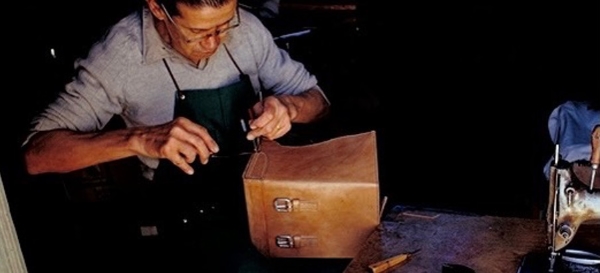
The afternoon was great. I got another piece of leather – the cow’s rump – which he says is particularly strong, and while Q was making the bags I made a new saddle cover, and finished it, with his help and advice, by 6pm. Marvellous. The hide cost 90,000 pesos (£2) and I still have half left.
Sunday September 29th
The idyll continues. Spent the whole working day with Q. He was actively encouraging me to make things. Gave me scrap canvas, more advice, and took me to his home for lunch. Wife is fat, youngish, Italian origin. She was a bit tipsy (on gin, I think) and had a mouth full of biscuit meal. She thinks that language difficulties can be overcome by getting very close and shouting. Has pretty daughter and handsome son-in-law, and doll-like grandson.
The sports reporter of the newspaper El Pueblo came into Q’s shop and gossiped knowledgably about ERP [The People’s Revolutionary Army attacking Argentina’s institutions] and how they were getting their arms and equipment into the country – including ist class medical stuff. Has myopic eyes, neat moustache, sports jacket, florid complexion, player running to seed.
Wanted to buy an entire cowhide for 70 pesos, but price turned out to be 70,000 pesos, or 700 new ones i.e. £15 – £20. Too bad. [I did buy one when I went back, 26 years later.]
At 4.30 Cinto’ arrived with Stella, only to give me a letter and my screwdriver and postcards.
The Plaza – church, post office, hotel, police station, restaurant, confiteria.
At 6.30pm police station unusually alert after the assassination at the hotel. Fat policemen in Khaki drill with sub-machine guns, standing to salute the flag as it’s lowered. At night the police whistle to each other across the square at half hour intervals.
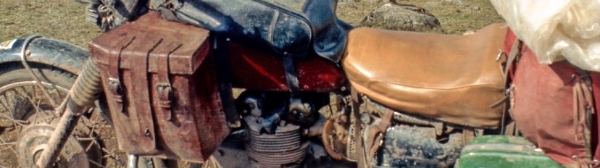
Quiroz made the two boxes, still on the bike today, and I made the saddle cover.
Given my appearance and eccentric mode of travel, it was always uncertain how I would be viewed in a new destination, but more often than not I was received as a visiting dignitary. So it was in San Ignacio.
September 12th. San Ignacio.
Lunch at Auto Club hostel. Then taken to parish priest – “Der Farrer” – José Marx. German missionary of the Stegler Order. Blond – thinning hair carefully brushed across on top, calm outwardly. Sitting on chair in front of mural painted on the convex curve of the back wall, which must be the outer side of the altar. It depicts a conquistador and friar standing back to back. The C. is looking over the Iguacu Falls, and the friar is holding his cross up to an Indian couple working in a field.
He thought his being sent to San Ignacio very significant. “Es gibt kein Zufall,” [There is no coincidence.] He has been trying to set up industries for the indigent Indian population to run for themselves – i.e. the 20% that the Eldorado German [whom I met yesterday] thinks of as wastrels. Has started a cooperative for extracting essence from citronella – previously in Puerto Rico did something similar but was sent packing to Rome by local bishop who thought he was causing too much trouble. He returned to convince the same bishop that he was doing good.
Was in Mexico too for a five-year period, knows Ivan Illich [a controversial priest at that time] but has little respect for him – says he preaches simplicity, poverty, and lives rich – takes his jet to USA for holidays. Has language school in Cuernavaca, very expensive, where he also indoctrinates.
Marx wants to do ‘Son et Lumière’ in the ruins – and bring tourists from B.A. Has built a guest house – sleeps 12.
Walked around the ruins admiring them and enjoying the calm but could feel no special affinity. Had dinner at hotel again – with two Berlin students. No bill. Slept well.
September 13th
Spent an hour next day writing generalisations into Marx’s guest book. Don’t know why. Doesn’t seem like a very useful thing to do. Better to have sent him a letter. Still, it was an act of gratitude.
[A friend in London had an uncle, Clinton Poore, with an Estancia near Villaguay, where I would be welcomed. A letter would be waiting at the post office in Villaguay telling me how to get there.]
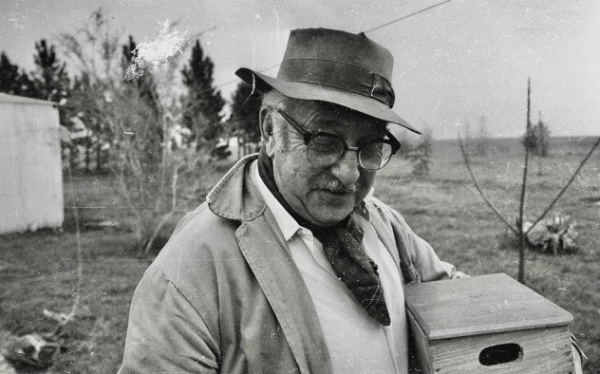
‘Uncle’ Clinton
Travelled on from San Ignacio to Posadas, Corrientes, Goya. Got first glimpse of really flat endless ranch land west of Posadas. Uninterrupted road – no villages, houses. Then, towards Corrientes more detailed landscape. Ran out of petrol one kilometre short of petrol station. Difficult to get lift. People afraid of being robbed (Cf. Clinton’s story about boy and girl dressed up to play tennis, who mugged driver.)
Decided that timing must be wrong. Stopped to change plate and plugs [I don’t understand this at all.]
Stayed overnight at Goya in “Sportsman’s Hotel.” Dinner at Colonial Restaurant. Prices about half of Brazil. More continental atmosphere. Tables and chairs to drink at, like café. Changed $10. Went on to Villaguay, by dirt road, but missed turning and rode around Bovril for a while looking for right road (No.6).
Arrived in Villaguay at 5.30. Letter was at post office waiting. Big military garrison with warnings about sentries shooting. Came out on dirt road to Estancia la Estella to arrive just before dark. Stella and Babs were there. Clinton was at farmer’s meeting.
Sunday 15th
Heavy cloud and rain. Roads impassable. All clay and greasy. Cooped up for three days, watching birds from windows. Cardinals with red faces, other birds like robins but most luminous red all over except wings. “Ben di vin” birds but bigger and called something else. [Pronounced Benjivin, the bird makes a sound like “welcome” in Portuguese.]
Wednesday 18th
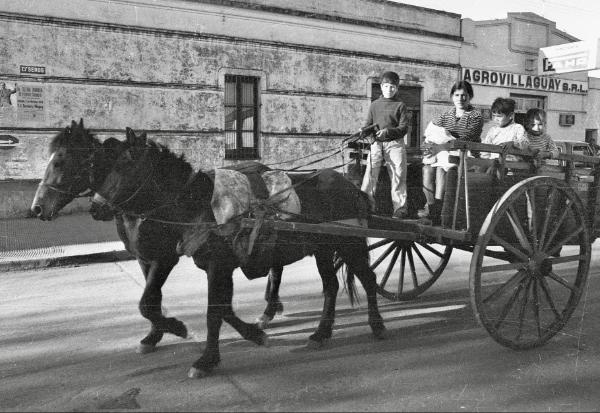
Went out to shop on sulky. Cloud was beginning to break up a little. Cart is little more than a bench slung over the axle. One horse in the shafts. And another alongside on the left. Trotted all the way, 8 kilometres, over the black earth roads through silent fields with copses of gum trees to break up flat skyline. Big fields of cows at pasture, reaped maize, ploughed fields. Owls swooping around in daylight, wild guinea pigs in long grass beside road. My companion was young man with ten brothers and sisters. He was very smartly dressed in brown jacket and clean brown bombaços and gum boots. The horses knew the way. Slowed down where road narrowed to cross drainage ducts, and in boggy patches where other carts had driven deep ruts the two horses couldn’t trot side by side and the one on the left was pushed out slipping and sliding back into the ruts. Both seemed very willing and always began to trot again as soon as they could.
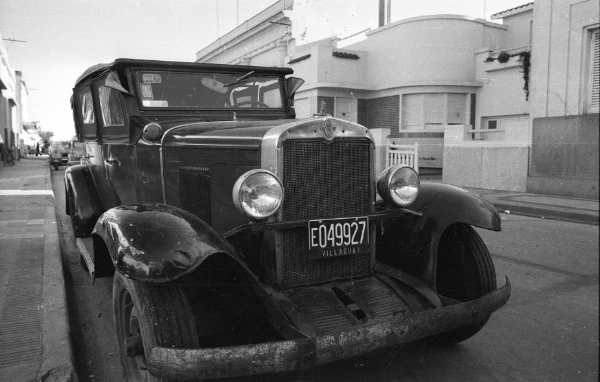
Ancient cars were favoured here because their big wheels do better in the mud.
The store had wooden fence set round it, and six horses were tied up, some with carts. In the shop it was very quiet. Some men sitting, a small bar on right of the door with tin sink to wash glasses. Men all wore hats of some sort and observed me curiously. Boy presented a list to storekeeper. I took a cognac. He drank Amargo, some sort of dark non-alcoholic drink.
The butcher was opposite. Beefy man with one eye. Knife and steel in sheath of kind all men carry. Cut down half a carcass of glistening red cow, and bundled meat into two sacks. Woman had a handsome face, and the little girl was pretty, as they all are. By the time we left the cloud had almost gone, lingering only on the horizon.
Next week, the birth of the ultimate leather tank bags.
I crossed the river and entered Argentina with a minimum of fuss and took the road south through the heavily forested State of Misiones, where the Spanish Jesuits had established some of their missions in the 17th century.
September 11th
Customs on both sides of Iguaçu are minimal. Not interested in my papers at all. What a contrast with Fortaleza.
Dirt road starts at T-junction with tar road joining Foz with Cataras and gives little trouble except dust for 30 kms or so. Ride south on dirt road through forest. Birds with split tails hover above. Prices about half, it seems. Loose stones on road, heavy red dust clouds. Strap breaks on tank bag. Hit a swarm of bees. Notice how slow my reflexes are, or seem to be.
Soldiers stop me at wooden bridge, but quite regular. This is obviously a timber producing area, just like second half of Paraná. Lorries loaded with logs pass by, there are cleared areas in forest, some also replanted with coniferous saplings. Pass a sawmill on right.
Before Eldorado I see sign “Permitido Acampar.” Not quite sure what it means and assume it’s offering a piece of ground on the right just before a bridge over a river. Across road is a bar/comedor where I could eat and I go across there to see if I could get some supper. Three dark and uncommunicative people sit by open window on far side. I ask about “jantar” forgetting that in Spanish it’s “cenar” They seem to understand and nod. They say I can camp here, pointing to grass at back with see-saw and swings, and landscaped terrace leading down to river. They show no interest or enthusiasm. I can’t help expecting some trick. Perhaps they’ll charge for camping. Maybe food’s rotten.
Down to river – Paraythini – to splash water on my dusty face. Into restaurant. Group speaking German. Place has huge wooden ceiling, unsupported. Delicatessen-type cold cupboards. More Germans. Dinner has German style salad. Blonde people rush in – men with widow’s peaks. Boys close-cropped golden hair. Then music blasts out – German ballads. I’m in Germany.
Talk to owner in German. Grandfather came after first world war. Also a bit of Swedish. Says 80 per cent of population of Misiones is European and majority are German, with some English, Italians, etc. German schools. He comes from Paraguay didn’t speak Spanish till he was 7 years old. Says since a year everything has gone to pot. Fixed prices, fixed wages. Wife has 60 hectares of the best oranges in the world left to rot because can’t afford labourers’ wages. Has to buy wine at 4.70 pesos and sell it at 4.50. Result, no wine. Says can’t get oil, meat, screws, all sorts of things. Says he hears that it’s the Jews in the South who own the basic industries – iron, copper, etc – who are running the economy for their profit. Believes that Argentina will split in two, like Vietnam. Agricultural North can’t work without Industrial South. Dictatorship is the answer. [He got his wish – be careful what you wish for!]
Happy to talk. Gives me whisky.
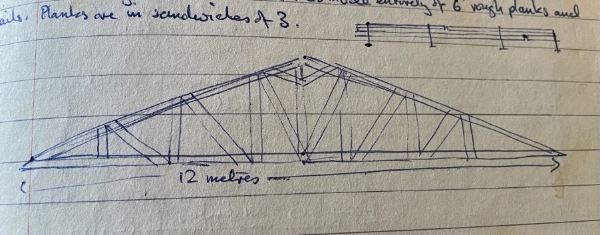
Next morning I was shown the roof. It’s made entirely of six -inch rough planking and nails. Planks are in sandwiches of three. [I made a drawing of it.]
September 12th
Shook dew off my tent and fly-sheet, packed up, shaved in empty motel room, had breakfast (5 pesos) and left for San Ignacio [Famous ruins of a mission]. Passed many orange groves, lemons, tea fields (like fields of clipped hedges). Lorries with sacks of green leaves pass by – probably yerba. Also oranges in trucks. Cattle on rough pasture, with shallow pools of water, Ibis and similar larger bird and many varieties of other birds, hawks, owls, kingfisher, plover, many waterbirds, storks (rather grubby, black and white) little birds all red or yellow with red faces, etc. etc.
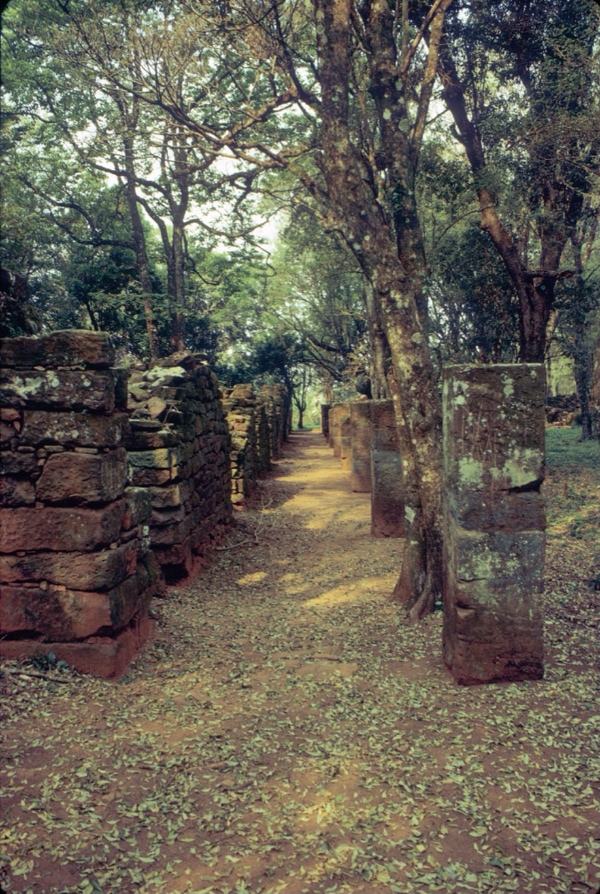
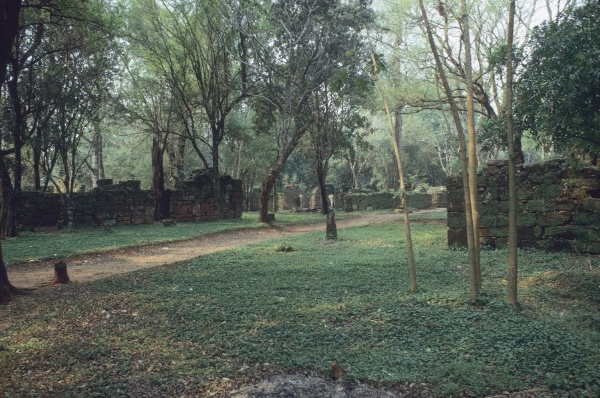
San Ignacio as I saw it. It’s a UNESCO world heritage site now.
Next week, my meeting with Marx. Don’t miss it.
September 10th, Paraná
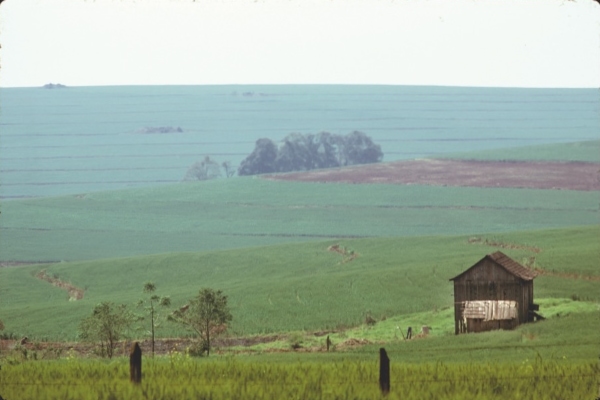
The deep rich soil of the State of Paraná
Travelled from Curitiba 350 km app. Find dirt path off road leading down to reaped maize field and clearing above stream with shed and slimsy wooden shelter of branches and veneer over heap of corn husks. Put my ‘rede’ [hammock] across two posts, tying it to crosspiece. Got out tin of feijoada [Black bean stew] and coffee. Went for short walk and came back just before dusk to light a fire, feeding it carefully since half the countryside seems to be burning and I don’t want to give the corn husks a chance. The stars are very bright and there’s one – Venus? – that’s bigger than I’ve ever seen it. Find myself thinking about Jo, recalling moments of our life together with sweet and painful clarity. I am always expecting a letter to tell me she’s given me up. A tremendous shooting star strikes across my head. Not falling away as usual but travelling towards me with a big trail and actually bursting above me – can see the fragments. What luck that must bring! Unless it’s a satellite, with people frying inside.
Hope my hammock doesn’t bring the house down over my head. Funny thought – could hardly have serious consequences. Unless freak accident. Instantly I see myself in dark struggling with my eye gouged out by a broken stick, screaming for help, staggering up to road, blood streaming through my fingers, to be run over by a lorry. I amaze myself, even, by the gruesomeness of the scene. I realise that my imagination always anticipates the worst and runs through the horrible consequences with practiced relish. I’m afraid to imagine beautiful sequences for fear of disappointment? Is this everybody?
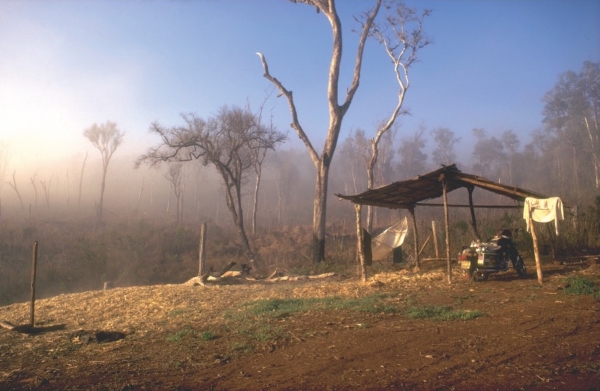
The flimsy structure held up my hammock and survived the night
Night is a series of problems. At first warm above, cold below. Eventually put Lilo under me as insulator and it works. But temperature keeps dropping. At 3 am feet are frozen (despite thick socks) and I have to get up to fetch long pants and long sleeves. But even these don’t get me quite warm again. There’s a freezing mist. Lorries keep going all night. How great it would be to get away from those grinding diesel engines. Noise carries so far and lights sweep for miles.
Morning watch birds through strings of hammock as they fly down to peck at the earth. Oh, the mice in the corn husks are busy at night too, and once a bird flew down to attack them. Its black silhouette rushed past my face but I couldn’t see if it had struck successfully.
There’s a small bird of deep dusty red with crimson cap – a very plump biggish bird with a fine pointed beak – hops along like a big red India-rubber ball. Then there are the two wood-peckers sitting on a stump and looking at me, perhaps nine inches to a foot long, yellow head with markings, yellow breast, mottled plumage, looks grey from a distance. They work on a tree over my head. Flocks of blue birds and green birds flap about, and smaller yellow birds swoop down from the ‘blob’ tree. Can’t get near birds with the camera. Despite trucks it’s so peaceful and interesting. The colours and shapes of things feel hospitable. Sun breaks up mist by 8am and by 9am it’s hot.
200 miles to Iguaçu. One stop at a fruit stand. Group of road workers (DNER) talk to me. “Every day is Sunday for you:” Tell me of nice site with good water at Km 12 “out of Iguaçu” and Supermercado Moringa where Japanese will sell me pesos. Go there. No pesos. Buy meat and butter and condensed milk. Go to site and make dinner. Water is good, as promised, but people have used fountain as a latrine. Want to sleep there but decide against it. Too near road, and prospect of 12 hours darkness drives me to motel. Not bad at 30 crz but not enough bedding. Paraguayan boy speaks a very clear English. Says he learned it for three months.
September 11th
To Iguaçu Falls. Spectacular. Breathtaking. Leaves me in a strangely depressed mood. Was there only an hour taking pictures – composites – thinking “all this way to spend an hour.” But that’s all it takes. After that the impact lessens.
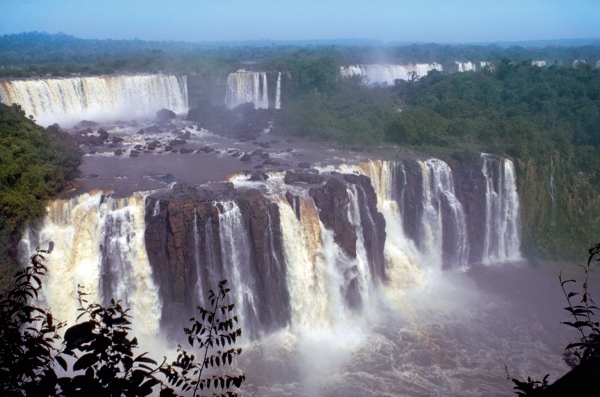
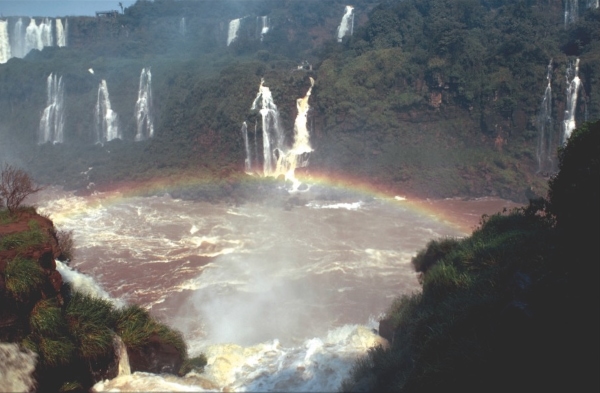
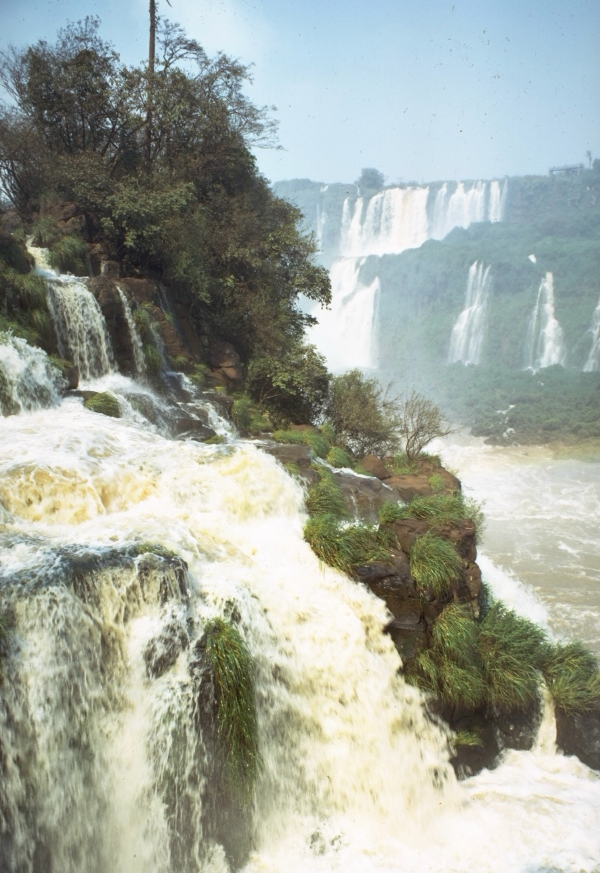
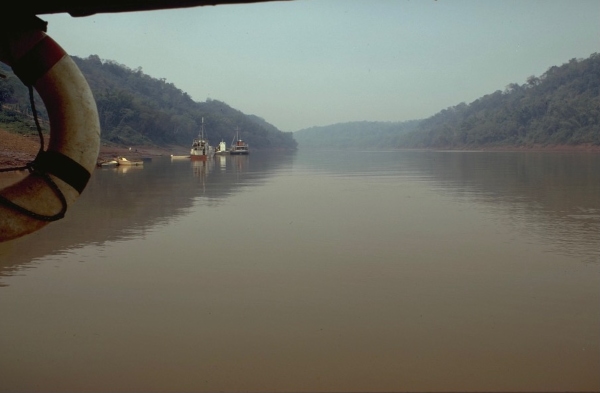
After the turbulence of the falls the river crossing was unbelievably peaceful and calm
Should have gone on to the Argentinian side but couldn’t bring myself to do it. Why? Because it’s not what I need. Instead ride south over dirt road into Missiones.
Missiones is a state of Argentina. That afternoon I found myself in Germany. You’ll find out all about it next week.
6th September, Sâo Paulo to Curitiba
Probably the nastiest ride of all time. At first the dreaded traffic didn’t bother me. Then came fog (or cloud), rain, wind. And it went on non-stop for 8 hours. Cold. Throttle and clutch cable seized. Couldn’t see – and froze.
[I didn’t record the diesel that dirty trucks spewed over me, though I still remember it very well. The road climbed unexpectedly high before coming down again.]
Arrived in Curitiba – for want of anything on the way – ready to spend a fortune to find warmth and shelter. But two men in a VW stopped and talked and led eventually to beautiful hospitality. Warm shower, bed, food, conversation. Fat man is drug salesman, dapper man is sweet maker. Town is, they say, one with the highest all-round standard of living in Brazil, and also most costly. Very civilised town centre (as mentioned in Brasilia).
Went out on 7th September (National Day, Saturday) to see city and then to meet “moto queros” as they call themselves, and to oil my cables. Also repaired damage to right pannier. Discussed politics. These men are solidly behind the regime, convinced it is doing the only possible thing.
Now I’m in a land of plenty where almost every family, it seems, can have its share of modest comforts in the bourgeois style, and a little left over for luxuries. Marcio earns 65000 cruzeiros a month from Glaxo. He has been doing this work for twelve years, previously for Italian firms, but he puts Glaxo above them all. He met his wife 18 months ago at the Rio carnival. She was from Curitiba and her four sisters and two brothers nearly all live there, so he came to live here too. They have a four-room flat, polished parquet floors, electric shower (which always just misses the temperature you’d like) and rather than spend on furniture they have a foam rubber slab on the bedroom floor, and bean bags in the living room, but that’s because the flat is not theirs, and they want one of their own.
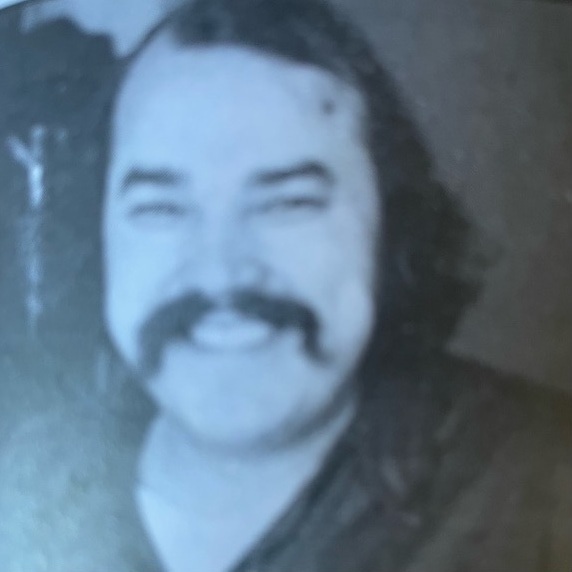
Marcio in 1974
Unlike the Rio rich he makes do with one of the whiskies that pretend to be imported but are firmly called by everyone “Nacional Scotch.” E.g. “Old Lord” blended whisky – malt whisky distilled and bottled in Scotland 12 years ago. Well I’m no hand at scotch at all but I’m not going to swallow a 12-year-old malt at £2 a litre when a bottle of Johnny Walker goes for twice the price.
Also on the drink shelf is an elaborate carton in blue & gold armorial motifs advertising its content as Pinwhinnie Royale Scotch Whisky, and inside is blue cloth bag tied with a golden card at the top containing a smallish bottle _ but by the feel of it the bottle is empty. There are cigars from Bahia in individual jacaranda sleeves, a gift from his father, each costing 25 crz he says. Very good I admit. And electric Japanese clocks. And o ktail sticks from Minas of twisted silver and coloured stones, and a trophy from Glaxo and a wooden carnival whistle and three special looking bottles of wine, one with label attached, and some glass and silver. On the table there are pine cones and a red brown polished nut that looks like a small, closed cone but isn’t – a kernel rattles inside and it comes from a beach near Rio.
There are few blacks down here and there are jokes about them though nobody admits to prejudice. There’s that smell though!
The men dress warmly and fondle their paunches through jersey knitwear. I can scarcely remember a paunch in Ceara. Women are cosy, the weather is cold, but there’s no indoor heating. People go around complaining of cold but looking healthy. There are sparrows on the rooftops and pigeons in the squares and the whole thing is just what you’d expect from a fusion of German and Northern Italian, but strong civic sense.
The Moto Queros received me in a circle specially carved out of the mosaic stone paving at the city centre where the Rua dos Flores is a pedestrian street. And some very nice light metal and acrylic structures have been put up for coffee, phones and information. They sat on their Suzukis – 550 ’75 and a 550 ’74 and a 380 GT, all three-cylinder machines, gleaming, all sitting still as museum pieces, men trapped in an unfulfillable dream. It seems a pity to say so, but few motorcycles get the use for which they were designed.
Marcio said: “It’s easier for me to like what I do than do what I like.”
He is from Campo Grande in Matto Grosso. Family owns huge area of farmland. His full name is Marcio Mascarenhas Grise – Albaneira de Lourdes is his wife.
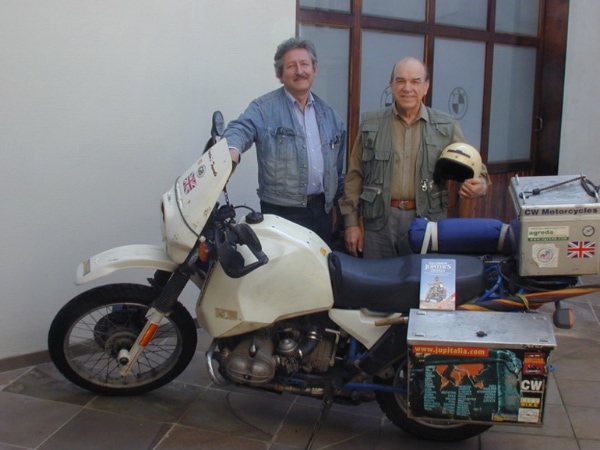
Marcio and me in 2001
[Before I left them to go on to Argentina, Marcio insisted that I exchange helmets with him. I wasn’t too keen on his rather heavy black fibre helmet but I couldn’t refuse.]
[I returned to Curitiba in 2001 and found him again, now in a palatial penthouse apartment. In the meantime, he had become fairly rich, enormously fat and then, after a near-death experience, quite slim. To my astonishment he and Albaneira had preserved my helmet like a museum piece, and he showed us around town with great pride. Unfortunately, all the stress he had put his body through was too much, and he died not many years later.]
I was in Brazil for 9/11. I watched it on a hotel TV in Receife. Because my Portuguese was poor I thought, for a while, that it was another disaster movie. It felt rather remote. People I talked to later were sad but had mixed feelings.
See you next week.
Friday, August 30th
My last night in Rio. Lulu, Holly, Esmeralda and Tito, and Gill Anthony gathered at “Amigo Fritz” to say goodbye. Shrimps and corn. Old sayings. Antonio came too. This morning left Rio at 7.30 (saying goodbye to Jandira for second time).
With Antonio – his clutch cable had broken, my front brake was still soft. We made a sorry pair in the Rio traffic. Saw Copacabana, Flamengo, for the last time. Then up the mountain to Petropolis where he said goodbye. We’d had breakfast and I took pictures on his Pentax. Was tempted to call on Lulu again in Petropolis but didn’t. Climb to Petropolis made engine oil smoke, didn’t realise I was pushing it so hard. 3,500 feet going up non-stop.
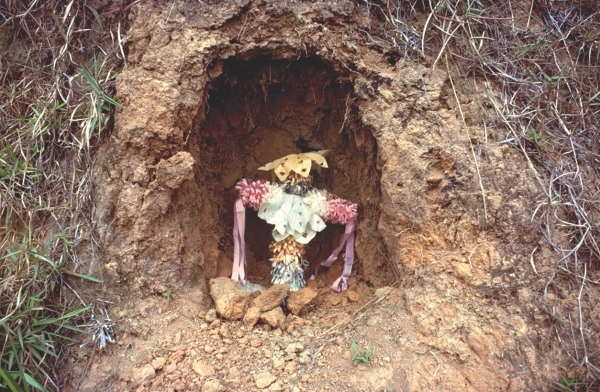
A roadside shrine
Determined to sleep out in hammock, and from 4pm looked for suitable place. Eventually found rising ground beside road to take bike off the road. Fell over once. Camouflaged bike with branches, and slung ‘rede’ [Portuguese for hammock – pronounced like ‘hedge’] between two trees at top of clearing by cow fence. Cooked tea, farofa and bananas. Heard crunching sound behind me, like distant cart crossing gravel. Looked round and saw great blaze of crackling grass and brushwood. Thought it would engulf me too but much relieved to see it was on the other side of the road, with wind blowing away. Took great care with my cigarette ends. Night was successful on the whole though traffic was noisy and got chilly in the morning. Trouble is still that the darkness lasts too long. Need either light or company.
[I wanted to explore inland before going south, and headed for Congonhas, a famous church.]
Saturday, 31st
Got up at six. Dawn was a lovely rosy spectacle. Little blue hummingbirds came by – and stopped a while. Called “kiss birds” in Portuguese. Enchanting and apparently unafraid. Rode on to Congonhas – lovely church, painted wood, like circus or fairground. Very joyful – birds chirping and flying under the ceiling. The 12 Apostles are quite striking and much more lively than most such sculpture. The stand around in an almost naturally haphazard manner (and remind me a little of Greek – Roman – Cyrene). Bought a stone egg, a soapstone carving and five coffee spoons with stones in handles.
On to Ouro Prêto. Bigger place. Found some students of geology, or mining, and they let me stay the night. In evening the square is lovely. Met two characters in front of top church where paintings and quick jewelry are sold. Also boy who does prints of town, which he also sells in Rio and Bahia as well as here. Says it’s a living. Other character with a bit of Paul Winstanley about his face and, I imagine, something about his circumstances told me stories about the town. The two churches with the same name. One for the whites, one for the Africans. And how the saves were freed by a slave who first bought his own freedom, then made a lot of money and came back to buy freedom for the others. They in turn repeated the process so that many were freed. They built a fortress to protect themselves of which the walls remain, complete with defensive apertures. Other character made jewelry and spoke dreamily. Another squatted and carved flutes from bamboo.
Saw a squad of DOPS [drugs] police arrive on Harley Davidsons. Geological museum has solemnly draped coffin containing the cinders of a Brasilian geologist (Goreix?) who died in France in 1919 and was exhumed in 1970 and sent back to Minas. There are xeroxed copies of the order to exhume and a sort of waybill to transport the remains to Brazil. The Brazilian and French flags droop behind the coffin, very theatrical and not unfunny.
September 1st
From Ouro Prèto to Tiradentes. San Jâo del Rei. Had my boots shined after 51km dirt road. Saw other little humming birds, this time black and white. Passed men on horses with wide-brimmed hats, Spanish style. Determined to sleep out again. Found a small dirt road and followed it. African talked to me and suggested the station where a quiet telegraphist, all alone, let me sling the hammock over the station platform. After rice and sardines, made tea. Slept very well. Hot milk in the morning. Quiet on the station bench at night. Then went back to “posto” on main road to drink some beer and fetch fresh water. Long walk through empty land under moonlight. Train came through at 3am but hardly disturbed. Occurred to me, on dirt road, to call my novel “A Private Staton.” I had no idea, of course, that I would sleep that night in a private station. [Chronology is hard to follow now.]
Have spent very little money but bought 33 cruzeiros of souvenirs in Congonhas.
[Money was an important factor. I had always intended to travel in poverty, believing that would be the best way to understand the world around me. There was always tension between me and the Sunday Times because, being what they were, they usually chose the most expensive way of supporting me (tyres, parts, funds, communications) and then complained about the cost.]
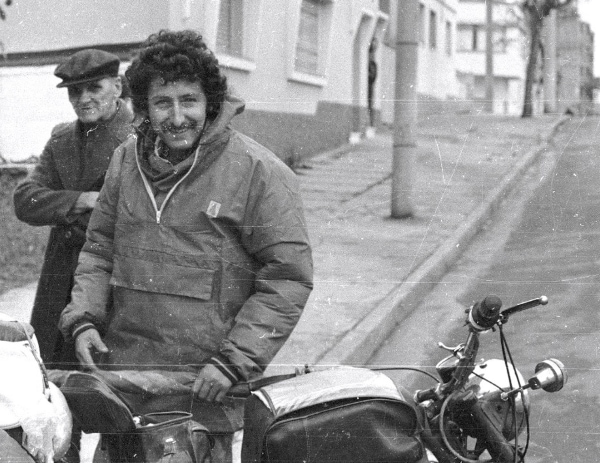
September 2nd
A colder day. Got to Sâo Paula at 3.30. Found José do P. without too much difficulty at 4.45. [I was planning to meet with my Egyptian friend, Amin Simaika, and his brother so that I could hand over the sword I had been carrying from Cairo.] The brothers drove up at 5. Extraordinary, really, to see Amin, looking the same, with pop eyes, burnished face, little moustache over the lip. Brother very hospitable, with loving Brazilian wife. No sooner settled than phone call from Rio. Lulu rang about telegram. Valerie Walker would bring it, together with other things I stupidly left behind. Everything sorted itself out too well. We talked endlessly about what the brothers would do in Brazil, about making money to escape from Sâo Paulo to a country place. Aziz works at three jobs a day – used to work five. Is a radiologist. Wife is Marilda. Have two apartments.
[As well as the sword, he also entrusted me with $2000 cash to take out of Egypt for him.]
Amin sent $35,000 by strangers like myself, in similar amounts, and lost only one amount of $200 sent with a man he had known for 20 years. Still very nervous, agitated. Noticed for first time that he expresses himself physically in very Egyptian poses, body bent slightly forward, arms gesticulating, but in frozen frames and with something of the quality of figures on a frieze. Looks always run down, but when I challenged him to run up hill his legs pumped him up much faster than I could go, and there is much power in that tortured frame.
Aziz described humorously his search for a wife. Recommendations. Even a marriage bureau.
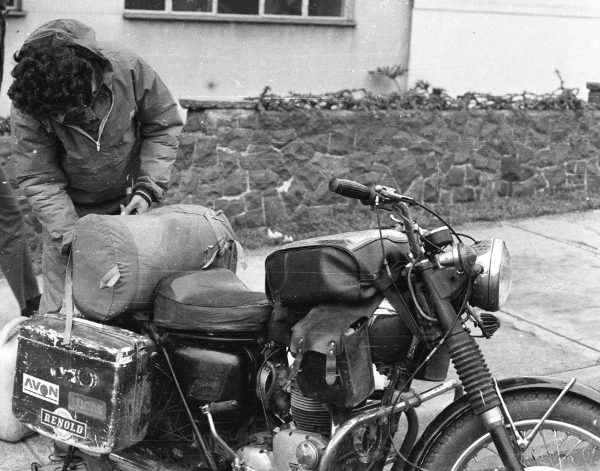
Tank bags, type 2, made in Nairobi. The final version was built by Sr. Quiroz in Argentina
That’s all for now. I’m off to London this weekend for a fancy do at the Royal Automobile Club., and then to a gathering of the faithful at Gieboldehausen so I might have to miss a week. But I will be back.
August 21/22
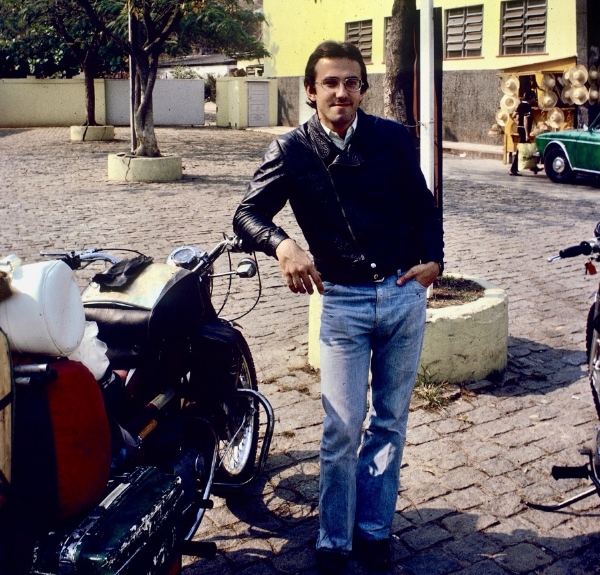
Full-sized motorcycles were extremely rare, and extremely expensive in Rio in the seventies. I only met one rider, Antonio, and we became friends. I think his was a Norton.
Somebody in the military government must have thought it worth trying to persuade me that they were the good guys. They booked me two nights at the Hotel Nacional and bought me a bus ticket there and back. The bus was very luxurious, better than a plane, 16 hours overnight and I arrived in the morning. Brasilia, built from scratch by Niemeyer, was quite bewildering. This is what I wrote.
Down, round, under, up, round, over, W/3, L/2, Zones, Sectors, blocks, giant inhabited sculptures loom up, swim past and drop again into the great areas of empty lawn. Here’s the gymnasium, seats 10,000 people in pretty coloured plastic bucket seats for prize fights, ice shows, Johnny Mathis. Here’s the church – immense cube of blue glass panes and fluted ceiling. Here’s the cathedral, a wigwam of concrete spatulas supposed to represent the crown of thorns, with no pews, only a scattering of marble blocks in one area and metallic angels floating in space, picking up distant laughter like a vast ear trumpet. Here’s a residential area – three kinds of apartment – cheap, middle and expensive, from 800 Cruzeiros to 3000 a month. The government housed in regimented rows of greenish dominoes glowing like sophisticated electronic hardware, a guard of honour for the twin towers that zoom up at the end of the avenue, seat of the congress.
“Small politicians with no specialised knowledge. Criticised for being unable to debate sensibly with the technocrats..”
[I meet my interlocutor – a high-ranking diplomat.]
Under a triptych depicting a mysterious cataclysm, a comet or saucer swims fish-like over a Latin township of spires and compressed humanity, releasing a gloomy doom, soaring away from the rubble and fleeing insect figures, strange background for a conversation with a diplomat imbued with the tough unsentimental talk of technocratic dictatorship.
“This is a government supported and protected by the army. Oscar Wilde said there is no such thing as a good or bad book – only well written or badly written. We cannot afford discussion and debate of moral issues. It’s a luxury we cannot afford while people are starving and dying.
“A third of the population is illiterate. We hope to end this in ten years. The real revolution was in 1972 when the budget for education was 4% of GNP; [I think he meant GDP] and the military budget was 2.5%. but still it is not enough.
“We have not abandoned land reform, but it is no use taking a peasant from the North-east and putting him down on a strip of land in Amazonas without help or advice. In on or two years he will turn his land into sand.
“It is not really land reform. We call it colonisation. Do you know how much all this costs? We must find the money. So we are doing everything to make the south richer, so that money can be used to develop the north. We are in a capitalistic world and cannot escape it. Everywhere the world is becoming more capitalistic. Russia. Even China. ‘And the capitalistic countries are becoming more socialistic. I believe the world will eventually become one country through capitalistic interdependence. That is how the poor will be saved. But it will take many generations.
“We work very hard here. We take no vacations. For me or anyone else here to take a month’s vacation is unthinkable. While there are poor people we have to think of them.”
Could you compare Brasilia with the pyramids – the ultimate in technology, aesthetics and grandeur, raised over thirty million illiterate peasants? Here the monument is dedicated to them, but it is still the pharoic family in residence.
“Perhaps they will be proved right,” says Her Majesty’s First secretary when I meet him. “Brazil is making great economic progress. Has a big foreign debt but has no difficulty servicing it. We’ve got Germans, Chinese, Japanese and Arabs all wanting to invest. Argentina used to be the most advanced country in South America. Since I went there 12 years ago it has stood still. Now Brazil is ahead. There is no end of discussion and debate in Argentina. I remember a friend rushing up to me at election time in BA, his eyes glowing. ‘I’ve just formed a party,’ he said. It was the 19th party to put up candidates. The Brasilians tend to look down their noses at Argentina.”
(Nucleo Bandairante)
The first buildings of Brasilia still stand a few miles outside the city proper. Made of wood, two floors high, like frontier town. Other satellite towns have sprung up, in the case of one growing around existing town. Brasilia shimmers in a bowl, distantly, like futuristic image.
“Where are you from?
“Maranhao, Ceara. We like it here. Prefer to live in Brasilia. Got a good job. Driving for the ministry.”
“And you?”
“I’m from Goias, originally from Austria. Study Geology. Brasilia is lovely to look at but terrible to live in. Nothing to do but work.”
This sculpture is called “A Woman and her Shadow.” Bronze figure pursued by black ghost writhing with tentacles. The sculptor had cancer and knew it. Here’s another of hers. “Mermaid and Octopus.” But finely made.
The room for ceremonial treaty signing in Itamaraty has an 18th century jacaranda table belonging to Brazil’s first diplomat, bowed down at the centre by the weight of many elbows, many treaties.
This is the biggest unsupported ceiling in South America, and this is probably the biggest tapestry (although there’s one at the UN building, isn’t there?)
Itamaraty stands in a cool green pool cradled by thin concrete arches – delicate and beautiful – the showpiece of the government – by Niemeyer.
At the Nacional Hotel the hunters come to breakfast with James Bond briefcases (still?) all geared up – it’s in the way they walk, stand, talk to each other, all unnaturally bright.
And at night, hunting the hunters, in evening gown and green velvet smoking jacket, two society artists shamelessly advertising their appeal with clippings from featherweight journals and lists of featherweight patrons. Lord and Lady Antonia Fraser, Baron Thyssen and his lovely Baroness (which one?)
“Yes, we churn it out. We believe in flooding the market – we make a good living, thank you – you’ll find our work in the best hotels and airports, and us too. He carves wooden panels, she paints primitives, 1000 Crzs upwards.
On the grass lawns, between lanes of traffic, peasants earn their Salario minima hoeing at weeds in brightly colourd clothes, moving slowly in rows of three or six. Nobody seems to know what the Salario minima is (except them, of course). Is it 280, 320, 360?
Anthropologists say that eventually there will be no more Africans. Will there be any whites?
Of course!
Next week, away from Rio and the journey gets going again, at last.
Rio, August
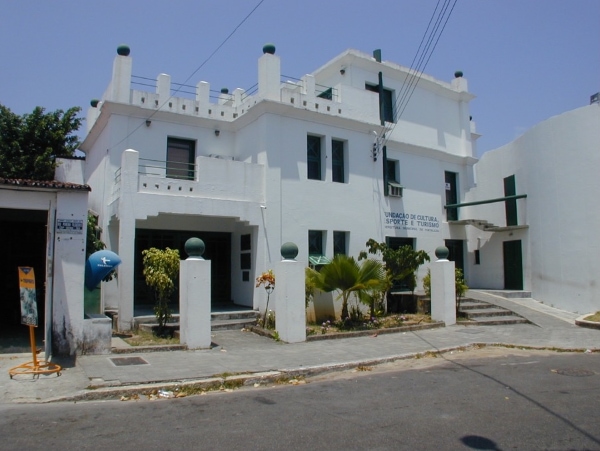
The police station in Fortaleza where I was locked up has become (25 years later) a cultural centre after many cosmetic changes. It used to bristle with antennae.
[My imprisonment/detention in Fortaleza was Kafkaesque, in the sense that I was locked up in an office where, during the day, all normal office procedures took place. There was a plump young blonde secretary at one desk, and the head of a drug squad (Toxicos) at another. A handful of agents, three or four men, one woman, hung around waiting for a call. I watched them all from my place, standing at the wall. There was only rarely a spare chair. If I wandered too far from the wall a fierce older agente pushed me back. Otherwise, they all behaved as though I didn’t exist. At the end of the office day the desks were locked and pushed to the wall. Everyone went home. The door was locked and I was left for the night with a pile of three straw mattresses. The first days were the worst, when I really thought they might do away with me. The atmosphere got gradually easier, and in the second week when it seemed most probable that eventually I would be freed the female agent, who spoke reasonable English, began to talk with me. It was then that a young shipping clerk was locked up with me and, the following night, we first made the acquaintance of a lawyer named Andrade. I wrote his story into my notebook much later, when I was in Rio. This is exactly how I wrote it.]
ANDRADE’S STORY
He looked utterly defeated when I first saw him, and all the more pathetic because he was so well dressed and groomed and obviously accustomed to comfort and respect. Superintendent Xavier brought him in one evening, saying “You can stay here, if you like, but you can’t converse with these,” meaning us, the clerk from Maranäo and me.
Andrade mumbled something about not needing company, and they left the room. It was his mouth I remember most. It seemed to have imploded, and his head looked like a tin full of steam after it had condensed.
Where he spent the night I don’t know, but the following day, a Saturday, he was back looking more controlled. For me, who was living in a regulated squalor, he was a phenomenon. He had his hammock, a new looking, brightly coloured affair, which he slung across a corner of the room. Unlike us, he had obviously been forewarned. We didn’t speak for a while, but eventually we were talking quite freely. [But only in Portuguese which I was gradually picking up.]
We played two games of chess with the cardboard pieces on a board drawn on the back of a large brown envelope. He had already told his story to the clerk, but it went too fast for me, and I persuaded him to tell it again slowly. I don’t know how he managed it, but he conveyed to me a vivid picture of the main event which was the beginning of the tale.
It seems that in some way the brother of the Governor of Såo Paulo had betrayed or slandered him, and he came to the Governor’s palace to protest and receive satisfaction. He charged the brother to his face with his slimy behaviour, and the brother replied in terms which Andrade could not tolerate. He therefore gave the brother a punch on the nose. Th brother then drew a gun and Andrade fell sprawling on the marble floor with a bullet through his calf. However, as he lay on his back, propped up on his left elbow he was able to draw his own gun and he shot the brother once in each shoulder and once through the leg. Andrade pulled up his trouser leg to reveal a whitish shin. On the right side halfway down was a scar like a halfpenny. On the back of the calf was another. The scars gave him great satisfaction. He said that, as a result of this incident, he was unable to make a satisfactory living in Såo Paulo. He lost his job as a lawyer in the state government, and doors were closed to private practice. He was said to have been politically undesirable. [The shooting occurred in 1964 after the military coup.]
In 1970 he left S.P. and came to Céara, a sufficient distance away to outrun the slanders. In Fortaleza he built up a new reputation, became involved in the creation of important enterprises (water treatment, Parque de Pais?) Then he became associated with the director of Larousse for Céara, and was instrumental in making it the most successful branch of the business in Brazil. The HQ was in Såo Paulo and in 1973 he was suddenly dismissed, just before Christmas. The principals refused to see him, and he decided not to take any action for loss of earnings, etc. Some months later his former boss in Céara was also dismissed and accused of fraud. This man invited Andrade to help him prepare a case against Larousse, but in the meanwhile, A had discovered that it was his boss, whom he had considered to be his greatest friend, who had denounced him to Såo Paulo as a swindler. A instead gave evidence for the firm against his boss.
Now he himself had been arrested and told that a criminal process begun against him years ago in S.P. had been to trial and he had been convicted in his absence and sentenced to five years. He was now waiting to be sent to prison in S.P. He seemed quite without hope.
That evening his son, a young man in the expensive casual clothing that rich sons wear in Brazil, came with pieces of roast chicken on a plate with a cloth knotted over it, and a bag of other odds and ends. They embraced and talked. A left the room and came back into the room bouncing with optimism, smiling broadly. His son and his friends had discovered that there had never been a judgement against him, after all. The whole thing was a wicked lie disseminated by his enemies. The truth would emerge and he would be free again.
I found it as difficult to believe now in the rosy future he painted as I had been to share in the black despair of a short while earlier. But because he was so exhilarated, I congratulated him heartily and pretended to share in the wonder of it all.
What we were experiencing, however, seemed a long way from what I could accept as reality, like his keen earlier interest in ways of escaping from the police station. [He said that compared with the prison in S.P. this was very easy: I wondered how he knew, but didn’t ask him.]
The euphoria lasted for a day, through Sunday. On Monday morning I saw them, he and the clerk, standing oddly near the wall with the sun in their faces, as though they would be lucky to see it again. He was taken to other offices, and I didn’t speak to him again. I saw him though when he came to collect his hammock and other things, and his face had once more collapsed into bitter dejection.
When I got out myself Mario [a priest] brought me a newspaper which described how Supt. Xavier had winkled this crooked lawyer Andrade out of Fortaleza High Society and sent him packing to S.P. where he had been sentenced for various frauds.
Much later, looking at a map of Såo Paulo, I was surprised by the large number of streets named after different men all bearing the name Andrade.
The heat is getting to me. I dread to think of the future. Isn’t it Kafka all over again that at a time like this a stony-faced villain makes us waste our wealth on munitions.
Another dive into the relative innocence of the past next week.
